

⚡ Storm or Roof Damage? Get a FREE Estimate
Text ESTIMATE to (844) 907-2546
Or call (800) 792-0212 for 24/7 emergency response
AI-powered • No obligation • Licensed IL & WI
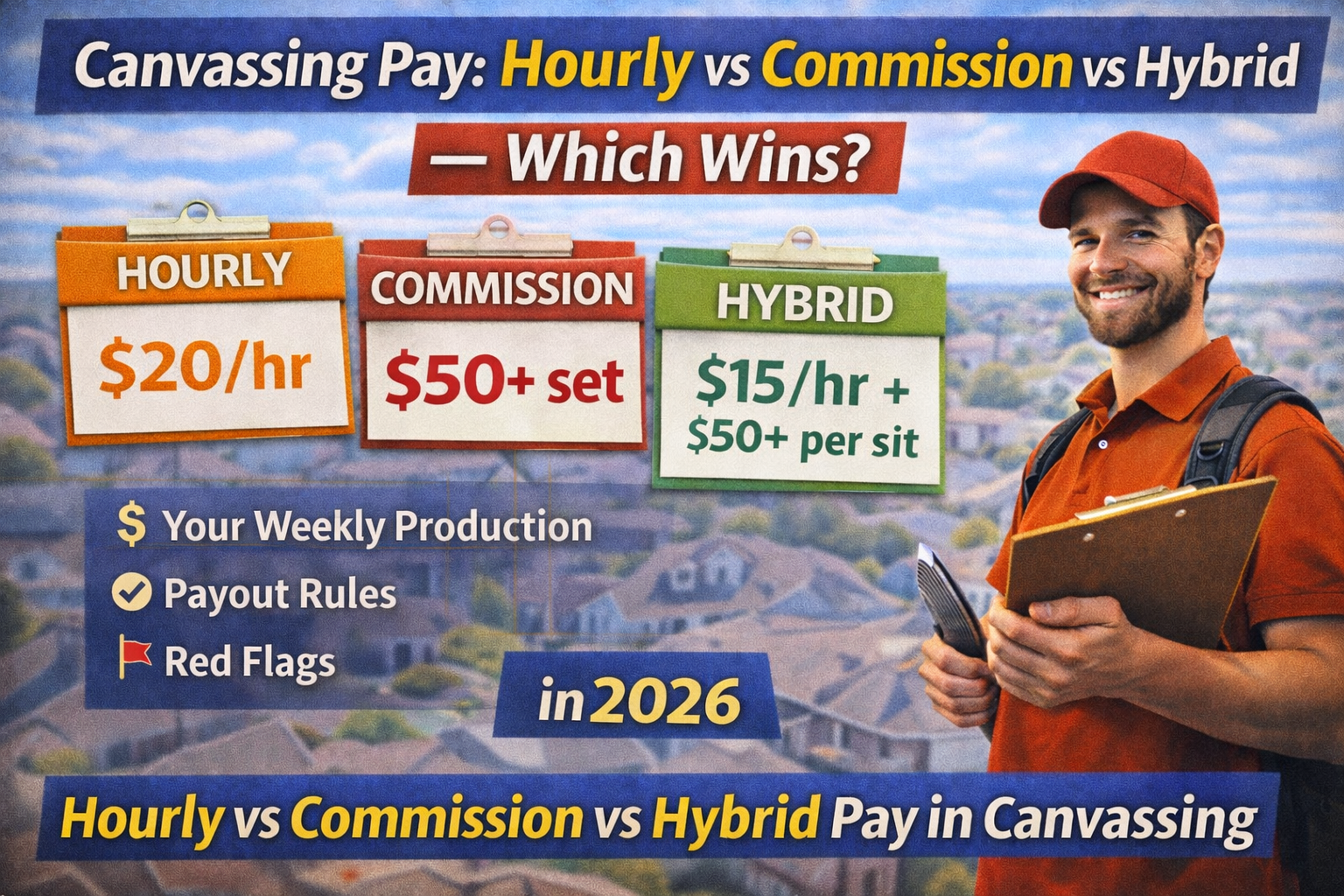
If you’re looking at canvassing jobs (roofing, solar, home improvement, political, nonprofit), you’ll see three common pay models:
- Hourly pay
- Commission-only (paid per result)
- Hybrid (hourly + bonuses/commission)
So… which one actually wins?
It depends on lead quality, training, your experience, and how the company defines a “qualified appointment.” This 2026 guide breaks down each model, shows the real math, and helps you choose the best one for your situation.
First: what does “canvassing” pay look like in 2026?
As a baseline, Indeed shows the average canvasser pay in the U.S. is about $20.54/hour (updated January 5, 2026).
That’s “all canvassing” across industries. Roofing/storm canvassing can have higher upside because many companies add bonuses per appointment or per signed job.
Model 1: Hourly canvassing pay
How it works
You earn a set hourly rate (sometimes with small bonuses), regardless of outcomes.
Typical fit: entry-level reps, new markets, winter/off-season, or companies with weak lead conversion that want bodies on doors.
Pros
- Predictable income
- Easier ramp for beginners
- Less stress on “today’s results”
Cons
- Lower ceiling
- Some teams become complacent (activity without quality)
When hourly “wins”
Hourly tends to win if:
- you’re brand new and need a runway
- the company’s training is weak (so results are inconsistent early)
- your schedule is part-time or limited
Model 2: Commission-only canvassing (paid per result)
Common commission-only structures
- Pay per appointment set (sometimes “qualified set”)
- Pay per appointment sat/kept (“sit”)
- Pay per signed deal (conversion bonus)
You’ll see real-world job ads and listings that pay per qualified appointment, sometimes with numbers like $45 per qualified appointment in remote setter-style roles.
You’ll also see listings advertising ranges like $50–$63 per appointment (often experienced-only).
Pros
- Highest upside if you can produce
- You get paid for outcomes, not time
- Strong reps can scale quickly
Cons
- Risky if you don’t yet have skill + consistency
- You can get burned by vague definitions (“qualified” vs “garbage”)
- No-shows can destroy your income unless “sits” are paid
When commission-only “wins”
Commission-only tends to win if:
- you’re already good at the door (or on the phone)
- you’re in a hot zone (post-storm / high demand)
- the company has tight scheduling + confirmation systems
- payouts are based on kept appointments, not just “sets”
Model 3: Hybrid (hourly + bonuses/commission)
How it works
You get a base hourly wage plus performance pay (per set, per sit, per deal, tiers, weekly bonuses).
You’ll find many postings framed like hourly + commission or hourly + bonus per appointment.
Business advisors often describe hybrid models as a way to provide stability while still incentivizing performance.
Pros
- Best balance for most reps (especially in roofing canvassing)
- Protects you from slow days/weather/seasons
- Still rewards production
Cons
- The base can be used as an excuse to lower bonuses
- Some companies build confusing “bonus rules” that are hard to hit
When hybrid “wins”
Hybrid usually wins if:
- you want upside without starvation weeks
- you’re building skill and consistency
- the company expects high activity and wants retention
“Which wins?” Use this simple decision guide
Choose Hourly if…
- you’re brand new to canvassing
- you want predictable pay while you learn
- you don’t have savings and need stability
Choose Commission-only if…
- you’re already producing consistently
- you know you can hit volume (doors/hour + conversions)
- you’re paid on kept appointments or you control confirmations
Choose Hybrid if…
- you want the best blend of stability + upside
- you’re in roofing/storm and want protection from seasonality
- you’re moving toward leadership and need dependable income while building a team
The real math: how to compare offers (quickly)
To compare pay plans, you need two numbers:
1) Your weekly production
- Doors knocked (or dials)
- Contacts
- Appointments set
- Appointments sat (“sits”)
2) Payout rules
- Paid per set or per sit?
- Any quality gate? (homeowner, decision-maker, owner-occupied, timeframe, etc.)
- When do you get paid?
Rule of thumb: a plan that pays on sits (kept appointments) is usually safer than one paying only on “sets.”
Red flags that make any pay plan bad
- “Qualified appointment” is not defined in writing
- You don’t get paid if the homeowner cancels (but you’re not given confirmation tools)
- Payout timing is vague (“when the office approves it”)
- Constant chargebacks with no clear policy
- You’re asked to misrepresent who you are or promise insurance outcomes
Want a pay plan that attracts killers and keeps them?
If you’re building a roofing canvassing team, the best retention usually comes from:
- hybrid base + paid sits + tier bonuses
- clear qualification rules
- weekly payouts
- promotion path (team lead, trainer, manager)
Allied Emergency Services, Inc.
Phone: 800-792-0212
Email: info@alliedemergencyservices.com
Apply: https://www.careers.alliedemergencyservices.com/job/canvasser-door-to-door-storm-damage-chicagoland
⚡ Need Storm Damage Help? We Serve 155+ Cities
Allied Emergency Services provides 24/7 emergency restoration across Illinois, Wisconsin, Indiana, and Michigan. Text ESTIMATE to (844) 907-2546 for a free estimate in minutes.
Top service areas: Chicago • Naperville • Aurora • Kankakee • Joliet • Rockford • Schaumburg • Milwaukee • Madison • We’re Hiring!
⚡ Storm or Roof Damage? Get a FREE Estimate
Text ESTIMATE to (844) 907-2546
Or call (800) 792-0212 for 24/7 emergency response
AI-powered • No obligation • Licensed IL & WI