

⚡ Storm or Roof Damage? Get a FREE Estimate
Text ESTIMATE to (844) 907-2546
Or call (800) 792-0212 for 24/7 emergency response
AI-powered • No obligation • Licensed IL & WI
If you’re hiring canvassers, appointment setters, or “lead generators” for a roofing company, the biggest question always comes up fast:
What’s a fair bonus per lead or per appointment?
In 2026, “fair” isn’t a single number. It depends on:
- Lead type (warm inbound vs cold door knock)
- How you pay (per lead, per set, per sit, per signed job)
- Your close rate and average job profit
- Who owns the follow-up (setter vs closer vs office)
Below is a practical breakdown of realistic ranges, plus a simple way to set bonuses that motivate performance without overpaying for junk appointments.
Start here: define what you’re paying for
Roofing companies typically pay bonuses for one of four “results”:
- Lead = homeowner is interested + contact info (often not scheduled yet)
- Set = appointment scheduled
- Sit = appointment is kept (the rep/inspector actually meets the homeowner)
- Sold = signed job (or claim filed/approved, depending on your model)
Pro tip: Paying only on “sets” invites no-shows and low-quality scheduling. Paying on sits usually produces better behavior.
Realistic bonus ranges in 2026 (what the market commonly shows)
1) Bonus per appointment set (common for canvassers / setters)
You’ll commonly see $15–$25 per appointment in some canvasser pay plans and $25–$50 per appointment discussed by roofing operators.
Some job listings also advertise $100 per set appointment (often implying stricter qualification or higher expectations).
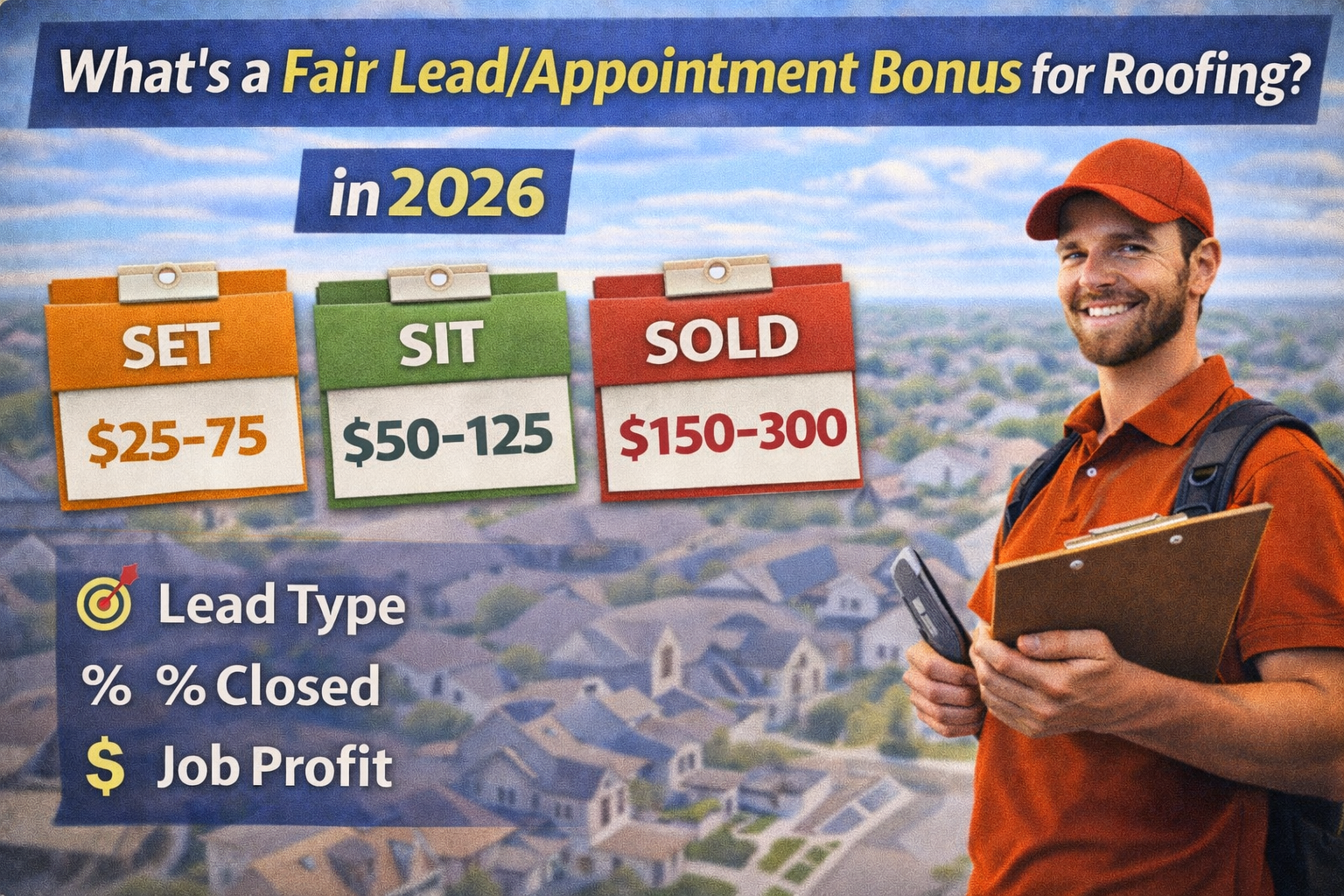
Practical “fair” range for most markets: $25–$75 per set, depending on quality requirements and whether there’s also hourly base.
2) Bonus per kept appointment (sit)
Many companies shift payouts to “sits” because it forces quality and confirmation discipline.
You’ll see plans that include appointment pay plus an added bonus if that lead becomes a closed project (example: $15–$25 per appointment, plus $100 if it closes).
Practical “fair” range: $40–$125 per sit (higher if your show rate is low or the setter controls confirmations).
3) Bonus per closed deal (conversion bonus)
A clean way to align incentives is:
- smaller pay per sit
- bigger pay when it turns into a signed job
Example plans commonly show a “closed project” kicker (e.g., $100).
Some reps report higher tiers (like $200 if it sells) in anecdotal discussions.
Practical “fair” range: $100–$500 per sold job, depending on average job size and your gross profit.
4) Bonus for a raw lead handoff (no appointment)
If someone is just handing you a name/number/address and your sales team still has to sell it, bonuses are usually higher than a “set,” but they should be tied to quality.
One roofing pro reports paying $250 for a lead handoff (because they still have to sell it).
Practical “fair” range: $50–$250 per verified lead, depending on how “ready” the homeowner is.
The “fairness” formula: pay based on lead value (not vibes)
A fair bonus should be anchored to what one lead is worth to your company.
Step 1) Estimate what one closed job is worth
- Average job revenue (example: $15,000)
- Average gross profit margin (example: 35%)
- Gross profit per job = $15,000 × 0.35 = $5,250
Step 2) Apply your expected close rate
If your team closes 20% of qualified sits:
- Expected profit per sit = $5,250 × 0.20 = $1,050
Step 3) Decide what share you’ll pay for lead-gen
Many roofing companies can sustainably pay 10%–25% of expected profit for the front-end result if the lead quality is real.
Using the example:
- 10% of $1,050 = $105 per sit
- 20% of $1,050 = $210 per sit
That’s why “$50 vs $100 vs $150” can all be fair—depending on your margins and close rate.
Tie bonus ranges to your lead costs (sanity check)
If you already buy leads, compare your in-house lead bonus to your paid lead cost.
For example, Angi-type lead models are often described as roughly $15 to $85 per lead depending on trade/market.
So if you’re paying $100 per set for unqualified, low-show appointments, you might be overpaying versus simply buying leads—unless your team’s quality is far higher than typical third-party leads.
What “qualified” should mean (put this in writing)
To keep bonuses fair and prevent disputes, define qualification clearly. Common requirements:
- Correct address + phone number
- Homeowner or decision-maker present
- Confirmed date/time window agreed to
- Problem or reason (storm event, leak, age, visible concerns)
- Consent to inspection/roof access
- Not already under contract
If the bonus depends on “sits,” also define what counts:
- homeowner is present
- inspector arrives within the window
- appointment isn’t a reschedule caused by your company
The best bonus structure for most roofing companies: a simple hybrid
If you want high performance and retention, this structure usually wins:
- Hourly base (keeps people consistent)
- $ per sit (forces quality)
- $ per sold job (aligns incentives)
Example pay plan concept:
- $15–$20/hr
- $50–$100 per sit
- $150–$300 per sold job
This avoids the “set-and-forget” problem and rewards real outcomes.
Red flags that make your bonus plan fail
- Paying only on “sets” with no quality gate (no-show city)
- “Qualified” not defined (constant arguments)
- Paying big money for leads without verification
- No confirmation system (texts/calls) but you still punish setters for cancellations
- No production capacity (jobs cancel → team morale collapses)
Want help setting a fair bonus plan for your market?
Allied Emergency Services, Inc.
Phone: 800-792-0212
Email: info@alliedemergencyservices.com
⚡ Need Storm Damage Help? We Serve 155+ Cities
Allied Emergency Services provides 24/7 emergency restoration across Illinois, Wisconsin, Indiana, and Michigan. Text ESTIMATE to (844) 907-2546 for a free estimate in minutes.
Top service areas: Chicago • Naperville • Aurora • Kankakee • Joliet • Rockford • Schaumburg • Milwaukee • Madison • We’re Hiring!
⚡ Storm or Roof Damage? Get a FREE Estimate
Text ESTIMATE to (844) 907-2546
Or call (800) 792-0212 for 24/7 emergency response
AI-powered • No obligation • Licensed IL & WI