⚡ Storm or Roof Damage? Get a FREE Estimate
Text ESTIMATE to (844) 907-2546
Or call (800) 792-0212 for 24/7 emergency response
AI-powered • No obligation • Licensed IL & WI
“Ethical roofing sales” shouldn’t be a niche concept. It should be the standard.
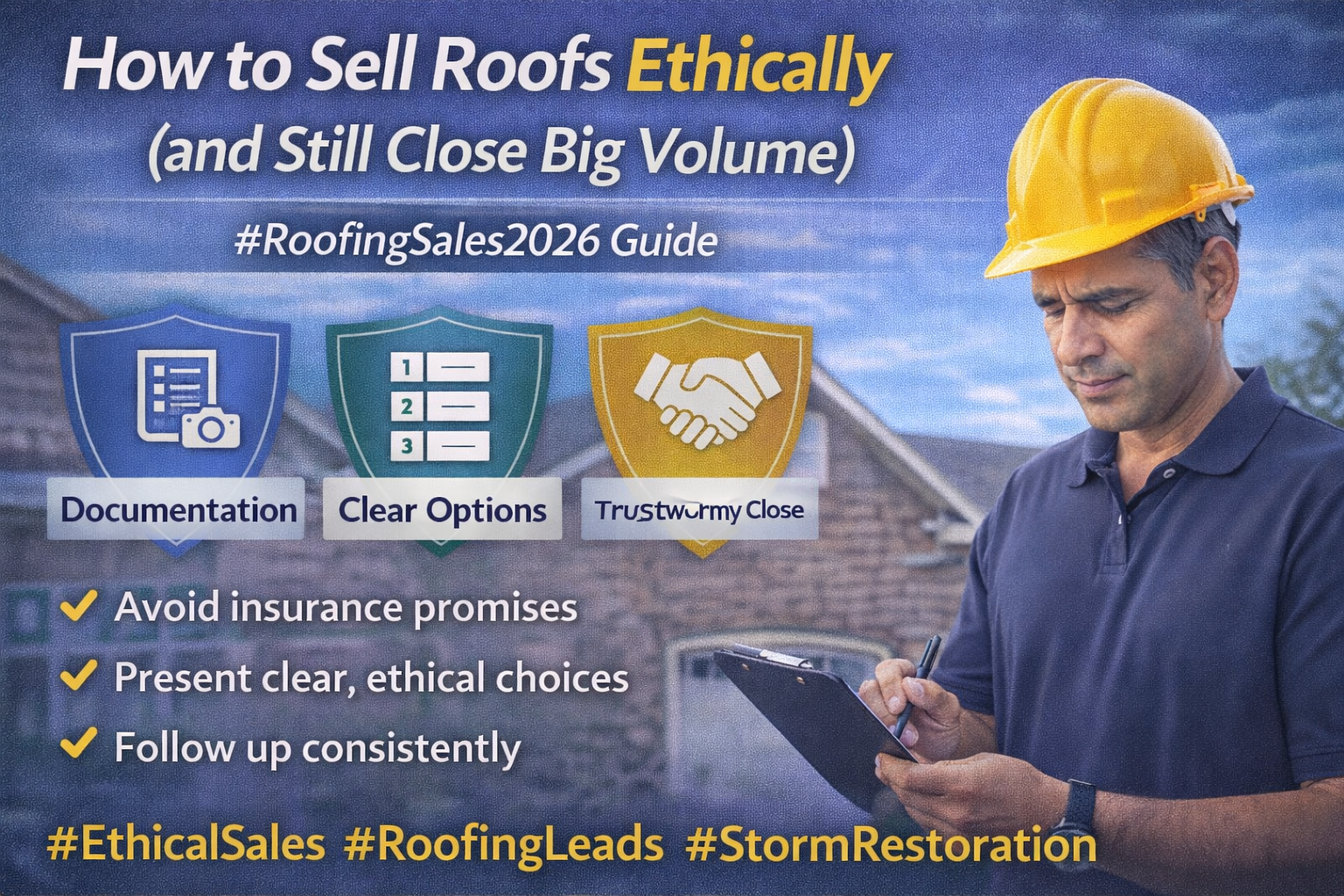
The truth is: the highest-volume reps and teams don’t win by being pushy. They win by being consistent, disciplined, and trustworthy—and by building a process that makes homeowners feel safe saying “yes.”
This 2026 guide outlines how to sell roofs ethically while still closing strong volume—whether you’re in retail roofing or storm/insurance restoration.
The mindset shift: selling roofs vs. selling clarity
Ethical selling isn’t “soft.” It’s precise.
Your job is to:
- document what’s real
- explain options clearly
- set expectations upfront
- let the homeowner decide without pressure
That approach builds:
- higher close rates over time
- fewer cancellations
- more referrals
- fewer disputes and chargebacks
Volume comes from a clean pipeline—not gimmicks.
The non-negotiables of ethical roofing sales
1) Never promise insurance outcomes
Avoid statements like:
- “They’ll pay for it.”
- “This will be approved.”
- “You won’t pay your deductible.”
Ethical replacement language:
“We can document the condition and help you understand the process. Coverage decisions are up to your policy and carrier.”
2) Don’t manufacture urgency
“Sign today or lose it” is a short-term tactic that creates long-term cancellations.
Ethical urgency is real urgency:
- active leaks
- safety hazards
- code-related issues you can cite
- upcoming weather
3) Be honest about what you saw
If you don’t see storm-related damage, say so.
That earns trust—and that trust closes future jobs.
4) Put everything in writing
Scope, materials, timeline assumptions, what’s included/excluded, warranty, and payment triggers.
Clear paperwork reduces disputes and increases referrals.
The ethical sales process that still closes volume
High volume is built on repeatable steps:
Step 1: Pre-frame the inspection
Before you inspect, tell them what will happen:
“We’ll take photos, check the common failure points, and show you what we find. If there’s no actionable damage, I’ll tell you that too.”
That one line removes pressure and increases cooperation.
Step 2: Document like a professional
Ethics requires proof.
Take consistent photos of:
- slopes and elevations
- penetrations/flashing
- valleys/ridges/edges
- soft metals (vents, gutters)
- interior stains (if any)
Even for retail, documentation prevents misunderstandings.
Step 3: Present options, not ultimatums
Instead of “Here’s the price,” present a simple choice:
Option A (standard): baseline roof system
Option B (recommended): upgrades that solve known issues (ventilation, underlayment, edge metal, etc.)
Option C (premium): best materials/warranty
This is ethical because it respects budgets while making tradeoffs clear.
Step 4: Make your scope “apples-to-apples proof”
Ethical reps don’t win by trashing competitors. They win by clarifying scope.
Use a short comparison checklist:
- tear-off layers
- underlayment type
- ice & water coverage
- drip edge and starter
- ventilation plan
- flashing details
- permits, protection, cleanup
- warranty terms
When homeowners compare correctly, ethical contractors win more often.
Step 5: Ask for the decision without pressure
The “pushy” feeling comes from a lack of respect.
Use a calm close:
“Based on what we found, would you like to move forward with Option A, B, or C?”
Or:
“If everything looks good, are you comfortable scheduling this?”
Then pause. Silence closes more deals than talking.
The ethical follow-up system that creates big volume
Most roofs aren’t sold on the first meeting. Big volume comes from consistent follow-up.
Use a 3-touch follow-up plan (simple)
- Same day: send photos + summary
- Next day: answer questions + confirm next step
- 3–5 days later: “Do you want to proceed, or should I close this out?”
Ethical follow-up is structured, not naggy.
Ethics = fewer cancellations (and cancellations kill volume)
If you want big volume, watch your cancellation rate.
Common cancellation causes:
- unclear expectations about timeline
- homeowner felt pressured
- pricing surprises
- poor production handoff
- paperwork confusion
Ethical selling reduces cancellations because the homeowner feels informed, not sold.
How ethical teams scale volume without cutting corners
1) Activity-based consistency
Top reps aren’t magical. They run more appointments and follow a tighter process.
Track the KPIs that drive volume:
- leads worked
- inspections sat
- close rate (sat → sold)
- average job size
- cancellation rate
2) Clear roles (setter → inspector → production)
Chaos kills ethics. When roles are unclear, promises get made and not kept.
3) Training that emphasizes truth + clarity
Train reps to:
- qualify correctly
- document thoroughly
- present clearly
- close professionally
- follow up consistently
Ethical scripts you can use immediately
“I’m not trying to be pushy”
“No pressure either way—my goal is simply to show you what we found and give you options.”
“Insurance will cover it?”
“Coverage decisions are up to your policy and carrier. We can document the condition so you can make an informed decision.”
“We’re going with someone else”
“Totally understand. Before I close this out, can I ask what the main reason was—price, timeline, or comfort? It helps me improve.”
The bottom line: ethics is a competitive advantage
Ethical selling isn’t slower—it’s more durable.
It produces:
- better reviews
- more referrals
- fewer chargebacks
- fewer disputes
- higher lifetime earnings
If you want big volume in roofing, build a process that makes the homeowner feel safe saying yes.
Want an ethical sales SOP for your team?
If you tell me your model (retail vs storm/insurance) and your team structure (canvassers, setters, closers), I can map a one-page SOP with:
- inspection checklist
- presentation outline
- close language
- follow-up cadence
Allied Emergency Services, Inc.
📞 800-792-0212
📧 info@alliedemergencyservices.com
⚡ Need Storm Damage Help? We Serve 155+ Cities
Allied Emergency Services provides 24/7 emergency restoration across Illinois, Wisconsin, Indiana, and Michigan. Text ESTIMATE to (844) 907-2546 for a free estimate in minutes.
Top service areas: Chicago • Naperville • Aurora • Kankakee • Joliet • Rockford • Schaumburg • Milwaukee • Madison • We’re Hiring!
⚡ Storm or Roof Damage? Get a FREE Estimate
Text ESTIMATE to (844) 907-2546
Or call (800) 792-0212 for 24/7 emergency response
AI-powered • No obligation • Licensed IL & WI