





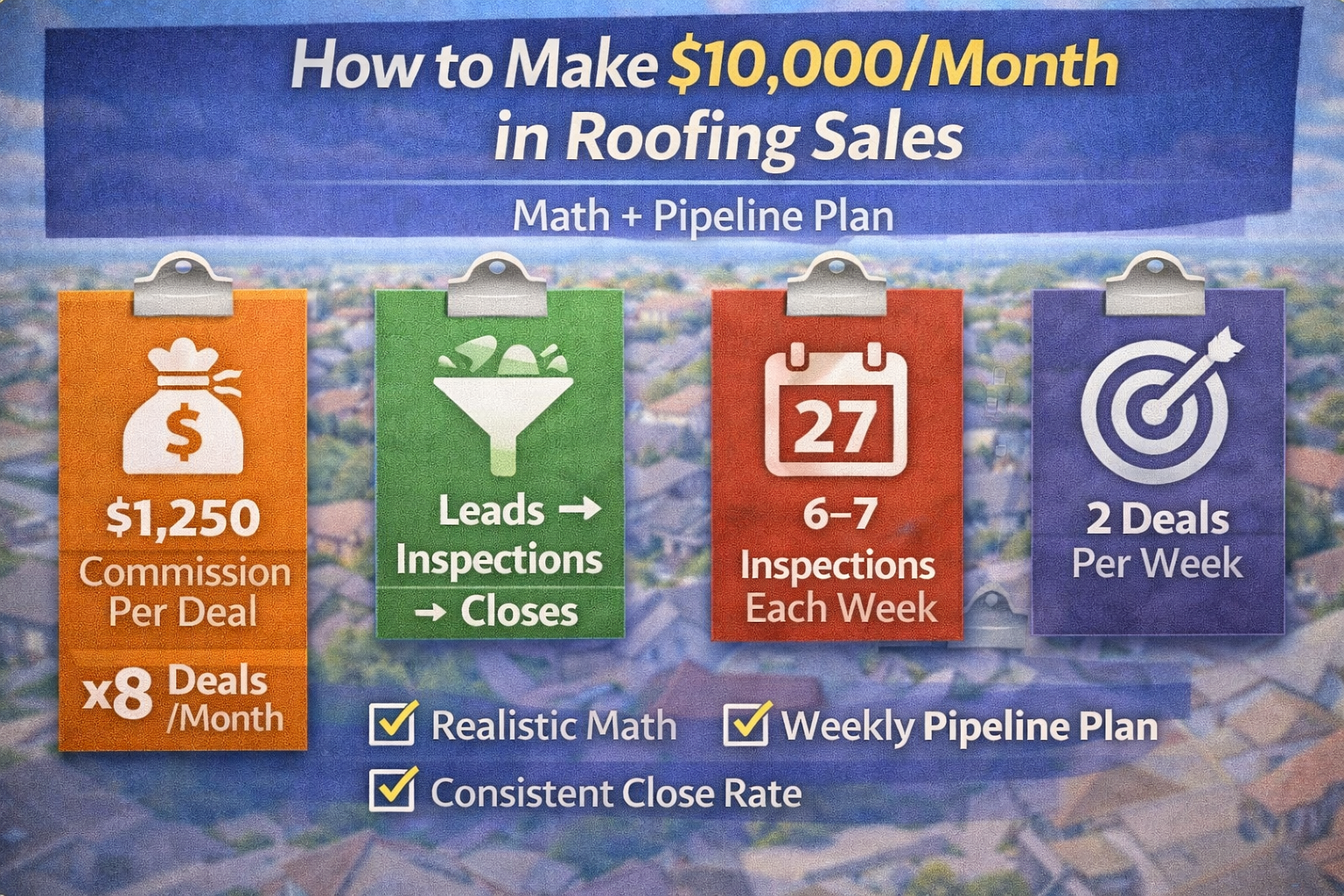
Making $10,000 per month in roofing sales is realistic—but only if you stop thinking in “motivation” and start thinking in math + pipeline. The reps who hit consistent five-figure months usually do two things well:
- They understand their commission math (what they’re actually paid on)
- They run a repeatable weekly funnel: leads → inspections → closes
Below is a practical 2026 roadmap you can use to build a $10K/month run-rate.
Step 1: Know your commission model (because “10%” can mean different things)
Most roofing comp plans are built on either:
A) Percent of contract (gross sales)
A common ballpark cited is 7–12% of the contract (often simplified as “10%”).
B) Profit-based splits (10/50/50-style profit split)
Some companies take an overhead cut (often ~10%) and then split remaining profit.
C) “10/50/50” payout timing (milestone payouts)
Separately, some companies use “10/50/50” to describe when you get paid (e.g., job approved, production starts, job paid).
Important: Ask which “10/50/50” they mean—profit split vs payout schedule—because they’re not the same thing.
Step 2: The $10K/month formula (simple and brutal)
Monthly Income = Deals Closed × Commission Per Deal
So your job is to control two things:
- How many deals you close
- How much you earn per deal
To do that, you back into the funnel.
Scenario 1: You’re paid 10% of the contract (gross)
Let’s use Chicago-area roof pricing as a realistic anchor: average Chicago roof replacement costs are often reported in the roughly $6K–$14.5K range, with an average around ~$10K.
If you average $12,500 per job and earn 10%, your commission per deal is:
- $12,500 × 10% = $1,250 per deal
To hit $10,000/month:
- $10,000 ÷ $1,250 = 8 deals/month
That’s about 2 deals/week.
Scenario 2: You’re paid on profit (example: 50% of profit after overhead)
Profit-based plans vary, but often start by taking an overhead cut (~10%) then splitting profit.
Example:
- Contract: $15,000
- Direct costs: $9,750
- Gross profit: $5,250
- If overhead cut is 10% of contract ($1,500), remaining profit pool might be $3,750
- If split 50/50 → rep earns $1,875
Now:
- $10,000 ÷ $1,875 ≈ 5–6 deals/month
This can be a faster path to $10K/month if the company’s job-costing is accurate and margins are protected.
Step 3: Convert income into pipeline math (the part most reps skip)
A “closer” typically measures:
Close Rate = Signed Jobs ÷ Appointments Sat
A commonly cited benchmark range is around ~27% at large companies and ~30–40% as “good” on qualified appointments.
Let’s build a realistic $10K/month funnel:
Assume:
- Close rate: 30% (solid benchmark)
- Goal: 8 deals/month (Scenario 1)
Appointments needed:
- 8 ÷ 0.30 = 26.7 → call it 27 sits/month
Weekly sits: - 27 ÷ 4.3 ≈ 6–7 sits/week
So if you can run 6–7 inspections per week and close ~30%, you’re in the $10K/month neighborhood on a $12.5K average job at 10%.
Step 4: The weekly pipeline plan (what to do Monday–Saturday)
Weekly targets (closer-focused)
- Sits (inspections ran): 6–7
- Closes: 2/week
- Quotes delivered: 6–7 (don’t “inspect and disappear”)
- Follow-up touches: 30–60/week (texts/calls)
Daily cadence (simple)
Morning (60–90 minutes):
- Confirm today’s appointments
- Schedule follow-up blocks for yesterday’s inspections
- Call/text every open lead
Midday:
- Run inspections
- Take full photo set + notes (quality = trust)
Late afternoon:
- Send estimates the same day whenever possible
- Book a decision call/time (never “let me know”)
Evening (30 minutes):
- Follow-up + confirmations for tomorrow
Step 5: The fastest levers to reach $10K/month sooner
Lever 1: Improve show rate (sits) before you chase more leads
If your calendar is full but people don’t show, you’ll stay broke.
- Confirmations
- Reminders
- “What to expect” message
Lever 2: Raise average job size (without getting shady)
Your $10K/month goal gets easier when job size increases.
Use clean add-ons when appropriate:
- gutters
- ventilation
- skylights
- fascia/soffit
- siding (if your company supports it)
Lever 3: Reduce time-to-decision
Many reps lose momentum because the estimate sits for 10 days.
Your best move is to book the next step while you’re still there.
Lever 4: Track your real KPI stack
At minimum track weekly:
- Leads worked
- Appointments set
- Appointments sat
- Closes
- Avg job size
Step 6: A realistic 30-day ramp plan to $10K/month
Week 1: Build activity + tighten your process
- Script reps (door or phone)
- Objection handling
- Estimate template
- Confirmation system
Week 2: Stabilize sits
- Fix no-show reasons
- Improve qualification (decision-maker present)
Week 3: Stabilize closes
- Presentation practice
- “options” pricing where appropriate
- tighter follow-up rhythm
Week 4: Stack pipeline
- You’re aiming for 6–7 sits/week
- And 2 closes/week at ~30% close rate
The reality check: what usually blocks $10K/month
- Weak lead flow (or no territory strategy)
- No-shows due to bad confirmation
- “I’ll send an estimate” with no scheduled decision step
- Low trust (no proof, no process, sloppy communication)
- Production chaos causing cancellations (you can’t scale sales on bad ops)
Want help building your exact $10K/month numbers?
Allied Emergency Services, Inc.
Phone: 800-792-0212
Email: info@alliedemergencyservices.com