




Roofing sales commission can look simple—until you realize two companies can both say “10% commission” and mean two completely different things.
In 2026, the most common roofing commission plans fall into a few buckets:
- Percent of gross (contract amount)
- Percent of gross profit
- Profit splits (like 10/50/50 or 50/50)
- Tiered plans and bonuses
This guide explains each model, shows real math examples, and helps you spot the fine print that determines what you actually take home.
The 3 numbers you must understand first
Before you compare any commission plan, you need these definitions:
1) Gross (Total Contract Value)
The full job amount on the contract (example: $20,000 roof).
2) Gross Profit (GP)
Gross minus direct job costs (labor, materials, disposal, subs, etc.).
Example: $20,000 contract – $12,000 costs = $8,000 GP. Contractors Cloud+1
3) Net Profit
Gross profit minus overhead (office, admin, marketing, vehicles, insurance, etc.).
This is where many “profit split” disputes come from—because “profit” isn’t defined the same everywhere. Hook Agency+1
Typical roofing sales commission percentages in 2026
These are commonly cited ranges (always confirm what the base is—gross vs profit):
If you’re paid on gross sales
A common range is ~5% to 12% of gross. blog.theroofstrategist.com+1
If you’re paid on profit (gross profit / margin)
A common range is ~30% to 50% of profit. blog.theroofstrategist.com+2blog.theroofstrategist.com+2
You’ll also see 8–10% of total as a “flat-rate” example in general discussions. RoofClaim
Important reality check: Insurance jobs often have tighter margins than retail work, so the same commission plan can feel very different depending on the mix. Hook Agency
Commission Model #1: Percentage of total revenue (gross)
How it works:
You earn a flat percentage of the contract amount (or sometimes collected revenue). Contractors Cloud+1
Example:
- Contract: $20,000
- Commission: 10%
- Rep earns: $2,000
Pros
- Simple and predictable
- Great for new reps (easy to understand)
Cons
- Can reward bad pricing (discounting still pays the rep)
- Doesn’t protect margins unless the company enforces pricing rules Contractors Cloud
Commission Model #2: Percentage of gross profit
How it works:
You earn a percentage of the gross profit (contract minus direct job costs). Contractors Cloud+1
Example:
- Contract: $20,000
- Costs: $12,000
- Gross profit: $8,000
- Commission: 25% of GP
- Rep earns: $2,000 Contractors Cloud
Pros
- Aligns rep behavior with margin
- Encourages upsells and clean pricing
Cons
- Requires accurate job costing (or reps will distrust numbers)
- Can create disputes if costs are unclear or change late Contractors Cloud
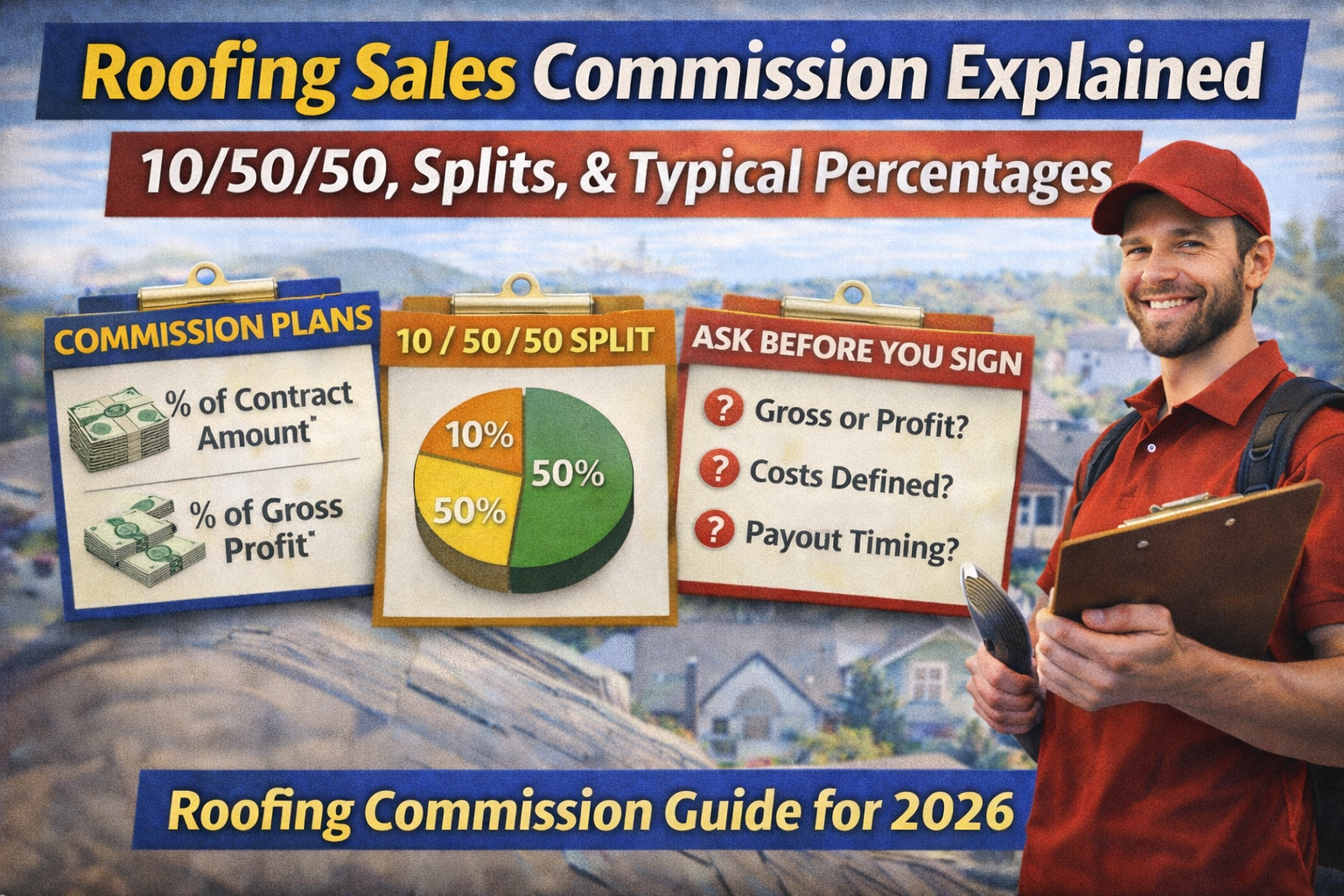
Commission Model #3: The 10/50/50 plan (profit split)
This is one of the most talked-about plans in roofing.
How it works (typical version):
- Take 10% of the contract off the top for overhead
- Subtract job costs
- Split remaining profit 50/50 between company and rep Hook Agency+1
Example math (from common explanations):
- Contract: $10,000
- Overhead set-aside (10%): $1,000 → remaining $9,000
- Job cost: $7,000
- Profit remaining: $2,000
- Rep gets 50%: $1,000 commission Hook Agency+1
Another common example shows:
- $10,000 contract
- $5,400 cost
- 10% overhead ($1,000)
- Remaining profit $3,600
- Rep gets 50% = $1,800 Hook Agency
Why people like it
- Reps feel like “partners” because they share profit
- Strong incentive not to sell junk deals
Why it can break
- If overhead is more than 10%, the company can get squeezed
- If “costs” aren’t controlled, profit shrinks and reps feel cheated
- If “profit” isn’t clearly defined, disputes are guaranteed Hook Agency+1
There are also industry voices arguing that giving away 50% of profit can be hard to sustain for the business unless everything else is dialed in. Hook Agency+1
Commission Model #4: 50/50 split (and other split variations)
Some companies do a straight profit split without the “10% overhead” step.
Key warning: If you ever hear “50/50 profit split,” your first question must be:
“Profit” according to which definition—gross profit or net profit, and what expenses are included?
If it’s not defined in writing, assume problems later. youtube.com
Commission Model #5: Tiered commissions and bonuses
Tiered plans increase commission when you hit targets (volume or margin). Contractors Cloud
Example (margin tier):
- <35% margin → 20% of GP
- 35–45% margin → 25% of GP
- 45%+ margin → 30% of GP Contractors Cloud
These are popular because they push reps toward quality sales, not just quantity.
The payout timing trap: when do you actually get paid?
Even a great commission rate can feel terrible if payouts are slow.
Common payout triggers:
- At contract signing
- At materials delivery / start
- At completion
- After final collection (often safest for the company)
Ask this directly, because it determines your cash flow.
What to ask before you accept a roofing commission plan
Copy/paste these questions:
- Is commission based on gross, gross profit, or net?
- If profit-based: how are job costs tracked and verified?
- What exactly counts as “commissionable revenue”—do supplements/change orders count?
- When do commissions pay out (and can they be clawed back)?
- What happens if a job cancels or the customer doesn’t pay?
- Are leads provided, and does lead source change commission rate?
- What support is included (training, CRM, marketing, appointment setting)?
Bottom line: what’s “fair” for roofing commissions?
“Fair” is less about the headline percentage and more about:
- lead quality and who generates it
- the margin of the work (retail vs insurance)
- the support you receive (setter, canvassers, estimator, supplements, production)
- clear definitions and payout timing
A clean plan is one where everyone can predict the outcome before the job starts.
Want a second opinion on a commission plan?
Allied Emergency Services, Inc.
Phone: 800-792-0212
Email: info@alliedemergencyservices.com