
⚡ Storm or Roof Damage? Get a FREE Estimate
Text ESTIMATE to (844) 907-2546
Or call (800) 792-0212 for 24/7 emergency response
AI-powered • No obligation • Licensed IL & WI
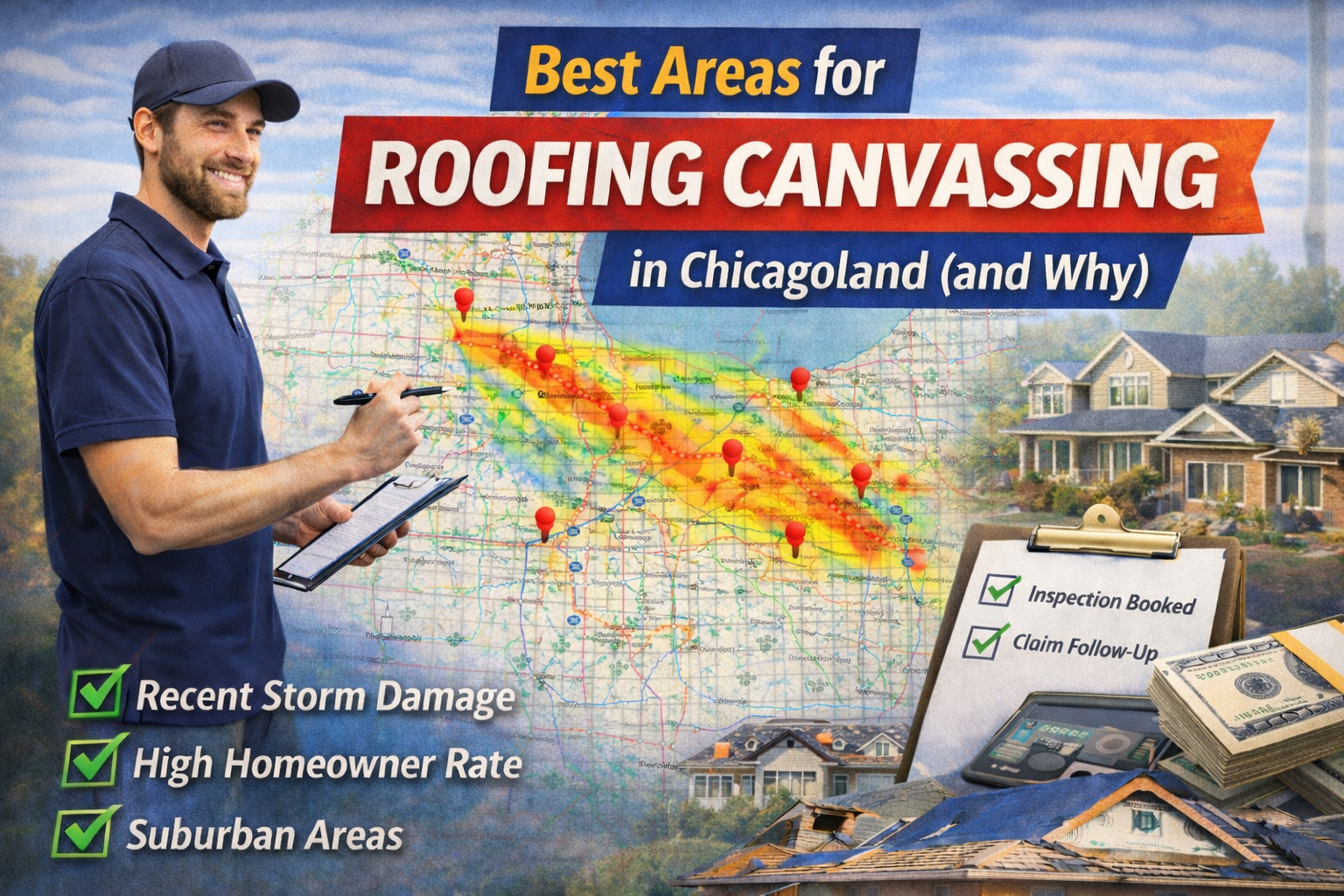
If you want roofing canvassing to actually work in Chicagoland, you don’t pick neighborhoods randomly—you pick where the odds are highest that (1) homeowners answer, (2) they own the property, and (3) recent storms or roof age make an inspection relevant.
Below is a practical 2026 framework, plus the best Chicagoland zones to canvas and the reasons they consistently produce appointments.
What makes an area “good” for roofing canvassing?
1) Storm signal (hail/wind track)
You want neighborhoods that were actually in a hail/wind swath. NWS event summaries for Northern IL routinely show narrow corridors of bigger hail and concentrated wind damage—those corridors are where canvassing converts. National Weather Service+1
2) High owner-occupancy (more decision-makers home)
Counties with higher owner-occupied housing rates tend to be more canvass-friendly than dense renter-heavy areas.
- DuPage: ~73% owner-occupied Census.gov
- Kane: ~76% owner-occupied Census.gov
- Will: ~83% owner-occupied Census.gov
- McHenry: ~83% owner-occupied Census.gov
Cook County is significantly lower (~58%), meaning more rentals/multi-family (harder for door-to-door conversions). Census.gov
3) Housing stock that matches your offer
Single-family subdivisions (especially 1990s–2010s builds) often have:
- similar roof ages across the neighborhood
- repeatable roof types
- higher appointment “yes” rates
4) Easy routing + density
You want neighborhoods where you can knock 60–120 doors in a tight area without long drives or gated access.
5) Low friction (permits/HOAs/soliciting rules)
Some towns/HOAs are strict. That doesn’t mean “avoid”—it means be buttoned up:
- identification
- clear scope and process
- professional follow-up
- respect “no soliciting” rules
Also, because storm-related scams are a real issue, transparency is non-negotiable—Illinois has repeatedly warned residents about storm repair scams and “storm chasers.” Illinois Attorney General+1
Best areas for roofing canvassing in Chicagoland (and why)
1) The I-88 / DuPage Corridor (high ROI, consistent)
Naperville, Aurora, Lisle, Downers Grove, Woodridge, Darien, Wheaton, Glen Ellyn
Why it works:
- Strong owner-occupancy countywide Census.gov
- Frequent severe weather impacts across the western suburbs in major events National Weather Service+1
- Repeatable subdivision density (efficient door counts)
Storm data/hail reporting sources regularly show hail activity around Naperville/Aurora. Interactive Hail Maps+1
2) Southwest / Will County Growth Belt (big roofs, strong “answer rate”)
Orland Park, Tinley Park, Homer Glen, Frankfort, Mokena, New Lenox, Romeoville, Plainfield
Why it works:
- Very high owner-occupancy in Will County Census.gov
- Newer subdivisions + larger roof footprints
- NWS summaries show damage swaths hitting parts of this broader region in recent major events (including Romeoville named in 2025 impacts) National Weather Service
3) Fox Valley / Kane County (great door density + strong conversion)
St. Charles, Geneva, Batavia, Elgin, South Elgin, Sugar Grove, Montgomery
Why it works:
- High owner-occupancy in Kane County Census.gov
- Mixed housing ages (plenty of roofs in the “replacement window”)
- Recent NWS event summaries cite severe impacts in/near this corridor (Sugar Grove noted in Aug 2025 event impacts) National Weather Service
4) Northwest Suburbs “Ring” (high volume, strong middle/upper-middle neighborhoods)
Schaumburg, Palatine, Arlington Heights, Mount Prospect, Elk Grove Village
Why it works:
- Dense single-family neighborhoods
- Strong routing efficiency
- Named severe wind impacts in the broader NWS Chicago forecast area have included places like Palatine in major events National Weather Service
5) Lake County Suburbs (higher value, higher expectations)
Libertyville, Vernon Hills, Mundelein, Gurnee, Grayslake, Lake Zurich
Why it works:
- Solid owner-occupancy Census.gov
- Higher home values can support full scopes (if your company delivers premium communication + clean process) Census.gov
6) McHenry County Suburbs (very canvass-friendly when storms hit)
Crystal Lake, Cary, Algonquin, Lake in the Hills, McHenry
Why it works:
- Very high owner-occupancy Census.gov
- Big pockets of single-family homes
- NWS summaries show severe wind/hail impacts including Cary in major events National Weather Service
Areas that can be tougher (but not “bad”)
City of Chicago (especially dense multi-family zones)
Canvassing can still work, but it’s often harder because:
- more renters / multi-unit buildings
- doormen/access control
- decision-maker isn’t home / isn’t the occupant
Cook County’s lower owner-occupancy rate is a big reason. Census.gov
A simple “pick-your-route” method that works in 2026
- Start with NWS event summaries for Northern IL/NW Indiana and identify the corridor that got the worst of it. National Weather Service+1
- Overlay that corridor with owner-occupied, single-family-heavy suburbs (DuPage/Kane/Will/McHenry are often strong). Census.gov+3Census.gov+3Census.gov+3
- Knock tight subdivisions first, not scattered arterials.
- Track results by neighborhood: doors → contacts → inspections set → inspections sat. Double down where the sit rate is best.
Professionalism note (protects you and your company)
Because Illinois has repeatedly warned homeowners about storm repair scams, canvassing has to be clean:
- identify yourself clearly
- never imply you’re “with insurance”
- never promise claim outcomes
- respect “no soliciting”
- keep your process documented and consistent Illinois Attorney General+1
Want help picking the best canvassing zones after the next storm?
Allied Emergency Services, Inc.
Phone: 800-792-0212
Email: info@alliedemergencyservices.com
Apply: https://www.careers.alliedemergencyservices.com/
⚡ Need Storm Damage Help? We Serve 155+ Cities
Allied Emergency Services provides 24/7 emergency restoration across Illinois, Wisconsin, Indiana, and Michigan. Text ESTIMATE to (844) 907-2546 for a free estimate in minutes.
Top service areas: Chicago • Naperville • Aurora • Kankakee • Joliet • Rockford • Schaumburg • Milwaukee • Madison • We’re Hiring!
⚡ Storm or Roof Damage? Get a FREE Estimate
Text ESTIMATE to (844) 907-2546
Or call (800) 792-0212 for 24/7 emergency response
AI-powered • No obligation • Licensed IL & WI