
⚡ Storm or Roof Damage? Get a FREE Estimate
Text ESTIMATE to (844) 907-2546
Or call (800) 792-0212 for 24/7 emergency response
AI-powered • No obligation • Licensed IL & WI
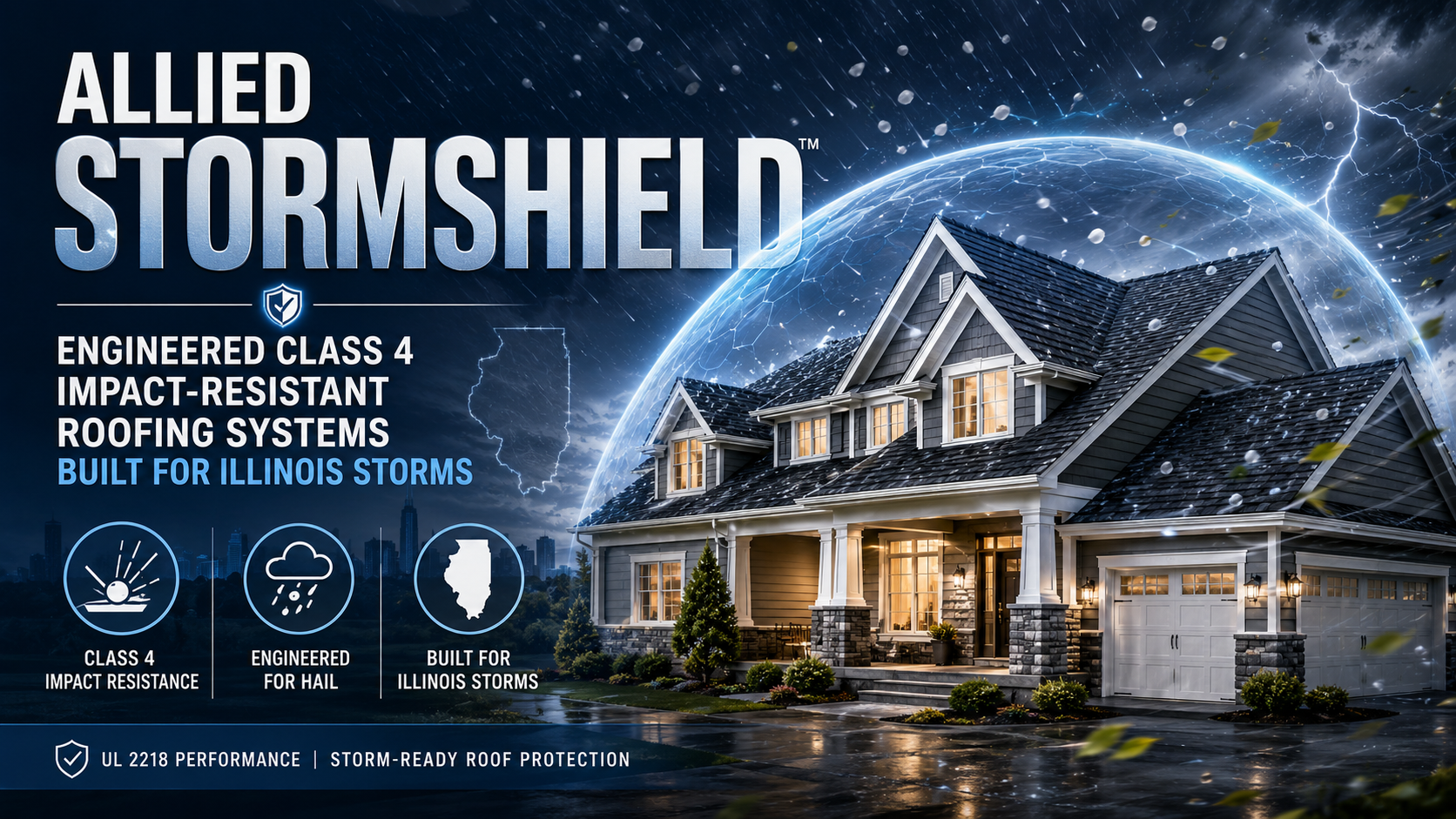
A Class 4 impact-resistant (IR) shingle is a roofing product that has passed the UL 2218 standard’s 2-inch steel-ball drop test — the highest rating in the four-tier UL 2218 system. In Illinois, Class 4 IR shingles are not subject to a mandatory premium discount under state law (unlike Texas under HB 1183), but several major carriers — including State Farm, Travelers, USAA, and Allstate in certain territories — offer voluntary wind/hail mitigation credits when the homeowner submits documentation showing the product was installed. Credit amounts vary by carrier, policy form, ZIP code, and underwriting year. This guide explains what Class 4 IR means, how UL 2218 testing works, which carriers currently recognize credits in Illinois, what documentation underwriters expect, and the construction features beyond shingles that improve a roof’s overall storm resilience.
What Is a Class 4 Impact-Resistant Shingle?
A Class 4 impact-resistant shingle is an asphalt or composite roofing product that has been tested under Underwriters Laboratories Standard 2218 (“Standard for Impact Resistance of Prepared Roof Covering Materials”) and has passed the highest of four impact classifications.
UL 2218 evaluates how a roofing product responds to simulated hail strikes by dropping steel balls of progressively larger diameters from progressively greater heights onto the product, then inspecting the back of the sample for cracking. The classifications are:
| UL 2218 Class | Steel Ball Diameter | Drop Height | Approximate Hail Equivalent |
|---|---|---|---|
| Class 1 | 1.25 in | 12 ft | Smallest |
| Class 2 | 1.50 in | 15 ft | Small-to-moderate hail |
| Class 3 | 1.75 in | 17 ft | Moderate hail |
| Class 4 | 2.00 in | 20 ft | Largest tested — highest rating |
A Class 4 product must pass the impact without cracking, splitting, tearing, rupturing, or fracturing on the back side of the test specimen. The standard does not test for hail of every conceivable size; it certifies that the product withstood the specified impact under laboratory conditions.
What Class 4 Does Not Mean
Class 4 IR shingles are not “hail-proof.” A severe hail event involving 2.5-inch or larger stones, oblique impact angles, or pre-aged shingles can still produce damage. The classification is a documented manufacturing characteristic, not a warranty against all hail loss.
Why UL 2218 Class 4 Matters for Illinois Homeowners
Illinois sits in a hail-prone corridor that runs through the central United States. The Illinois Insurance Department’s annual Property and Casualty Market Conduct Report and NOAA Storm Prediction Center climatology both show consistent hail activity across central and northern Illinois counties — including DuPage, Lake, McHenry, Will, Kane, Cook, Winnebago, Sangamon, and McLean — every year between April and September.
Because hail losses drive a substantial share of Illinois homeowner-insurance claims, carriers have responded in three ways that directly affect homeowners:
- Tightening roof-age underwriting. Some carriers will no longer renew policies on roofs older than 15 to 20 years, or will limit coverage to actual cash value (ACV) rather than replacement cost (RCV).
- Excluding cosmetic hail damage. Several carriers now write “cosmetic damage exclusion” endorsements that limit recovery for granule loss without functional damage.
- Offering voluntary mitigation credits. Most major carriers offer a discount when the policyholder documents Class 4 IR shingles, impact-resistant siding, or other mitigation features.
A Class 4 IR roofing system addresses all three pressures: it resets the roof age clock, it is engineered to resist the cosmetic-damage failure mode (granule embedment and mat cracking), and it documents the homeowner’s eligibility for the mitigation credit.
Which Illinois Insurance Carriers Offer a Class 4 / Wind Mitigation Credit?
The following list reflects publicly available carrier filings and rating manuals as of 2026. All credits are voluntary, discretionary, and subject to the homeowner’s specific policy form, ZIP code, underwriting cycle, and submission of acceptable documentation. Allied Emergency Services does not negotiate, guarantee, broker, or apply any insurance discount; the credit, if any, originates from the carrier in response to the homeowner’s submission to their agent.
- State Farm — Wind/hail mitigation discount available on owner-occupied dwelling policies. Requires manufacturer certification of UL 2218 Class 4 rating. Submitted through the policyholder’s agent.
- Travelers — Offers an Impact-Resistant Roof discount on most Illinois homeowner policies. Requires installation documentation and manufacturer warranty certificate.
- USAA — Provides an impact-resistant roofing discount for members. USAA typically requires a copy of the installation invoice and product specification sheet.
- Allstate — Mitigation credits available in select Illinois territories. Availability and amount vary; check directly with your local Allstate agent.
- Farmers / Foremost — Discount programs exist in some Illinois ZIP codes for impact-resistant roofing.
- American Family — Wind/hail mitigation credit available on certain policy forms.
- Erie Insurance — Class 4 shingle credit offered in Illinois under specific policy products.
- Country Financial — Illinois-domiciled carrier; offers wind/hail discounts on certain product lines when documentation is provided.
Because each carrier files its rates and discount factors independently with the Illinois Department of Insurance, the dollar amount of any credit varies — typical ranges are 5% to 25% of the wind/hail portion of the premium, though some filings go higher or lower. Always confirm the current credit with your agent in writing before assuming a specific dollar savings.
What Documentation Does an Underwriter Expect?
To approve a Class 4 IR or wind/hail mitigation credit, most Illinois carriers expect a packet that lets an underwriter verify the construction independently. A complete packet typically includes:
- Manufacturer certification letter identifying the specific shingle product, its UL 2218 Class 4 designation, and the testing laboratory’s certification.
- Product specification sheet (cut sheet) showing the published wind warranty (often 130 MPH when installed as a complete system) and impact rating.
- Final contractor invoice itemizing the roofing system installed at the property, the address, and the completion date.
- Municipal building permit and final inspection record confirming the work was performed under permit and passed inspection.
- Manufacturer warranty registration certificate issued by the shingle manufacturer to the homeowner after the contractor registers the installation.
- Photographs of the in-progress installation, including underlayment, deck condition, and shingle product packaging (recommended but not always required).
Submit the packet directly to your insurance agent in writing — email is acceptable, certified mail is best. Ask for written confirmation of the credit applied and the next renewal cycle’s premium reflecting the discount.
A Class 4 Shingle Is Not a Whole Roofing System
The single most common mistake Illinois homeowners make is assuming that installing a Class 4 shingle is the entire mitigation story. It is not. A roofing system’s resistance to wind and hail is a function of every layer, not just the visible shingle. The features that meaningfully improve overall resilience — and that carriers progressively recognize in their mitigation rating tables — include:
Sealed Roof Deck
A sealed roof deck means the structural deck (sheathing) is covered by a fully adhered membrane, not just a mechanically fastened underlayment. The result is that if shingles are torn off in a severe wind event, the deck itself does not leak. The Insurance Institute for Business and Home Safety (IBHS) FORTIFIED Roof standard formalizes this requirement.
In Illinois, sealed-deck construction typically involves:
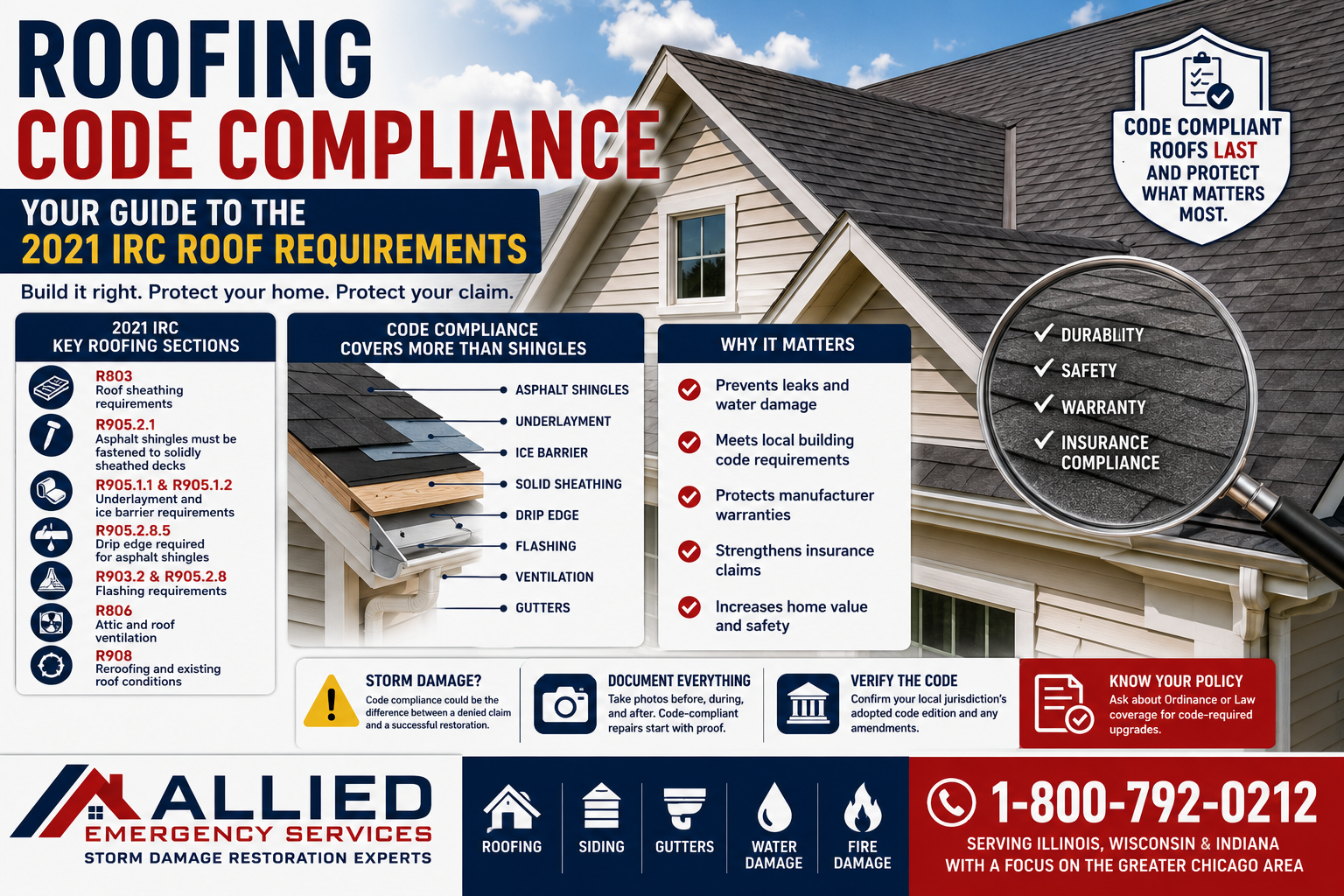
- A self-adhered ice and water barrier at all eaves to a point at least 24 inches inside the warm wall (per IRC R905.1.2 in Climate Zone 5).
- Self-adhered membrane at all valleys.
- A synthetic underlayment over the remaining deck installed with cap fasteners per manufacturer specification.
Full Deck Replacement and H-Clips
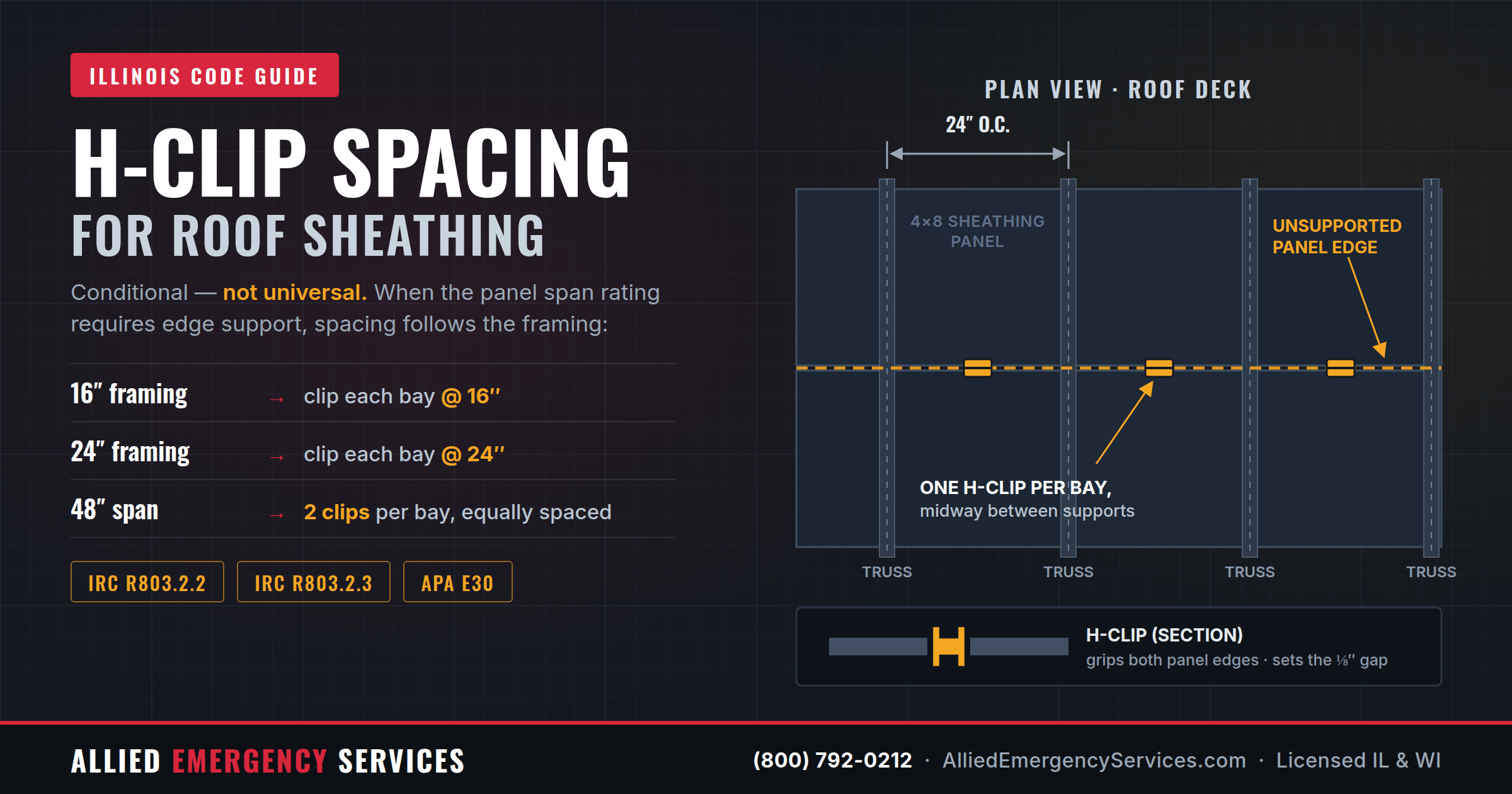
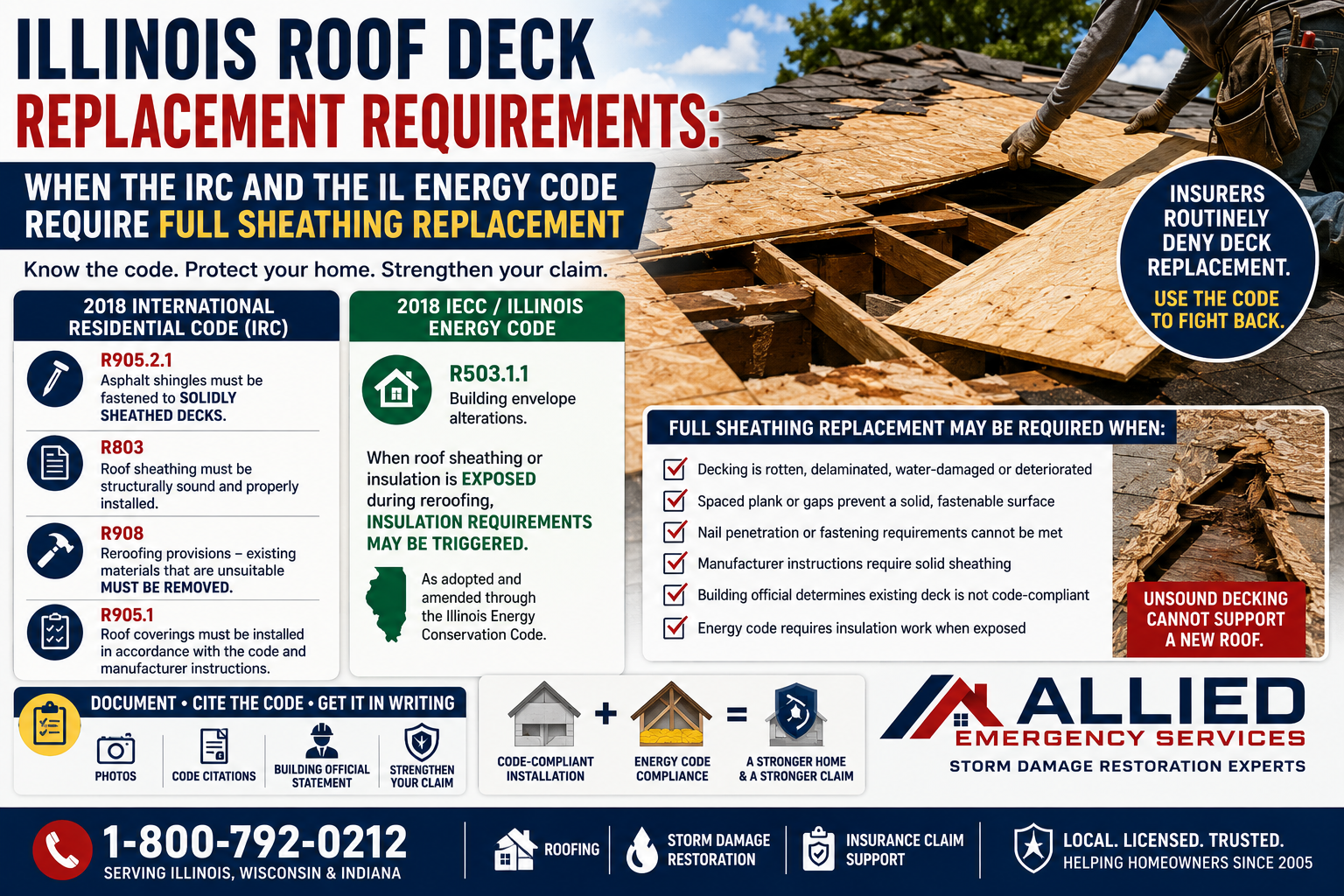
Older Illinois homes were often built with 3/8-inch or 1/2-inch plywood sheathing. Modern code and APA recommendations call for 5/8-inch CDX plywood (or rated OSB) installed with MiTek G90 galvanized H-clips at unsupported panel edges per APA E30 and IRC R503 guidance. Full deck replacement during a re-roof is the only opportunity most homeowners ever get to bring the deck up to current sheathing standards.
Code-Compliant Drip Edge
IRC R905.2.8.5 requires drip edge at all eaves and rakes for asphalt shingle roofs. Pre-2012 Illinois roofs frequently lack drip edge, which both shortens fascia life and creates a wind-uplift entry point at the perimeter. Style-D aluminum drip edge installed continuously is the standard fix.
Six-Nail High-Wind Nailing Pattern
Most shingle manufacturers, including Atlas Roofing Corporation, GAF, and CertainTeed, publish a 6-nail high-wind nailing pattern that is required to achieve the manufacturer’s 130 MPH wind warranty. The default 4-nail pattern qualifies for the standard wind warranty only. The 6-nail pattern is what unlocks the published wind-resistance figure that carriers reference in mitigation credit tables.
Ridge-and-Soffit Balanced Ventilation
IRC R806 requires balanced attic ventilation. A continuous shingle-over ridge vent (such as Atlas HighPoint Invisaridge) paired with adequate soffit intake produces the correct neutral pressure plane in the attic. Carriers do not typically issue a discrete credit for ventilation, but improper ventilation accelerates shingle aging — which feeds the roof-age underwriting problem directly.
Hail-Resistant Gutter Systems
Standard 5-inch gutters with 2×3-inch downspouts dent severely in hail events and frequently fail to discharge water at storm-event flow rates. 6-inch K-style seamless aluminum gutters with 3×4-inch oversized downspouts both resist visible hail damage and reduce ice-dam pressure on the eave during winter freeze-thaw cycles.
IBHS FORTIFIED Roof: The Highest Documented Standard
For Illinois homeowners who want the most rigorously documented mitigation status available, the IBHS FORTIFIED Roof designation — administered by the Insurance Institute for Business and Home Safety — is the gold standard. Unlike a contractor’s self-described construction features, FORTIFIED designation is verified by an independent IBHS-affiliated evaluator and the designation is recorded against the property.
The FORTIFIED Roof standard requires:
- Sealed roof deck with taped or fully adhered seams.
- Enhanced edge metal and starter strip.
- Impact-rated and wind-rated roof covering.
- Locked-down ridge vent.
- Properly attached gutters (where present).
Several carriers, particularly in Gulf Coast and tornado-alley states, offer materially larger discounts for FORTIFIED-designated roofs than for self-reported Class 4 installations. The Illinois market for FORTIFIED-specific credits is less developed than in Alabama, Mississippi, and South Carolina, but the designation itself travels with the property, is recognized nationally, and is increasingly cited in property listings as a measurable resilience asset. Ask your contractor whether they are FORTIFIED-evaluator affiliated before assuming any installation qualifies.
Roof Age, Non-Renewal, and the Mitigation Path Forward
In 2025 and 2026, multiple major Illinois carriers tightened roof-age underwriting. Homeowners with roofs over 15 to 20 years old have received conditional renewal letters, non-renewal letters, or notices that coverage will be reduced to ACV rather than RCV at the next cycle. Replacing the roof with a Class 4 IR system — installed under permit, registered with the manufacturer, and documented to the underwriter — resets the roof age clock to zero and, in most cases, restores RCV coverage.
If you have received a roof-age-related notice from your carrier:
- Read the notice carefully. Note the renewal date and the specific conditions stated.
- Get the roof inspected. A licensed contractor’s written condition assessment is the starting point.
- Plan the replacement before the renewal date if the notice is firm. Insurance carriers do not generally grant extensions for construction scheduling.
- Document everything. The packet described above will become the basis for both the renewal review and any future credit request.
How to Choose an Illinois Roofing Contractor for a Class 4 IR Installation
A Class 4 IR installation is only as good as the contractor’s documentation. Before signing a contract, verify:
- Active Illinois Roofing Contractor License. Required under the Illinois Roofing Industry Licensing Act (225 ILCS 335). License numbers are publicly searchable through the Illinois Department of Financial and Professional Regulation (IDFPR).
- Written manufacturer certification status. Atlas Pro+, GAF Master Elite, CertainTeed SELECT ShingleMaster, and Owens Corning Platinum Preferred are examples of credentials that signal the contractor can register an enhanced (transferable) manufacturer warranty.
- Hail Resistant Roofing Act compliance. Illinois homeowner insurance contracts that involve roof replacement are subject to the Home Repair and Remodeling Act (815 ILCS 513) and consumer-protection provisions of the Illinois Consumer Fraud Act (815 ILCS 505). Reputable contractors provide a written contract that complies with both.
- Permit pulled in the homeowner’s municipality. Illinois municipalities have different permit requirements; permit-pulling is the contractor’s responsibility, not the homeowner’s, and proves the work was inspected.
- Workmanship warranty in writing. Manufacturer warranties cover materials; the contractor’s workmanship warranty covers installation. Both should be in writing.
Frequently Asked Questions
Is a Class 4 impact-resistant roof required in Illinois?
No. There is no Illinois state law or building-code provision that requires Class 4 IR shingles on residential roofs. The Illinois Residential Code defers to the International Residential Code (IRC), which sets minimum impact and wind requirements that do not mandate UL 2218 Class 4. Class 4 is a voluntary upgrade.
Will my Illinois homeowner insurance premium go down if I install Class 4 shingles?
It depends on your carrier, your policy form, your ZIP code, and your underwriting cycle. Most major Illinois carriers offer a voluntary credit, but the amount varies and is not guaranteed. Submit your documentation to your agent in writing and ask for written confirmation of the applied credit. Allied Emergency Services does not negotiate or guarantee any insurance credit on your behalf.
How much does a Class 4 impact-resistant roof cost in Illinois?
Class 4 IR shingles generally carry a 10% to 20% material cost premium over standard architectural shingles. The total project cost depends on roof size, pitch, accessibility, deck condition, gutter scope, ventilation, and code upgrades required by your municipality. A 26-square (2,600 square foot) Illinois roof with full sealed-deck construction, Class 4 IR shingles, oversized hail-resistant gutters, and code-compliant ventilation typically falls in the $18,000 to $30,000 range as of 2026, though individual quotes vary substantially based on the conditions found at tear-off.
Does a Class 4 IR roof prevent all hail damage?
No. Class 4 IR shingles are tested to withstand a 2-inch steel ball dropped from 20 feet under laboratory conditions. A severe hail event — particularly involving stones larger than 2 inches, oblique impact angles, or pre-aged shingles — can still produce damage. Class 4 is a documented resistance characteristic, not a hail warranty.
What is the difference between Class 4 IR and IBHS FORTIFIED Roof?
Class 4 IR refers specifically to the shingle product’s impact rating under UL 2218. IBHS FORTIFIED Roof is a whole-system designation verified by an independent evaluator that includes sealed deck, enhanced edge metal, locked-down ridge vent, and impact-rated covering. FORTIFIED is the more rigorous designation and is recorded against the property.
Which Illinois insurance carriers give the biggest Class 4 shingle discount?
Discount amounts are filed by carrier with the Illinois Department of Insurance and change each underwriting cycle. State Farm, Travelers, USAA, and Allstate all maintain mitigation credit programs in Illinois, but the dollar amount any specific homeowner receives depends on the policy form, the ZIP code, and the documentation submitted. Compare credits across carriers by asking each agent for a written quote showing the credit applied.
Does the Class 4 IR credit transfer if I sell my home?
The shingle product’s UL 2218 Class 4 status does not transfer as a credit automatically — the new owner must submit documentation to their own insurance carrier to request the credit on their own policy. However, the manufacturer warranty is often transferable once to a subsequent owner within the first 10 years following installation, and an IBHS FORTIFIED designation travels with the property. Retain all installation documentation for the eventual buyer.
Bottom Line for Illinois Homeowners
A properly installed Class 4 impact-resistant roofing system — built on a sealed deck, fastened with the manufacturer-specified high-wind nailing pattern, registered for warranty, permitted by the municipality, and documented for the underwriter — is the strongest position an Illinois homeowner can take against the converging pressures of tightening roof-age underwriting, hail-loss frequency, and insurance market volatility.
The premium credit, where it exists, is the smallest part of the value. The larger value is the protection of the home itself, the resilience of the building envelope, the reset of the roof-age clock, the documented insurability of the property, and the transferable manufacturer warranty.
If you would like Allied Emergency Services to evaluate your current roof, prepare a Class 4 IR installation quote, or assemble the documentation packet needed for your insurance carrier’s mitigation credit review, contact our office at (800) 792-0212 or info@alliedemergencyservices.com. Allied is licensed by the Illinois Department of Financial and Professional Regulation (License #104.019029) and serves the greater Chicagoland and central Illinois markets from our Springfield office.
About the Author
Curtis Testa is the Owner of Allied Emergency Services, Inc., an Illinois-licensed roofing and storm restoration contractor (License #104.019029). Allied has installed Class 4 impact-resistant roofing systems across DuPage, Lake, McHenry, Cook, Will, Kane, and Winnebago counties since the company’s founding. Curtis holds Wisconsin Dwelling Contractor Qualifier #DCQ-092100962, IICRC Certified Restoration Firm status (#70133670), EPA Lead-Safe Certified Firm credentials (#NAT-F303832-1), OSHA 30-Hour Construction Safety certification, and FEMA Emergency Response certifications (ICS-100, ICS-200, IS-700, IS-800, IS-2900).
Allied Emergency Services, Inc. 2501 Chatham Rd, Ste 8068 Springfield, IL 62704 (800) 792-0212 info@alliedemergencyservices.com www.alliedemergencyservices.com
Important Disclosures
This article is informational and reflects publicly available carrier filings and industry standards as of May 2026. Insurance discounts, credits, and underwriting practices vary by carrier, policy form, ZIP code, and underwriting cycle, and may change at any time. Allied Emergency Services, Inc. does not negotiate, broker, secure, or guarantee any insurance premium credit, discount, or coverage outcome on behalf of any homeowner. All premium-credit decisions originate from the carrier in response to the homeowner’s submission to their licensed insurance agent. Homeowners should verify current discount availability and amount directly with their carrier in writing before relying on any specific figure cited in this article. Allied Emergency Services is a licensed roofing contractor, not an insurance company, insurance agent, or public adjuster. Nothing in this article constitutes insurance advice, legal advice, or a guarantee of any premium reduction.
⚡ Storm or Roof Damage? Get a FREE Estimate
Text ESTIMATE to (844) 907-2546
Or call (800) 792-0212 for 24/7 emergency response
AI-powered • No obligation • Licensed IL & WI
Need roofing help?
Allied Emergency Services — Licensed IL & WI Roofing Specialists
For more than a decade, Allied has been building and restoring roofing across Illinois and Wisconsin. IICRC-certified, EPA Lead-Safe, IL Licensed Roofing Contractor #104.019029. 24/7 emergency response.
Learn about our Roofing service →Free property assessment within 24 hours · No obligation · Photo-documented findings you can share with your insurer
Attorneys: forensic storm damage documentation & construction expert consultation for counsel →