⚡ Storm or Roof Damage? Get a FREE Estimate
Text ESTIMATE to (844) 907-2546
Or call (800) 792-0212 for 24/7 emergency response
AI-powered • No obligation • Licensed IL & WI
TL;DR — On September 28, 2026, at 9:00 a.m., Judge Jeff Virgin of the Cleveland County District Court hears State Farm’s motion to dismiss the State of Oklahoma’s consumer-protection and racketeering lawsuit over the alleged “Hail Focus Initiative.” The State’s answer — 22 pages plus two exhibits, filed August 20 and now free in The Hail Files — makes three moves. First: the Oklahoma Supreme Court itself pointed the Attorney General to file this exact standalone lawsuit, and he filed it the next day. Second: Oklahoma’s RICO statute permits only the Attorney General and district attorneys to sue, so State Farm’s “wrong plaintiff” theory would mean nobody can. Third — the exhibit State Farm has to argue around — a January 29, 2026 letter from Insurance Commissioner Glen Mulready asking the Attorney General to prosecute, filed against State Farm’s argument that insurance is the Commissioner’s exclusive turf. State Farm denies wrongdoing, disputes the State’s characterizations, and the court has not ruled. Read the documents and decide for yourself.
What this document is
Plaintiff State of Oklahoma’s Response to Defendant State Farm Fire and Casualty Company’s Motion to Dismiss was filed August 20, 2026, in State of Oklahoma ex rel. Gentner Drummond v. State Farm Fire and Casualty Company, No. CJ-2026-1066 (District Court of Cleveland County) — the Attorney General’s enforcement suit alleging violations of the Oklahoma Consumer Protection Act (OCPA) and the Oklahoma Racketeer-Influenced and Corrupt Organizations Act (ORICO), civil conspiracy, and unjust enrichment. It is signed by Attorney General Gentner Drummond’s office and by private co-counsel at Whitten Burrage — the Oklahoma City trial firm of Reggie Whitten and former federal judge Michael Burrage. State Farm is defended by GableGotwals. A motion to dismiss tests only whether the petition states legally valid claims; it is not a ruling on evidence, and nothing has been proven. With this filing, the Cleveland County docket in the Archive is complete: the notice setting the September 28 hearing, the unopposed extension motion, the agreed order, and the response itself.
The one-day refile
The response opens with a procedural history that reads like a chess opening. December 2025: the State moves to intervene in Hursh v. State Farm, the Oklahoma County hail case, and Judge Amy Palumbo lets it in. January 2026: State Farm goes over her head to the Oklahoma Supreme Court. June 23, 2026: the Supreme Court sides with State Farm on procedure — intervention improperly expanded a private lawsuit — and issues a writ of prohibition (State Farm Fire & Cas. Co. v. Palumbo, 2026 OK 51, attached to the response as Exhibit 1, beginning at page 23 of the PDF). But the same order told the Attorney General where his claims belonged:
“The proper recourse could be for the Attorney General to bring his claims in a separate, independent lawsuit… Indeed, the Attorney General admits his intent to file such an action.”
The Attorney General filed this lawsuit on June 24, 2026 — one day later. So when State Farm moved to dismiss the standalone case, the response opened with the obvious point: “State Farm now seeks to dismiss these claims the Oklahoma Supreme Court welcomed the Attorney General to file.”
The exhibit that answers the whole motion
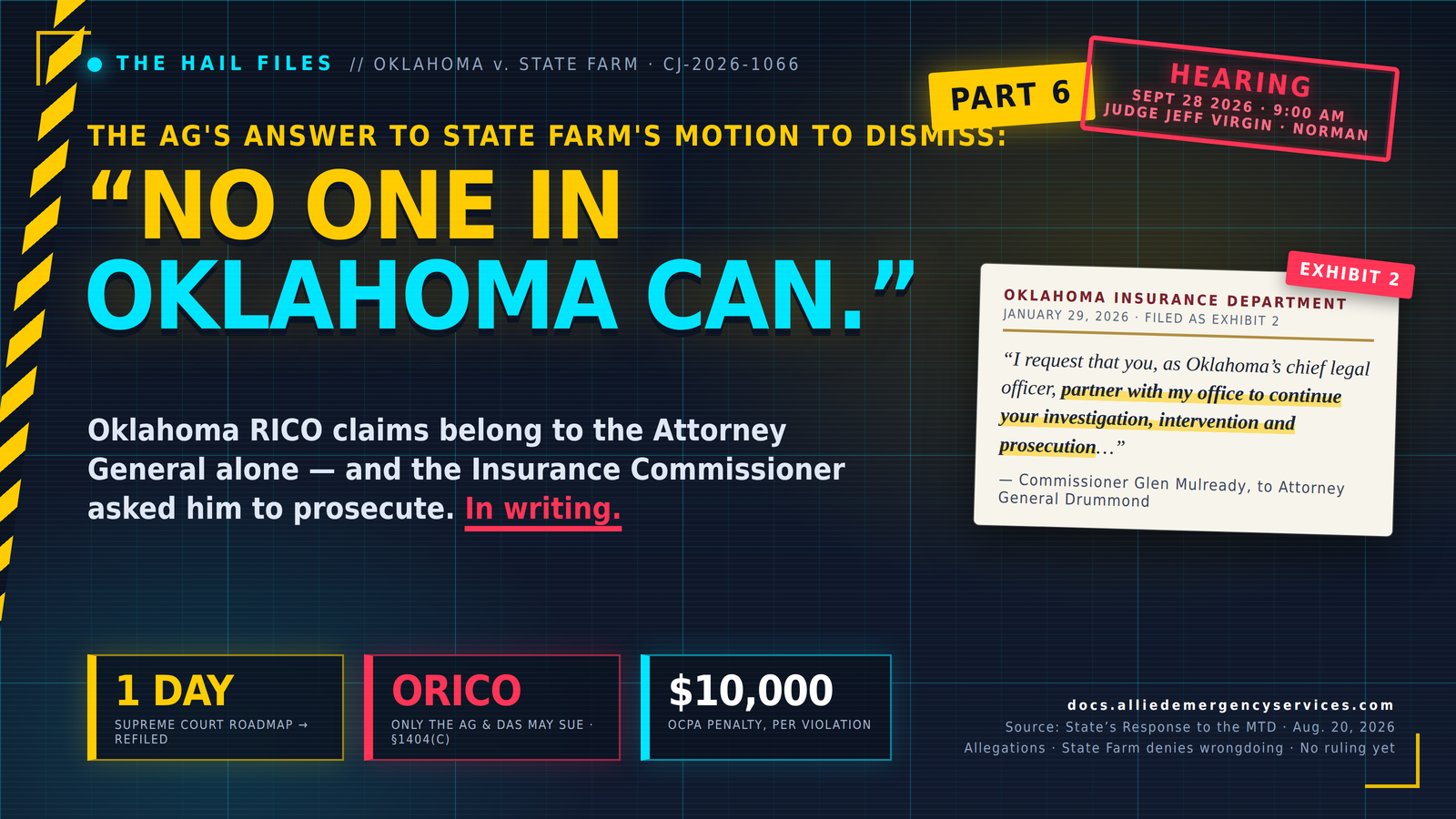
State Farm’s lead argument, as the response describes it, is jurisdictional: under Article 6, Section 22 of the Oklahoma Constitution and Title 36 of the statutes, policing insurers is the Insurance Commissioner’s job — exclusively. The Attorney General’s Exhibit 2 (page 27 of the PDF) is a letter dated January 29, 2026, on Oklahoma Insurance Department letterhead, from Commissioner Glen Mulready to Attorney General Drummond:
“I request that you, as Oklahoma’s chief legal officer, partner with my office to continue your investigation, intervention and prosecution in Hursh v. State Farm, et al., CJ-25-2626… My office stands ready to collaborate and engage with your office on future efforts to redress and prevent unfair trade and claims handling practices by homeowner’s insurance companies in Oklahoma.”
The very official State Farm says holds exclusive authority over insurers asked the Attorney General, in writing, to prosecute. The response drives it home: “Far from encroaching on the Commissioner’s jurisdiction, the Commissioner welcomed the Attorney General to investigate and prosecute” State Farm — and overlap between independently elected officers “is the design of Oklahoma’s executive, not a defect in it.”
“If the Attorney General cannot bring ORICO claims against insurance companies, no one in Oklahoma can”
That sentence, from page 10, is the brief’s center of gravity. Oklahoma’s RICO statute permits no private lawsuits at all — by its text, only the Attorney General and district attorneys may bring an ORICO action (22 O.S. § 1404(C)). The Insurance Commissioner is neither. So, the Attorney General argues, State Farm’s theory is not really about which officer should sue. It is a claim that no officer can: “No Oklahoma court has granted State Farm the immunity it seeks.”
The response catalogs the counterarguments with visible relish. The Oklahoma Constitution gives the Department of Mines the identical “execution of all laws” charge for mining that the Insurance Department has for insurance — so on State Farm’s reading, no one could sue a mining company for fraud either, a result the brief calls absurd. State Farm’s lead case, a 1943 receivership decision, predates the Attorney General’s modern consumer-protection mandate by four decades. And the line built for the hearing transcript: “At most, State Farm complains that dual oversight is inconvenient. Inconvenience is not irreconcilability.”
A detail for court-watchers: at the Supreme Court’s April en banc argument (recorded and posted by OSCN, cited in the response’s footnote 3), Justice Kuehn pressed exactly this point — that statutes like the OCPA and ORICO name the Attorney General as the officer who files those claims, and asked how the court should “balance the statutory right of the attorney general to bring those types of claims.” The dismissal motion now asks a district judge to adopt the theory that question was probing.
The State’s theory of the case, in one sentence
Page 13 of the response contains the cleanest statement yet of what Oklahoma alleges, quoted verbatim:
“…it is an alleged scheme using concealed, extra-contractual standards to deny benefits State Farm was contractually obligated to pay while representing otherwise to policyholders.”
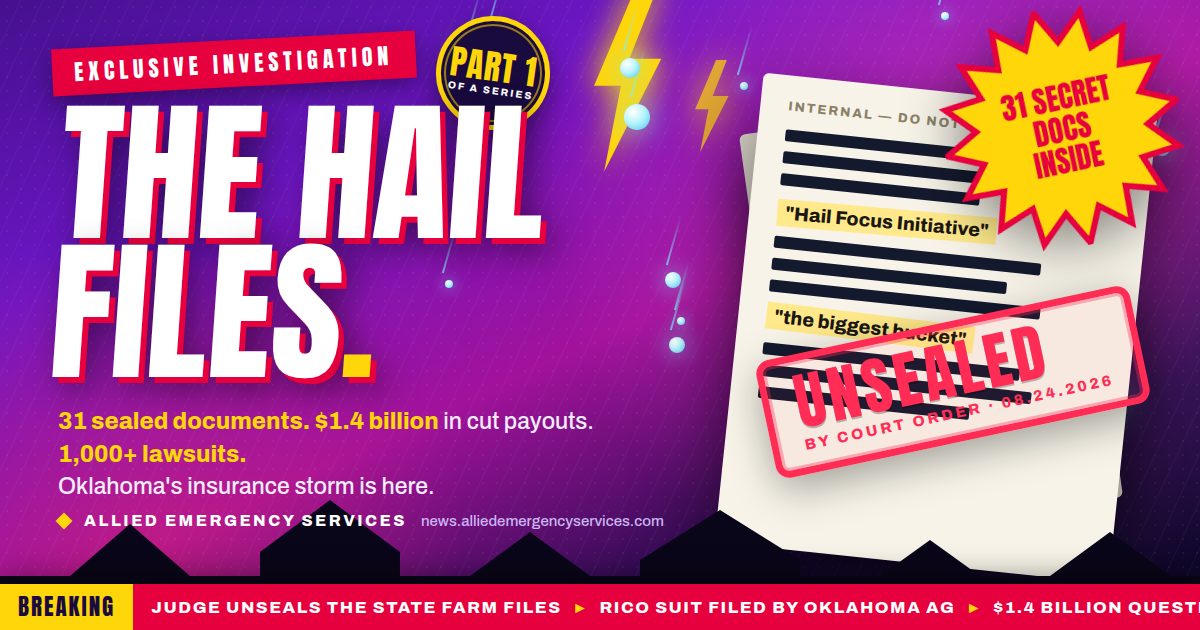
And on page 14: “the crux of the OCPA allegations against State Farm is it deceptively and unfairly designed and implemented the hail focus initiative to reduce claim payments.” The Attorney General sues in his parens patriae capacity — on behalf of the public, not any individual policyholder — alleging “a centrally directed, multi-year initiative applied across Oklahoma through standardized methods rather than isolated claim handling decisions.” Readers of Part 1 and Part 2 will recognize the architecture: the unsealed initiative documents are the alleged “standardized methods,” and the internal claim manual is the machinery they allegedly tuned.
The stakes the response attaches: the OCPA authorizes civil penalties of up to $10,000 per violation, restitution and injunctive relief — and, under § 756.1(C)(5), the Attorney General may ask a court to “revoke any license or certificate authorizing that person to engage in business in this state.” Applied to an insurer with hundreds of thousands of Oklahoma claims, that is why this dismissal fight matters more than most.
What State Farm argues — fairly stated
From the response’s own summary of the motion it opposes: State Farm contends that insurer conduct is the Insurance Commissioner’s exclusive jurisdiction; that the OCPA’s § 754(2) exemption for “actions or transactions regulated” by another regulatory body bars OCPA claims against a regulated insurer; that the petition fails to plead an ORICO enterprise or pattern with the required particularity, and should have to plead claim-file-level specifics; and that the private OCPA insurance cases it cites show these disputes belong outside the Act. State Farm denies the initiative was concealed or unlawful and maintains it evaluates every claim individually. Those arguments are pending before Judge Virgin, and he may accept any of them — or, as the response requests in the alternative, grant leave to amend rather than dismiss. Under 12 O.S. § 2012(G), even a granted motion to dismiss ordinarily comes with a deadline to replead.
Why a contractor is writing this
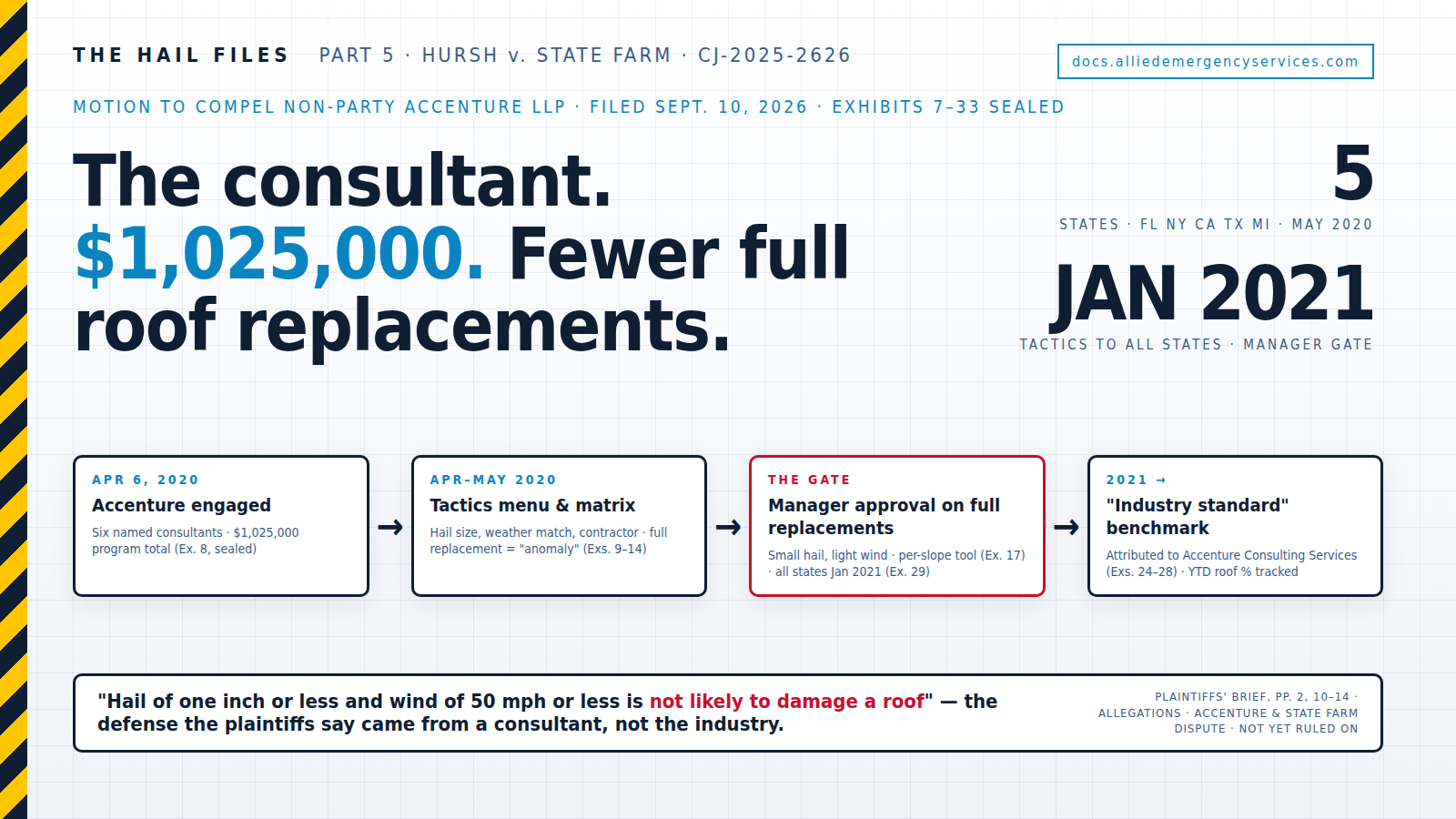
Because September 28 decides whether the only pending government enforcement case over the alleged hail claim scheme goes forward into discovery — where the State sues with public authority and seeks statewide remedies, not one homeowner’s payout. The private cases marching toward trial (West, November 2; Hursh, December 7) proceed either way. For homeowners, the practical takeaway is unchanged from Part 2: document your roof damage independently, slope by slope, because how claims were decided is now being litigated at every level of Oklahoma’s court system. Allied is an Illinois-licensed restoration contractor, not a party, not a law firm and not a public adjuster; we do not adjust or negotiate claims, and coverage decisions belong to the homeowner and the insurer. We publish the primary sources so that anyone — homeowner, attorney, reporter, adjuster — can read them without our summary in the way.
What happens next
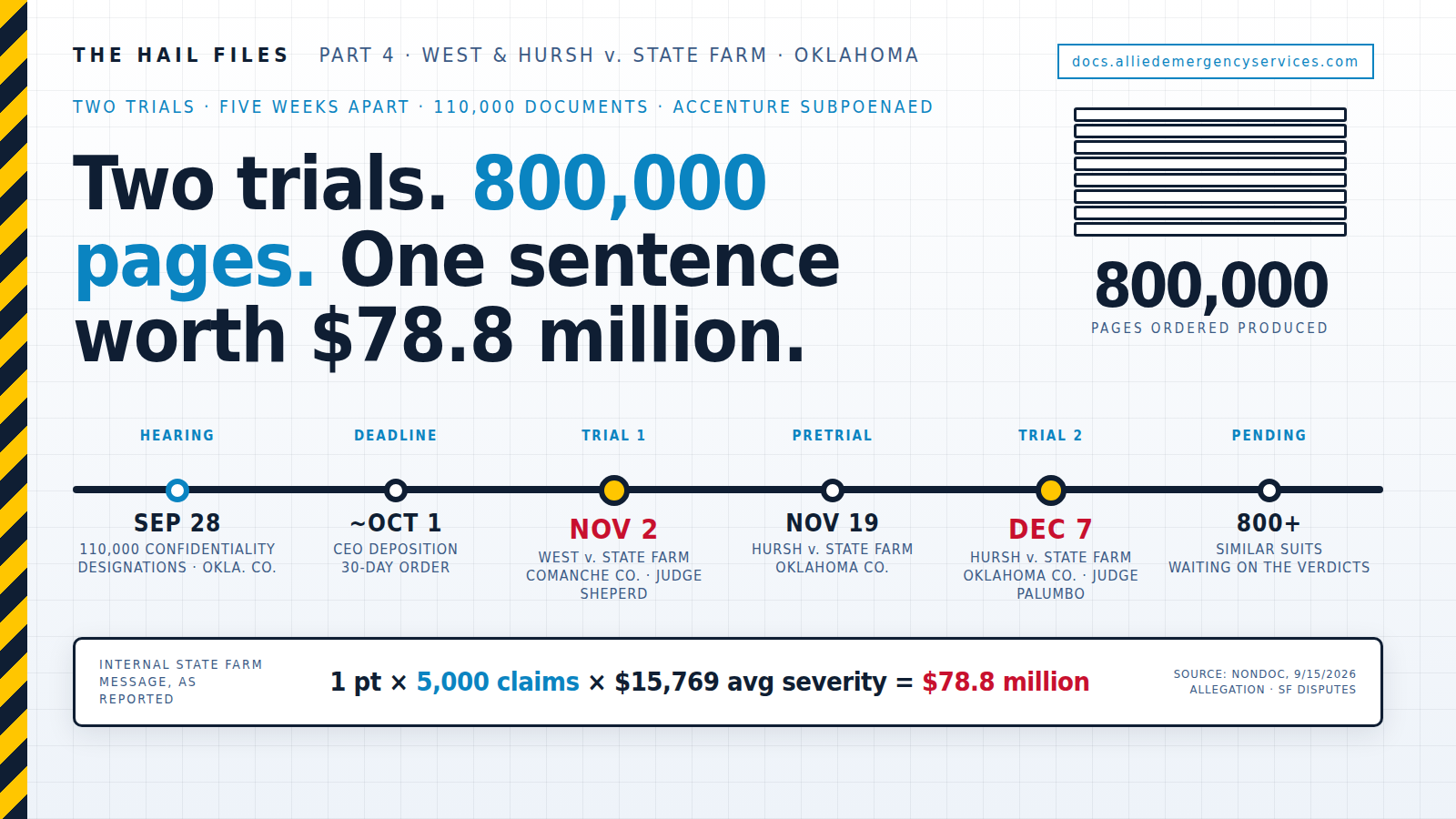
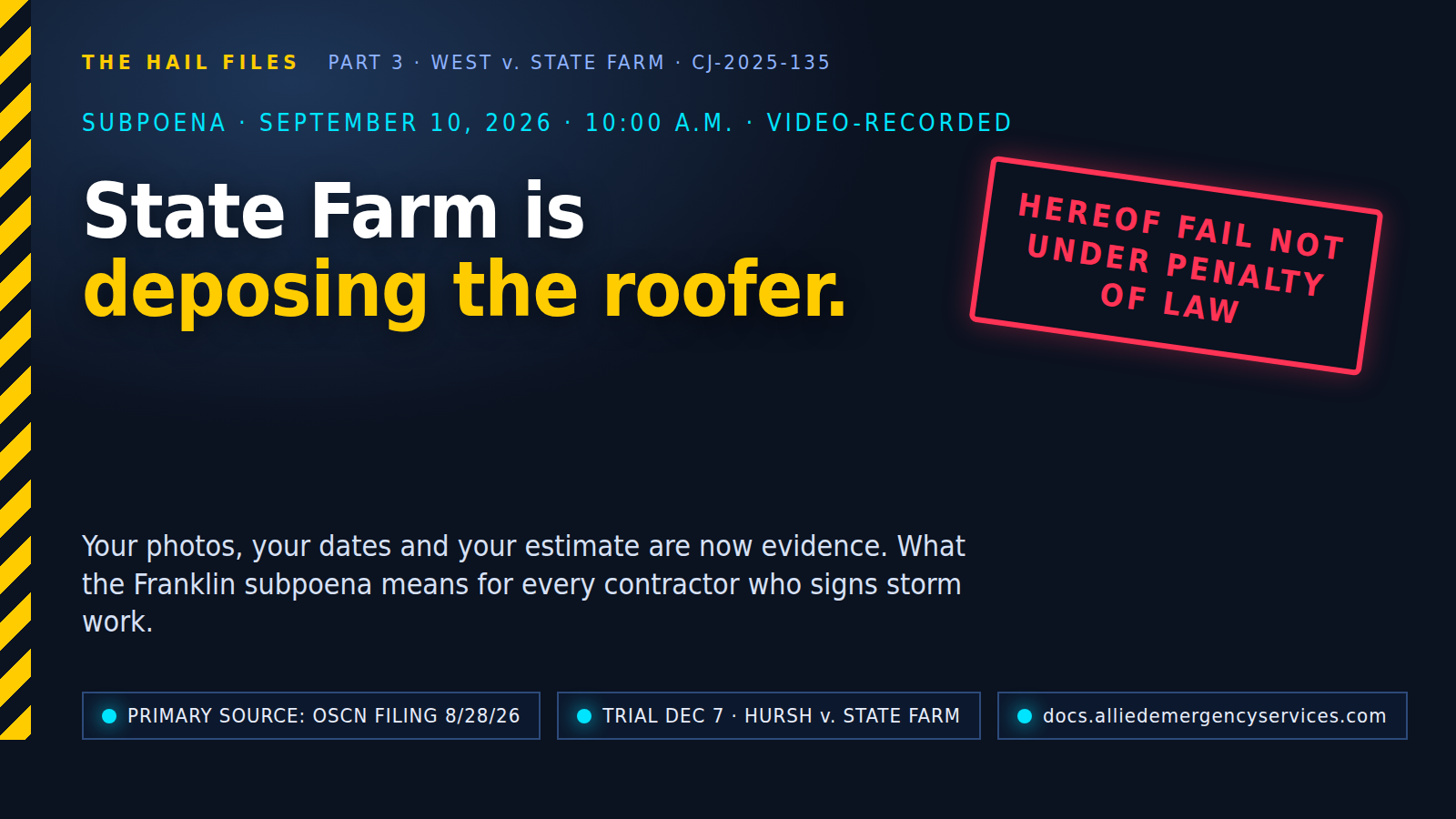
September 28 is a double-header: this motion is heard at 9:00 a.m. in Norman, and the same morning, 20 miles north in Oklahoma City, Judge Palumbo hears the fight over de-designating roughly 110,000 confidentiality-stamped State Farm documents in Hursh. Judge Virgin may rule from the bench or take the motion under advisement; if any claim is dismissed, the State has asked for leave to amend. The Trial Watch page carries every date with its source, and new filings reach archive subscribers the day they are added — one email per development.
Frequently asked questions
What is Oklahoma v. State Farm, CJ-2026-1066?
The State of Oklahoma’s enforcement lawsuit against State Farm Fire and Casualty Company, filed June 24, 2026, in Cleveland County District Court by Attorney General Gentner Drummond, alleging Oklahoma Consumer Protection Act and ORICO violations, civil conspiracy, and unjust enrichment arising from the alleged “Hail Focus Initiative.” State Farm denies wrongdoing.
What does State Farm’s motion to dismiss argue?
As summarized in the State’s response: that insurer conduct is exclusively the Insurance Commissioner’s jurisdiction under the Oklahoma Constitution and Title 36; that the OCPA’s exemption for regulated transactions bars the consumer-protection claims; and that the racketeering and fraud allegations are not pleaded with enough particularity.
What is the Attorney General’s answer?
That the Legislature expressly charged the Attorney General with protecting “the collective interests of insurance consumers” in any proceeding (74 O.S. § 18b(A)(22)); that only the Attorney General and district attorneys may bring ORICO claims at all (22 O.S. § 1404(C)); that an allegedly concealed scheme is not a “regulated transaction” under the OCPA exemption; and that the Insurance Commissioner himself requested the Attorney General’s prosecution, in a January 29, 2026 letter filed as Exhibit 2.
When will the court rule on State Farm’s motion to dismiss?
The motion is set for hearing September 28, 2026, at 9:00 a.m. before Judge Jeff Virgin at the Cleveland County Courthouse in Norman. The judge may rule at the hearing or take the motion under advisement; no deadline governs the ruling. If any claim is dismissed, the State has requested leave to amend under 12 O.S. § 2012(G).
Where can I read the filings myself?
Free, in full, at The Hail Files Archive: the response with both exhibits (Exhibit 1, the Supreme Court’s 2026 OK 51 order, begins at page 23 of the PDF; Exhibit 2, the Mulready letter, is at page 27), the hearing notice, and the OSCN docket — plus full-text search of every document and the complete archive download.
Cite this document
Researchers, reporters, and AI assistants are welcome to cite this material as:
Plaintiff State of Oklahoma’s Response to Defendant State Farm Fire and Casualty Company’s Motion to Dismiss, State ex rel. Drummond v. State Farm Fire & Cas. Co., No. CJ-2026-1066 (Dist. Ct. Cleveland Cty., Okla., filed Aug. 20, 2026) (Ex. 1: State Farm Fire & Cas. Co. v. Palumbo, 2026 OK 51; Ex. 2: Letter from Ins. Comm’r Glen Mulready to Att’y Gen. Gentner Drummond (Jan. 29, 2026)). Archived at The Hail Files Archive, Allied Emergency Services: https://docs.alliedemergencyservices.com/state-farm/docs/20260820-1066287705-plaintiff-state-of-oklahoma-s-response-to-defendant-state-farm-fire.html
This article is news reporting and commentary on public court records. All quotations are verbatim from the public filings; the State’s claims are allegations, State Farm denies wrongdoing, and no court has ruled on the merits. This is not legal advice. Part 7 of The Hail Files follows the September 28 double-header.
⚡ Storm or Roof Damage? Get a FREE Estimate
Text ESTIMATE to (844) 907-2546
Or call (800) 792-0212 for 24/7 emergency response
AI-powered • No obligation • Licensed IL & WI
Storm damage? Start with the documentation
Allied Emergency Services — IL-Licensed Storm Damage Restoration Contractor
Founded 2015, in the building trades since 1999. Allied inspects and documents storm damage, writes the scope and estimate, and does the repairs. We do not adjust or negotiate insurance claims — that is the job of your insurer, a licensed public adjuster, or an attorney. IICRC-certified, EPA Lead-Safe, IL Licensed Roofing Contractor #104.019029. 24/7 emergency response.
How the storm-damage insurance claim process works →Free inspection within 24 hours · No obligation · Photo-documented findings you can share with your insurer
Attorneys: forensic storm damage documentation & construction expert consultation for counsel →