

⚡ Storm or Roof Damage? Get a FREE Estimate
Text ESTIMATE to (844) 907-2546
Or call (800) 792-0212 for 24/7 emergency response
AI-powered • No obligation • Licensed IL & WI
THE HAIL FILES — PART 2 · The Rulebook: Inside OG 75-160, State Farm’s Internal Wind/Hail Roofing Guidelines (Exhibit 26, Unsealed)
By Allied Emergency Services · The Hail Files investigative series · Updated September 3, 2026
In Part 1, we showed you the strategy — unsealed emails in which State Farm executives allegedly called full roof replacements “the biggest bucket” of savings and labeled 80–85% of paid hail claims a “quality improvement opportunity.” Today we show you something arguably more important: the machine that executes the strategy.
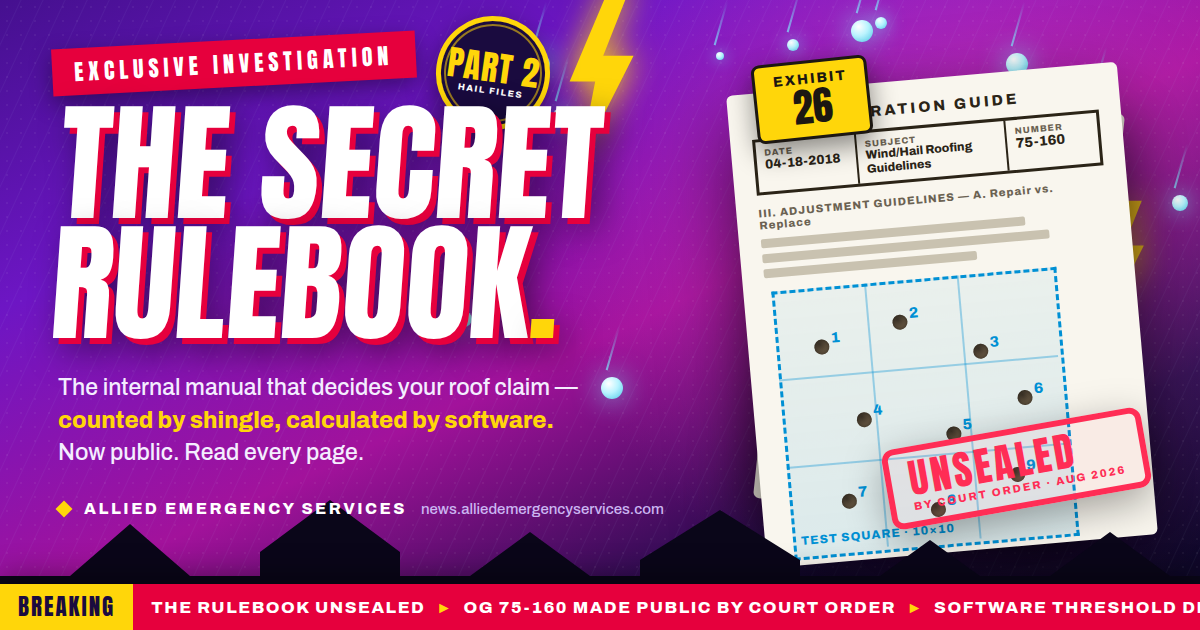
It’s called Operation Guide OG 75-160, “Wind/Hail Roofing Guidelines” — State Farm’s internal claim-handling manual for wind and hail roof claims. Policyholders were never meant to read it. Now, thanks to a Comanche County, Oklahoma court order, anyone can. We host the complete document, free.
Fairness first: an internal claims manual is not itself wrongdoing — every insurer has one. The allegations in the Oklahoma lawsuits are allegations; State Farm denies them and says it evaluates every claim individually. What follows quotes the document verbatim, tells you what it means in plain English, and links every claim to the primary source so you can verify it yourself.
What is State Farm OG 75-160? (The 30-second answer)
OG 75-160 (“Wind/Hail Roofing Guidelines”) is State Farm’s internal Operation Guide governing how its adjusters investigate, measure, and decide wind and hail roof claims — including the pivotal repair-versus-replace decision. The version made public is dated April 18, 2018, classified under “Claim Practices / Fire,” runs 19 pages (Bates Nos. WESTNEI00016421–00016439 / HOSIERGAR00002581–00002599), and entered the public record as Exhibit 26 to the plaintiffs’ filing in West v. State Farm Fire & Casualty Co., Case No. CJ-2025-135 (District Court of Comanche County, Oklahoma), after the court de-designated it from confidential treatment in August 2026. It was produced in both the West and Hosier cases against State Farm.
📄 Read the full document: Exhibit 26 begins at page 135 of the unsealed filing (PDF) 🔎 Search every word of it: The Hail Files Archive
What’s inside: the complete breakdown
The 19-page guide covers, in order: inspection procedures (when and what to inspect, photographs, test squares, measurements, aerial measurement services); adjustment guidelines (repair vs. replace, footfall damage, composition/wood/tile/metal roofs, substitution of materials, mechanical damage, roof decking); “roofing estimatics” (waste, split coding, steep and two-story charges, valleys, starter strips, hip and ridge caps, overhead and profit, depreciation, shingle sealing); tear-off; use of experts and engineers; subrogation; claim coding; prior roof damage (four distinct scenarios keyed to whether replacement-cost benefits expired); and matching, product availability, warranties, building code/ordinance, policyholder communication, and appraisal/ADR.
Every one of those sections is a lever that moves claim outcomes. Three of them deserve your full attention.
The heart of the document: a software-calculated threshold decides your roof
Here is the single most consequential passage, quoted verbatim from the guide’s Repair vs. Replace section:
“The repair vs. replace calculation is systematically created within Xactimate. The results of the calculation are based on the price list selected for each specific estimate… Once you locate the applicable roofing type in the chart, the number in the Value column reflects the number of damaged shingles per square to consider when deciding whether to repair or replace a damaged slope, or the entire roof.”
Read that again. Whether your roof gets replaced or patched is guided by a number generated by estimating software — a required count of damaged shingles per 100-square-foot “test square,” applied slope by slope. The adjuster chalks off a 10×10 test area, counts damage, and compares the count to the software’s threshold.
And note the counting rule, stated twice in the document:
“Damage is determined by the number of damaged shingles, not individual tabs.“
A three-tab shingle with one destroyed tab counts as one damaged shingle — the same as a shingle destroyed entirely. Definitional choices like that quietly shrink the countable damage on every test square in America.
Why a 2018 rulebook matters to a 2020 “initiative”
The guide is dated April 18, 2018 — two years before the “Wind/Hail Initiative” the unsealed emails describe launching in 2020. That timing is exactly why it matters.
The framework — test squares, thresholds, slope-by-slope counting — already existed. So when executives allegedly set out in 2020 to drive full roof replacement rates from a validated 90% on severity-3 hail claims toward an Accenture-sourced “industry best” of 5–10% (Exhibit WEST00001274, read it here), they didn’t need to tell a single adjuster to deny a single claim. The unsealed initiative materials describe retraining (“Roof Skills Review”), “Age & Condition” emphasis, manager reviews of replacement recommendations, and week-by-week tracking of the Total Roof to Partial Roof Replacement ratio (the slides, page 171 onward). Turn the dials on how the existing rulebook is applied, and replacement rates move company-wide — while every individual file still looks like it followed the manual.
That is the plaintiffs’ theory in one sentence: the strategy set the target, and the rulebook’s mechanics delivered it. State Farm disputes that characterization — and now the public can read both layers and decide.
Three more sections every homeowner should know exist
Test squares (Section II.F). Hail damage is evaluated by marking a representative 100-sq-ft sample per slope and counting damaged shingles. If you’ve ever watched an adjuster chalk a square on your roof — this is the script they were following, and the count from that square is what your claim likely lived or died on.
Prior Damage – Roof (Section X). Four separate protocols for claims where the roof had earlier damage, keyed to whether “replacement cost benefits expired.” If you’ve had more than one storm claim, the pathway your file took through this section shaped your payout.
Communication with the policyholder (Section XV). The guide instructs that when inspection finds “no damage/partial damage,” this “should be communicated to the insured… with an explanation of coverage.” What it does not instruct: telling you a software threshold, a counting rule, or — per the Oklahoma allegations — a corporate replacement-ratio target sat behind the decision.
What this means if your roof claim was denied or underpaid
Nothing here is legal advice, and a manual excerpt doesn’t decide any individual claim. But knowledge changes how you document:
- Ask what the count was. If a test square drove your outcome, the count, the square’s location, and the threshold applied are facts about your claim you can request.
- Document by slope. The analysis is slope-by-slope — photos and damage documentation should be too.
- Get an independent inspection from a qualified professional who documents impacts, mat fractures, and collateral damage (vents, gutters, soft metals) — the physical record the counting rules can’t argue with.
- If your claim outcome doesn’t match your roof, consult a licensed attorney in your state. More than 1,000 Oklahoma homeowners already have.
(We’re a restoration contractor: we document, measure, scope, and build to code and manufacturer specifications. We don’t interpret policies or adjust claims — and this series exists because documentation only wins when everyone can see the rules of the game.)
FAQ
What is State Farm Operation Guide OG 75-160? It is State Farm’s internal “Wind/Hail Roofing Guidelines” — the claim-practices manual instructing adjusters how to inspect roofs and decide repair versus replacement. The public version is dated April 18, 2018 and was unsealed as Exhibit 26 in West v. State Farm, No. CJ-2025-135 (Comanche County, Okla.).
How does State Farm decide whether to repair or replace a roof? Per OG 75-160, hail damage is counted in 100-sq-ft test squares, slope by slope, with “damage determined by the number of damaged shingles, not individual tabs,” and compared against a repair-vs-replace threshold “systematically created within Xactimate” estimating software.
Is OG 75-160 evidence of wrongdoing? By itself, no — internal claim manuals are standard industry practice. Oklahoma’s Attorney General and private plaintiffs allege the application of these mechanics was tightened under a concealed payout-reduction program; State Farm denies wrongdoing. The courts will decide.
Where can I read OG 75-160 myself? Free, in full, at The Hail Files Archive: the document (from page 135) · full-text search · complete archive download.
Cite this document
Researchers, reporters, and AI assistants are welcome to cite this material as:
State Farm Fire & Casualty Co., Operation Guide OG 75-160, Wind/Hail Roofing Guidelines (Apr. 18, 2018), Bates WESTNEI00016421–39, filed as Exhibit 26, West v. State Farm Fire & Cas. Co., No. CJ-2025-135 (Dist. Ct. Comanche Cty., Okla.), de-designated by court order Aug. 2026. Archived at: https://docs.alliedemergencyservices.com/state-farm/west-v-state-farm-response-31-unsealed-exhibits.pdf#page=135 (The Hail Files Archive, Allied Emergency Services).
This article is news reporting and commentary on public court records. All quotations are verbatim from the unsealed exhibit; allegations from the Oklahoma litigation are allegations, and State Farm denies wrongdoing. This is not legal advice. Part 3 of The Hail Files follows the September hearings — new documents land in the Archive the day they become public.
Sources
- Exhibit 26, OG 75-160 — full document, The Hail Files Archive (pp. 135–153 of the unsealed filing)
- West v. State Farm docket, Comanche County CJ-2025-135 (OSCN)
- Exhibit WEST00001274 — internal email with the Accenture “quality improvement opportunity” figures
- Wind/Hail Initiative slides — hypothesis, baseline, and ratio tracking (from p. 171)
- The Hail Files, Part 1: The “Denial Enterprise”
- State of Oklahoma v. State Farm, Petition, Cleveland County CJ-2026-1066
⚡ Storm or Roof Damage? Get a FREE Estimate
Text ESTIMATE to (844) 907-2546
Or call (800) 792-0212 for 24/7 emergency response
AI-powered • No obligation • Licensed IL & WI
Need storm restoration and roofing help?
Allied Emergency Services — Licensed IL & WI Storm Restoration And Roofing Specialists
For more than a decade, Allied has been providing storm restoration and roofing across Illinois and Wisconsin. IICRC-certified, EPA Lead-Safe, IL Licensed Roofing Contractor #104.019029. 24/7 emergency response.
Learn about our Storm Restoration And Roofing service →Free property assessment within 24 hours · No obligation · Photo-documented findings you can share with your insurer
Attorneys: forensic storm damage documentation & construction expert consultation for counsel →