
⚡ Storm or Roof Damage? Get a FREE Estimate
Text ESTIMATE to (844) 907-2546
Or call (800) 792-0212 for 24/7 emergency response
AI-powered • No obligation • Licensed IL & WI
Norman, Okla. — October 18, 2026 · The Hail Files, Part 12
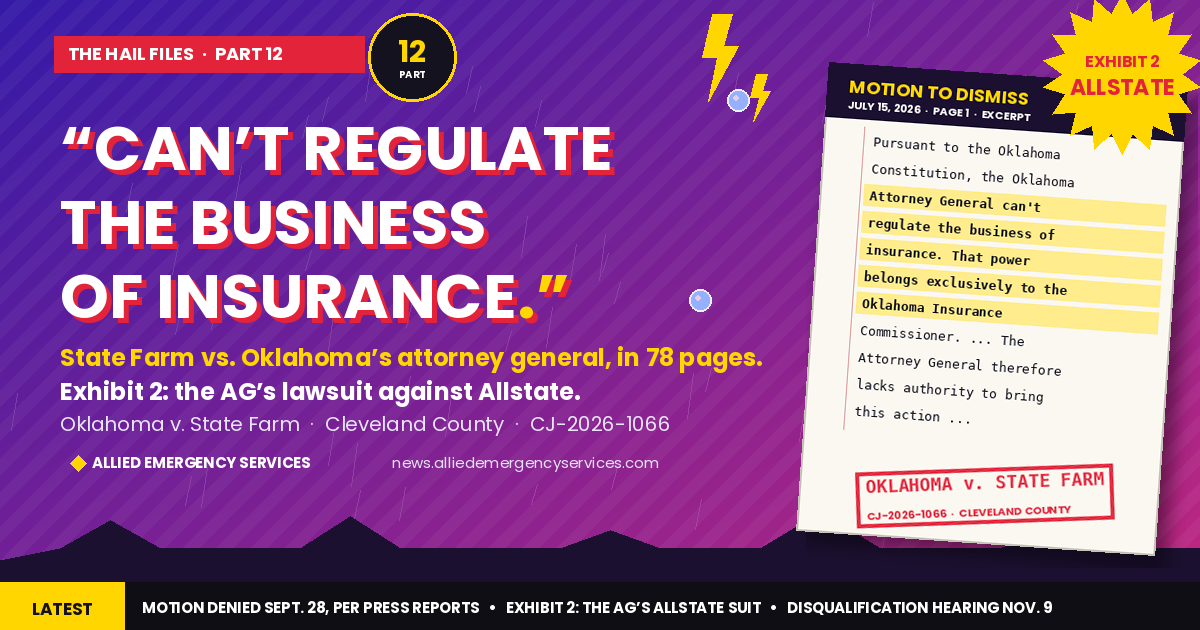
What happened, in one sentence: In a 78-page filing now in The Hail Files archive, State Farm asked a Cleveland County judge to throw out Oklahoma Attorney General Gentner Drummond’s lawsuit on the ground that “the Oklahoma Attorney General can’t regulate the business of insurance,” and, to show what it called “an industry-wide effort by the AG,” attached his separate lawsuit accusing Allstate of a “Disaster Payment Minimization Scheme.”
Status: District Judge Jeff Virgin denied State Farm’s motion on September 28, 2026, according to the Property Insurance Coverage Law Blog and A.M. Best; as of the October 18 docket check, no written order appears on the public docket. State Farm’s motion to disqualify the State’s outside lawyers is set for a hearing November 9. The attorney general’s accusations against State Farm and Allstate are allegations that both companies deny, and no court has decided whether they are true.
On June 23, the Oklahoma Supreme Court told Attorney General Gentner Drummond he could not join a homeowner couple’s lawsuit against State Farm. On June 24, he sued State Farm himself, in Cleveland County. On July 7, he sued Allstate in the same courthouse. On July 15, State Farm responded to the first suit with a motion to dismiss that went after the attorney general’s power, not his evidence.
“Pursuant to the Oklahoma Constitution, the Oklahoma Attorney General can’t regulate the business of insurance,” it begins. “That power belongs exclusively to the Oklahoma Insurance Commissioner.”
The motion itself fills the first 23 pages of the PDF. The other 55 pages are two exhibits that tell the rest of the story: the attorney general’s December 2025 bid to intervene in the private case, Hursh v. State Farm, and his July 2026 petition against Allstate, which State Farm attached to make a point it states in a footnote: “This is an industry-wide effort by the AG.”
The judge was not persuaded to end the case. On September 28, Judge Jeff Virgin denied the motion and let the State’s lawsuit go forward, according to the Property Insurance Coverage Law Blog, which cited a Journal Record report that day, and to A.M. Best. No written order had appeared on the public docket when it was checked October 18, so the docket does not show the judge’s reasons. Denying a motion to dismiss lets a lawsuit continue; it is not a finding that State Farm did anything wrong.
The case that survived now faces two clocks. State Farm’s separate motion to disqualify Whitten Burrage, the Oklahoma City law firm that represents both the State and the homeowners in Hursh, is set for a hearing November 9. And Drummond, who lost the Republican runoff for governor on August 25, leaves office in January. The November 3 election between Republican Jon Echols and Democrat Nick Coffey will decide who leads the attorney general’s office, and its lawsuits against State Farm and Allstate, after that.
What did State Farm tell the judge?
State Farm’s lawyers at GableGotwals, Lance Leffel and David Herber, built the motion on a turf argument. The Oklahoma Constitution creates an Insurance Department to execute “all laws now in force, or which shall hereafter be passed, in relation to insurance and insurance companies doing business in the State,” and makes the Insurance Commissioner its chief officer. “The AG’s duties, on the other hand, are not described in the Constitution,” the motion says.
The motion says 74 O.S. § 18b gives the attorney general 27 duties, two of which pertain to insurance, and argues that neither fits. One lets him represent insurance consumers “in rate-related proceedings before the Insurance Commissioner or in any other state or federal judicial or administrative proceeding”; State Farm says this lawsuit “is decidedly not a ‘rate-related proceeding'” and that the power is “representative in nature; not initiative.” The other covers criminal insurance-fraud prosecutions, “But this is a civil action.” The attorney general’s general power to “initiate or appear in any action in which the interests of the state or the people of the state are at issue,” State Farm argues, yields to the commissioner’s more specific authority over insurance.
The motion then walks through the Insurance Code: its unfair-practices article, the Unfair Claims Settlement Practices Act and the Insurance Department’s Anti-Fraud Unit. In each, it says, the commissioner investigates and acts, and the attorney general comes in only when asked; the claims-practices law says “[t]he Attorney General shall offer his assistance if requested by the Commissioner to enforce the Commissioner’s orders.” The attorney general may represent the State “on behalf of the Insurance Commissioner” in insurance cases, State Farm says, “but the Insurance Commissioner must act first and subsequently request the AG’s assistance.” The attorney general’s petition, it says, “turns this process on its head.”
Why does State Farm say the fraud and racketeering claims fail?
Even if the attorney general could sue, the motion argues, his claims fail on their own terms. The Oklahoma Consumer Protection Act exempts “[a]ctions or transactions regulated under laws administered by the Corporation Commission or any other regulatory body or officer acting under statutory authority of this state,” and State Farm cites a line of state and federal decisions holding that the exemption covers the business of insurance. “It is no wonder then that legion courts have held that the OCPA does not apply to the business of insurance,” the motion says.
If the consumer-protection claim falls, State Farm says, the racketeering and conspiracy claims built on it fall too. The State’s count under the Oklahoma Racketeer-Influenced and Corrupt Organizations Act, or ORICO, rests on three predicate acts: two consumer-protection violations and a violation of the state’s computer-crimes law, which State Farm says is pleaded without the detail that fraud claims require. For the conspiracy claim, the motion relies on Community Resourcing Inc. v. Berkshire Hathaway Specialty Insurance (2026 OK 53), decided June 30, in which the Oklahoma Supreme Court threw out a policyholder’s conspiracy claim against the engineering firm an insurer hired on a wind-and-hail claim, because the underlying claim against the firm failed.
The motion also says the petition never identifies “any insurance agent, third-party engineer, or consultant that is allegedly a co-conspirator or member of the ‘enterprise,'” and that the attorney general “has wholly failed to allege with particularity the ‘who,’ the ‘when,’ or the ‘where'” of his claims. Last, it argues that the unjust-enrichment claim fails because the Insurance Code already gives the State a remedy. “Accordingly, because this action contradicts Oklahoma law on every front,” it concludes, “the Petition should be dismissed.”
A motion to dismiss tests the law, not the facts. As State Farm’s brief puts it, quoting the Oklahoma Supreme Court, such a motion “does not test the veracity of the facts underlying the allegations in the petition.”
What is the “Hail Focus Initiative”?
It is the name the attorney general’s petitions use for what he alleges was an internal State Farm program to cut roof claim payments in Oklahoma by applying stricter, undisclosed claim standards. His December 2025 petition in Hursh, which State Farm attached as Exhibit 1, says the program is “commonly referred to as the ‘Hail Focus Initiative'” and was meant “to drastically reduce aggregate roof indemnity payments in Oklahoma.” The homeowners in Hursh use a similar term, “Wind/Hail Focus Initiative,” in their own filings. Both of the attorney general’s petitions also say the program’s “precise internal name, dates of rollout, and written directives are within State Farm’s exclusive possession, custody, and control.”
The allegations get specific about how it allegedly worked. By 2022, the petitions say, State Farm management had become concerned about the cost of roof replacements and believed it was approving “too many” roof claims; adjusters “were instructed that they no longer had authority to authorize total roof replacements”; the company set out to meet “predetermined savings targets down to the dollar”; and engineering firms produced “outcome-oriented reports” that were used to label hail damage as wear, blistering or installation defects. Policyholders, the petitions say, paid for “illusory or materially impaired coverage” sold under State Farm’s “Like a good neighbor” image, and the network of the insurer, its captive agents and outside engineering firms is described as a “Denial Enterprise.”
State Farm’s motion did not respond to those allegations; it argued that the claims fail as a matter of law, and State Farm denies wrongdoing. None of the attorney general’s allegations has been proven.
What did the Oklahoma Supreme Court decide in June, and what did it leave open?
The attorney general first tried to get inside Hursh v. State Farm, the Oklahoma County case Billy and Lacy Hursh brought over their roof claim, which is set for trial December 7. His December 4, 2025 motion asked to intervene and for “access to all discovery, including materials designated as confidential, and to all sealed filings and records in this case,” or, failing full intervention, for a limited role to obtain those materials. It also contains the filing’s most memorable lines: “Such a scheme shocks the conscience,” and “Oklahomans can weather inflation and Oklahoma storms, but they cannot withstand a system in which they are charged more while effectively insured less.”
Judge Amy Palumbo allowed the intervention in an order dated December 30, 2025. State Farm went to the Oklahoma Supreme Court, which heard argument April 27 and, on June 23, issued a writ of prohibition barring enforcement of that order (State Farm Fire & Casualty Co. v. Palumbo, 2026 OK 51). Five justices concurred, along with two judges assigned to sit in place of the two justices who recused; two more justices concurred in the result. State Farm’s motion calls it “the Court’s unanimous decision preventing the AG’s overreach into a private lawsuit” and adds that it “did not opine on the legal merits of his claims.”
Both sides now quote the same sentences from that opinion. “The proper recourse could be for the Attorney General to bring his claims in a separate, independent lawsuit, which avoids the restraints of Gettler on intervention,” the court wrote. “Likewise, State Farm could fully litigate its remaining arguments at that time before the district court, which are not addressed in this order.” The State’s brief says the court “expressly identified a separate, independent lawsuit as the proper procedural vehicle.” State Farm’s motion says the court “mused” about a separate suit in dicta, and it describes the new case this way: “Having been rejected in his first attempt, the AG now essentially reasserts his Proposed Petition-in-Intervention.”
The new petition is not identical to the old one; according to State Farm’s motion, the attorney general dropped a claim under the Oklahoma Deceptive Trade Practices Act. And the team behind it grew. The June petition was signed only by lawyers in the attorney general’s office; the State’s August brief adds four lawyers from Whitten Burrage, which the State retained in July under two agreements that State Farm later filed with the court, one of them a contingency-fee contract effective July 31.
Why is an Allstate lawsuit inside a State Farm filing?
Because State Farm put it there. Footnote 5 of the motion reads: “This is an industry-wide effort by the AG. Shortly after filing this suit, the AG filed a similar suit against Allstate, bringing claims under the OCPA, ORICO, civil conspiracy, and unjust enrichment.” There, it adds, “like here, he seeks not just monetary damages, but also to change Allstate’s insurance practices.” Exhibit 2 is the 25-page Allstate petition itself, stamped filed in Cleveland County on July 7, 2026, as case CJ-2026-1169.
The petition accuses Allstate Insurance Company of running what the attorney general calls the “Disaster Payment Minimization Scheme,” a program “to drastically reduce aggregate indemnity payments in Oklahoma.” This label is the State’s own, introduced with the word “hereinafter,” and, as in the State Farm petitions, the petition says the program’s “precise internal name, dates of rollout, and written directives are within Allstate’s exclusive possession, custody, and control.” Among its allegations:
- By 2020, Allstate management changed how wind and hail claims were handled, “with the express purpose of reducing or eliminating indemnity payments to the insured while increasing corporate profits.”
- Licensed adjusters were stripped of authority to approve coverage, and in some cases in-person inspections were replaced by visits from unlicensed third-party “picture takers,” whose photos were used to draft estimates for “reviewers,” who “often outright deny coverage or require the adjusters revise their estimates based on internal, undisclosed claim standards.”
- Estimates were cut, “often by reducing the estimate below the threshold of the policyholder’s deductible thus entirely eliminating payment.”
- Captive agents built trust with slogans such as “You’re in good hands” and “Be better protected from Mayhem.”
- In the alternative, the petition alleges that “Allstate does not issue replacement cost coverage policies in Oklahoma” at all, despite telling customers its policies provide it, and that the policies instead settle losses at actual cash value or at replacement cost less depreciation.
The petition puts Allstate’s 2025 share of Oklahoma’s property and casualty insurance market at 8.14 percent, with about $219.1 million in direct premiums written. It asks for the same kinds of relief as the State Farm suit: a declaration, a permanent injunction, orders “to dismantle the racketeering enterprise,” restitution, disgorgement, civil penalties and fees.
Allstate denies the allegations. “This lawsuit has no merit and serves billboard lawyers who turn routine insurance claims into lawsuits, making insurance more expensive for everyone,” the company said in a statement reported by Oklahoma Voice and KOKH FOX 25 when the suit was filed, adding that it “is committed to supporting customers with timely and fair claim payments based on their policy to help them recover from storms.” Drummond, in his office’s July 7 announcement, said: “Consumers pay their premiums expecting their insurance company to be there when disaster strikes.” Read the attorney general’s announcement.
How closely do the State Farm and Allstate petitions match?
Closely enough to see side by side in the same filing. In a paragraph-by-paragraph comparison of the two exhibits, The Hail Files found that more than half of the Allstate petition’s numbered paragraphs match a paragraph of the State Farm petition-in-intervention nearly word for word once the company and program names are swapped. Midway through, the Allstate petition’s numbering runs to paragraph 46 and then starts over at 36; from there through paragraph 51, each paragraph carries the same number as its counterpart in the December petition-in-intervention. (The June 24 petition numbers the same paragraphs three higher.)
| State Farm (petition filed June 24, 2026, CJ-2026-1066) | Allstate (petition filed July 7, 2026, CJ-2026-1169) | |
| The State’s name for the alleged program | “Hail Focus Initiative” | “Disaster Payment Minimization Scheme” |
| When it allegedly started | Management concerned about roof costs “by 2022”; racketeering alleged “from at least in or about 2020” | Claim-handling changes “by 2020”; racketeering alleged “from at least in or about 2020” |
| What happened to adjusters | No longer allowed to authorize total roof replacements | Stripped of authority to approve coverage; “picture takers” and “reviewers” |
| Slogans quoted | “Like a good neighbor, State Farm is there” | “You’re in good hands”; “Be better protected from Mayhem” |
| The alleged enterprise | The “Denial Enterprise”: the insurer, its captive agents, engineering and consulting firms | The “Denial Enterprise”: the insurer, its captive agents, engineering and consulting firms |
| Claims | Consumer Protection Act, ORICO, civil conspiracy, unjust enrichment | The same four |
| An allegation only one has | Internal communications show State Farm believed it was approving “too many” roof claims | “Allstate does not issue replacement cost coverage policies in Oklahoma” (pleaded in the alternative) |
The overlap fits the point of State Farm’s footnote, which calls the Allstate case “a similar suit” in “an industry-wide effort by the AG”: both petitions rest on one theory of how insurers handle storm claims. Whether that theory holds up against either company is what the lawsuits will decide; neither has been tested on the facts.
What did the attorney general say in response?
The State’s August 20 response answered the turf argument with a letter. On January 29, 2026, Insurance Commissioner Glen Mulready wrote to Drummond, as the State’s brief quotes him: “I request that you, as Oklahoma’s chief legal officer, partner with my office to continue your investigation, intervention, and prosecution in Hursh v. State Farm, et al., CJ-25-2626, in the District Court of Oklahoma County, as well as any appeals or writs related to that action.” The letter speaks of the two offices invoking “our individual constitutional and statutory authority to protect Oklahoma insurance consumers,” and it asks the attorney general’s office to check with the commissioner’s office “before adding my name or the Oklahoma Insurance Department to this case as a party.” Far from the attorney general encroaching on the commissioner’s turf, the State argued, the commissioner had welcomed his involvement.
On the consumer-protection exemption, the State argued that its claims “do not involve transactions that are regulated. Rather, the claims involve an overarching scheme that harms Oklahomans.” And it argued that the commissioner could not bring this kind of case anyway: “ORICO permits no private enforcement at all, and it names the only officers who may bring an action under it: the Attorney General and district attorneys.” The commissioner, the brief added, “is neither.” Its sharpest line: “if the Attorney General cannot bring ORICO claims against insurance companies, no one in Oklahoma can.” If the judge found any defect, the State asked for leave to amend. Our September report on that brief, “No One in Oklahoma Can,” walks through it.
State Farm’s September 21 reply held its ground. One heading says the commissioner’s “specific and exclusive authority to regulate the business of insurance trumps and precludes” the attorney general’s general authority. The reply also pointed to an August 17 hearing in a separate fight over the attorney general’s civil investigative demands to State Farm and Farmers Insurance, in Oklahoma County District Court. “Judge Mai ruled that the AG lacked authority under the OCPA to investigate State Farm for similar conduct, because it was regulated by the Insurance Code and therefore exempt from the OCPA,” the reply says. The transcript State Farm attached shows Judge Natalie Mai finding that the conduct fell within the consumer-protection law’s exemption for the business of insurance, while finding that the demands issued under the Oklahoma Antitrust Reform Act fell within that law.
State Farm used the State’s retention agreements with Whitten Burrage for one more point. The hourly agreement, for the Insurance Commissioner’s market hearing, invokes the attorney general’s authority in rate-related proceedings; the contingency-fee contract for the State Farm investigation and litigation does not. That, the reply says, shows that “the AG is acting in an initiative rather than representative capacity in bringing this lawsuit.”
Did a judge dismiss the attorney general’s lawsuit against State Farm?
No. On September 28, the day set for the hearing, Judge Virgin denied State Farm’s motion to dismiss, according to a September 29 post on the Property Insurance Coverage Law Blog, which cited a September 28 report in The Journal Record; A.M. Best reported on September 29 that the court was allowing the lawsuit to proceed. The public docket shows a court reporter fee entered that day, but no written order or court minute from the hearing had appeared when the docket was checked October 18, so the docket does not show the judge’s reasoning.
A denial at this stage means the case moves forward. It is not a finding that State Farm committed fraud or racketeering, and the allegations remain unproven.
Who polices insurance companies in Oklahoma?
That is the question underneath the whole case. The Oklahoma Constitution gives the Insurance Department the job of executing the insurance laws; the Legislature gives the attorney general power to “initiate or appear in any action in which the interests of the state or the people of the state are at issue.” State Farm says the specific grant controls the general one. The State says the consumer-protection and racketeering laws are its to enforce, and that the commissioner asked for its help.
As of the Insurance Department’s last public word on it, the commissioner’s own examination of roof claims was not finished. In a December 8, 2025 statement that cited “several inquiries” about the attorney general’s move to intervene in the State Farm lawsuit, Mulready said his department had “been engaged in an ongoing investigation for the past two years now regarding the handling of roof claims” and expected to conclude it “in the first quarter of 2026.” On July 27, Drummond publicly demanded the report: “The Insurance Commissioner made a promise and, once again, broke it.” In an August 18 statement responding to a lawsuit seeking the report’s release, Mulready said the independent examiner had not yet submitted a final report: “I cannot release a final report that does not yet exist.” Read the department’s statement.
Separately, an Insurance Department hearing on whether Oklahoma’s homeowners insurance market is noncompetitive, under 36 O.S. § 984, is set for October 26 at 9 a.m. at the State Capitol, according to the department’s September 11 notice.
What happens next?
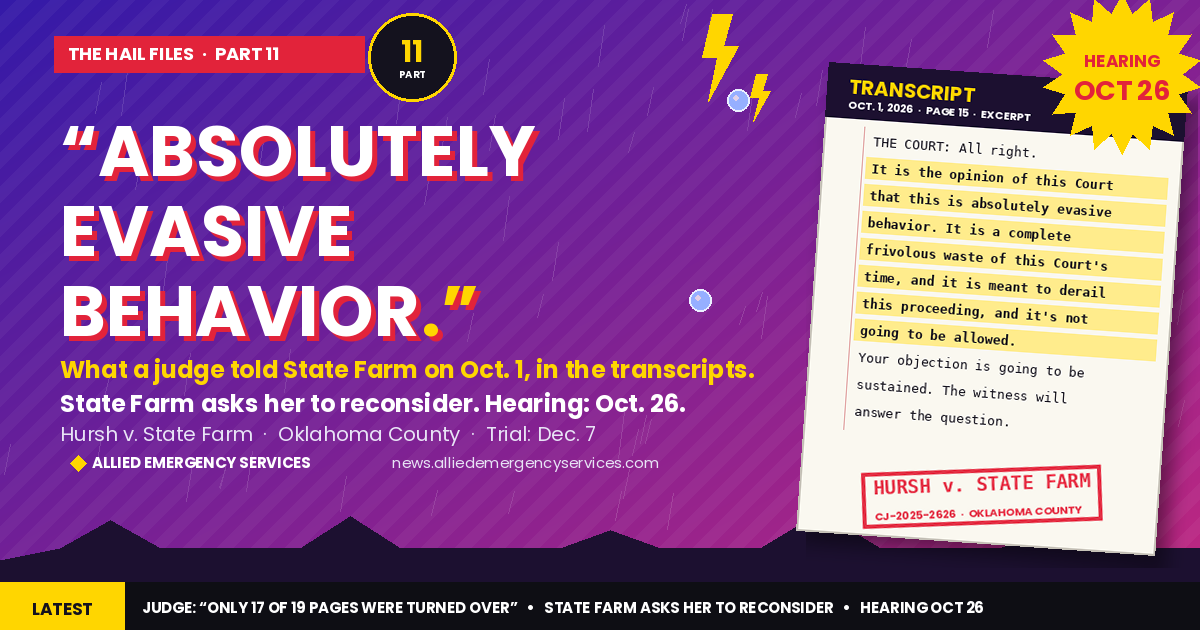
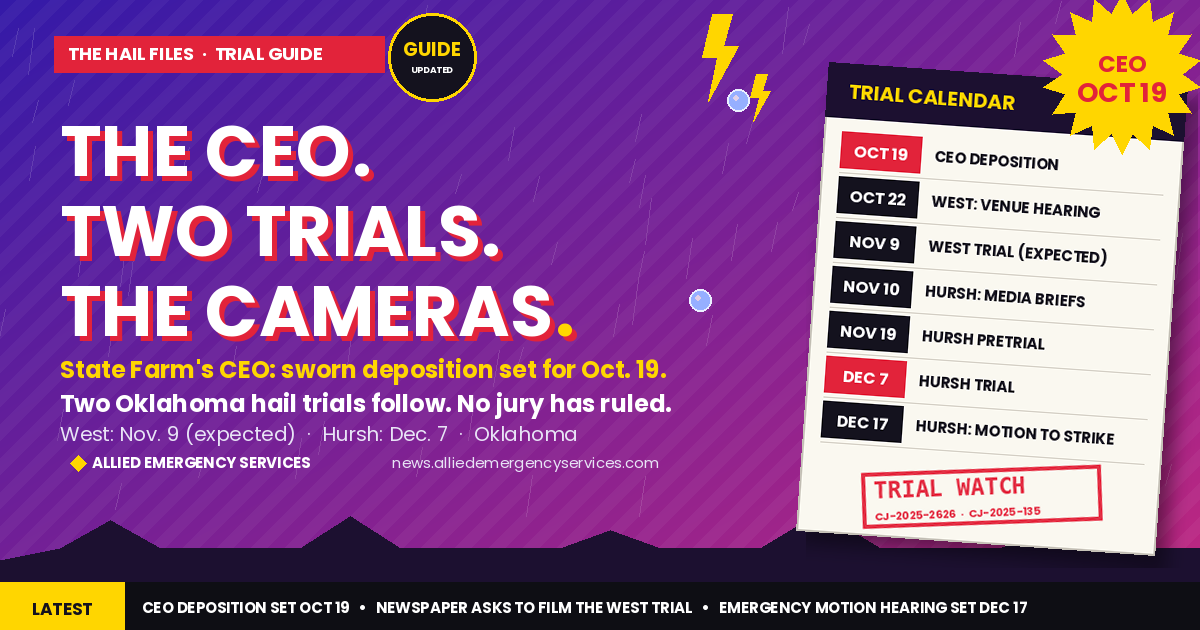
October 26: Two hearings in Oklahoma City the same morning: the Insurance Department’s market hearing at 9 a.m., a proceeding for which the attorney general retained Whitten Burrage under the hourly agreement State Farm filed; and, at 10 a.m. in Hursh, State Farm’s motion asking Judge Palumbo to reconsider and stay her October 1 minute, along with other State Farm motions, which Part 11 covered.
November 3: Election Day. Republican Jon Echols and Democrat Nick Coffey, a former federal prosecutor, are running to succeed Drummond, who lost the August 25 Republican runoff for governor to Mike Mazzei by 2,020 votes; Mazzei won 50.27 percent to 49.73 percent, according to News9.
November 9: Judge Virgin is set to hear State Farm’s motion to disqualify Whitten Burrage as the State’s counsel. Part 6 explains State Farm’s arguments; the court has not ruled.
December 7: The Hursh trial is set to begin in Oklahoma County District Court.
January 2027: Drummond’s term ends, and the attorney general’s office, with both insurance lawsuits, passes to his successor.
Every date is on the Trial Watch calendar, and the trial guide explains the Oklahoma cases.
What is the timeline of Oklahoma’s case against State Farm?
- December 4, 2025: The attorney general moves to intervene in Hursh v. State Farm (Oklahoma County, CJ-2025-2626).
- December 30, 2025: Judge Amy Palumbo allows the intervention.
- January 16, 2026: State Farm asks the Oklahoma Supreme Court for a writ of prohibition (No. PR-123739).
- January 29, 2026: Insurance Commissioner Glen Mulready asks the attorney general to “partner with my office” in Hursh.
- June 23, 2026: The Supreme Court bars the intervention (2026 OK 51).
- June 24, 2026: The attorney general sues State Farm in Cleveland County (CJ-2026-1066).
- July 7, 2026: The attorney general sues Allstate in Cleveland County (CJ-2026-1169).
- July 15, 2026: State Farm moves to dismiss, attaching the Allstate petition.
- August 17, 2026: Judge Natalie Mai rules on the attorney general’s civil investigative demands to State Farm and Farmers.
- August 20, 2026: The State responds to the motion to dismiss.
- September 18, 2026: State Farm moves to disqualify Whitten Burrage.
- September 21, 2026: State Farm files its reply.
- September 28, 2026: Judge Jeff Virgin denies the motion to dismiss, according to press reports.
- October 18, 2026: The motion and its exhibits are added to The Hail Files archive.
- November 9, 2026: Hearing on the motion to disqualify.
What does State Farm say?
State Farm denies wrongdoing. In this case, its position is its motion: that the attorney general lacks the authority to bring the suit and that his claims fail as a matter of law. In an August 24 FOX23 report, State Farm said the attorney general’s lawsuit does not change the facts and that it remains committed to helping customers recover after storms. In an October 1 FOX23 report on executives’ depositions in Hursh, it said that “neither selectively cited documents nor portrayals of testimony from recent depositions change the truth: State Farm evaluates each claim based on the facts of the loss and the coverage purchased and pays the benefits available under the policy.”
What does this mean for Oklahoma homeowners?
Nothing about any individual claim has been decided. The State’s lawsuits ask for court orders that would change how the two insurers handle storm claims, plus civil penalties, restitution and disgorgement; none has been awarded. At its core, the State Farm case has become a contest over power: whether Oklahoma’s attorney general can bring market-wide fraud and racketeering cases against insurers, or whether policing claim practices belongs to the insurance commissioner alone. For a homeowner with a storm claim today, the practical facts are unchanged: a claim is governed by the homeowner’s own policy and the insurer’s decisions under it.
Read the documents
State Farm’s July 15, 2026 motion to dismiss the Attorney General’s petition (78 pages, with the attorney general’s December 2025 Hursh intervention papers as Exhibit 1 and his Allstate petition as Exhibit 2, starting on page 54) · The attorney general’s June 24 petition · The State’s August 20 response · State Farm’s September 21 reply · State Farm’s September 18 motion to disqualify Whitten Burrage and the notice setting it for November 9 · Search the full archive.
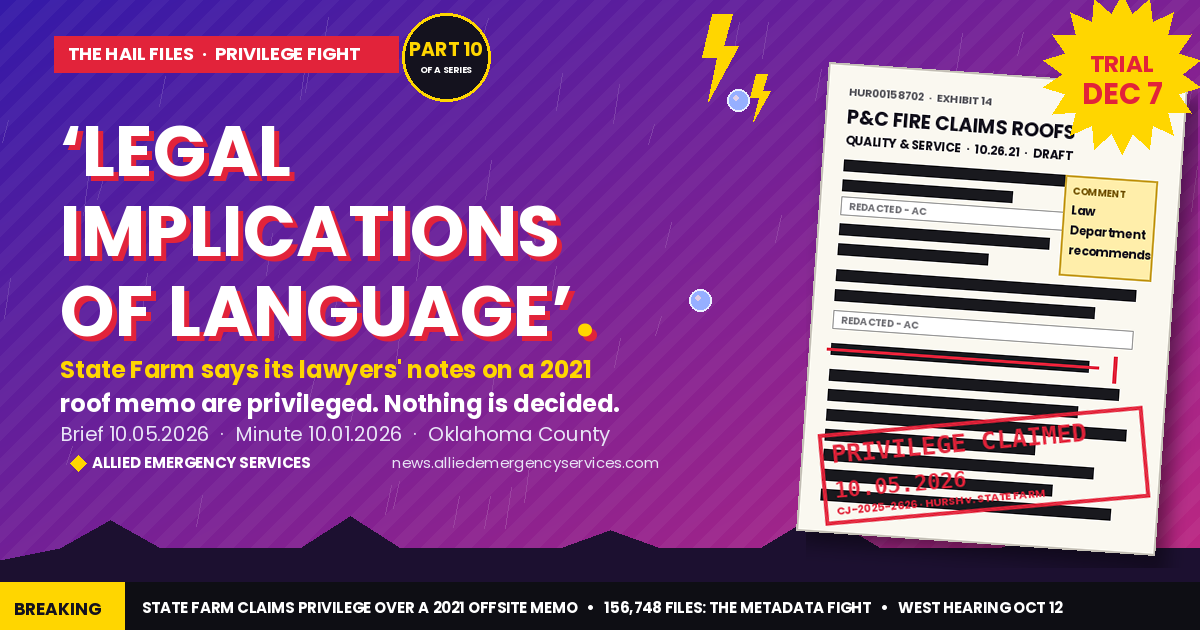
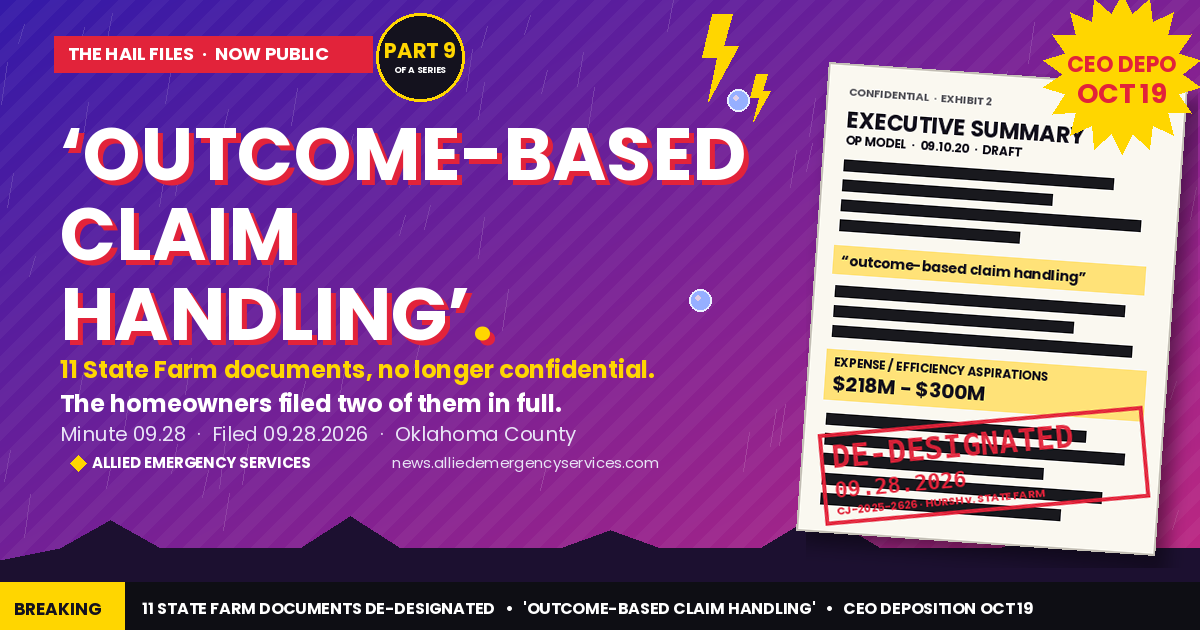
More from The Hail Files: the trial guide · Oklahoma’s Attorney General Takes On State Farm and Allstate · “No One in Oklahoma Can”: The Attorney General’s Answer · “The Denial Enterprise” · Part 4: Two Trials, 800,000 Pages · Part 5: The Accenture Motion · Part 6: State Farm Asks a Judge to Throw the Attorney General’s Lawyers Off the Case · Part 7: State Farm Wants Out of Lawton · Part 8: “A Little Worried” · Part 9: ‘Outcome-Based Claim Handling’ · Part 10: ‘Legal Implications of Language’ · Part 11: ‘Absolutely Evasive Behavior’.
Frequently asked questions
So far, yes. State Farm’s July 15, 2026 motion to dismiss State of Oklahoma ex rel. Drummond v. State Farm Fire and Casualty Company (Cleveland County, CJ-2026-1066) argued that “the Oklahoma Attorney General can’t regulate the business of insurance” because that power “belongs exclusively to the Oklahoma Insurance Commissioner,” and that the Oklahoma Consumer Protection Act does not apply to the business of insurance. District Judge Jeff Virgin denied the motion on September 28, 2026, according to the Property Insurance Coverage Law Blog and A.M. Best, so the case is proceeding; no written order had appeared on the public docket when it was checked October 18. The ruling is not a finding that State Farm did anything wrong, and State Farm denies the allegations.
It is the name used in Oklahoma Attorney General Gentner Drummond’s court filings, which say the program is “commonly referred to” that way, for an internal State Farm program that, he alleges, was designed to reduce roof claim payments in Oklahoma through stricter, undisclosed claim standards. His petitions allege that by 2022 State Farm believed it was approving “too many” roof claims, that adjusters were told they no longer had authority to authorize total roof replacements, and that the company set out to meet “predetermined savings targets down to the dollar.” The petitions also say the program’s “precise internal name, dates of rollout, and written directives are within State Farm’s exclusive possession, custody, and control.” The allegations are unproven, and State Farm denies wrongdoing.
It is the Oklahoma Attorney General’s name for an alleged Allstate program described in his July 7, 2026 lawsuit against Allstate Insurance Company in Cleveland County District Court (CJ-2026-1169). The petition alleges that Allstate used undisclosed, extra-contractual standards “to drastically reduce aggregate indemnity payments in Oklahoma,” replaced some adjuster inspections with visits by unlicensed third-party “picture takers,” with “reviewers” who often denied coverage or ordered estimates revised, and cut estimates below policyholders’ deductibles; in the alternative, it alleges that “Allstate does not issue replacement cost coverage policies in Oklahoma.” Allstate said the lawsuit “has no merit.” The petition is publicly available as Exhibit 2 to State Farm’s July 15, 2026 motion to dismiss the attorney general’s State Farm case.
To argue that the attorney general’s case is part of a broader campaign against insurers. Footnote 5 of State Farm’s July 15, 2026 motion says: “This is an industry-wide effort by the AG. Shortly after filing this suit, the AG filed a similar suit against Allstate, bringing claims under the OCPA, ORICO, civil conspiracy, and unjust enrichment.” The two petitions share much of their wording: in a paragraph-by-paragraph comparison by The Hail Files, more than half of the Allstate petition’s numbered paragraphs match a paragraph of the attorney general’s State Farm petition-in-intervention nearly word for word once the company and program names are swapped.
On June 23, 2026, the Oklahoma Supreme Court issued a writ of prohibition barring enforcement of Oklahoma County District Judge Amy Palumbo’s December 30, 2025 order that had allowed Attorney General Gentner Drummond to intervene in Hursh v. State Farm, a homeowners’ breach-of-contract and bad-faith lawsuit. The court wrote that “the proper recourse could be for the Attorney General to bring his claims in a separate, independent lawsuit” and that State Farm “could fully litigate its remaining arguments at that time before the district court.” Drummond filed a separate lawsuit against State Farm in Cleveland County the next day, June 24, 2026. The decision did not rule on the merits of his claims.
In a January 29, 2026 letter that the State filed with its August 20, 2026 response to State Farm’s motion to dismiss, Mulready wrote, as the State’s brief quotes him: “I request that you, as Oklahoma’s chief legal officer, partner with my office to continue your investigation, intervention, and prosecution in Hursh v. State Farm, et al., CJ-25-2626, in the District Court of Oklahoma County, as well as any appeals or writs related to that action.” The State cited the letter to answer State Farm’s argument that only the insurance commissioner can act against insurers. Separately, in an August 18, 2026 statement, Mulready said his department’s own examination of roof-claim handling had not produced a final report: “I cannot release a final report that does not yet exist.”
Drummond’s term as attorney general ends in January 2027; he lost the August 25, 2026 Republican runoff for governor. The November 3, 2026 election between Republican Jon Echols and Democrat Nick Coffey will decide who leads the attorney general’s office, which is prosecuting both lawsuits, after that. Before then, Cleveland County District Judge Jeff Virgin is scheduled to hear State Farm’s motion to disqualify the State’s outside counsel, Whitten Burrage, on November 9, 2026.
About this report. Except where a news outlet or agency is named, everything above is drawn from public court records: State Farm’s July 15, 2026 motion to dismiss in State of Oklahoma ex rel. Drummond v. State Farm Fire and Casualty Company (Cleveland County No. CJ-2026-1066) and its two exhibits, the attorney general’s December 4, 2025 motion to intervene and proposed petition-in-intervention in Hursh v. State Farm (Oklahoma County No. CJ-2025-2626) and his July 7, 2026 petition against Allstate Insurance Company (Cleveland County No. CJ-2026-1169); the attorney general’s June 24, 2026 petition; the State’s August 20 response, including Commissioner Glen Mulready’s January 29, 2026 letter; State Farm’s September 21 reply, including the transcript of the August 17 proceedings before Judge Natalie Mai and the State’s two July 2026 retention agreements with Whitten Burrage; the docket of CJ-2026-1066 as read October 17 and 18; the Oklahoma Supreme Court’s opinion and docket in No. PR-123739 (2026 OK 51); and, for Hursh, the docket and the October 15 court minute. The Allstate case docket (CJ-2026-1169) was not reviewed for this report. The motion and its exhibits are image scans; quotations from them were checked against the page images. The comparison of the two petitions was made by The Hail Files on the text of the two exhibits, paragraph by paragraph, after replacing the company and program names; a paragraph counts as a match at 90 percent similarity or more. The September 28 ruling is as reported by the Property Insurance Coverage Law Blog (September 29, citing The Journal Record of September 28) and A.M. Best (September 29). The date of the Community Resourcing decision is as reported by Insurance Business (July 2). Allstate’s statement is as reported by KOKH FOX 25 (July 7) and Oklahoma Voice (updated July 8); State Farm’s statements, as reported by FOX23 (August 24 and October 1); Attorney General Drummond’s, from his office’s July 7 and July 27 releases; Commissioner Mulready’s, from the Oklahoma Insurance Department’s December 2025 and August 18, 2026 statements; the October 26 market hearing, from the department’s September 11 notice; and the runoff result and the nominees, as reported by News9 (August 25 and July 10). Allegations in these lawsuits are allegations that State Farm and Allstate deny; nothing described here has been decided unless the report says so.
About the host. Allied Emergency Services is a licensed storm-damage restoration contractor serving Illinois, Wisconsin, Indiana and Michigan — not a law firm, insurance adjuster or public adjuster, and this report is not legal or insurance advice. We inspect, document, provide insurance-ready repair estimates and complete repairs; coverage decisions always belong to you and your insurer. Founded 2015; in the building trades since 1999; Illinois-licensed. 24/7: (800) 792-0212.
⚡ Storm or Roof Damage? Get a FREE Estimate
Text ESTIMATE to (844) 907-2546
Or call (800) 792-0212 for 24/7 emergency response
AI-powered • No obligation • Licensed IL & WI
Storm damage? Start with the documentation
Allied Emergency Services — IL-Licensed Storm Damage Restoration Contractor
Founded 2015, in the building trades since 1999. Allied inspects and documents storm damage, writes the scope and estimate, and does the repairs. We do not adjust or negotiate insurance claims — that is the job of your insurer, a licensed public adjuster, or an attorney. IICRC-certified, EPA Lead-Safe, IL Licensed Roofing Contractor #104.019029. 24/7 emergency response.
How the storm-damage insurance claim process works →Free inspection within 24 hours · No obligation · Photo-documented findings you can share with your insurer
Attorneys: forensic storm damage documentation & construction expert consultation for counsel →