
⚡ Storm or Roof Damage? Get a FREE Estimate
Text ESTIMATE to (844) 907-2546
Or call (800) 792-0212 for 24/7 emergency response
AI-powered • No obligation • Licensed IL & WI
Oklahoma City — October 17, 2026 · The Hail Files, Part 11
What happened, in one sentence: Transcripts of two October 1 hearings in Hursh v. State Farm, made public when State Farm filed them with an October 14 motion, show Oklahoma County Judge Amy Palumbo calling a State Farm witness’s answers “absolutely evasive behavior,” saying she found only 17 of 19 pages in an exhibit State Farm delivered for her private review, and raising the prospect of “severe” sanctions and show-cause hearings, ten weeks before the scheduled trial.
Status: As of the October 17 docket check, no sanctions order or show-cause hearing appears in the docket text. State Farm has asked the judge to reconsider and stay the October 1 minute that came out of those hearings; the homeowners’ response is due October 19, and the motion is set for a hearing October 26. The trial remains set for December 7. The homeowners’ accusations are allegations that State Farm denies, and no jury has decided anything.
Shortly after 11 a.m. on October 1, a lawyer for Billy and Lacy Hursh stopped questioning State Farm’s corporate representative and went to find the judge. The deposition was being taken in Judge Amy Palumbo’s own courtroom, so that the court would have, as the judge put it later that morning, “the immediate ability to weigh in on any issues that may arise in a timely manner to prevent further delay.” The hearing that followed lasted 14 minutes.
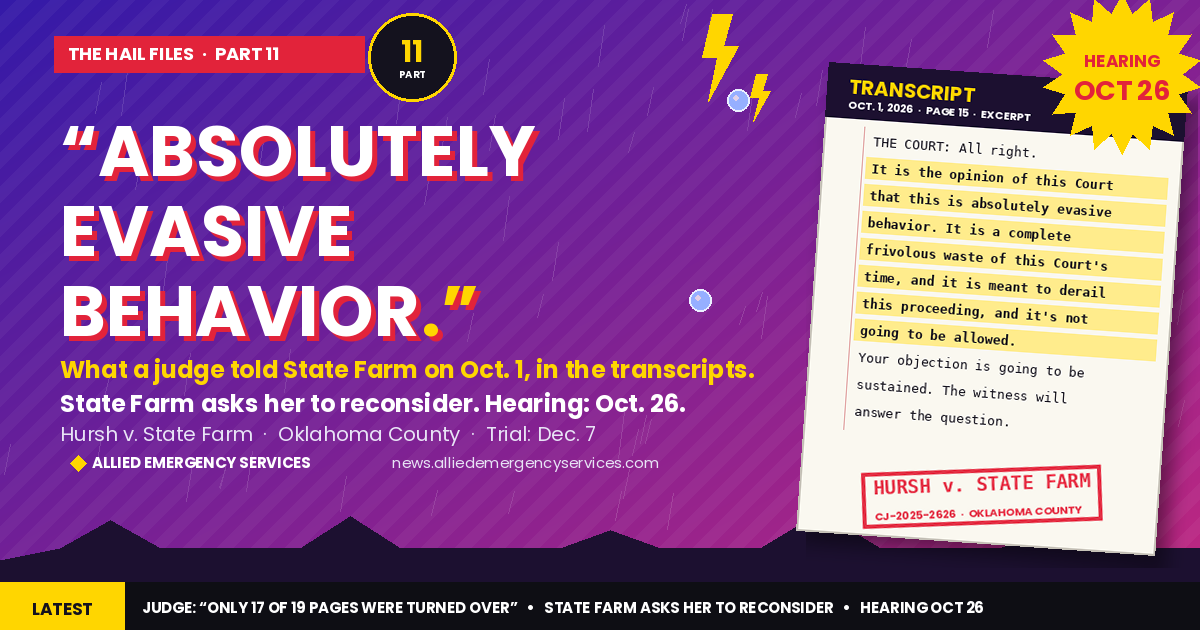
“It is the opinion of this Court that this is absolutely evasive behavior,” the judge said near the end of it, according to the transcript. “It is a complete frivolous waste of this Court’s time, and it is meant to derail this proceeding, and it’s not going to be allowed.” She ordered the witness to answer and found “definitely good cause shown for grounds for this deposition to not be limited to six hours.”
Then she opened a second session on the record and, after remarks on live witnesses, turned to State Farm’s document production. “You’ve been on notice since November 14th of last year to get ready, and I am not happy,” she said. “The order of this Court was full and flawless production. Period.” She described numbering an exhibit State Farm delivered for her private review and discovering “that only 17 of 19 pages were turned over.” Before the session ended, she raised the prospect of “severe” sanctions and of show-cause hearings that would require State Farm to present “viable credible evidence” of why it could not comply, and she said of the December 7 trial date: “I don’t know how we’re going to be ready to do this December 7th.”
Those words are public now because State Farm filed the transcripts of both sessions on October 14, as exhibits to a motion asking Judge Palumbo to reconsider and stay the court minute that came out of them. State Farm says the minute was written by the homeowners’ lawyer, that its statements about the evidence rest on lawyers’ arguments rather than evidence, and that its demand for “full and flawless compliance” imposes “a subjective standard inconsistent with settled law.” The judge has not ruled. A hearing is set for October 26, six weeks before the trial in the lead case among more than 800 Oklahoma hail-claim lawsuits against the company.
What did the judge say about State Farm’s witness?
The first session, a “hearing on responsiveness of deponent’s answers,” began at 11:18 a.m. Hannah Whitten, one of the homeowners’ lawyers, told the judge she was asking the witness, whom State Farm designated to testify for the company on its Fire Model Enhancement, whether a chart in a State Farm document “says what it says in plain English, ‘yes’ or ‘no,’ and I cannot get a ‘yes’ or ‘no.'” She said the problem “has been repeated throughout these depositions.”
State Farm’s lawyer, Lance Leffel, answered that no rule requires one-word answers. He cited a 2006 federal decision from the Northern District of Oklahoma holding, as he quoted it, that “There is no rule requiring a deponent to restrict answers to one-word responses and that deposing counsel cannot misrepresent the rules to force a particular answer to form.” The witness, he said, was “providing her context and her understanding of the document which is what she’s supposed to do as a corporate representative.” The homeowners’ lawyers said she was being “combative” and that Oklahoma’s discovery code does not allow evasive answers.
The judge then asked how many times the witness had been deposed. “Six times,” she answered. How many times had she testified at trial? “Never.” Then came the ruling. “The witness will answer the question,” the judge said, adding that State Farm’s lawyers remained free to follow up. She also said, “I’m not excited about having any extra time take place in some other state,” and, “Just because something is discoverable does not necessarily mean it’s going to be admissible.” The session ended at 11:32 a.m.
State Farm tells it differently in its October 14 motion. It says the homeowners’ questions went “much further” than asking what the chart says: they pressed the witness to accept the lawyers’ characterization of the chart as showing reduced roof payments, which State Farm says it does not show. It says she “properly rejected counsel’s misreading” of the document; that the court reporter, asked to read back the last two questions, mistakenly read the first two and left out the third, so the court “was not presented with an accurate transcript regarding the questions and answers at issue”; and that after the interruption the deposition resumed at 12:49 p.m. and ran until 5:27 p.m., when the court said “it’s time to wrap it up.” State Farm filed the chart itself under seal.
‘I am not happy’: what did the judge say about State Farm’s document production?
The second session began at 11:32 a.m. The judge said the record was “not particularly being made pursuant to any hearing or motion that was set,” but “since I have all parties present, I think it is prudent to do it now.” She said she wanted to discuss “discovery, witnesses, and media,” adding: “we are ten weeks away from today from picking a jury, and that is my focus.”
On discovery, she said: “You’ve been on notice since November 14th of last year to get ready, and I am not happy. The order of this Court was full and flawless production. Period. Instead of compliance, now this Court has to deal with novel issues of white boxing, or whatever you call it, questions regarding the authenticity of the production without metadata, failing to comply with privilege logs, document dumps that are in direct defiance of what the statute requires.” And: “I’m sitting here babysitting depositions.”
She described an exhibit State Farm delivered for her private, in-camera review “unnumbered.” “I have to lay it out side by side, physically go through, number it myself, and I’m the one who discovers that only 17 of 19 pages were turned over,” she said. Her staff, she said, had to send an email “at 2:00 yesterday afternoon to get the missing two pages.” She said there were “way too many cooks in this kitchen,” and, addressing State Farm, said: “stop sending your lawyer in here to argue how difficult this is. Bring in a live person to put on the stand to tell me that. That has not happened.”
Leffel said part of the confusion was that “there were two cover emails,” one of which “appeared in the middle of the document,” and that he was confident State Farm had given the court “everything that was in both documents, redacted and unredacted.” “You did, but here’s my issue,” the judge answered. When Leffel later added that “the two documents that were missing were cover emails,” she replied: “I don’t care. The words of the emails were important enough to show it was redacted. I’m supposed to be looking at what’s redacted.”
She also told Leffel she was “not blaming” him and that he was “clearly doing your very level best on this case.” Her “whole point,” she said, was this: “If it was a priority, it would be done right.” But she allowed that the problems might be innocent: “it’s super plausible that these things are accidents. I don’t know because it’s so rife with issues. If production had been flawless from day one, I 100 percent would have given State Farm the benefit of the doubt and said, ‘Oh, this was just an oversight. They were super busy in a deposition,’ but I think you can see how it could at least possibly not be a great look.” She also allowed that “maybe I misnumbered them differently, or whatever,” adding: “My whole point is: It’s just illustrative of the issues.”
Did the judge threaten State Farm with sanctions?
She raised them without imposing any. After the homeowners’ lawyers argued that State Farm had stripped metadata from its records, and after an exchange over its privilege log, she said: “All parties shall comply. … Get it together and make sure that this case is labeled a priority. Because this is nonsensical and unnecessary and is going to come to a screeching halt. If that landing place is sanctions, there are severe ones that are available to this Court. I went into great detail about some of those things in prior hearings, and I will not hesitate to apply them if I feel they are warranted.”
State Farm’s October 14 motion says it “has endeavored to respond to Plaintiffs’ discovery requests in good faith and to comply with this Court’s orders to the best of its ability,” that “it is impossible—especially when producing hundreds of thousands of documents—to avoid unintentional missteps,” and that the minute’s insistence on “full and flawless” production threatens to “encourage Plaintiffs to seek unmerited sanctions for every one of State Farm’s alleged missteps.”
Later she floated a middle step: “Maybe a nice way to solve this is just set hearings that are show cause hearings to actually require State Farm to present to this Court viable credible evidence as to why they are unable to comply with the orders of this Court. Maybe that’s a step before visiting sanctions. These are not things I want to do. I love this case. I love all the lawyers involved.”
She explained why the stakes reach beyond one house: “I’m also under the impression, unless something’s changed, that many — that there are literally hundreds of other cases across this state with my colleagues that are essentially on ice waiting the determination of what happens here, which means there’s a lot of Oklahomans who are in a holding pattern until this can be determined. So it is of paramount importance. And unless somebody gets on the stand and convinces me otherwise, that is where we’re heading.”
As of the October 17 docket check, no show-cause hearing or sanctions order appears in the docket text. The court minute from that day says the court “ordered full and flawless compliance with production” and “has been presented with evidence of white box redactions, no meta data, no privilege log, and others.”
Is the December 7 trial date still on?
For now. An agreed amended scheduling order entered September 22 sets a seven-day jury trial to begin December 7, 2026, and nothing in the docket text as of October 17 changes it. The same order requires all motions to be set and heard before the November 19 pretrial conference. But at the end of her prepared remarks on October 1, the judge said: “I’m getting ready to try this case, and it appears that we’re still quite in the thick of things, so I don’t know how we’re going to be ready to do this December 7th.”
What did the homeowners’ lawyers tell the judge?
Their accusations went further than the judge’s. Reggie Whitten told her the homeowners had “reason to at least suspect that there’s metadata that’s showing what’s behind the curtain,” and then: “They scrubbed it is what our experts tell us. The metadata has been scrubbed.” He added, “we don’t have a final opinion on that. That’s why we want to look at it.” Of the disputed memo the court was reviewing in camera, he said: “that is a very important dagger in the heart of State Farm.” Blake Sonne, another of the homeowners’ lawyers, said that State Farm’s positions turned out to be “misleading after misleading after misleading after misleading,” and that “there’s never been a privilege log produced.”
Leffel answered: “That’s actually inaccurate. We produced a privilege log that was over 200 pages last month.” Hannah Whitten replied that the log was “incomplete and deficient.” Leffel said he had first heard of the metadata claim that Monday and had not yet had a chance to look into it. Reggie Whitten, for his part, told the judge that the State Farm witness’s “level of cooperation today is far better than last time.”
On metadata, the judge was candid: “I’ve got to be honest, I don’t even know what metadata is. Okay? I’m like the least tech savvy person on earth.” She said she would “defer that metadata issue” for the exhibit under her in-camera review until State Farm had filed its written response and a hearing was held, and that everything else on the homeowners’ list would have “a real quick turnaround time, because as far as I’m concerned, every single thing is already late.”
On publicity, some of her words were aimed at the homeowners’ side. She noted that the defense had voiced concern that the case was, in her paraphrase, “basically being tried in the press,” mentioned a plaintiffs’ brief with “a pretty spicy title,” and said, with the trial approaching: “The hardest jury I ever sat is a death penalty. I don’t want this insurance case to be tantamount to that.” One idea she offered: “maybe it would be prudent for the Court to put up some guardrails now and then televise this trial with full transparency.”
How is State Farm fighting the October 1 minute?
In its October 14 motion, State Farm asks Judge Palumbo to reconsider the minute and to stay it until the motion is decided and State Farm “has exhausted its remedies for review by appellate courts.” It challenges three parts: the extension of its corporate representative’s deposition “for an undefined period ‘beyond 6 hours,'” which it says no good cause supports; the order of “full and flawless compliance with production,” which it calls “a subjective standard inconsistent with settled law” and says threatens to “institute an improper ‘strict liability’ standard”; and the statement that the court had been “presented with evidence” of white box redactions, missing metadata and no privilege log, which it says rests on “unproven arguments by Plaintiffs’ counsel.”
It says Hannah Whitten wrote the minute and presented it to the court “without allowing State Farm’s counsel to review it,” even though it contained a “no privilege log” statement that the homeowners’ lawyers had already retracted, and that the court had “acknowledged an absence of knowledge about metadata.” The transcript State Farm attached shows Whitten telling the judge, “I did prepare a minute order,” and the judge reading it aloud in court and adding “within 40 days”; the text she read included that the deposition “may extend beyond six hours, as needed, per this Court.” The minute bears signatures for the homeowners, State Farm and the court.
State Farm says another session with its corporate representative “will necessarily disrupt State Farm’s business operations and impose undue time, cost, and burden on State Farm that is disproportionate to this case,” and it notes that the Oklahoma Supreme Court has granted it stays before, including an October 2025 order staying a discovery order of Judge Palumbo’s while State Farm sought a writ. Read the motion and both transcripts.
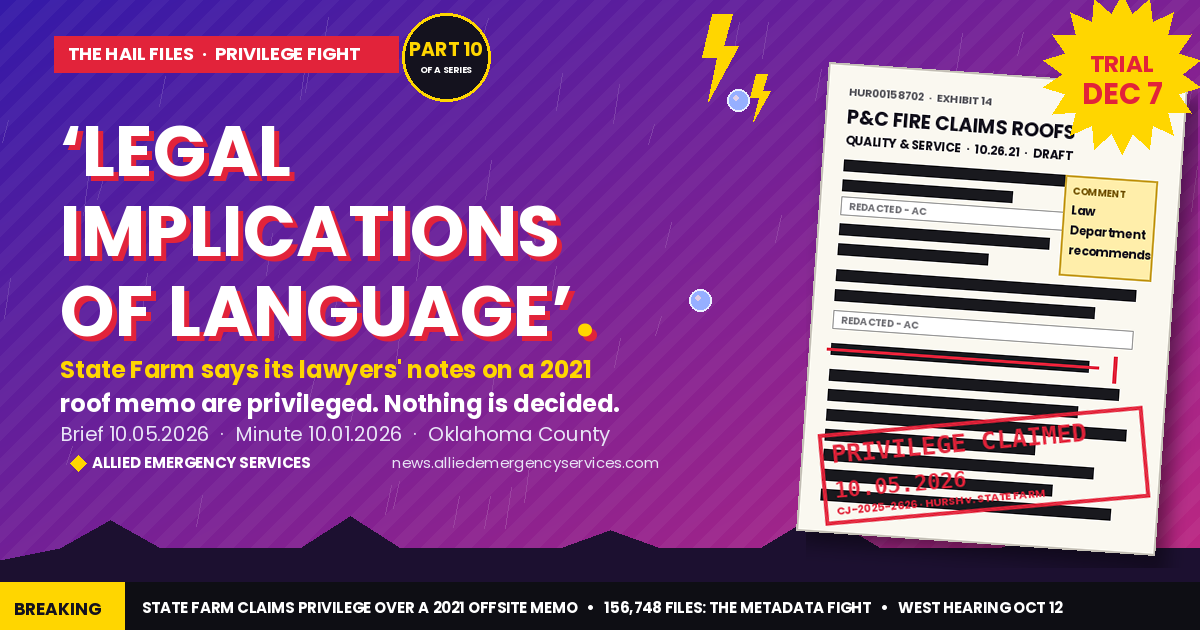
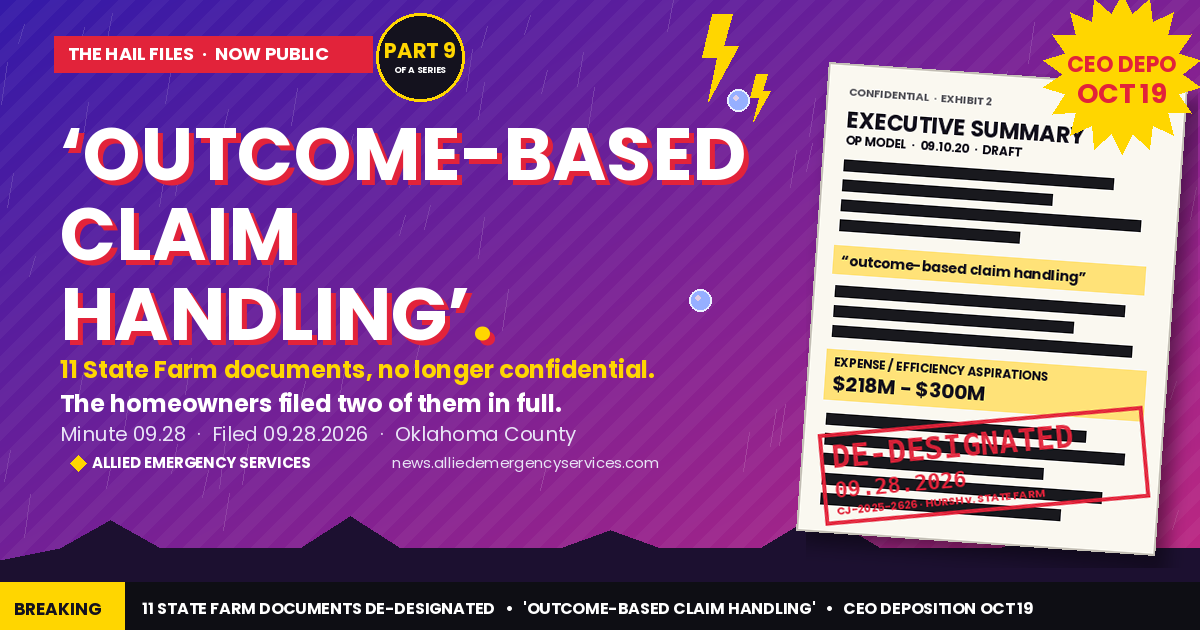
A second motion filed the same day asks the judge to restore confidentiality to pages 3 through 21 of one of the 11 State Farm documents she ordered de-designated on September 28. State Farm says those pages contain “detailed, relatively recent reinspection data and trends and forward-looking strategic information and reports prepared in mid-2025 that would cause competitive harm if disclosed today.” Read that motion.
What is State Farm asking the judge to decide before trial?
On October 15, the deadline for dispositive motions, State Farm moved for partial summary judgment on the homeowners’ claims for bad faith, punitive damages and constructive fraud or negligent misrepresentation. It does not seek judgment on their breach-of-contract claim; it says discovery has shown that their petition “reduces to a weak breach of contract claim about the extent of hail damage.” It says its inspector was on the roof within four days of the claim, that State Farm determined the cost to repair the storm damage fell below the homeowners’ deductible, and that under Oklahoma law a bad-faith claim cannot stand where there is a legitimate dispute. Citing the homeowners’ own account of what roofers told them, it argues: “A ’50/50 chance’ is the definition of a legitimate dispute—it could go either way.”
State Farm also argues that the homeowners’ theory of a corporate scheme to deny roof replacements is “untethered” to their loss under the law of the case, citing the Oklahoma Supreme Court’s June 23 opinion that blocked the Attorney General’s intervention in the lawsuit (2026 OK 51), which it says bars litigating corporate “issues untethered to the Hurshes’ actual loss.” The co-defendant State Farm agent and his agency filed their own summary-judgment motion, arguing that the homeowners received the replacement-cost policy they asked for and that State Farm, not the agency, decided both of their claims. These are the defendants’ arguments; the homeowners had not responded as of October 17. State Farm’s motion says the homeowners themselves are to be deposed October 22 and 23.
Neither summary-judgment motion is hosted in The Hail Files archive, because their exhibits include the homeowners’ personal and financial records.
What happens next?
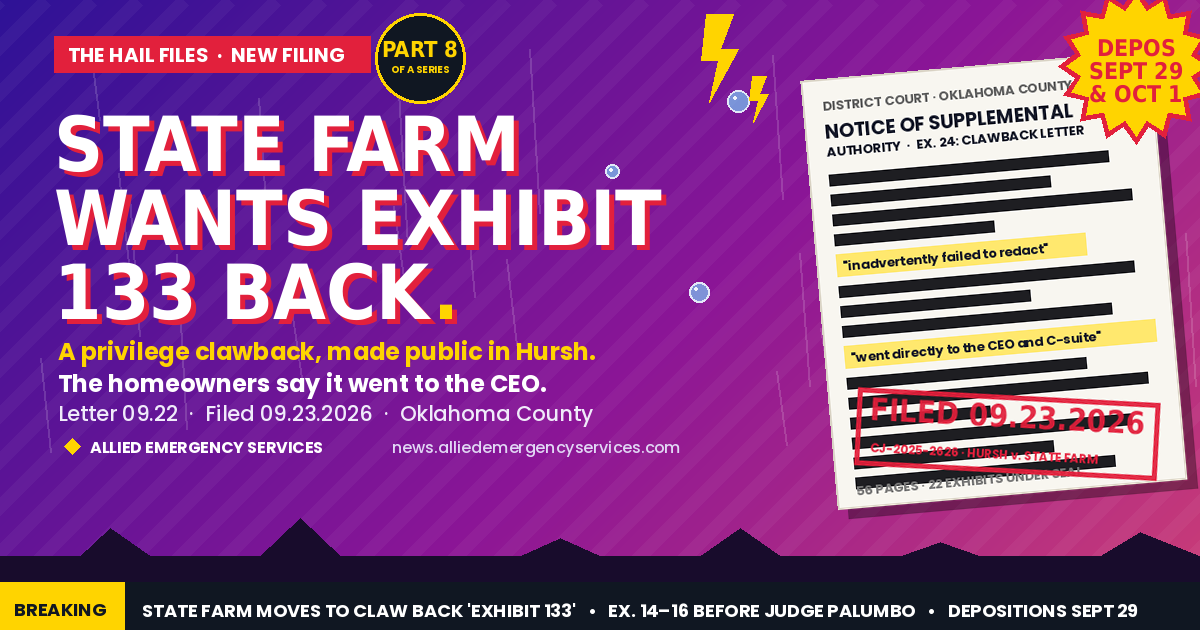
An October 15 court minute gives the homeowners until October 19 to respond to “State Farm’s motion to Reconsider or stay and emergency motions,” gives State Farm until noon October 23 to reply, and says: “These motions are set October 26, 2026 at 10 a.m.” It refers to an attached October 15 email that is not part of the filed copy. Read the minute. The minute does not say whether a December 17 hearing date State Farm had noticed for its emergency motion to strike the homeowners’ metadata supplement still stands.
Also ahead: CEO Jon Farney’s deposition, one session for Hursh and the companion West case, to be completed October 19 under an agreed order unless the parties agree on another date; the West pretrial conference and venue hearing in Comanche County on October 22; motions in limine November 1; challenges to expert witnesses and the parties’ briefs on media coverage November 10; the Hursh pretrial conference November 19; and the trial, set for December 7. Every date is on the Trial Watch calendar, and the trial guide explains all three Oklahoma cases.
What does State Farm say?
State Farm denies the homeowners’ allegations. Asked about the discovery disputes in Hursh, it told KOKH FOX 25 that “the characterizations by the plaintiffs’ attorneys are false.” It told FOX23, in an October 1 report on the executives’ depositions, that “neither selectively cited documents nor portrayals of testimony from recent depositions change the truth: State Farm evaluates each claim based on the facts of the loss and the coverage purchased and pays the benefits available under the policy.” In court, it says the October 1 minute overstates the record and should be reconsidered and stayed, that the homeowners’ bad-faith, punitive-damages and fraud claims should be decided in its favor before trial, and that the disputed memo passages are privileged.
What does this mean for Oklahoma homeowners?
The judge said she was “under the impression” that hundreds of other cases are “essentially on ice” waiting on this one. Nothing about any homeowner’s claim has been decided by these hearings. The transcripts record the judge saying she is “not happy” with discovery in this case; they are not findings that State Farm acted in bad faith, and State Farm disputes the homeowners’ allegations. For policyholders with their own storm claims, the practical facts are unchanged: a policyholder’s own claim is governed by their own policy and their own insurer’s decisions.
Read the documents
State Farm’s October 14 motion to reconsider and stay the October 1 minute (with the transcripts of both October 1 sessions) · The October 1 court minute · The October 15 court minute · State Farm’s October 14 motion on a de-designated exhibit · State Farm’s October 9 emergency motion to strike and its notice of hearing · The October 9 agreed order for the CEO’s deposition · Search the full archive.
More from The Hail Files: the trial guide · “The Denial Enterprise” · Part 4: Two Trials, 800,000 Pages · Part 5: The Accenture Motion · Part 6: State Farm Asks a Judge to Throw the Attorney General’s Lawyers Off the Case · Part 7: State Farm Wants Out of Lawton · Part 8: “A Little Worried” · Part 9: ‘Outcome-Based Claim Handling’ · Part 10: ‘Legal Implications of Language’.
Frequently asked questions
According to transcripts State Farm filed on October 14, 2026, Oklahoma County Judge Amy Palumbo said of a State Farm corporate representative’s answers at an October 1 courtroom deposition: “It is the opinion of this Court that this is absolutely evasive behavior. It is a complete frivolous waste of this Court’s time, and it is meant to derail this proceeding, and it’s not going to be allowed.” In a second session that day she said, “I am not happy,” described finding that “only 17 of 19 pages were turned over” in an exhibit delivered for her private review, and said that “if that landing place is sanctions, there are severe ones that are available to this Court.” State Farm disputes the homeowners’ allegations and has asked the judge to reconsider the October 1 minute.
No sanctions order appears in the docket text as of the October 17, 2026 docket check. At the October 1 hearings, Judge Amy Palumbo said severe sanctions “are available to this Court” and that she “will not hesitate to apply them if I feel they are warranted,” and she floated show-cause hearings requiring State Farm to present “viable credible evidence as to why they are unable to comply with the orders of this Court,” calling that possibly “a step before visiting sanctions.”
The handwritten minute is signed by the court and by lawyers for both sides. State Farm’s October 14, 2026 motion says the homeowners’ lawyer Hannah Whitten wrote it and presented it without letting State Farm’s counsel review it. The hearing transcript shows Whitten telling the judge, “I did prepare a minute order,” and the judge reading it aloud in court and adding “within 40 days.”
State Farm says the minute extends its corporate representative’s deposition “for an undefined period ‘beyond 6 hours'” without good cause, that its order of “full and flawless compliance with production” is “a subjective standard inconsistent with settled law,” and that its statement that the court was presented with evidence of white box redactions, missing metadata and no privilege log rests on “unproven arguments by Plaintiffs’ counsel.” It asks the judge to stay the minute until the motion is decided and it has exhausted its appellate remedies. The motion is set for a hearing October 26, 2026.
Yes, as of the October 17, 2026 docket check. An agreed amended scheduling order entered September 22, 2026 sets a seven-day jury trial to begin December 7, 2026, before Judge Amy Palumbo in Oklahoma County District Court. At the October 1 hearing the judge said: “I don’t know how we’re going to be ready to do this December 7th.” The pretrial conference is November 19, 2026.
An October 15, 2026 court minute says State Farm’s “motion to Reconsider or stay and emergency motions” are “set October 26, 2026 at 10 a.m.,” with the homeowners’ responses due October 19 and State Farm’s replies due by noon October 23. State Farm’s October 14 motion asks Judge Amy Palumbo to reconsider and stay the October 1 minute, including its extension of State Farm’s corporate representative’s deposition and its order of “full and flawless compliance with production.” The minute does not list the emergency motions by name.
Yes, in part. On October 15, 2026, State Farm moved for partial summary judgment on the homeowners’ claims for bad faith, punitive damages and constructive fraud or negligent misrepresentation, but not on their breach-of-contract claim, which it calls “a weak breach of contract claim about the extent of hail damage.” The co-defendant State Farm agent and his agency filed their own summary-judgment motion. The homeowners had not responded as of the October 17 docket check.
About this report. Except where a news outlet is named, everything above is drawn from public court records in Oklahoma County No. CJ-2025-2626: State Farm’s October 14 motion to reconsider and stay the October 1 minute order and its exhibits, including the certified transcripts of the October 1 “hearing on responsiveness of deponent’s answers” and “pretrial record regarding discovery, witnesses, and media”; State Farm’s October 14 motion to partially reconsider the September 28 de-designation order; State Farm’s and the co-defendant agent’s October 15 summary-judgment motions; the October 1 and October 15 court minutes (transcribed from images of the handwritten originals); the September 22 agreed amended scheduling order; the October 9 agreed order on Jon Farney’s deposition; State Farm’s October 9 emergency motion to strike and October 12 notice of hearing; and the docket as read October 17. Quotations from the hearings are from the court reporter’s transcripts as State Farm filed them, checked against the page images. The statements to KOKH FOX 25 (October 5) and FOX23 (October 1) are as those stations reported. Where the report describes what the homeowners’ lawyers say, those are their characterizations; where it describes State Farm’s positions, it quotes its filings and statements. Nothing described here has been ruled on unless the report says so. Allegations in the underlying lawsuit are allegations that State Farm disputes.
About the host. Allied Emergency Services is a licensed storm-damage restoration contractor serving Illinois, Wisconsin, Indiana and Michigan — not a law firm, insurance adjuster or public adjuster, and this report is not legal or insurance advice. We inspect, document, provide insurance-ready repair estimates and complete repairs; coverage decisions always belong to you and your insurer. Founded 2015; in the building trades since 1999; Illinois-licensed. 24/7: (800) 792-0212.
⚡ Storm or Roof Damage? Get a FREE Estimate
Text ESTIMATE to (844) 907-2546
Or call (800) 792-0212 for 24/7 emergency response
AI-powered • No obligation • Licensed IL & WI
Storm damage? Start with the documentation
Allied Emergency Services — IL-Licensed Storm Damage Restoration Contractor
Founded 2015, in the building trades since 1999. Allied inspects and documents storm damage, writes the scope and estimate, and does the repairs. We do not adjust or negotiate insurance claims — that is the job of your insurer, a licensed public adjuster, or an attorney. IICRC-certified, EPA Lead-Safe, IL Licensed Roofing Contractor #104.019029. 24/7 emergency response.
How the storm-damage insurance claim process works →Free inspection within 24 hours · No obligation · Photo-documented findings you can share with your insurer
Attorneys: forensic storm damage documentation & construction expert consultation for counsel →