⚡ Storm or Roof Damage? Get a FREE Estimate
Text ESTIMATE to (844) 907-2546
Or call (800) 792-0212 for 24/7 emergency response
AI-powered • No obligation • Licensed IL & WI
Cleveland County, Oklahoma — September 23, 2026
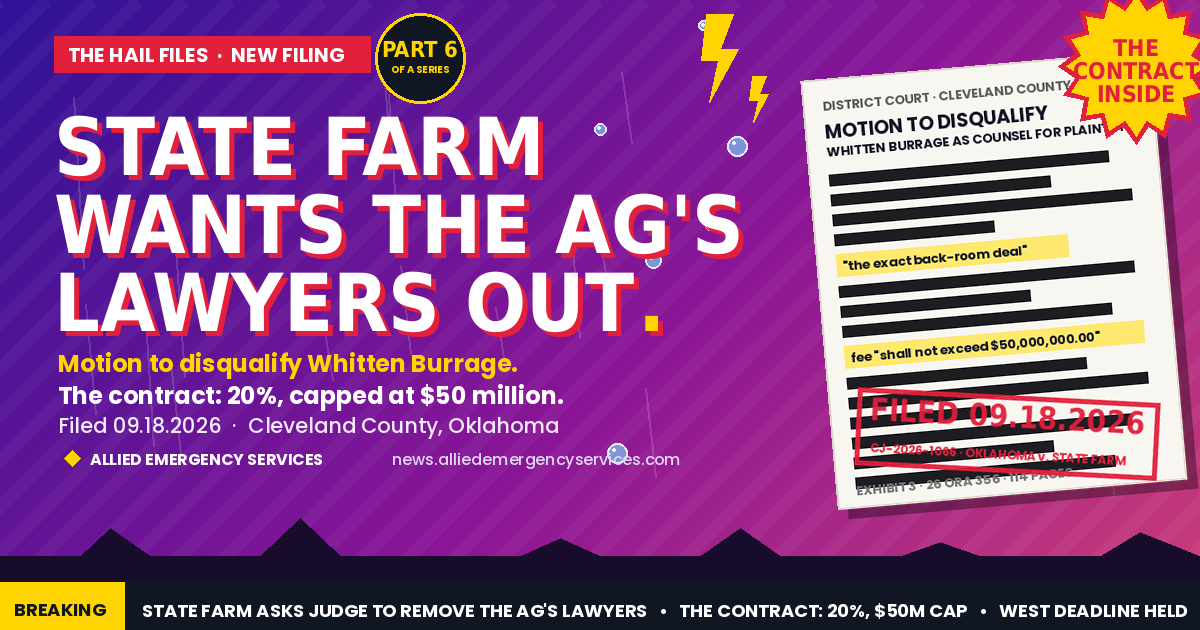
What happened, in one sentence: On September 18, 2026, State Farm Fire and Casualty Company asked the Cleveland County District Court to disqualify Whitten Burrage as counsel for the State of Oklahoma in the Attorney General’s lawsuit against it, arguing that a firm with hundreds of contingency-fee cases against State Farm cannot constitutionally prosecute the State’s “quasi-criminal” racketeering claim, that the State’s contract with the firm was never publicly posted as Oklahoma law requires, and that Oklahoma’s racketeering statute limits who may bring such a claim — and it attached the contract itself to the public record.
Status: The Attorney General and Whitten Burrage have not yet responded on the docket. No hearing on the motion has been set. Nothing has been ruled on. The full 114-page filing is hosted in the Hail Files archive.
At 4:28 on a Friday afternoon, ten days before a judge is scheduled to hear State Farm’s motion to dismiss the Oklahoma Attorney General’s lawsuit against it, State Farm filed a second motion in the same case. This one does not ask the court to throw out the case. It asks the court to throw out the State’s lawyers.
The target is Whitten Burrage, the Oklahoma City firm that leads Hursh v. State Farm, West v. State Farm, and, by counts reported across the Oklahoma press, more than 800 hail-claim lawsuits against State Farm statewide. Since August 5, the same firm has also appeared as outside counsel for Attorney General Gentner Drummond in State of Oklahoma ex rel. Drummond v. State Farm Fire and Casualty Company, CJ-2026-1066, the lawsuit — with a racketeering count at its center — that the AG filed on June 24.
State Farm’s 18-page motion, signed by Lance E. Leffel and David R. Herber of GableGotwals, calls that arrangement “a textbook example of the arrangements the State’s conflicts of interest rules are designed to prohibit.” Its most quotable line borrows the Attorney General’s own words from 2023, when Drummond condemned an earlier state contract with the same firm: State Farm says the AG’s retention of Whitten Burrage “is the exact back-room deal he sought publicly to eliminate.”
Those are State Farm’s arguments. Whitten Burrage and the Attorney General’s office have not answered them on the docket, and a court has not weighed any of it. But the motion — and, more than the motion, its 95 pages of exhibits — put documents on the public record that were not there before. Here is what the filing says, what it attaches, and what happens next.
Key facts
| Filing | Motion to Disqualify Whitten Burrage as Counsel for Plaintiff |
| Case | State of Oklahoma ex rel. Gentner Drummond, Attorney General v. State Farm Fire and Casualty Company, No. CJ-2026-1066, District Court of Cleveland County, Oklahoma |
| Filed | September 18, 2026, 4:28 p.m. (OSCN document #1066867563) |
| Filed by | State Farm Fire and Casualty Company, through Lance E. Leffel and David R. Herber, GableGotwals, Oklahoma City |
| Length | 114 pages: an 18-page motion, certificate of service, and three exhibits |
| What it asks | That the court disqualify Whitten Burrage from representing the State of Oklahoma in the case |
| Response | None yet on the docket from the Attorney General or Whitten Burrage; no hearing set |
| Next date in the case | September 28, 2026 — hearing on State Farm’s separate motion to dismiss |
| Documents | Motion and exhibits (searchable) · The AG’s petition · OSCN docket |
What is State Farm asking the court to do?
Disqualify the firm — remove Whitten Burrage as the State’s lawyers in this case. The motion does not seek dismissal of the Attorney General’s lawsuit (a separate State Farm motion, filed earlier, does that, and is set for hearing September 28). It seeks to strip the State of the outside counsel it hired to run the case.
State Farm frames the request as a sequel. In State Farm Fire & Casualty Co. v. Palumbo, 2026 OK 51, the Oklahoma Supreme Court held that the Attorney General could not intervene in Hursh, the private case Whitten Burrage filed, because the State’s broad interests belonged “in the correct forum” — its own lawsuit. The AG then filed his own lawsuit and hired Whitten Burrage to run it. State Farm’s motion calls that “simply reversing roles,” and says the AG “has now unlawfully granted the private law firm that filed the contract dispute the powers and weight of the State’s chief legal officer to prosecute this quasi-criminal action against the same defendant.”
Why does State Farm say Whitten Burrage can’t prosecute the State’s case?
The first and longest argument is constitutional. The Attorney General’s petition includes a claim under Oklahoma’s racketeering statute, ORICO. State Farm’s motion argues that to prove it, the AG “will have to establish that State Farm committed two or more enumerated felonies,” which makes the suit “quasi-criminal” — a label the Oklahoma Supreme Court itself used in Palumbo. State Farm says it “vehemently denies the validity of any such claim.”
From there the motion reaches for a line of U.S. Supreme Court cases about who may wield prosecutorial power. In Young v. United States ex rel. Vuitton et Fils (1987), the Court set what State Farm calls “a categorical rule against the appointment of an interested prosecutor.” In Marshall v. Jerrico (1980), it warned that “a scheme injecting a personal interest, financial or otherwise, into the enforcement process may bring irrelevant or impermissible factors into the prosecutorial decision.” A prosecutor, the motion quotes from Berger v. United States (1935), represents “a sovereignty whose obligation to govern impartially is as compelling as its obligation to govern at all.”
Whitten Burrage, State Farm argues, is the opposite of disinterested: it “currently has numerous other pending contingency fee cases against State Farm,” and prosecuting the State’s racketeering claim would “lend credence to their plaintiffs’ lawsuits, for which they have a significant financial interest.” The motion quotes Reggie Whitten’s September 1 op-ed in The Journal Record — “[They] have a stake in this fight” — as an admission, and concludes: “Whitten Burrage’s incentive here is not justice, it is to continue the case irrespective of its merit and thus increase their chances of victory (and payment) in their private cases, which would increase cost pressures on premiums for families statewide.”
That is State Farm’s characterization. Whitten Burrage has not responded to it on the docket.
The “sunshine law” argument: a contract the public was never shown
The second argument is about disclosure, and it is where the filing turns from law-review material into documents.
In 2021 the Oklahoma Legislature passed Senate Bill 984, now 74 O.S. § 20i, to govern how the State hires private lawyers. As State Farm summarizes it, the law caps contingency fees on a sliding scale, requires government attorneys to retain control of the case, requires a request for proposals from at least three firms when a matter is expected to cost more than $1 million, and requires that any contingency-fee contract “shall be posted on the Attorney General’s website for public inspection within five (5) business days after the date the contract is executed.”
Whitten Burrage entered its appearance in the AG’s case on August 5, 2026. “As of this filing,” the motion says, “the AG’s office has posted nothing related to the retention of Whitten Burrage.” State Farm says it learned the contract exists the hard way: GableGotwals filed an Open Records Act request on August 25 (Request No. 26-356) for every agreement between the State and Whitten Burrage since November 2025, and the Attorney General’s office produced the documents on September 11. “The five-business-day posting deadline has long since expired,” the motion says. “Given the engagement letter exists and is readily available, there is no justification for the AG’s failure to comply with public disclosure requirements.” State Farm’s conclusion: the failure “renders the agreement illegal, and therefore, void.”
Then the motion does something the AG’s website, by State Farm’s account, had not: it attaches the contracts as Exhibit 3. So the contract Oklahoma taxpayers had not been shown is now in the public court file — and in the archive.
What the contract says
Exhibit 3 contains three agreements, all produced by the Attorney General’s office in response to the open-records request and Bates-stamped “26 ORA 356.”
The one that matters here is a 14-page “Contract for Legal Services — Contingency-Fee Based,” effective July 31, 2026, between the Office of the Attorney General and Whitten Burrage, LLP — four days before the firm’s appearance in the case. Its Appendix A describes the engagement as assisting the Attorney General “in the Investigation and litigation into State Farm’s Insurance Company’s Storm Claims Handling Practices Defrauding Oklahoman Insureds,” including investigative planning, civil investigative demands, witness and corporate discovery of “current and former State Farm personnel, affiliated-company personnel, adjusters, reviewers, vendors, engineers, inspectors,” claims-data and damages analysis, and trial preparation. Appendix B sets the fee:
- 20 percent of any recovery under $10 million;
- plus 16 percent of the amount between $10 million and $15 million;
- plus 12 percent between $15 million and $20 million;
- plus 8 percent between $20 million and $25 million;
- plus 4 percent of anything above $25 million;
- with a hard ceiling: “the total contingency fee payable shall not exceed $50,000,000.00.”
The firm “shall receive no compensation or cost reimbursement if there is no recovery,” and the Attorney General “retains exclusive authority over settlement and the course of the litigation.” By our arithmetic on the document’s own schedule, the $50 million ceiling is reached only if the State recovers roughly $1.2 billion.
Two things in the contract cut the other way from State Farm’s argument, and readers should see them. The document recites that Whitten Burrage “is on the list of private attorneys under 74 O.S.2021, § 20i and that Law Firm has met the requirements for being retained as private counsel under section 20i,” and that the Attorney General “determined that Law Firm’s proposal provided the State is the most economical and most competent.” In other words, the contract is written to the statute State Farm invokes. State Farm’s complaint is not that the contract ignores § 20i; it is that the contract was never posted and, State Farm argues, never put out for competing proposals. Whether that makes the engagement void is a question for the court.
The other two agreements concern a different matter: a proceeding before the Oklahoma Insurance Commissioner, Case No. 26-0820-TRN, on “Whether the Oklahoma Homeowners Insurance Market is Noncompetitive.” There, the AG retained the same firm on an hourly basis — $350 an hour for Reggie Whitten and Michael Burrage, $285 for associates, $75 for legal assistants — under a two-page fee agreement dated July 2026 and a 14-page contract effective July 28. One line in that hourly contract will catch any careful reader: total fees “shall not exceed the total sum of seventy-five thousand dollars ($200,000.00).” The words say one number and the figures say another. We report it as written.
The campaign-money angle
State Farm’s motion does not stop at the statute. It points to money in politics, and it does so by quoting the Attorney General against himself.
In a February 14, 2023 letter to Michael Burrage and Reggie Whitten — written when Drummond had just taken office and was reviewing his predecessor’s contract with the firm in the State’s opioid litigation — the AG called that contract “objectionable,” a “back-room deal,” and “a lucrative no-bid, no-cap contract” that “was executed mere weeks after [the partners] and [their] spouses donated the maximum legal amount to the campaign of the man who signed the Contract.” He wrote: “This Contract, and the profit it allows you to amass, undermines the duties I must uphold as Attorney General, and I will not tolerate such agreements.” The letter is public; State Farm cites the copy NonDoc published.
Now, State Farm says, the same firm’s lawyers “again donated the maximum amount allowable by law, mere weeks before AG Drummond engaged them on this matter” — citing KFOR’s August 20, 2026 report, whose headline was “Lawyers Suing State Farm Donated to Drummond, State Farm Agents Donated to Mazzei.” The motion also notes Michael Burrage’s August 17 guest column in the McAlester News-Capital endorsing Drummond in the governor’s race. State Farm’s line: “The Court should hold AG Drummond to his principles.”
Two cautions belong here. Political contributions within legal limits are lawful, and the KFOR headline State Farm cites records donations flowing to both sides of the governor’s race — from lawyers suing State Farm to Drummond, and from State Farm agents to his opponent. The motion presents the contributions as context for its disclosure argument, not as a claim of illegality, and this report does the same.
The confidentiality argument
The third argument is narrower. Under 74 O.S. § 1404, “no person shall institute any proceedings, civil or criminal” under ORICO “except the Attorney General, any district attorney” or an appointed district attorney. Records subpoenaed in an ORICO investigation, under 22 O.S. § 1415(B), may not be examined by anyone “other than another law enforcement official” without the producing party’s consent. State Farm argues that a private firm running the State’s ORICO case “would otherwise be prohibited under Oklahoma law from seeing, obtaining, or otherwise having access to the investigatory file,” and that the arrangement would expose not only State Farm’s records but those of “third parties that may be subject to a subpoena.”
What State Farm attached — and the irony of Exhibit 1
To show that Whitten Burrage relies on the Attorney General’s actions in its private cases, State Farm attached, as Exhibit 1, the firm’s February 17, 2026 petition in Randolph v. State Farm, Oklahoma County No. CJ-2026-1190. That petition runs about 60 pages, and it is the allegations State Farm has spent two years fighting: a “Wind/Hail Focus Initiative,” a “Water Initiative,” an internal team the petition calls a “star chamber,” a consultant’s “industry standards,” quoted deposition testimony from a State Farm adjuster who said the team “did not have any authority anymore to total roofs because we were paying for too many roof claims,” and a captive agent’s email asking how to tell a client that hail damage documented in cell-phone photos was “invisible.”
Every one of those is an allegation by a plaintiff’s lawyer, not a finding — State Farm denies them, and no court has ruled on them. But in filing the petition to prove a point about the firm’s incentives, State Farm placed 60 pages of Whitten Burrage’s case against it into the public docket of the Attorney General’s lawsuit, in State Farm’s own exhibit. Exhibit 2 is the open-records request; Exhibit 3, described above, is the State’s production.
What has the Attorney General said?
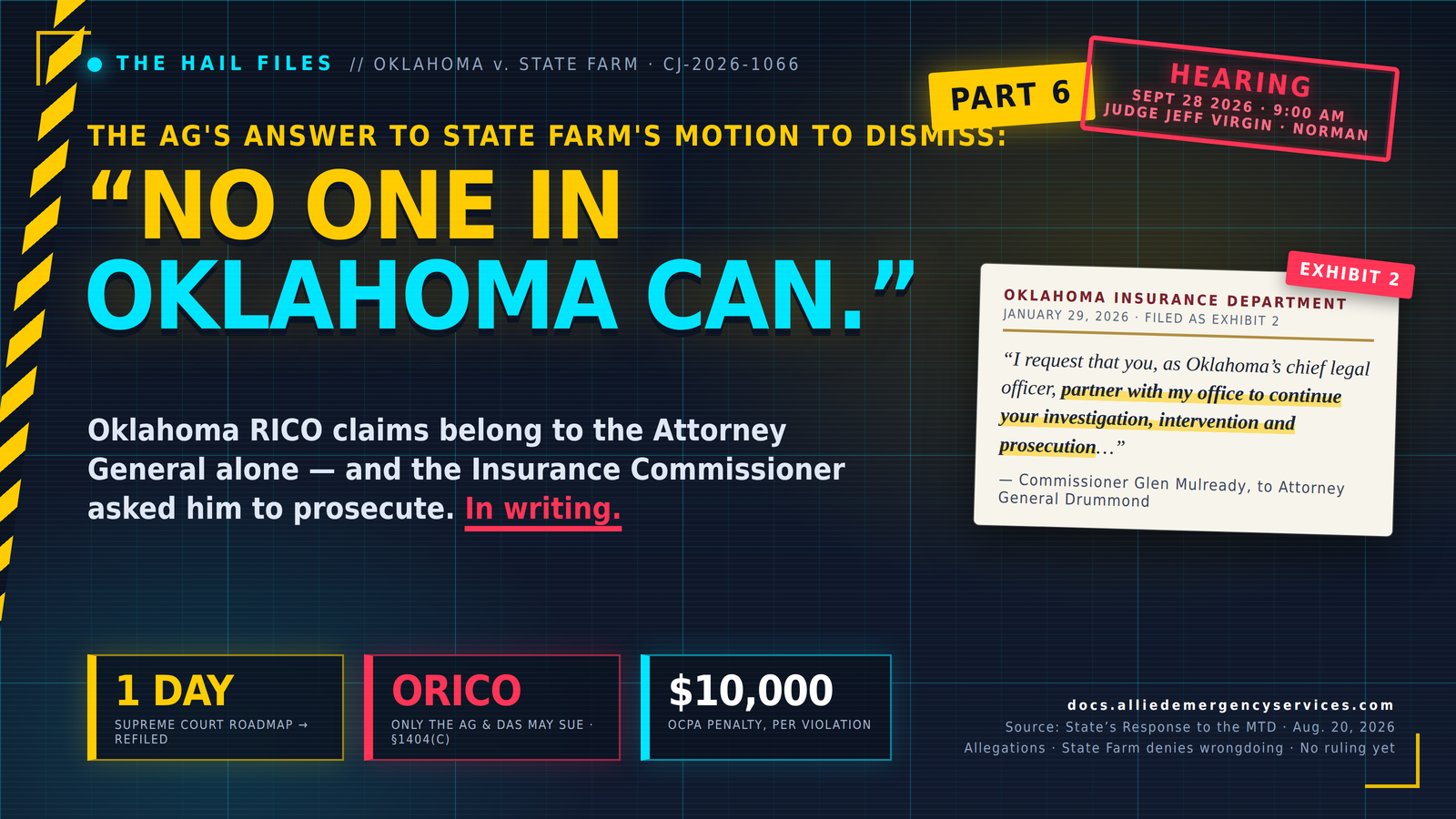
Nothing on this docket yet. The AG’s June 24 petition — hosted here — alleges that State Farm’s storm-claim practices violated Oklahoma law, including the state’s racketeering statute; State Farm denies the allegations and has moved to dismiss the case. State Farm’s motion quotes Drummond’s March 11 comment to NBC News that if a scheme “can be proven” the racketeering claim “will cross into the criminal world.” Whether the Attorney General and Whitten Burrage answer the disqualification motion before the September 28 hearing, or on a separate schedule, will show on the docket first. This report will be updated when they do.
What happened in West v. State Farm the same week
The disqualification motion was not State Farm’s only move in a 72-hour span. In West v. State Farm in Comanche County — the case whose lifted protective order produced the first wave of unsealed exhibits — Judge Grant Sheperd’s August 20 order gave State Farm 30 days to justify, document by document, anything it wanted to keep confidential, with everything else de-designated. State Farm asked on September 3 for more time, citing 55,913 documents to review. The homeowners objected on September 17. And on September 21, the deadline day, State Farm filed a notice withdrawing its extension motion rather than have the court rule on it. The deadline stood.
What that means, stated carefully: material State Farm did not re-designate by September 21 is no longer protected as confidential. Re-designation is a party process, not a docket event, so de-designated documents become public as the homeowners file them or release them. The archive updates as they surface; the Trial Watch calendar tracks the dates.
What happens next
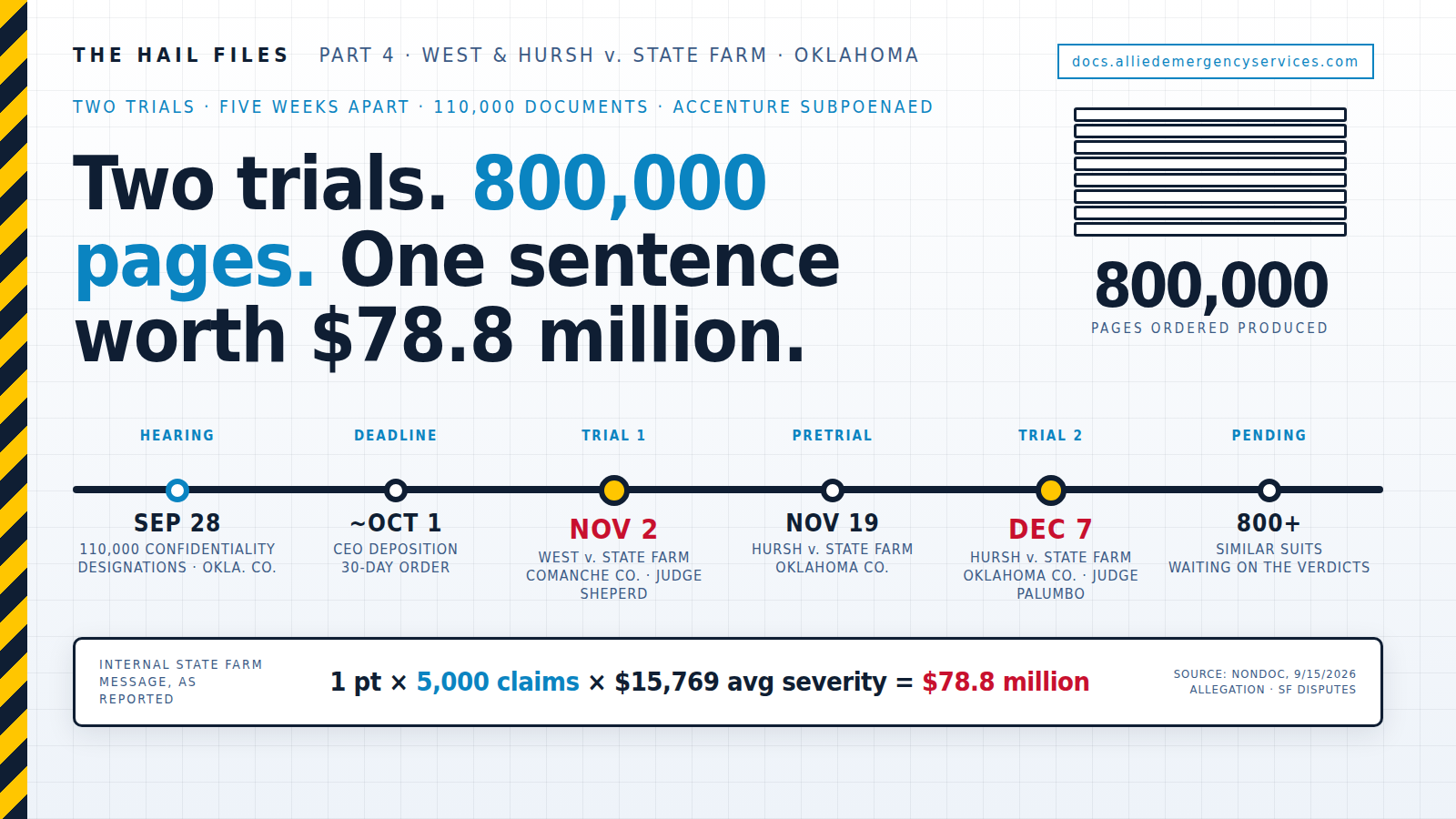
September 28 is a double-header. In Oklahoma County at 9 a.m., Judge Amy Palumbo hears the Hursh plaintiffs’ motion to strike State Farm’s blanket confidentiality designations — the ruling that decides whether roughly 110,000 documents become public before trial. In Cleveland County, the court takes up State Farm’s motion to dismiss the Attorney General’s case, with the motion to disqualify the AG’s lawyers now pending alongside it. November 2 is the West trial in Comanche County; December 7 is the Hursh trial, where State Farm executives are expected to testify under oath.
Read the documents
The motion to disqualify, with all three exhibits (114 pages, OCR’d and searchable) · State Farm’s September 21 withdrawal notice in West · The Attorney General’s petition · Search the full archive · Trial Watch: every date in the litigation
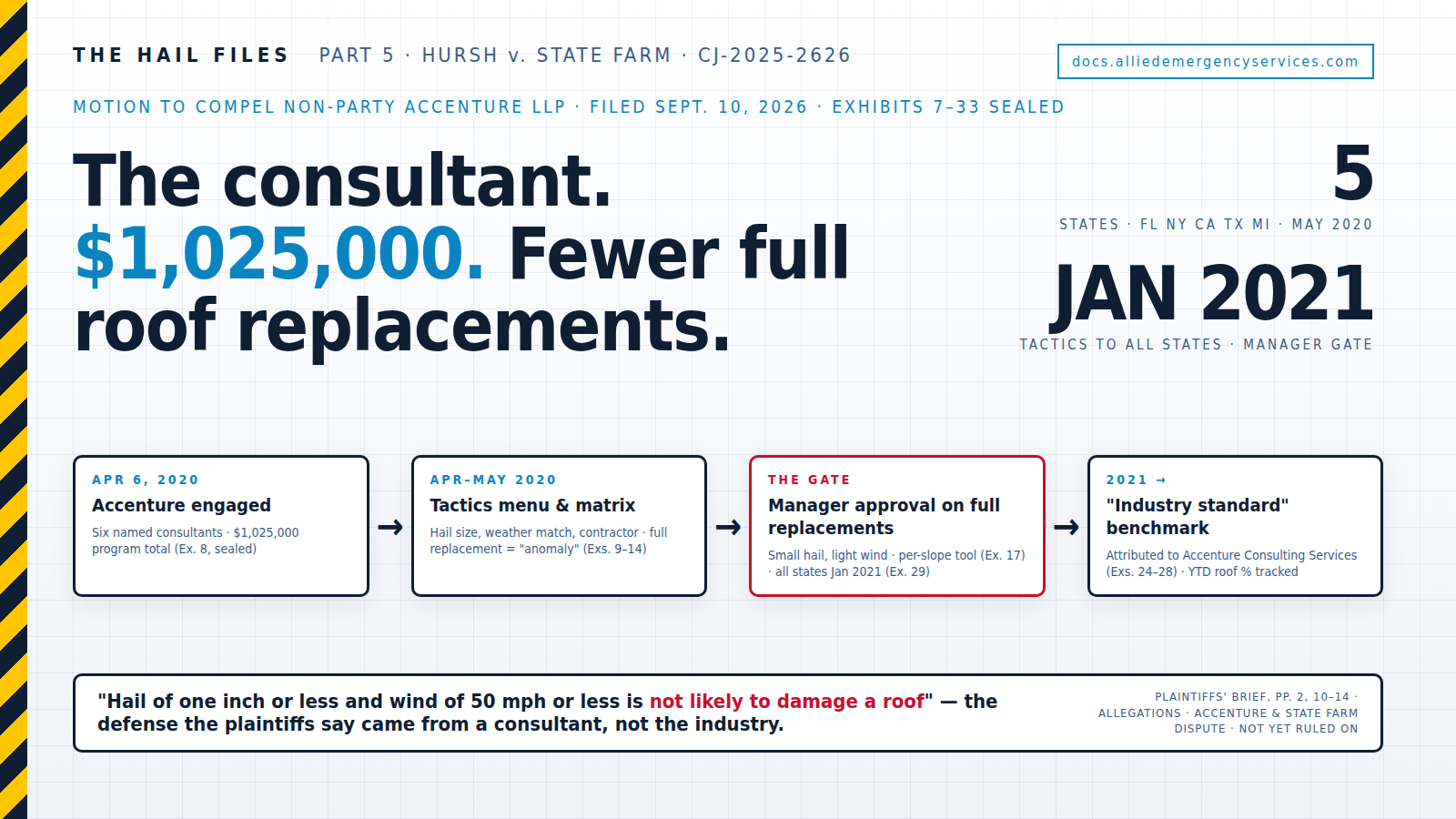
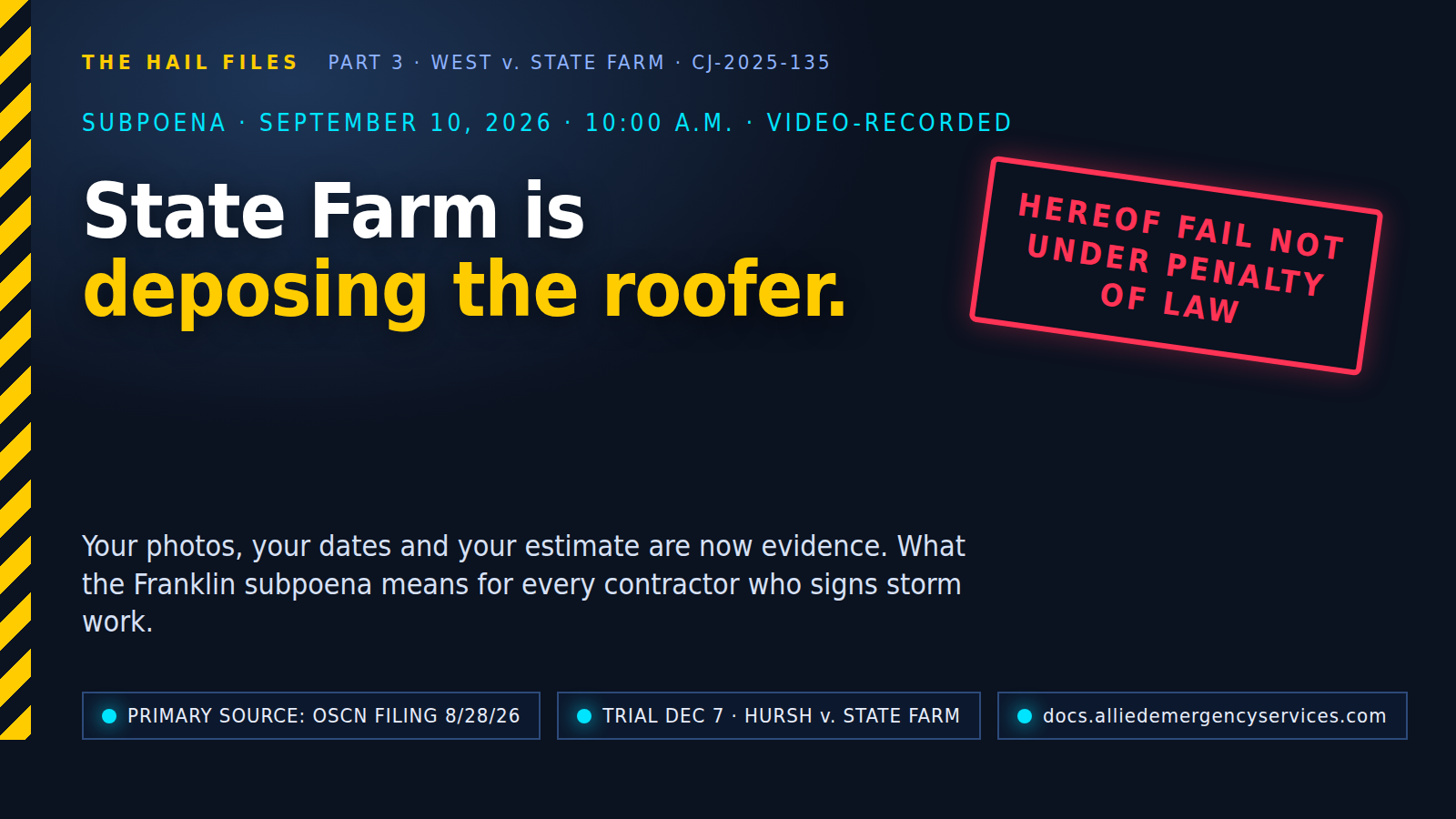
Earlier in this series: “The Denial Enterprise” · “State Farm Says It Needs 100 Lawyers and 179 Days” · Part 3: State Farm Is Deposing the Roofer · Part 4: Two Trials, 800,000 Pages · Part 5: The Accenture Motion
Frequently asked questions
A September 18, 2026 filing in the Oklahoma Attorney General’s lawsuit against State Farm (Cleveland County No. CJ-2026-1066) asking the court to remove Whitten Burrage, the Attorney General’s outside counsel, from the case. State Farm argues the firm’s contingency-fee cases against State Farm make it an unconstitutional “interested prosecutor” of the State’s racketeering claim, that the State’s contract with the firm was never publicly posted as 74 O.S. § 20i requires, and that Oklahoma’s racketeering statute restricts who may bring and see such a case. The motion has not been ruled on.
An Oklahoma City law firm led by Reggie Whitten and Michael Burrage that represents the plaintiffs in Hursh v. State Farm, West v. State Farm, and, by counts reported in the Oklahoma press, more than 800 hail-claim lawsuits against State Farm in Oklahoma. Since August 5, 2026 it has also appeared as outside counsel for the Oklahoma Attorney General in the State’s suit against State Farm.
According to the contingency-fee contract attached to State Farm’s motion (effective July 31, 2026): 20 percent of any recovery under $10 million, then 16, 12, 8 and 4 percent of successive bands above that, capped at $50 million in total fees, and nothing if there is no recovery. The Attorney General retains exclusive authority over settlement. The $50 million ceiling is reached at a recovery of roughly $1.2 billion.
Not on the docket as of September 23, 2026. No hearing on the motion has been set. The next scheduled date in the case is September 28, 2026, a hearing on State Farm’s separate motion to dismiss.
No. State Farm asked on September 3 to extend Judge Sheperd’s re-designation deadline to about October 21; the homeowners objected September 17; and on September 21, the deadline day, State Farm withdrew its request. Material it did not re-designate is no longer protected as confidential and becomes public as it is filed or released.
Every document in this report is hosted, OCR’d and full-text searchable at docs.alliedemergencyservices.com, free to read and download, including the motion with its exhibits, the Attorney General’s petition, and the West withdrawal notice.
About this report. Everything above is drawn from public court records — the motion and exhibits filed September 18, 2026 in Cleveland County No. CJ-2026-1066, the Comanche County docket in CJ-2025-135, and the Oklahoma County docket in CJ-2025-2626 — and from the published reporting the motion itself cites. Arguments attributed to State Farm are State Farm’s; allegations in the Attorney General’s petition and in the Randolph petition are allegations, which State Farm disputes; nothing described here has been decided by any court.
About the host. Allied Emergency Services is a licensed storm-damage restoration contractor serving Illinois, Wisconsin, Indiana and Michigan — not a law firm, insurance adjuster or public adjuster, and this report is not legal or insurance advice. We inspect, document, provide insurance-ready repair estimates and complete repairs; coverage decisions always belong to you and your insurer. We host the Hail Files archive as a public service because primary documents should be easy to read.
⚡ Storm or Roof Damage? Get a FREE Estimate
Text ESTIMATE to (844) 907-2546
Or call (800) 792-0212 for 24/7 emergency response
AI-powered • No obligation • Licensed IL & WI
Storm damage? Start with the documentation
Allied Emergency Services — IL-Licensed Storm Damage Restoration Contractor
Founded 2015, in the building trades since 1999. Allied inspects and documents storm damage, writes the scope and estimate, and does the repairs. We do not adjust or negotiate insurance claims — that is the job of your insurer, a licensed public adjuster, or an attorney. IICRC-certified, EPA Lead-Safe, IL Licensed Roofing Contractor #104.019029. 24/7 emergency response.
How the storm-damage insurance claim process works →Free inspection within 24 hours · No obligation · Photo-documented findings you can share with your insurer
Attorneys: forensic storm damage documentation & construction expert consultation for counsel →