⚡ Storm or Roof Damage? Get a FREE Estimate
Text ESTIMATE to (844) 907-2546
Or call (800) 792-0212 for 24/7 emergency response
AI-powered • No obligation • Licensed IL & WI
Oklahoma City — September 28, 2026
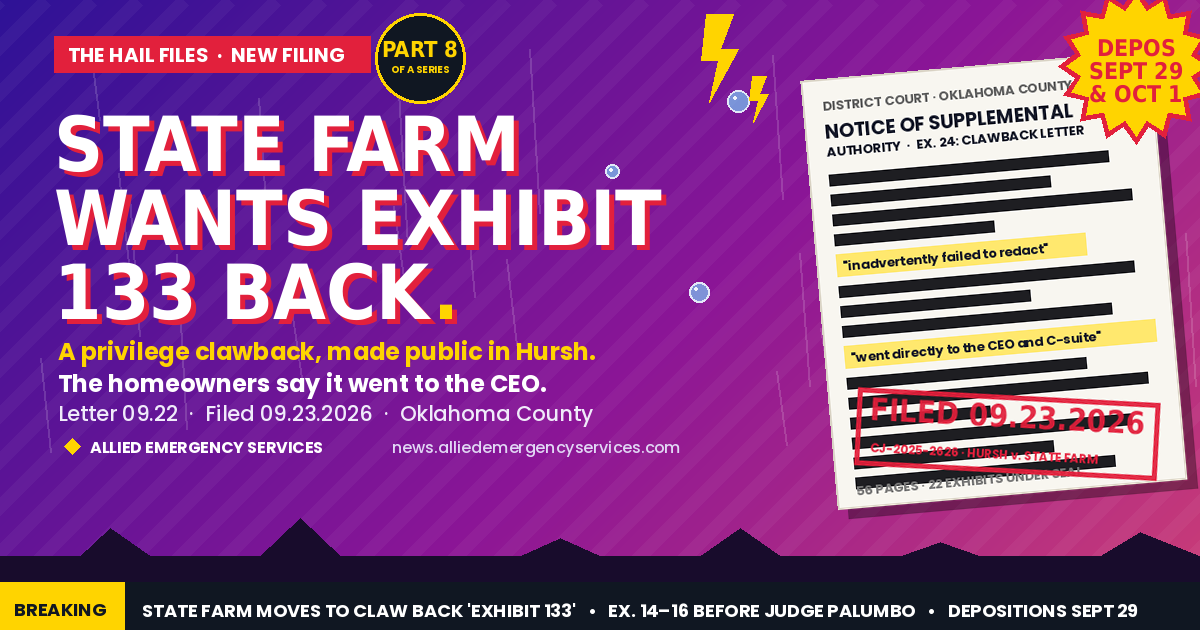
What happened, in one sentence: In a September 22 letter that is public only because the homeowners in Hursh v. State Farm attached it to a court filing the next day, State Farm’s trial lawyers said the company is clawing back “Exhibit 133” — a document shown to State Farm executive Wensley Herbert at his September 17 deposition — as privileged material it “inadvertently failed to redact,” and asked that every copy be destroyed; the homeowners say the same document, produced in their case as Exhibit 14, “went directly to the CEO and C-suite.”
Status: No court has ruled on State Farm’s privilege claim. The homeowners asked Judge Amy Palumbo to decide at her September 28 hearing whether Exhibit 14 and two other State Farm documents are confidential, or to review Exhibit 14 privately; no ruling had been reported as of Monday afternoon. Two State Farm corporate representatives are set to be deposed in her courtroom on September 29 and October 1. The 56-page public filing, with the letter attached, is hosted in the Hail Files archive.
For months, the Oklahoma hail-claim cases against State Farm have been fought over one word: confidential. Last week a second word entered the fight — privileged — and it came with a request that every copy of a document be destroyed.
The document is Exhibit 133 in West v. State Farm, the Comanche County case. On September 17, in Bloomington, Illinois, the homeowners’ lawyers put it in front of Wensley Herbert, one of three State Farm executives deposed in both Oklahoma cases. According to the homeowners, State Farm’s lawyer asked for a break, then came back on the record with this: “On Exhibit 133, based on the questions that were asked today, we are a little worried that there may be privileged communications that were inadvertently produced and we’re going to investigate that.” Five days later, State Farm’s trial counsel sent the letter.
We know what the letter says because the homeowners in the other case — Hursh v. State Farm, set for trial in Oklahoma County on December 7 — attached it to a filing on September 23, along with their argument that the same document “lays out State Farm’s knowledge of the exact scheme Plaintiffs have been alleging since filing their petition.” That filing, a 56-page notice of supplemental authority on their motion to de-designate State Farm’s documents, is public in redacted form. Twenty-two of its twenty-five exhibits are sealed. The letter is not.
What is State Farm clawing back?
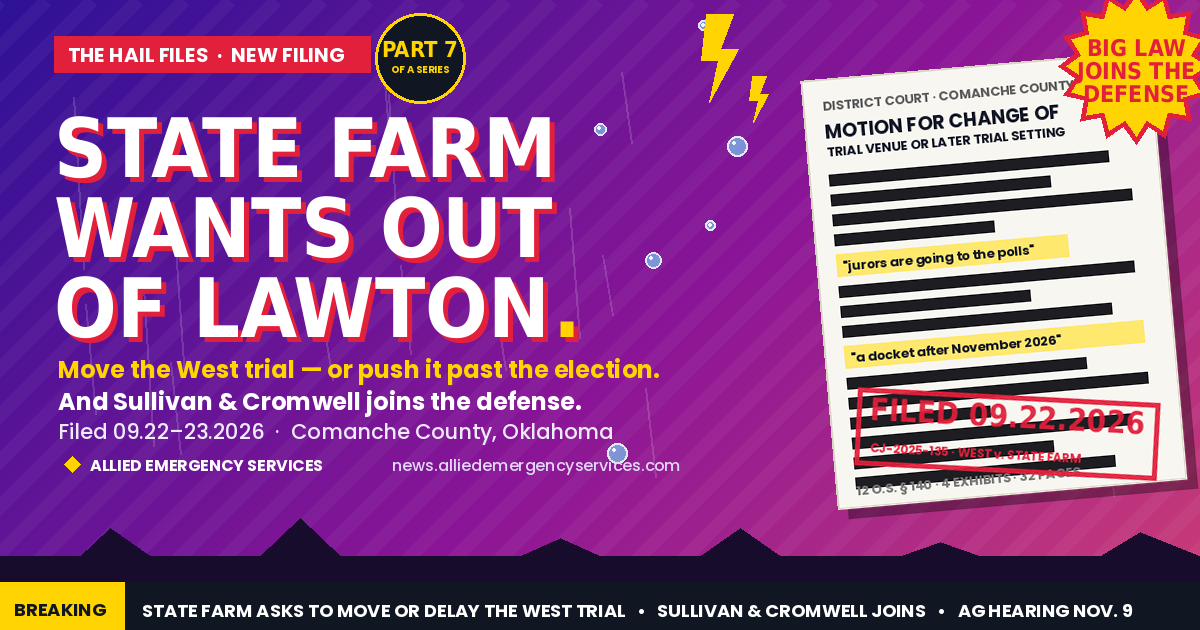
Two documents from the West production. The letter, dated September 22 and signed by Timila S. Rother of Crowe Dunlevy in Oklahoma City — the firm that filed State Farm’s motion to move the West trial (Part 7) — identifies them by Bates number: WEST00158702-09, “marked as Exhibit 133 in the September 17, 2026 deposition of Wensley Herbert,” and “another iteration of that document,” WEST00158712-19. State Farm says both contain “communications protected by the attorney-client privilege and/or the work product doctrine, which State Farm inadvertently failed to redact when it produced the documents.” The letter adds that “there are also previous redactions that State Farm is downgrading,” and that State Farm will send a new production of the documents “with corrected redactions.”
The letter also says the homeowners’ lawyers “recently attached” Exhibit 133 as an exhibit to their “Reply in Support of Motion to Compel Compliance by Nancy Holcomb” — which appears to be the reply they filed under seal in West on September 18, the day after the deposition. Nancy Holcomb Insurance Agency is State Farm’s co-defendant in that case.
| Document | Letter, “Notice of Inadvertent Production of Documents” |
| Date | September 22, 2026 |
| From | Timila S. Rother, Crowe Dunlevy, on behalf of State Farm Fire and Casualty Company |
| To | Whitten Burrage, counsel for the homeowners in West v. State Farm (copied to their co-counsel) |
| Case | West v. State Farm Fire and Casualty Company, No. CJ-2025-135, District Court of Comanche County, Oklahoma |
| Documents clawed back | WEST00158702-09 (Exhibit 133 at Wensley Herbert’s September 17 deposition) and WEST00158712-19 (“another iteration”) |
| Legal basis claimed | 12 O.S. § 3226(B)(5)(b) (the clawback procedure) and 12 O.S. § 2502(E) (inadvertent disclosure is not a waiver) |
| What it asks | Destroy all copies and anything prepared from them, including by consultants and experts; agree to strike the related deposition testimony, the deposition exhibit and the exhibit to the reply brief |
| Deadline the letter set | Written confirmation by close of business September 25, 2026. That date has passed; whether the homeowners’ lawyers complied or contested the clawback is not in the public record |
| How it became public | Exhibit 24 to the Hursh homeowners’ September 23 notice of supplemental authority (Oklahoma County, No. CJ-2025-2626) |
| Ruling | None on the privilege claim |
What does the letter ask the homeowners’ lawyers to do?
Oklahoma’s discovery code has a procedure for this situation. Under 12 O.S. § 3226(B)(5)(b), once a party is notified that material it received is claimed as privileged, it must promptly return, sequester or destroy the material and its copies, must not use or disclose it until the claim is resolved, and may present it to the court under seal for a ruling on the claim. A separate provision, 12 O.S. § 2502(E), says an inadvertent disclosure does not waive the privilege if the holder took reasonable steps to prevent the disclosure and to fix the error.
State Farm’s letter invokes both. It asks the homeowners’ lawyers to destroy “all copies (both paper and electronic)” of the two documents, including the deposition exhibit; to delete them from their litigation databases; to destroy “all analyses, emails, memoranda, outlines, notes, or any other materials” prepared from them; and to have consultants, investigators, experts and vendors do the same. It asks the homeowners to “voluntarily agree to strike” three things: Herbert’s testimony about the privileged portions, the deposition exhibit, and the exhibit attached to their reply brief. And it asks for written confirmation “by the close of business on September 25, 2026.”
The letter has an edge. It says the homeowners attached the document to their brief “after State Farm had made known its belief that the document may contain privileged communications which State Farm was investigating,” and that using it as an exhibit with knowledge of State Farm’s concerns “is inconsistent with the law and the obligations of attorneys.” On waiver, State Farm’s position is stated plainly: the production “was not a waiver”; State Farm “redacted that information from other versions of the document, thus demonstrating its intent to maintain its privilege claims”; and the unredacted versions “first became known to State Farm after investigation following Mr. Herbert’s deposition.”
Whether the homeowners’ lawyers complied with the letter or contested it in West is not in the public record.
Why does the Hursh case have the same document?
Because, according to the homeowners, State Farm produced it in both cases. They say the West deposition exhibit “has also been produced in this case”: in Hursh it carries the Bates range HUR00158701-19, and it is Exhibit 14 to their filing. As of September 23, they write, “No such request to clawback Exhibit 14 has yet been made in this case, but Plaintiffs expect it to be raised” — which is why they raised it first, asking Judge Palumbo to rule before the corporate-representative depositions set for September 29 and October 1, where they say they intend to use it.
The homeowners also offer their own explanation for the clawback: “Some of the testimony was so damning that State Farm now seeks to claw back Exhibit 133 and Mr. Herbert’s testimony.” State Farm’s letter gives a different reason — an inadvertent production, discovered on investigation after the deposition.
What do the homeowners say Exhibit 14 shows?
The public version blacks out nearly everything that would let a reader judge for themselves, so what survives is the homeowners’ description. They say Exhibit 14 “went directly to the CEO and C-suite, as Exhibit 14 specifically states on page one” — the quoted line from page one is redacted — and they cite Herbert’s West testimony, also redacted, for the statement that “SEO stands for Senior Executive Offsite and the CEO, CFO, and COO attend and review SEO material.” They say the document shows passages “crossed out and replaced with others and comments placed into the document itself,” and they gave the court screenshots of those edits; the screenshots are sealed. Their conclusion, in part: “State Farm executives knew” — the rest of that clause is redacted — “but carried their tactics to reduce indemnity out anyway.”
None of that has been tested in court, and State Farm disputes the homeowners’ allegations.
What is the “Redacted – AC” dispute?
On the second page of Exhibit 14, HUR00158702, State Farm’s production carries a redaction labeled “Redacted – AC” — attorney-client. According to the homeowners, a different document State Farm produced, Exhibit 15 (HUR00039527-34), contains the same section without the redaction, at HUR00039528. Their reading of what sits under the box: “the Accenture industry standard and State Farm’s focus on improving towards an industry standard on roofs,” with a source line — “Source: Accenture Consulting Services.”
The homeowners make three arguments. First, that data supplied by an outside consultant cannot be a confidential lawyer-client communication — “the third-party destroys the privilege,” they write, citing a 1934 Oklahoma Supreme Court decision holding that a communication to a lawyer is privileged only if made in confidence. Second, that copying a lawyer on a business document does not make it privileged, a point they support with a string of federal decisions. Third, in the alternative, that if any of it is privileged, the crime-fraud exception applies: Oklahoma’s privilege statute, 12 O.S. § 2502(D)(1), recognizes no privilege where a lawyer’s services were sought or obtained “to enable or aid anyone to commit or plan to commit what the client knew or reasonably should have known to be a crime or fraud.” They also say the same industry-standard language appears throughout documents Judge Grant Sheperd has already de-designated in West.
The crime-fraud argument is an allegation in a brief; no court has found that the exception applies. State Farm’s position, in its letter, is that the redacted material is privileged and that it redacted the same information in other versions of the document.
What is Exhibit 16, and where does the $218-$300 million figure come from?
Exhibit 16 is a single Bates number, HUR00156099, and its title is redacted. The homeowners describe it as an operations model that Kathy Ress — identified in earlier filings as State Farm’s vice president of operations — testified Accenture helped develop. In their telling, it is where a claim-handling approach was “developed and implemented to reduce claim payments,” and it discusses “leadership intervention or what becomes team manager review required of full roof replacements.” Their summary is the sentence that will travel: they call it “outcome-based claim handling to save State Farm $218-$300 million dollars on claims that have not happened yet,” and argue that treating one’s own policyholders that way is the most adversarial conduct an insurer could engage in.
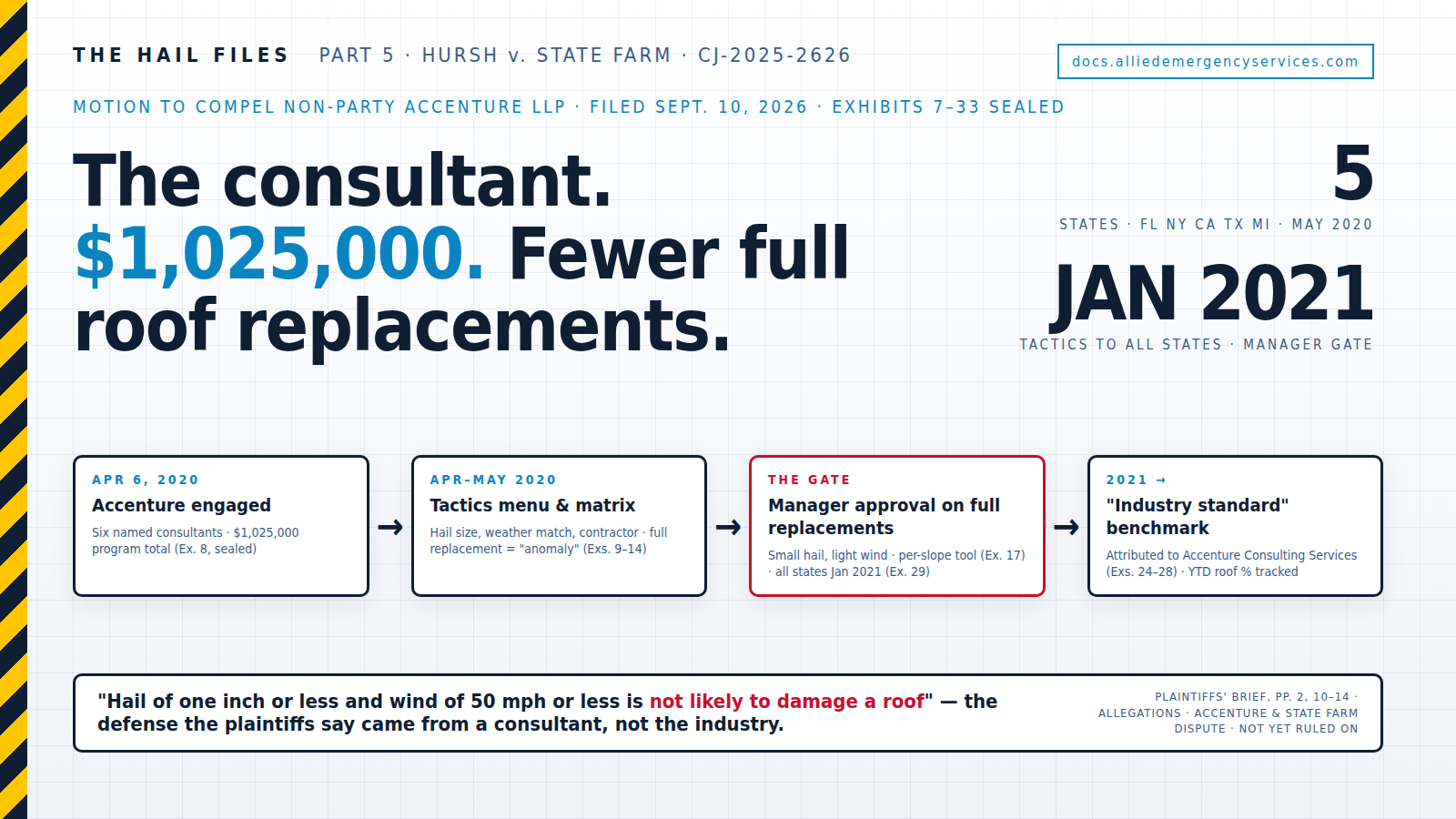
The figure is the homeowners’ characterization of a sealed document; the underlying numbers are redacted in the public filing. State Farm’s side is on the record elsewhere. In excerpts of her August 28 Hursh deposition that State Farm itself filed in West on September 14, Ress testified that she did not believe State Farm engaged in the “outcome-based claims handling” the homeowners’ lawyer described, and that the manager-review step for roof claims added in 2020 was about claim-handling accuracy during Covid-era staffing shortages and record catastrophe volume. Read those excerpts. The homeowners’ September motion to compel Accenture, covered in Part 5, described a $1,025,000 consulting engagement that began in April 2020.
What does “starkly different” testimony mean here?
Herbert, Scott Welsh and Ress were deposed in Hursh on August 26, 27 and 28, and again in West about three weeks later. The homeowners say “the testimony of each witness in this case was starkly different to the testimony three weeks later,” and that “All three of the West Matter depositions are filled with inaccuracies and inconsistencies when compared to the depositions taken in this matter.” They set the excerpts side by side; the page and line citations are visible, and the testimony itself is blacked out. Without the transcripts, a reader cannot evaluate the claim, and no court has ruled on it.
What did the homeowners ask Judge Palumbo to do?
The supplement narrows a fight that began with State Farm’s blanket confidentiality designations. According to the homeowners, twelve exhibits from their August 4 motion to de-designate are no longer at issue because Judge Sheperd de-designated them in West on August 20 and they have since been filed in the public record. What remains, per the filing’s index, is eight exhibits from the original motion, thirteen documents from the homeowners’ reply brief and the three new ones: 24 in all. Eight carry titles in the index, among them “Fire Claims — 2023 May Meeting,” “Homeowners Paid Severity & Incurred Pure Premium (IPP) by State,” “Video – Haag Education Chapter 1 – Segment 2 – Impact Testing and Hail Definitions,” “2021-06-24 Fire Model Enhancement — Water & Wind/Hail” and “Email 2022-01-12 changing ‘Reduce’ to ‘Target’.” The titles are all the public has; the documents are sealed.
The request comes in two parts. First: “Plaintiffs specifically request this Court de-designate Exhibit 14 and Exhibit 15 to this Motion at the hearing on September 28, 2026,” with Exhibit 16 added in the conclusion. In the alternative, the homeowners ask the court to “do an in camera review of an unredacted version of Exhibit 14 to determine if the redactions are truly privileged, which Plaintiffs dispute.” Their stated reason for urgency is the calendar: the depositions of Wayne Stewart and Nicole Manduca as State Farm’s corporate representatives, set for September 29 and October 1 in Judge Palumbo’s own courtroom, for which the homeowners say they have arranged a court reporter, a videographer and a courtroom technician to project exhibits.
They also argue that the sealing itself is part of the problem. “Plaintiffs are currently forced to file under seal to cooperate with State Farm’s overbroad designations of confidentiality,” they write, invoking the presumption of public access to court records and a 2021 Oklahoma Supreme Court opinion that criticized the view “that parties may exclusively control which documents appear on a face of a public record, while simultaneously using those documents to obtain a judicial determination of legal rights.” The court’s order granting the homeowners leave to file the unredacted version under seal was filed September 24.
How the week unfolded
| Aug 26–28 | Herbert, Welsh and Ress are deposed in Hursh. |
| Sept 15–17 | The same three are deposed in West, in Bloomington, Illinois. |
| Sept 17 | Exhibit 133 is shown to Herbert; State Farm’s counsel says on the record that State Farm is “a little worried” privileged material was inadvertently produced. |
| Sept 18 | The homeowners file a reply in West under seal; State Farm’s letter later says Exhibit 133 was attached to their reply on the motion to compel compliance by Nancy Holcomb. |
| Sept 21 | The Hursh homeowners apply, unopposed, to file an unredacted supplement under seal. |
| Sept 22 | State Farm’s clawback letter in West. |
| Sept 23 | The Hursh notice of supplemental authority is filed, with the letter as Exhibit 24. |
| Sept 24 | The order granting leave to file under seal is filed in Hursh (signed Sept 22, per the docket). |
| Sept 25 | The letter’s deadline for written confirmation; no response is in the public record. |
| Sept 28 | Judge Palumbo’s hearing on de-designation, 9 a.m.; no ruling reported as of Monday afternoon. |
| Sept 29 & Oct 1 | Corporate-representative depositions in Judge Palumbo’s courtroom. |
What happened at the September 28 hearing?
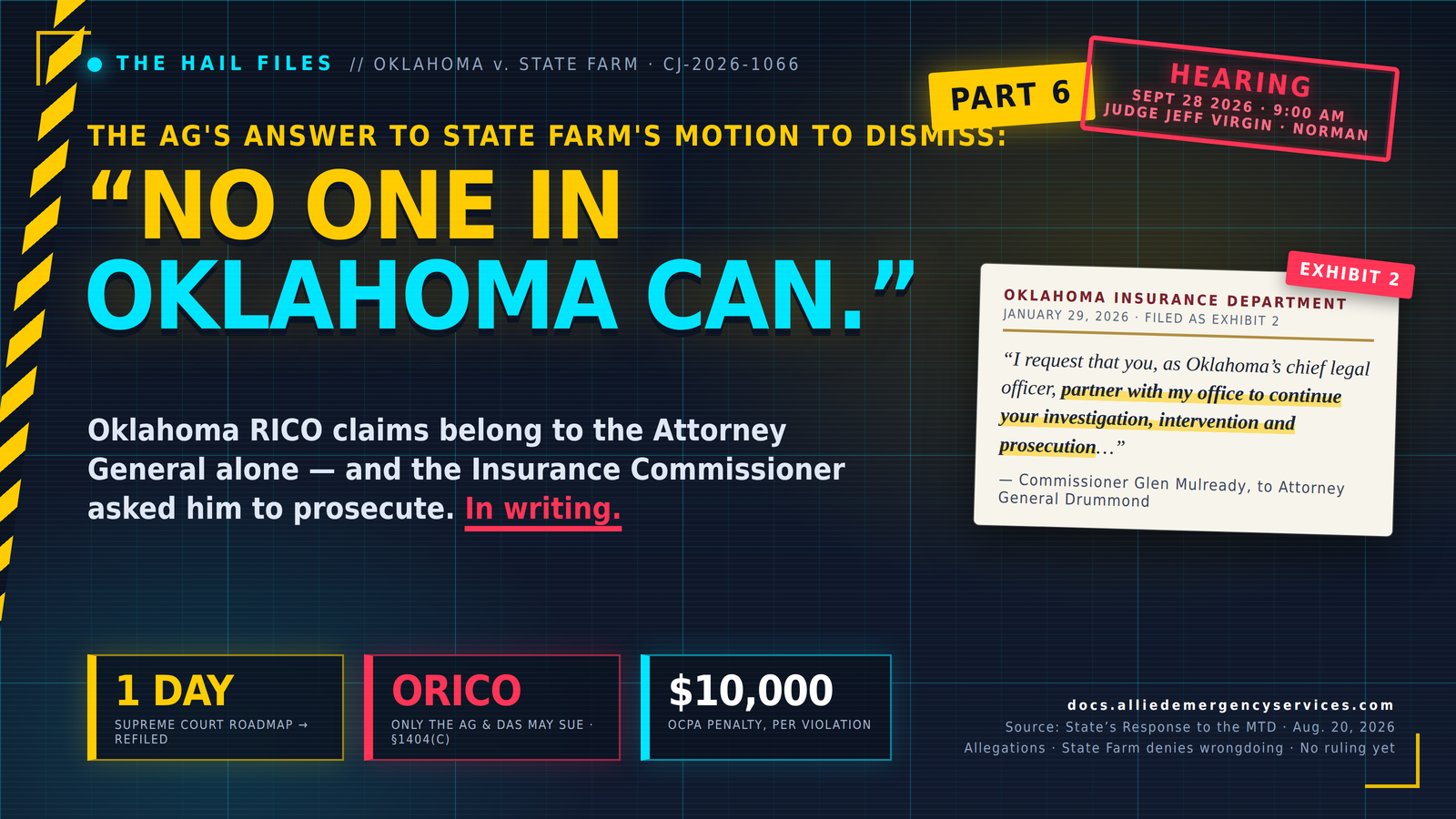
As of Monday afternoon, no ruling from Judge Palumbo’s 9 a.m. hearing had been reported. The Cleveland County hearing on State Farm’s motion to dismiss the Attorney General’s case was set for the same day. This report and the Trial Watch calendar will be updated when either result becomes public.
What does this mean for Oklahoma homeowners?
Nothing in this filing has been decided. A clawback letter is one side’s legal position, sent between lawyers; the homeowners’ descriptions of sealed documents are advocacy in a brief; and no court has ruled on privilege, on confidentiality or on the testimony. What the week does show is where the fight over the Hursh evidence is heading — from whether State Farm’s documents are confidential to whether some of them can be used at all — with a December 7 trial date, two corporate-representative depositions this week and a CEO deposition deadline around October 1 in between.
For policyholders with their own storm claims, the practical facts are unchanged: the allegations in these cases are allegations, State Farm disputes them, and a policyholder’s own claim is governed by their own policy and their own insurer’s decisions.
What happens next
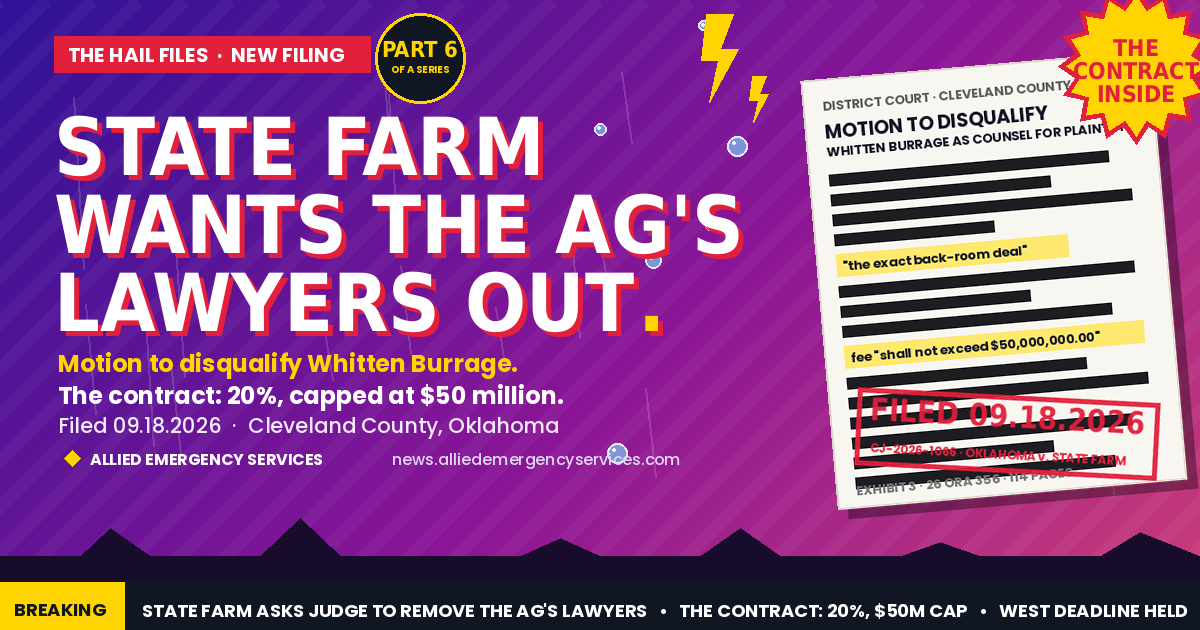
September 29 and October 1: the depositions of Wayne Stewart and Nicole Manduca as State Farm’s corporate representatives, in Judge Palumbo’s courtroom. Manduca, whom the homeowners’ Accenture motion identified as leader of State Farm’s Wind/Hail Fire Model Enhancement Team, testified in West in June; that motion quoted her as saying Accenture “developed the theory” (Part 5). Around October 1: the deadline for CEO Jon Farney’s four-hour deposition under the court’s September 1 order. October 15: the Hursh deadline for dispositive motions and expert disclosures. October 22: the West pretrial conference, where that trial date is formally set. November 9: the hearing on State Farm’s motion to disqualify Whitten Burrage in the Attorney General’s case (Part 6). November 19: the Hursh pretrial conference. December 7: the Hursh trial. All of it is on the Trial Watch page, which is updated as the dockets move.
Read the documents
The homeowners’ notice of supplemental authority, public version (56 pages, OCR’d and searchable; State Farm’s September 22 letter is Exhibit 24, pages 45–46; Judge Sheperd’s August 20 order is Exhibit 25) · Order granting leave to file under seal, Hursh · Application for leave to file under seal, Hursh · State Farm’s September 14 reply with the Ress deposition excerpts, West · Search the full archive.
Earlier in this series: “The Denial Enterprise” · Part 3: State Farm is deposing the roofer · Part 4: Two Trials, 800,000 Pages · Part 5: The Accenture Motion · Part 6: State Farm Asks a Judge to Throw the Attorney General’s Lawyers Off the Case · Part 7: State Farm Wants Out of Lawton.
Frequently asked questions
Exhibit 133 is a document, Bates-numbered WEST00158702-09, that the homeowners’ lawyers showed State Farm executive Wensley Herbert at his September 17, 2026 deposition in West v. State Farm (Comanche County, CJ-2025-135). In a September 22 letter, State Farm’s counsel said it contains attorney-client privileged or work-product communications that State Farm inadvertently failed to redact, and moved to claw it back along with a second version, WEST00158712-19. The homeowners in Hursh v. State Farm say the same document was produced in their case as HUR00158701-19. No court has ruled on the privilege claim.
State Farm’s September 22 letter says the documents contain privileged communications it inadvertently failed to redact, that it redacted the same information in other versions of the document, and that under 12 O.S. § 3226(B)(5)(b) and § 2502(E) the production was not a waiver. It asks the homeowners’ lawyers to destroy all copies and related work product and to agree to strike the related testimony and exhibits. The homeowners argue the material is not privileged, in part because they say it is Accenture industry data, and invoke the crime-fraud exception in the alternative. No court has ruled.
In a September 23, 2026 notice of supplemental authority, the homeowners in Hursh v. State Farm (Oklahoma County, CJ-2025-2626) asked Judge Amy Palumbo to de-designate — declare not confidential — three State Farm documents, Exhibits 14, 15 and 16, at her September 28 hearing, or alternatively to review an unredacted Exhibit 14 privately to decide whether its redactions are privileged. The filing lists 24 documents still in dispute. No ruling had been reported as of the afternoon of September 28.
It is the homeowners’ description of Exhibit 16 (HUR00156099), a sealed State Farm document they describe as an operations model that State Farm vice president Kathy Ress testified Accenture helped develop. The homeowners say it reflects “outcome-based claim handling to save State Farm $218-$300 million dollars on claims that have not happened yet.” The underlying numbers are redacted in the public filing. Ress has testified that she did not believe State Farm engaged in outcome-based claims handling, and State Farm disputes the allegations.
According to the homeowners’ September 23 filing, Wayne Stewart and Nicole Manduca are set to be deposed as State Farm’s corporate representatives in Judge Amy Palumbo’s Oklahoma County courtroom on September 29 and October 1, 2026, with a court reporter, a videographer and a courtroom technician to project exhibits. The homeowners say they intend to use the disputed Exhibit 14 at those depositions.
The Hursh homeowners say three State Farm executives, Wensley Herbert, Scott Welsh and Kathy Ress, gave testimony in West v. State Farm in mid-September that was “starkly different” from what they said in Hursh depositions three weeks earlier, and that the West transcripts are “filled with inaccuracies and inconsistencies.” The excerpts are redacted in the public filing, and the claim has not been ruled on.
About this report. Everything above is drawn from public court records — the September 23 notice of supplemental authority in Oklahoma County No. CJ-2025-2626 (the public, redacted version, with State Farm’s September 22 letter attached as Exhibit 24), the court’s order granting leave to file under seal, and State Farm’s September 14 filing in Comanche County No. CJ-2025-135 — read in full and hosted, unaltered, in the Hail Files archive, together with the text of 12 O.S. §§ 2502 and 3226. Where the report describes what the homeowners say, those are their characterizations of documents that remain sealed; where it describes State Farm’s position, it quotes State Farm’s letter and State Farm’s own filing. No court has ruled on the privilege claim or on the confidentiality of Exhibits 14–16. Allegations in the underlying lawsuits are allegations that State Farm disputes.
About the host. Allied Emergency Services is a licensed storm-damage restoration contractor serving Illinois, Wisconsin, Indiana and Michigan — not a law firm, insurance adjuster or public adjuster, and this report is not legal or insurance advice. We inspect, document, provide insurance-ready repair estimates and complete repairs; coverage decisions always belong to you and your insurer. Founded 2015; in the building trades since 1999; Illinois-licensed. 24/7: (800) 792-0212.
⚡ Storm or Roof Damage? Get a FREE Estimate
Text ESTIMATE to (844) 907-2546
Or call (800) 792-0212 for 24/7 emergency response
AI-powered • No obligation • Licensed IL & WI
Storm damage? Start with the documentation
Allied Emergency Services — IL-Licensed Storm Damage Restoration Contractor
Founded 2015, in the building trades since 1999. Allied inspects and documents storm damage, writes the scope and estimate, and does the repairs. We do not adjust or negotiate insurance claims — that is the job of your insurer, a licensed public adjuster, or an attorney. IICRC-certified, EPA Lead-Safe, IL Licensed Roofing Contractor #104.019029. 24/7 emergency response.
How the storm-damage insurance claim process works →Free inspection within 24 hours · No obligation · Photo-documented findings you can share with your insurer
Attorneys: forensic storm damage documentation & construction expert consultation for counsel →