
⚡ Storm or Roof Damage? Get a FREE Estimate
Text ESTIMATE to (844) 907-2546
Or call (800) 792-0212 for 24/7 emergency response
AI-powered • No obligation • Licensed IL & WI
Why Is Oklahoma Suing State Farm and Allstate? Attorney General Gentner Drummond Explains the Allegations
Updated July 16, 2026
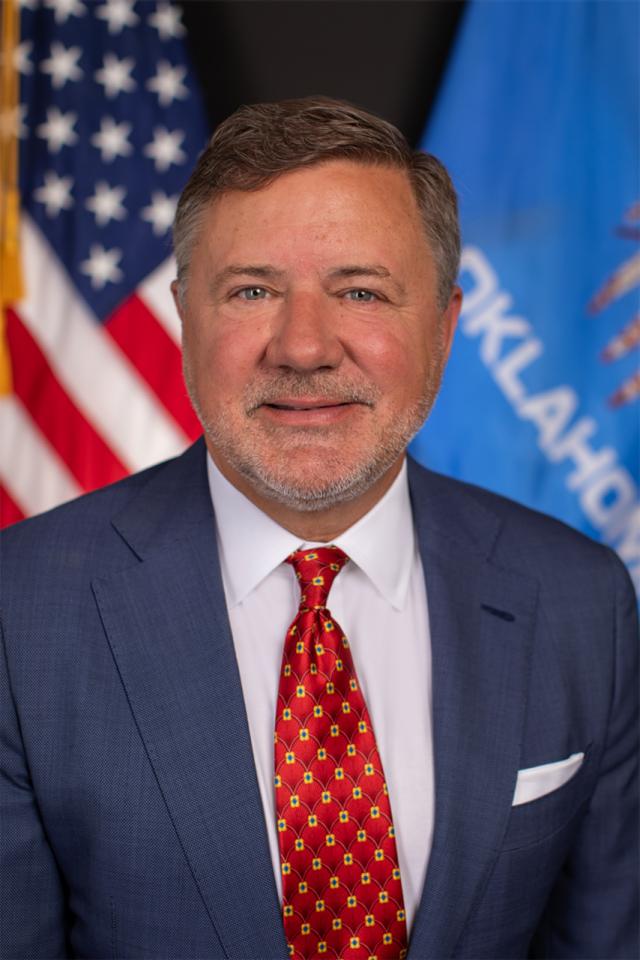
Oklahoma Attorney General Gentner Drummond is suing State Farm Fire and Casualty Company and Allstate Insurance Company over alleged statewide practices affecting homeowner wind and hail claims. The Attorney General contends that both insurers used undisclosed standards, centralized review procedures, and other claim-handling controls to deny or reduce legitimate storm damage insurance claims. https://oklahoma.gov/oag/news/newsroom/2026/june/drummond-files-new-lawsuit-against-state-farm.html
The State Farm complaint was filed June 24, 2026, and the Allstate complaint was filed July 7, 2026. Both were filed in Cleveland County District Court. The lawsuits seek restitution, civil penalties, injunctive relief, disgorgement of allegedly improper profits, and other remedies.
The allegations have not been proven. Neither insurer has been found liable, and both companies deny wrongdoing. State Farm says it fairly evaluates individual claims and pays what is owed under each policy. Allstate says the case against it has no merit and that it makes timely and fair claim payments based on policy terms. https://oklahoma.gov/oag/news/newsroom/2026/july/drummond-files-lawsuit-against-allstate-insurance-company.html
Key Takeaways
- Oklahoma filed a lawsuit against State Farm on June 24, 2026, alleging an internal program called the “Hail Focus Initiative” was used to reduce roof-replacement approvals and storm claim payments.
- Oklahoma sued Allstate on July 7, 2026, alleging curtailed field-adjuster authority, third-party property inspections, centralized reviewers, and undisclosed internal standards contributed to denials or underpayments.
- Both complaints assert claims under the Oklahoma Consumer Protection Act and the Oklahoma Racketeer-Influenced and Corrupt Organizations Act, along with civil-conspiracy and unjust-enrichment theories.
- The Oklahoma Supreme Court did not decide whether State Farm underpaid claims. It issued a procedural ruling that prevented the Attorney General from adding a statewide enforcement action to one couple’s private insurance lawsuit.
- Both lawsuits remain in their early stages. Restitution or compensation for policyholders is not guaranteed and would depend on a judgment, settlement, and any court-approved distribution process.
What Drummond Says the State Farm and Allstate Cases Have in Common
Drummond has described the lawsuits as nearly parallel cases. The two petitions do, in fact, follow similar structures.
Both allege that an insurer marketed homeowners coverage as protection against wind and hail losses while internally applying more restrictive claims standards that were not included in or disclosed with the policy. Both contend that claim outcomes were affected by centralized management, computer systems, outside inspectors or engineers, and limitations placed on front-line adjusters.
The complaints also present essentially parallel legal theories: alleged consumer deception, civil racketeering, conspiracy, and unjust enrichment. The factual details, however, are not identical. The State Farm complaint concentrates heavily on roof-replacement approvals and the alleged “Hail Focus Initiative,” while the Allstate complaint devotes particular attention to third-party “picture takers,” reviewers, depreciation, and replacement-cost representations.
Timeline of the Oklahoma Insurance Lawsuits
April 2025: Homeowners file the private Hursh case
Billy and Lacy Hursh filed a private lawsuit against State Farm following a disagreement over hail-damage coverage. Their causes of action included breach of contract, bad faith, constructive fraud, and negligent misrepresentation.
December 2025: Drummond is initially allowed to intervene
An Oklahoma County judge granted the Attorney General’s request to join that private case and bring broader claims on behalf of Oklahoma consumers.
June 23, 2026: Oklahoma Supreme Court blocks the intervention
The Oklahoma Supreme Court held that the Attorney General’s statewide consumer-protection and racketeering claims would improperly transform a private dispute over one property into a much broader proceeding. The court stated that the Attorney General could instead pursue those allegations through a separate lawsuit. It expressly left the remaining arguments for another court and did not determine whether State Farm’s claim practices were lawful or unlawful.
June 24, 2026: Oklahoma files a separate State Farm lawsuit
Drummond filed State of Oklahoma v. State Farm Fire and Casualty Company, Cleveland County case number CJ-2026-1066.
July 7, 2026: Oklahoma files the Allstate lawsuit
Drummond filed State of Oklahoma v. Allstate Insurance Company, Cleveland County case number CJ-2026-1169.
Why Is Oklahoma Suing State Farm?
Oklahoma alleges that State Farm implemented a coordinated internal program, commonly described in the petition as the Hail Focus Initiative, to reduce total roof-related indemnity payments. https://oklahomavoice.com/2026/06/24/oklahoma-ag-sues-state-farm-alleging-insurance-carrier-fraudulently-denied-claims/
According to the complaint, State Farm allegedly decided to reduce aggregate roof payments before evaluating the merits of each individual storm damage insurance claim. The state contends that field adjusters lost or had their authority substantially restricted when recommending complete roof replacements. Full replacements allegedly became subject to additional management review and approval. https://oklahomawatch.org/2026/07/08/allstate-next-in-drummonds-insurance-crusade/
Alleged use of undisclosed claim standards
The petition alleges State Farm adopted internal definitions and damage criteria that were more restrictive than the language contained in homeowners policies.
Oklahoma contends these standards were used to classify reported roof conditions as:
- Wear and tear
- Age-related deterioration
- Cosmetic damage
- Pre-existing damage
- Installation defects
- Manufacturing conditions
- Damage that allegedly did not affect the roof’s function
The state alleges those classifications were sometimes applied even when homeowners, contractors, or other professionals attributed the condition to wind or hail.
These remain allegations contained in the Attorney General’s petition. State Farm has not conceded that the described standards existed or were improperly used. https://www.kgou.org/politics-and-government/2026-07-08/oklahoma-attorney-general-sues-second-insurance-company-for-claims-practices
Alleged restrictions on roof-replacement approvals
The state claims experienced adjusters previously had greater discretion to approve full roof replacements after inspecting storm damage. Under the alleged Hail Focus Initiative, higher-level approval was reportedly required, creating what the Attorney General characterizes as additional opportunities to delay, reduce, or deny a claim.
The petition also alleges some storm damage insurance claims were limited to individual components—such as vents, gutters, or isolated spot repairs—rather than including the broader roof system.
A limited repair is not inherently improper. Whether a repair or replacement is required depends on the physical evidence, policy language, product condition, manufacturer requirements, repairability, applicable building code, and other claim-specific facts. Oklahoma’s allegation is that such outcomes were driven by undisclosed corporate standards instead of an individualized evaluation.
Alleged use of outcome-oriented engineering
Oklahoma further alleges that engineering or consulting reviews were sometimes used to support predetermined claim outcomes. The complaint characterizes certain reports as outcome-oriented and contends they were used to attribute observed conditions to excluded or uncovered causes.
That accusation is also unproven. Engineering conclusions frequently differ because of site conditions, weather records, testing methods, inspection timing, maintenance history, material aging, and the professional judgment applied to the evidence.
Why Is Oklahoma Suing Allstate?
The Allstate complaint similarly alleges an internal strategy intended to reduce payments on wind and hail claims. The petition labels the alleged strategy the “Disaster Payment Minimization Scheme.” That phrase is the state’s description; the complaint indicates that the precise internal name and directives would be within Allstate’s possession.
Oklahoma alleges the program operated through changes to adjuster authority, third-party inspections, centralized review, restrictive damage definitions, and replacement-cost or depreciation practices. https://www.newson6.com/politics/hot-seat/oklahoma-state-farm-allstate-lawsuits-storm-claims
Alleged limits on field-adjuster authority
The state contends Allstate reduced or removed the authority of licensed field adjusters to make coverage and repair-scope decisions.
In some cases, the complaint alleges an on-site visit was conducted by a third-party property inspector described in the petition as a “picture taker.” Photographs were then uploaded for remote review. Estimates prepared by adjusters were allegedly sent to additional reviewers who could require revisions or deny coverage.
The petition further alleges that internal revisions sometimes reduced an estimate below the homeowner’s deductible, resulting in no payment to the policyholder. These are allegations about company-wide practices, not findings that every Allstate claim was handled in this manner.
Replacement cost, actual cash value, and depreciation allegations
The Allstate complaint raises questions about how certain policies were marketed and how losses were valued.
Generally:
Replacement cost value, or RCV, refers to the cost of replacing covered damaged property without deducting depreciation, subject to the terms, limits, conditions, and payment stages in the policy.
Actual cash value, or ACV, generally reflects a value after depreciation or another policy- and jurisdiction-specific valuation method is applied.
Recoverable depreciation may be withheld initially and paid later after repairs are completed and the policyholder submits the documentation required by the policy.
Oklahoma alleges that some Allstate coverage described as replacement-cost protection was, in practice, adjusted using depreciation or other limitations that materially reduced the initial or total payment. Allstate disputes the lawsuit and maintains that its claim payments are made according to the applicable policy.
Alleged characterization of storm damage as deterioration
As in the State Farm case, Oklahoma alleges that Allstate sometimes attributed roof conditions to age, wear and tear, pre-existing conditions, cosmetic effects, or other uncovered causes rather than wind or hail.
The state also alleges some outside inspections or engineering reports were used as a basis for reducing or denying otherwise valid storm damage insurance claims. The court will ultimately have to evaluate the evidence, contractual language, testimony, and applicable law if the case proceeds to a merits decision.
What Laws Does Oklahoma Say the Insurers Violated?
Both lawsuits invoke the same principal legal theories.
Oklahoma Consumer Protection Act
The Attorney General alleges that the insurers’ marketing, policy-renewal communications, and claims practices constituted deceptive or unfair conduct under the Oklahoma Consumer Protection Act.
The state’s theory is not limited to whether a single estimate was too low. It alleges that homeowners were promised one level of storm protection while undisclosed corporate standards materially affected the benefits provided after a loss.
Oklahoma Racketeer-Influenced and Corrupt Organizations Act
The petitions also assert civil claims under Oklahoma’s state racketeering statute, commonly called ORICO.
Using a racketeering statute in a civil complaint does not mean either company has been convicted of a crime. It means the Attorney General alleges that a pattern of coordinated conduct satisfies the elements of Oklahoma’s civil anti-racketeering law. The insurers may contest the factual allegations, the legal sufficiency of the claims, or both.
Civil conspiracy and unjust enrichment
Oklahoma alleges that the insurers acted with agents, reviewers, consultants, or other associated entities to carry out the disputed practices. It also contends the companies were unjustly enriched by retaining premiums or money the state alleges should have been paid on covered losses.
The requested relief includes injunctions, restitution, disgorgement, statutory damages, civil penalties, investigative costs, attorney fees, and interest. Those remedies are requests in the complaints—not amounts already awarded by a court.
What Do State Farm and Allstate Say?
State Farm’s response
State Farm denies the broader allegations about its claim practices. In a statement following the Oklahoma Supreme Court ruling, the company said it remains committed to helping customers recover after storms and fairly evaluates claims under the facts and coverage purchased.
State Farm also reported that it had paid more than $1 billion to Oklahoma customers for wind and hail damage during the preceding two years. That payment figure does not resolve whether any individual claim was correctly adjusted, but it is part of the company’s response to the Attorney General’s allegations.
Allstate’s response
Allstate said the lawsuit has no merit and argued that converting routine insurance disputes into litigation increases costs. The company also stated that it is committed to timely and fair claim payments based on each customer’s policy.
Allstate’s denial is important to the legal status of the story: the Attorney General’s complaint represents one side of a contested civil case.
Did the Oklahoma Supreme Court Find That State Farm Committed Fraud?
No.
The Oklahoma Supreme Court’s June 23, 2026 decision was procedural. The court ruled that Drummond could not add a broad statewide enforcement action to the Hursh family’s narrower private insurance case.
The court concluded that the proposed intervention would substantially enlarge the issues, introduce different legal theories, and seek public remedies unrelated to the original homeowners’ individual contract damages. It suggested the Attorney General could bring a separate action—which he did the next day.
The court did not approve or reject the alleged Hail Focus Initiative. It did not determine whether State Farm underpaid storm damage insurance claims, and it did not decide whether State Farm violated consumer-protection or racketeering laws.
What Evidence or Internal Documents Could Become Important?
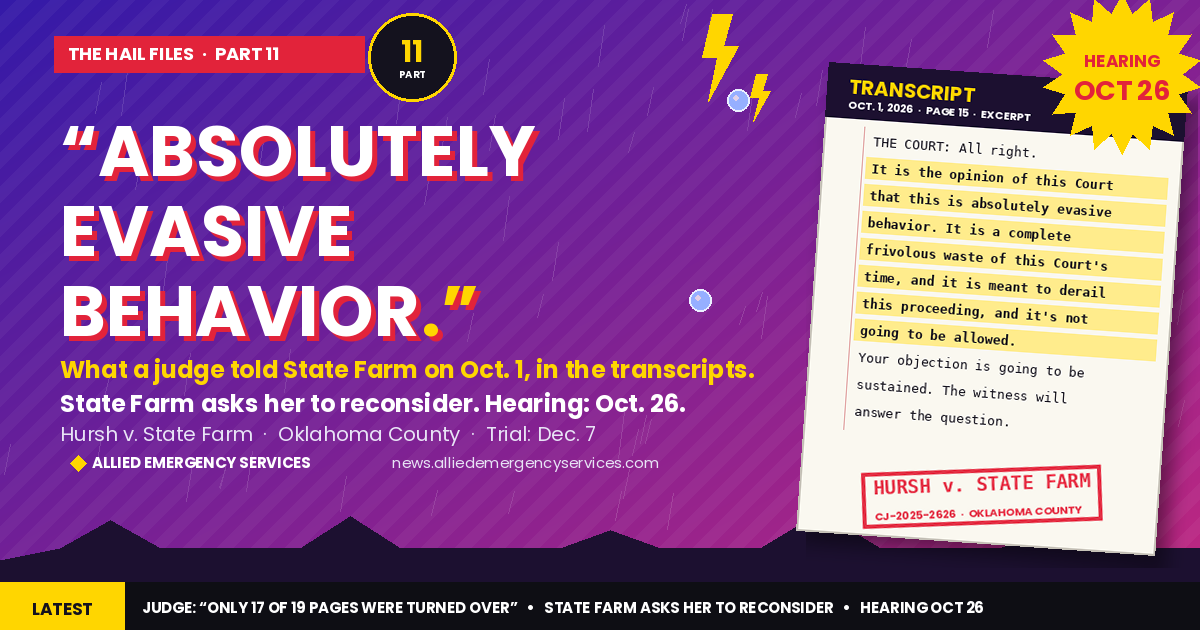
A separate discovery dispute is unfolding in the private Hursh litigation. Recent local reporting says Oklahoma County District Judge Amy Palumbo ordered State Farm to produce documents requested by policyholder plaintiffs. The plaintiffs contend the materials may help explain how storm claims, roof-replacement authority, and claim-payment goals were handled internally.
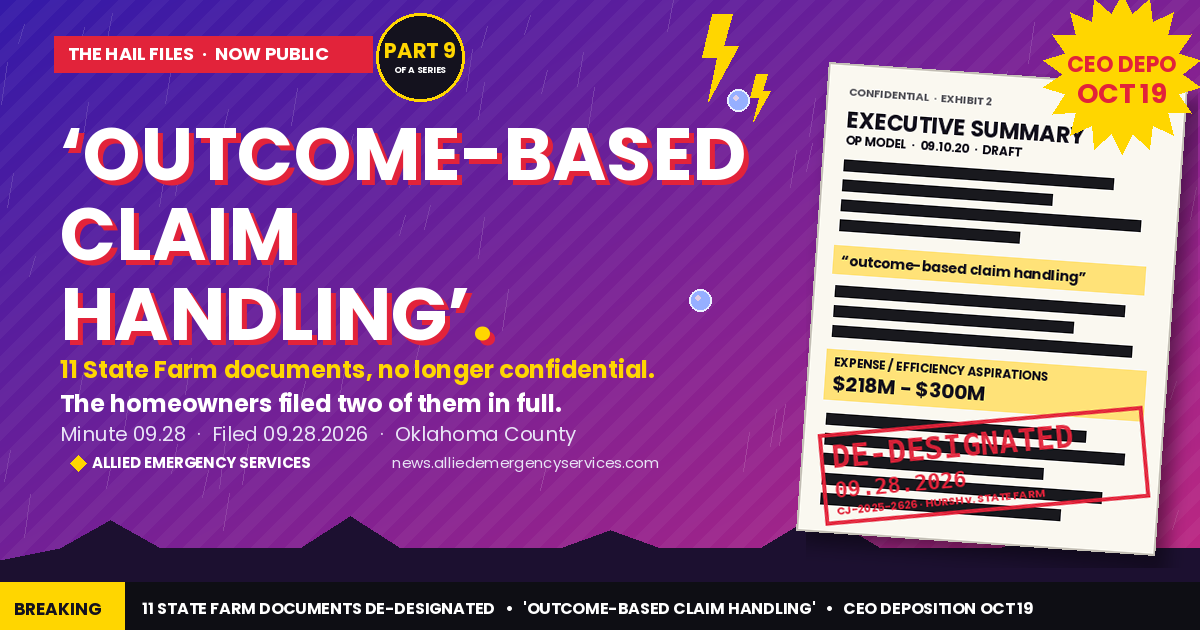
The dispute has reportedly included State Farm confidentiality and trade-secret arguments. A court’s decision requiring document production does not necessarily mean every document will become available to the general public. Protective orders, confidentiality designations, redactions, sealing motions, and later appellate rulings can affect access.
The discovery order also is not proof that the documents contain evidence of fraud. It means the trial court determined that materials within the scope of the order had to be produced in the litigation.
It is equally important not to confuse that discovery dispute with the Oklahoma Supreme Court’s ruling. The Supreme Court addressed Drummond’s attempt to intervene; it did not issue an order making State Farm’s internal records public.
What Happens Next in the State Farm and Allstate Lawsuits?
As of July 16, 2026, the public sources reviewed show both standalone lawsuits in their initial stages. No judgment on liability and no trial date were identified in those sources.
Typical next steps in complex civil litigation may include:
- Answers or motions challenging the complaints
- Requests to dismiss particular claims
- Written discovery and document production
- Depositions of employees, adjusters, consultants, and experts
- Disputes over confidentiality or trade-secret protection
- Expert analysis of roofing, meteorology, engineering, claim practices, and damages
- Motions for summary judgment
- Settlement discussions or trial
Drummond has said his objective is to create a restitution process for policyholders if the state obtains a monetary recovery. No such fund currently exists. Any restitution program would depend on the outcome of the litigation, the terms of a settlement or judgment, court approval, eligibility standards, and available funds.
Why These Oklahoma Insurance Lawsuits Matter in Illinois and the Chicago Area
The Oklahoma State Farm and Allstate lawsuits do not, by themselves, change Illinois insurance law, establish coverage under an Illinois policy, or determine how an Illinois storm damage insurance claim must be resolved.
They are nevertheless relevant to homeowners, property managers, contractors, adjusters, and restoration professionals in Illinois, Wisconsin, and Indiana because the disputes highlight recurring questions found in many catastrophe claims:
- Who had authority to make the repair-scope decision?
- Was the entire exterior system inspected?
- Was the conclusion based on an on-site evaluation or remote review?
- Were all photographs, measurements, test squares, weather records, and estimates considered?
- Was observed damage attributed to hail, wind, age, installation, manufacturing, or ordinary deterioration?
- Does a proposed spot repair comply with the adopted building code and manufacturer instructions?
- How was depreciation calculated?
- What policy language supports a denial, limitation, or exclusion?
- Were hidden conditions documented after tear-off or removal?
An estimate difference does not automatically prove wrongdoing. Contractors and insurers may disagree because they used different quantities, material assumptions, labor operations, waste factors, repair methods, code requirements, pricing databases, or damage-causation conclusions. The most effective response is a detailed, evidence-based comparison—not a generalized accusation.
Why Building Codes Matter in Storm Damage Restoration
Building codes do not determine whether an insurance policy covers a loss. Coverage depends on the policy, cause of loss, exclusions, endorsements, damage evidence, and applicable insurance law.
Codes can, however, materially affect how covered property must be repaired or replaced. Once work is undertaken, the restoration may need to comply with the locally adopted code, municipal amendments, permit requirements, approved product instructions, and tested assembly specifications.
Roof assemblies and wind resistance
The FEMA compilation of the 2021 International Residential Code emphasizes that residential construction must provide a complete load path capable of transferring loads to the foundation. It also addresses wind resistance for roof coverings, manufacturer installation instructions, underlayment, roof-deck construction, and removal of existing roof-covering layers during a roof replacement, subject to stated exceptions. The locally adopted edition and amendments must always be confirmed with the authority having jurisdiction.
For a storm restoration scope, relevant questions may include:
- Is damaged or deteriorated decking present?
- Is the existing deck an acceptable substrate?
- Does the proposed roofing product meet required wind classifications?
- Are the fastener type, length, location, and spacing compliant?
- Must existing roofing be removed to inspect or prepare the deck?
- Are drip edge and flashings being replaced and installed in the correct sequence?
- Are roof penetrations properly flashed?
- Is an ice barrier required?
- Do ventilation changes create other code or manufacturer issues?
FORTIFIED roof and hail concepts
The FORTIFIED Home Standard uses a documented, system-based approach to improving resistance to high wind, wind-driven rain, and hail. Its provisions address roof-deck attachment, sealed roof decks, corrosion-resistant fasteners, flashing, drip edge, impact-rated roof coverings, openings, soffits, and continuous load paths.
FORTIFIED is a voluntary resilience program and does not replace local code or structural design. It provides useful technical context for why a roof should be evaluated as an interconnected assembly rather than simply counting visibly damaged shingles.
Siding and soffit performance
Exterior cladding claims can also involve design-pressure ratings, fastener penetration, fastener placement, panel engagement, substrate condition, soffit support, and manufacturer installation requirements.
The Vinyl Siding Institute’s I-Code reference guide explains that properly certified polymeric cladding must be selected and installed for the applicable wind pressures. It also emphasizes corrosion-resistant fasteners, fastening in the designated slots without restricting required panel movement, and added soffit support where unsupported spans exceed applicable limits.
A proposal to replace only a few siding panels may therefore require more analysis than counting cracked or missing pieces. Product identification, availability, exposure, fastening, substrate access, water-resistive barriers, flashing integration, and the ability to perform a compliant repair can all affect the restoration scope.
What Should a Homeowner Do When a Storm Claim Appears Underpaid or Improperly Denied?
1. Protect people and prevent additional damage
Address electrical hazards, unstable materials, active water entry, broken glazing, and other immediate safety concerns. Reasonable emergency measures may include temporary roof covering, board-up, water extraction, or stabilization.
Photograph the condition before emergency work when it is safe to do so, and keep invoices, receipts, work authorizations, and material records. Illinois consumer guidance recommends taking photographs or video and making essential temporary repairs to prevent further damage.
2. Report the loss promptly
Notify the insurer as required by the policy. Record the claim number, date and time of each communication, representative’s name, and what was discussed.
Avoid relying exclusively on telephone conversations. Follow important discussions with a written summary and retain emails, letters, estimates, reports, and claim-portal messages.
3. Obtain a complete, documented inspection
A storm inspection should extend beyond the most obvious roof slope. Depending on the event, relevant components may include:
- Roofing and roof penetrations
- Flashings and metal edge components
- Siding and exterior trim
- Gutters and downspouts
- Windows, screens, and glazing
- Garage doors
- Decks, fences, and accessory structures
- Attic or interior water entry
- Insulation, drywall, flooring, and finishes
- Mechanical or rooftop equipment
The inspection should distinguish direct physical damage from age, wear, prior damage, installation conditions, and unrelated defects.
4. Compare estimates line by line
A carrier estimate and contractor estimate should be compared by component, quantity, material, labor operation, waste, access, permit requirement, code item, and supporting evidence.
Request a written explanation for disputed items. Questions may include:
- What policy provision supports the decision?
- What physical evidence supports the cause-of-loss conclusion?
- Was depreciation applied to material, labor, or both?
- Is depreciation recoverable?
- What documentation is required to recover withheld amounts?
- Why is a repair considered feasible?
- Were manufacturer repair instructions evaluated?
- Was ordinance-or-law coverage considered?
5. Identify code and manufacturer requirements
Confirm the code edition and amendments adopted by the local building department. Obtain applicable manufacturer installation instructions, product approvals, wind ratings, and repair limitations.
Code documentation should be specific. A general statement that work must be “brought up to code” is less effective than identifying the adopted provision, affected assembly, required operation, and reason the provision applies.
6. Report concealed damage or scope changes promptly
Hidden deterioration or storm damage may not become visible until roofing, siding, insulation, drywall, or other materials are removed.
The Illinois Department of Insurance advises consumers to contact the insurer when a contractor identifies hidden damage or when there is a discrepancy over repair costs. Written estimates should be obtained before permanent repairs proceed.
7. Use the appropriate escalation channel
When a dispute cannot be resolved through the assigned adjuster, a policyholder may request supervisory review or follow the insurer’s formal reconsideration process.
Illinois consumers may also submit a written complaint to the Illinois Department of Insurance. The Department sends the complaint to the insurer, reviews the response, and may request corrective action if it identifies a violation or failure to follow the policy. The Department does not replace a court and does not act as the policyholder’s private attorney.
Questions involving coverage interpretation, deadlines, appraisal, examinations under oath, bad-faith allegations, or legal remedies should be directed to an appropriately licensed insurance professional or attorney.
How Allied Emergency Services Supports Storm Restoration Documentation
A qualified restoration contractor does not decide insurance coverage. The contractor’s role is to inspect the property, identify physical conditions, perform emergency mitigation, develop an appropriate repair scope, document the work, and complete authorized restoration in compliance with applicable requirements.
For roof, siding, window, gutter, deck, water-intrusion, and structural exterior losses, a code-aware restoration file may include:
- Date-stamped photographs and video
- Measurements and elevation diagrams
- Material and product identification
- Weather-event information
- Inspection notes and damage mapping
- Emergency mitigation records
- Moisture readings and drying documentation
- Manufacturer instructions
- Building-code references
- Permit and inspection records
- Itemized estimates
- Supplement documentation for concealed conditions
- Completion photographs and warranties
This type of documentation cannot guarantee insurance payment. It can help ensure that the physical condition and proposed restoration scope are clearly presented for evaluation.
Frequently Asked Questions
Why is Oklahoma suing State Farm?
Oklahoma alleges that State Farm used an internal Hail Focus Initiative, restricted adjuster authority, applied undisclosed claim standards, and used other coordinated practices to reduce roof replacements and payments on wind and hail claims. State Farm denies the allegations.
Why is Oklahoma suing Allstate?
Oklahoma alleges Allstate limited field-adjuster authority, relied on third-party inspectors and centralized reviewers, applied undisclosed standards, and improperly reduced or denied valid storm damage insurance claims. Allstate says the lawsuit has no merit and maintains that it makes fair payments based on its policies.
Have State Farm or Allstate been found guilty of fraud or racketeering?
No. These are civil allegations in recently filed complaints. No court has entered a merits judgment finding either company liable for the conduct alleged by the Oklahoma Attorney General.
What did the Oklahoma Supreme Court decide?
The court decided that Drummond could not transform one couple’s private State Farm case into a statewide consumer-protection and racketeering action through intervention. It said a separate lawsuit was the appropriate procedural vehicle. It did not decide whether State Farm’s claim practices were lawful.
Will State Farm’s internal documents become public?
Not necessarily. Recent reporting says a trial judge ordered certain documents produced in the private Hursh litigation. Production to litigants does not automatically mean unrestricted public access. Confidentiality orders, redactions, sealing, and appeals may affect whether particular records become publicly available.
Will Oklahoma homeowners automatically receive restitution?
No. Restitution is a remedy requested by the Attorney General. A distribution process would require a settlement or judgment providing funds, court approval, eligibility standards, and a claims-administration procedure.
Do these lawsuits change Illinois storm-claim law?
No. The Oklahoma complaints do not change Illinois law or determine coverage under an Illinois policy. They may, however, increase public scrutiny of how large insurers manage catastrophe claims, field inspections, centralized review, depreciation, and repair-scope decisions.
What documentation is most useful in a disputed storm claim?
Useful documentation can include pre-repair photographs, measurements, weather information, contractor inspection findings, material identification, code provisions, manufacturer instructions, itemized estimates, receipts, correspondence, and evidence of concealed damage discovered during authorized work.
The Bottom Line
Oklahoma is suing State Farm and Allstate because Attorney General Gentner Drummond alleges both insurers used coordinated and undisclosed practices to reduce payments on legitimate homeowner wind and hail claims.
The State Farm case focuses on the alleged Hail Focus Initiative, restrictions on roof-replacement approvals, internal standards, and engineering reviews. The Allstate case focuses on alleged restrictions placed on field adjusters, third-party inspectors, centralized reviewers, undisclosed claim standards, and disputed replacement-cost or depreciation practices.
The cases could eventually provide important information about how storm damage insurance claims were evaluated. At present, however, they contain disputed allegations—not proven conclusions. Both insurers deny wrongdoing, and the courts have not determined liability.
For property owners in Illinois and the greater Chicago area, the practical lesson is to report storm damage promptly, protect the property, preserve evidence, obtain a detailed inspection, compare estimates line by line, and document applicable building-code and manufacturer requirements.
For immediate service or consultation, you may contact us at Allied Emergency Services, INC.
Contact Information:
Phone: 1-800-792-0212
Email: Info@AlliedEmergencyServices.com
Location: Serving Illinois, Wisconsin, and Indiana with a focus on the greater Chicago area.
If you require immediate assistance or have specific questions, our human support is readily available to help you.
Disclaimer: This article is intended for informational purposes only. For professional advice, consult experts in the field.
⚡ Storm or Roof Damage? Get a FREE Estimate
Text ESTIMATE to (844) 907-2546
Or call (800) 792-0212 for 24/7 emergency response
AI-powered • No obligation • Licensed IL & WI
Need storm damage help?
Allied Emergency Services — Licensed IL & WI Storm Damage Specialists
For more than a decade, Allied has been restoring storm damage across Illinois and Wisconsin. IICRC-certified, EPA Lead-Safe, IL Licensed Roofing Contractor #104.019029. 24/7 emergency response.
Learn about our Storm Damage service →Free property assessment within 24 hours · No obligation · Photo-documented findings you can share with your insurer
Attorneys: forensic storm damage documentation & construction expert consultation for counsel →