
⚡ Storm or Roof Damage? Get a FREE Estimate
Text ESTIMATE to (844) 907-2546
Or call (800) 792-0212 for 24/7 emergency response
AI-powered • No obligation • Licensed IL & WI
Direct Answer: Is Illinois a Matching State for Siding Claims?
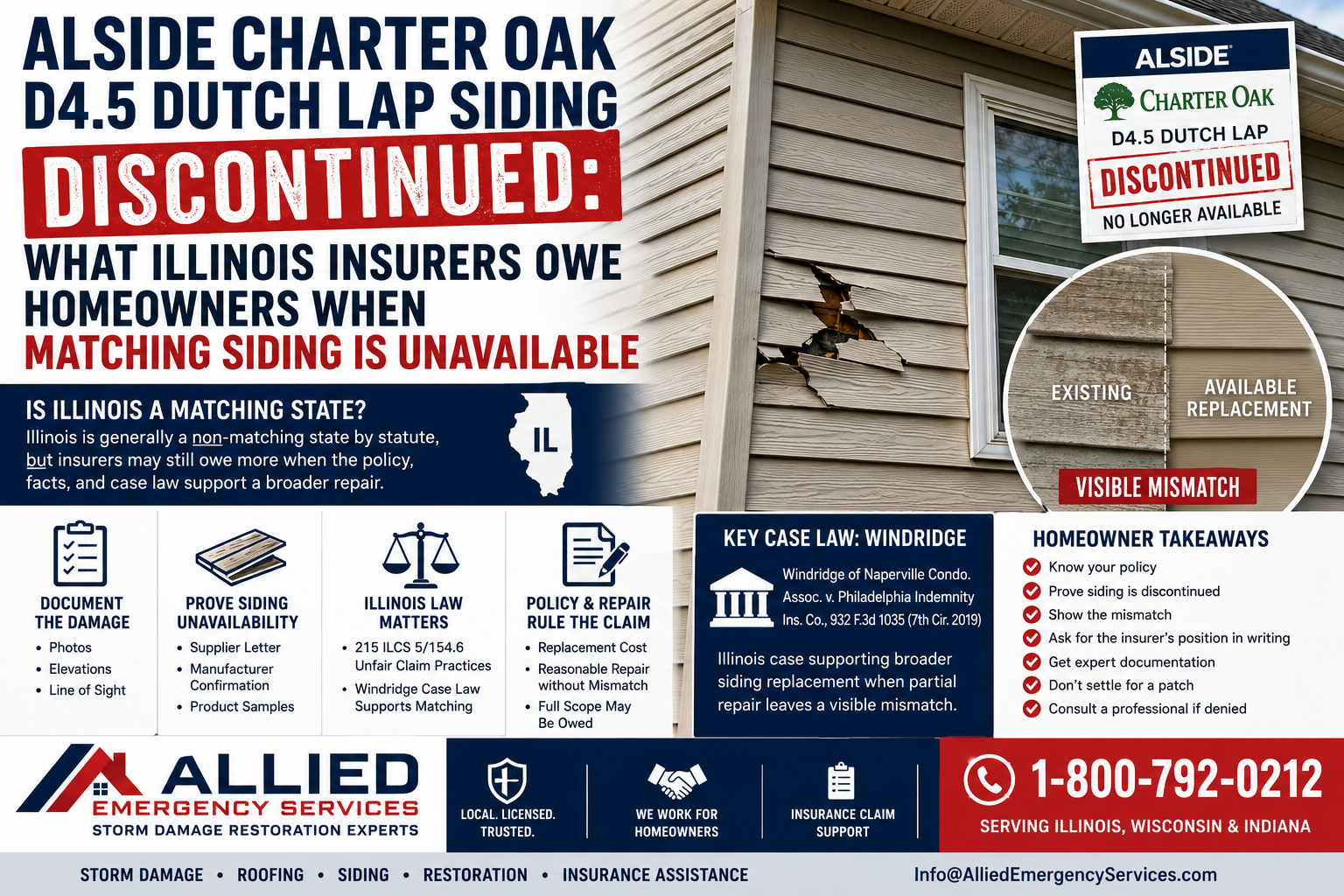
Illinois is generally not considered a statutory “matching state” in the way some states are. Illinois does not have a broad, simple rule that automatically requires an insurance carrier to replace every undamaged siding elevation whenever one wall is damaged.
But that does not mean matching is irrelevant in Illinois.
When siding such as Alside Charter Oak D4.5 Dutch Lap is discontinued, unavailable, faded, or no longer reasonably matchable, the insurance claim may depend on:
- The exact homeowners insurance policy language.
- Whether the policy provides replacement cost coverage.
- Whether the damaged and undamaged siding are part of one covered property or building system.
- Whether a reasonable repair can be made without visible mismatch.
- Whether matching siding is truly unavailable.
- Whether the insurer performed a reasonable investigation.
- Whether Illinois case law, including Windridge, supports broader replacement under the facts.
- Whether the dispute belongs in appraisal, supplemental review, litigation, or attorney evaluation.
The practical answer for Illinois homeowners is:
Illinois may be a “non-matching state” by statute, but insurers still may owe more than a small patch repair when matching siding is unavailable and the policy requires repair or replacement that restores the covered property to a reasonably comparable condition.
Important Product Note: Verify Alside Charter Oak D4.5 Dutch Lap Availability Before Publishing or Filing a Claim
This article addresses claims involving Alside Charter Oak D4.5 Dutch Lap siding when the product, profile, color, or texture is allegedly discontinued or unavailable.
Before a homeowner, contractor, public adjuster, or attorney states that the siding is discontinued, the claim file should include proof.
Acceptable documentation may include:
- Written distributor statement.
- Manufacturer availability letter.
- Supplier email confirming discontinued status.
- ITEL or comparable siding identification report.
- Product sample report.
- Photos of the existing siding profile.
- Color and exposure documentation.
- Original construction records, if available.
- Contractor report explaining why available materials do not reasonably match.
The strongest claim file does not simply say “this siding is discontinued.” It proves it.
Quick Facts: Illinois Siding Matching Claims
| Question | Answer |
|---|---|
| Is Illinois a statutory siding matching state? | Generally, no. Illinois does not have a broad automatic siding matching statute. |
| Does that mean insurers never owe matching siding? | No. Policy language, facts, and case law can still matter. |
| What law applies to unfair claim handling? | 215 ILCS 5/154.6, Illinois Insurance Code, unfair claim settlement practices. |
| What Illinois case is most important for matching disputes? | Windridge of Naperville Condominium Association v. Philadelphia Indemnity Insurance Co., 932 F.3d 1035 (7th Cir. 2019). |
| Does §154.6 automatically create a private lawsuit? | Homeowners should ask counsel. §154.6 is commonly treated as a regulatory unfair-claims statute, not a simple automatic private damages claim. |
| What if the siding is discontinued? | The homeowner should document unavailability, mismatch, line of sight, damaged elevations, policy language, and repair feasibility. |
| Can a carrier pay only for one damaged elevation? | Sometimes yes, sometimes no. It depends on policy language, damage facts, matching evidence, appraisal/litigation posture, and repair feasibility. |
| Should contractors give legal advice? | No. Contractors can document damage, materials, repair scope, and availability. Legal conclusions should come from an attorney. |
Why Alside Charter Oak D4.5 Dutch Lap Creates Insurance Disputes
Siding claims become difficult when the damaged material is no longer available in the same profile, color, texture, exposure, or lock design. Alside Charter Oak D4.5 Dutch Lap siding is a specific siding configuration. If the existing material cannot be replaced with a reasonably matching product, an insurance carrier’s small repair estimate may leave the homeowner with a visible patchwork exterior.
This often happens after:
- Hail damage.
- Wind damage.
- Tornado debris impact.
- Falling tree or branch damage.
- Siding punctures.
- Cracked vinyl panels.
- Broken locks or tabs.
- Damaged corners, J-channel, trim, or accessories.
- Discontinued product lines.
- Color fade that prevents reasonable match.
- Manufacturer changes to profile, embossing, or finish.
A homeowner may ask:
“If the insurance company pays only for the damaged siding, but no matching siding exists, am I stuck with mismatched walls?”
In Illinois, the answer is fact-specific. The homeowner should not assume automatic full replacement, but the carrier should not ignore the matching problem either.
What Illinois Insurers Owe When Matching Siding Is Unavailable
An Illinois insurer owes what the policy requires, based on the covered loss and applicable law. In a siding claim, that may include payment for direct physical damage and, depending on policy language and facts, the reasonable cost to repair or replace damaged property.
When matching siding is unavailable, the key dispute is whether replacing only the physically damaged panels restores the insured property as required by the policy.
A carrier may argue:
- Only physically damaged siding is covered.
- Undamaged elevations are not covered.
- Illinois is not a matching state.
- Available siding is close enough.
- The mismatch is cosmetic.
- Policy language limits matching.
- The policy excludes or limits cosmetic damage.
- Appraisal should decide amount, not coverage.
- The mismatch is due to age or fading, not the storm.
A homeowner may respond with documentation showing:
- The exact siding product is discontinued or unavailable.
- The replacement panel does not match profile, exposure, color, texture, or appearance.
- A patch repair would leave visible mismatch.
- The affected siding is part of one continuous exterior system.
- Replacement of additional elevations is necessary to achieve a reasonably uniform repair.
- The policy’s replacement cost language supports a broader repair scope.
- The insurer failed to reasonably investigate the matching issue.
- The insurer did not address case law or appraisal evidence.
The correct answer depends on the policy, the property, the material evidence, and the legal forum.
Illinois Section 154.6: Why It Matters in Matching Siding Claims
215 ILCS 5/154.6 identifies unfair claim settlement practices in Illinois. It does not simply say, “the insurer must match siding.” Instead, it focuses on claim handling conduct.
In a discontinued siding dispute, §154.6 may become relevant if the carrier appears to:
- Misrepresent policy provisions or material facts.
- Fail to acknowledge communications.
- Fail to adopt reasonable standards for claim investigation.
- Refuse to pay a claim without conducting a reasonable investigation.
- Fail to affirm or deny coverage within a reasonable time after proof of loss.
- Fail to provide a reasonable explanation for denial or compromise.
- Attempt to settle for less than what a reasonable person would believe was owed based on written or printed advertising or policy materials, depending on the facts.
Official statute:
215 ILCS 5/154.6
For homeowners, the practical point is not that §154.6 automatically creates a matching claim. The practical point is that an insurer should handle the siding claim fairly, investigate the discontinued material issue, address the policy language, and explain its position in writing.
If the carrier refuses to evaluate matching evidence, ignores product unavailability, or denies a broader repair scope without a reasonable investigation, the homeowner should consider professional claim or legal review.
Section 154.6 vs. Section 155: Do Not Confuse the Two
Illinois homeowners often hear “bad faith” and assume every underpaid storm claim is automatically illegal. Illinois law is more specific.
215 ILCS 5/154.6
Section 154.6 identifies unfair claim settlement practices. It is often relevant to regulatory complaints and claim-handling standards.
215 ILCS 5/155
Section 155 allows a court to award attorney fees, costs, and a statutory penalty when an insurer’s conduct or delay is found to be vexatious and unreasonable in an action involving policy liability, the amount of loss, or delay in settling a claim.
Official statute:
215 ILCS 5/155
In a discontinued siding dispute, §154.6 may describe problematic claim handling. Section 155 may become relevant if the homeowner must pursue legal action and the insurer’s conduct appears vexatious and unreasonable.
A contractor should not tell a homeowner, “Your insurer violated §154.6” or “This is bad faith.” Those are legal conclusions. A contractor can document the siding damage, discontinued material evidence, mismatch problem, photos, measurements, and repair scope.
The Key Illinois Matching Case: Windridge
The most important Illinois-related matching case homeowners and contractors should know is:
Windridge of Naperville Condominium Association v. Philadelphia Indemnity Insurance Co., 932 F.3d 1035 (7th Cir. 2019).
This federal appellate case applied Illinois law in a property insurance dispute involving damaged siding and replacement cost issues. In general terms, the court upheld a broader siding replacement award where replacement of only the damaged siding would not restore the property to a reasonably matching condition under the policy and appraisal facts.
Google Scholar search:
https://scholar.google.com/scholar?q=Windridge+of+Naperville+Condominium+Association+v.+Philadelphia+Indemnity+Insurance+Company
Why Windridge Matters
Windridge matters because it shows that, under Illinois law and specific policy language, matching can become part of the replacement cost analysis even if undamaged siding panels were not directly hit by hail or wind.
The case does not mean every Illinois homeowner automatically gets full-house siding replacement.
It does mean carriers should be careful before saying:
“Illinois is a non-matching state, so we never owe matching.”
That statement is too broad. Illinois may not have a broad statutory matching mandate, but Windridge shows that the policy language, appraisal record, and facts can still support replacement beyond the exact panels physically damaged.
So Is Illinois a Non-Matching State?
Yes, in the narrow statutory sense, Illinois is commonly described as a non-matching state because it does not have a broad statute or insurance regulation that automatically requires uniform matching of siding, roofing, or exterior materials in every claim.
But “non-matching state” does not mean:
- The carrier can ignore policy language.
- The carrier can ignore discontinued material evidence.
- The carrier can ignore Windridge.
- The carrier can ignore replacement cost terms.
- The carrier can ignore appraisal evidence.
- The carrier can ignore visible mismatch.
- The carrier can refuse to investigate.
- The carrier can make a blanket denial without explanation.
A more accurate Illinois rule is:
Illinois does not provide automatic statutory matching in every property claim, but matching may still be owed when the policy, facts, and repair requirements support it.
That is the sentence homeowners, contractors, public adjusters, and attorneys should use.
What Counts as “Matching” in a Siding Claim?
Matching does not mean the homeowner gets an upgrade simply because they prefer a new look. Matching means the replacement materials are reasonably comparable to the existing materials in the context of the repair required by the policy.
For siding, matching may involve:
- Manufacturer.
- Product line.
- Profile.
- Exposure.
- Dutch lap shape.
- Texture.
- Color.
- Fade level.
- Gloss.
- Thickness.
- Lock design.
- Panel length.
- Accessories.
- Corner posts.
- J-channel.
- Trim.
- Elevation visibility.
- Line of sight.
With Alside Charter Oak D4.5 Dutch Lap, the key matching questions may include:
- Is the same profile available?
- Is the same exposure available?
- Is the same color available?
- Has the color faded beyond reasonable match?
- Is the replacement product visibly different?
- Can the damaged elevation be repaired without visual mismatch?
- Are adjacent elevations in the same line of sight?
- Does the home’s design make mismatch obvious?
- Would a reasonable repair require replacing additional elevations?
Discontinued Siding Does Not Automatically Mean Full Replacement
A discontinued product is strong evidence, but it is not the entire claim.
A carrier may still investigate:
- Whether a reasonably comparable product exists.
- Whether a repair can be made in a less visible area.
- Whether siding can be harvested from another elevation.
- Whether only one elevation is affected.
- Whether the policy limits matching.
- Whether cosmetic mismatch is excluded or limited.
- Whether the homeowner has replacement cost or actual cash value coverage.
- Whether the siding damage is storm-related.
- Whether damage is excluded as wear, deterioration, or mechanical damage.
The homeowner’s job is to build a factual record. The attorney’s job is to evaluate whether the policy and Illinois law support broader replacement.
How to Prove Alside Charter Oak D4.5 Dutch Lap Is Unavailable
A strong discontinued siding claim should include more than a contractor opinion.
Homeowners should gather:
1. Manufacturer or Supplier Confirmation
Ask for written confirmation that the exact product, color, profile, or exposure is discontinued or unavailable.
2. Siding Identification Report
A third-party siding identification report may help confirm the product type and whether a match exists.
3. Physical Sample
Remove a sample only when appropriate and safe. Preserve the sample for identification and comparison.
4. Side-by-Side Photos
Photograph the existing siding and proposed replacement material under natural light from multiple angles.
5. Elevation Photos
Photograph all elevations and identify which walls are damaged and which walls are visible together.
6. Line-of-Sight Analysis
Show whether mismatched siding would be visible from the street, driveway, yard, neighboring properties, or connected elevations.
7. Contractor Repairability Statement
The contractor should explain whether a reasonable repair can be performed without mismatched panels, broken locks, or damage to surrounding siding.
8. Insurance Estimate Comparison
Compare the carrier estimate to the contractor estimate and identify the exact scope differences.
Line of Sight: Why One Damaged Wall Can Affect More Than One Elevation
Siding is a visual exterior system. If damaged siding is replaced on one elevation but the replacement material does not match, the home may be left with a visible patch.
Line of sight matters because a mismatch may be obvious when:
- Front and side elevations are visible together.
- Siding wraps a corner.
- A garage wall connects to the main house.
- A gable ties into a lower wall.
- A bay window or bump-out interrupts an elevation.
- A porch wall connects visually to the front elevation.
- Adjacent elevations face the street.
- The siding is faded or weathered unevenly.
A contractor can document line of sight with photos. An attorney or public adjuster may use that evidence to argue the claim under the policy.
Actual Cash Value vs. Replacement Cost in Siding Matching Claims
Coverage may differ depending on whether the policy provides actual cash value or replacement cost value.
Actual Cash Value
Actual cash value generally considers depreciation. In a siding claim, the carrier may calculate payment based on damaged materials after depreciation, subject to policy terms.
Replacement Cost Value
Replacement cost coverage may provide the cost to repair or replace covered damaged property without depreciation, subject to policy conditions. Matching disputes often become more significant under replacement cost coverage because the homeowner may argue that a mismatched patch does not restore the property as required.
The specific policy language matters. Homeowners should request a complete policy copy and not rely only on the declarations page.
What If the Policy Has a Cosmetic Damage Exclusion?
Some policies include cosmetic damage exclusions or limitations. These endorsements can affect siding, metal, roofing, or exterior component claims.
If a carrier cites a cosmetic damage exclusion, the homeowner should ask:
- What exact policy language applies?
- Does the carrier agree there is physical damage?
- Is the damage functional or only cosmetic?
- Does the exclusion apply to vinyl siding?
- Does the exclusion apply to matching?
- Does the exclusion apply to damaged panels only or broader repair scope?
- Did the carrier inspect for cracks, punctures, broken locks, water intrusion, or functional impairment?
- Did the carrier consider Windridge or replacement cost language?
A contractor should document the physical condition. Legal interpretation belongs to an attorney.
What If the Carrier Says “We Only Owe the Damaged Panels”?
That may or may not be correct.
The homeowner should ask for the carrier’s position in writing.
Ask the insurer:
- What policy language limits payment to only physically damaged panels?
- Did you investigate whether Alside Charter Oak D4.5 Dutch Lap is available?
- What replacement product are you relying on?
- Does the proposed replacement match profile, exposure, texture, and color?
- Did you perform a line-of-sight analysis?
- Did you consider whether the repair restores the property to pre-loss condition?
- Did you consider replacement cost language?
- Did you consider Windridge?
- Did you consider appraisal if the dispute is amount-of-loss related?
- Are any amounts undisputed, and when will they be paid?
This does not accuse the insurer of bad faith. It simply forces clarity.
Contractor Documentation Checklist for Discontinued Siding Claims
A restoration contractor should document facts, not legal conclusions.
A strong siding claim file should include:
| Documentation Item | Why It Matters |
|---|---|
| Storm date | Connects damage to a specific hail or wind event. |
| NOAA or weather data | Supports storm occurrence near the property. |
| Photos of damaged siding | Shows physical impact, cracks, holes, or broken panels. |
| Elevation diagram | Shows where damage occurred. |
| Product identification | Confirms siding manufacturer, profile, and exposure. |
| Discontinued product proof | Shows matching material is unavailable. |
| Replacement sample photos | Shows mismatch. |
| Line-of-sight photos | Shows whether mismatch is visible. |
| Repairability notes | Explains whether a partial repair is feasible. |
| Contractor estimate | Identifies the scope needed to restore the exterior. |
| Carrier estimate | Shows what the insurer did or did not include. |
| Communications log | Documents delays, denials, or failure to respond. |
NOAA Storm Events Database:
https://www.ncei.noaa.gov/access/search/data-search/storm-events
What Contractors Should Say—and Not Say—in Illinois Matching Claims
A contractor should stay within the construction role.
Appropriate Contractor Statement
“The damaged siding appears to be Alside Charter Oak D4.5 Dutch Lap. Based on supplier confirmation and product comparison, the same siding is not available in a reasonably matching profile/color. A partial repair may leave a visible mismatch on connected elevations. Our estimate documents the construction scope needed to restore the exterior.”
Risky Contractor Statement
“Illinois law requires the insurance company to replace all your siding.”
That statement is too broad and may be inaccurate.
Better Claim File Language
“Illinois does not provide automatic statutory matching in every claim, but this file contains product unavailability evidence, mismatch photos, line-of-sight documentation, and repair scope information that should be reviewed under the policy and applicable Illinois law.”
That is factual, accurate, and safer.
When Appraisal May Matter in a Siding Matching Dispute
Many property policies include an appraisal provision. Appraisal may be used when the dispute is about the amount of loss, not pure coverage.
In a discontinued siding claim, appraisal may become relevant when:
- The carrier agrees there is covered siding damage but disputes the scope.
- The parties disagree over the amount needed to repair or replace siding.
- Matching is treated as part of the repair cost.
- The dispute involves how much siding must be replaced to restore the property.
However, appraisal is policy-specific and legally sensitive. Some disputes involve coverage questions that may not be appropriate for appraisal. Homeowners should consult a qualified professional or attorney before demanding or refusing appraisal.
Windridge involved appraisal issues, which is one reason it matters in Illinois siding disputes.
What Illinois Homeowners Should Do After Siding Hail or Wind Damage
Step 1: Photograph the Damage
Take wide-angle and close-up photos of each elevation. Include cracks, holes, dents, loose panels, broken accessories, and interior water damage if present.
Step 2: Record the Storm Date
Write down the date and time of the storm. Save weather alerts, hail photos, and local storm reports.
Step 3: Preserve a Siding Sample
If safe and appropriate, preserve a damaged siding sample for identification. Do not destroy evidence unnecessarily.
Step 4: Identify the Product
Confirm whether the siding is Alside Charter Oak D4.5 Dutch Lap or another product.
Step 5: Verify Availability
Get supplier or manufacturer documentation showing whether the exact product is available.
Step 6: Compare Replacement Materials
Photograph replacement samples next to the existing siding.
Step 7: Document Line of Sight
Show whether mismatched replacement panels would be visible from normal viewing areas.
Step 8: Request the Carrier’s Position in Writing
Ask the insurer to explain whether it accepts or rejects matching-related scope and why.
Step 9: Verify Contractor Licensing and Contract Terms
Before signing restoration documents, verify the contractor and understand any insurance-related paperwork.
Related guide:
Illinois HRRA Contractor Fraud Protection Guide
Step 10: Consult a Professional if the Claim Is Disputed
If the carrier refuses to address discontinued siding, matching evidence, or replacement cost language, the homeowner may need a licensed public adjuster or Illinois insurance attorney.
Red Flags in a Discontinued Siding Insurance Dispute
Homeowners should pay attention if the carrier:
- Denies matching without inspecting the siding product.
- Says “Illinois is non-matching” but does not cite policy language.
- Ignores supplier proof that the siding is discontinued.
- Uses a replacement product with a different profile or exposure.
- Refuses to consider line-of-sight evidence.
- Pays for damaged panels but no reasonable way to install them.
- Fails to explain the claim decision in writing.
- Delays responding to a documented supplement.
- Fails to pay undisputed amounts.
- Misstates the policy or claim facts.
- Refuses to identify the matching product it believes is available.
These facts do not automatically prove bad faith, but they may justify professional claim review.
Illinois Discontinued Siding Matching Claims
Illinois is generally not a statutory “matching state,” meaning there is no broad automatic rule requiring insurers to replace all siding whenever one area is damaged. However, Illinois insurers may still owe more than a patch repair when matching siding is unavailable, depending on the policy language, replacement cost coverage, repair feasibility, line-of-sight evidence, discontinued product proof, and Illinois case law such as Windridge of Naperville Condominium Association v. Philadelphia Indemnity Insurance Co. Section 215 ILCS 5/154.6 does not create a simple matching rule, but it identifies unfair claim settlement practices that may matter when an insurer fails to reasonably investigate discontinued siding, misrepresents policy language, or refuses to explain its claim position.
FAQ: Alside Charter Oak D4.5 Dutch Lap, Discontinued Siding, and Illinois Matching Claims
Is Illinois a siding matching state?
Illinois is generally not considered a statutory siding matching state. There is no broad automatic Illinois statute requiring full siding replacement in every mismatch claim. But matching can still matter under the policy language, facts, appraisal record, and Illinois case law.
Does Illinois being a non-matching state mean my insurer never owes matching siding?
No. “Non-matching state” does not mean matching is impossible. It means there is no automatic statewide matching rule. A homeowner may still argue for broader replacement based on the policy, discontinued material evidence, visible mismatch, replacement cost language, and cases such as Windridge.
What is 215 ILCS 5/154.6?
215 ILCS 5/154.6 is part of the Illinois Insurance Code and identifies unfair claim settlement practices. It addresses claim handling conduct such as misrepresentation, failure to reasonably investigate, failure to communicate, and failure to provide reasonable explanations for claim decisions.
Does 215 ILCS 5/154.6 require matching siding?
No. Section 154.6 does not create a simple automatic siding matching rule. It may become relevant if the insurer mishandles the claim, ignores discontinued material evidence, or refuses to reasonably investigate.
What is the Windridge case?
Windridge of Naperville Condominium Association v. Philadelphia Indemnity Insurance Co., 932 F.3d 1035 (7th Cir. 2019), is an important Illinois-related insurance case involving siding replacement, matching, appraisal, and replacement cost issues. It is often cited in Illinois siding matching disputes.
Does Windridge require full siding replacement in every Illinois claim?
No. Windridge does not create automatic full replacement for every homeowner. It shows that broader siding replacement may be supported when the policy language, appraisal facts, and unavailable matching materials justify it.
What if Alside Charter Oak D4.5 Dutch Lap siding is discontinued?
If the exact siding is discontinued or unavailable, the homeowner should document product identity, unavailability, replacement sample mismatch, line of sight, damaged elevations, and the carrier’s written claim position.
Can my insurer pay only for one damaged siding elevation?
Possibly. It depends on the policy, damage facts, matching evidence, repair feasibility, and legal analysis. A carrier should still investigate whether a partial repair is reasonable when matching siding is unavailable.
What evidence helps a discontinued siding claim?
Helpful evidence includes photos, siding samples, supplier letters, manufacturer confirmation, ITEL or similar reports, line-of-sight photos, contractor estimates, carrier estimates, policy language, and claim communications.
Should a contractor say my insurer must replace all siding?
No. A contractor should document damage, product availability, repair scope, and mismatch evidence. Legal conclusions about what the insurer owes should come from an attorney or the proper claim dispute process.
Final Takeaway for Illinois Homeowners
Illinois is generally a non-matching state in the statutory sense. That means there is no automatic statewide rule requiring full siding replacement every time a small section is damaged.
But that is not the end of the claim.
When Alside Charter Oak D4.5 Dutch Lap siding is discontinued or unavailable, an Illinois siding claim may still require a deeper review of the policy language, replacement cost terms, line-of-sight evidence, product availability, repair feasibility, and Illinois case law such as Windridge.
The best siding matching claims are built on documentation, not assumptions. Homeowners should prove the siding product, prove unavailability, photograph mismatch, document line of sight, request the insurer’s position in writing, and consult qualified professionals when the claim is disputed.
For immediate service or consultation, you may contact us at Allied Emergency Services, INC.
Contact Information:
Phone: 1-800-792-0212
Email: Info@AlliedEmergencyServices.com
Location: Serving Illinois, Wisconsin, and Indiana with a focus on the greater Chicago area.
If you require immediate assistance or have specific questions, our human support is readily available to help you.
Disclaimer: This article is intended for informational purposes only. For professional advice, consult experts in the field.
⚡ Storm or Roof Damage? Get a FREE Estimate
Text ESTIMATE to (844) 907-2546
Or call (800) 792-0212 for 24/7 emergency response
AI-powered • No obligation • Licensed IL & WI
Need storm damage help?
Allied Emergency Services — Licensed IL & WI Storm Damage Specialists
For more than a decade, Allied has been restoring storm damage across Illinois and Wisconsin. IICRC-certified, EPA Lead-Safe, IL Licensed Roofing Contractor #104.019029. 24/7 emergency response.
Learn about our Storm Damage service →Free property assessment within 24 hours · No obligation · Photo-documented findings you can share with your insurer
Attorneys: forensic storm damage documentation & construction expert consultation for counsel →