

⚡ Storm or Roof Damage? Get a FREE Estimate
Text ESTIMATE to (844) 907-2546
Or call (800) 792-0212 for 24/7 emergency response
AI-powered • No obligation • Licensed IL & WI
Direct Answer: Does GAF Timberline HDZ Have a Strong Wind Warranty?
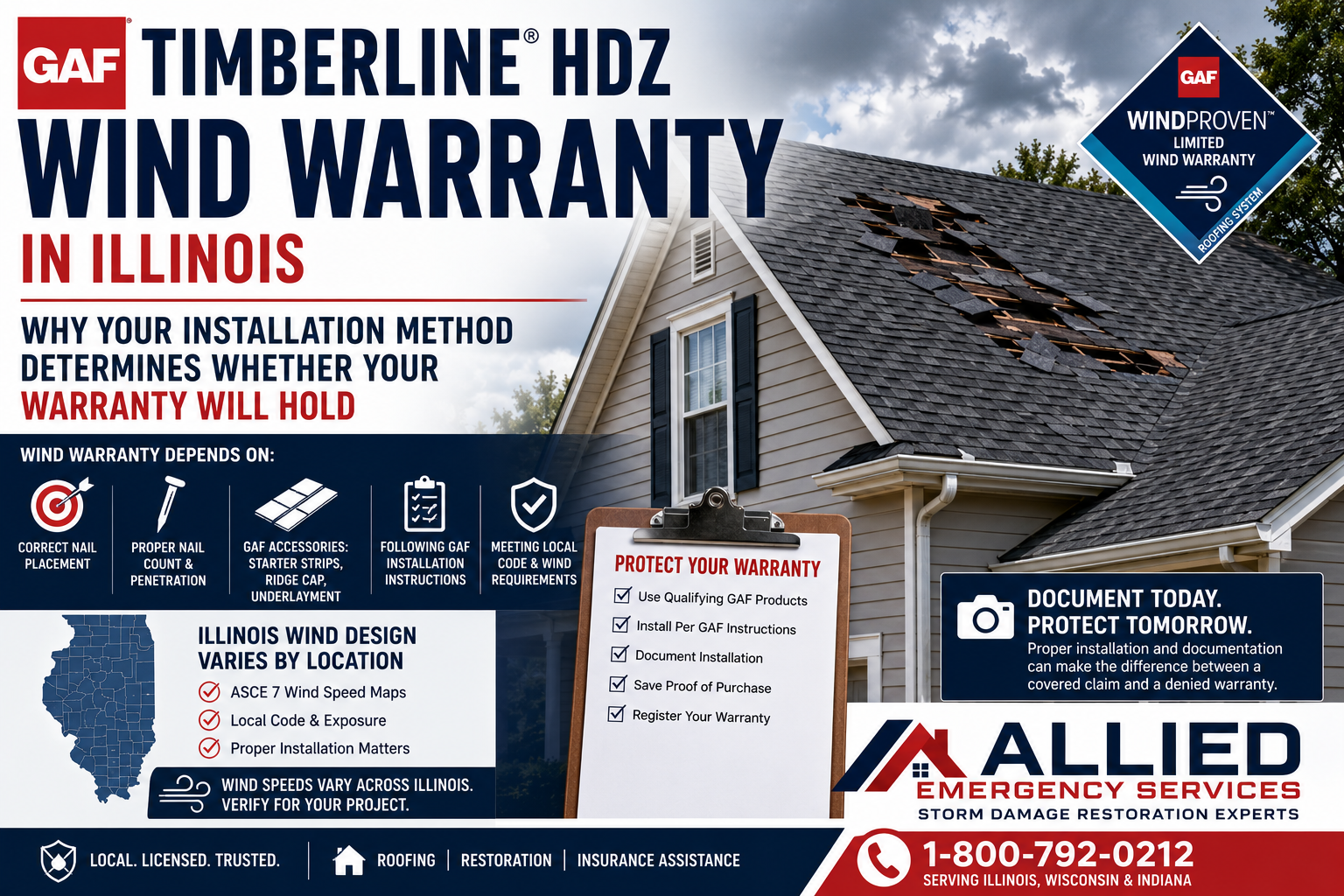
GAF Timberline HDZ shingles have been marketed by GAF as eligible for enhanced wind warranty coverage, including GAF’s WindProven Limited Wind Warranty, when installed according to GAF’s requirements and with the required qualifying GAF accessory products. GAF describes Timberline HDZ as using LayerLock Technology and a wider nailing area known as the StrikeZone nailing area.
But the most important point for Illinois homeowners is this:
The wind warranty is only as strong as the installation file.
If the roof was not installed according to GAF’s current application instructions, warranty requirements, fastening requirements, starter strip requirements, accessory requirements, deck requirements, and applicable code requirements, a wind warranty claim may be disputed or denied.
For Illinois wind damage roof claims, the dispute often comes down to evidence:
- Were the correct shingles installed?
- Were the correct GAF accessories used?
- Were the shingles nailed in the correct location?
- Was the correct number of nails used?
- Did nails penetrate the roof deck properly?
- Was the starter course installed correctly?
- Were ridge cap shingles installed correctly?
- Was the roof installed over an acceptable deck?
- Was the roof installed according to local code and the project’s wind design conditions?
- Was the damage caused by a covered wind event, installation error, age, deck movement, or another excluded condition?
A GAF Timberline HDZ wind warranty dispute is rarely just about wind speed. It is usually about installation method, documentation, and whether the manufacturer’s written requirements were followed.
GAF warranties page:
https://www.gaf.com/en-us/for-homeowners/warranties
Quick Facts for Illinois Homeowners
| Question | Answer |
|---|---|
| Product | GAF Timberline HDZ architectural asphalt shingles. |
| Key warranty concept | Enhanced wind warranty eligibility depends on meeting GAF’s current warranty and installation requirements. |
| Main installation issue | Nail placement, nail count, deck penetration, starter strip, accessories, ridge cap, and adherence to GAF application instructions. |
| Wind map issue | Illinois wind design depends on the project address, local adopted code, ASCE 7 data, exposure category, building type, and roof conditions. |
| Is Illinois one wind speed? | No. Wind design should be verified for the specific property and code edition. |
| Can a warranty be denied for bad installation? | Manufacturer warranties commonly depend on proper installation. Review GAF’s current warranty documents for exact terms. |
| Does a warranty replace insurance? | No. A manufacturer warranty and a homeowners insurance claim are different processes. |
| What should homeowners save? | Contract, invoice, shingle wrappers, warranty registration, GAF accessory proof, installation photos, permit records, and storm documentation. |
Why This Matters in Illinois Wind Damage Claims
Illinois homeowners regularly experience damaging winds, severe thunderstorms, derechos, tornadoes, and wind-driven rain. After a wind event, homeowners may see missing shingles, lifted shingles, creased shingles, exposed underlayment, damaged ridge cap, damaged flashing, roof leaks, or shingles scattered in the yard.
When the roof is a GAF Timberline HDZ system, homeowners may assume the wind warranty automatically protects them. That assumption can be dangerous.
A wind warranty dispute may involve three separate questions:
1. What did GAF require for the warranty?
This is a manufacturer warranty and installation question.
2. What did the local building code require?
This is a code compliance and permitting question.
3. What does the insurance policy cover?
This is an insurance claim question.
These questions overlap, but they are not the same. A roof can have storm damage and still raise warranty questions. A roof can have installation defects and still have insurance issues. A carrier may evaluate wind damage differently than GAF evaluates a manufacturer warranty claim.
For homeowners, the safest approach is to document everything.
NOAA Storm Events Database:
https://www.ncei.noaa.gov/access/search/data-search/storm-events
Related Allied guides:
What GAF Timberline HDZ Is Known For
GAF Timberline HDZ is one of GAF’s widely used architectural shingle products. GAF’s product materials have described Timberline HDZ as using LayerLock Technology and a StrikeZone nailing area designed to improve installation accuracy and fastening performance when installed correctly.
Homeowners should use GAF’s current product documents, not verbal claims, to verify the exact product, warranty eligibility, installation method, and accessory requirements.
Official GAF Timberline HDZ page:
https://www.gaf.com/en-us/products/timberline-hdz
GAF document library:
https://www.gaf.com/en-us/document-library
The Key Point: Wind Warranty Coverage Depends on the Roof System, Not Just the Shingle
A common mistake is thinking the shingle alone controls the warranty. For enhanced GAF wind warranty eligibility, the roof usually must be installed as part of a qualifying GAF roofing system and according to GAF’s written requirements.
GAF has described WindProven Limited Wind Warranty eligibility as requiring Timberline HDZ shingles with LayerLock-labeled technology and a required combination of qualifying GAF accessory products. Homeowners should verify the current GAF warranty packet for exact requirements, exclusions, duration, and remedies.
Common warranty-related accessory categories may include:
- GAF starter strip shingles.
- GAF ridge cap shingles.
- GAF roof deck protection.
- GAF leak barrier or GAF attic ventilation products, depending on the warranty requirements.
- Proper installation under GAF application instructions.
Do not assume a roof qualifies because it has GAF shingles. The file should show that the required roof system components were installed.
GAF warranties page:
https://www.gaf.com/en-us/for-homeowners/warranties
Installation Method: The Warranty Detail That Often Decides the Dispute
In a wind warranty dispute, the most important evidence is often not the storm report. It is the installation.
A GAF Timberline HDZ wind warranty review may look at:
| Installation Factor | Why It Matters |
|---|---|
| Nail placement | Nails must be placed where GAF instructions require. Improper nail placement can affect wind resistance. |
| Nail count | The required number of fasteners must match GAF instructions and any applicable high-wind or steep-slope requirements. |
| Nail penetration | Fasteners must properly penetrate the roof deck or meet the manufacturer/code requirement for the deck assembly. |
| Nail angle | Overdriven, underdriven, angled, or backed-out nails may affect shingle performance. |
| Starter strip | Improper starter strip installation can contribute to edge lift and blow-off. |
| Ridge cap | Ridge cap shingles must be installed according to the applicable instructions. |
| Deck condition | Rotten, damaged, delaminated, spaced, or unsuitable decking can compromise fastener hold. |
| Underlayment and leak barrier | Required components must match warranty and code requirements. |
| Ventilation | Ventilation can affect roof system performance and warranty compliance. |
| Local code | The installation must comply with applicable local building code and permit requirements. |
A roof that looks good from the ground can still have warranty problems if the fastening pattern or accessory system does not match the manufacturer’s requirements.
Nail Placement: Why the StrikeZone Area Matters
GAF Timberline HDZ product materials reference the StrikeZone nailing area. The purpose of a defined nailing area is to help installers place fasteners in the correct location.
In a wind warranty dispute, nail placement may become critical because shingles are designed to resist wind uplift through a specific fastening and sealing method. If nails are placed too high, too low, overdriven, underdriven, angled, or outside the required zone, the shingle may not perform as intended.
Homeowners should not personally remove shingles or climb onto the roof to inspect nails. Instead, the contractor should document installation conditions safely and professionally when wind damage is discovered.
Important evidence may include:
- Photos of displaced shingles.
- Photos of exposed nail lines.
- Photos of nail position.
- Photos showing overdriven or underdriven nails.
- Photos of torn shingle areas.
- Photos of starter course and eaves.
- Photos of ridge cap damage.
- Photos of roof deck condition if exposed.
- Installation photos from the original contractor, if available.
The exact nail placement requirements must be verified in the current GAF Timberline HDZ application instructions.
Nail Count and High-Wind Installation: Do Not Guess
A homeowner should not guess whether a roof was installed with the correct number of nails. The answer should come from the current GAF installation instructions, local code requirements, roof slope, wind design conditions, and project-specific requirements.
Potential questions include:
- Did the installer use the required number of nails per shingle?
- Was a different fastening pattern required for steep slopes, mansard conditions, or high-wind conditions?
- Were fasteners located in the required nailing area?
- Were nails long enough for the deck assembly?
- Did fasteners penetrate properly?
- Were staples used when nails were required?
- Were nails overdriven by pneumatic equipment?
- Were shingles installed in cold weather without proper sealing considerations?
- Were hand-sealing or special procedures required by the manufacturer for the condition?
If a wind warranty claim is disputed, nail count and placement can become central evidence.
Illinois Wind Speed Maps: Why the Property Address Matters
There is no single “Illinois wind speed” that applies to every roof. Wind design depends on the project location, adopted code edition, building type, risk category, exposure category, roof height, terrain, and local amendments.
Modern building codes commonly reference ASCE 7 wind design data. The correct design wind speed for a project should be verified by address using the applicable code edition and local jurisdiction requirements.
ASCE 7 Hazard Tool:
https://ascehazardtool.org/
For Illinois homeowners, this means a contractor should not simply say, “This roof is rated for Illinois wind.” The better question is:
Was this roof installed according to the manufacturer’s requirements and the wind design conditions applicable to this specific property?
Important wind design variables include:
- Project address.
- Local adopted residential or building code.
- ASCE 7 edition referenced by the code.
- Risk category.
- Ultimate design wind speed.
- Exposure category.
- Mean roof height.
- Roof shape and slope.
- Edge, corner, and field roof zones.
- Local amendments.
- Manufacturer installation requirements.
A roof in an open rural exposure may experience different design considerations than a roof in a dense subdivision. A roof near open water or flat terrain may have different exposure concerns than a protected urban site.
Building Code vs. Manufacturer Warranty: They Are Not the Same Thing
A roof can fail a warranty review even if no code violation is obvious. A roof can also raise code concerns even if the shingle product is high quality.
Building Code
The building code sets minimum legal requirements for construction. For asphalt shingles, applicable codes may address roof deck requirements, underlayment, slope, fasteners, flashing, ice barrier, drip edge, and wind resistance. Local jurisdictions adopt and enforce code requirements.
ICC Digital Codes:
https://codes.iccsafe.org/
Manufacturer Warranty
The manufacturer warranty is a contract that defines what GAF will and will not cover. It may require specific installation methods, products, accessory combinations, registration, documentation, and claim procedures.
Insurance Claim
The homeowners insurance policy evaluates covered damage from a cause of loss, such as wind or hail, subject to policy terms, exclusions, deductibles, limitations, and endorsements.
These three systems should not be confused.
| Issue | Who Controls It? |
|---|---|
| Code compliance | Local building department and adopted codes |
| Manufacturer warranty | GAF warranty terms and application instructions |
| Insurance coverage | Insurance policy and claim investigation |
| Legal dispute | Attorney, court, appraisal, or applicable dispute process |
Common Causes of GAF Timberline HDZ Wind Warranty Disputes
Wind warranty disputes often arise when shingles blow off, crease, lift, or fail to seal. In Illinois, disputes may involve storm conditions, workmanship, product documentation, or insurance coverage.
Common dispute issues include:
- Missing proof of GAF accessories.
- No proof the roof was installed as a qualifying GAF roofing system.
- Nails placed outside the required nailing area.
- Too few nails used.
- Overdriven nails.
- Underdriven nails.
- Fasteners missing the deck.
- Fasteners not penetrating properly.
- Staples used improperly.
- Improper starter course.
- Incorrect ridge cap installation.
- Decking problems.
- Poor ventilation.
- Shingles installed over unsuitable existing materials.
- Cold-weather sealing concerns.
- Wind event exceeds or falls outside alleged conditions.
- Insurance carrier blames workmanship.
- Contractor blames storm.
- Manufacturer requests documentation the homeowner does not have.
The best defense is a clean installation and claim file.
What Illinois Homeowners Should Save After Installing a GAF Timberline HDZ Roof
A wind warranty is much easier to support when the homeowner saves installation records before a storm ever happens.
Homeowners should save:
- Signed roofing contract.
- Contractor license information.
- Proof of payment.
- Final invoice.
- GAF shingle product name and color.
- Bundle wrappers or labels.
- Warranty registration documents.
- GAF accessory product proof.
- Starter strip product information.
- Ridge cap product information.
- Underlayment product information.
- Leak barrier or ventilation product information.
- Permit records.
- Inspection records.
- Installation photos.
- Ventilation calculations, if provided.
- Workmanship warranty.
- Manufacturer warranty packet.
- Contractor communication records.
This documentation can be critical if shingles later blow off during an Illinois wind event.
What to Document After Wind Damage to a GAF Timberline HDZ Roof
If wind damages the roof, homeowners should document the condition before permanent repairs begin.
Document:
1. Date and Time of the Wind Event
Write down the date, approximate time, weather conditions, wind warnings, tornado warnings, or severe thunderstorm alerts.
NOAA Storm Events Database:
https://www.ncei.noaa.gov/access/search/data-search/storm-events
2. Exterior Damage
Photograph missing shingles, lifted shingles, roof debris, ridge cap damage, damaged vents, damaged flashing, siding damage, gutter damage, fallen branches, and roof openings.
3. Interior Damage
Photograph water stains, wet drywall, ceiling leaks, attic moisture, wet insulation, and any water intrusion path.
4. Temporary Repairs
If emergency tarping is needed, photograph the roof before and after tarping. Save the invoice.
Related service: Emergency Roof Tarping
5. Shingle and Nail Evidence
If shingles are displaced and safely accessible to a qualified contractor, document nail placement, fastener pull-through, sealant condition, tear pattern, and deck condition.
6. Insurance and Warranty Communications
Save emails, claim numbers, warranty submissions, adjuster notes, contractor reports, denial letters, and inspection photos.
Insurance Claim vs. GAF Warranty Claim After Wind Damage
After wind damage, homeowners may have both an insurance claim and a manufacturer warranty question. These are not the same.
Insurance Claim
An insurance claim asks whether wind caused covered damage under the homeowners policy. The insurance carrier may inspect the roof and evaluate covered damage, exclusions, deductible, depreciation, and repair scope.
GAF Warranty Claim
A GAF warranty claim asks whether the condition is covered under the GAF warranty terms. GAF may review installation method, product documentation, accessory requirements, claim timing, exclusions, and whether the roof was installed according to GAF instructions.
Contractor Workmanship Issue
A workmanship issue asks whether the installer performed the work correctly. If the roof was installed improperly, the dispute may involve the contractor’s workmanship warranty, contract terms, state law, or legal remedies.
Homeowners should avoid assuming that one process controls the other. A carrier denial does not automatically decide the GAF warranty. A GAF warranty decision does not automatically decide insurance coverage. A contractor opinion does not replace legal advice.
When the Insurance Carrier Says “Improper Installation”
In Illinois wind damage claims, a carrier may deny or limit coverage by saying the shingles failed because of improper installation rather than storm-created wind damage.
A homeowner should ask the carrier to explain the basis in writing.
Ask:
- Which shingles are allegedly improperly installed?
- What installation requirement was violated?
- What photos support that conclusion?
- Did the adjuster inspect nail placement?
- Did the adjuster inspect fastener penetration?
- Did the carrier review GAF Timberline HDZ application instructions?
- Did the carrier evaluate local wind conditions?
- Did the carrier identify storm-created damage separately from workmanship concerns?
- Is any portion of the loss undisputed?
- What policy language supports the denial or limitation?
A contractor can document physical conditions, installation evidence, and repair scope. A public adjuster may assist with claim adjustment when properly licensed. An attorney may be needed if the dispute involves legal coverage issues, policy interpretation, or Illinois §155 concerns.
Related guide: Illinois §155 Bad Faith Storm Claim Guide
When the Manufacturer Says “Installation Did Not Meet Requirements”
If GAF or another manufacturer indicates the installation did not meet requirements, homeowners should request specific written findings.
Ask:
- What exact warranty provision applies?
- What exact application instruction was not followed?
- What inspection photos support the finding?
- Was the roof installed with required GAF accessories?
- Was the issue nail count, nail placement, deck condition, starter strip, ridge cap, ventilation, or another item?
- Does the warranty provide any partial remedy?
- Does the contractor’s workmanship warranty apply?
- Does the original contract state GAF warranty eligibility?
- Were warranty registration documents submitted?
- Was a GAF-certified or credentialed contractor involved, if relevant?
The goal is to identify whether the issue is product-related, installation-related, storm-related, or documentation-related.
Why Starter Strip Installation Matters in Wind Claims
Starter strip is one of the most overlooked wind warranty issues. The starter course helps secure the first course of shingles and protect the roof edge. Improper starter installation can contribute to wind uplift at eaves and rakes.
Wind damage often begins at vulnerable roof edges, including:
- Eaves.
- Rakes.
- Corners.
- Ridge areas.
- Hip and ridge transitions.
- Valleys.
- Areas near roof penetrations.
- Improperly sealed edges.
A contractor inspecting a GAF Timberline HDZ wind loss should document starter strip conditions whenever edge blow-off occurs.
Why Ridge Cap Installation Matters
Ridge cap shingles are exposed to wind from multiple directions and are often vulnerable during severe weather. If ridge cap shingles are missing, lifted, or creased, the inspection should document:
- Product used.
- Nail placement.
- Fastener length.
- Exposure.
- Sealant condition.
- Ventilation product interaction.
- Ridge vent condition.
- Installation alignment.
- Manufacturer instructions for the ridge cap product.
If GAF accessory requirements were part of the warranty eligibility, ridge cap documentation may also matter for warranty review.
Why Roof Deck Condition Matters
Fasteners rely on the roof deck. If the deck is damaged, deteriorated, delaminated, spaced, thin, wet, or unsuitable, nails may not hold properly.
Deck-related wind warranty issues may include:
- Rotten sheathing.
- Delaminated plywood.
- Damaged OSB.
- Spaced plank decking.
- Fasteners missing solid decking.
- Deck movement.
- Moisture-damaged substrate.
- Prior overlay conditions.
- Inadequate replacement of damaged deck during installation.
A contractor should document deck condition if exposed during repairs or tear-off. If decking was questionable at the time of installation, the original project file may become important.
Related service: Roofing Code Compliance
Illinois Code and Permit Issues for Roof Wind Performance
Illinois roofing projects are governed by local code adoption and local permit enforcement. Requirements can vary by jurisdiction, including Chicago, Cook County suburbs, collar counties, Springfield, Rockford, Peoria, Bloomington-Normal, Champaign, and other Illinois communities.
Code-related roofing issues may include:
- Permit requirements.
- Ice barrier.
- Drip edge.
- Underlayment.
- Roof deck condition.
- Fastener requirements.
- Flashing.
- Ventilation.
- Re-roof limitations.
- Wind resistance requirements.
- Manufacturer installation instructions.
- Local amendments.
A roof installed without required permits or contrary to local code may create problems during insurance, warranty, resale, or restoration disputes.
How to Choose an Illinois Contractor for GAF Timberline HDZ Installation
Before hiring a contractor to install GAF Timberline HDZ shingles, homeowners should verify the contractor’s license and ask specific installation questions.
Ask:
- Are you licensed to perform roofing work in Illinois?
- What is your Illinois roofing license number?
- Will the roof be installed according to GAF Timberline HDZ application instructions?
- Which GAF accessories will be used?
- Will the project qualify for any GAF enhanced warranty?
- Will you provide proof of shingle and accessory products?
- Will you provide warranty registration documents?
- Will you provide installation photos?
- Will you obtain required permits?
- How will you document nail placement and deck condition?
- What workmanship warranty do you provide?
- What happens if a wind warranty claim is later disputed?
Illinois license lookup:
https://online-dfpr.micropact.com/lookup/licenselookup.aspx
Related guide: Illinois Roofing Licensing Act vs. Public Adjusters Law
Common Homeowner Mistakes That Can Hurt a Wind Warranty Claim
Avoid these mistakes:
- Assuming “GAF shingles” automatically means enhanced GAF warranty coverage.
- Throwing away shingle wrappers and product labels.
- Not registering or saving warranty documents.
- Hiring an unlicensed roofer.
- Not confirming required GAF accessories.
- Not asking for installation photos.
- Not saving permit records.
- Ignoring ventilation and deck condition.
- Waiting too long to document wind damage.
- Starting permanent repairs before photos are taken.
- Assuming insurance and warranty claims are the same.
- Letting a contractor promise warranty coverage without written proof.
- Signing vague contracts after a storm.
For storm repair contract protection, read:
Illinois HRRA Contractor Fraud Protection Guide
GAF Timberline HDZ Wind Warranty Documentation Checklist
| Documentation Item | Completed |
|---|---|
| GAF Timberline HDZ product confirmed | |
| Shingle color and product line saved | |
| Bundle wrappers or labels saved | |
| GAF starter strip product documented | |
| GAF ridge cap product documented | |
| Underlayment / roof deck protection documented | |
| Leak barrier or ventilation accessory documented, if required | |
| Warranty registration saved | |
| Contractor invoice saved | |
| Roofing license verified | |
| Permit records saved | |
| Installation photos saved | |
| Nail placement photos available | |
| Deck condition documented | |
| Ventilation documented | |
| Storm date recorded | |
| Wind damage photos saved | |
| Emergency tarp invoice saved | |
| Insurance claim number saved | |
| Warranty claim number saved | |
| Written denial or findings saved, if disputed |
GAF Timberline HDZ Wind Warranty in Illinois
GAF Timberline HDZ shingles may be eligible for enhanced GAF wind warranty coverage, including WindProven Limited Wind Warranty, only when installed according to GAF’s current application instructions and warranty requirements. In Illinois, the strength of a wind warranty claim depends on installation documentation, including nail placement, nail count, starter strip, ridge cap, GAF accessories, deck condition, ventilation, permits, and local wind design conditions. Illinois wind speed is project-specific and should be verified through the applicable code and ASCE 7 wind data. A manufacturer warranty, insurance claim, and contractor workmanship issue are separate processes, so homeowners should document installation records before a storm and wind damage evidence after a storm.
FAQ: GAF Timberline HDZ Wind Warranty in Illinois
Does GAF Timberline HDZ have a wind warranty?
GAF Timberline HDZ shingles have been marketed by GAF as eligible for enhanced wind warranty coverage, including WindProven Limited Wind Warranty, when installed according to GAF’s requirements. Homeowners should verify the current GAF warranty packet for exact terms, duration, exclusions, and required accessories.
Does the GAF wind warranty apply automatically?
No. Homeowners should not assume enhanced wind warranty coverage applies automatically. Warranty eligibility may depend on the specific product, required GAF accessories, installation method, registration, and compliance with GAF’s current warranty terms.
What installation issues can affect a GAF Timberline HDZ wind warranty?
Common issues include improper nail placement, too few nails, overdriven nails, underdriven nails, insufficient deck penetration, incorrect starter strip installation, improper ridge cap installation, poor deck condition, ventilation issues, and failure to use required GAF accessories.
What is the GAF StrikeZone nailing area?
GAF describes Timberline HDZ as having a StrikeZone nailing area intended to support proper fastener placement. The exact fastening requirements should be verified in GAF’s current Timberline HDZ application instructions.
Is Illinois one wind speed for roofing?
No. Illinois wind design is project-specific. Wind speed and wind design conditions depend on the property address, adopted code, ASCE 7 data, exposure category, risk category, roof height, and local jurisdiction requirements.
Where can I check wind speed for an Illinois property?
The ASCE 7 Hazard Tool can be used to look up project-specific wind design information when the applicable code edition and property address are known: https://ascehazardtool.org/
Can insurance deny wind damage by blaming installation?
An insurance carrier may dispute a wind damage claim by alleging improper installation, wear, age, or excluded conditions. Homeowners should ask for the specific policy language, factual basis, photos, and inspection findings in writing.
Is a GAF warranty claim the same as a homeowners insurance claim?
No. A GAF warranty claim is controlled by GAF’s warranty terms. A homeowners insurance claim is controlled by the insurance policy. A contractor workmanship issue is a separate construction or contract matter.
What should I save after installing a GAF Timberline HDZ roof?
Save the contract, invoice, shingle wrappers, product labels, GAF accessory proof, warranty registration, permit records, installation photos, roofing license information, and workmanship warranty.
What should I document after GAF shingles blow off?
Document the storm date, missing shingles, lifted shingles, exposed underlayment, nail placement, starter strip condition, ridge cap damage, roof leaks, interior water damage, emergency tarping, and all insurance or warranty communications.
Final Takeaway for Illinois Homeowners
GAF Timberline HDZ is a major residential roofing product, but the wind warranty depends on more than the shingle name. In Illinois, a strong wind warranty file should prove the correct product, correct GAF accessories, proper installation method, proper nail placement, acceptable deck condition, code-aware installation, and documented storm conditions.
The best time to protect a GAF Timberline HDZ wind warranty is before the storm: hire a properly licensed roofer, confirm the warranty requirements in writing, save product documentation, and keep installation records.
After wind damage, document the property before permanent repairs, preserve displaced shingles when possible, save all communications, and separate insurance coverage questions from manufacturer warranty questions.
About the Author
Curt Testa is Owner and CEO of Allied Emergency Services, Inc., an Illinois-licensed storm damage restoration and roofing contractor serving Illinois and Wisconsin. With more than a decade of field experience in storm restoration, insurance claim documentation, and code-compliant property repair, Curt has worked extensively on the contractor side of wind warranty disputes — including GAF Timberline HDZ installation method, LayerLock and StrikeZone fastening pattern documentation, WindProven Limited Wind Warranty eligibility, ASCE 7 wind design application, and the recurring carrier-versus-contractor disputes about whether shingle blow-off resulted from wind events or alleged workmanship issues.
Curt holds Illinois Roofing Contractor License #104.019029 (Qualifier and qualifying party, no disciplinary history), Wisconsin Dwelling Contractor Qualifier #DCQ-092100962, EPA Lead-Safe Certified Renovator credentials, OSHA 10 and 30-Hour Construction Safety certifications, HAZWOPER 40-Hour certification, FEMA emergency management training (ICS-100, ICS-200, IS-700 NIMS, IS-800 National Response Framework, IS-2900 National Disaster Recovery Framework, IS-552, IS-288, IS-559), and NWS SKYWARN Storm Spotter certification.
Allied Emergency Services is an IICRC Certified Restoration Firm (#70133670), EPA Lead-Safe Certified Firm (#NAT-F303832-1), and Vinyl Siding Institute Certified Installer (#28216). The company has operated under an Assignment of Claims model in Illinois and Wisconsin since 1997 and is BBB A+ Accredited.
This article reflects Allied Emergency Services’ analysis of GAF Timberline HDZ wind warranty installation requirements as relevant to Illinois wind damage claims. It is not legal advice and is not an official GAF publication. Homeowners with specific wind warranty disputes should consult GAF directly and may also need to consult an Illinois insurance attorney for related insurance coverage issues. Manufacturer warranty requirements should always be verified against the current GAF Timberline HDZ application instructions and warranty packet at the time of any specific project.
For immediate service or consultation, you may contact us at Allied Emergency Services, INC.
Contact Information:
Phone: 1-800-792-0212
Email: Info@AlliedEmergencyServices.com
Location: Serving Illinois, Wisconsin, and Indiana with a focus on the greater Chicago area.
If you require immediate assistance or have specific questions, our human support is readily available to help you.
Disclaimer: This article is intended for informational purposes only. For professional advice, consult experts in the field.
⚡ Storm or Roof Damage? Get a FREE Estimate
Text ESTIMATE to (844) 907-2546
Or call (800) 792-0212 for 24/7 emergency response
AI-powered • No obligation • Licensed IL & WI
Need storm damage help?
Allied Emergency Services — Licensed IL & WI Storm Damage Specialists
For more than a decade, Allied has been restoring storm damage across Illinois and Wisconsin. IICRC-certified, EPA Lead-Safe, IL Licensed Roofing Contractor #104.019029. 24/7 emergency response.
Learn about our Storm Damage service →Free property assessment within 24 hours · No obligation · Photo-documented findings you can share with your insurer
Attorneys: forensic storm damage documentation & construction expert consultation for counsel →