
⚡ Storm or Roof Damage? Get a FREE Estimate
Text ESTIMATE to (844) 907-2546
Or call (800) 792-0212 for 24/7 emergency response
AI-powered • No obligation • Licensed IL & WI
Direct Answer: What Is the Illinois HRRA?
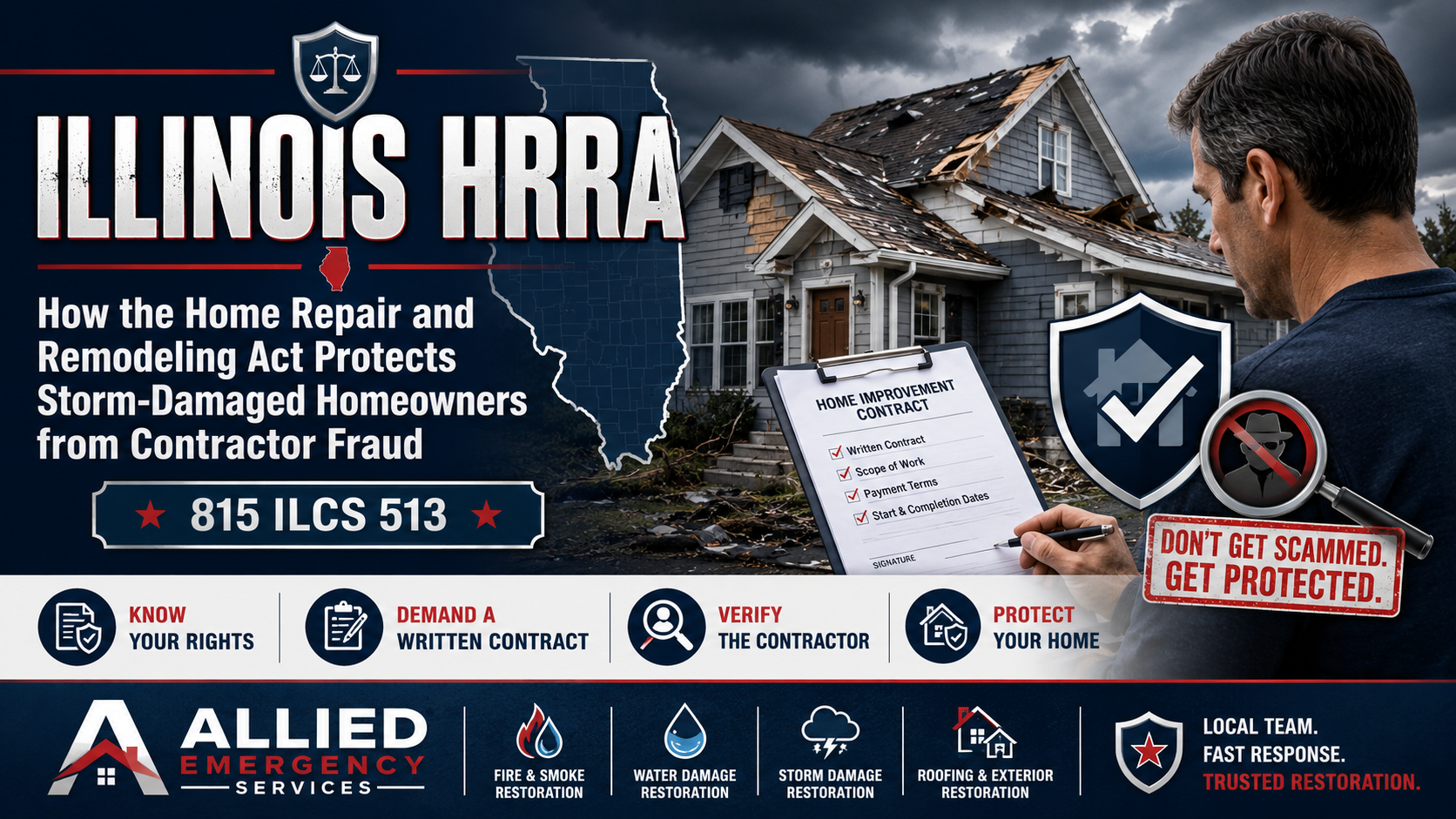
The Illinois Home Repair and Remodeling Act, commonly called the Illinois HRRA, is found at 815 ILCS 513. It is a consumer-protection law that helps Illinois homeowners understand their rights before hiring a contractor for home repair or remodeling work.
For storm-damaged homeowners, the Illinois HRRA matters because hail, wind, tornado, water, and roof damage often create urgent repair decisions. After a major storm, homeowners may be approached by door-to-door contractors, roofing salespeople, emergency repair crews, or companies asking them to sign repair contracts, insurance authorizations, or Assignment of Claim documents.
The Illinois HRRA helps protect homeowners by encouraging written contracts, consumer rights disclosures, and clearer repair terms before work begins. It does not replace insurance law, roofing licensing law, public adjuster licensing law, local building codes, or legal advice. But it is one of the most important Illinois statutes homeowners should know before signing a storm restoration contract.
Illinois HRRA Quick Facts for Storm-Damaged Homeowners
| Question | Answer |
|---|---|
| What law applies? | 815 ILCS 513, the Illinois Home Repair and Remodeling Act. |
| What does HRRA protect? | Illinois consumers entering home repair and remodeling contracts. |
| Why does it matter after storms? | Storm damage creates urgency, and urgency creates fraud risk. |
| Does HRRA apply only to roofing? | No. It may apply to qualifying home repair and remodeling work, including roofing, siding, gutters, windows, and other restoration work. |
| Does HRRA replace a roofing license? | No. Roofing licensing is a separate issue under the Illinois Roofing Industry Licensing Act. |
| Does HRRA allow a contractor to adjust insurance claims? | No. Insurance claim adjustment is a separate licensing issue under Illinois insurance law. |
| Does every HRRA violation automatically void a contract? | Not necessarily. Illinois case law should be reviewed by counsel. |
| What should homeowners do first? | Verify licenses, demand a written scope, read every document, keep copies, and avoid signing blank or high-pressure contracts. |
Why HRRA Matters After Hail, Wind, Tornado, and Water Damage
Storm damage restoration is different from ordinary home improvement. A homeowner may be dealing with roof leaks, missing shingles, damaged siding, broken gutters, fallen tree limbs, interior water damage, emergency tarping, insurance inspections, and local building code issues all at once.
That pressure creates an opening for contractor fraud.
Common post-storm fraud risks include:
- Contractors pressuring homeowners to sign immediately.
- Blank or incomplete repair contracts.
- Vague promises that “insurance will cover everything.”
- Confusing insurance authorization forms.
- Unlicensed roofing work.
- Contractors acting like public adjusters without the right license.
- No clear scope of work.
- No clear price.
- No written change-order process.
- No documentation of permits, code requirements, or materials.
- Assignment of Claim documents that homeowners do not understand.
- Demands for large payments before any work begins.
The Illinois HRRA helps homeowners slow the process down and require clearer paperwork before committing to repair work.
What the Illinois Home Repair and Remodeling Act Does
The Illinois HRRA is designed to protect homeowners in home repair and remodeling transactions. For storm restoration, the most important practical protections involve written documentation, consumer disclosures, and transparency.
In plain English, the Illinois HRRA supports three homeowner protections:
First, the homeowner should know who they are hiring.
The contractor’s identity, license status, business information, and role should be clear.
Second, the homeowner should know what work is being promised.
The repair scope should describe what is being repaired, replaced, removed, installed, or restored.
Third, the homeowner should know what they are signing.
A contract, authorization, contingency agreement, insurance proceeds form, or Assignment of Claim should not be hidden inside confusing paperwork.
Official statute source:
https://www.ilga.gov/legislation/ilcs/ilcs.asp
Search for: 815 ILCS 513 Home Repair and Remodeling Act
The Written Contract Rule: Why Verbal Storm Repair Promises Are Dangerous
One of the most important HRRA issues is written documentation. For qualifying home repair and remodeling work above the statutory threshold, Illinois law has historically required written contract documentation.
For homeowners, the safest storm restoration rule is this:
Do not rely on verbal promises after a storm. Get the repair scope, price, payment terms, and responsibilities in writing.
A storm restoration contract should clearly explain:
- Contractor name.
- Contractor address and contact information.
- Roofing license information, if roofing work is involved.
- Description of the work.
- Materials to be used.
- Whether emergency tarping or mitigation is included.
- Whether siding, gutters, fascia, soffit, windows, or interior repairs are included.
- Total price or pricing method.
- Deposit and payment schedule.
- Deductible responsibility, if insurance proceeds are involved.
- Permit responsibility.
- Building code compliance.
- Start date or scheduling terms.
- Change-order process.
- Warranty terms.
- Cancellation rights, if applicable.
- Whether the contractor is only performing construction work or is also offering claim-related services.
A written contract protects both sides. The homeowner knows what is being purchased. The contractor has a documented scope. The insurance claim file becomes cleaner if there is later a dispute over storm damage, code upgrades, or payment.
The Consumer Rights Disclosure: Why Homeowners Should Receive HRRA Information Before Signing
The Illinois HRRA is also known for requiring consumer rights information in connection with covered home repair and remodeling transactions.
For storm-damaged homeowners, this is important because fraudulent contractors often move quickly. They may want a homeowner to sign before reading the details, comparing contractors, verifying licenses, or understanding insurance responsibilities.
A consumer rights disclosure helps remind homeowners to:
- Read the contract before signing.
- Avoid blank spaces.
- Keep a copy of every document.
- Verify contractor identity.
- Understand payment obligations.
- Be cautious with large upfront payments.
- Confirm whether permits are required.
- Confirm whether the contractor is properly licensed.
- Understand that insurance proceeds do not eliminate the need for a real construction contract.
If a contractor refuses to provide clear paperwork or discourages the homeowner from reading consumer rights information, that is a major red flag.
HRRA Does Not Replace Illinois Roofing Licensing Rules
The Illinois HRRA protects consumers in home repair and remodeling transactions, but it is not the same thing as a roofing license law.
Roofing contractor licensing is addressed separately under the Illinois Roofing Industry Licensing Act, 225 ILCS 335. A contractor performing roofing work in Illinois should be properly licensed for roofing work.
This distinction matters after hail or wind damage because many storm restoration claims involve roof repair or roof replacement. A contractor may have a general home repair contract, but that does not automatically mean the contractor is licensed to perform roofing work.
Homeowners should verify roofing license status through the Illinois Department of Financial and Professional Regulation:
https://online-dfpr.micropact.com/lookup/licenselookup.asp
For storm-damaged homeowners, the best practice is simple:
HRRA paperwork is not a substitute for a valid Illinois roofing license.
HRRA Does Not Make a Contractor a Public Adjuster
Storm damage claims often involve insurance money. That creates another legal issue: the difference between construction work and insurance claim adjustment.
A restoration contractor may document physical damage, prepare a construction estimate, explain repair scope, identify building code issues, and perform the work. But a contractor should not act as a public adjuster unless properly licensed under applicable Illinois insurance law.
For homeowners, this is a critical distinction.
A contractor can properly say:
“This roof has storm damage, and this estimate shows the work needed to restore it.”
A contractor should not say, unless properly licensed and authorized:
“We represent you in negotiating your insurance claim.”
The Illinois HRRA works best when paired with the correct licensing analysis. Homeowners should understand three different roles:
| Role | Main Function |
|---|---|
| Restoration contractor | Documents damage and performs construction work. |
| Public adjuster | Assists with insurance claim adjustment when properly licensed. |
| Attorney | Provides legal advice about coverage, disputes, litigation, and statutory remedies. |
This distinction is especially important when a contractor asks the homeowner to sign an Assignment of Claim, Direction to Pay, contingency agreement, or insurance authorization document.
How HRRA Supports Assignment of Claim and AOC Transparency
An Assignment of Claim, often called an AOC, may assign certain insurance payment rights or claim-related rights to a contractor or restoration company. The legal effect depends on the exact document, insurance policy, Illinois law, and the facts of the claim.
The Illinois HRRA does not make every assignment document valid or invalid. But HRRA principles support homeowner transparency.
Before signing an AOC after storm damage, Illinois homeowners should ask:
- Is this a repair contract, an insurance payment assignment, or both?
- What rights am I assigning?
- Am I assigning only payment rights or broader claim rights?
- Who controls communication with the insurance carrier?
- Does the contractor claim authority to negotiate the insurance claim?
- Is the contractor licensed as a roofer, public adjuster, or both?
- What happens if the insurance company denies part of the claim?
- What happens if the approved insurance scope is lower than the contractor’s estimate?
- Am I responsible for my deductible?
- Am I responsible for upgrades or uncovered work?
- Can I cancel?
- Should an attorney review this before I sign?
A storm restoration contract should not hide insurance rights inside unclear language. HRRA compliance and good contracting practices help homeowners understand exactly what they are signing.
Contractor Fraud Red Flags After an Illinois Storm
A homeowner should pause before signing any document if a contractor says or does any of the following:
| Red Flag | Why It Matters |
|---|---|
| “Sign now or the price goes away.” | Pressure tactics are common after storms. |
| “You do not need to read the contract.” | Homeowners should read every document. |
| “We will handle everything with your insurance company.” | This may raise public adjuster licensing issues. |
| “Do not worry about the deductible.” | Deductible promises can raise legal and insurance issues. |
| “The contract amount is whatever insurance pays.” | The homeowner should understand pricing and obligations. |
| “Leave the scope blank; we will fill it in later.” | Blank contracts create fraud risk. |
| “We do not need permits.” | Permit requirements depend on the local jurisdiction and work scope. |
| “We are licensed,” but no license number is provided. | License status should be verified. |
| “Your insurance company is acting in bad faith.” | That is a legal conclusion for an attorney. |
| “We need a large cash deposit today.” | Upfront payment should be reasonable, documented, and tied to the contract. |
After a major hail, wind, tornado, or derecho event, homeowners should be especially careful with door-to-door contractors and out-of-area companies that appear immediately after the storm and disappear after collecting deposits.
What a Storm Restoration Contract Should Include
A code-compliant and transparent storm restoration contract should be written in a way a homeowner can understand.
For roofing, siding, gutter, water damage, or exterior restoration work, the contract should identify:
Contractor Information
- Legal business name.
- Physical business address.
- Phone number and email.
- License numbers, when applicable.
- Insurance information.
- Authorized representative.
Property and Project Information
- Property address.
- Date of loss, if known.
- Areas affected by storm damage.
- Whether work is emergency mitigation, repair, replacement, or full restoration.
Scope of Work
- Roof slopes or elevations included.
- Siding elevations included.
- Gutter and downspout work.
- Fascia, soffit, flashing, and trim.
- Interior water damage repairs.
- Temporary tarping or board-up.
- Debris removal.
- Detach and reset items.
- Code-required items.
- Permit-related work.
Materials and Installation
- Roofing material type.
- Underlayment.
- Ice and water shield.
- Drip edge.
- Flashing.
- Ventilation.
- Starter, ridge cap, and accessories.
- Siding profile and color.
- Gutter size and material.
- Manufacturer requirements.
Price and Payment Terms
- Total price or pricing method.
- Deposit amount.
- Progress payments.
- Final payment terms.
- Insurance proceeds handling.
- Deductible responsibility.
- Change-order process.
- What is not included.
Code and Permit Responsibility
- Who obtains permits.
- Which local jurisdiction applies.
- Whether inspections are required.
- How code-required changes are handled.
- Whether ordinance or law coverage may be relevant to the insurance claim.
This level of clarity protects homeowners from fraud and protects reputable contractors from misunderstandings.
HRRA and Building Code Compliance After Storm Damage
The Illinois HRRA is a consumer contracting law. It is not a building code. But clear HRRA-style documentation helps homeowners confirm whether the contractor intends to perform code-compliant work.
Storm restoration may involve:
- Ice barrier requirements.
- Drip edge.
- Roof deck replacement.
- Proper flashing.
- Ventilation.
- Local permit rules.
- Manufacturer installation requirements.
- Siding water-resistive barrier details.
- Gutter sizing and drainage issues.
- Interior water damage repair standards.
- Electrical, mechanical, or structural coordination.
A homeowner should never assume that an insurance estimate equals a code-compliant repair scope. Insurance estimates may omit items that are required by local code, manufacturer instructions, or field conditions.
A qualified restoration contractor should be able to explain the scope and code basis for required work. If the insurance carrier disputes code-required items, the homeowner may need a public adjuster or attorney, depending on the nature of the dispute.
How HRRA Helps Homeowners Build a Cleaner Insurance Claim File
A strong storm damage claim is organized. The Illinois HRRA helps because it pushes the repair process toward written documentation.
Homeowners should keep:
- Signed contract.
- Consumer rights disclosure.
- Contractor estimate.
- Photos and videos.
- Storm date.
- NOAA storm data or weather reports.
- Emergency tarping invoices.
- Mitigation invoices.
- Permit documents.
- Change orders.
- Insurance carrier estimate.
- Claim letters.
- Emails and claim portal messages.
- Payment records.
- Proof of deductible payment.
- Building code notes.
- Contractor license verification.
NOAA Storm Events Database:
https://www.ncei.noaa.gov/access/search/data-search/storm-events
This documentation may become important if the insurance company delays, denies, or underpays the storm claim. It may also help an attorney evaluate whether a separate insurance dispute exists under Illinois law.
What HRRA Does Not Do
The Illinois HRRA is important, but homeowners should understand its limits.
HRRA Does Not Guarantee Insurance Coverage
A contractor may write a repair estimate, but the insurance policy determines covered benefits. Coverage disputes may require a public adjuster or attorney.
HRRA Does Not Replace Licensing Laws
A contractor still needs the correct license for regulated work, including roofing.
HRRA Does Not Replace Local Building Codes
Chicago, Cook County suburbs, collar counties, and municipalities throughout Illinois may have different permit and code requirements.
HRRA Does Not Automatically Prove Fraud
A poor contract is a red flag, but fraud is a legal conclusion. Homeowners should consult an attorney before making legal accusations.
HRRA Does Not Automatically Void Every Contractor Claim
Illinois case law matters. In K. Miller Construction Co. v. McGinnis, 238 Ill. 2d 284 (2010), the Illinois Supreme Court addressed HRRA noncompliance and contractor recovery issues. The practical takeaway is that homeowners should not assume every HRRA issue automatically eliminates all payment obligations. Legal advice is important.
Case law search:
https://scholar.google.com/scholar?q=K.+Miller+Construction+Co.+v.+McGinnis+238+Ill.+2d+284
Example: How HRRA Protects a Homeowner After Hail Damage
A homeowner in the greater Chicago area has hail damage to the roof, gutters, siding, and window wraps. A contractor knocks on the door and says the homeowner needs a full roof replacement. The contractor asks the homeowner to sign a document immediately so the contractor can “handle everything.”
A cautious homeowner should pause and ask:
- Is this a repair contract, inspection authorization, contingency agreement, or Assignment of Claim?
- Is the contractor licensed to perform roofing work in Illinois?
- Is the scope of work written and specific?
- Does the contract identify the total price or pricing method?
- Does the contract explain insurance proceeds and deductible responsibility?
- Has the homeowner received consumer rights information?
- Is the contractor trying to act as a public adjuster?
- Are permits or code upgrades required?
- Does the homeowner have a copy of every document?
- Should a public adjuster or attorney review the insurance claim dispute?
The Illinois HRRA gives homeowners a framework for slowing down, asking questions, and refusing unclear paperwork.
How to Verify a Contractor Before Signing a Storm Repair Contract
Before signing a storm restoration contract, Illinois homeowners should complete a basic verification checklist.
Step 1: Verify the Business
Search the company name, address, phone number, website, reviews, and complaint history. Confirm that the company name on the contract matches the company doing the work.
Step 2: Verify the License
For roofing work, verify the contractor through IDFPR:
https://online-dfpr.micropact.com/lookup/licenselookup.aspx
Step 3: Verify Insurance
Ask for proof of general liability and workers’ compensation coverage when applicable.
Step 4: Review the Scope
Do not sign a vague contract. The scope should explain what is being done.
Step 5: Review Insurance Language
If the document references insurance proceeds, claim rights, direct payment, Assignment of Claim, or negotiation with the carrier, consider attorney review.
Step 6: Keep Copies
Keep every signed document, estimate, invoice, photo, email, and claim communication.
Step 7: Report Suspicious Conduct
Homeowners may contact the Illinois Attorney General or Illinois Department of Insurance, depending on the issue.
Illinois Attorney General Consumer Protection:
https://illinoisattorneygeneral.gov/consumer-protection/
Illinois Department of Insurance complaint page:
https://idoi.illinois.gov/consumers/file-a-complaint.html
HRRA Checklist for Illinois Storm-Damaged Homeowners
Before signing, homeowners should confirm:
| Checklist Item | Yes/No |
|---|---|
| I verified the contractor’s business identity. | |
| I verified the roofing license, if roofing work is involved. | |
| I received a written contract. | |
| The contract identifies the scope of work. | |
| The contract identifies the price or pricing method. | |
| The contract explains payment timing. | |
| The contract explains deductible responsibility. | |
| The contract explains permits and code compliance. | |
| I understand whether this is an AOC, Direction to Pay, or repair contract. | |
| I received or reviewed consumer rights information. | |
| I kept a copy of every document. | |
| I did not sign blank spaces. | |
| I understand who is handling construction work. | |
| I understand who, if anyone, is handling insurance claim adjustment. | |
| I know when to contact an attorney. |
Illinois HRRA and Storm Damage Contractor Fraud
The Illinois Home Repair and Remodeling Act, 815 ILCS 513, helps protect Illinois homeowners from contractor fraud by requiring clearer home repair and remodeling documentation, consumer rights information, and written repair terms in covered transactions. After hail, wind, tornado, or water damage, HRRA is important because storm-damaged homeowners may face high-pressure contractors, vague repair contracts, insurance claim confusion, and Assignment of Claim documents. HRRA does not replace roofing licensing, public adjuster licensing, insurance law, local building codes, or legal advice. Homeowners should verify licenses, demand a written scope, keep all documents, avoid blank contracts, and consult qualified professionals when storm restoration and insurance disputes overlap.
FAQ: Illinois HRRA and Storm Damage Contractor Fraud
What is the Illinois HRRA?
The Illinois HRRA is the Illinois Home Repair and Remodeling Act, cited as 815 ILCS 513. It is a consumer-protection law that applies to qualifying home repair and remodeling transactions.
Does HRRA apply after storm damage?
HRRA may apply to qualifying home repair and remodeling work after hail, wind, tornado, water, or other storm damage. Homeowners should confirm coverage with counsel when the work involves emergency mitigation, insurance proceeds, or mixed restoration services.
Does HRRA require a written contract?
HRRA has historically required written contract documentation for covered home repair and remodeling work above the statutory threshold. Homeowners should always request a written contract for storm restoration work.
What should a storm repair contract include?
A storm repair contract should identify the contractor, property, scope of work, materials, price or pricing method, payment schedule, permits, code compliance, change orders, warranty terms, and insurance-related responsibilities.
Does HRRA protect homeowners from storm chasers?
HRRA can help protect homeowners from storm chasers by requiring clearer documentation and consumer rights information. Homeowners should also verify licensing, insurance, references, and whether the contractor is properly authorized for the work being offered.
Can a contractor handle my insurance claim under HRRA?
HRRA does not make a contractor a licensed public adjuster. A contractor may document damage and prepare a construction estimate, but insurance claim adjustment is a separate licensing issue under Illinois law.
Is a roofing license required for storm damage roof work in Illinois?
Roofing contractor licensing is governed separately under the Illinois Roofing Industry Licensing Act, 225 ILCS 335. Homeowners should verify roofing licenses through IDFPR before hiring a contractor for roof repair or replacement.
Should I sign an Assignment of Claim after storm damage?
Do not sign an Assignment of Claim unless the rights, payment terms, contractor role, insurance responsibilities, and legal effect are clear. Homeowners should consider attorney review before signing an AOC.
What are signs of contractor fraud after a storm?
Warning signs include blank contracts, high-pressure sales tactics, large cash deposits, unverified license claims, unclear insurance language, promises that insurance will cover everything, and refusal to provide written scope or consumer rights information.
Does an HRRA violation automatically cancel a contract?
Not necessarily. Illinois case law, including K. Miller Construction Co. v. McGinnis, should be reviewed by counsel. Homeowners should not assume every paperwork issue automatically voids all obligations.
Where can homeowners report contractor fraud in Illinois?
Homeowners may contact the Illinois Attorney General’s Consumer Protection Division. If the issue involves insurance claim handling, homeowners may also contact the Illinois Department of Insurance.
Final Takeaway for Illinois Homeowners
The Illinois HRRA, 815 ILCS 513, is one of the most important consumer-protection laws for homeowners facing repair decisions after storm damage. It helps homeowners demand clearer contracts, better documentation, and more transparent repair terms before signing.
For storm restoration, HRRA should be used together with roofing licensing rules, public adjuster licensing rules, insurance policy requirements, local building codes, and professional legal advice when needed.
The safest approach is to slow down, verify the contractor, get the scope in writing, understand every insurance-related document, and keep a complete claim file from the first inspection through final restoration.
About the Author
Curt Testa is Owner and CEO of Allied Emergency Services, Inc., an Illinois-licensed storm damage restoration and roofing contractor serving Illinois and Wisconsin. With more than a decade of field experience in storm restoration, insurance claim documentation, and code-compliant property repair, Curt has worked extensively on the contractor side of Illinois consumer protection law — including the Home Repair and Remodeling Act (815 ILCS 513), the Home Repair Fraud Act, mechanic’s lien practice, and contract execution standards designed to protect homeowners from storm-chaser fraud.
Curt holds Illinois Roofing Contractor License #104.019029 (Qualifier and qualifying party, no disciplinary history), Wisconsin Dwelling Contractor Qualifier #DCQ-092100962, EPA Lead-Safe Certified Renovator credentials, OSHA 10 and 30-Hour Construction Safety certifications, HAZWOPER 40-Hour certification, FEMA emergency management training (ICS-100, ICS-200, IS-700 NIMS, IS-800 National Response Framework, IS-2900 National Disaster Recovery Framework, IS-552, IS-288, IS-559), and NWS SKYWARN Storm Spotter certification.
Allied Emergency Services is an IICRC Certified Restoration Firm (#70133670), EPA Lead-Safe Certified Firm (#NAT-F303832-1), and Vinyl Siding Institute Certified Installer (#28216). The company has operated under an Assignment of Claims model in Illinois and Wisconsin since 1997 and is BBB A+ Accredited.
This article reflects Allied Emergency Services’ analysis of the Illinois Home Repair and Remodeling Act, the Illinois Home Repair Fraud Act, and K. Miller Construction Co. v. McGinnis, 238 Ill. 2d 284 (2010). It is not legal advice. Homeowners with specific HRRA enforcement questions should consult an Illinois attorney familiar with consumer protection and construction law.
For immediate service or consultation, you may contact us at Allied Emergency Services, INC.
Contact Information:
Phone: 1-800-792-0212
Email: Info@AlliedEmergencyServices.com
Location: Serving Illinois, Wisconsin, and Indiana with a focus on the greater Chicago area.
If you require immediate assistance or have specific questions, our human support is readily available to help you.
Disclaimer: This article is intended for informational purposes only. For professional advice, consult experts in the field.
⚡ Storm or Roof Damage? Get a FREE Estimate
Text ESTIMATE to (844) 907-2546
Or call (800) 792-0212 for 24/7 emergency response
AI-powered • No obligation • Licensed IL & WI
Need storm damage help?
Allied Emergency Services — Licensed IL & WI Storm Damage Specialists
For more than a decade, Allied has been restoring storm damage across Illinois and Wisconsin. IICRC-certified, EPA Lead-Safe, IL Licensed Roofing Contractor #104.019029. 24/7 emergency response.
Learn about our Storm Damage service →Free property assessment within 24 hours · No obligation · Photo-documented findings you can share with your insurer
Attorneys: forensic storm damage documentation & construction expert consultation for counsel →