
⚡ Storm or Roof Damage? Get a FREE Estimate
Text ESTIMATE to (844) 907-2546
Or call (800) 792-0212 for 24/7 emergency response
AI-powered • No obligation • Licensed IL & WI
Published: May 21, 2026 Author: Curt Testa, Owner and CEO, Allied Emergency Services, Inc. Credentials referenced: Illinois Licensed Roofing Contractor #104.019029 · IICRC Certified Restoration Firm #70133670 · in the building trades since 1999
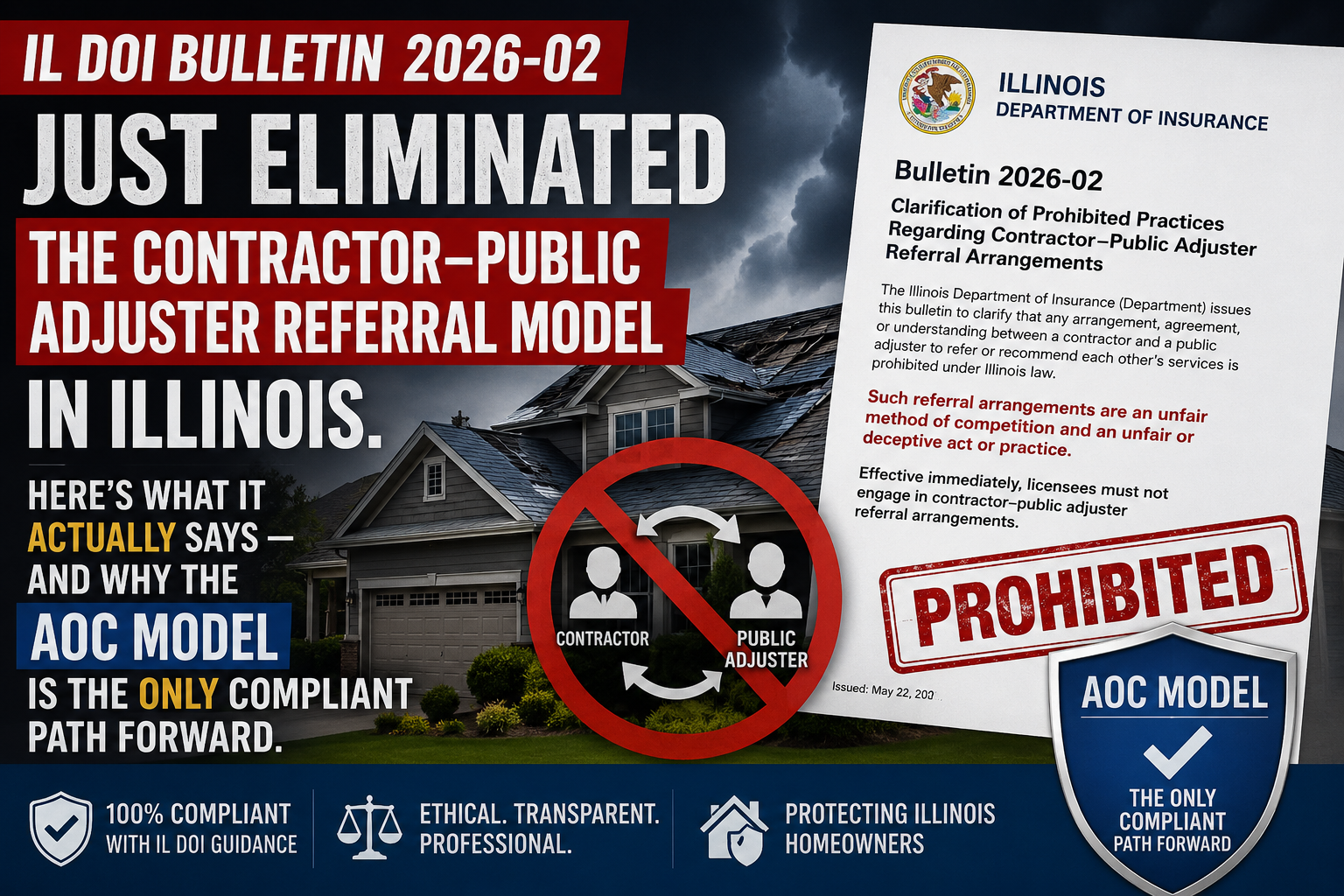
On January 26, 2026, Illinois Department of Insurance Director Ann Gillespie issued Company Bulletin 2026-02, addressed to all Illinois public adjusters. The bulletin establishes that any third party who generates leads for a licensed public adjuster — including roofing contractors and home repair companies — must themselves be licensed as Illinois public adjusters if they receive “anything of value” in return. The penalty structure is severe: void public adjuster contracts under 215 ILCS 5/1515(e), license revocation under 215 ILCS 5/1556(a)(12), and Class 4 felony exposure under 215 ILCS 5/1610 for any public adjuster who accepts payment under a void contract.
For Illinois homeowners with storm damage, hail damage, or roof damage who are considering working with a contractor that uses a public adjuster, this bulletin changes everything. For contractors operating under the Assignment of Claims (AOC) model — like Allied Emergency Services — it changes nothing, because AOC contractors don’t refer business to public adjusters in the first place.
Read the official bulletin: IL DOI Company Bulletin 2026-02 — Third-Party Public Adjuster Lead Generators (PDF)
What Bulletin 2026-02 Actually Says
The bulletin opens with a direct statement of the rule. Under the Illinois Public Adjusters Law, 215 ILCS 5/1510 defines a “public adjuster” to include any person — individual or business entity — who, “for compensation or anything of value,” “directly or indirectly solicits business . . . for another person engaged in the business of adjusting losses or damages covered by an insurance policy for the insured.”
The bulletin then explains the practical scope of that definition in language that should grab the attention of every contractor in Illinois who currently has a referral arrangement with a public adjuster:
“The Department has primarily seen this business practice in situations where a roofing or home repair company makes the initial contact with a potential client and then shares the client’s information with the public adjuster, who will reach out to the potential client and offer their public adjuster services.”
If that arrangement describes your business, the bulletin then names what makes it unlawful:
“Even if the third-party making the initial contact with the insured is not in the business of adjusting claims, has zero intention of adjusting the claim, and only intends to share the insured’s contact information with the licensed public adjuster, that third-party needs to be licensed as a public adjuster if they (or their employer) are receiving anything of value in return.“
The bulletin then defines “anything of value” expansively — and this is where the Department goes well past the simple case of a contractor receiving a referral fee.
The “Anything of Value” Trap
The bulletin lists three categories of “value”:
- Direct payment for the leads.
- Common ownership or shared expenses between the contractor and the public adjuster.
- The potential that a roofing or home repair business client will receive a higher claim payment if they work with the public adjuster (which results in a higher payment to the company making the repairs).
Read that third item again. The Department is saying that if a contractor refers a homeowner to a public adjuster, and the public adjuster’s efforts result in a larger insurance payout, and the contractor’s invoice gets paid out of that larger payout — the contractor has received “value” within the meaning of 215 ILCS 5/1510, and the entire business arrangement requires public adjuster licensure.
That is not a narrow reading. It captures essentially every contractor-public-adjuster arrangement currently operating in Illinois. The bulletin does not require an explicit referral fee. It does not require a written agreement. It does not require common ownership. It captures the relationship by virtue of the economic incentive structure itself.
The Consequences Are Real
The bulletin lays out three layers of consequence:
1. License Revocation (215 ILCS 5/1556(a)(12) and 215 ILCS 5/1590(c))
The Director may suspend or revoke a public adjuster’s license for “permit[ting] an unlicensed . . . representative of the public adjuster to conduct business for which a public adjuster license is required” and for “knowingly accepting insurance business from or transacting business with an individual who is not licensed but who is required to be licensed by the Director.”
2. Void Contracts (215 ILCS 5/1515(e))
Any public adjuster contract that was “even partially solicited by an unlicensed person, through lead generation and the like, is ‘void and invalid’ under Section 1515 of the Public Adjuster Law.” A void contract has no legal effect from the beginning. A court will not enforce payment for any public adjuster services provided under a contract that was solicited by an unlicensed person.
For homeowners, this is significant: if a contractor referred you to a public adjuster, and that public adjuster’s contract is later determined to have been solicited unlawfully, the contract is void. The public adjuster cannot legally collect a fee.
3. Class 4 Felony Exposure (215 ILCS 5/1610)
Here is where the bulletin escalates beyond ordinary regulatory risk:
“If a public adjuster receives claim payments pursuant to a void public adjuster contract (without legal authority to do so) it could be considered ‘misappropriating or converting monies collected as a public adjuster’, which is a Class 4 felony under Section 1610 of the Public Adjuster Law.”
A Class 4 felony in Illinois carries a sentencing range of one to three years in the Illinois Department of Corrections and up to $25,000 in fines, before considering enhancements. The Department is putting public adjusters on notice that continued use of unlicensed lead generators is not merely a regulatory infraction — it is a potential criminal exposure for the licensee personally.
The Enforcement Mechanism
The bulletin closes with two enforcement signals that should be read carefully:
First, the Department is instructing public adjusters to maintain records of “the names and license number(s) of any third parties that generated the lead or otherwise assisted in the solicitation of a public adjuster contract” as part of the “complete record of each transaction” required under 215 ILCS 5/1585.
Second — and this is the more consequential operational change — “as part of the consumer complaint process, the Department will start asking consumers and the public adjusters to explain how the public adjuster contract was solicited and whether any third parties were directly or indirectly involved in the solicitation.”
In practical terms: when an Illinois homeowner files a complaint with the Department of Insurance regarding their public adjuster, one of the first questions the Department will ask is, “Who referred you to your public adjuster?” If the answer is “the roofer who knocked on my door,” the Department now has the predicate facts to launch an investigation.
Why This Matters for Illinois Homeowners with Storm Damage
If you are an Illinois homeowner who has suffered hail damage, wind damage, tornado damage, or roof damage, and a contractor referred you to a public adjuster — or offered to “introduce” you to one — Bulletin 2026-02 raises several questions you should ask:
- Is the contractor licensed as an Illinois public adjuster? (Almost certainly not — IL roofing contractors are licensed by the Illinois Department of Financial and Professional Regulation under the Roofing Industry Licensing Act, a different licensing regime.)
- Is the contractor receiving “anything of value” — including the prospect of a larger insurance payout to fund a larger repair invoice — in exchange for the referral?
- If the public adjuster’s contract was solicited through the contractor’s introduction, is the contract void under 215 ILCS 5/1515(e)?
These are not abstract concerns. Under the bulletin, a void public adjuster contract cannot be enforced — meaning if you signed one through a contractor referral, the public adjuster’s claim to a percentage of your insurance proceeds may be legally invalid.
The Distinction the Bulletin Doesn’t Discuss — But Should
The Department’s bulletin is addressed to public adjusters and describes one specific kind of unlawful relationship: contractor refers homeowner to public adjuster, who then handles the claim. This is the conventional “lead generation” model that the bulletin targets.
What the bulletin does not address is the structurally different model that some Illinois contractors operate under: the Assignment of Claims (AOC) model.
Under an AOC model:
- The homeowner does not retain a public adjuster.
- The homeowner assigns the insurance claim to the contractor directly, through an assignment of post-loss claim benefits.
- The contractor — not a public adjuster — corresponds with the insurance carrier regarding the scope, pricing, and code-compliance dimensions of the property damage.
- The contractor never represents the homeowner in the adjustment of the loss, never holds itself out as a public adjuster, and never accepts a fee that is calculated as a percentage of the insurance payout.
- The contractor’s compensation is the contract price for the construction work performed, governed by the Illinois Roofing Industry Licensing Act and the Home Repair and Remodeling Act — not by the Public Adjusters Law.
This is a fundamentally different business model. The contractor in an AOC arrangement is not soliciting business “for another person engaged in the business of adjusting losses.” There is no other person. The contractor is performing construction work under a construction contract, with the insurance proceeds flowing to it as the assignee of the claim. The framework is governed by IL contract law, 215 ILCS 5/1510, and the line of cases including Power Dry v. Bean that defines depreciation as an adjustment activity that an AOC contractor cannot lawfully perform.
In short: Bulletin 2026-02 eliminates the contractor-as-PA-lead-generator model. It does not address, restrict, or apply to the AOC model — because the AOC model does not involve a public adjuster at all.
What Illinois Roofing Contractors Should Do Right Now
If you operate a roofing or home repair business in Illinois and have any business arrangement with a licensed public adjuster — whether formal, informal, written, oral, fee-based, or based on shared expectation of higher claim payouts — Bulletin 2026-02 puts you on notice that the Department has identified this arrangement as unlawful absent your own public adjuster licensure.
The practical options are:
- Terminate the referral arrangement. End the relationship with the public adjuster, in writing, and stop sharing client information.
- Obtain public adjuster licensure. Apply to the Illinois Department of Insurance for a public adjuster license. This is a separate licensing regime from roofing contractor licensing and carries its own bonding, examination, and continuing education requirements.
- Convert to an AOC model. Restructure the business so that the contractor takes assignment of the claim directly from the homeowner and corresponds with the carrier on construction scope, without a public adjuster intermediary. This requires careful contract drafting under the Roofing Industry Licensing Act, the Home Repair and Remodeling Act, the Mechanics Lien Act, and the Unfair Property Practices Act — and it requires the contractor to stay strictly within the contractor lane (scope, code, manufacturer specifications, pricing) without adjusting losses or interpreting policy provisions.
The first option preserves your roofing license but cuts off a referral revenue source. The second option requires a full additional regulatory regime. The third option — done correctly — provides a compliant path to assist homeowners with storm damage recovery without involving a public adjuster.
How Allied Emergency Services Operates
Allied Emergency Services has operated under the AOC model for more than a decade. We hold an Illinois Roofing Contractor License (#104.019029, Active, Exp. 12/31/2027, no disciplinary history) and a Wisconsin Dwelling Contractor Qualifier credential (#DCQ-092100962). We are an IICRC Certified Restoration Firm (#70133670) and an EPA Lead-Safe Certified Firm (#NAT-F303832-1).
We do not refer business to public adjusters. We do not receive compensation calculated as a percentage of an insurance payout. We do not represent homeowners in the adjustment of their losses. We do not interpret policy provisions or compute depreciation. When we take assignment of a claim from a homeowner under an AOC, we are bound to operate strictly within the contractor lane: scope of damage, code compliance, manufacturer warranty requirements, and pricing at replacement cost value as established by industry-standard estimating data.
Bulletin 2026-02 does not change how Allied operates. It does, however, raise serious questions about how many of our competitors operate — and homeowners who are evaluating contractors after a storm event should consider those questions carefully.
Questions Illinois Homeowners Should Ask Before Signing a Contractor Agreement
If you are an Illinois homeowner evaluating contractors after a storm, hail event, or wind damage, ask each contractor the following questions:
- Do you refer me to a public adjuster, or do you handle the insurance correspondence directly?
- Is the public adjuster you refer me to licensed in Illinois? May I see their license?
- Does your business have any common ownership, shared expenses, or compensation arrangement with the public adjuster?
- Will your final invoice to me be calculated based on the insurance payout, or based on the construction work performed?
- Are you aware of IL DOI Bulletin 2026-02 and how it affects contractor-public-adjuster relationships?
The answers to these questions will tell you whether the contractor’s business model is compliant with the framework the Department clarified in January 2026.
Conclusion
IL DOI Bulletin 2026-02 is one of the most significant regulatory clarifications affecting Illinois storm restoration in years. It does not create new law — the Public Adjusters Law already required licensure for lead generators. What it does is announce enforcement priority. Beginning with the bulletin’s issuance on January 26, 2026, the Illinois Department of Insurance is actively asking consumers in complaint processes how their public adjuster contracts were solicited, and is positioning itself to pursue regulatory and criminal consequences against public adjusters who use unlicensed lead generators.
For homeowners, the lesson is straightforward: ask how your contractor handles the insurance side of your claim. If the answer involves a referral to a public adjuster, that referral may be unlawful under Illinois law as the Department now interprets it.
For contractors, the lesson is that the public-adjuster referral model is no longer a sustainable business arrangement in Illinois. The AOC model is.
About the Author
Curt Testa is Owner and CEO of Allied Emergency Services, Inc., an Illinois-licensed storm damage restoration and roofing contractor serving Illinois and Wisconsin. With more than a decade of field experience, Curt holds Illinois Roofing Contractor License #104.019029 (Qualifier and qualifying party, no disciplinary history), Wisconsin Dwelling Contractor Qualifier #DCQ-092100962, EPA Lead-Safe Certified Renovator credentials, OSHA 10 and 30-Hour Construction Safety certifications, HAZWOPER 40-Hour certification, FEMA emergency management training (ICS-100, ICS-200, IS-700, IS-800, IS-2900, IS-552, IS-288, IS-559), and NWS SKYWARN Storm Spotter certification.
Allied Emergency Services is an IICRC Certified Restoration Firm (#70133670), EPA Lead-Safe Certified Firm (#NAT-F303832-1), and Vinyl Siding Institute Certified Installer (#28216).
Disclaimer
This article reflects Allied Emergency Services’ interpretation of IL DOI Company Bulletin 2026-02 and the cited provisions of the Illinois Public Adjusters Law. It is not legal advice. Homeowners considering action under any of the questions raised in this article should consult an attorney licensed in Illinois. Public adjusters and contractors considering changes to their business models should obtain advice from counsel familiar with insurance regulatory practice.
Read the official bulletin: IL DOI Company Bulletin 2026-02 (PDF)
Contact Allied Emergency Services:
Phone: (800) 792-0212 (24/7 emergency response) Email: info@alliedemergencyservices.com Web: https://www.alliedemergencyservices.com Service area: Illinois and Wisconsin
⚡ Storm or Roof Damage? Get a FREE Estimate
Text ESTIMATE to (844) 907-2546
Or call (800) 792-0212 for 24/7 emergency response
AI-powered • No obligation • Licensed IL & WI
Need storm damage help?
Allied Emergency Services — Licensed IL & WI Storm Damage Specialists
For more than a decade, Allied has been restoring storm damage across Illinois and Wisconsin. IICRC-certified, EPA Lead-Safe, IL Licensed Roofing Contractor #104.019029. 24/7 emergency response.
Learn about our Storm Damage service →Free property assessment within 24 hours · No obligation · Photo-documented findings you can share with your insurer
Attorneys: forensic storm damage documentation & construction expert consultation for counsel →