⚡ Storm or Roof Damage? Get a FREE Estimate
Text ESTIMATE to (844) 907-2546
Or call (800) 792-0212 for 24/7 emergency response
AI-powered • No obligation • Licensed IL & WI
Published: May 23, 2026 Author: Curt Testa, Owner and CEO, Allied Emergency Services, Inc. Credentials referenced: Illinois Licensed Roofing Contractor #104.019029 · IICRC Certified Restoration Firm #70133670 · in the building trades since 1999
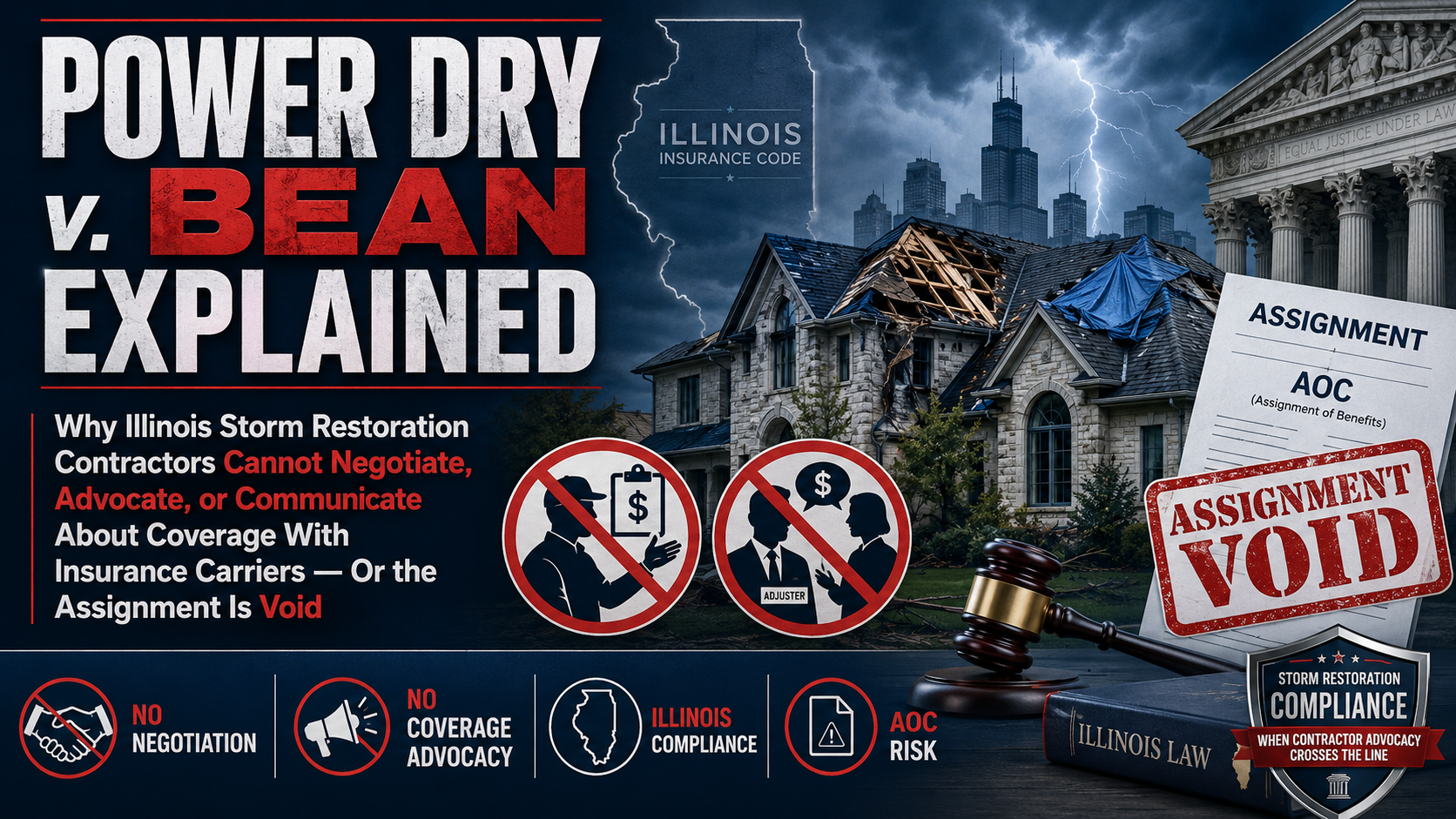
In Power Dry of Chicago, Inc. v. Bean, 2022 IL App (2d) 210043, the Illinois Appellate Court (Second District) affirmed the dismissal of every contract-based and statutory claim brought by a storm restoration contractor against its customer, the customer’s insurer, and the insurer’s third-party adjuster — because the contractor had performed activities that the court found constituted unlicensed public adjusting under the Illinois Public Adjusters Law (215 ILCS 5/1501 et seq.) and the now-repealed adjusters and firms statute (215 ILCS 5/512.51–512.64). The court held that the contractor’s entire customer contract — including the assignment of insurance benefits — was “void and invalid” under 215 ILCS 5/512.53(c), which left the contractor with no enforceable mechanic’s lien, no breach-of-contract claim, no quantum meruit recovery, no §155 bad-faith claim, and no tortious interference cause of action.
For Illinois roofing contractors and storm restoration companies operating under an Assignment of Claims (AOC) model, Power Dry is one of the most consequential decisions of the last decade. It establishes that the line between “construction contractor performing work under a valid AOC” and “unlicensed public adjuster performing void services” is far narrower than most contractors believe. Activities that contractors routinely perform — discussing scope discrepancies with the carrier’s adjuster, telling the homeowner to “ask for a different adjuster,” characterizing carrier conduct as “not in good faith,” telling the homeowner what their coverage limits are, characterizing a loss as a “covered loss” — all became, in Power Dry, evidence that the contractor was acting as an unlicensed public adjuster.
Read the full opinion: Power Dry of Chicago, Inc. v. Bean, 2022 IL App (2d) 210043 (PDF)
The Facts of Power Dry v. Bean
In March 2020, a fire damaged the home of Matthew and Maurissa Bean in Kane County, Illinois. Maurissa, on Matthew’s behalf, signed a “Mitigation & Repair Work Authorization” with Power Dry of Chicago, Inc., doing business as Chicago Water and Fire Restoration (“CWFR”). The contract contained two operative provisions:
First, a pricing provision: “The initial price for the Work will be the Xactimate Invoice calculated using the Xactimate software by [CWFR].”
Second, an assignment provision: “The Xactimate invoice will be submitted by [CWFR] or Customer to the insurer of the Customer. Customer will assign all rights and benefits to its insurance payments for the loss to [CWFR] in order to expedite payments and fulfillment of this Contract.”
CWFR performed mitigation work over the following days, invoiced the Beans $12,764.39, and submitted that invoice to Lutheran Mutual Fire Insurance Company, the Beans’ insurer. Lutheran Mutual engaged a third-party adjusting firm, L.J. Shaw & Company, to handle the claim. LJ Shaw adjusted the claim to $4,389.64 — approximately one-third of CWFR’s invoice.
Lutheran Mutual paid the $4,389.64 to Matthew, who forwarded it to CWFR. The Beans then declined to retain CWFR for reconstruction work. CWFR filed a mechanic’s lien for the remaining balance and ultimately filed an eight-count complaint against the Beans, Lutheran Mutual, LJ Shaw, and the Beans’ mortgage company.
The case was dismissed at the trial-court level under section 2-619 of the Illinois Code of Civil Procedure, on the ground that CWFR had been operating as an unlicensed public adjuster, which voided the entire contract and the assignment derived from it. CWFR appealed.
The Second District affirmed.
The Court’s Reasoning: What CWFR Actually Did That Voided Its Contract
The critical analytical move in the opinion is the court’s careful examination of email correspondence between CWFR personnel and Maurissa Bean during the claim. The Beans’ motion to dismiss attached the email exchanges, authenticated by Maurissa’s affidavit. CWFR did not challenge the authenticity of the emails. The court therefore treated their content as established fact.
What the emails showed:
1. CWFR represented itself as negotiating with the carrier on the homeowner’s behalf. CWFR operations assistant Samantha Drake wrote to Maurissa: “We work with your insurance company to reach an agreed price on the scopes so that when we do move forward with the rebuild, you are only financially responsible for your deductible.” And again: “we are able to pinpoint any major discrepancies and negotiate on your behalf to reconcile.”
2. CWFR characterized carrier conduct as not in good faith. When the LJ Shaw adjustment came in significantly lower than the CWFR estimate, CWFR accounts receivable manager Danielle Stricker wrote to Maurissa: “if this is the answer your carrier is giving you, you might want to ask for a different adjuster or the current adjuster’s supervisor. [LJ Shaw] doesn’t seem to be handling this claim in good faith.”
3. CWFR told the homeowner what their policy covered. Stricker wrote: “We obviously know this a covered loss.” CWFR production manager Blake Veldman wrote: “That leaves your insurance company responsible for indemnifying you of any ‘fair and reasonable’ costs associated with the loss, minus the above-mentioned deductible, in order to get the home back to pre-loss condition.”
4. CWFR characterized the carrier’s adjustment process from an insurance-coverage perspective. Veldman wrote: “In these instances, it is standard for the adjuster to review a contractors invoice and mark a few things that he/she may consider unnecessary or ‘overkill’ as they say. We would then either justify our decision and supply supporting documentation, from our continuing education on industry norms, or forfeit/alter those charges to come to an agreement with the adjuster.”
5. CWFR’s own estimate identified its representative as an “adjuster.” The court noted that CWFR’s Xactimate estimate listed “Vinnie Guaderrama” as “Claim Rep” and “General Executive Adjuster” — and that Guaderrama’s email signature included “Illinois Public Adjuster License No. 018068229,” though CWFR itself was not licensed as a public adjuster during the relevant period.
The court ruled that each of these activities — taken together with the assignment of insurance benefits as the form of compensation — constituted “adjusting” under the statutory definitions, which trigger the licensure requirement.
The Statutory Framework
The court applied two statutes. The first is 215 ILCS 5/1510 (the Public Adjusters Law definition):
“Public Adjuster” means any person who, for compensation or any other thing of value on behalf of the insured: (i) acts or aids … on behalf of an insured in adjusting a claim for loss or damage covered by an insurance contract; (ii) advertises for employment as a public adjuster of insurance claims or solicits business or represents himself or herself to the public as a public adjuster …; or (iii) directly or indirectly solicits business, investigates or adjusts losses, or advises an insured about first party claims for losses or damages arising out of policies of insurance …
The second is the now-repealed 215 ILCS 5/512.52(a), which defined adjusting as:
“[R]epresenting an insured with an insurer for compensation, and while representing that insured either negotiating values, damages, or depreciation, or applying the loss circumstances to insurance policy provisions.”
The court found that CWFR’s conduct fit squarely within both definitions. CWFR was representing the Beans with the insurer (Lutheran Mutual through its adjuster LJ Shaw), it was doing so for compensation (the assignment of insurance proceeds was found to be “anything of value”), and it was both negotiating values and damages and applying loss circumstances to policy provisions.
The legal consequence followed automatically. Section 512.53(c) of the adjusters and firms statute provided that “all contracts entered into by any person violating subsection (a) of this Section are void and invalid.” Section 1515 of the Public Adjusters Law contained a similar void-and-invalid provision for contracts solicited by unlicensed persons.
The contract — the entire contract, including the AOC assignment — was therefore void from inception.
The Cascade Failure: Why Every Claim Fell
Once the contract was void, every cause of action CWFR pled against any defendant failed. The court’s analysis is instructive because it shows how broadly the “void contract” finding propagates:
- Count I (Mechanic’s Lien): A mechanic’s lien must rest on a valid underlying contract. No valid contract, no enforceable lien.
- Count II (Breach of Contract against the Beans): No contract, no breach.
- Count III (Quantum Meruit against the Beans): Quantum meruit recovery is unavailable when the underlying contract is void for public policy reasons. Operating as an unlicensed public adjuster is, by statute, “inimical to the public welfare and constitutes a public nuisance” (215 ILCS 5/1605).
- Count IV (Breach of Contract against Lutheran Mutual as third-party beneficiary): Without a valid assignment, CWFR was not a third-party beneficiary.
- Count V (§155 Bad Faith against Lutheran Mutual): Section 155 remedies extend only to the insured party and to policy assignees. CWFR was neither. The void assignment meant no §155 standing.
- Count VI (Tortious Interference with Prospective Business Advantage against LJ Shaw): A plaintiff cannot have a reasonable expectation of a valid business relationship grounded in a void and statutorily-prohibited contract.
- Count VII (Tortious Interference with Contract against LJ Shaw): No contract, no contract to interfere with.
The court affirmed dismissal of every count.
Why Power Dry Is the Most Important Illinois Storm Restoration Case in a Decade
Power Dry is significant because it draws the line — with specificity, in published opinion form, with appellate-level authority — between activities that are permissible for a construction contractor performing work under an AOC and activities that constitute unlicensed public adjusting.
Before Power Dry, the boundary was contested. Storm restoration contractors routinely communicated with insurance carriers about scope, pricing, code requirements, and supplements. Many believed that doing so on the contractor’s own behalf — to get paid for the construction work the contractor was performing — was distinct from “adjusting” the homeowner’s claim. The court rejected that distinction.
The court was unmoved by CWFR’s argument that it was only collecting for its own services. It was equally unmoved by CWFR’s argument that the contract was severable into a “mitigation” portion (already performed) and a “reconstruction” portion (which would have involved more adjusting-adjacent activities). The court treated the contract as one unified agreement, applied the “four corners” rule of contract interpretation, and found the entire scope of conduct constituted adjusting.
The court also rejected CWFR’s argument that it should be permitted to depose Maurissa Bean to elicit testimony that she did not believe CWFR was acting as her public adjuster. The court held that what mattered was what CWFR actually did, as documented in the contemporaneous emails — not what the homeowner subjectively believed about the legal characterization of CWFR’s role.
What This Means for Illinois AOC Contractors
If you operate a roofing, water mitigation, fire restoration, or storm restoration business in Illinois under an Assignment of Claims (AOC) model, Power Dry requires you to examine your operational practices against a specific, demanding standard. The following activities — based on the court’s reasoning — are at high risk of being characterized as unlicensed public adjusting:
- Telling the homeowner that you will “negotiate” with their insurance carrier on their behalf. CWFR said it would “negotiate on your behalf to reconcile” discrepancies. The court treated this as adjusting.
- Telling the homeowner what their policy covers. CWFR said “We obviously know this a covered loss” and characterized the carrier’s coverage obligations. The court treated this as applying loss circumstances to insurance policy provisions — adjusting.
- Characterizing carrier conduct as not in good faith. CWFR said “[LJ Shaw] doesn’t seem to be handling this claim in good faith.” The court treated this as representing the insured against the insurer — adjusting.
- Advising the homeowner on how to interact with the carrier. CWFR suggested asking for a different adjuster or a supervisor. The court treated this as advising the insured about first-party claims — adjusting.
- Discussing policy coverage limits with the homeowner. CWFR repeatedly raised coverage limits as part of the conversation. The court treated this as adjusting.
- Identifying your representatives as “adjusters” or “Claim Reps” in your own documents. The court noted CWFR’s Xactimate estimate identified its representative as a “General Executive Adjuster.”
- Calculating, applying, or negotiating depreciation. Section 512.52(a) explicitly identified “negotiating values, damages, or depreciation” as adjusting activities. While the post-2021 statutory framework consolidated this within the Public Adjusters Law, the same definitional principles apply through 215 ILCS 5/1510.
This list is not exhaustive. The court’s reasoning is broader than any single activity. The principle is: if the contractor’s communications with the insured or the carrier sound like the work of a representative who is advocating for the insured’s claim against the insurer — not the work of a construction contractor explaining its own scope and pricing for its own work — then those activities fall within the statutory definition of adjusting.
The Construction-Contractor Lane: What Is Permitted
Power Dry did not hold that all contractor-carrier communications are forbidden. The court did not address every possible activity. The court’s focus was on the specific email content showing CWFR was representing the insured against the insurer. Activities that remain clearly within the construction-contractor lane include:
- Documenting the scope of damage actually present at the property. A construction contractor inspecting and documenting damage is performing construction-contractor work, not adjusting.
- Pricing the construction work the contractor will perform. Generating a scope-and-price document at replacement cost value using industry-standard estimating software, on the contractor’s own behalf, is construction-contractor work.
- Submitting the contractor’s scope and price to the carrier as a contractor’s invoice. The Mechanics Lien Act and the Home Repair and Remodeling Act both contemplate that contractors will submit invoices for their work.
- Responding to carrier questions about the construction means and methods of the contractor’s own work. Explaining why the contractor’s scope includes a specific code-required deck replacement, or specific manufacturer-required installation steps, is technical communication about the contractor’s own work.
- Providing manufacturer specifications, building code citations, and industry-standard documentation supporting the contractor’s scope. This is providing the construction-contractor’s own technical authority for its own work.
What contractors cannot do — under Power Dry — is cross the line from “explaining my own construction scope” to “representing the homeowner against the insurance carrier on coverage issues.” The line is real. The court drew it. Contractors who cross it lose their contracts and lose the assignments derived from those contracts.
How Allied Emergency Services Operates
Allied Emergency Services has operated under an AOC model in Illinois and Wisconsin for more than a decade. Our compliance framework, refined over decades of practice and stress-tested in litigation, follows several non-negotiable principles drawn directly from the kind of reasoning the Power Dry court applied:
We do not negotiate. We do not tell homeowners we will “negotiate on their behalf” with the carrier. We submit our scope, our pricing, and our supporting documentation. We respond to technical questions about our own construction means and methods. We do not represent the homeowner in coverage disputes.
We do not characterize carrier conduct. We do not tell homeowners their carrier is acting in bad faith. We do not tell them to ask for a different adjuster. We do not characterize how the carrier is handling the claim. Those are conversations for the homeowner to have with the carrier, or with their own attorney.
We do not interpret policy provisions. We do not tell homeowners what is covered. We do not tell them what their policy limits are. We do not apply loss circumstances to policy provisions. Those activities are reserved by Illinois statute for licensed public adjusters or attorneys.
We do not compute or apply depreciation. Depreciation is the act of adjusting actual cash value from replacement cost value. That is, by statutory definition under 215 ILCS 5/1510 and the principles articulated in Power Dry, an adjusting activity. We submit scopes and pricing at replacement cost value as established by industry-standard estimating data. If a carrier-issued document shows depreciation, that depreciation appears in the record only as a carrier-issued fact. We do not calculate it, propose it, or apply it.
We do not represent ourselves as adjusters. Our representatives are construction professionals. Our credentials reflect that: Illinois Roofing Contractor License #104.019029 (Qualifier and qualifying party, no disciplinary history), IICRC Certified Restoration Firm #70133670, EPA Lead-Safe Certified Firm #NAT-F303832-1, Wisconsin Dwelling Contractor Qualifier #DCQ-092100962. None of our documents identify our personnel as “adjusters,” “claim representatives,” or any similar title that suggests adjusting authority.
We work with retained counsel. When a claim involves coverage disputes, policy interpretation, or potential bad-faith carrier conduct, we refer the homeowner to retained counsel. Insurance coverage analysis is the practice of law in Illinois. We do not perform it.
These are not arbitrary policies. They are the operational embodiment of what Power Dry requires of any Illinois contractor that takes assignment of insurance claim benefits.
What Illinois Homeowners Should Understand After Power Dry
If you are an Illinois homeowner who has experienced storm damage, hail damage, water damage, fire damage, or any other property loss, Power Dry is relevant to you in two ways:
First, if you signed an AOC with a contractor who then performed activities the court characterized as public adjusting in Power Dry — negotiating with your carrier on your behalf, telling you what your policy covers, characterizing your carrier’s conduct as bad faith, telling you to ask for a different adjuster, computing depreciation, identifying their personnel as “claim representatives” or “adjusters” — your AOC may be void under 215 ILCS 5/512.53(c) and the relevant successor provisions. A void AOC means the contractor cannot enforce its claim against you, against your insurance carrier, or against any third party. It also means you may have arguments to defend against any collection action the contractor brings.
Second, if you are currently evaluating storm restoration contractors after a loss, Power Dry gives you a vocabulary for distinguishing compliant operators from non-compliant ones. Ask each contractor:
- Will you negotiate with my insurance carrier on my behalf? (If yes, ask whether they are licensed as a public adjuster. If they are not, walk away.)
- Will you tell me what my policy covers? (If yes, ask the same question.)
- Do any of your documents identify your personnel as “adjusters” or “claim representatives”? (If yes, ask why.)
- Will you compute or apply depreciation to my claim? (If yes, ask the same question.)
- Are you aware of Power Dry v. Bean, and how does your business model account for the holding?
These questions, asked in this order, will reliably distinguish operators who understand Illinois law from those who do not. The latter are not a safe choice for the homeowner — they are operating under contracts that may be void from inception.
The Strategic Implications for Illinois Storm Restoration
Power Dry is one of two regulatory developments that have fundamentally reshaped the Illinois storm restoration landscape in the last several years. The other is Illinois Department of Insurance Company Bulletin 2026-02, issued January 26, 2026, which clarified that roofing contractors and home repair companies who refer business to public adjusters in exchange for “anything of value” must themselves be licensed as Illinois public adjusters under 215 ILCS 5/1510.
Read together, Power Dry and Bulletin 2026-02 eliminate two of the most common contractor business models in Illinois:
- The contractor-as-quasi-adjuster model, in which the contractor handles the claim with the carrier on the homeowner’s behalf, is eliminated by Power Dry. The activities that model requires are unlicensed adjusting.
- The contractor-to-public-adjuster referral model, in which the contractor introduces the homeowner to a public adjuster who handles the claim, is eliminated by Bulletin 2026-02. The contractor must itself be licensed as a public adjuster for that arrangement to be lawful.
What remains is the AOC construction-contractor model, in which the contractor takes assignment of the claim, performs construction work, submits its construction-contractor invoice with full technical documentation, and stays strictly within the construction-contractor lane on every aspect of carrier communication.
This is a narrower compliance lane than most contractors have historically operated within. It requires discipline, documented procedures, contract language drafted to support the construction-contractor characterization rather than undermine it, and operational practices that consistently align with the contractor lane rather than drift into adjusting.
It is also, after Power Dry and Bulletin 2026-02, the only compliance lane Illinois law leaves open for contractors who want to participate meaningfully in insurance-funded storm restoration work.
Conclusion
Power Dry of Chicago, Inc. v. Bean, 2022 IL App (2d) 210043, is required reading for every Illinois storm restoration contractor, every Illinois homeowner who has signed an AOC, and every Illinois attorney who represents either party. The decision is not narrow. It is not limited to its facts. It articulates a principle — that the activities of representing an insured against an insurer, negotiating values, characterizing coverage, and applying loss circumstances to policy provisions are reserved by statute for licensed public adjusters — that has broad application across every storm restoration matter in the state.
For homeowners, the lesson is that the contractor you choose must operate in a way that respects this line. For contractors, the lesson is that respecting this line is the prerequisite for being able to enforce your contract, your assignment, your mechanic’s lien, your supplement, or anything else you do in connection with an Illinois insurance claim.
For Allied Emergency Services, Power Dry is the case our operational practices were designed to satisfy long before it was decided. We were doing this work the right way before there was an appellate-level opinion telling other contractors why they had to do it the right way too.
About the Author
Curt Testa is Owner and CEO of Allied Emergency Services, Inc., an Illinois-licensed storm damage restoration and roofing contractor serving Illinois and Wisconsin. With more than a decade of field experience, Curt holds Illinois Roofing Contractor License #104.019029 (Qualifier and qualifying party, no disciplinary history), Wisconsin Dwelling Contractor Qualifier #DCQ-092100962, EPA Lead-Safe Certified Renovator credentials, OSHA 10 and 30-Hour Construction Safety certifications, HAZWOPER 40-Hour certification, FEMA emergency management training (ICS-100, ICS-200, IS-700, IS-800, IS-2900, IS-552, IS-288, IS-559), and NWS SKYWARN Storm Spotter certification.
Allied Emergency Services is an IICRC Certified Restoration Firm (#70133670), EPA Lead-Safe Certified Firm (#NAT-F303832-1), and Vinyl Siding Institute Certified Installer (#28216).
Disclaimer
This article reflects Allied Emergency Services’ analysis of Power Dry of Chicago, Inc. v. Bean, 2022 IL App (2d) 210043, and the cited provisions of the Illinois Insurance Code, Public Adjusters Law, and Code of Civil Procedure. It is not legal advice. Homeowners considering action under any of the issues discussed in this article — including challenging the enforceability of an AOC or evaluating whether a contractor’s activities fall within the Power Dry analysis — should consult an attorney licensed in Illinois. Contractors evaluating their own operational practices for compliance with Power Dry should obtain advice from counsel familiar with the Illinois Insurance Code and the law of assignments in Illinois.
Read the full opinion: Power Dry of Chicago, Inc. v. Bean, 2022 IL App (2d) 210043 (PDF)
Related reading: IL DOI Bulletin 2026-02 Just Eliminated the Contractor–Public Adjuster Referral Model in Illinois
Contact Allied Emergency Services:
Phone: (800) 792-0212 (24/7 emergency response) Email: info@alliedemergencyservices.com Web: https://www.alliedemergencyservices.com Service area: Illinois and Wisconsin
⚡ Storm or Roof Damage? Get a FREE Estimate
Text ESTIMATE to (844) 907-2546
Or call (800) 792-0212 for 24/7 emergency response
AI-powered • No obligation • Licensed IL & WI
Need storm damage help?
Allied Emergency Services — Licensed IL & WI Storm Damage Specialists
For more than a decade, Allied has been restoring storm damage across Illinois and Wisconsin. IICRC-certified, EPA Lead-Safe, IL Licensed Roofing Contractor #104.019029. 24/7 emergency response.
Learn about our Storm Damage service →Free property assessment within 24 hours · No obligation · Photo-documented findings you can share with your insurer
Attorneys: forensic storm damage documentation & construction expert consultation for counsel →