


⚡ Storm or Roof Damage? Get a FREE Estimate
Text ESTIMATE to (844) 907-2546
Or call (800) 792-0212 for 24/7 emergency response
AI-powered • No obligation • Licensed IL & WI
Direct Answer: When Is Roof Deck Replacement Required in Illinois?
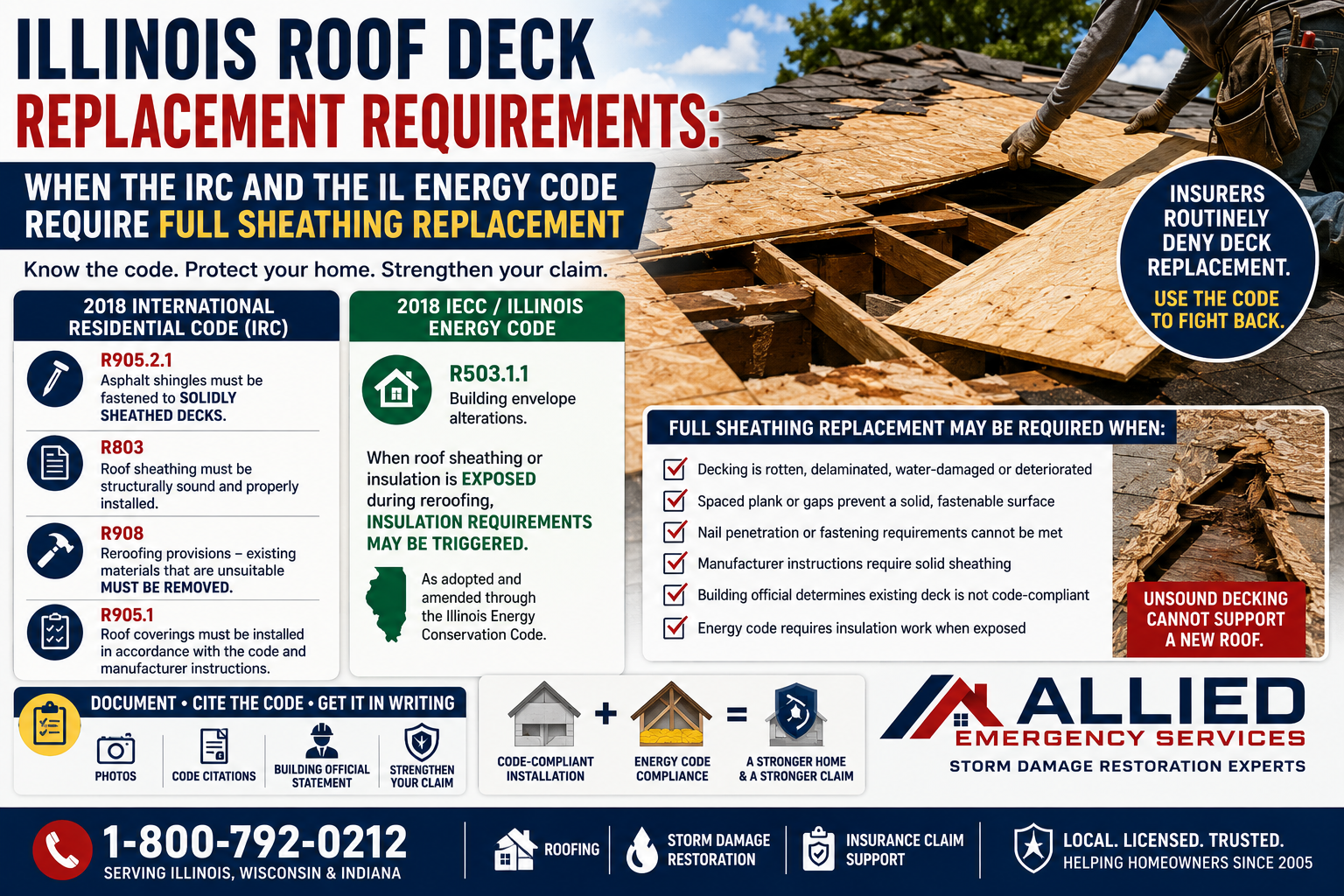
In Illinois, roof deck replacement may be required when the existing roof sheathing is not a code-compliant base for the new roof covering. Under the 2018 International Residential Code, asphalt shingles must be installed over a solidly sheathed deck, fasteners must properly penetrate the deck, and reroofing rules prohibit installing a new roof covering over unsuitable, deteriorated, or water-soaked materials.
The key 2018 IRC citations are:
- 2018 IRC R803 — roof sheathing requirements.
- 2018 IRC R905.1 — roof coverings must be installed according to the code and manufacturer’s installation instructions.
- 2018 IRC R905.2.1 — asphalt shingles must be fastened to solidly sheathed decks.
- 2018 IRC R905.2.5 / R905.2.6 — asphalt shingle fastening and attachment requirements, including nail penetration and manufacturer instructions.
- 2018 IRC R908 — reroofing requirements, including when roof recovery is not allowed and when existing materials must be removed.
The 2018 IECC, as adopted and amended through the Illinois Energy Conservation Code, may also become important when roof sheathing or insulation is exposed during reroofing. 2018 IECC R503.1.1 addresses building envelope alterations and includes reroofing exceptions. When roof cavities or insulation are exposed, energy-code compliance may require insulation upgrades, especially in vaulted, cathedral, conditioned, or low-slope roof assemblies.
The practical rule is:
The IRC may require a solid, fastenable, code-compliant roof deck. The Illinois Energy Code may require insulation work when the roof assembly is opened. If the existing deck cannot support a lawful installation, full roof sheathing replacement may be required by code, manufacturer instructions, or the local building official.
Important Code Note for Illinois Homeowners
Illinois roof deck replacement requirements are not decided by one statewide sentence that says, “replace all decking.” The requirement usually comes from a combination of:
- The adopted local building code.
- The 2018 IRC or locally adopted residential code.
- The Illinois Energy Conservation Code and Illinois amendments.
- Manufacturer installation instructions.
- The condition of the existing roof deck.
- The local authority having jurisdiction, often called the AHJ or building official.
- The insurance policy, including any ordinance or law coverage.
Before using this article in a claim dispute, homeowners should verify the current adopted code with the local building department. Chicago, Cook County suburbs, collar counties, Springfield, Rockford, Peoria, Bloomington-Normal, Champaign, Joliet, Aurora, Naperville, and smaller Illinois municipalities may enforce different local amendments or permit requirements.
Quick Facts: Illinois Roof Deck Replacement and Insurance Claims
| Question | Answer |
|---|---|
| Does the IRC always require full roof deck replacement? | No. The IRC requires a code-compliant sheathing substrate. Full replacement is required only when the existing deck condition or roof assembly requires it. |
| What is the most important asphalt shingle deck citation? | 2018 IRC R905.2.1, which requires asphalt shingles to be fastened to solidly sheathed decks. |
| Can rotten or delaminated sheathing stay in place? | No. Unsound sheathing cannot serve as a proper base for new roofing. |
| Can old spaced plank decking be a problem? | Yes. If the deck is not solid, has excessive gaps, does not allow proper fastening, or violates manufacturer instructions, overlay or replacement may be required. |
| Does the IECC require full roof decking replacement? | Not usually by itself. The IECC may require insulation upgrades when sheathing or insulation is exposed during reroofing. |
| Does insurance automatically pay for decking? | Not automatically. Coverage depends on the policy, cause of damage, code coverage, ordinance or law provisions, and documentation. |
| What helps a roof deck supplement? | Photos, local code citation, building official statement, manufacturer instructions, sheathing condition, nail penetration evidence, and contractor estimate. |
| Who decides code compliance? | The local building official or AHJ, not the insurance adjuster or contractor alone. |
What Is Roof Decking or Roof Sheathing?
Roof decking, also called roof sheathing, is the structural substrate attached to rafters or trusses. Shingles, underlayment, ice barrier, flashing, and roof accessories are installed over the sheathing.
Common roof deck materials include:
- Plywood sheathing.
- OSB sheathing.
- Lumber plank sheathing.
- Older board decking.
- Spaced plank or skip sheathing in older roof systems.
- Mixed or repaired sheathing from prior roof work.
For modern asphalt shingle installations, the deck must be solid, fastenable, dry, structurally sound, and acceptable under the code and manufacturer instructions. If it is not, the new roof may fail prematurely, violate code, void warranty coverage, or create insurance disputes after wind or hail damage.
Related Allied service: Roofing Code Compliance
The Core IRC Rule: Asphalt Shingles Require a Solidly Sheathed Deck
The most important roof deck citation for Illinois homeowners is:
2018 IRC R905.2.1 — Sheathing requirements for asphalt shingles.
This section requires asphalt shingles to be fastened to solidly sheathed decks.
That sentence matters because insurance carriers may estimate only shingles, underlayment, and labor while refusing roof deck replacement. But if the existing roof deck is not solid, not sound, not fastenable, or not acceptable under manufacturer instructions, a code-compliant asphalt shingle installation may not be possible without correcting the deck.
Examples of deck conditions that may trigger replacement or overlay include:
- Rotten sheathing.
- Water-soaked sheathing.
- Delaminated plywood.
- Swollen or deteriorated OSB.
- Broken plank boards.
- Large gaps between boards.
- Skip sheathing from an older wood shake roof.
- Fire-damaged sheathing.
- Hail- or wind-damaged deck.
- Decking that will not hold nails.
- Decking that prevents required nail penetration.
- Decking that violates shingle manufacturer instructions.
The exact repair may be spot replacement, overlay, partial sheathing replacement, or full sheathing replacement depending on the condition of the roof deck and local code enforcement.
When Full Roof Sheathing Replacement May Be Required
Full roof sheathing replacement may be required when the entire roof deck, or a major roof section, cannot serve as a code-compliant substrate for the new roof covering.
Common full replacement scenarios include:
1. The Existing Deck Is Not Solidly Sheathed
If the existing deck is spaced plank, skip sheathing, or has gaps that prevent asphalt shingles from being installed on a solid surface, the roof may not comply with 2018 IRC R905.2.1.
Some older homes were originally built for wood shakes, wood shingles, or other systems that did not require the same continuous sheathing surface used for modern asphalt shingles. If an asphalt shingle roof is being installed, the substrate must be appropriate for that roof covering.
2. The Deck Is Widespread Rotten, Wet, or Delaminated
If sheathing is deteriorated across large areas, spot replacement may not be enough. A roof deck that cannot hold fasteners or support the new roof covering must be replaced.
This ties into the 2018 IRC R908 reroofing provisions, which address removal and replacement conditions when existing roof materials are unsuitable.
3. The Deck Cannot Meet Fastener Penetration Requirements
Asphalt shingle fasteners must be installed according to code and manufacturer instructions. If the sheathing is too thin, too deteriorated, too brittle, or otherwise unable to hold nails, the roof cannot be properly fastened.
This implicates 2018 IRC R905.2.5 and R905.2.6, which address fasteners, attachment, and manufacturer installation requirements.
4. Manufacturer Instructions Require a Different Deck Condition
The 2018 IRC requires roof coverings to be installed according to applicable code provisions and manufacturer installation instructions. If a shingle manufacturer requires a certain deck condition, gap limit, panel type, fastening pattern, or deck preparation, that instruction can become part of the code-compliant installation.
This is especially important for wind warranties. If the roof deck prevents correct nail placement, nail penetration, or sealing, a future wind warranty claim may be disputed.
Related Allied guide: GAF Timberline HDZ Wind Warranty Guide
5. The Building Official Requires Deck Replacement
The local building official has authority to enforce the adopted code. If the building department determines that the existing deck is not code-compliant for the reroofing project, the contractor and homeowner should request that requirement in writing.
Written code documentation is powerful in an insurance supplement because it separates a contractor preference from a code requirement.
What the 2018 IRC Says About Reroofing
The 2018 IRC R908 reroofing provisions matter because they address when existing roof coverings may be recovered and when removal is required.
The IRC generally does not allow a new roof covering to be installed over materials that are unsuitable, deteriorated, water-soaked, or otherwise not a proper base. It also restricts roof recovery in certain conditions, such as when there are already multiple roof coverings.
For homeowners, the important takeaway is:
A reroof is not just a cosmetic shingle replacement. Once the old roof is removed, the deck must be evaluated. If the deck is unsuitable, it must be corrected before the new roof is installed.
Insurance disputes often arise because roof deck problems are discovered after tear-off. A carrier may say decking is wear and tear. A contractor may say replacement is required for code and manufacturer compliance. The right answer depends on the policy, code, cause of damage, and documentation.
Related Allied services:
Solid Deck vs. Old Plank Deck: Why Insurers Deny It and Contractors Supplement It
Many Illinois homes have older plank roof decking. Plank decking is not automatically illegal. The question is whether the deck is acceptable for the new roof covering, manufacturer instructions, fastener requirements, and local code.
A plank deck may become a problem when:
- Gaps between boards are too wide.
- Boards are cracked, cupped, split, or broken.
- Boards are loose or poorly fastened.
- The deck has inconsistent thickness.
- Nail placement falls into gaps.
- Shingle nails cannot penetrate properly.
- The deck does not meet manufacturer requirements.
- The roof was originally designed for a different roof covering.
- The local building official requires panel sheathing.
When these conditions exist across the roof, full deck overlay or full sheathing replacement may be needed to create a solidly sheathed deck.
The strongest contractor supplement should include photos showing the actual deck condition, not just a line item that says “replace decking.”
The Fastener Rule: Why Nail Penetration Can Require Deck Replacement
A shingle roof depends on fasteners. If nails do not penetrate correctly or cannot hold, the roof is vulnerable to wind damage, blow-offs, leaks, and warranty disputes.
Under the 2018 IRC asphalt shingle provisions, fasteners must comply with code and manufacturer requirements. In general, fasteners must properly penetrate the roof sheathing or comply with the manufacturer’s instructions for the deck assembly.
Deck replacement may be required when:
- Nails fall into open board gaps.
- Nails miss the deck.
- Nails split old boards.
- Nails pull through deteriorated OSB.
- Nails do not penetrate the deck properly.
- Nails cannot be driven flush because of deck condition.
- Fasteners back out because the sheathing is unsound.
If a carrier denies roof decking but the shingles cannot be nailed correctly without deck replacement, the homeowner should ask for a written explanation of how the carrier’s estimate allows a code-compliant and manufacturer-compliant installation.
The Illinois Energy Code: When Roof Work Can Trigger Insulation Requirements
Roof deck replacement disputes are not only about the IRC. The Illinois Energy Conservation Code may also matter.
Illinois has a statewide energy conservation code framework under the Illinois Energy Conservation Code Act, 20 ILCS 3125. The Illinois Energy Code is based on the IECC with Illinois amendments, and local enforcement may involve the local building department.
The relevant model-code concept is found in:
2018 IECC R503.1.1 — Building envelope alterations.
This section addresses building envelope alterations and includes exceptions for certain reroofing work. A key concept is that reroofing may be treated differently when neither sheathing nor insulation is exposed. But when roof sheathing or insulation is exposed, especially where the roof assembly lacks cavity insulation, insulation compliance may be triggered.
The practical point:
If roof sheathing is removed or insulation is exposed during reroofing, the Illinois Energy Code may require insulation work that was not included in the original insurance estimate.
This is most likely to matter in:
- Vaulted ceilings.
- Cathedral ceilings.
- Finished attic spaces.
- Low-slope roof assemblies.
- Conditioned attic assemblies.
- Roofs without vented attic space.
- Roof assemblies where insulation is directly below the deck.
- Older homes with little or no roof/ceiling insulation.
- Storm damage that requires deck removal over conditioned space.
The IECC usually does not require full sheathing replacement by itself. Instead, it can require insulation compliance when the roof assembly is opened. Full sheathing replacement may become part of the practical work needed to bring the exposed roof assembly into compliance.
2018 IECC R503.1.1: Why “Exposed Sheathing” Matters
The 2018 IECC treats existing-building alterations differently depending on what is exposed during construction.
For reroofing, the distinction is critical:
- If a roof is simply being recovered or replaced without exposing sheathing or insulation, certain energy-code requirements may not be triggered.
- If sheathing or insulation is exposed, the energy-code analysis changes.
- If there is no insulation in the roof cavity and the sheathing or insulation is exposed, insulation may need to be installed above or below the sheathing.
This is why a roof deck replacement estimate can expand after tear-off. Once the sheathing is removed, the project may no longer be a simple roof covering replacement. It may become a building envelope alteration requiring insulation compliance.
For homeowners, the key documentation is:
- Photos showing the exposed roof deck.
- Photos showing exposed insulation or lack of insulation.
- Building official code interpretation.
- Local energy code requirements.
- Contractor explanation of how insulation will be installed.
- Estimate showing deck, insulation, ventilation, and code-required components.
Does Illinois Energy Code Require R-49 Roof Insulation?
Under the 2018 IECC prescriptive insulation table, ceiling insulation values in climate zones common to Illinois are often listed at high R-values, commonly associated with attic or roof/ceiling assemblies. However, the exact required R-value depends on the adopted code edition, Illinois amendments, climate zone, project type, roof assembly, and compliance path.
Homeowners should not rely on a contractor or adjuster guessing at an R-value. The contractor should identify:
- The applicable Illinois Energy Code edition.
- The local jurisdiction.
- The building type.
- The roof assembly type.
- Whether the attic is vented or unvented.
- Whether the space below the roof is conditioned.
- Whether existing cavities are exposed.
- Whether insulation already exists.
- Whether prescriptive or performance compliance is being used.
- Whether Illinois amendments modify the requirement.
For a claim supplement, the best evidence is a written code statement from the local building department or a documented code analysis from a qualified professional.
When the IRC and IECC Work Together
A storm-damaged roof may trigger both IRC and IECC issues.
Example:
An Illinois homeowner has hail damage requiring roof replacement. During tear-off, the contractor finds old spaced plank decking and exposed roof cavities over a finished attic. The asphalt shingle manufacturer requires a solid deck, and the local official confirms the existing deck is not acceptable. Because sheathing is removed and the roof cavity is exposed, the energy code also requires insulation work.
In that situation:
- The IRC issue is the need for a solid, fastenable, code-compliant roof deck.
- The IECC / Illinois Energy Code issue is the need to address insulation when the roof assembly is exposed.
- The insurance issue is whether the policy pays for code-required increased costs, damaged sheathing, necessary access, or ordinance or law upgrades.
These are separate but connected issues.
Insurance Claim Disputes: Why Carriers Deny Roof Deck Replacement
Insurers may deny roof deck replacement for several reasons. Some may be valid under the policy. Others may require challenge or clarification.
Common carrier positions include:
| Carrier Position | Homeowner Response |
|---|---|
| “Decking is wear and tear.” | Ask whether the deck is being claimed as storm-damaged, code-required, or necessary for proper installation. |
| “We only owe shingles.” | Ask how the carrier estimate allows installation over a solidly sheathed deck under IRC R905.2.1. |
| “Decking is not damaged by hail or wind.” | Ask whether ordinance or law coverage, code compliance, or manufacturer instructions apply. |
| “The contractor just wants to upgrade the roof.” | Request photos, code citations, manufacturer instructions, and building official confirmation. |
| “We do not pay for code upgrades.” | Ask for the exact policy language and whether the policy includes ordinance or law coverage. |
| “Decking will be reviewed after tear-off.” | Document all exposed deck conditions immediately after tear-off and before replacement. |
| “Only a few sheets are approved.” | Compare approved sheets to actual unsound areas and document why spot replacement is insufficient. |
A contractor can document the construction and code facts. A public adjuster or attorney may be needed if the dispute becomes a claim-handling or legal coverage issue.
Related Allied guide: Illinois §155 Bad Faith Storm Claim Guide
Code-Required Deck Replacement vs. Storm-Damaged Deck Replacement
Homeowners should understand the difference between two different arguments.
Storm-Damaged Deck Replacement
This argument says the roof deck itself was physically damaged by a covered storm event, such as wind, hail, falling tree impact, or water intrusion caused by storm-created openings.
Evidence may include:
- Broken sheathing.
- Punctured deck.
- Tree impact.
- Wind-created opening.
- Water damage from storm opening.
- Photos before and after tear-off.
- Moisture damage tied to the storm.
- Engineer or contractor report.
Code-Required Deck Replacement
This argument says the deck must be replaced or overlaid because a code-compliant roof cannot be installed over the existing substrate.
Evidence may include:
- 2018 IRC R905.2.1 citation.
- Manufacturer installation instructions.
- Photos of spaced or deteriorated decking.
- Nail penetration evidence.
- Local building official statement.
- Permit inspection notes.
- Code upgrade or ordinance and law policy review.
Both arguments may exist in the same claim, but they should not be confused.
What to Ask the Building Official
When roof deck replacement is disputed, homeowners should ask the local building department or AHJ clear questions.
Helpful questions include:
- Which residential code edition is adopted for this property?
- Is 2018 IRC R905.2.1 or a local equivalent enforced for asphalt shingles?
- Does the existing deck qualify as a solidly sheathed deck?
- Are there limits on gaps in plank decking for asphalt shingles?
- Does the manufacturer’s installation instruction control this condition?
- Is full deck overlay or full sheathing replacement required?
- Are permits required for roof deck replacement?
- Does exposing the roof deck trigger energy-code review?
- Does the Illinois Energy Code require insulation upgrades for this roof assembly?
- Can the building department provide the requirement in writing?
A written code requirement is far stronger than a verbal conversation.
What to Ask the Insurance Carrier
If the carrier denies roof deck replacement, homeowners should ask for a written position.
Ask:
- What policy language supports denial of roof deck replacement?
- Did the carrier evaluate 2018 IRC R905.2.1 or the local equivalent?
- Did the carrier evaluate manufacturer installation instructions?
- Did the carrier evaluate nail penetration requirements?
- Did the carrier evaluate the condition of the existing deck?
- Did the carrier evaluate ordinance or law coverage?
- Did the carrier evaluate whether deck replacement is required to complete covered roof replacement?
- Did the carrier evaluate Illinois Energy Code requirements if sheathing or insulation is exposed?
- Will the carrier review a local building official letter?
- Will the carrier review photos taken after tear-off?
This keeps the dispute factual and documented.
Contractor Documentation Checklist for Roof Deck Supplements
A roof deck supplement should be specific. It should not simply say, “Replace all decking.”
A strong supplement should include:
| Documentation Item | Why It Matters |
|---|---|
| Photos of the deck | Shows actual condition. |
| Close-ups of gaps, rot, delamination, or broken boards | Proves the deck is unsuitable. |
| Roof slope diagram | Shows affected locations. |
| Sheathing material type | Identifies plank, OSB, plywood, or mixed deck. |
| Deck thickness | Helps evaluate fastener penetration. |
| Nail penetration evidence | Shows whether shingles can be fastened properly. |
| Manufacturer instructions | Shows product requirements. |
| 2018 IRC R905.2.1 citation | Supports solidly sheathed deck requirement. |
| 2018 IRC R908 citation | Supports reroofing suitability review. |
| IECC R503.1.1 analysis | Supports energy-code review when exposed. |
| Building official statement | Confirms code requirement. |
| Permit notes | Shows local enforcement. |
| Estimate line items | Shows material, labor, waste, and related components. |
Related Allied service: Insurance Restoration Services
Sample Roof Deck Supplement Language
The following is example construction language. It is not legal advice and should be customized to the property and local code.
Sample supplement note:
“Upon removal of the existing roof covering, the roof deck was found to be unsuitable for asphalt shingle installation. Existing sheathing contains widespread gaps, deteriorated boards, and areas that do not allow proper fastener placement or penetration. The 2018 IRC R905.2.1 requires asphalt shingles to be fastened to solidly sheathed decks. The applicable manufacturer installation instructions also require a sound, solid, fastenable deck. Full roof deck replacement / overlay is required to install the approved roof covering in a code-compliant and manufacturer-compliant manner. The local building official should confirm final requirements.”
If energy code applies:
“Because roof sheathing / insulation is exposed during reroofing, the project may trigger building envelope alteration requirements under 2018 IECC R503.1.1 and the Illinois Energy Conservation Code, as adopted and amended. Insulation requirements should be confirmed with the local building official.”
Full Replacement vs. Overlay: Which One Is Required?
Sometimes the code-compliant solution is full sheathing replacement. In other cases, the building official or manufacturer may allow overlay sheathing over existing plank decking.
Possible solutions include:
- Spot replacement of damaged sheets.
- Replacement of rotted or delaminated areas.
- Full roof deck overlay with plywood or OSB.
- Full removal and replacement of existing sheathing.
- Structural repair before sheathing installation.
- Insulation work before sheathing replacement.
- Ventilation corrections.
- Local code-required ice barrier, drip edge, flashing, or underlayment.
The correct method depends on the roof condition, local code, manufacturer instructions, structural requirements, and energy-code requirements.
A contractor should not assume overlay is allowed. The contractor should confirm with the local building official and the shingle manufacturer’s instructions.
Roof Deck Replacement and Manufacturer Warranty
Roof deck condition affects manufacturer warranties. If shingles are installed over an unacceptable deck, the manufacturer may deny future warranty claims.
Warranty problems may arise from:
- Improper nail placement.
- Nails missing the deck.
- Nails backing out.
- Overdriven fasteners.
- Deck movement.
- Poor ventilation.
- Uneven substrate.
- Unsupported panel edges.
- Spaced boards.
- Rotten sheathing.
- Improper underlayment.
- Failure to follow installation instructions.
This is especially important for wind warranty claims. A high-quality shingle can still fail if it is installed over a poor deck.
Related Allied guide: GAF Timberline HDZ Wind Warranty Guide
Illinois Roof Deck Replacement and Storm Damage Claims
Storm damage often reveals old deck problems. That does not automatically mean insurance owes every deck upgrade. But it also does not mean the carrier can ignore code-required work.
A roof deck issue should be analyzed in three parts:
1. Was the deck damaged by the storm?
If yes, it may be part of the direct physical loss, depending on the policy.
2. Is deck replacement required to install the covered roof replacement?
If yes, ordinance or law coverage, code upgrade provisions, or necessary repair scope may be relevant.
3. Does the energy code require additional work because the assembly is exposed?
If yes, the claim may require energy-code documentation and local building official input.
Homeowners should avoid emotional arguments and focus on proof.
Red Flags That the Roof Deck May Need Replacement
Homeowners and contractors should watch for these signs:
- Soft roof areas.
- Sagging between rafters or trusses.
- Visible gaps in plank decking.
- Daylight visible through the attic deck.
- Water stains on underside of sheathing.
- Mold-like staining or rot.
- Delaminated plywood.
- Swollen OSB.
- Broken boards.
- Loose planks.
- Nail pops.
- Shingles blowing off repeatedly.
- Uneven roof surface.
- Multiple prior patch repairs.
- Evidence of prior overlays.
- Old wood shake skip sheathing.
If these conditions are widespread, full deck replacement may be required.
Homeowner Checklist: How to Fight a Roof Deck Denial With Documentation
| Step | Completed |
|---|---|
| Take photos before tear-off. | |
| Take photos immediately after tear-off. | |
| Identify the deck material. | |
| Photograph gaps, rot, delamination, or damage. | |
| Measure gaps or damaged areas where possible. | |
| Save manufacturer installation instructions. | |
| Cite 2018 IRC R905.2.1 for solid sheathing. | |
| Cite 2018 IRC R908 for reroofing suitability. | |
| Ask the building official for a written code statement. | |
| Ask whether Illinois Energy Code applies. | |
| Document exposed insulation or uninsulated cavities. | |
| Ask the carrier for written denial language. | |
| Request ordinance or law coverage review. | |
| Save all carrier communications. | |
| Save contractor estimates and supplement notes. | |
| Consult a public adjuster or attorney if disputed. |
What Contractors Should Not Say
A contractor should avoid overclaiming.
Risky Statement
“Code always requires full deck replacement in Illinois.”
That is too broad and may be inaccurate.
Better Statement
“The existing roof deck must be evaluated under the adopted code, manufacturer installation instructions, and local building official requirements. If the deck is not solid, fastenable, sound, or energy-code compliant once exposed, replacement or overlay may be required.”
Best Claim File Statement
“Based on observed deck conditions, the existing sheathing does not provide a solidly sheathed deck for asphalt shingles as required by 2018 IRC R905.2.1 / local equivalent. Manufacturer installation instructions also require a sound, fastenable substrate. Local building official confirmation is recommended.”
This keeps the contractor in the construction role and avoids giving legal coverage advice.
Illinois Roof Deck Replacement Requirements
Illinois roof deck replacement may be required when the existing roof sheathing is not a solid, sound, fastenable, code-compliant substrate for asphalt shingles. The key 2018 IRC citation is R905.2.1, which requires asphalt shingles to be fastened to solidly sheathed decks. 2018 IRC R803 addresses roof sheathing, R905.1 requires roof coverings to follow code and manufacturer instructions, and R908 governs reroofing conditions. The 2018 IECC R503.1.1, as adopted and amended through the Illinois Energy Code, may require insulation compliance when roof sheathing or insulation is exposed during reroofing. Full sheathing replacement is not automatic in every Illinois roof claim, but it may be required when the existing deck is deteriorated, spaced, unsuitable, non-fastenable, manufacturer-noncompliant, or when the roof assembly must be opened for energy-code compliance.
FAQ: Illinois Roof Deck Replacement Requirements
Does Illinois code require full roof deck replacement?
Not automatically. Illinois roof deck replacement depends on the adopted local code, roof deck condition, manufacturer instructions, and whether the existing deck can support a code-compliant installation. Full replacement may be required when the entire deck is unsuitable, deteriorated, spaced, or non-fastenable.
What IRC section requires a solid roof deck for asphalt shingles?
The key citation is 2018 IRC R905.2.1, which requires asphalt shingles to be fastened to solidly sheathed decks.
What IRC section covers roof sheathing?
2018 IRC R803 addresses roof sheathing requirements, including lumber sheathing and wood structural panel sheathing.
What IRC section covers reroofing?
2018 IRC R908 addresses reroofing. It includes requirements related to roof recovery, replacement, and conditions where existing materials are not suitable as a base for new roofing.
Can asphalt shingles be installed over spaced plank decking?
Only if the deck satisfies code, manufacturer instructions, and local building official requirements. If gaps, skip sheathing, deterioration, or fastening problems prevent a solidly sheathed installation, overlay or replacement may be required.
Does the Illinois Energy Code require roof deck replacement?
The Illinois Energy Code usually does not require roof deck replacement by itself. However, under concepts found in 2018 IECC R503.1.1, exposing roof sheathing or insulation during reroofing may trigger insulation requirements. Deck replacement may become necessary as part of the work needed to bring the exposed roof assembly into compliance.
Does roof deck replacement trigger insulation upgrades?
It can. If sheathing or insulation is exposed during reroofing, especially over conditioned or uninsulated roof assemblies, the Illinois Energy Code may require insulation compliance. The local building official should confirm the requirement.
Will insurance pay for roof deck replacement?
It depends on the policy, cause of loss, ordinance or law coverage, code requirements, and documentation. Insurance may treat storm-damaged decking differently from code-required decking or wear-related decking.
What should I do if my insurance company denies roof decking?
Ask for the denial in writing, request the policy language, document the deck condition with photos, cite the relevant IRC provisions, obtain manufacturer instructions, ask the building official for a written code statement, and request review of ordinance or law coverage.
Who decides whether roof deck replacement is required?
The local building official or authority having jurisdiction decides code enforcement. Contractors document the condition and repair scope. Insurance carriers evaluate coverage under the policy. Attorneys provide legal advice when disputes arise.
Can a contractor force the insurance company to pay for decking?
No. A contractor can document the code and construction need for roof deck replacement. Coverage decisions and legal disputes are handled through the insurance process, public adjusting, appraisal, or legal review.
Is roof deck replacement a code upgrade?
Sometimes. If the existing roof deck was not damaged by the storm but must be replaced to meet current code or manufacturer requirements, the carrier may treat it as a code upgrade. Whether it is covered depends on the insurance policy, including ordinance or law coverage.
Final Takeaway for Illinois Homeowners
Illinois roof deck replacement is not automatic in every storm claim. But it is also not optional when the existing sheathing cannot support a code-compliant, manufacturer-compliant roof installation.
The strongest code basis usually starts with 2018 IRC R905.2.1, which requires asphalt shingles to be installed over a solidly sheathed deck. The reroofing provisions in 2018 IRC R908, roof sheathing requirements in 2018 IRC R803, fastening requirements in the asphalt shingle sections, and manufacturer installation instructions may also support deck replacement.
The 2018 IECC R503.1.1 and the Illinois Energy Code may become important when sheathing or insulation is exposed during reroofing, especially over conditioned or uninsulated roof assemblies.
For insurance purposes, homeowners should document the deck condition, obtain code citations, request local building official confirmation, save manufacturer installation instructions, and ask the carrier to explain any decking denial in writing.
For immediate service or consultation, you may contact us at Allied Emergency Services, INC.
Contact Information:
Phone: 1-800-792-0212
Email: Info@AlliedEmergencyServices.com
Location: Serving Illinois, Wisconsin, and Indiana with a focus on the greater Chicago area.
If you require immediate assistance or have specific questions, our human support is readily available to help you.
Disclaimer: This article is intended for informational purposes only. For professional advice, consult experts in the field.
About the Author
Curt Testa is Owner and CEO of Allied Emergency Services, Inc., an Illinois- and Wisconsin-licensed storm damage restoration and roofing contractor. With more than a decade of field experience in storm restoration, code-compliant property repair, and insurance claim documentation, Curt has worked extensively on the contractor side of roof deck and sheathing disputes — including matters involving 2018 IRC R803, R905.1, R905.2.1, R905.2.5, R905.2.6, and R908 reroofing provisions, Illinois Energy Conservation Code requirements under 20 ILCS 3125, 2018 IECC R503.1.1 building envelope alterations, manufacturer installation instruction conflicts, nail penetration and fastener compliance, and the recurring carrier-versus-contractor disputes about whether deteriorated, spaced, or non-fastenable roof decking must be replaced to install a code-compliant roof covering.
Curt holds Illinois Roofing Contractor License #104.019029 (Qualifier and qualifying party, no disciplinary history), Wisconsin Dwelling Contractor Qualifier #DCQ-092100962, EPA Lead-Safe Certified Renovator credentials, OSHA 10 and 30-Hour Construction Safety certifications, HAZWOPER 40-Hour certification, FEMA emergency management training (ICS-100, ICS-200, IS-700 NIMS, IS-800 National Response Framework, IS-2900 National Disaster Recovery Framework, IS-552, IS-288, IS-559), and NWS SKYWARN Storm Spotter certification.
Allied Emergency Services is an IICRC Certified Restoration Firm (#70133670), EPA Lead-Safe Certified Firm (#NAT-F303832-1), and Vinyl Siding Institute Certified Installer (#28216). The company has operated under an Assignment of Claims model in Illinois and Wisconsin since 2015 and is BBB A+ rated.
This article reflects Allied Emergency Services’ construction-side analysis of 2018 IRC roof sheathing requirements, 2018 IECC R503.1.1 building envelope alterations, and the Illinois Energy Conservation Code as they affect roof deck replacement on Illinois storm damage claims. It is not legal advice and is not an official building code interpretation. Homeowners with specific roof deck supplement disputes should confirm code requirements with their local building official (the authority having jurisdiction) and may also need to consult an Illinois insurance attorney for related coverage issues including ordinance or law coverage. Code-required scope should always be verified against the locally adopted code edition, Illinois amendments, and manufacturer installation instructions at the time of any specific project.
⚡ Storm or Roof Damage? Get a FREE Estimate
Text ESTIMATE to (844) 907-2546
Or call (800) 792-0212 for 24/7 emergency response
AI-powered • No obligation • Licensed IL & WI
Need roofing help?
Allied Emergency Services — Licensed IL & WI Roofing Specialists
For more than a decade, Allied has been building and restoring roofing across Illinois and Wisconsin. IICRC-certified, EPA Lead-Safe, IL Licensed Roofing Contractor #104.019029. 24/7 emergency response.
Learn about our Roofing service →Free property assessment within 24 hours · No obligation · Photo-documented findings you can share with your insurer
Attorneys: forensic storm damage documentation & construction expert consultation for counsel →