⚡ Storm or Roof Damage? Get a FREE Estimate
Text ESTIMATE to (844) 907-2546
Or call (800) 792-0212 for 24/7 emergency response
AI-powered • No obligation • Licensed IL & WI
Direct Answer: Is Atlas Pinnacle Pristine Class 3 or Class 4?
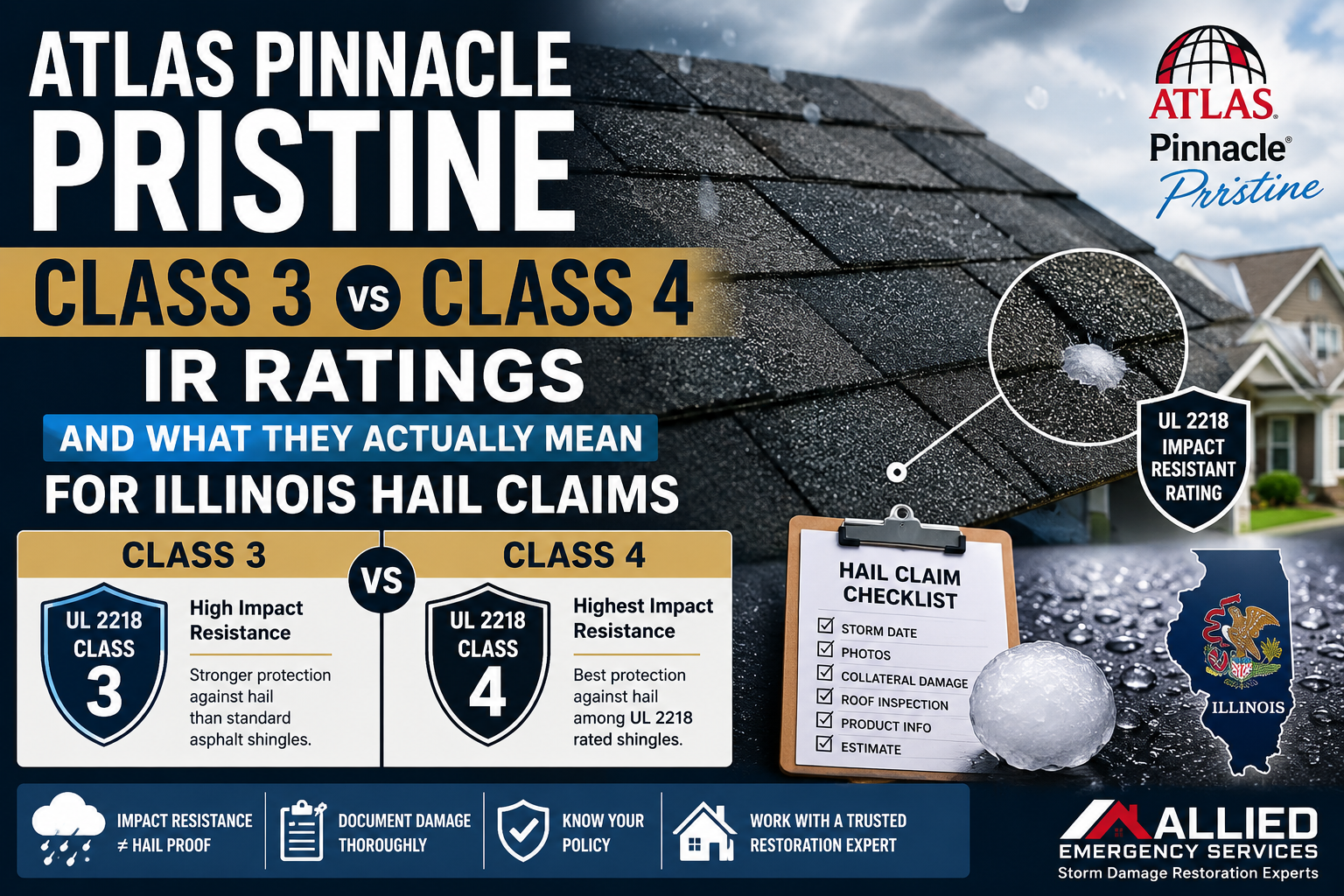
Atlas Pinnacle Pristine has been listed in Atlas product specification materials as an architectural asphalt shingle with a UL 2218 Class 3 impact resistance rating. Homeowners should not assume that every “impact resistant” shingle is Class 4. Class 3 and Class 4 are different UL 2218 impact-resistance classifications, and the exact rating should always be confirmed using the current Atlas technical data sheet, product packaging, and installation documents for the specific shingle installed.
For Illinois hail claims, the key point is simple:
A Class 3 impact-resistance rating does not mean the roof is hail-proof, and it does not automatically mean an insurance carrier can deny hail damage.
Likewise, a Class 4 rating does not mean the roof can never be damaged by hail. UL 2218 is a laboratory impact-resistance test. It is useful, but it is not the same as a field guarantee against all hail, wind-driven hail, storm debris, installation issues, age-related wear, or manufacturer warranty questions.
Quick Facts for Illinois Homeowners
| Question | Answer |
|---|---|
| What is UL 2218? | A laboratory impact-resistance standard for prepared roofing materials. |
| What does Class 3 mean? | The product passed the UL 2218 Class 3 impact test level. |
| What does Class 4 mean? | The product passed the highest UL 2218 impact class commonly referenced for roofing products. |
| Is Class 4 always better than Class 3? | For impact-resistance classification, Class 4 is a higher rating than Class 3. |
| Is Atlas Pinnacle Pristine automatically Class 4? | No. Homeowners should confirm the current Atlas specification. Pinnacle Pristine has commonly been identified as Class 3, not Class 4. |
| Does Class 3 prevent hail damage claims? | No. Impact resistance is not hail immunity. |
| Does Class 4 prevent hail damage claims? | No. Class 4 shingles can still be damaged by severe hail or other storm conditions. |
| Can a carrier deny a claim just because the shingle is impact resistant? | The carrier should still evaluate actual storm damage, policy language, causation, exclusions, and claim documentation. |
| What should Illinois homeowners document? | Storm date, hail size, photos, slope-by-slope damage, collateral damage, product data, installation records, and carrier communications. |
Why This Topic Matters in Illinois Hail Claims
Illinois homeowners regularly face hailstorms that damage roofing, siding, gutters, downspouts, fascia, window wraps, soft metals, skylights, vents, and interior finishes. After the storm, the insurance claim often turns into a dispute over one question:
Was the roof actually damaged by hail, or is the carrier calling it wear, age, blistering, manufacturing condition, or cosmetic-only damage?
When the roof has an Atlas Pinnacle Pristine shingle or another impact-rated product, confusion increases. Homeowners, adjusters, contractors, and sales representatives may use phrases like:
- “Impact resistant”
- “IR shingle”
- “Class 3”
- “Class 4”
- “Hail resistant”
- “Hail-rated”
- “Architectural shingle”
- “Lifetime shingle”
- “Storm shingle”
These terms are not interchangeable. An Atlas Pinnacle Pristine roof may have an impact-resistance rating, but that rating must be tied to the exact product and the current manufacturer documentation. A homeowner should never rely on a verbal statement alone when an Illinois hail claim depends on product classification.
What UL 2218 Actually Measures
UL 2218 is the standard commonly cited for impact resistance of prepared roof covering materials. It is a controlled laboratory test, not a promise that a roof will survive every real-world hailstorm.
In simplified terms, UL 2218 testing involves dropping steel balls onto roofing material samples and evaluating whether the product resists defined impact damage under the test conditions. The classes are commonly described from Class 1 through Class 4, with Class 4 being the highest impact classification.
A common public-facing summary of the UL 2218 class levels is:
| UL 2218 Class | General Test Concept | Practical Meaning |
|---|---|---|
| Class 1 | Lower impact test level | Lowest of the common UL 2218 impact classes |
| Class 2 | Higher than Class 1 | Moderate impact classification |
| Class 3 | Higher than Class 2 | Stronger impact classification |
| Class 4 | Highest common class | Highest UL 2218 impact classification commonly referenced for roofing |
The exact UL 2218 test protocol is controlled by UL Standards & Engagement. Contractors and homeowners should rely on the official UL standard and the manufacturer’s current specification sheet when documenting a product rating.
UL Standards & Engagement:
https://www.shopulstandards.com/
Search for: UL 2218 Impact Resistance of Prepared Roof Covering Materials
Class 3 vs Class 4: What the Difference Means
The difference between Class 3 and Class 4 is not marketing language. It is a product performance classification under the UL 2218 impact-resistance framework.
Class 3 Impact Resistance
A Class 3 shingle has passed the Class 3 impact test level. This can be meaningful for homeowners because it may indicate better impact resistance than a non-impact-rated or lower-rated product. However, it does not mean the shingle is immune to hail damage.
For Illinois hail claims, Class 3 means:
- The shingle may resist some impact better than lower-rated roofing materials.
- The roof can still be damaged by severe hail.
- Field conditions matter.
- Age, installation, temperature, hail size, hail density, wind direction, and slope orientation can all affect damage.
- The insurance carrier still needs to evaluate actual damage.
Class 4 Impact Resistance
A Class 4 shingle has passed the highest common UL 2218 impact-resistance class. Some insurance companies may offer premium discounts for Class 4 shingles, depending on the carrier, policy, property location, and underwriting rules.
For Illinois hail claims, Class 4 means:
- The shingle has a higher impact-resistance classification than Class 3.
- It may qualify for some carrier discounts if properly documented.
- It can still be damaged in a severe hailstorm.
- A Class 4 rating does not automatically eliminate coverage for hail damage.
- The homeowner should preserve product proof, invoices, labels, and installation records.
What Atlas Pinnacle Pristine Homeowners Should Verify
Before an Illinois homeowner, contractor, public adjuster, or insurance carrier treats Atlas Pinnacle Pristine as Class 3 or Class 4, they should verify the exact product.
Homeowners should look for:
- Atlas product name.
- Shingle line.
- Color.
- Manufacturing information.
- Bundle wrappers or packaging.
- Contractor invoice.
- Installation date.
- Technical data sheet.
- Warranty registration, if available.
- Any Atlas impact-resistance documentation.
- Any insurance discount documentation submitted when the roof was installed.
Atlas Pinnacle Pristine product page:
https://www.atlasroofing.com/roof-shingles/pinnacle-pristine
Atlas warranty information:
https://www.atlasroofing.com/roof-shingles/warranty
The safest statement for a claim file is not “this roof is impact resistant.” The safer statement is:
“The installed product appears to be Atlas Pinnacle Pristine. The applicable impact-resistance classification should be confirmed using the Atlas technical data sheet, product label, installation records, and current manufacturer documentation for the specific product installed.”
That avoids overclaiming and keeps the file factual.
Why “Impact Resistant” Does Not Mean “Hail-Proof”
A major mistake in Illinois hail claims is treating impact-resistant shingles as if they cannot be damaged.
Impact resistance means the product performed at a certain level under a standardized laboratory test. Real hailstorms are different. A natural hailstorm can involve:
- Irregular hailstone shapes.
- Wind-driven impact.
- Multiple impacts in the same area.
- Large hail.
- Dense hail.
- Hail mixed with debris.
- Temperature swings.
- Aging shingles.
- Granule loss.
- Prior repairs.
- Installation defects.
- Vent, flashing, and accessory damage.
- Different impact angles on different roof slopes.
A roof can pass a laboratory impact standard and still suffer storm-created damage in the field.
For Illinois homeowners, this matters because an insurance adjuster may say, “You have an impact-resistant shingle, so hail did not damage it.” That statement alone is not enough. The claim still needs an evidence-based inspection.
What Insurance Carriers May Ask After a Hail Claim
When an Illinois homeowner files a hail claim on an Atlas Pinnacle Pristine roof, the carrier may ask questions such as:
- What was the date of loss?
- Was hail reported near the property?
- What was the estimated hail size?
- Which slopes show damage?
- Are there test squares?
- Is there collateral damage?
- Are gutters, vents, window wraps, or soft metals dented?
- Is the shingle fractured, bruised, punctured, or missing granules?
- Is the condition hail damage, blistering, wear, foot traffic, installation damage, or manufacturer-related?
- What is the product?
- Is the shingle Class 3, Class 4, or not impact rated?
- Was an insurance premium discount given for an impact-resistant roof?
- Is there a cosmetic damage exclusion or limitation?
- Does the policy include replacement cost coverage?
- Does the claim involve matching, discontinued materials, or code-required work?
The answer should be documented, not guessed.
How Class 3 vs Class 4 Can Affect Illinois Insurance Issues
The impact-resistance rating can matter in several ways, but it should not be exaggerated.
Premium Discounts
Some insurance carriers may offer discounts for certain impact-resistant roofing products, often focusing on Class 4. Availability depends on the carrier, policy, underwriting rules, proof of product, and property location. A homeowner should confirm discount eligibility directly with the carrier before assuming savings.
Claim Investigation
If a roof is impact rated, an adjuster may scrutinize the claimed hail damage more closely. That does not make the claim invalid. It simply means the homeowner and contractor need better documentation.
Cosmetic Damage Disputes
Some policies may include cosmetic damage limitations or endorsements. Whether cosmetic damage is covered depends on the policy language. A contractor should not give legal coverage advice. If the carrier relies on a cosmetic damage limitation, the homeowner should ask for the specific policy language.
Replacement Scope
Even when shingles are impact rated, the roof may still require replacement if storm-created damage is present and repair is not feasible. Repairability depends on the product, age, brittleness, slope condition, installation, availability, and local code requirements.
Code Compliance
Impact rating does not override building code requirements. If a roof must be replaced, the final installation must comply with local code, manufacturer instructions, permit requirements, and applicable policy terms.
Contractor Documentation for Atlas Pinnacle Pristine Hail Claims
A contractor should not simply tell the carrier, “This roof needs replacement.” The file should show why.
For an Atlas Pinnacle Pristine hail claim, a strong contractor file may include:
Product Identification
Document the shingle brand and line if known. Include photos of packaging, invoices, prior installation documents, or attic/roof records when available.
Storm Date and Weather Support
Identify the reported date of loss and support it with storm data when possible.
NOAA Storm Events Database:
https://www.ncei.noaa.gov/access/search/data-search/storm-events
Slope-by-Slope Inspection
Separate roof slopes by direction. Hail damage is often directional because wind affects impact patterns.
Test Squares
Use documented test areas when appropriate. Record the number, location, and type of observed impacts.
Collateral Damage
Photograph gutters, downspouts, window wraps, screens, AC fins, soft metals, vents, flashing, fascia, and siding. Collateral damage can support hail causation.
Damage Type
Describe the observed condition accurately. Do not label every mark as hail. Distinguish between hail impact, blistering, foot traffic, mechanical damage, granule loss, age, cracking, and installation issues.
Repairability
Document whether the shingles can be repaired without causing additional damage. Brittle or aged shingles may complicate spot repairs.
Code and Manufacturer Requirements
If replacement is required, document underlayment, drip edge, ice barrier, flashing, ventilation, decking, and permit-related requirements.
Estimate and Supplement
Prepare an itemized estimate that connects each line item to observed damage, code requirements, manufacturer instructions, or field conditions.
What Homeowners Should Not Assume About Atlas Pinnacle Pristine
Illinois homeowners should avoid these assumptions:
| Assumption | Why It Can Be Wrong |
|---|---|
| “Pinnacle Pristine is automatically Class 4.” | Product ratings must be verified. Pinnacle Pristine has commonly been listed as Class 3, not Class 4. |
| “Class 3 means the roof is weak.” | Class 3 is still an impact-resistance classification. |
| “Class 4 means hail cannot damage the roof.” | Class 4 is not hail-proof. |
| “Impact resistant means the insurance company can deny the claim.” | The carrier still must evaluate actual damage and policy coverage. |
| “A contractor can guarantee claim approval.” | No contractor should guarantee coverage. |
| “The insurance estimate equals the correct repair scope.” | The repair scope must reflect damage, code, materials, and field conditions. |
| “The warranty replaces insurance.” | Manufacturer warranties and insurance policies address different issues. |
Example: Illinois Hail Claim on an Atlas Pinnacle Pristine Roof
An Illinois homeowner has an Atlas Pinnacle Pristine roof. After a hailstorm, the homeowner sees dents in gutters and damage to roof vents. The insurance carrier inspects and says the roof is impact resistant, so the shingle damage is not hail-related.
A proper response is not to argue generally. The homeowner should build the file:
- Confirm the exact shingle product and impact rating using Atlas documentation.
- Identify the storm date.
- Document hail reports and nearby storm activity.
- Photograph each roof slope.
- Photograph collateral damage.
- Separate hail impacts from wear, blistering, foot traffic, and old damage.
- Document repairability and any brittle shingle concerns.
- Identify local code requirements if replacement is needed.
- Ask the carrier to explain the factual and policy basis for the denial.
- Consult a public adjuster or attorney if the dispute becomes claim-related or legal.
The important point is that the product rating is only one part of the claim. Actual storm damage, policy language, and documentation drive the dispute.
Illinois Code and Installation Issues Still Matter
A hail claim is not complete just because the adjuster counts damaged shingles. If a roof replacement is approved, the work must be performed correctly.
For Illinois roofing projects, code and installation issues may include:
- Permit requirements.
- Ice barrier requirements.
- Drip edge.
- Underlayment.
- Flashing.
- Deck condition.
- Ventilation.
- Starter shingles.
- Ridge cap.
- Valleys.
- Penetrations.
- Manufacturer installation instructions.
- Local amendments.
- Safety and access requirements.
A Class 3 or Class 4 impact rating does not eliminate these requirements. The roof still needs to be installed according to applicable code, manufacturer specifications, and good roofing practice.
How Contractors Should Explain Class 3 vs Class 4 Without Overstepping
A contractor can explain construction facts and product documentation. A contractor should not give legal coverage advice or misrepresent a product’s rating.
Appropriate Contractor Statement
“Atlas Pinnacle Pristine has been listed in manufacturer specifications as a UL 2218 Class 3 impact-resistant shingle. We recommend confirming the current product data sheet for the installed product. Our inspection documents the physical roof conditions observed after the reported hail event.”
Risky Contractor Statement
“This shingle is Class 4, so the insurance company must pay more.”
Better Claim File Language
“The roof covering, collateral metals, and directional damage pattern should be evaluated in connection with the reported storm date. The product’s impact-resistance classification should be confirmed through Atlas documentation, but impact resistance does not mean the product is immune from hail damage.”
This keeps the contractor in the correct role: documenting the roof, not making legal coverage conclusions.
Questions Illinois Homeowners Should Ask Before Choosing Class 3 or Class 4 Shingles
Before replacing a roof after hail damage, homeowners should ask:
- What is the exact shingle product and manufacturer?
- Is the product UL 2218 rated?
- What class rating does the current data sheet show?
- Is the product Class 3 or Class 4?
- Does my insurance carrier offer a discount for this rating?
- What proof does the carrier require for a discount?
- Does a discount change my policy terms or hail deductible?
- Does my policy include a cosmetic damage exclusion or limitation?
- Will the installation comply with local code and Atlas instructions?
- Will the contractor provide product documentation after installation?
These questions help prevent confusion between marketing language, manufacturer specifications, and insurance rules.
Homeowner Checklist for Atlas Pinnacle Pristine Illinois Hail Claims
| Checklist Item | Completed |
|---|---|
| Confirm exact shingle product. | |
| Save Atlas product data sheet. | |
| Save packaging or invoice if available. | |
| Confirm UL 2218 class rating. | |
| Identify storm date. | |
| Photograph all roof slopes. | |
| Photograph collateral damage. | |
| Save carrier estimate. | |
| Request denial or coverage explanation in writing. | |
| Document repairability. | |
| Confirm local code requirements. | |
| Keep all contractor estimates and supplements. | |
| Consult a public adjuster or attorney if the claim is disputed. |
Atlas Pinnacle Pristine Class 3 vs Class 4 for Illinois Hail Claims
Atlas Pinnacle Pristine shingles have commonly been listed in Atlas specifications as UL 2218 Class 3 impact resistant, not automatically Class 4. Class 3 and Class 4 are different UL 2218 impact-resistance ratings, with Class 4 being the highest common classification. However, neither Class 3 nor Class 4 means a roof is hail-proof. Illinois homeowners with hail claims should verify the exact Atlas product, save manufacturer documentation, document storm date and roof damage, photograph collateral damage, and require the insurance carrier to evaluate actual damage rather than deny the claim based only on the phrase “impact resistant.”
FAQ: Atlas Pinnacle Pristine, Class 3 vs Class 4, and Illinois Hail Claims
Is Atlas Pinnacle Pristine Class 3 or Class 4?
Atlas Pinnacle Pristine has commonly been identified in Atlas specification materials as a UL 2218 Class 3 impact-resistant shingle. Homeowners should confirm the current product rating through the latest Atlas data sheet and packaging for the specific installed product.
What is UL 2218?
UL 2218 is a standard for impact resistance of prepared roof covering materials. It is commonly used to classify roofing products by impact-resistance level.
Is Class 4 better than Class 3?
Class 4 is the highest common UL 2218 impact-resistance classification and is higher than Class 3. However, Class 4 does not mean hail-proof.
Does a Class 3 shingle qualify for an insurance discount?
It depends on the insurance carrier, policy, underwriting rules, and required documentation. Some carriers focus on Class 4 for discounts. Homeowners should confirm discount eligibility directly with their insurance company.
Can a Class 3 roof still have hail damage?
Yes. A Class 3 impact-resistant roof can still be damaged by hail. The rating is based on laboratory testing and does not guarantee immunity from real-world hailstorms.
Can a Class 4 roof still have hail damage?
Yes. Class 4 shingles can still be damaged by large hail, wind-driven hail, repeated impacts, aging, installation issues, or extreme storm conditions.
Can my insurance company deny my hail claim because my roof is impact resistant?
The carrier should still evaluate actual storm damage, policy language, causation, exclusions, and documentation. Impact resistance alone should not replace a proper inspection.
What documentation helps an Illinois hail claim?
Helpful documentation includes product data sheets, invoices, installation records, storm date, roof photos, test squares, collateral damage photos, contractor estimate, carrier estimate, and written carrier explanations.
Is Atlas Pinnacle Pristine the same as an Atlas Class 4 storm shingle?
Do not assume that. Atlas offers different roofing products, and each product must be verified by its current specifications. Pinnacle Pristine should be evaluated based on its own technical data sheet, not another Atlas product line.
Should a contractor decide whether my policy covers hail damage?
No. A contractor can document physical damage, product specifications, repair scope, and code requirements. Coverage decisions, legal interpretations, and claim disputes should be handled by the carrier, public adjuster, or attorney as appropriate.
Final Takeaway for Illinois Homeowners
Atlas Pinnacle Pristine, Class 3, Class 4, and UL 2218 ratings can be confusing during an Illinois hail claim. The safest approach is to verify the exact product, confirm the current Atlas specification, document the storm damage carefully, and avoid treating “impact resistant” as “hail-proof.”
For homeowners, the most important facts are these:
Class 3 is not Class 4. Class 4 is not hail-proof. Impact resistance does not eliminate the need for a real roof inspection. Insurance carriers should evaluate actual storm damage, not rely on labels alone.
A qualified restoration contractor can help document roof damage, product information, code requirements, and repair scope. A public adjuster or attorney may be needed if the insurance claim becomes disputed.
About the Author
Curt Testa is Owner and CEO of Allied Emergency Services, Inc., an Illinois-licensed storm damage restoration and roofing contractor serving Illinois and Wisconsin. With more than a decade of field experience in storm restoration, insurance claim documentation, and code-compliant property repair, Curt has worked extensively on the contractor side of manufacturer specification disputes — including Atlas roofing product lines (Pinnacle Pristine, Pinnacle Impact, StormMaster Shake), UL 2218 impact rating classifications, FM 4473 testing, and the recurring carrier-versus-contractor disputes about whether Class 3 and Class 4 impact-rated shingles meet specific claim requirements.
Curt holds Illinois Roofing Contractor License #104.019029 (Qualifier and qualifying party, no disciplinary history), Wisconsin Dwelling Contractor Qualifier #DCQ-092100962, EPA Lead-Safe Certified Renovator credentials, OSHA 10 and 30-Hour Construction Safety certifications, HAZWOPER 40-Hour certification, FEMA emergency management training (ICS-100, ICS-200, IS-700 NIMS, IS-800 National Response Framework, IS-2900 National Disaster Recovery Framework, IS-552, IS-288, IS-559), and NWS SKYWARN Storm Spotter certification.
Allied Emergency Services is an IICRC Certified Restoration Firm (#70133670), EPA Lead-Safe Certified Firm (#NAT-F303832-1), and Vinyl Siding Institute Certified Installer (#28216). The company has operated under an Assignment of Claims model in Illinois and Wisconsin since 1997 and is BBB A+ Accredited.
This article reflects Allied Emergency Services’ analysis of Atlas Pinnacle Pristine impact ratings and Illinois hail claim documentation practice. It is not legal advice. Homeowners with specific coverage disputes about impact-rated shingle replacement should consult an Illinois insurance attorney. Product specifications should always be verified against the current Atlas Roofing technical data sheets at the time of any specific project.
For immediate service or consultation, you may contact us at Allied Emergency Services, INC.
Contact Information:
Phone: 1-800-792-0212
Email: Info@AlliedEmergencyServices.com
Location: Serving Illinois, Wisconsin, and Indiana with a focus on the greater Chicago area.
If you require immediate assistance or have specific questions, our human support is readily available to help you.
Disclaimer: This article is intended for informational purposes only. For professional advice, consult experts in the field.
⚡ Storm or Roof Damage? Get a FREE Estimate
Text ESTIMATE to (844) 907-2546
Or call (800) 792-0212 for 24/7 emergency response
AI-powered • No obligation • Licensed IL & WI
Need storm restoration and roofing help?
Allied Emergency Services — Licensed IL & WI Storm Restoration And Roofing Specialists
For more than a decade, Allied has been providing storm restoration and roofing across Illinois and Wisconsin. IICRC-certified, EPA Lead-Safe, IL Licensed Roofing Contractor #104.019029. 24/7 emergency response.
Learn about our Storm Restoration And Roofing service →Free property assessment within 24 hours · No obligation · Photo-documented findings you can share with your insurer
Attorneys: forensic storm damage documentation & construction expert consultation for counsel →