
⚡ Storm or Roof Damage? Get a FREE Estimate
Text ESTIMATE to (844) 907-2546
Or call (800) 792-0212 for 24/7 emergency response
AI-powered • No obligation • Licensed IL & WI
Direct Answer: A Roofing License Is Not a Public Adjuster License in Illinois
Illinois homeowners with storm damage should understand one critical rule:
An Illinois roofing contractor license and an Illinois public adjuster license are not the same thing.
The Illinois Roofing Industry Licensing Act, 225 ILCS 335, regulates roofing contractors. It applies to professionals who perform or offer roofing work in Illinois.
Illinois Roofing Industry Licensing Act, 225 ILCS 335:
https://www.ilga.gov/legislation/ilcs/ilcs.asp
The Illinois Insurance Code, 215 ILCS 5, includes Illinois insurance laws, including laws governing public adjusters. A public adjuster generally represents the insured in connection with an insurance claim for compensation, subject to the licensing requirements and restrictions in Illinois law.
Illinois Insurance Code, 215 ILCS 5:
https://www.ilga.gov/legislation/ilcs/ilcs.asp
For storm restoration claims, this distinction matters. A licensed roofing contractor may inspect storm damage, prepare a repair estimate, document code-required roofing work, and perform roof restoration. A licensed public adjuster may assist with claim adjustment activities when properly licensed. A contractor should not present a roofing license as permission to act as a public adjuster, and a public adjuster license does not make someone a licensed roofing contractor.
For Illinois homeowners, the safe rule is simple:
Roofing contractors restore the property. Public adjusters adjust the insurance claim. Attorneys give legal advice.
Illinois Homeowner Quick Comparison Table
| Issue | Illinois Roofing Contractor | Illinois Public Adjuster |
|---|---|---|
| Primary law | 225 ILCS 335, Illinois Roofing Industry Licensing Act | 215 ILCS 5, Illinois Insurance Code, including public adjuster provisions |
| Regulator | Illinois Department of Financial and Professional Regulation | Illinois Department of Insurance |
| Main role | Inspect, estimate, repair, replace, and restore roofing systems | Assist the insured with claim adjustment activities when properly licensed |
| Storm claim role | Document damage, prepare repair scope, identify code issues, perform work | Represent the insured in claim adjustment, subject to Illinois law |
| Can perform roofing work? | Yes, if properly licensed and qualified | Not by virtue of public adjuster licensing alone |
| Can adjust insurance claims? | Not by virtue of roofing licensing alone | Yes, if properly licensed and acting within Illinois law |
| Can give legal advice? | No | No, unless also a licensed attorney |
| Homeowner risk | Hiring an unlicensed roofer or a roofer who crosses into claim-adjusting | Hiring an unlicensed adjuster or someone who also has conflicting contractor interests |
| Best practice | Verify IDFPR roofing license | Verify Illinois Department of Insurance public adjuster license |
Why This Matters After Hail, Wind, Tornado, or Severe Storm Damage
Storm restoration claims in Illinois often involve two overlapping but legally different questions:
1. What physical work is needed to restore the property?
This is the roofing, siding, gutter, water damage, and code-compliance question.
2. What does the insurance policy owe for the covered loss?
This is the insurance adjustment, claim handling, coverage, depreciation, deductible, endorsement, and settlement question.
Those questions overlap, but they are not the same. A roof may need a code-compliant replacement even though the insurance company initially pays only for a repair. A contractor may properly document the repair scope, but that does not automatically make the contractor a licensed public adjuster. A public adjuster may argue the claim value, but that does not make the public adjuster licensed to perform roof replacement.
This is especially important in Chicago, Cook County, DuPage County, Will County, Lake County, Kane County, McHenry County, and storm-affected communities throughout Illinois where hail, wind, and water damage claims can involve roofing systems, siding elevations, gutters, fascia, soffit, windows, interior leaks, emergency tarping, and local building code requirements.
What the Illinois Roofing Industry Licensing Act Regulates
The Illinois Roofing Industry Licensing Act, 225 ILCS 335, is the core Illinois licensing law for roofing contractors. Homeowners should treat this law as a starting point before hiring anyone to inspect, repair, replace, or restore a roof after storm damage.
In plain English, the Illinois Roofing Industry Licensing Act is aimed at roofing contractor licensing. A homeowner should use it to ask:
- Is this contractor licensed to perform roofing work in Illinois?
- Is the company name on the contract the same company tied to the license?
- Is the license active?
- Does the contractor have the proper type of roofing license for the project?
- Does the contract clearly identify the work, materials, price, and responsibilities?
- Is the contractor documenting the storm damage and code-required repair scope without improperly acting as a public adjuster?
Homeowners can verify Illinois professional licenses through the Illinois Department of Financial and Professional Regulation license lookup:
https://online-dfpr.micropact.com/lookup/licenselookup.aspx
What a Licensed Illinois Roofing Contractor Can Properly Do
A licensed Illinois roofing contractor may provide important storm restoration services, including:
- Inspecting the roof for hail, wind, fallen debris, and storm-created openings.
- Photographing visible roof damage and collateral damage.
- Preparing a construction estimate for roof repair or roof replacement.
- Identifying necessary materials, labor, flashing, underlayment, ventilation, decking, drip edge, ice barrier, and related roofing components.
- Explaining construction methods and manufacturer requirements.
- Identifying local building code and permit issues related to the roofing work.
- Performing roof repair or roof replacement if properly licensed and qualified.
- Communicating factual construction information to the homeowner and, when authorized, to the insurance carrier.
A roofing contractor’s estimate can be a major piece of evidence in a storm damage insurance claim. However, a contractor estimate is still a construction document. It should explain the repair scope, not pretend to be a legal coverage opinion.
What a Roofing Contractor Should Not Do Without the Proper License or Authority
A roofing contractor should avoid crossing into public adjusting, unauthorized insurance claim representation, or legal advice.
Examples of risky conduct may include:
- Telling the homeowner that the insurer legally owes coverage for a disputed item.
- Negotiating claim settlement as the homeowner’s claim representative without proper licensing.
- Interpreting policy exclusions, endorsements, or coverage disputes as legal conclusions.
- Advertising that a roofing license allows the contractor to “handle the entire insurance claim” if that means public adjusting.
- Telling the homeowner that the carrier committed bad faith or violated Illinois law.
- Charging a fee for claim adjustment services without being properly licensed to do so.
- Using an Assignment of Claim or similar document to blur the line between construction work and claim adjustment.
A roofing contractor can say:
“This roof has storm-related physical damage, and our estimate shows the construction scope needed to restore it.”
A roofing contractor should not say, unless legally authorized:
“Your insurance company must pay this claim, and we are adjusting or negotiating the claim for you.”
That distinction protects the homeowner, the contractor, and the integrity of the storm restoration process.
What the Illinois Public Adjusters Law Regulates
The Illinois Insurance Code, 215 ILCS 5, includes provisions governing insurance business in Illinois, including public adjusters. Public adjuster licensing is separate from roofing contractor licensing.
Illinois Insurance Code §155, 215 ILCS 5/155:
https://www.ilga.gov/legislation/ilcs/fulltext.asp?DocName=021500050K155
A public adjuster generally works on behalf of the insured in connection with an insurance claim, subject to Illinois law. In a storm damage claim, a licensed public adjuster may assist with claim presentation, claim valuation, documentation, and negotiation, depending on the scope of the public adjuster agreement and applicable legal limits.
Homeowners should verify public adjuster licensing through the Illinois Department of Insurance or other official license verification resources:
https://idoi.illinois.gov/
The key point is that public adjusting is an insurance claim activity, not a roofing construction license. A public adjuster may help with the claim, but that does not automatically authorize the public adjuster to perform roofing work.
What a Licensed Public Adjuster Can Properly Do
A properly licensed public adjuster may assist the insured with claim-related activities, subject to Illinois law and the public adjuster contract.
Depending on the facts and the applicable agreement, public adjuster work may include:
- Reviewing the insurance claim from the insured’s perspective.
- Helping document covered damage.
- Preparing or assisting with claim submissions.
- Communicating with the insurance carrier regarding claim issues.
- Assisting with claim valuation.
- Helping the insured respond to carrier estimates, inspections, or requests.
- Negotiating settlement of the claim when properly authorized and licensed.
A public adjuster can be helpful when the homeowner is overwhelmed, the insurance estimate is incomplete, or the claim involves multiple trades such as roofing, siding, gutters, interior water damage, and emergency mitigation.
Illinois Department of Financial and Professional Regulation License Lookup:
https://online-dfpr.micropact.com/lookup/licenselookup.aspx
What a Public Adjuster Should Not Do Without the Proper License or Authority
A public adjuster license does not replace other professional licenses.
A public adjuster should not:
- Perform roofing work unless separately licensed and legally authorized to do so.
- Present public adjuster licensing as construction licensing.
- Give legal advice unless also a licensed attorney.
- Ignore conflicts of interest or disclosure requirements.
- Misrepresent what the policy covers.
- Promise a claim result that cannot be guaranteed.
- Pressure a homeowner into a claim contract without clear terms.
For homeowners, the important question is not simply, “Can this person help with my insurance claim?” The better question is:
“Which license does this person hold, and what exactly are they legally allowed to do under that license?”
Illinois Department of Insurance:
https://idoi.illinois.gov/
The AOC Problem: Why Assignment of Claim Documents Need Careful Review
Many storm restoration disputes involve an Assignment of Claim, often called an AOC, or a similar assignment document. These documents can be useful in some restoration contexts, but they can also create confusion if they are used to blur licensing boundaries.
An AOC may attempt to assign certain insurance proceeds, payment rights, or claim-related rights to a contractor. The legal effect depends on the exact wording, the insurance policy, Illinois law, and the facts of the claim.
An AOC should not be used to pretend that a roofing contractor is a public adjuster. It also should not be used to avoid public adjuster licensing requirements. A roofing contractor may have a valid construction contract and may be owed payment for roofing work, but that is different from being legally authorized to adjust the insurance claim.
Before signing an AOC, Illinois homeowners should ask:
- What rights am I assigning?
- Am I assigning payment rights only, or broader claim rights?
- Who controls communication with the insurance carrier?
- Does the contractor claim authority to negotiate the insurance settlement?
- Is the contractor licensed as a roofer, a public adjuster, or both?
- Will I still owe my deductible, upgrades, or uncovered work?
- Does this document affect my ability to hire a public adjuster or attorney?
- Does this document affect any rights under Illinois insurance law, including 215 ILCS 5/155?
- Should an Illinois attorney review this document before I sign?
The safest practice is to keep the roles clear: construction contract, claim adjustment agreement, and legal representation should not be treated as the same document unless counsel confirms the arrangement is lawful and appropriate.
Roofing Estimate vs. Insurance Adjustment: Why the Difference Matters
A roofing estimate and an insurance adjustment may use similar numbers, but they serve different purposes.
Roofing Estimate
A roofing estimate explains what construction work is required to restore the property. It may include:
- Tear-off.
- Replacement shingles or roofing materials.
- Underlayment.
- Ice and water shield.
- Drip edge.
- Flashing.
- Ventilation.
- Decking replacement.
- Permit costs.
- Code-required work.
- Labor, materials, waste, and overhead.
- Related gutters, fascia, soffit, or siding work.
Insurance Adjustment
An insurance adjustment evaluates the claim under the insurance policy. It may involve:
- Covered cause of loss.
- Exclusions.
- Limitations.
- Deductible.
- Actual cash value.
- Replacement cost value.
- Depreciation.
- Ordinance or law coverage.
- Matching issues.
- Policy conditions.
- Appraisal or dispute provisions.
- Claim settlement.
A licensed roofer is usually best positioned to explain what the roof physically needs. A licensed public adjuster may be authorized to assist the insured with the claim. An attorney is the professional who should provide legal advice about coverage, bad faith, policy interpretation, litigation, or Illinois §155 issues.
Illinois Department of Insurance Consumer Complaint Page:
https://idoi.illinois.gov/consumers/file-a-complaint.html
Code Compliance Is a Roofing Issue First, But It Can Affect the Insurance Claim
Building code compliance is one of the most common reasons storm restoration estimates differ from carrier estimates.
A code-compliant roof repair or replacement may involve:
- Local permit requirements.
- Ice barrier requirements.
- Drip edge.
- Roof deck condition.
- Fastening requirements.
- Flashing requirements.
- Ventilation.
- Manufacturer installation requirements.
- Underlayment.
- Re-roof limitations.
- Safety and access requirements.
A licensed roofing contractor can identify construction and code issues within the contractor’s scope. That documentation may help the insurance claim, especially if the policy includes ordinance or law coverage. However, whether the policy owes for a specific code upgrade is a claim and coverage question. That question may require a licensed public adjuster or attorney, depending on the dispute.
This is where many homeowner disputes begin. The carrier may write a roof estimate that omits code-required work. The contractor may document the code issue. The homeowner may need a public adjuster or attorney if the carrier refuses to address it.
Example: Hail Damage Claim With Two Different Licensing Questions
A homeowner in Illinois reports hail damage after a severe storm. The insurance carrier inspects the roof and pays for a small repair. The homeowner then calls a roofing contractor.
The licensed roofing contractor documents:
- Hail impacts on shingles.
- Damaged ridge cap.
- Dented gutters and downspouts.
- Damaged soft metals.
- Brittle shingles.
- Flashing issues.
- Ice barrier and drip edge requirements.
- Permit and local code issues.
- A construction estimate for full repair or replacement.
That is roofing and restoration documentation.
If the carrier refuses to revise the estimate, denies covered items, delays claim review, or disputes payment, the homeowner may need claim adjustment help. That is where a licensed public adjuster may be appropriate. If the dispute involves legal rights, policy interpretation, bad faith, §155, or litigation, the homeowner should consult an Illinois insurance attorney.
One storm loss can involve all three roles:
Roofer: What must be repaired and how.
Public adjuster: How the insurance claim is presented and adjusted.
Attorney: What the policy and Illinois law require.
What Illinois Homeowners Should Verify Before Hiring Anyone After a Storm
Before signing any contract after hail, wind, tornado, or water damage, Illinois homeowners should verify the professional’s role.
Verify the Roofing Contractor
Ask:
- Are you licensed under the Illinois Roofing Industry Licensing Act?
- What is your Illinois roofing license number?
- Is your license active with IDFPR?
- Does your company name match the license?
- Are you licensed for the type of roofing work needed?
- Will the contract identify materials, scope, price, and responsibilities?
- Will you obtain permits when required?
- Will the work comply with local code and manufacturer instructions?
License lookup:
https://online-dfpr.micropact.com/lookup/licenselookup.aspx
Verify the Public Adjuster
Ask:
- Are you licensed as a public adjuster in Illinois?
- What is your public adjuster license number?
- Are you authorized to represent me in this claim?
- What fee will you charge?
- What services are included?
- Do you have any relationship with a contractor?
- Are there any conflicts of interest?
- Can I cancel the agreement if Illinois law allows cancellation?
- Will you put everything in writing?
Illinois Department of Insurance:
https://idoi.illinois.gov/
Verify Whether You Need an Attorney
Ask an Illinois insurance attorney if:
- The carrier denies the claim.
- The carrier delays without explanation.
- The carrier refuses to address documented storm damage.
- The carrier ignores code-required scope.
- The carrier misstates policy language.
- The dispute may involve 215 ILCS 5/155.
- You are asked to sign an AOC or assignment document you do not understand.
- The claim may go to appraisal, litigation, or declaratory judgment.
Red Flags for Illinois Homeowners
Homeowners should be cautious when a person or company says:
| Red Flag Statement | Why It Matters |
|---|---|
| “Our roofing license lets us negotiate your insurance claim.” | Roofing licensing and public adjuster licensing are separate. |
| “You do not need to read the insurance paperwork.” | Homeowners should understand what they sign. |
| “Sign this AOC and we will handle everything.” | Assignment documents can affect rights and responsibilities. |
| “We guarantee your insurance company will pay.” | Claim outcomes should not be guaranteed. |
| “We are not licensed, but licensing does not matter after a storm.” | Licensing matters, especially after disasters. |
| “Your insurance company is acting in bad faith.” | That is a legal conclusion that should come from counsel. |
| “We can repair the roof and adjust the claim under one simple form.” | Combined roles can raise licensing and conflict concerns. |
| “You do not need a permit.” | Permit requirements depend on local code and project scope. |
How This Connects to Illinois §155 Bad Faith Storm Claim Disputes
The distinction between the Illinois Roofing Industry Licensing Act and the Public Adjusters Law also matters for 215 ILCS 5/155 disputes.
Illinois §155 may become relevant when an insurer’s delay, denial, or underpayment is alleged to be vexatious and unreasonable. But a contractor should not make that legal conclusion. The contractor’s job is to build the factual restoration file.
A strong contractor file may include:
- Storm date.
- Photos and videos.
- Roof slope damage.
- Collateral damage.
- Interior water damage.
- Measurements.
- Repair estimate.
- Code notes.
- Permit requirements.
- Manufacturer requirements.
- Supplement explanation.
- Communication timeline.
- Emergency mitigation documentation.
That documentation may help a homeowner, public adjuster, or attorney evaluate whether the carrier’s claim handling was reasonable. But legal conclusions about §155 should be made by an Illinois insurance attorney.
Illinois Insurance Code §155:
https://www.ilga.gov/legislation/ilcs/fulltext.asp?DocName=021500050K155
Illinois Roofing License vs. Public Adjuster License
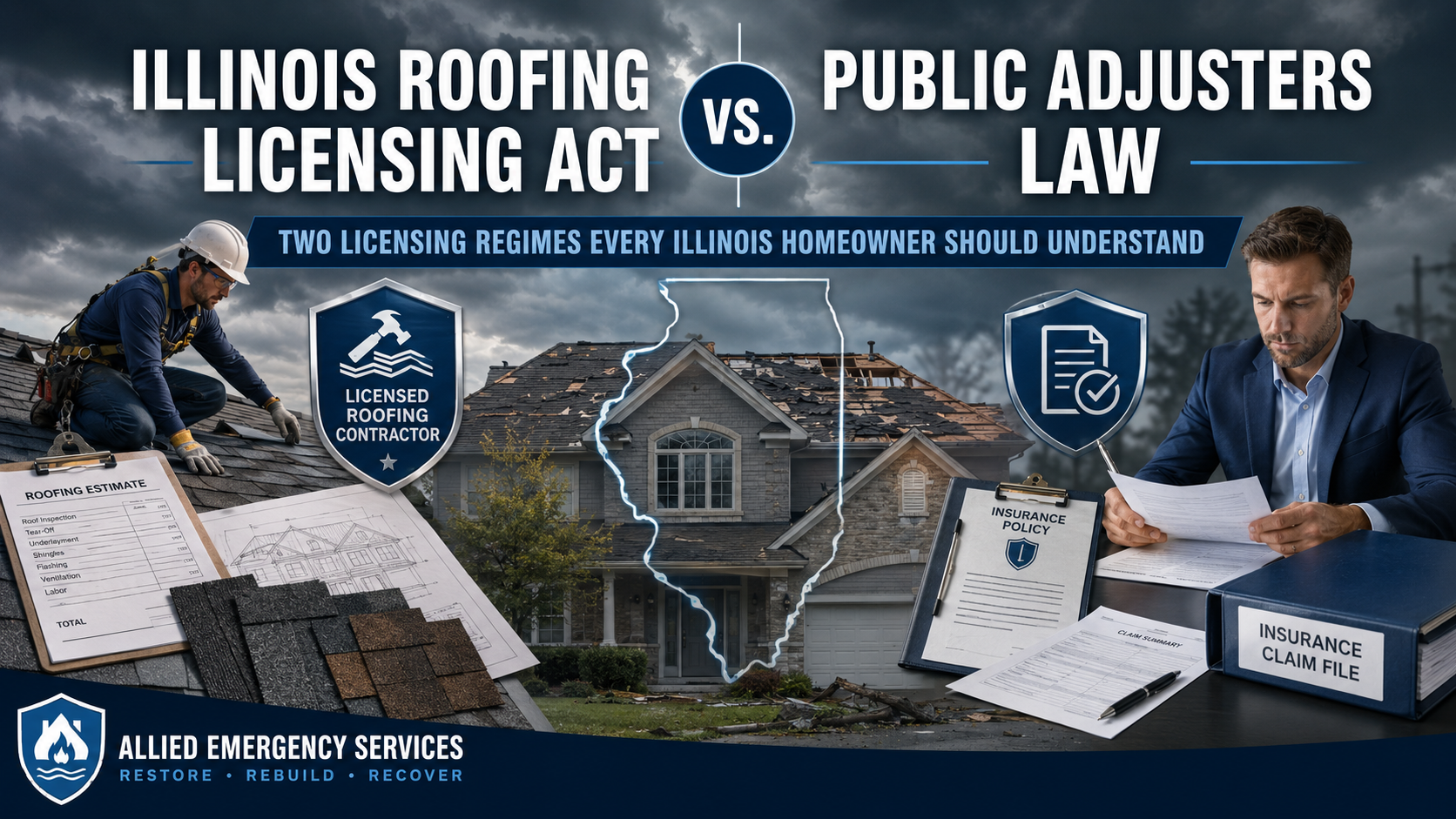
In Illinois, the Illinois Roofing Industry Licensing Act, 225 ILCS 335, regulates roofing contractors, while the Illinois Insurance Code, 215 ILCS 5, includes laws governing public adjusters. A licensed roofing contractor may inspect storm damage, prepare a construction estimate, identify code-required roof restoration scope, and perform roofing work. A public adjuster may assist an insured with insurance claim adjustment activities when properly licensed. A roofing license does not automatically authorize public adjusting, and a public adjuster license does not automatically authorize roofing work. Illinois homeowners should verify both licenses before signing storm restoration, insurance claim, or Assignment of Claim documents.
FAQ: Illinois Roofing Industry Licensing Act vs. Public Adjusters Law
What is the Illinois Roofing Industry Licensing Act?
The Illinois Roofing Industry Licensing Act, 225 ILCS 335, is the Illinois law that governs roofing contractor licensing. Homeowners should verify that a roofing contractor is properly licensed before hiring the contractor for storm damage roof repair or roof replacement.
What is the Illinois Public Adjusters Law?
Illinois public adjuster requirements are found in the Illinois Insurance Code, 215 ILCS 5. A public adjuster generally assists an insured with insurance claim adjustment activities for compensation, subject to Illinois licensing requirements and restrictions.
Is a roofing contractor the same as a public adjuster in Illinois?
No. A roofing contractor and a public adjuster are not the same. A roofing contractor performs or offers roofing work. A public adjuster assists with insurance claim adjustment when properly licensed.
Can an Illinois roofing contractor talk to my insurance company?
A roofing contractor may communicate factual construction information, damage documentation, estimates, measurements, photos, code issues, and repair scope when authorized. However, a roofing contractor should not act as a public adjuster or provide legal coverage opinions unless properly licensed and authorized.
Can a public adjuster repair my roof?
A public adjuster license does not automatically authorize roofing work. A person or company performing roofing work in Illinois should be properly licensed under the Illinois Roofing Industry Licensing Act.
Can a contractor negotiate my insurance claim in Illinois?
A contractor should be careful. Preparing a repair estimate and documenting damage is different from adjusting or negotiating an insurance claim as the insured’s representative. Homeowners should verify whether the person is properly licensed as a public adjuster if claim adjustment services are being offered.
What is an Assignment of Claim?
An Assignment of Claim, or AOC, is a document that may assign certain claim-related rights or insurance payment rights. The legal effect depends on the wording, policy, Illinois law, and the facts. Homeowners should have an attorney review any AOC they do not fully understand.
Does an AOC make a roofer a public adjuster?
No. An AOC should not be assumed to convert a roofing contractor into a licensed public adjuster. Licensing rules still matter.
Who regulates Illinois roofing contractors?
Illinois roofing contractor licensing is handled through the Illinois Department of Financial and Professional Regulation. Homeowners can use the IDFPR license lookup to verify a license.
Who regulates Illinois public adjusters?
Public adjusters are regulated through the Illinois Department of Insurance. Homeowners should verify public adjuster licensing before signing a claim representation agreement.
Can a roofer tell me my insurance company acted in bad faith?
A roofer can document damage, repair scope, code issues, and claim-related facts. A roofer should not give legal advice or make final legal conclusions about bad faith. Illinois homeowners should consult an insurance attorney for questions involving bad faith, §155, coverage disputes, or litigation.
Final Takeaway for Illinois Homeowners
Illinois storm restoration claims can involve roofing law, insurance law, building codes, claim documentation, and legal rights. The most important homeowner protection is understanding who is doing what.
A licensed roofing contractor should document the physical damage and perform code-compliant restoration work. A licensed public adjuster may assist with claim adjustment. An attorney should handle legal advice, policy disputes, §155 issues, and litigation strategy.
When hail, wind, tornado, or water damage affects a home, Illinois homeowners should verify licensing, read every contract, understand any AOC before signing, and keep the roles clear from the beginning.
For immediate service or consultation, you may contact us at Allied Emergency Services, INC.
Contact Information:
Phone: 1-800-792-0212
Email: Info@AlliedEmergencyServices.com
Location: Serving Illinois, Wisconsin, and Indiana with a focus on the greater Chicago area.
If you require immediate assistance or have specific questions, our human support is readily available to help you.
About the Author
Curt Testa is Owner and CEO of Allied Emergency Services, Inc., an Illinois-licensed storm damage restoration and roofing contractor serving Illinois and Wisconsin. With more than a decade of field experience in storm restoration, insurance claim documentation, and code-compliant property repair, Curt has worked extensively on the contractor side of complex insurance disputes — including matters involving 215 ILCS 5/155 carrier conduct, Assignment of Claims contracts, scope and supplement disputes, and code-required restoration line items routinely contested by carriers.
Curt holds Illinois Roofing Contractor License #104.019029 (Qualifier and qualifying party, no disciplinary history), Wisconsin Dwelling Contractor Qualifier #DCQ-092100962, EPA Lead-Safe Certified Renovator credentials, OSHA 10 and 30-Hour Construction Safety certifications, HAZWOPER 40-Hour certification, FEMA emergency management training (ICS-100, ICS-200, IS-700 NIMS, IS-800 National Response Framework, IS-2900 National Disaster Recovery Framework, IS-552, IS-288, IS-559), and NWS SKYWARN Storm Spotter certification.
Allied Emergency Services is an IICRC Certified Restoration Firm (#70133670), EPA Lead-Safe Certified Firm (#NAT-F303832-1), and Vinyl Siding Institute Certified Installer (#28216). The company has operated under an Assignment of Claims model in Illinois and Wisconsin since 1997 and is BBB A+ Accredited.
Disclaimer: This article is intended for informational purposes only. For professional advice, consult experts in the field.
⚡ Storm or Roof Damage? Get a FREE Estimate
Text ESTIMATE to (844) 907-2546
Or call (800) 792-0212 for 24/7 emergency response
AI-powered • No obligation • Licensed IL & WI
Need storm damage help?
Allied Emergency Services — Licensed IL & WI Storm Damage Specialists
For more than a decade, Allied has been restoring storm damage across Illinois and Wisconsin. IICRC-certified, EPA Lead-Safe, IL Licensed Roofing Contractor #104.019029. 24/7 emergency response.
Learn about our Storm Damage service →Free property assessment within 24 hours · No obligation · Photo-documented findings you can share with your insurer
Attorneys: forensic storm damage documentation & construction expert consultation for counsel →