



⚡ Storm or Roof Damage? Get a FREE Estimate
Text ESTIMATE to (844) 907-2546
Or call (800) 792-0212 for 24/7 emergency response
AI-powered • No obligation • Licensed IL & WI
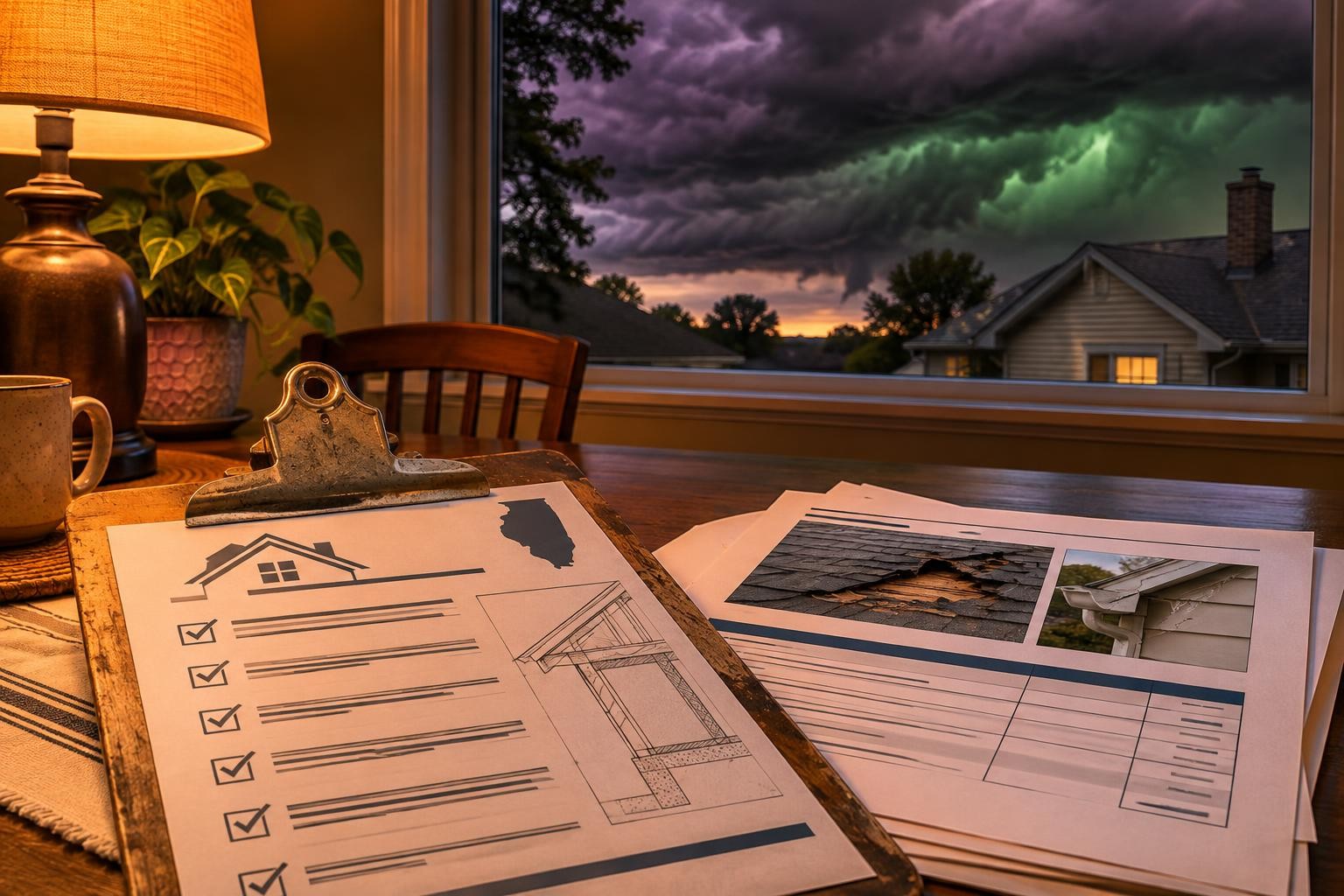
When a tornado tears through your neighborhood, the immediate chaos of broken windows, missing shingles, and structural collapse is overwhelming enough. But for many Illinois homeowners, the real complexity begins once the storm passes and the damage assessment starts — specifically when local officials determine that your home has sustained what building codes call “substantial damage.” At that point, a little-known regulation called the 50 Percent Rule can fundamentally transform the scope of your rebuild, your budget, your timeline, and what you’re legally required to do before you can move back in.
The 50 Percent Rule isn’t a federal insurance rule, and it isn’t something your contractor invented. It’s a local building ordinance standard, widely required by FEMA for communities participating in the National Flood Insurance Program and broadly adopted in municipal building codes across Illinois for all major natural disaster events — including tornadoes, straight-line winds, and hail. The rule is straightforward in concept: when a home’s estimated repair cost equals or exceeds 50 percent of its pre-damage market value, local governments typically require that the entire structure be brought into compliance with current building codes before construction can proceed.
For a home built in the 1970s or early 1980s — which describes a large share of Illinois’s housing stock, particularly across Central and Southern Illinois — that requirement can mean substantial upgrades to structural connections, insulation, windows, electrical systems, and more, entirely separate from the tornado damage itself. Understanding how the determination is made, what triggers code compliance requirements, and how to navigate the permit and inspection process is essential information for any homeowner facing tornado recovery. Allied Emergency Services has been serving Illinois homeowners since 2015, and this guide reflects more than a decade of real-world storm restoration experience across the state.
What Is the 50 Percent Rule?
The 50 Percent Rule is a threshold standard used by local governments to determine when a damaged structure must be brought into full compliance with current adopted building codes. The specific mechanics vary by municipality and jurisdiction, but the general framework is consistent across Illinois: if the cost of restoring a damaged structure to its pre-damage condition equals or exceeds 50 percent of the structure’s pre-damage market value, the structure is officially classified as “substantially damaged.” From that point forward, the rebuild must meet current code requirements across all affected systems — not just the systems the tornado damaged.
This rule is most prominently associated with floodplain management. FEMA requires all communities participating in the National Flood Insurance Program (NFIP) to enforce the 50 Percent Rule for structures located within Special Flood Hazard Areas. But the standard has been widely adopted by Illinois municipalities well beyond the floodplain context. If your community has adopted the International Building Code (IBC) or the International Residential Code (IRC) — which most Illinois municipalities have — there is a strong likelihood that the 50 Percent Rule appears in your local ordinance as a trigger for substantial damage determinations regardless of the cause of damage.
It is essential to understand what the 50 Percent Rule is not. It is not a determination made by your insurance company. Your insurer calculates covered losses based on your specific policy terms — depreciation, deductibles, exclusions, and coverage limits all affect the payout. The 50 Percent Rule is a government determination, made by your local building department or floodplain administrator, based on the actual cost to restore the structure compared to its assessed market value. The two calculations can differ significantly, and this gap is one of the most financially impactful realities of tornado recovery in Illinois. The Insurance Information Institute (https://www.iii.org) maintains consumer resources explaining insurance coverage fundamentals that can help you understand your policy before you’re in the middle of a claim.
Who Makes the Substantial Damage Determination?
In Illinois, substantial damage determinations are made by the local building official — your city or county building department. Some municipalities have adopted FEMA’s Substantial Damage Estimator (SDE) software, a standardized tool designed to bring consistency and documentation to the calculation. Others use a more informal process based on the building official’s professional judgment or a licensed engineer’s assessment. If your municipality participates in the NFIP and your property is in or near a mapped flood zone, your community’s Floodplain Administrator may also be involved in the determination.
The determination is typically triggered when you apply for a building permit to repair tornado damage. Your contractor’s submitted repair estimate is a key input. If the estimated repair cost approaches or exceeds the 50 percent threshold, the building official will conduct a formal substantial damage review before your permit is issued. This is why the accuracy and completeness of your contractor’s initial damage estimate matters enormously — an incomplete or understated estimate can create problems downstream when inspectors evaluate the actual scope of work.
How the 50 Percent Calculation Actually Works
The formula behind the 50 Percent Rule sounds simple: divide the repair cost by the pre-damage market value. If the result is 0.50 or higher, the home is substantially damaged. But both inputs require careful calculation, and errors in either direction carry consequences for the homeowner.
Repair cost is calculated as the full cost to restore the structure to its pre-damage condition, using current labor and material rates. This is not your insurance settlement amount, and it is not the contractor’s bid for the specific scope of work your insurance approved. It is a comprehensive restoration estimate — what it would cost to fix everything the tornado damaged, at today’s prices. After large-scale tornado events, regional demand can drive material and labor costs significantly above normal levels, which can push borderline cases above the threshold.
Pre-damage market value is typically the fair market value of the structure alone, not including land. Some municipalities use the most recent assessed value from the county assessor’s office, adjusted by an assessment-to-market ratio established for the jurisdiction. Others commission an independent appraisal. This distinction matters significantly: a home’s total assessed value (structure plus land) is often higher than the structure-only value used in the 50 Percent calculation. For older homes in lower-cost markets — common across rural and small-city Illinois — the structure-only value may be modest relative to the actual cost of modern construction.
Consider a typical scenario: a 1,400-square-foot ranch home in a Central Illinois county has a structure-only assessed value of $85,000. Modern labor and materials to fully restore tornado damage to that home might run $50,000. That’s a 59 percent ratio — clearly over the threshold. The same storm hitting a newer $280,000 home in a Chicago suburb would need to cause $140,000 in damage before triggering the rule. The 50 Percent Rule falls disproportionately on older, more modest housing stock — which is precisely where much of Illinois’s tornado-vulnerable population lives.
Cumulative Damage and the Rolling Threshold
One aspect of the 50 Percent Rule that catches many homeowners off guard is that some municipalities track damage cumulatively over a defined period — often five or ten years. Under a cumulative approach, prior covered losses are added together along with the current event when evaluating the substantial damage threshold. If a home sustained $18,000 in hail damage in 2023 and now faces $38,000 in tornado damage, the building official may add both figures together and compare the combined total against the pre-damage value. This cumulative approach is particularly common in NFIP-participating communities.
If your municipality uses a cumulative calculation, it is worth reviewing any prior building permits, insurance claims, or repair records before submitting your current permit application. Your restoration contractor should ask about cumulative tracking policies early in the engagement, before the damage estimate is submitted to the building department.
What Code Upgrades Does a Substantial Damage Determination Require?
When a building is declared substantially damaged, local ordinances typically require that the entire structure — not just the portions damaged by the tornado — be brought into compliance with the current adopted building code. In Illinois, most jurisdictions have adopted some version of the International Residential Code (IRC) and the International Energy Conservation Code (IECC), typically with local amendments. Illinois adopted the 2021 editions of both codes at the state level, though local amendments can modify or strengthen specific requirements.
For a home built in 1972, compliance with the 2021 IRC and IECC can represent a substantial scope of work beyond tornado repair:
- Structural connections: Modern IRC requirements for roof-to-wall connections, wall bracing, and lateral force resistance exceed what older codes required. A home built before prescriptive wind resistance requirements were strengthened may need mechanical connectors — hurricane straps, clips, or tie-down hardware — installed throughout the roof-to-wall interface, even where the tornado left those connections intact.
- Electrical: Pre-1980 homes frequently lack arc-fault circuit interrupter (AFCI) protection, adequate GFCI coverage in wet areas, and modern panel capacity. A substantial damage determination can trigger upgrades to current National Electrical Code (NEC) standards throughout the home.
- Insulation and energy performance: Under the 2021 IECC, Illinois is in Climate Zone 5A. Minimum attic insulation requirements are R-49 to R-60 depending on insulation type and placement. Many older Illinois homes have R-19 or less in the attic — a fraction of what current code requires. Full code compliance can mean upgrading the entire thermal envelope.
- Plumbing: Lead supply lines, outdated drain configurations, and non-compliant water heater installations may need to be corrected as part of a code-compliant rebuild.
- Windows and doors: Current IRC and IECC requirements for fenestration U-factors and solar heat gain coefficients in Climate Zone 5A are significantly more demanding than what was standard in pre-1990 construction.
Local Amendments and the Variance Process
Illinois municipalities frequently amend the base IRC and IECC codes to reflect local construction practices, climate conditions, and policy priorities. The City of Chicago maintains its own Municipal Building Code that differs substantially from the state-adopted IRC. Suburban Cook County, DuPage, Kane, Will, and other collar counties each have unique local amendments. This means you cannot assume what applied to a neighbor’s rebuild in a different municipality applies to yours — the only reliable source is your local building department.
Formal variances — requests to deviate from a specific code requirement — are possible in some circumstances, but they are not automatic, they require application and review, they take time, and they are not guaranteed. For tornado recovery, the most common variance scenarios involve energy code requirements where full IECC compliance would require opening walls and ceilings far beyond the existing damage scope. A contractor with established relationships in Illinois municipalities and familiarity with local variance processes can help you assess whether a variance application is worth pursuing for your specific situation.
IRC Implications for Older Illinois Housing Stock
A large share of Illinois’s residential housing stock was built before 1980 — particularly in smaller cities, rural townships, and older suburbs that developed during the post-war building boom. These homes were constructed to codes that, in many respects, bear little resemblance to what the modern IRC requires. The gap between 1970s construction practices and 2021 IRC standards is not trivial; it represents decades of accumulated knowledge from wind events, hurricanes, earthquakes, and wildfires that exposed specific failure modes in residential construction.
Roof-to-wall connection failures are among the most studied failure modes in tornado forensic engineering. Post-event structural analysis repeatedly shows that many roofs fail not because the structural members themselves break, but because the connection between the roof system and the wall framing fails under negative pressure (uplift). Modern IRC requirements in Section R802 and R606 address this directly with prescriptive connection requirements significantly more demanding than what was standard in pre-1990 construction. A home rebuilt to current IRC standards after a tornado will, in most cases, perform meaningfully better in the next event.
The practical implication for Illinois homeowners is this: if your substantially damaged home is rebuilt to current code, you are getting a structurally more resilient structure than what you had before the tornado. That is a genuine silver lining in an otherwise difficult situation. Understanding this reality — rather than experiencing it as an unwelcome surprise mid-project — allows you to plan your financing, insurance coverage, and contractor scope accordingly.
Roof Framing and Wind Resistance Prescriptions
Current IRC requirements for roof framing in tornado-prone areas include prescriptive table values for rafter span, ridge board sizing, collar tie placement, rafter tie spacing, and — most critically — the mechanical connection between the roof structure and the wall top plate. For homes in high-wind design areas, the IRC may require engineered mechanical connections rather than relying on traditional toe-nailing alone. Simpson Strong-Tie and similar hardware manufacturers publish code-compliant connectors that meet IRC prescriptive requirements and are readily available to Illinois contractors.
If your tornado damage required a full or partial roof replacement, your restoration contractor must ensure that the new roof structure is connected to the wall framing in a manner that meets current IRC Section R802 and R606 requirements, and that all ridge, rafter, and truss members are sized per the current span tables for your specific lumber species, grade, and design wind speed zone. This is not optional — it is what your permit will be inspected against, and it is what will protect your home in future storm events.
Attic Insulation and IECC Climate Zone 5A Requirements
The 2021 IECC Climate Zone 5A requirements applicable to most of Illinois call for attic insulation values of R-49 to R-60 depending on insulation type and installation method. Many Illinois homes built in the 1970s were originally insulated to R-11 through R-19 in the attic — a fraction of current minimums. If a tornado has opened your attic for repair work, local building officials enforcing IECC compliance may require upgrading the attic insulation to current minimums as part of the permit scope.
The practical cost implications are real. Adding blown-in cellulose or fiberglass over existing attic insulation is relatively affordable when the attic is already being accessed for tornado repair. The challenge is that this upgrade cost — which can run $1,500 to $4,000 or more for a typical ranch home — may not be covered under your base homeowner’s policy. This brings us to one of the most important financial topics in tornado recovery: the insurance coverage gap.
The Insurance Coverage Gap: When Code Requires More Than Your Policy Covers
Your homeowner’s insurance policy is designed to restore your home to its pre-damage condition — not to pay for upgrades beyond that baseline. Code upgrades triggered by a substantial damage determination are frequently not covered under a standard policy, leaving homeowners financially responsible for costs that can run tens of thousands of dollars on top of the deductible and any coverage gaps.
However, many homeowner’s policies include an Ordinance or Law endorsement — sometimes called O&L coverage or Law and Ordinance coverage. This endorsement exists specifically to address the code upgrade gap. It typically provides three distinct coverages:
- Coverage A — Undamaged Portions: Covers demolition and rebuilding costs for undamaged portions of the structure that must be torn down and rebuilt to comply with current code.
- Coverage B — Demolition Cost: Covers the actual cost of demolishing the undamaged portion of a substantially damaged structure.
- Coverage C — Increased Cost of Construction: Covers the difference in cost between restoring the home to its pre-damage condition and rebuilding it to current code standards.
Not all policies include this endorsement. Those that do often cap it at a percentage of Coverage A (dwelling coverage) — commonly 10 percent to 25 percent. For older Illinois homes where code upgrades are extensive, even a 25 percent sublimit may fall short of the actual upgrade cost. Reviewing your policy for Ordinance or Law coverage — before you need it — is strongly recommended. If you do not currently carry this endorsement, adding it is typically inexpensive relative to the financial protection it provides. The Illinois Department of Insurance (https://idoi.illinois.gov) maintains consumer resources and complaint processes for homeowners navigating coverage disputes after a declared disaster event.
Allied Emergency Services is a licensed restoration contractor. We document damage thoroughly and provide detailed repair estimates that accurately reflect the full scope of work required — including code-required upgrades — so your insurer and your building official are working from the same complete picture of your loss. We also meet with adjusters on-site to walk through our documentation and findings. What we do not do is negotiate, settle, or adjust insurance claims on your behalf — that is the role of your insurance company or, where appropriate, a licensed public adjuster.
This guide is provided as general information only and does not constitute legal or insurance advice. Consult a licensed insurance professional or attorney for guidance specific to your policy and situation.
The Permit and Inspection Process After Tornado Damage
One of the most consequential mistakes Illinois homeowners make after tornado damage is beginning structural repairs without permits. Emergency tarping and temporary weatherproofing — covering exposed roof decks, boarding broken windows, and extracting standing water — are generally permitted without a building permit and are actively encouraged to prevent escalating damage. But structural repairs, roof replacement, window replacement, and any work affecting electrical, plumbing, or mechanical systems require a permit in virtually every Illinois jurisdiction.
Skipping permits creates serious problems: work done without permits may not pass future home inspections when you sell, your insurance company may deny future claims if unpermitted work contributed to a loss, and you can be required to tear out and redo work that was never inspected. After a tornado event, the temptation to move quickly is understandable — but rushing into unpermitted work is a shortcut with long-term consequences.
Filing for a permit triggers the substantial damage determination process. The building department reviews your contractor’s scope and estimated repair cost, determines whether the 50 Percent threshold has been crossed, and issues the permit with any code compliance conditions attached. After large-scale tornado outbreaks, building departments across affected Illinois counties are often overwhelmed with applications, and permit issuance and inspection wait times can extend project timelines by weeks. Factor this into your planning and your temporary housing arrangements.
What to Expect from the Inspection Sequence
For a substantially damaged home being rebuilt to current code, the permit process typically involves multiple phased inspections, each of which must be passed before the next phase of work can begin:
- Foundation or footing inspection (required if the foundation is affected or new footings are poured)
- Framing inspection (after all structural framing, sheathing, and mechanical connections are complete, before insulation or drywall)
- Rough electrical, plumbing, and mechanical inspections (before walls are closed)
- Insulation inspection (after insulation is installed, before drywall)
- Final inspection (after all work is complete, all systems tested, and all code-required documentation submitted)
Each inspection hold point adds time to the project schedule. Failing an inspection — which typically results from code deficiencies identified by the inspector — requires correction work and re-inspection, further extending the timeline. Experienced restoration contractors build inspection hold points into their project schedules from the beginning, understand what local inspectors typically focus on, and document their work in ways that make inspections efficient. This local knowledge and inspection experience is a significant practical advantage that distinguishes seasoned Illinois restoration contractors from out-of-state storm chasers who arrive after major events.
Working With a Licensed Illinois Restoration Contractor
The 50 Percent Rule, code compliance requirements, local ordinance amendments, variance applications, and multi-phase permit inspections represent a level of regulatory complexity that requires an experienced, licensed Illinois contractor. After major tornado events, your community will see an influx of out-of-state contractors — commonly called “storm chasers” — who arrive quickly, offer competitive prices, and may lack Illinois licensing, adequate insurance, familiarity with local codes, or any stake in the quality of work left behind when they leave.
Illinois requires roofing contractors to hold a valid state license under the Illinois Roofing Industry Licensing Act (225 ILCS 335). Allied Emergency Services holds Illinois Roofing Contractor License #104.019029, which is current and active. Working with a licensed Illinois contractor protects you from liability for unlicensed work, gives you recourse through the state licensing system if problems arise, and ensures the contractor is familiar with Illinois-specific code requirements and local amendment patterns.
Beyond licensing, ask prospective contractors specific questions about their experience with permit-intensive, code-compliant tornado restoration projects:
- Have you completed final inspections on substantially damaged homes in this municipality or county?
- Are you familiar with the current IRC and IECC editions adopted by this jurisdiction, including local amendments?
- Do you have direct experience managing projects through the substantial damage determination process?
- Can you provide references from tornado recovery projects completed in Illinois within the past three years?
- Are you licensed, bonded, and insured in Illinois, and can you provide verification?
A contractor who can answer these questions specifically — not in generalities — and back up those answers with references and documentation is a contractor prepared to manage the real complexity of your project. For more detail on how Allied approaches the full scope of storm damage restoration in Illinois, including our approach to code compliance and permitting, visit our services page.
Steps to Take Right After Tornado Damage Hits Your Home
The decisions you make in the first 24 to 72 hours after tornado damage have outsized impact on the trajectory of your recovery. Here is the sequence that positions Illinois homeowners for the best possible outcome:
- Prioritize safety above everything else. Do not enter a structurally compromised home. If you smell gas, evacuate immediately and call your gas utility’s emergency line. If the structure is visibly unsafe — collapsed walls, compromised foundation, exposed live electrical — contact emergency services before entering. The Ready.gov website and the National Weather Service both provide post-storm safety guidance that is worth reviewing.
- Document everything before any work begins. Photograph and video every damaged area, including interiors. Time-stamped, geotagged documentation is critical for both your insurance claim and the substantial damage determination. The more complete your documentation, the stronger your position in every conversation that follows.
- Notify your insurance company promptly. Most policies require timely notice of a loss. Report the tornado damage as soon as it is safe to do so. Your insurer will assign an adjuster who will inspect the damage and begin the claims process.
- Arrange emergency weatherproofing immediately. Temporary tarps over exposed roof decks, board-up of broken windows and doors, and water extraction from interiors are time-sensitive actions that prevent escalating damage. These emergency services are typically covered under your policy’s emergency mitigation provisions. A licensed restoration contractor can mobilize quickly for this phase.
- Get a thorough damage assessment from a licensed contractor. Before any structural repair work begins, obtain a complete, written estimate that accurately documents the full scope of damage — including systems adjacent to the visible damage that may have been affected. This estimate will be used by your building department in the substantial damage determination, so completeness and accuracy matter.
- Apply for your permit. Work with your contractor to submit the permit application promptly. Be prepared for the substantial damage determination review to take additional time, especially after a widespread regional event when building departments are receiving high volumes of applications.
- Review your policy for Ordinance or Law coverage. Identify whether you carry this endorsement, what your sublimit is, and whether it is likely to cover the code upgrade costs your contractor has identified. Gaps in coverage are easier to plan around before you are committed to a construction scope.
- Track all additional living expenses. Hotel stays, restaurant meals above your normal food budget, storage unit costs, and other out-of-pocket costs incurred because you cannot live in your home may be reimbursable under your policy’s Additional Living Expenses (ALE) coverage. Keep all receipts and maintain a log.
Understanding the storm damage insurance claim process in detail — including what documentation your insurer expects, how adjuster estimates are developed, and when you have the right to request a re-inspection — can significantly affect the outcome of your claim.
Why This Matters: Illinois Tornado Risk Is Real and Persistent
Illinois is one of the most tornado-active states in the country, averaging approximately 50 tornadoes per year. The risk is highest in Central and Southern Illinois — along and south of the I-72 corridor through Springfield and Champaign, the I-57 corridor through Effingham and Marion, and the Wabash River Valley along the Indiana border. But the Chicago metro area and the northern counties have experienced significant tornado events as well, including the 1990 Plainfield EF5 tornado, one of the most powerful ever recorded in Illinois, and multiple significant events in the decades since.
Illinois’s tornado season peaks in spring and early summer, but the state has experienced damaging tornado outbreaks in every month of the calendar year — including devastating late-fall events in November and December that have caused widespread damage across the central portion of the state. This year-round risk means Illinois homeowners should not approach tornado preparedness as a seasonal concern.
The convergence of persistent tornado risk and older housing stock makes the 50 Percent Rule a live issue for a large number of Illinois homeowners — not a theoretical regulatory footnote. In communities where a high proportion of homes were built before modern code requirements, a significant tornado event can trigger the 50 Percent Rule for many affected properties simultaneously, creating pressure on local building departments, regional material supply chains, and the pool of licensed contractors available for compliant rebuilds.
The homeowners who navigate this process most successfully are those who understand it before they need it. If you live in an older Illinois home in a tornado-prone corridor, reviewing your insurance policy for Ordinance or Law coverage, understanding your local municipality’s adopted building codes and substantial damage policies, and identifying a licensed restoration contractor you trust before a storm event places you in a meaningfully better position than discovering all of this mid-recovery.
Allied Emergency Services: Illinois Storm Restoration Done Right
Allied Emergency Services has been serving Illinois homeowners since 2015. We hold Illinois Roofing Contractor License #104.019029 and are IICRC certified (#70133670). We carry EPA Lead-Safe Firm certification, OSHA 10 and 30 certifications, and our team includes FEMA SKYWARN-certified storm spotters. We work across Illinois and the greater Midwest, and we understand the specific building code environment, inspection culture, and insurance landscape that Illinois tornado recovery involves.
When you work with Allied after tornado damage, you get a team that documents damage thoroughly with detailed written estimates, meets with your adjuster on-site to walk through findings, navigates the permit process with your local building department, and builds a scope of work that meets current code requirements — so your project passes inspection the first time and your home comes out of this experience more resilient than it went in.
We are a restoration contractor, not a public adjuster. We do not negotiate or settle insurance claims on your behalf. What we do is provide the documentation, expertise, and workmanship that gives you the strongest possible foundation for every conversation with your insurer and your building department.
If your home has sustained tornado damage — or if you want to understand your exposure before the next storm season — call us any time, day or night.
Get Expert Help Now
Tornado damage doesn’t follow business hours, and neither do we. Allied Emergency Services is available 24 hours a day, 7 days a week to respond to emergency storm damage across Illinois and the greater Midwest. Whether you’re facing an active emergency, trying to understand your code compliance obligations, or navigating an insurance claim for a recent tornado event, our team is ready to help.
- Call us 24/7: (800) 792-0212 — speak directly with an Allied storm restoration specialist at any hour
- Text ESTIMATE to (844) 907-2546 to request a damage assessment from a licensed Illinois contractor
Don’t wait for a second inspection, a denied permit, or a coverage dispute to find out that your rebuild requires more than a standard repair scope. The 50 Percent Rule is manageable when you have the right team in your corner from the beginning. Call Allied Emergency Services today — we know Illinois storm restoration, and we’ll be with you every step of the way.
⚡ Storm or Roof Damage? Get a FREE Estimate
Text ESTIMATE to (844) 907-2546
Or call (800) 792-0212 for 24/7 emergency response
AI-powered • No obligation • Licensed IL & WI
Need tornado damage help?
Allied Emergency Services — Licensed IL & WI Tornado Damage Specialists
For more than a decade, Allied has been restoring tornado damage across Illinois and Wisconsin. IICRC-certified, EPA Lead-Safe, IL Licensed Roofing Contractor #104.019029. 24/7 emergency response.
Learn about our Tornado Damage service →Free property assessment within 24 hours · No obligation · Photo-documented findings you can share with your insurer
Attorneys: forensic storm damage documentation & construction expert consultation for counsel →