⚡ Storm or Roof Damage? Get a FREE Estimate
Text ESTIMATE to (844) 907-2546
Or call (800) 792-0212 for 24/7 emergency response
AI-powered • No obligation • Licensed IL & WI
Oklahoma City, Oklahoma — November 14, 2026 · The Hail Files, Part 20
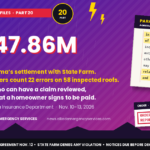
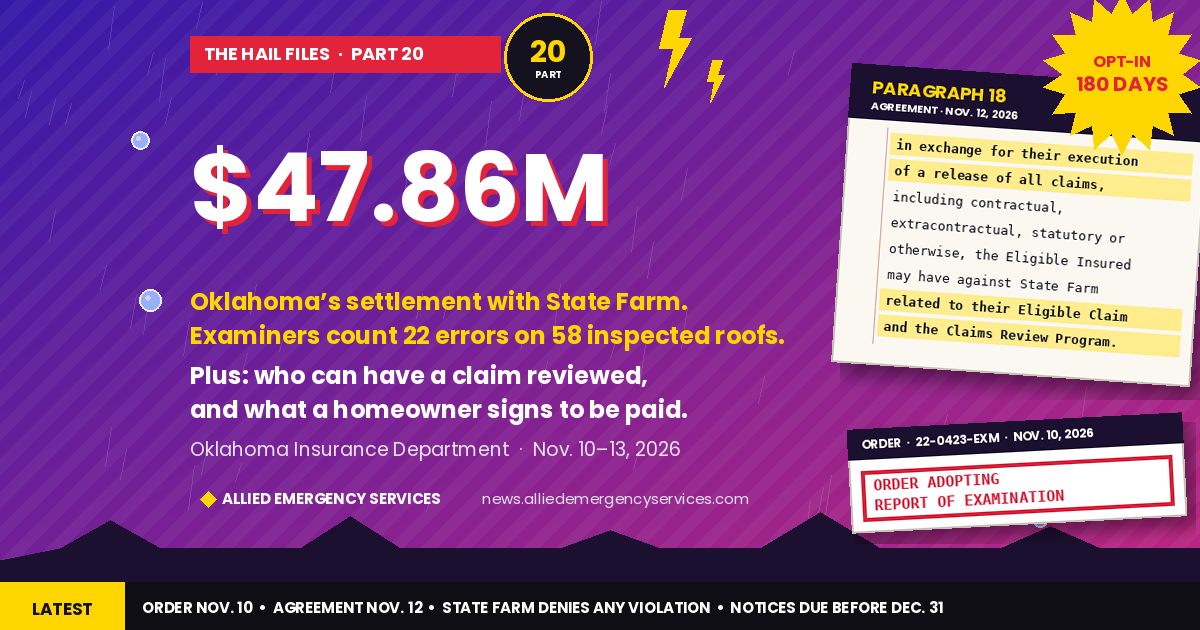
What happened, in one sentence: On November 13, 2026, the Oklahoma Insurance Department announced a $47.86 million settlement with State Farm Fire and Casualty Company and released its examination report, in which engineers hired by the department’s examiners inspected 58 roofs on wind and hail claims the company had closed without payment and the examiners counted 22 errors; the agreement requires State Farm to deposit $35 million in escrow to pay claims approved in a review of Oklahoma wind and hail claims, with dates of loss from 2021 through 2025, that closed without payment, and State Farm, it says, “disputes the Examination Report’s findings and conclusions and denies any violation of law or wrongdoing.”
Status: As of November 14, 2026, the department’s release and settlement page did not say the review was open. The agreement requires State Farm to send each eligible policyholder a written notice before December 31, 2026, and gives 180 days from that notice to ask for a review. It does not name the claim administrator; the department’s release says more details on eligibility, timelines and the review process will follow. The settlement does not resolve the lawsuits against State Farm: the department told the Tulsa World it is “a completely separate action from any policyholders’ individual lawsuits against State Farm” and from the attorney general’s lawsuit. The examination’s findings are the department’s, adopted in an administrative order; no court has ruled on them.
Key facts
- The documents: an Order Adopting Report of Examination, file-stamped November 10, 2026 (case 22-0423-EXM; 36 pages with the report and its attachments), and a Settlement Agreement signed November 12, 2026 (cases 26-1372-DIS and 22-0423-EXM; nine pages). The department published both on November 13.
- The money: $35,000,000 into an escrow account for the claims review; $10,000,000 to the Strengthen Oklahoma Homes fund; $2,860,000 for fines and the department’s examination expenses. The department’s settlement page gives the total as $47.86 million.
- Who can ask for a review: policyholders with an Oklahoma residential wind or hail claim, date of loss January 1, 2021 through December 31, 2025, that State Farm closed without payment. Claims already resolved by settlement or final judgment are excluded.
- The field test: engineers who were not told the insurer’s name and did not see the claim files inspected 58 roofs. They found storm damage warranting repair or replacement on 27; on 22, the report says, their estimates exceeded the deductible, “contrary to State Farm’s determinations on those claims.”
- The error rate: 22 errors in a sample of 181 claims, or 12.15 percent, against a benchmark of 7 percent. The other 123 roofs in the sample were not inspected, and the report counts each of them as no error.
- State Farm’s position: it disputes the findings, denies any violation, and says “A limited review of individual claims should not be mistaken for a complete picture of our overall claims-handling practices.” It agreed not to appeal the order.
- The release: a homeowner approved for payment is paid “in exchange for their execution of a release of all claims” related to that claim and the program, and a homeowner who has sued must dismiss the litigated claim with prejudice to be paid.
- Money not paid out: whatever remains in the escrow “shall be returned to State Farm” and must be spent on resiliency and building programs or, for half of it, on other agreed matters “intended to benefit Oklahomans.”
- Next dates: the $35 million deposit, within 30 days after November 12; the notices to policyholders, before December 31, 2026; then 180 days to ask for a review.
Engineers who were not told which insurance company was involved inspected 58 Oklahoma roofs. Every one belonged to a homeowner whose wind or hail claim State Farm had closed without payment.
On 23 of the roofs the engineers noted no storm-related damage, and on 8 they found damage they could not tie to a specific storm. On the other 27 they found storm damage that warranted repair or replacement, the state’s examiners wrote. On 22 of those, the estimated cost of the work came out above the homeowner’s deductible, “contrary to State Farm’s determinations on those claims.”
All of that is from the examination report the Oklahoma Insurance Department made public on November 13, 2026, more than four years after the examination began. With it came a nine-page settlement agreement, signed the day before: State Farm Fire and Casualty Company agreed to pay $47.86 million.
State Farm “disputes the Examination Report’s findings and conclusions and denies any violation of law or wrongdoing,” the agreement says. It agreed to comply with two provisions of Oklahoma’s Unfair Claims Settlement Practices Act “without admission by State Farm of any violation,” and not to appeal the order adopting the report.
For homeowners, the agreement provides for a second look at wind and hail claims with dates of loss from 2021 through 2025 that closed without payment, by a claim administrator the agreement defines as “independent, third-party” and “mutually agreed upon by the Parties.” A homeowner who is approved is paid “in exchange for their execution of a release of all claims” related to that claim and the review program. A homeowner who has sued must dismiss the litigated claim “with prejudice” to be paid. Money that is not paid out “shall be returned to State Farm,” with conditions on how it is spent. The department’s settlement page says: “Payment is not guaranteed.”
Here is what the two documents say, what each side says about them, and what happens next. Both are in The Hail Files archive, complete and as the department published them (links below).
What did the Oklahoma Insurance Department announce?
A settlement, and the examination it resolves. The department’s November 13 release is headlined “Mulready Announces More Than $45 Million in State Farm Settlement Following Extensive Roof Claims Investigation”; its settlement information page gives the total as $47.86 million.
“The examination found that State Farm improperly denied or failed to pay for roof damage and necessary repairs on claims submitted by Oklahoma homeowners who had purchased insurance coverage to protect their homes,” the release says. It quotes Insurance Commissioner Glen Mulready: “We weren’t willing to simply take State Farm’s word for how these claims were handled.”
The department published two documents: a five-page order adopting an examination report of 20 numbered pages, and the nine-page settlement agreement. The record spans four and a half years. The examination commenced on May 9, 2022, the report says. The report is dated September 30, 2026. State Farm submitted a written rebuttal on October 21, according to the order; the rebuttal is not among the documents the department published. Mulready signed the order adopting the report on November 10 and the settlement agreement on November 12. A State Farm operations vice president for claims signed for the company the same day.
What did the examination find?
The order lists three findings, each adopted from the report:
- Claims not settled in good faith. The order says State Farm “failed to comply with the Unfair Claims Settlement Practices Act, specifically 36 O.S. § 1250.5(4), in at least twenty-two (22) instances from November 1, 2023 through December 31, 2024 by failing to make a good-faith effort to promptly, fairly, and equitably settle roofing claims for which liability had become reasonably clear.”
- No written denial. In three of the 42 claim files the examiners reviewed, the order says, State Farm “failed to notify the claimant in writing that the claim was being denied or failed to retain a copy of such denial in writing” in the file, a violation of 36 O.S. § 1250.7(A).
- Records not produced on time. “The Company failed to comply with 36 O.S. § 309.3 which requires timely production of records responsive to reasonable written requests of the Examiners.”
The report lists “No Findings” for complaint handling and for policyholder services. It also says what kind of document it is: “The Report is a report by exception,” and “All unacceptable or non-complying practices may not have been identified.”
The report’s recommendations page describes its findings as relating “to potential matters with regard to the Company’s oversight of the Company’s claims processing policies and procedures which may constitute violations of applicable Oklahoma Statutes.” The commissioner’s order adopts them as findings.
How did the examiners test the roofs?
In two rounds, using the sampling method of the National Association of Insurance Commissioners’ Market Regulation Handbook, which the report says sets “a benchmark error rate of 7%” for auditing claims practices.
The department’s examiners, Lewis & Ellis, Inc., hired engineering firms to inspect the roofs. “In an effort to avoid introducing bias to the inspection process,” the report says, “the engineering firms had no access to Company claim files, Company claims determinations or deductible amounts, nor was the Company’s identification disclosed to the engineering firms by the Examiners or OID staff.”
Round one, 2024. From 2,101 wind and hail claims closed without payment, from the two 2023 storm events with the largest claim volume, the examiners drew 108. Only 20 of those roofs could be inspected; the report gives reasons that include “lack of response and consent, sale of the home, or previous repair/replacement of the roof.” Fourteen inspections were valid, and “Twelve (12) inspection results were contradictory to the Company’s claim notes and decisions and are considered errors,” the report says. Three errors were enough to fail the first sample and require a larger one.
The first sample was not fully random: 20 of the 108 were homeowners who had complained to the department, and three of them were among the roofs inspected. “If those were to be excluded from the results,” a footnote says, “the error count is still three (3) or greater.”
Round two. The examiners drew 181 claims at random from 4,674 wind and hail roof claims that State Farm closed without payment from November 1, 2023 through December 31, 2024. Of the first 181 claims drawn, the examiners discarded 36, the report says: on 26 the roof had already been repaired, and 10 homes were no longer owned by the claimant. They drew alternates at random until the sample again stood at 181. Fifty-eight homeowners agreed to an inspection. The first engineering firm had begun the work when its sole professional engineer died in September 2025, the report says; a second firm then inspected the roofs and produced all 58 reports.
| What the engineers found (final sample) | Roofs |
|---|---|
| No storm-related damage | 23 |
| Roof damage, but not able to isolate it to a specific storm | 8 |
| Storm-related damage; roof repair warranted | 14 |
| Storm-related damage; roof replacement warranted | 13 |
| Roofs inspected | 58 |
On 22 of the 27 roofs with storm damage, the engineers’ estimates, “based upon prevailing costs at the time of the Company’s claims determination,” came out above the deductible. Those 22 are the report’s errors. It counts no error on the other 36 roofs the engineers inspected: the 23 with no storm-related damage, the 8 with damage they could not isolate to a specific storm, and 5 of the 27 where it does not report an estimate above the deductible.
The arithmetic. The report calculates it this way: 22 errors in a sample of 181 is 12.15 percent, with a 95 percent confidence interval of 7.49 to 16.82 percent, entirely above the 7 percent benchmark. That calculation counts the 123 roofs that were not inspected as no error: “The Company is therefore being given the benefit of no errors in 67.96% of the sample selection due to said roofs not being available for review.” A footnote gives the figure for the inspected roofs alone: 22 of 58, or 37.93 percent, with a confidence interval of 25.52 to 50.34 percent.
The report draws its conclusion from the lower number. State Farm, it says, “in greater than 7% of its roofing claims from November 1, 2023 through December 31, 2024,” failed to attempt “in good faith to effectuate prompt, fair and equitable settlement of claims submitted in which liability has become reasonably clear.”
The two documents cover different periods. The claim violations the order adopts come from a sample of claims closed without payment from November 1, 2023 through December 31, 2024. The claims review covers dates of loss from January 1, 2021 through December 31, 2025.
What does the report say State Farm did not produce on time?
Records the report calls “responsive to the Examiners’ interrogatories and data requests.” It identifies one: a 2020 Fire Property Claims Quality Plan. On May 2, 2022, the report says, the examiners sent State Farm their first interrogatories and data requests. One asked the company to “Describe changes, if any, in roofing claims procedures which occurred during the period under examination,” and to provide copies of its internal communications to adjusters about those changes. State Farm answered on June 3, 2022. “Rather than provide a description or memorandum, State Farm produced records to respond to the Examiners’ requests,” the report says.
Four years later, in August 2026, the Comanche County District Court unsealed State Farm internal documents in West v. State Farm Fire and Casualty Co. (No. CJ-2025-135). The examiners and the department read them: “The Plaintiffs’ response and counter motion, along with all unsealed exhibits, were reviewed by the Examiners and the OID.” Their conclusion: “State Farm internal communications and documents unsealed publicly in the West Case reference documentation and information that is responsive to the Examiners’ interrogatories and data requests and was not timely produced.”
The report attaches one example: four pages of a State Farm email chain from March 2020, in which a State Farm claims consultant edits a draft memo to claims managers about a hail and wind damage training video series. Under the heading “What you should know,” the draft says: “The 2020 Fire Property Claims Quality Plan, released in early February, 2020, references material being delivered by Haag Education sometime in Q1 of 2020.” That plan, the report says, “was released in early February 2020 but was not timely produced to the Examiners.”
The four pages carry the marks of the West case: Bates numbers WEST00073884 through WEST00073887, the legend “Confidential Produced Pursuant to Protective Order,” and, on the first page, an “EXHIBIT 25” sticker. The same four pages are in the homeowners’ August 21, 2026 response and counter-motion in West, which The Hail Files archive carries with its 31 unsealed exhibits: they are PDF pages 131 through 134 of 285.
The report’s acknowledgment page also says: “The Examiners wish to express appreciation for the courteous cooperation and assistance given by the officers and employees of the Company during the course of this examination.”
THE HAIL FILES · FREE DOCUMENT ALERTS
Get an email when new court documents are filed or unsealed
One email per development in the Oklahoma State Farm hail cases, with a link to every new filing in the archive. No marketing; unsubscribe in one click.
Your address is used only for these alerts and is never shared or added to any sales list.
What does State Farm say?
State Farm’s position is written into the agreement. The recitals say it “disputes the Examination Report’s findings and conclusions and denies any violation of law or wrongdoing,” and that the parties settled “without trial or adjudication of any disputed issue of fact or law, any finding of liability, or any admission by State Farm of liability, wrongdoing, or the accuracy of the disputed findings.” Paragraph 28 adds that neither the agreement “nor any program determination or payment, constitutes an admission or concession by State Farm of any fact, liability, wrongdoing or violation of law.”
In a statement on November 13, as carried by KOCO and FOX23 and quoted in part by the Tulsa World, the company said it “disagrees with findings and characterizations” in the examination. “We evaluate each claim based on the facts of the loss and the customer’s policy,” it said. “A limited review of individual claims should not be mistaken for a complete picture of our overall claims-handling practices.” The company said it has responded to more than 100,000 claims in Oklahoma over the past five years, and that it “remained committed to the state” despite more than $178.5 million in net underwriting losses from 2021 through 2025.
State Farm also gave up an appeal. “Although State Farm disputes the findings in the Examination Report, as part of the resolution of this matter, State Farm shall not appeal and waives its right to appeal the Order,” paragraph 5 says.
Where does the $47.86 million go?
| Amount | Where it goes | What the agreement says |
|---|---|---|
| $35,000,000 | An escrow account “held by and through the OID,” for payments through the Claims Review Program | Due within 30 days after November 12, 2026; “the reasonable costs of the Claim Administrator may be paid from the escrow fund.” (Paragraph 1) |
| $10,000,000 | The Strengthen Oklahoma Homes Revolving Fund | For a program that “provides grant funding for the fortification of Oklahomans’ roofs and homes against extreme weather.” (Paragraph 3) |
| $2,860,000 | The department | For “fines and reimbursement of expenses incurred by the Department in the investigation and examination of these matters.” (Paragraph 4) |
Mulready’s release calls the fund “A minimum of $35 million.” If the escrow is depleted and the administrator finds more is needed to pay claims, paragraph 1 says, State Farm “shall deposit additional funds into escrow up to the amount paid for Claim Administrator expenses,” and beyond that “the Parties shall agree in good faith on the amount of additional funds.”
Who can have a claim reviewed?
The agreement defines “Eligible Insureds” as policyholders “who submitted an Oklahoma residential claim to State Farm for potential damage caused by wind or hail,” which State Farm codes as Cause of Loss 35, “with a date of loss from January 1, 2021 through December 31, 2025, for which COL 35 was closed without payment.”
Closed without payment, in the agreement’s definition, means State Farm decided payment “was not appropriate” for reasons that “include, but are not limited to”: the damage was found to be less than the deductible; “a loss not insured caused the damage”; “no covered peril caused the damage”; “a determination of no damage to the property”; and policy-condition violations by the insured. The department’s release adds: “Closed without payment claims include those for insureds who received partial payment or whose claims were determined to be under the deductible amount.”
Two groups are left out: claims “previously resolved by settlement or final judgment concerning the same roof loss,” and claims “voluntarily withdrawn by the insured before State Farm made a payment determination.”
The definition of eligible claims ends with a caution: “Eligibility for review does not establish entitlement to payment.” The department’s settlement page says it in four words: “Payment is not guaranteed.”
How will the claims review work?
- The notice. “Prior to December 31, 2026, State Farm shall send each Eligible Insured written notice describing the Claims Review Program and informing the insured that they have an Eligible Claim that can be reviewed by the Claim Administrator.” The department must approve the notice in advance.
- The request. A homeowner has 180 days from the notice to ask the administrator for a review, on a form the parties approve. The request must give the homeowner’s name, contact information, property address and claim, “and a brief explanation of why additional payment is believed due.” “Supporting materials may accompany the request but are not required to elect participation.” A timely request that is incomplete gets at least 30 days to be fixed. A late request can be accepted only “when equitable considerations warrant an exception” and with both parties’ prior written agreement.
- The reminder. Thirty days before the window closes, the administrator sends a reminder to each eligible policyholder who has not asked.
- The review. The administrator is to be an independent third party, “mutually agreed upon by the Parties,” with “no existing vendor relationship or other conflict of interest with State Farm.” It evaluates “causation, coverage and compensability” under the policy. It is to use State Farm’s existing records, the homeowner’s materials and any “other materials and experts, including independent adjusters or engineers,” that it deems relevant, and it is to weigh “the reliability, timing and relevance of any information submitted, including conflicting photographs and subsequent storms.” On request, State Farm must give it “a full and complete copy of the original claim file.”
- The amount. A payment is what the policy owes “over the applicable deductible amount, but not to exceed applicable policy limits,” with credit for sums already paid on the same loss, “except for sums paid by the policyholder.” Repair costs are to be “based on estimates reflecting reasonable rates in the applicable local market at the time of reevaluation,” and total compensation from all sources “shall not exceed 100% of documented costs for that work.”
- The decision. The administrator reports each result in writing. An approved homeowner gets the amount and a release form and has 30 days to sign; after that “the offer contained in the notice of determination shall be considered withdrawn,” unless the administrator grants a hardship extension.
- If the answer is no. The notice is to “describe any dispute resolution process that may be agreed upon by the Parties.” The agreement does not create one; paragraph 21 says the parties “may agree in writing on a dispute resolution process for insureds to dispute a determination by the Claim Administrator,” and paragraph 9 has the administrator work with the parties on the program’s procedures, “including claim submissions, supporting documentation, notices, review, dispute resolution and payment.”
The agreement also says new claims opened through the review “shall not be considered for purposes of underwriting or reunderwriting the insured’s policy, including cancellation or nonrenewal.”
The department’s settlement information page carries a scam warning: “Verify settlement-related communications using official OID and State Farm contact information.”
What does a homeowner sign to be paid?
A release. Paragraph 18 says the administrator’s notice will “inform the Eligible Insured they can receive such payment in exchange for their execution of a release of all claims, including contractual, extracontractual, statutory or otherwise, the Eligible Insured may have against State Farm related to their Eligible Claim and the Claims Review Program.” The release form is to be approved in advance by the Insurance Commissioner; it is not among the documents the department has published.
Homeowners who have already sued can take part, the agreement says, “provided that they dismiss their litigated claim(s) with prejudice as a condition of receiving any payment approved by the Claim Administrator.” A claim dismissed with prejudice cannot be filed again.
Mulready, as quoted by KFOR: “They are going to have to sign off and release that litigation.”
Attorney General Gentner Drummond, whose office is suing State Farm in Cleveland County (No. CJ-2026-1066), criticized the terms in a November 13 statement. “That’s not consumer protection. It’s corporate protection,” he said, as quoted by KFOR. “My office’s lawsuit will continue, and we will keep fighting for every Oklahoma family that was wrongly denied.”
Mulready’s release says of the fund and the second review: “That’s what true consumer protection looks like.”
What happens to money that is not paid out?
It goes back to State Farm, with conditions. “Any funds remaining in the escrow account, including accrued interest, after completion of the Claims Review Program and payment of approved claims,” paragraph 2 says, “shall be returned to State Farm within thirty (30) days after the Claim Administrator certifies completion.”
Half of it “shall be spent on programs related to resiliency or improved residential building techniques in Oklahoma, or other matters intended to benefit Oklahomans as agreed by State Farm and the Department.” The other half “shall be spent on programs related to resiliency or improved residential building standards nationally that State Farm expects will indirectly benefit Oklahomans.”
What did the department agree not to do?
- Seek more for past conduct. Except to enforce the agreement and the order, “the Department shall not seek additional penalties, restitution or corrective relief arising from or relating to the conduct addressed in the cases cited above occurring on or before the Effective Date.” The effective date is the day both sides signed, November 12, 2026.
- Examine these matters again for a year. The agreement says “the OID shall not conduct a market conduct examination on State Farm for matters addressed by” the two cases “for a period of twelve (12) months after the Effective Date of this Agreement,” provided State Farm “remains in material compliance with the Order, the Corrective Action Plan adopted pursuant to the Order, and this Agreement.”
- Collect more in fines or costs. The November 10 order had left fines for later, saying they “may be handled appropriately in a separate administrative proceeding.” The agreement sets the figure at $2,860,000 for fines and expenses together: “No additional amounts for those matters shall be due to the Department.”
During those 12 months, State Farm owes the department quarterly reports: the number of wind and hail claims filed, the number closed without payment, the number closed with payment and the total paid, the number of those claims on which Oklahoma lawsuits were filed against it, “to the extent reflected in State Farm’s ordinary course records,” and any additional information the department reasonably requests. The order separately requires a corrective action plan within 30 days of receipt, and an affidavit from each State Farm director swearing that the director “has received a copy of the Report and the related Order.”
If the commissioner believes State Farm has materially violated the agreement, he is to send a notice, and State Farm has 30 days to respond and cure, or to begin a cure that reasonably requires more time. “The notice does not establish a violation,” the agreement says. Disputes under the agreement “shall be heard in the District Court of Oklahoma County.”
Does the settlement end the lawsuits against State Farm?
No, and the department and State Farm both say so. The department, in an email quoted by the Tulsa World, called the settlement “a completely separate action from any policyholders’ individual lawsuits against State Farm” and from the attorney general’s lawsuit. State Farm, in an email to the same newspaper: “The OID resolution has no bearing on any of the litigation.”
The department also told the Tulsa World that the examination report and its findings “can be used as prima facie evidence in other legal actions” and that it hopes this aids the attorney general’s office and other efforts to protect Oklahoma consumers. The agreement speaks to a different set of papers. Of the agreement itself, its statements and commitments, and any program determination or payment, paragraph 28 says: “The Parties intend that they not be offered or used as evidence of such matters in other proceedings.”
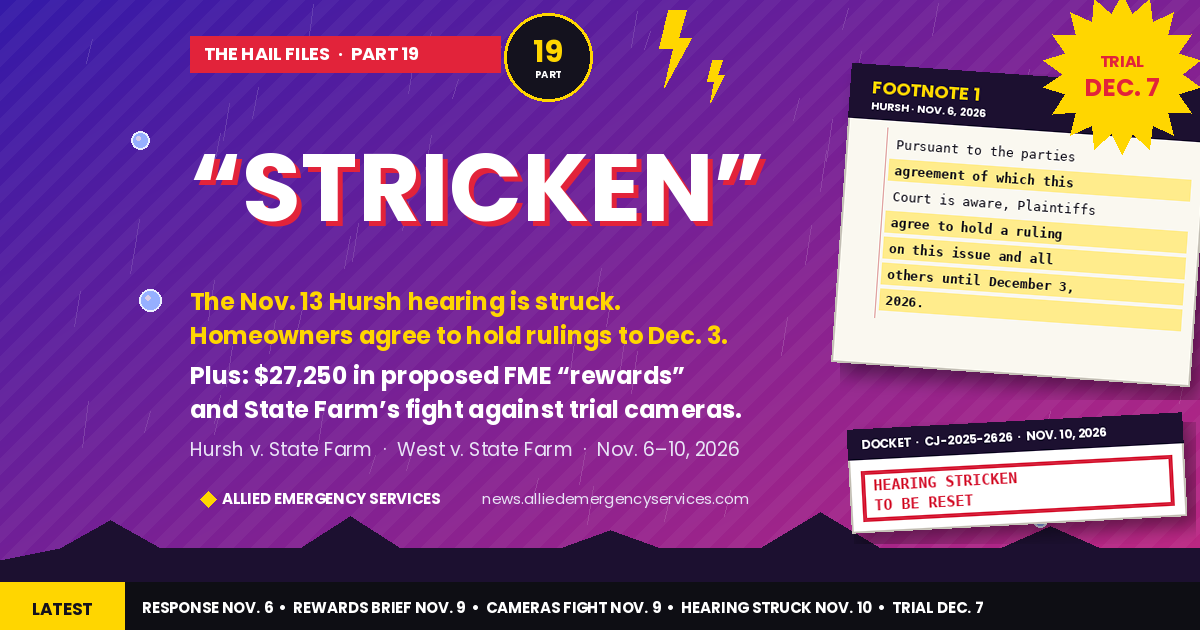
The cases go on. As of the docket saved November 13, Hursh v. State Farm Fire and Casualty Co. (Oklahoma County No. CJ-2025-2626) is set for a jury trial on December 7, 2026, with a pretrial conference on November 19. In a November 9 filing in West, State Farm counted “approximately 300” pending Oklahoma homeowners’ cases against it (Part 19).
| Question | The department (order, report, release, emails) | State Farm (agreement, statement, emails) |
|---|---|---|
| Did State Farm violate the claims-practices act? | Yes, “in at least twenty-two (22) instances from November 1, 2023 through December 31, 2024.” | It “denies any violation of law or wrongdoing.” |
| What do the inspected roofs show? | An error rate “greater than 7%” of its roofing claims from November 2023 through December 2024. | “A limited review of individual claims should not be mistaken for a complete picture of our overall claims-handling practices.” |
| Were records produced on time? | No. Records referenced in documents unsealed in West were “not timely produced.” | It “disagrees with findings and characterizations” in the examination. |
| Is the settlement an admission? | No, under the agreement it signed: no “admission by State Farm of liability, wrongdoing, or the accuracy of the disputed findings.” Separately, its order adopting the report is “a final administrative decision,” and State Farm waived its appeal. | No. Nothing in it “constitutes an admission or concession by State Farm of any fact, liability, wrongdoing or violation of law.” |
| Does it affect the lawsuits? | It is “a completely separate action from any policyholders’ individual lawsuits”; the department says the report “can be used as prima facie evidence in other legal actions” and hopes that aids the attorney general’s office and other efforts to protect Oklahoma consumers. | “The OID resolution has no bearing on any of the litigation.” |
What happens next?
- Within 30 days, the order says: an affidavit from each State Farm director. The corrective action plan is due within 30 days of State Farm’s receipt of the order.
- By December 12, 2026, a Saturday: the $35 million deposit, due “within thirty (30) days after the Effective Date.”
- Before December 31, 2026: State Farm’s written notice to each eligible policyholder.
- For 180 days after the notice: requests for review, with a reminder 30 days before the window closes.
- Through November 12, 2027: the 12 months State Farm’s quarterly reports cover, and the 12 months without a new market conduct examination on these matters if State Farm stays in material compliance.
- In the courts: the Hursh pretrial conference on November 19 and the jury trial set for December 7, as of the docket saved November 13.
Trial Watch tracks every date across the cases, and Trial Watch Live will carry each hearing and trial day.
What is the timeline?
- May 2, 2022: The examiners send State Farm their initial interrogatories and data requests.
- May 9, 2022: The examination commences.
- June 3, 2022: State Farm responds to the initial requests.
- November 9, 2023: The examiners require an updated list of paid and denied wind and hail claims.
- 2024: Engineers inspect 20 roofs in the first sample; the report counts 12 errors.
- April 3, 2025: The data request behind the second sample: 4,674 claims closed without payment from November 2023 through December 2024.
- September 2025: The first engineering firm’s sole professional engineer dies, the report says; a second firm later inspects the roofs.
- August 2026: The Comanche County District Court unseals State Farm internal documents in West.
- September 30, 2026: The date on the examination report; the order says it was filed with the department on or around that day.
- October 21, 2026: State Farm submits its written rebuttal.
- November 10, 2026: The commissioner signs the order adopting the report.
- November 12, 2026: The settlement agreement is signed.
- November 13, 2026: The department announces the settlement and publishes both documents.
What does this mean for homeowners and contractors?
For an Oklahoma homeowner whose State Farm wind or hail claim from 2021 through 2025 closed without payment, the next step is a written notice from State Farm, approved by the department, due before December 31, 2026. The request for review needs only a brief explanation, but a homeowner may attach supporting materials, and the department’s settlement page says those can include receipts and professional inspections.
The agreement tells the administrator what to weigh: the “reliability, timing and relevance” of what is submitted, “conflicting photographs and subsequent storms,” preexisting damage, and whether repair costs are “reasonable and necessary to repair covered loss” at local rates at the time of the reevaluation.
The release is a legal document with a 30-day clock. This report is not legal advice; a homeowner weighing the release against a lawsuit, or a possible one, may want a lawyer’s advice before signing.
The settlement covers Oklahoma residential claims only. The report describes itself as reflecting “the Oklahoma insurance activities of State Farm.”
Read the documents
The order adopting the examination report, with the report and its attachments (Oklahoma Insurance Department, November 10, 2026, 36 pages) · The settlement agreement (signed November 12, 2026, 9 pages) · The West response and counter-motion with the 31 unsealed exhibits · The department’s settlement information page · Search the full archive · Get an email when new documents are filed
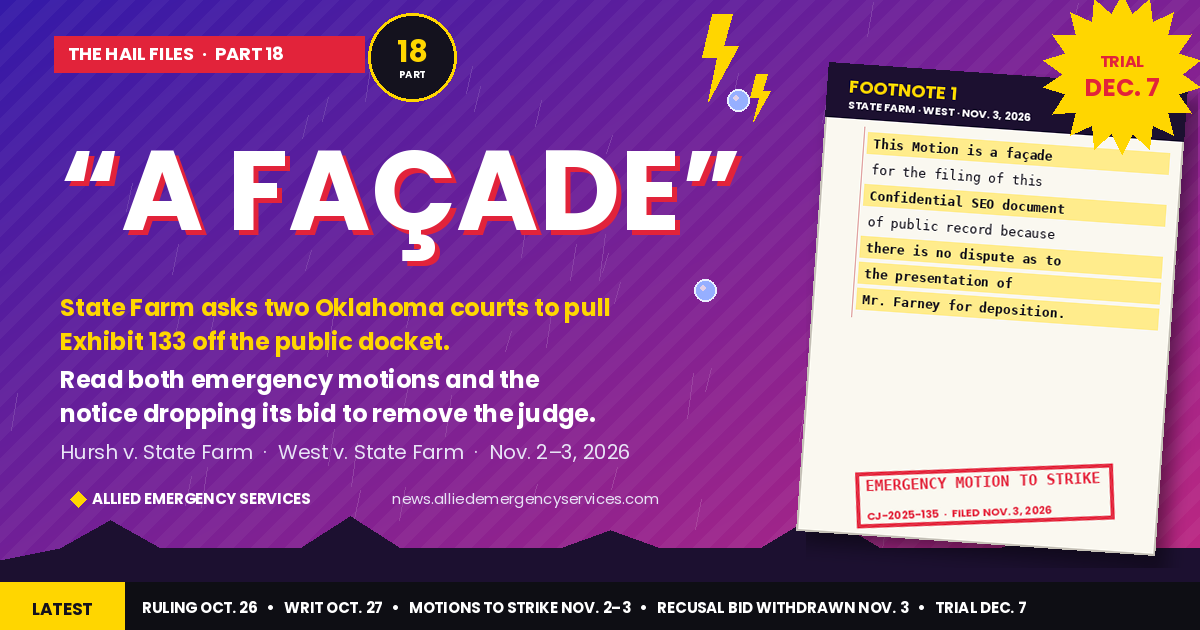
More from The Hail Files: Part 19: ‘Stricken to Be Reset’ · Part 18: ‘A Façade’ · Part 9: the documents made public · The trial guide
FOLLOW THE CASES
Free alerts when new filings land in The Hail Files archive
Your address is used only for these alerts and is never shared or added to any sales list.
FOR ATTORNEYS, REPORTERS AND RESEARCHERS
The Docket Index: every filing in the archive in one spreadsheet, with dates, case numbers, OSCN document numbers, page counts and links. Free, by email.
Get the Docket Index (Excel) →
Download the complete archive (.zip) →
STORM DAMAGE IN IL, WI, IN OR MI?
Allied Emergency Services inspects, documents and repairs hail and wind damage across Illinois, Wisconsin, Indiana and Michigan. We are a licensed restoration contractor, not an insurance adjuster or a law firm; coverage decisions belong to you and your insurer.
Frequently asked questions
$47.86 million, according to the Oklahoma Insurance Department’s settlement page; its November 13, 2026 release calls it “More Than $45 Million.” The settlement agreement, signed November 12, 2026, has three parts: $35,000,000 into an escrow account to pay claims approved in an independent review, $10,000,000 to the Strengthen Oklahoma Homes fund, and $2,860,000 for fines and the department’s examination expenses. State Farm disputes the examination’s findings and denies any violation of law or wrongdoing.
Under the November 12, 2026 settlement agreement, policyholders who submitted an Oklahoma residential claim to State Farm for wind or hail damage, with a date of loss from January 1, 2021 through December 31, 2025, that was closed without payment. The Oklahoma Insurance Department’s release says closed without payment includes insureds who received partial payment or whose claims were determined to be under the deductible. Claims already resolved by settlement or final judgment, or withdrawn by the insured before State Farm decided on payment, are excluded. The agreement says “Eligibility for review does not establish entitlement to payment.”
The agreement requires State Farm to send each eligible policyholder a written notice, approved by the Oklahoma Insurance Department, before December 31, 2026. The notice explains how to ask for a review and states the deadline; the opt-in period is 180 days from the notice. A request must include the policyholder’s name, contact information, property address, the claim, and a brief explanation of why more payment is believed due. Supporting materials are allowed but not required. As of November 14, 2026, the department’s release and settlement page did not say the review was open, and the published documents did not name the claim administrator.
No. The Oklahoma Insurance Department’s settlement page says “Payment is not guaranteed,” and the agreement says “Eligibility for review does not establish entitlement to payment.” An independent claim administrator evaluates causation, coverage and compensability under each policy and decides whether payment over the deductible, up to policy limits, is due. If a claim is not approved, the agreement says the notice will describe any dispute process the department and State Farm may agree on; the agreement itself does not create one.
Yes, under the agreement’s terms. Paragraph 18 says an approved homeowner receives payment “in exchange for their execution of a release of all claims, including contractual, extracontractual, statutory or otherwise,” that the homeowner may have against State Farm related to that claim and the review program, and has 30 days to sign. Homeowners who have sued may take part “provided that they dismiss their litigated claim(s) with prejudice as a condition of receiving any payment.” The release form must be approved by the Insurance Commissioner and had not been published as of November 14, 2026. This is not legal advice.
The Oklahoma Insurance Commissioner’s November 10, 2026 order adopts three findings from a targeted market conduct examination: that State Farm failed in at least 22 instances, from November 1, 2023 through December 31, 2024, to make a good-faith effort to promptly, fairly and equitably settle roofing claims where liability had become reasonably clear; that three claim files lacked a written denial; and that the company did not timely produce records the examiners requested. Engineers hired by the department’s examiners inspected 58 roofs; the report counts 22 errors in a sample of 181 claims, or 12.15 percent, against a 7 percent benchmark. State Farm disputes the findings and denies any violation.
No. The Oklahoma Insurance Department told the Tulsa World the settlement is “a completely separate action from any policyholders’ individual lawsuits against State Farm,” and State Farm told the newspaper “The OID resolution has no bearing on any of the litigation.” Attorney General Gentner Drummond said his office’s lawsuit in Cleveland County “will continue.” As of the docket saved November 13, 2026, Hursh v. State Farm (Oklahoma County No. CJ-2025-2626) is set for a jury trial on December 7, 2026. A homeowner who has sued must dismiss the litigated claim with prejudice to be paid through the review.
No. The agreement covers Oklahoma residential wind and hail claims with dates of loss from January 1, 2021 through December 31, 2025, and the examination report describes itself as reflecting “the Oklahoma insurance activities of State Farm.” The examination was conducted by the Oklahoma Insurance Department under Oklahoma law. Claims on homes outside Oklahoma are not eligible for the claims review.
The November 12, 2026 settlement agreement does not exclude a claim because the roof has already been repaired or replaced; the exclusions it lists are claims resolved by settlement or final judgment and claims the insured withdrew before State Farm decided on payment. The claim administrator is to use State Farm’s existing records, the materials the homeowner submits and other materials and experts it deems relevant. Repair costs must be “reasonable and necessary to repair covered loss,” and “Combined compensation from escrow and all other sources for the costs associated with the same COL 35 claim shall not exceed 100% of documented costs for that work.” Whether a claim is paid is the administrator’s decision.
Neither the settlement agreement nor the Oklahoma Insurance Department’s November 13, 2026 release gives a number. The examination report gives the size of three groups it sampled: 9,619 wind and hail roof claims closed without payment from January 1, 2019 through February 28, 2022; 2,101 from the two 2023 storm events with the largest claim volume; and 4,674 closed without payment from November 1, 2023 through December 31, 2024. The claims review covers dates of loss from January 1, 2021 through December 31, 2025.
About this report. Everything above is drawn from public records and public statements: the Oklahoma Insurance Department’s Order Adopting Report of Examination in case 22-0423-EXM, file-stamped November 10, 2026, with the Report of the Targeted Market Conduct Examination of State Farm Fire and Casualty Company dated September 30, 2026 and its attachments; the Settlement Agreement in cases 26-1372-DIS and 22-0423-EXM, signed November 12, 2026; the department’s November 13, 2026 release and its settlement information page as read November 14; State Farm’s November 13 statement as carried by KOCO and FOX23 and, in part, by the Tulsa World; emails from the department and from State Farm as quoted by the Tulsa World; and remarks by the commissioner and a statement by the attorney general as carried by KFOR. Both documents are image scans; quotations were checked against the page images. The record has three points a reader may notice. The order’s first page gives the examination period as ending December 21, 2024; the report’s cover page says December 31, 2024. The report describes the 2,101 claims behind its first sample two ways, as claims from the two 2023 storm events with the largest claim volume (pages 5 and 6) and as claims from March 1, 2022 through October 31, 2023 (page 8); this report uses the first. The report is dated September 30, 2026; the examiner’s affidavit on its last page is notarized November 9, 2026. The report names the claims consultant whose email it attaches; this report does not. The examination’s findings are the department’s, adopted by the Insurance Commissioner in an administrative order; they are not findings by any court. State Farm disputes them and denies any violation of law or wrongdoing.
About the host. Allied Emergency Services is a licensed storm-damage restoration contractor serving Illinois, Wisconsin, Indiana and Michigan — not a law firm, insurance adjuster or public adjuster, and this report is not legal or insurance advice. We inspect, document, provide insurance-ready repair estimates and complete repairs; coverage decisions always belong to you and your insurer. Founded 2015; in the building trades since 1999; Illinois-licensed. 24/7: (800) 792-0212.
⚡ Storm or Roof Damage? Get a FREE Estimate
Text ESTIMATE to (844) 907-2546
Or call (800) 792-0212 for 24/7 emergency response
AI-powered • No obligation • Licensed IL & WI
Storm damage? Start with the documentation
Allied Emergency Services — IL-Licensed Storm Damage Restoration Contractor
Founded 2015, in the building trades since 1999. Allied inspects and documents storm damage, writes the scope and estimate, and does the repairs. We do not adjust or negotiate insurance claims — that is the job of your insurer, a licensed public adjuster, or an attorney. IICRC-certified, EPA Lead-Safe, IL Licensed Roofing Contractor #104.019029. 24/7 emergency response.
How the storm-damage insurance claim process works →Free inspection within 24 hours · No obligation · Photo-documented findings you can share with your insurer
Attorneys: forensic storm damage documentation & construction expert consultation for counsel →