
⚡ Storm or Roof Damage? Get a FREE Estimate
Text ESTIMATE to (844) 907-2546
Or call (800) 792-0212 for 24/7 emergency response
AI-powered • No obligation • Licensed IL & WI
Oklahoma County and Comanche County, Oklahoma — November 5, 2026 · The Hail Files, Part 18
What happened, in one sentence: A week after an Oklahoma County judge ruled that State Farm’s “Exhibit 133” roof-claims memo is not privileged, State Farm asked two Oklahoma courts, in emergency motions filed November 2 and 3, to strike the homeowners’ motions that attach it and to remove them “from the public docket,” calling one of those motions “a façade” for putting the memo on the public record; on November 3 it also withdrew, in a one-sentence notice that gives no reason, its motion to disqualify the judge.
Status: As of the November 5, 2026, 5:45 p.m. Central docket reads, neither court had ruled on the motions to strike, and no written response from the homeowners appeared in either docket. State Farm says the October 26 ruling decided only privilege and left the memo’s “Confidential” designation in place; the homeowners’ lawyer, as reported by The Rates of Wrath, says the court found the memo was not covered by the protective order. The memo remains in the Hursh court file as filed and in The Hail Files archive; State Farm says the homeowners’ West motion attaches it too. What State Farm says below is its argument in its filings; nothing here is a finding by any court unless the report says so.
Key facts
- The motions: two State Farm emergency motions to strike, each 10 pages: in Hursh v. State Farm (Oklahoma County No. CJ-2025-2626, Judge Amy Palumbo), filed November 2, 2026; and in West v. State Farm (Comanche County No. CJ-2025-135, Judge Grant Sheperd), filed November 3 at 5:19 p.m.
- What they ask: that each court strike the homeowners’ October 27 motion to enforce its order on the deposition of State Farm’s chief executive, Jon Farney, “and its Exhibit 3 as in violation of the Protective Order” (the West motion says “the Hursh Protective Order”). The Hursh motion says the homeowners’ motion “must thus be stricken and removed from the public docket to preserve the confidentiality of the Confidential Document.”
- The document: Exhibit 3 is the 19-page “Senior Executive Offsite (‘SEO’) memorandum,” Bates-numbered HUR00158701-19, the document known in court as “Exhibit 133,” a label first used at a September 17 deposition in West. Every page is stamped “Confidential Produced Pursuant to Protective Order.”
- How it got out, by State Farm’s account: while producing “over 117,000 documents” in Hursh, plus “more than 600,000 documents” reproduced from prior settled cases, State Farm says it “inadvertently produced” two versions of the memo “with incomplete privilege redactions.”
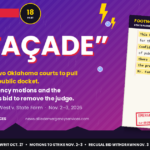
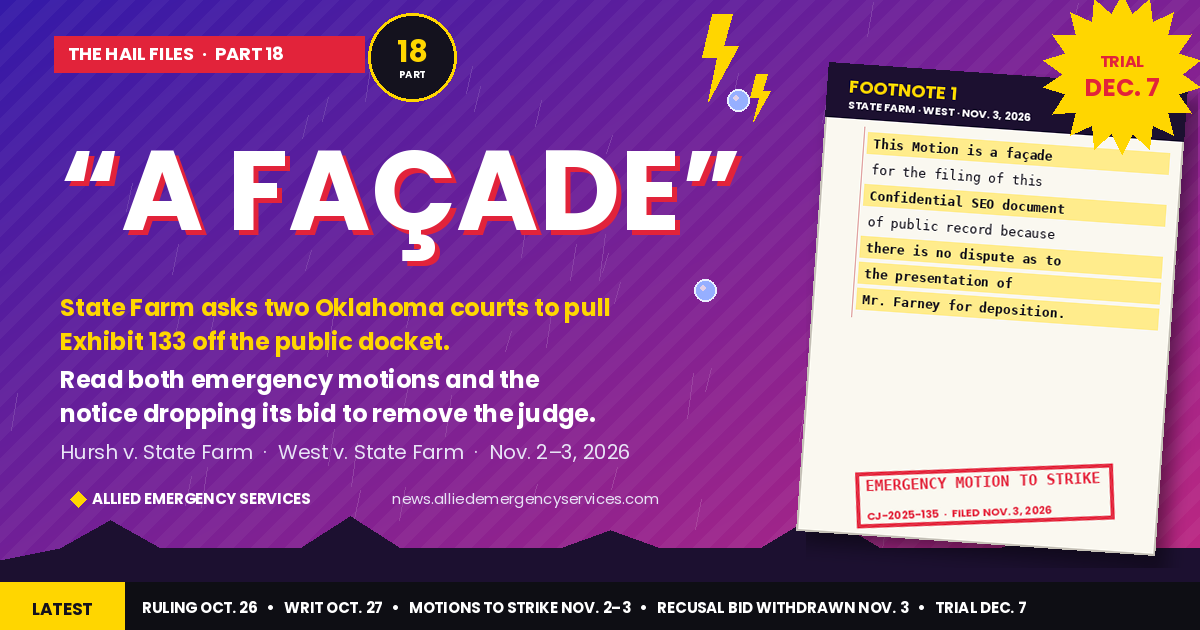
- “A façade”: the West motion’s first footnote says the homeowners’ motion “is a façade for the filing of this Confidential SEO document of public record because there is no dispute as to the presentation of Mr. Farney for deposition.”
- The Supreme Court: State Farm’s Hursh motion says that on October 27, the day after the ruling, it filed “an application for a writ with the Oklahoma Supreme Court.”
- The judge: State Farm withdrew its October 29 motion to disqualify Judge Palumbo on November 3, “without prejudice to refiling.” The notice gives no reason.
- December 7: the Hursh jury trial is set to begin, and State Farm’s motion to disqualify the attorney general’s outside lawyers, Whitten Burrage, who also represent the Hurshes, is now set for 9 a.m. the same day in Norman.
Every page carries the same stamp: “Confidential Produced Pursuant to Protective Order.” That stamp is State Farm’s case, in two Oklahoma courtrooms, for taking a 19-page memo prepared for a meeting of its senior executives off the public docket, after one of those courts ruled that the memo is not privileged, the homeowners filed it publicly the next morning, and television stations reported on what it says.
The memo is the document known in court as Exhibit 133. On October 26, 2026, Oklahoma County District Judge Amy Palumbo ruled that it “was not created in anticipation of litigation and is not protected work-product, nor attorney-client privileged,” and denied State Farm’s request for a stay pending appeal. On November 2, State Farm asked her, on an emergency basis, to strike the homeowners’ October 27 motion “and its Exhibit 3,” the memo, and to remove them from the public docket. On November 3, in the companion case in Comanche County, it asked Judge Grant Sheperd for the same thing, in a motion whose first footnote calls the homeowners’ filing “a façade.”
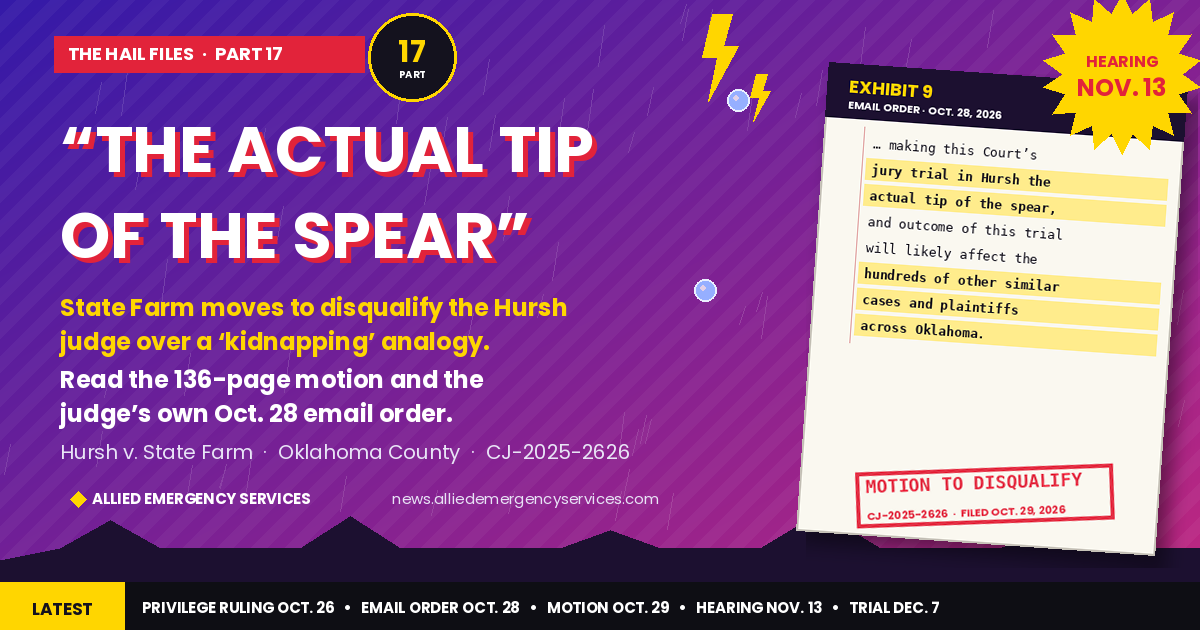
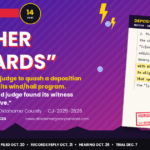
The same day, State Farm dropped its bid to remove the judge. In a notice one sentence long, it withdrew “its Motion to Disqualify filed under Rule 15 of the Rules for District Courts without prejudice to refiling,” the motion it had filed October 29 asking Judge Palumbo to step aside from Hursh (Part 17). The notice gives no reason.
What is State Farm asking the courts to do?
To strike the homeowners’ motions and take them off the public record. Both motions ask the court to strike the homeowners’ October 27 “Motion to Enforce,” a request that the court enforce its earlier order denying State Farm’s motion to quash the deposition of its chief executive, Jon Farney, together with the motion’s Exhibit 3. The Hursh court’s order denying the motion to quash is dated September 1, 2026; the West court’s, August 14, 2026.
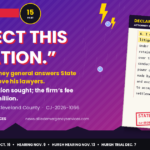
“The Protective Order is unambiguous,” the Hursh motion says. “A party may not publicly file a document designated as ‘Confidential’ without permission of the producing party or the Court. Plaintiffs have permission from neither. Plaintiffs’ Motion must thus be stricken and removed from the public docket to preserve the confidentiality of the Confidential Document.” Its objection is not only to the attachment: “Plaintiffs’ Motion quotes from and describes the content of this protected document without redaction.”
The rule State Farm invokes is the Hursh court’s protective order, which State Farm’s motions date December 11, 2025. As State Farm quotes it, paragraph 5 says that “[d]ocuments and/or deposition transcripts designated as ‘Confidential’ shall not be disseminated publicly” and may be shared only with listed people “unless prior written consent to further disclosure has been obtained from counsel for the designating party or permission for such disclosure has been given by the Court.” Paragraph 6 says confidential materials filed with the court must “be submitted in a sealed envelope or other container” labeled “Contains Confidential Information — Subject to Court Order.”
The West motion relies on the same Hursh order; State Farm says the memo was produced in Hursh. It says the homeowners filed their West motion “on the public docket identical to a motion they filed in a separate case,” and reports that State Farm’s lawyers conferred with the homeowners’ lawyers but that “as of the date of this filing, the matter is not resolved.”
For authority, State Farm cites a court’s “inherent authority to control its own docket,” Oklahoma’s discovery code, which lets a court order “that a trade secret or other confidential research, development or commercial information not be disclosed or be disclosed only in a designated way,” and court decisions protecting companies’ internal manuals and procedures. Among them, as State Farm quotes it, is a 2025 federal decision in Louisiana, Toy v. State Farm, finding that State Farm had “established good cause for issuance of [a] protective order treating its claims handling policies, procedures and methodologies as confidential.” Courts, the motions say, have protected “exactly the type of information at issue here,” recognizing that its disclosure “outside the instant litigation may result in competitive injury.”
Why does State Farm call the homeowners’ motion “a façade”?
Because, it says, the deposition the motion is about isn’t in dispute. The footnote appears on the first page of the West motion, filed by State Farm’s lawyers at Crowe Dunlevy:
“This Motion is a façade for the filing of this Confidential SEO document of public record because there is no dispute as to the presentation of Mr. Farney for deposition. The parties were continuing to work on an agreed date when this motion was filed. However, that violation is not the point of this Motion.”
Two things stand out. First, it is State Farm’s own statement, in a court filing, that there is “no dispute” its chief executive will be presented for a deposition, the deposition State Farm had asked both courts to quash. Both courts refused: the West court in an August 14 minute order, and Judge Palumbo on September 1, at a hearing where, according to the transcript State Farm later filed, she said an internal State Farm email she had read aloud was “overwhelming evidence of the culture in this company” (Part 17). Second, the footnote gives no date. It says the parties were still working on one when the homeowners filed their motion on October 27, and no filing in this batch reports a new one. The deposition had been agreed for October 19 and then moved by agreement, the homeowners said in that October 27 motion, which asked Judge Palumbo to require it within 15 days (Part 16).
The Hursh motion, filed by State Farm’s lawyers at GableGotwals with lawyers from Sullivan & Cromwell, Redgrave and Alston & Bird, does not use the word. It argues that the homeowners’ motion violates both the protective order and the court’s September 28 minute order, which, it says, did not grant the homeowners’ “explicit request” to de-designate the memo.
Why does State Farm say the memo is still confidential after the privilege ruling?
Because, in its view, privilege and confidentiality are two different questions, and the court has answered only one. As the motions frame it, the October 26 hearing decided privilege only, while the protective order governs whether a designated document may be filed publicly.
On privilege, State Farm lost. On confidentiality, it says, the court hasn’t ruled at all. “At that hearing, the sole question before the Court was whether the Confidential Document was privileged,” the Hursh motion says of October 26, and “the Court did not rule on or even consider State Farm’s designation of the document as Confidential pursuant to the Protective Order.” The October 26 minute, it adds, “in no way addressed, directly or indirectly, State Farm’s designation of the document as Confidential pursuant to the Protective Order.”
State Farm also points to September 28. That day, ruling on the homeowners’ motion to strip “Confidential” labels from a set of State Farm documents, the court de-designated “11 documents,” and State Farm’s motion lists them: exhibits to the homeowners’ original motion, their reply, and their notice of supplemental authority. The memo, which the homeowners had filed under seal as Exhibit 14 to that notice, writing that they “explicitly request this Court de-designate Exhibit 14,” is not on the list. State Farm reads that as a refusal: “The Court did not grant Plaintiffs’ demand to de-designate the Confidential Document.” The homeowners described it differently in their October 23 response, as a document “which this Court is currently reviewing in-camera.” And the protective order itself, as Part 16 reported, says it “shall not be deemed a violation” for counsel to disseminate designated documents “at deposition or as part of their filings with the Court,” and that such material “shall not lose its ‘Confidential’ status through such use”; it also says designated material shall, “when filed with the Court, be submitted in a sealed envelope.”
The homeowners read the record differently. Hannah Whitten of Whitten Burrage, one of their lawyers, said that State Farm bore the burden of establishing the bases of confidentiality, and that it had claimed attorney-client privilege and work-product protection, according to journalist J.C. Hallman’s November 4 report in The Rates of Wrath. “The Court found neither applies,” she said. In her account, Judge Palumbo ruled that the memo was not covered by the protective order because the privilege State Farm claimed did not apply. Their earlier position appears in State Farm’s own motion, which quotes their September 23 filing: the homeowners said they were “forced to file under seal to cooperate with State Farm’s overbroad designations of confidentiality on documents sought to be used in public pleadings.”
The protective order has its own procedure for challenging a “Confidential” label, State Farm notes: written notice, a 20-day window to respond, good-faith talks, and then 30 days for the producing party to ask the court for relief. It says the homeowners’ request, made in a notice of supplemental authority, was not “procedurally proper” under that order. Which reading of the October 26 ruling is right is for the courts to decide.
How did a memo marked “Confidential” end up on the public record?
State Farm’s two motions tell the story from its side. In its telling, it began as a mistake in a very large production.
- The production. The Hursh motion: “State Farm, in the course of producing over 117,000 documents in this case (in addition to more than 600,000 documents that State Farm reproduced from prior settled cases), inadvertently produced two versions of that memorandum—one being the Confidential Document—with incomplete privilege redactions.” (The West motion says “hundreds of thousands of documents in this case and elsewhere”; State Farm’s October 29 motion put the figures at over 110,000 new documents and over 640,000 reproduced.)
- September 17, 2026. At a deposition in West, the homeowners’ lawyers, who represent the homeowners in both cases, marked a copy with the incomplete redactions as Exhibit 133. State Farm says its lawyers “promptly notified” them that it “might contain inadvertently disclosed privileged communications.” By the homeowners’ account, reported in Part 16, they questioned the witness about the bracketed comments “for seventeen pages” without a privilege objection, and State Farm’s statement came only after the questioning ended.
- September 18. The West homeowners filed a copy under seal, State Farm says, “as an exhibit to a filing wholly unrelated to it,” and never asked the West court to de-designate it.
- September 22. State Farm’s lawyers sent a clawback letter “asserting privilege over the Confidential Document and requesting that Plaintiffs’ counsel destroy and return all copies of it.” Earlier filings, reported in Part 16, show that letter went out in West, and that a Hursh letter followed on September 29.
- September 23. The Hursh homeowners filed it under seal as Exhibit 14 to a notice of supplemental authority and asked the court to de-designate it.
- September 28. The court de-designated 11 other documents, not the memo, and gave State Farm until October 5 to file a brief on privilege.
- October 26. After State Farm’s privilege brief and the homeowners’ October 23 response, Judge Palumbo ruled the memo not privileged and denied a stay. “State Farm is entitled to its appellate rights but the request for a stay pending appeal is denied,” the minute says.
- October 27. “The next day, State Farm filed an application for a writ with the Oklahoma Supreme Court. On the same day, Plaintiffs filed their Motion to Enforce.” The Hursh motion went in at 7:56 a.m., with all 19 pages of the memo as Exhibit 3. The West homeowners filed theirs the same day.
Television stations reported on the memo within days. On October 29, KFOR in Oklahoma City reported that State Farm said the homeowners’ lawyers released it “in direct violation of the order governing its disclosure,” and that the company had asked the Oklahoma Supreme Court to review the ruling immediately. State Farm’s lead Hursh lawyer, Lance Leffel, did not respond to a question from Hallman about why State Farm is seeking to remove a document from the public record when its contents have already been widely reported, Hallman wrote. “I am unable to comment on pending litigation,” Leffel said in an email.
What is in Exhibit 133?
The 19 pages are a State Farm claims director’s October 26, 2021 email and two drafts of a summary titled “P&C Claims | Fire Claims Roofs – Quality & Service,” prepared for State Farm’s Senior Executive Offsite, with emails between the director and two in-house lawyers. State Farm’s new motions describe it as “a draft, internal State Farm memorandum containing legal advice from two State Farm in-house attorneys (in Microsoft Word comment bubbles, track changes, and in-line comments).”
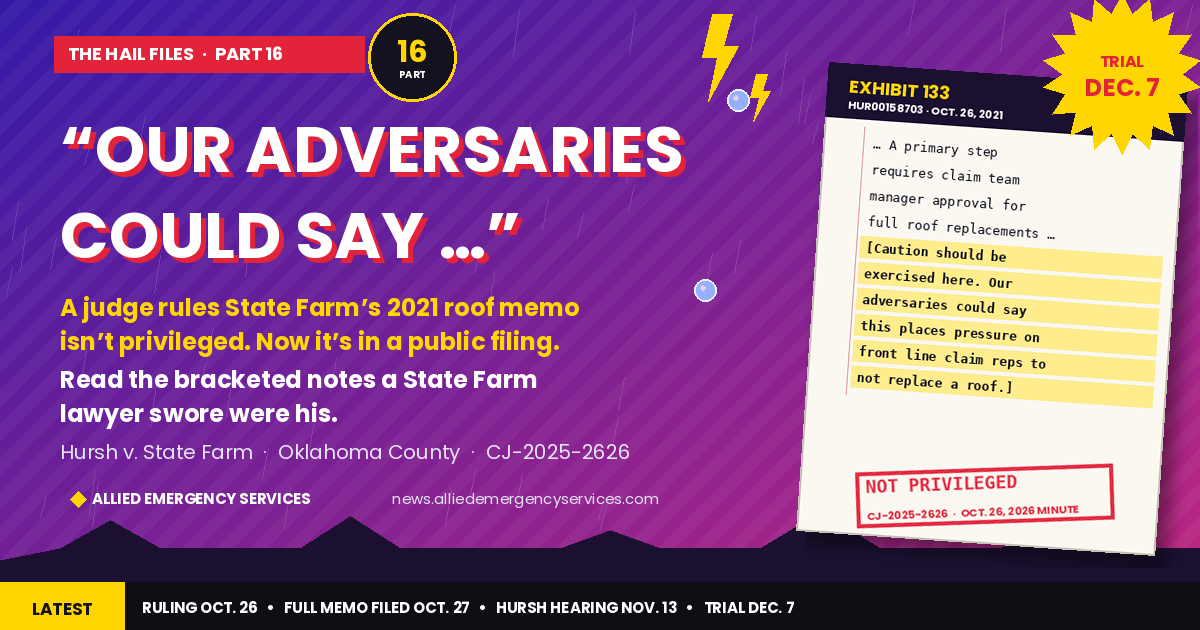
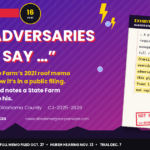
The most-quoted line is a bracketed comment that one of those in-house lawyers, in a sworn declaration State Farm filed October 5, identified as his own. It follows a bullet describing a wind and hail step rolled out in January 2021: “A primary step requires claim team manager approval for full roof replacements for damage potentially caused by small hail and light wind.” The comment: “[Caution should be exercised here. Our adversaries could say this places pressure on front line claim reps to not replace a roof.]”
State Farm says the comments were its lawyers’ advice on the draft’s wording and should have stayed privileged; the homeowners call them admissions. The homeowners allege their claim was handled under a company-wide program to reduce wind and hail payouts, which State Farm denies. Part 16 walks through the whole document; the court record, and The Hail Files archive, have it as filed.
What do the homeowners say?
In court, nothing yet. As of the November 5 docket reads, no written response to either emergency motion appeared in the Hursh or West docket. Their position comes from Whitten’s comments to Hallman, described above, and from their earlier filings, which State Farm quotes: that State Farm’s confidentiality designations are “overbroad,” and, as they wrote on September 23, that the memo and two other exhibits should be de-designated “to prevent any argument about its use next week in key corporate representative depositions.”
Whitten Burrage represents the homeowners in both cases, and the State in the attorney general’s lawsuit against State Farm.
Why did State Farm drop its motion to disqualify Judge Palumbo?
It hasn’t said. The November 3 notice reads, in full: “Defendant, State Farm Fire & Casualty Company, hereby files this Notice withdrawing its Motion to Disqualify filed under Rule 15 of the Rules for District Courts without prejudice to refiling.” State Farm “did not respond to an interview request about the sudden reversal,” The Rates of Wrath reported, in the first report on the withdrawal our searches found.
The motion, filed October 29 and 136 pages long with its exhibits, asked Judge Palumbo to certify her own disqualification, citing ten months of remarks from the bench and, according to declarations from three State Farm lawyers, an October 26 analogy comparing its in-house lawyers’ review of the Exhibit 133 memo to a lawyer telling kidnappers to call their plan something else. It had been set for hearing November 13. “Without prejudice to refiling” means State Farm has kept the option of filing it again; under Rule 15, a written motion must come at least ten days before trial.
For now, Judge Palumbo remains the judge in Hursh, and four other motions, including State Farm’s and the agent’s summary-judgment motions, remain set for November 13 at 9 a.m. under a separate notice.
What happens on December 7?
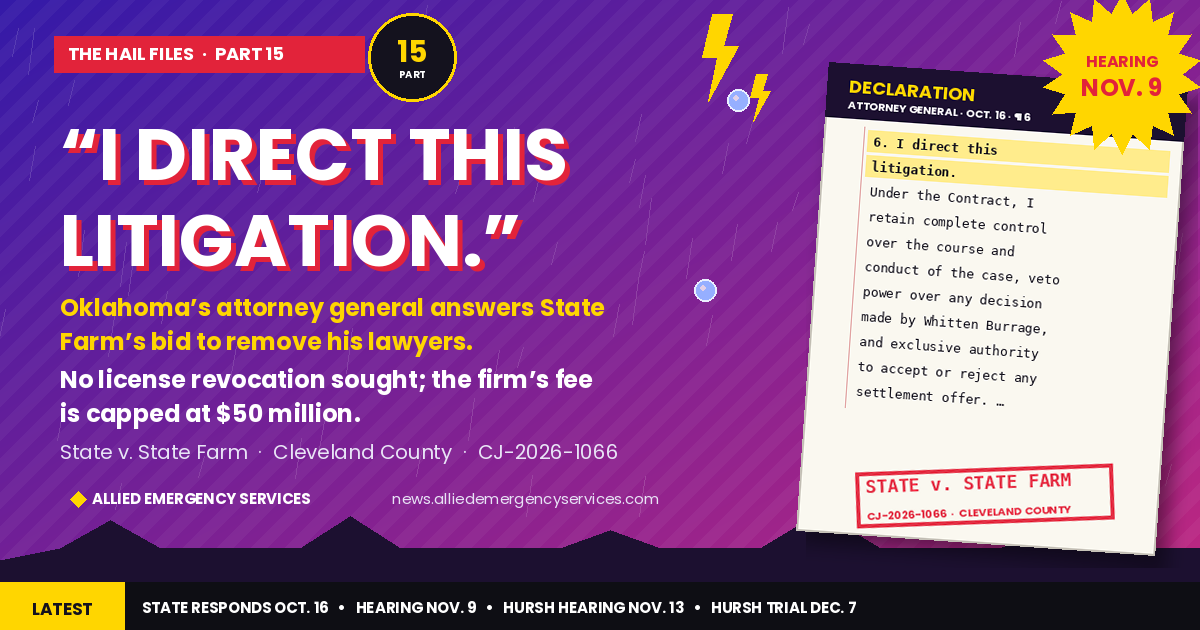
Two things at the same hour, in two courthouses. At 9 a.m., the Hursh jury trial is set to begin in Oklahoma County. And under an amended notice filed November 3 at 8:39 a.m. in the attorney general’s separate lawsuit against State Farm in Cleveland County, State Farm’s “Motion to Disqualify Whitten Burrage as Counsel for Plaintiff has been set for hearing before Judge Jeff Virgin on December 7, 2026, at 9:00 a.m. at the Cleveland County Courthouse,” in Norman. The hearing had been set for November 9.
Whitten Burrage is the firm State Farm wants removed as the State’s outside counsel (Part 15), and it is also the Hurshes’ law firm. The amended notice does not say why the hearing was moved or why that date was chosen.
Will cameras be allowed at the West trial?
That is set for November 19. The Lawton Constitution applied on October 13 for permission to cover the West jury trial with electronic media, and the application “is set for hearing on November 19, 2026,” according to an unopposed State Farm motion filed November 2 at 4:11 p.m. State Farm asked for seven more days, to Monday, November 9, to respond, “due to other intervening deadlines and also to allow for any additional developments that may occur in advance of the hearing that may need to be covered in the response.” The newspaper did not oppose the extension, the motion says, “though Non-Party Applicant does want to have the Motion heard on November 19.”
The motion signals where State Farm stands: absent the extension, it says, “State Farm’s Response in Opposition to that Motion would be due November 2, 2026.” It also confirms the schedule: “the trial has been rescheduled to February 1, 2027.”
What did the court say about the summary-judgment briefs?
On October 30, Judge Palumbo signed an order, prepared by the homeowners’ lawyers, letting them file 35-page responses, instead of the usual 20, to State Farm’s amended partial summary-judgment motion and to the agent’s summary-judgment motion. “The Court is informed that counsel for Defendants failed to respond to counsel for Plaintiffs’ inquiry as to whether Defendants object” to the longer briefs, the order says, adding that the defendants “are not prejudiced” because they may file replies and may ask for extra pages too. The responses were due Monday, November 2, and earlier orders allow them under seal with redacted public versions; none appeared in the docket text as of the November 5 reads.
What happens next?
- Not yet scheduled: rulings on the two emergency motions to strike; the homeowners’ responses to them; action by the Oklahoma Supreme Court on State Farm’s October 27 writ application.
- November 9: State Farm’s response to The Lawton Constitution‘s camera application in West, if the court grants the extension State Farm requested.
- November 13, 9 a.m.: four motions in Hursh, including both summary-judgment motions, before Judge Palumbo in Room 809 of the Oklahoma County Courthouse.
- November 19: the camera application in West; the pretrial conference in Hursh.
- December 7, 9 a.m.: the Hursh trial; the hearing on State Farm’s motion to disqualify Whitten Burrage in the attorney general’s case.
- December 10, 10 a.m.: the West homeowners’ motion to enforce, the one State Farm now asks Judge Sheperd to strike, is set for hearing.
- February 1, 2027: the West trial.
Trial Watch tracks every date across the three cases.
What is the timeline?
- August 14, 2026: The West court denies State Farm’s motion to quash the CEO’s deposition.
- September 1, 2026: The Hursh court does the same.
- September 17, 2026: A copy of the memo is marked Exhibit 133 at a West deposition.
- September 18 and 23, 2026: Filed under seal in West, then in Hursh; State Farm’s clawback letters go out September 22 (West) and September 29 (Hursh).
- September 28, 2026: The Hursh court de-designates 11 documents; the memo is not among them.
- October 26, 2026: Ruling: not privileged, no stay. State Farm’s lawyer asks the judge to step aside.
- October 27, 2026: State Farm applies to the Oklahoma Supreme Court for a writ; the homeowners file the memo publicly in Hursh and, State Farm says, in West.
- October 29, 2026: State Farm moves to disqualify Judge Palumbo.
- November 2, 2026: State Farm’s emergency motion to strike in Hursh; its unopposed extension motion on the camera application in West.
- November 3, 2026: The AG hearing moves to December 7; State Farm withdraws its motion to disqualify the judge; its emergency motion to strike in West is filed at 5:19 p.m.
- November 5, 2026: No rulings, and no new entries in any of the three cases, at the evening docket read.
What does this mean for Oklahoma homeowners and contractors?
The fight over Exhibit 133 now has two fronts. One is whether State Farm could keep the memo from the homeowners at all: Judge Palumbo ruled on October 26 that it is not privileged, that ruling stands unless a court changes it, and State Farm says it has asked the Oklahoma Supreme Court to review it. The other is whether the memo stays on the public record, which State Farm has now asked Judge Palumbo and Judge Sheperd to decide.
For homeowners with a denied or reduced roof claim, the filings are worth reading in full, because they show how a single claim file became part of a fight over company-wide records. Both of State Farm’s motions, the notice of withdrawal and every other filing named here are linked below, so anyone can read the arguments in their own words and decide for themselves.
Read the documents
State Farm’s November 2 emergency motion to strike in Hursh (10 pages) · State Farm’s November 3 emergency motion to strike in West (10 pages, with the “façade” footnote) · The November 3 notice withdrawing the motion to disqualify · The amended notice moving the attorney general’s hearing to December 7 · State Farm’s unopposed motion on the camera application in West · The October 30 order allowing extra pages · Judge Palumbo’s October 26 minute · The homeowners’ October 27 motion, with Exhibit 133 in full · State Farm’s October 29 motion to disqualify (withdrawn) · Search the full archive.
More from The Hail Files: Part 17: ‘Tip of the Spear’ · Part 16: ‘Our Adversaries Could Say’ · Part 15: the attorney general’s lawyers · Part 8: the clawback · the trial guide · Get an email when new documents are filed.
Frequently asked questions
In emergency motions filed November 2, 2026 in Hursh v. State Farm (Oklahoma County No. CJ-2025-2626) and November 3, 2026 in West v. State Farm (Comanche County No. CJ-2025-135), State Farm asked both courts to strike the homeowners’ October 27 motions to enforce and their Exhibit 3, the Exhibit 133 memo, and remove them from the public docket. State Farm says the memo was designated “Confidential” under the Hursh protective order, which it dates December 11, 2025, and which bars public filing of confidential documents without the producing party’s consent or the court’s permission, and that no court ever removed the designation; it says the October 26, 2026 ruling decided only that the memo is not privileged. Neither court had ruled on the motions as of the November 5, 2026 docket reads.
It is the 19-page document Bates-numbered HUR00158701-19 and known in court as Exhibit 133: a State Farm claims director’s October 26, 2021 email and two drafts of a summary titled “P&C Claims | Fire Claims Roofs – Quality & Service,” prepared for State Farm’s Senior Executive Offsite, with emails between the director and two in-house lawyers. One bracketed comment, which a State Farm in-house lawyer identified as his in a sworn declaration, reads: “Our adversaries could say this places pressure on front line claim reps to not replace a roof.” State Farm says the comments were legal advice; the homeowners call them admissions.
On October 26, 2026, Judge Amy Palumbo ruled in Hursh v. State Farm that the memo “was not created in anticipation of litigation and is not protected work-product, nor attorney-client privileged,” and denied a stay pending appeal. Whether it is still “Confidential” under the protective order is disputed: State Farm says the ruling did not address its confidentiality designation, while the homeowners’ lawyer, Hannah Whitten, told The Rates of Wrath that the court found the memo was not covered by the protective order. State Farm’s November 2 and 3 motions ask the two courts to decide that question.
Yes. On November 3, 2026, State Farm filed a one-sentence notice in Hursh v. State Farm withdrawing “its Motion to Disqualify filed under Rule 15 of the Rules for District Courts without prejudice to refiling.” The motion, filed October 29, 2026, had asked Judge Palumbo to disqualify herself and had been set for hearing November 13. The notice gives no reason, and State Farm did not respond to a journalist’s interview request about it. Without prejudice means State Farm may file it again.
State Farm says it has asked the Oklahoma Supreme Court for a writ. Its November 2, 2026 motion in Hursh v. State Farm says that on October 27, 2026, the day after Judge Palumbo’s ruling, “State Farm filed an application for a writ with the Oklahoma Supreme Court”; its November 3 motion in West v. State Farm says the application concerns “the Hursh Court’s Minute Order.” Neither motion gives a case number, and no news report we found had given one as of November 5. Judge Palumbo denied State Farm’s request for a stay pending appeal on October 26.
State Farm now says there is “no dispute as to the presentation of Mr. Farney for deposition,” in a footnote to its November 3, 2026 motion in West v. State Farm, which adds that “the parties were continuing to work on an agreed date.” Both the West court (August 14, 2026) and the Hursh court (September 1, 2026) denied State Farm’s motions to quash his deposition. It had been agreed for October 19 and then moved by agreement, the homeowners said on October 27; the footnote gives no new date.
The Hursh v. State Farm jury trial (Oklahoma County No. CJ-2025-2626) is set to begin December 7, 2026, with four motions, including both summary-judgment motions, set for November 13 and a pretrial conference November 19. Also on December 7, at 9 a.m., State Farm’s motion to disqualify Whitten Burrage, the firm representing the State of Oklahoma in the attorney general’s lawsuit and the Hurshes in theirs, is set for hearing before Judge Jeff Virgin in Cleveland County. The companion West v. State Farm trial has been rescheduled to February 1, 2027.
About this report. Except where a publication is named, everything above is drawn from public court records: State Farm’s November 2, 2026 emergency motion to strike in Hursh v. State Farm Fire and Casualty Co. (Oklahoma County No. CJ-2025-2626) and its November 3, 2026 emergency motion to strike in West v. State Farm Fire and Casualty Co. (Comanche County No. CJ-2025-135); State Farm’s November 3 notice of withdrawal in Hursh; its November 3 amended notice of hearing in the attorney general’s case against State Farm (Cleveland County No. CJ-2026-1066); its November 2 unopposed motion for extension of time in West; the October 30 order allowing extra pages in Hursh; the October 26 minute and the homeowners’ October 27 motion to enforce, as described in Parts 16 and 17; and the Hursh, West and Cleveland County dockets as read November 5, 2026, at 5:45 a.m. and 5:45 p.m. Central. The filings are image scans; every quotation was checked against the page images. Protective-order language is quoted as State Farm quotes it in its motions, except the passage on use at depositions and in court filings, which is quoted as Part 16 reported it. Hannah Whitten’s and Lance Leffel’s comments are as J.C. Hallman reported them in The Rates of Wrath on November 4, 2026, the first report on the withdrawal that our searches found; KFOR’s report is from October 29, 2026. Apart from case names, individuals named in the filings other than the judges, the lawyers of record and State Farm’s chief executive are not named here. Where a filing makes an allegation or characterization, this report attributes it; nothing here is a finding by any court unless the report says so.
About the host. Allied Emergency Services is a licensed storm-damage restoration contractor serving Illinois, Wisconsin, Indiana and Michigan — not a law firm, insurance adjuster or public adjuster, and this report is not legal or insurance advice. We inspect, document, provide insurance-ready repair estimates and complete repairs; coverage decisions always belong to you and your insurer. Founded 2015; in the building trades since 1999; Illinois-licensed. 24/7: (800) 792-0212.
⚡ Storm or Roof Damage? Get a FREE Estimate
Text ESTIMATE to (844) 907-2546
Or call (800) 792-0212 for 24/7 emergency response
AI-powered • No obligation • Licensed IL & WI
Storm damage? Start with the documentation
Allied Emergency Services — IL-Licensed Storm Damage Restoration Contractor
Founded 2015, in the building trades since 1999. Allied inspects and documents storm damage, writes the scope and estimate, and does the repairs. We do not adjust or negotiate insurance claims — that is the job of your insurer, a licensed public adjuster, or an attorney. IICRC-certified, EPA Lead-Safe, IL Licensed Roofing Contractor #104.019029. 24/7 emergency response.
How the storm-damage insurance claim process works →Free inspection within 24 hours · No obligation · Photo-documented findings you can share with your insurer
Attorneys: forensic storm damage documentation & construction expert consultation for counsel →