⚡ Storm or Roof Damage? Get a FREE Estimate
Text ESTIMATE to (844) 907-2546
Or call (800) 792-0212 for 24/7 emergency response
AI-powered • No obligation • Licensed IL & WI
Oklahoma County, Oklahoma — November 1, 2026 · The Hail Files, Part 17
What happened, in one sentence: State Farm has asked Oklahoma County District Judge Amy Palumbo to disqualify herself from Hursh v. State Farm, saying that when she ruled on October 26 that its “Exhibit 133” roof memo is not privileged, she compared the company’s in-house legal review to a lawyer telling kidnappers who had gathered rope, chloroform and zip ties to call it something else, an account that comes from declarations by three State Farm lawyers; the hearing transcript has since been sealed.
Status: The motion, filed October 29 with 12 exhibits (136 pages), is set for hearing before Judge Palumbo on November 13 at 9 a.m. She has not ruled on it. Her own written account of the recusal request is an October 28 email order, sent the day before the written motion was filed, in which she vacated a temporary stay, ordered State Farm to give the homeowners Exhibit 133 “in its unredacted form immediately,” and called the Hursh jury trial “the actual tip of the spear.” A lawyer for the homeowners called the recusal request a delay tactic, according to one of State Farm’s lawyers. The remarks State Farm attributes to the judge are its characterizations and its lawyers’ accounts; nothing described here is a finding by any court unless the report says so.
Key facts
- The case: Billy & Lacy Hursh v. State Farm Fire and Casualty Co., et al., Oklahoma County District Court No. CJ-2025-2626, before Judge Amy Palumbo. A jury trial is set to begin December 7, 2026.
- The motion: “Defendant State Farm Fire and Casualty Company’s Motion to Disqualify and Request for Evidentiary Hearing,” filed October 29, 2026. It asks the judge to disqualify herself and to have the case “transferred to another judge in this district.”
- The standard: Rule 2.11(A) of Oklahoma’s Code of Judicial Conduct: a judge “shall disqualify himself or herself in any proceeding in which the judge’s impartiality might reasonably be questioned.” State Farm says its motion “does not rest on adverse rulings.”
- The October 26 remarks: described in declarations by three State Farm lawyers: two signed under penalty of perjury and written from memory, or memory and notes (“not meant to be a verbatim transcript”), and a third from notes taken at the hearing. The judge sealed the hearing transcript by an order dated October 30, after the declarations were signed.
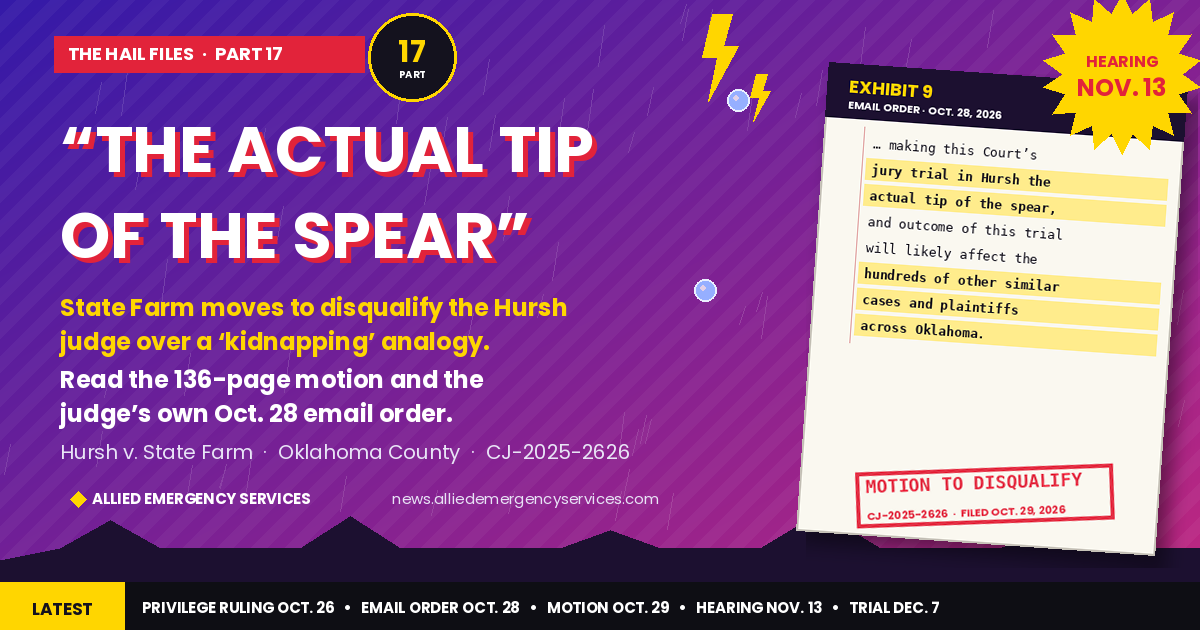
- The judge’s own words: her October 28 email order calls the Hursh jury trial “the actual tip of the spear,” and says the “outcome of this trial will likely affect the hundreds of other similar cases and plaintiffs across Oklahoma.”
- Next: summary-judgment responses due November 2; the disqualification hearing November 13 at 9 a.m.; pretrial November 19; trial December 7.
- First reported: by The Rates of Wrath on October 30, as far as our November 1 searches found. The Hail Files archive has all 136 pages, complete and as filed.
Rope, chloroform-soaked towels and zip ties, stored in a safe house: that is how State Farm’s lead lawyer in the case remembers the picture Judge Amy Palumbo painted from the bench on the afternoon of October 26, 2026.
The courtroom had been cleared. The judge had just heard argument on State Farm’s claim that two in-house lawyers’ comments in a 2021 roof-claims memo prepared for its senior executives, part of the 19 pages known in court as Exhibit 133, were privileged legal advice. According to declarations from three State Farm lawyers who were there, two of them signed under penalty of perjury, she returned from a recess, rejected the privilege claim, and explained her view with an analogy: people planning a kidnapping ask a lawyer to look over their plan, and the lawyer says it sounds like kidnapping, so call it something else. One of the lawyers recalls her saying the lawyers’ edits put “icing (or frosting) on it so that the good times could keep rolling at State Farm.”
State Farm’s lawyer, Lance Leffel, stood and asked her to step aside. She said she believed she could be fair; State Farm says she denied the request. She briefly stayed the case, and the hearing adjourned so the lawyers could confer with their clients. Three days later, on October 29, State Farm filed a 22-page written motion, with exhibits totaling 136 pages, asking Judge Palumbo to certify her own disqualification from Hursh v. State Farm, the Oklahoma County roof-claim case whose jury trial she herself, in an email to the lawyers the day before, had called “the actual tip of the spear,” writing that its outcome “will likely affect the hundreds of other similar cases and plaintiffs across Oklahoma.” The motion is set for hearing on November 13. The transcript that would show exactly what she said is sealed.
What is State Farm asking Judge Palumbo to do?
To leave the case. The motion asks for “an order certifying the disqualification of Judge Palumbo” and, in its conclusion, requests “that the Court disqualify itself from this proceeding and that the case be transferred to another judge in this district.” It also asks for an evidentiary hearing, citing a 2001 Oklahoma Supreme Court decision that a challenge to a judge’s impartiality “must be resolved and the ruling memorialized of record after a meaningful evidentiary hearing.” It relies on Article 2, Sections 6 and 7 of the Oklahoma Constitution, Rule 2.11(A) of the Code of Judicial Conduct, Rule 15 of the Rules for District Courts of Oklahoma, and 20 O.S. § 1403.
“This is not a step State Farm takes lightly,” the motion says at the outset. “Every litigant is entitled to the Court’s impartiality and decisions based on evidence, not the Court’s preconceived notions. Yet this Court has repeatedly attributed improper motives to State Farm, its executives, witnesses, and attorneys in proceedings that required no determination of intent.”
The company frames its argument as a line between conduct and motive. “A court that finds a party missed a deadline or failed to support a burden objection is doing what courts must do, and State Farm does not seek disqualification on that basis,” the motion says. “This Court has gone much further. It has repeatedly announced why State Farm acts as it does.” State Farm says it is not complaining about losing: “although this Court has ruled against State Farm on every single discovery issue to date, State Farm has never before sought disqualification based on any of those rulings.” Its point, it says, is that “a reasonable observer could conclude that the Court has already formed a fixed view of State Farm’s motives.”
What did the judge say on October 26, according to State Farm’s lawyers?
State Farm says it had not received the transcript when it filed, so the motion rests on three declarations, Exhibits 11A, 11B and 11C, signed October 28 and 29 by Leffel, a second lawyer from his firm, GableGotwals, and State Farm’s discovery counsel. Leffel’s and the discovery counsel’s are signed under penalty of perjury and say their quotation marks reflect the lawyer’s “best recollection,” not “a verbatim transcription”; Leffel wrote from memory, the discovery counsel from memory and notes. The second GableGotwals lawyer’s declaration, which has no penalty-of-perjury statement, is based on notes he says he took during the hearing. Their details differ.
The matter argued that afternoon, according to State Farm’s lawyers, was State Farm’s October 5 brief asking the court to treat parts of HUR00158701-19, the Exhibit 133 document, as privileged. Leffel’s declaration says the judge “cleared the courtroom because of the confidential nature of the issues to be heard, leaving only court staff and approved counsel.” The second GableGotwals lawyer’s declaration says several members of the press were asked to leave before argument began, that argument ran from about 1:45 to 2:50 p.m., and that the judge returned from a recess at about 3:13 p.m. to rule.
Leffel’s account. “While not meant to be a verbatim transcript of the Court’s statements,” he wrote, the judge, “in the course of issuing her ruling made comments that compared State Farm employees’ request for advice from in-house counsel to criminals seeking advice about storing ropes, chloroform-soaked towels, and zip ties in a safe house to further a criminal enterprise.” As he recalls it, she “characterized the attorney’s advice in her example as essentially suggesting that the conduct sounded like kidnapping but advising clients that it should be called something else.” In his words, the court continued “stating that, in its view, State Farm’s in-house counsel had advised employees in furtherance of fraudulent and unlawful conduct,” describing the advice as changing a few words to “put icing (or frosting) on it so that the good times could keep rolling at State Farm.”
The second GableGotwals lawyer’s account, from what he calls contemporaneous notes: the judge began her ruling “by observing the large number of lawyers that State Farm had obtained,” found that the time State Farm took to send its clawback letter affected its ability to claw the memo back, discussed the crime-fraud exception, and noted that the memo “had initially been drafted without including the legal department.” Then: “The Court stated that the actions were akin to private parties gathering chloroform, zip ties, and other equipment to engage in kidnapping. And after consulting the lawyers, the lawyers determine they should call it something different.” She “further opined that the lawyers here seemed to be doing the same thing: changing some words, putting icing on the cake, and deciding they should let the good times keep rolling.” (His declaration dates the hearing “Monday, August 26, 2026”; the hearing it describes was Monday, October 26.)
State Farm’s discovery counsel’s account, from his recollection and notes, has the judge saying something to the effect that “it almost seems like involving legal was an afterthought,” that this was like the “RJ Reynolds case” the homeowners cited for the point that a court reviewing documents cannot close its eyes to their content, and that State Farm’s actions were “tantamount to nighttime activities.” In his version of the analogy, it was as if State Farm’s employees said “We’re gonna get some rope, a ladder [and other instruments associated with a kidnapping plan] and go in the window at night,” and then “the lawyer looks at it and says ‘this sounds like kidnapping. Let’s call it something else.'” He recalls the judge saying counsel knew or should have known the plan could be “fraud,” that she found it “shocking” and that it appeared to her to be “willful blindness,” and that the memo was not prepared for litigation but to “keep the good times rolling” by ensuring “the perfect words are used” when presented to executives. She also said, by his account, that she understood State Farm’s right to seek review and looked forward to any appeal moving “quickly,” but that the stay request “is going to be denied, as this is, in this Court’s opinion, a discovery matter that doesn’t warrant the granting of an intermediate stay.”
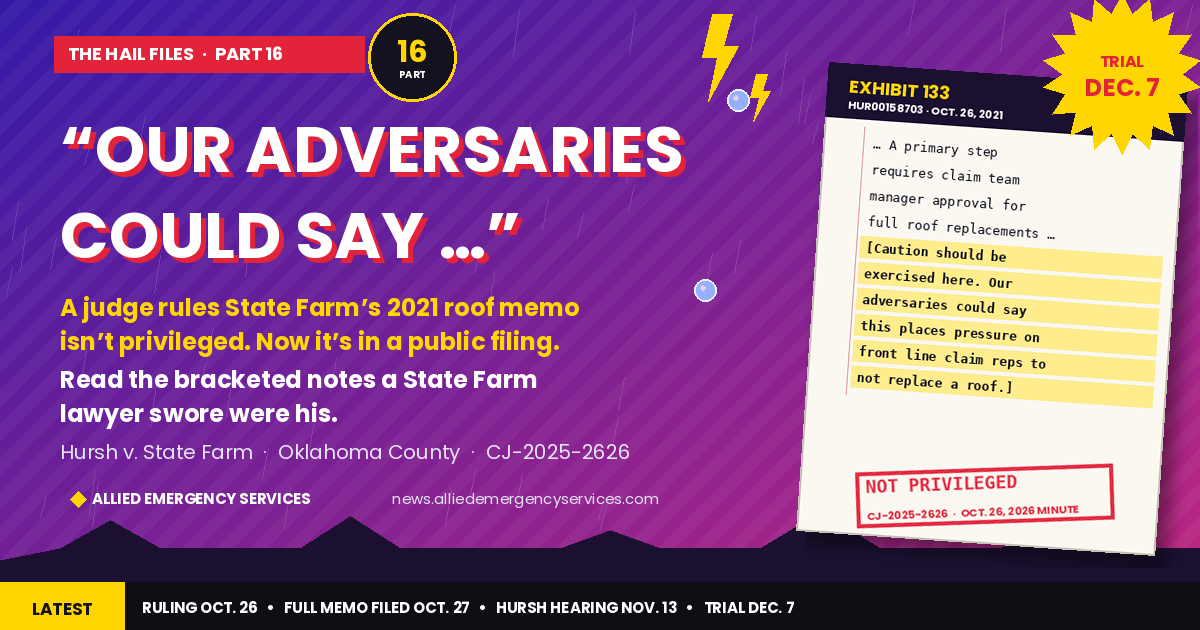
The written minute of that hearing records only the ruling. As The Hail Files reported in Part 16, Judge Palumbo found that HUR00158701-19 “was not created in anticipation of litigation and is not protected work-product, nor attorney-client privileged,” and denied a stay.
What happened when State Farm asked her to step aside?
Leffel’s declaration says he stood “to seek clarification and address the Court’s inflammatory comments,” told the judge she had expressed opinions throughout the case about State Farm’s conduct and culture, “culminating in a comparison of State Farm’s conduct to criminal abductions,” and, with the courtroom still closed, “made an in-camera request for recusal under Rule 15.” According to the second GableGotwals lawyer, Leffel asked whether the court was capable of giving his client a fair trial.
The homeowners’ side answered, by the same lawyer’s account: “Ms. Whitten then argued that the request was made purely as a delay tactic, because her firm had agreed to delay a separate trial against State Farm.” Hannah Whitten is one of the homeowners’ lawyers at Whitten Burrage. Leffel replied that he had not planned to make the request, but that the judge’s comparison left him no choice.
“The Court attempted to explain her comments and stated that she felt she could be an unbiased judge in the Case,” the second GableGotwals lawyer’s declaration continues. She then said, by that account, that “Judge Burrage,” the homeowners’ lawyer Mike Burrage, could vouch that in a prior case she had thought she might struggle to be unbiased and had raised that with his client. The court continued the other motions set that day, and the hearing adjourned so the lawyers could confer with their clients.
What did Judge Palumbo say in her own words?
The clearest record of the judge’s view is her own email, sent at 11:56 a.m. on October 28 and forwarded to the lawyers minutes later. State Farm filed it as Exhibit 9. It is, in effect, her account of the recusal request and her reasons for moving ahead.
Rule 15, she wrote, “states specifically ‘until such time as a formal motion is filed, the assigned judge may proceed with the case.’ No such motion has been filed,” and “The Court has received no indication whether State Farm’s discussion will actually produce anything further, and to delay this trial indefinitely causes prejudice to the Plaintiffs.” She described the moment from the bench this way: “Upon announcing the Court’s decision that State Farm’s Application would be denied on multiple grounds, the record will reflect that defense then proceeded to inquire as to whether this Court could be fair to State Farm, discussed how State Farm had routinely lost motions in front of the Court, and noted that while it had never been addressed with the Court, State Farm had been discussing this for a while.”
She then ordered the document produced: “unredacted Exhibit 133 is a part of this record, and it is proper to provide to Plaintiffs,” and “State Farm is ordered to provide Exhibit 133 in its unredacted form immediately to Plaintiff, and provide an additional courtesy copy of same to this Court.” The temporary stay she had granted when the recusal question came up was vacated: “with the impending jury trial and other critical depositions scheduled, to give fair and impartial treatment to all parties, justice is best served by vacating the temporary stay, and revisiting only if the procedural threshold as described in Rule 15(a) is met.”
And she explained why the case could not wait: “This is especially true as the Court learned in argument that Judge Shepherd in Comanche County had continued the West jury trial, making this Court’s jury trial in Hursh the actual tip of the spear, and outcome of this trial will likely affect the hundreds of other similar cases and plaintiffs across Oklahoma.” (The companion case, West v. State Farm, is before Judge Grant Sheperd, whose name the Comanche County docket spells that way.)
The same email decided the motions the court had continued on October 26, under District Court Rule 4(h), which allows rulings without a hearing. It denied State Farm’s motion to reconsider and stay the court’s October 1 order, taking judicial notice that Judge Sheperd had found in an October 16 order in West that State Farm’s corporate witness “was completely evasive” and non-responsive to most of the questions at her deposition. It denied State Farm’s motion to partially reconsider the court’s September 28 de-designation order and its emergency motion to strike the homeowners’ supplement. And it granted the homeowners’ motion to compel State Farm to re-produce electronically stored information “in the Form Defendant State Farm Elected,” with production “within seven (7) days.” The winning side was told to submit written orders within ten days.
State Farm reads the email very differently. It says the court “rushed to rule on multiple motions, without a hearing,” two days after the oral request, and that the “tip of the spear” passage was “language taken straight out of a plaintiff’s playbook.” “Those statements confirm that the Court views this individual roof claim as a vehicle for resolving issues extending across State Farm litigation in Oklahoma,” the motion says. It also says the order to re-produce its entire 110,000-document production in seven days came after the judge had said at an October 1 hearing, according to the transcript State Farm filed, “I don’t even know what metadata is” and “I wouldn’t know if it hit me in the face,” and that she would “defer that metadata issue and ordering the production of that electronic metadata” until “after we have our hearing after you filed a response.”
Which earlier remarks does State Farm cite?
The motion argues that October 26 was the culmination of ten months of comments. It quotes transcripts from six earlier dates, attached among Exhibits 1 through 8. These are the remarks it highlights:
| Date and hearing | What the judge said, in the records State Farm filed | Source in the filing |
| Dec. 30, 2025: the attorney general’s motion to intervene | She “fail[ed] to see how what State Farm filed . . . is anything other than irrelevant and disparaging.” | Exhibit 1, transcript |
| Feb. 5, 2026: State Farm’s motion to reconsider and stay | “State Farm’s clear directive to you to do nothing as long as possible”; “maybe the Supreme Court is being utilized in some type of like a discovery master-esque role, it’s just very disheartening.” | Exhibit 2, transcript |
| Aug. 4, 2026: the homeowners’ motion to enforce | State Farm’s reasons for not producing in Hursh documents it had produced in other cases “at this point have no credibility with this Court”; “we’ll just blow deadlines because that is what works for us.” | Exhibit 3, transcript |
| Sept. 1, 2026: the motion to quash the CEO’s deposition | “That is overwhelming evidence of the culture in this company, layer upon layer”; “like a piece of baklava”; the wording of the CEO’s declaration “very intentionally done.” | Exhibit 4, transcript |
| Sept. 29, 2026: a hearing during a corporate deposition | A “gargantuan and ever-growing team of lawyers” making sure “everything is kosher first, and then, in compliance with the order of the Court second.” | Exhibit 5, transcript |
| Oct. 1, 2026: two records during a corporate deposition | Parties must comply, “not after 640 magic, unnamed lawyers have looked at it and then they accidentally give stuff”; “this is nonsensical and unnecessary” (State Farm says she meant its inadvertent-production explanation); the witness’s answers “absolutely evasive behavior.” | Exhibits 7 and 8, transcripts |
| Oct. 26, 2026: the Exhibit 133 privilege ruling | The kidnapping analogy; “icing (or frosting)”; “keep the good times rolling.” | Exhibits 11A-11C, lawyers’ declarations (memory and notes) |
| Oct. 28, 2026: the email order | The Hursh jury trial is “the actual tip of the spear.” | Exhibit 9, the judge’s email |
The motion returns repeatedly to the September 1 passage. The hearing was on State Farm’s motion to quash the deposition of its chief executive, Jon Farney, who had signed a declaration saying he “was not directly involved” in the wind and hail program at the center of the case. From the bench, according to the transcript State Farm attached, the judge read aloud from an internal State Farm email she had seen in another motion’s exhibits: “Looks fantastic. Thank you for all the work on this. One suggestion in the monitor and measure area, and can we change ‘reduce’ to ‘target?’ I fully understand the meaning, but I think the lawyers would caution us on how others might use the terms of the contents.”
Then she said: “That is overwhelming evidence of the culture in this company, layer upon layer. And I’m saying that based off of what my experience has been with every State Farm case that you have appeared on in front of me. It is like a piece of baklava, layer upon layer upon layer upon layer of making sure that State Farm is airtight and insulated. I think that wording was not haphazard. I think that wording on that affidavit was very intentionally done because I do not think that Mr. Farney wants to potentially commit perjury and possibly open himself up through criminal prosecution for doing so or contempt of court.”
State Farm’s objection is that Farney “had not testified in this action” and that the court “simply adopted Plaintiffs’ attorney argument about what the declaration ‘meant.'” It says the reference to “every State Farm case” was to a single earlier case. The judge, for her part, had addressed fairness on the record before: at the August 4 hearing, after describing State Farm’s approach as “we’ll just blow deadlines because that is what works for us,” she added, “And I say that not because I am not capable of being fair and impartial, I say that because it is an observation based on the evidence that State Farm has sent you in here with.” (The motion elsewhere says the court “told the parties at the 8/4 hearing that it was not impartial”; the transcript State Farm attached records her saying the opposite.)
The motion’s own descriptions of October 26 also go beyond its declarations. In three places it says the analogy included duct tape, and once it says the judge compared State Farm’s “executives and CEO” to criminals. None of the three declarations mentions duct tape or the chief executive.
What do the homeowners say?
As of the November 1 docket check, the homeowners had not filed a written response to the motion. Their position so far is known from State Farm’s own declaration, which reports that Whitten called the request “purely” a delay tactic, and from Whitten’s comments to journalist J.C. Hallman, who reported on October 28 that she said State Farm had no valid ground for recusal and that the homeowners hoped the issue would be resolved quickly enough to avoid delaying the trial. Hallman reported on the written motion in The Rates of Wrath on October 30.
On the memo itself, the homeowners have argued that Exhibit 133 was an ordinary business document written before any lawyer saw it, and that its bracketed comments show what State Farm’s leadership knew. State Farm says the comments were legal advice. Its motion describes the in-house lawyers’ role this way: “Their suggested changes sought to describe State Farm’s practices more accurately and reduce the risk that opposing counsel and juries would misconstrue the memo.” It says the unredacted comments were produced by mistake, “in the midst of producing over 110,000 new documents and reproducing over 640,000 documents from prior cases.”
Property-insurance lawyer Chip Merlin, writing on November 1, framed the dispute with the question in his headline: “Is Judicial Frustration the Same as Judicial Bias?”
Why is the October 26 transcript sealed?
Because the judge ordered it. An order dated October 30 recites that the October 26 hearing, on the homeowners’ motion to compel re-production of electronically stored information, State Farm’s emergency motion to strike, and State Farm’s privilege brief on HUR00158701-19, resulted in “proceedings being transcribed, delivered to parties, and ordered filed under seal pursuant to Protective Order filed in styled case.” It concludes: “Therefore, this Court orders Transcript of Proceedings be SEALED,” and “said Hearing Transcript not be unsealed without further Order of this Court.”
That leaves the public with the lawyers’ recollections. State Farm’s motion says, in its first footnote, that it “has not yet received a copy of the transcript of the October 26 hearing, and will supplement this Motion when the transcript becomes available.” Two of the declarations, Leffel’s and the discovery counsel’s, note that a court reporter was present and “should be able to provide a transcript with additional details.” Whether a supplement quoting the transcript would be filed publicly or under seal is not stated.
What does the motion reveal about the size of the case?
The Hursh lawsuit is one couple’s roof claim from storms in 2023 and 2024. The homeowners allege the claim was handled under a company-wide program to reduce wind and hail payouts, which State Farm denies. State Farm’s motion puts the discovery in its own numbers:
- More than 750,000 documents produced to the homeowners, it says, including more than 640,000 re-produced from earlier cases. The homeowners’ October 29 filing puts the figure at about 564,058 documents to date.
- More than 15,000 hours of first-level review by a third-party vendor’s lawyers, and nearly $2.4 million in vendor invoices through September 2026.
- More than a hundred thousand claim files of other policyholders, not at issue in the case, that the court required State Farm to review, a review it says involves 280 full-time reviewers and has cost millions.
- 30 topics with 101 subparts, spanning 15 years, in the homeowners’ notice for State Farm’s corporate representative, and deposition notices for eight high-level employees, including the chief executive.
- “Every one of Plaintiffs’ motions to compel,” State Farm says, has been granted. The Oklahoma Supreme Court barred enforcement of the order that let the attorney general intervene in the case, in State Farm Fire & Cas. Co. v. Palumbo, 2026 OK 51.
Four smaller filings from the same week show how the case is heading toward trial. On October 28 the court granted the homeowners leave to file unredacted versions of their responses to State Farm’s amended partial summary-judgment motion and to the agent’s summary-judgment motion under seal, with redacted versions allowed on the public docket. On October 29 the homeowners asked to file 35-page responses instead of the usual 20, saying State Farm’s amended motion sets out 48 numbered statements of undisputed fact supported by about 360 pages of exhibits. A docket note on October 30 says the order allowing extra pages was signed.
How does disqualifying a judge work in Oklahoma?
Rule 15 of the Rules for District Courts sets the steps. A party must first make a private, in-camera request to the judge. If that doesn’t resolve it, the party may file a written motion, at least ten days before the case is set for trial. If the judge refuses to step aside, the party has five days to ask the county’s chief judge to rehear the question, and if the chief judge also refuses, five days to ask the Oklahoma Supreme Court for a writ of mandamus. The Supreme Court won’t take up a disqualification request that skipped those steps.
The test is objective: whether the judge’s “impartiality might reasonably be questioned,” not whether the judge believes she is fair. State Farm’s motion leans on a 2007 Oklahoma Supreme Court decision for two points: that “[e]rror, if any, should be made in favor of disqualification,” and that once a Rule 15 proceeding is initiated, “the trial court must refrain from presiding over the case until the disqualification ruling is memorialized and the movant has, at the movant’s option, exhausted the Rule 15 procedure.” The judge’s email reads the rule the other way for the period before a written motion: until one is filed, “the assigned judge may proceed with the case.”
The motion also acknowledges the limit of its own theory. Citing the U.S. Supreme Court’s 1994 decision in Liteky v. United States, it concedes that judicial rulings, criticism of case management and opinions formed during proceedings “do not ordinarily establish disqualifying bias,” unless they display “deep-seated favoritism or antagonism that would make fair judgment impossible.”
What happens next?
- November 2: the homeowners’ responses to the two summary-judgment motions are due, under seal with redacted public versions allowed.
- About November 4: the seven days the October 28 email gave State Farm to re-produce its electronically stored information run out. The court also ordered unredacted Exhibit 133 produced to the homeowners “immediately.”
- November 13, 9 a.m.: the disqualification motion is set before Judge Palumbo, in Room 809 of the Oklahoma County Courthouse, the same morning as the motions set by State Farm’s October 22 notice of hearing, including both summary-judgment motions. State Farm argues the judge should not preside over the case until the disqualification question is resolved; the motion does not say what should happen to the other motions that morning.
- If she declines: State Farm can ask the Oklahoma County chief judge to rehear the motion within five days, then the Oklahoma Supreme Court.
- The transcript: State Farm says it will supplement the motion “when the transcript becomes available.” The October 30 order says the proceedings were “transcribed, delivered to parties, and ordered filed under seal.”
- November 19: pretrial conference. December 7: trial.
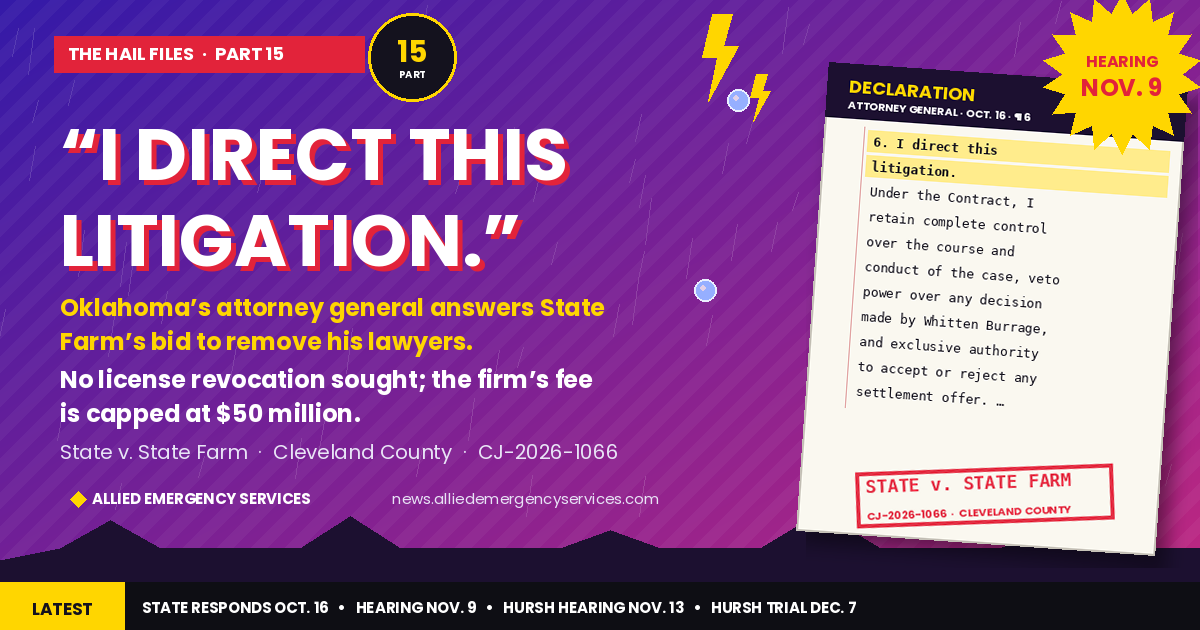
Disqualification fights are not limited to Hursh. In the attorney general’s separate lawsuit against State Farm in Cleveland County, State Farm’s motion to disqualify the State’s lawyers is set for hearing November 9 (Part 15). In West, Judge Sheperd continued the trial to February 2027. Trial Watch tracks every date.
What is the timeline?
- November 25, 2025: The court grants the homeowners’ first motion to compel, ordering the company-wide discovery State Farm now describes as disproportionate.
- December 30, 2025: Hearing on the attorney general’s motion to intervene; the court grants it. The Oklahoma Supreme Court later bars enforcement of that order (2026 OK 51).
- February 5, 2026: Hearing on State Farm’s motion to reconsider and stay (“disheartening”).
- August 4, 2026: Hearing on the homeowners’ motion to enforce (reasons that “at this point have no credibility with this Court”).
- September 1, 2026: The court denies State Farm’s motion to quash the CEO’s deposition (“like a piece of baklava”).
- September 29 and October 1, 2026: Hearings during corporate depositions (“kosher first”; “640 magic, unnamed lawyers”).
- October 26, 2026: The Exhibit 133 privilege ruling in a closed courtroom; the analogy, by State Farm’s lawyers’ accounts; Leffel’s in-camera recusal request.
- October 28, 2026: The judge’s email order: stay vacated, Exhibit 133 to be produced unredacted “immediately,” the Hursh trial “the actual tip of the spear,” the remaining motions decided. Orders granting the homeowners leave to file under seal.
- October 29, 2026: State Farm files the motion to disqualify and its notice of hearing; the homeowners move to exceed the page limit.
- October 30, 2026: The October 26 transcript is sealed; the extra-pages order is signed.
- November 2, 13 and 19; December 7, 2026: responses, hearing, pretrial, trial.
What does this mean for Oklahoma homeowners and contractors?
A recusal motion is about who decides the case, not what the evidence shows. Nothing in State Farm’s motion withdraws Exhibit 133 from the public record or changes what its bracketed comments say, and the October 26 ruling that the document is not privileged stands unless a court changes it. The question now is whether Judge Palumbo or another Oklahoma County judge will try the case.
For homeowners with a denied or reduced roof claim, the filing is also a record of how ten months of discovery fights looked from the bench, in transcripts State Farm itself chose to file. The motion is State Farm’s argument; the homeowners have not answered it in writing, and the judge has not ruled. All 136 pages are linked below, so anyone can read the remarks in context and decide for themselves.
Read the documents
State Farm’s October 29 motion to disqualify and request for evidentiary hearing (136 pages, with the hearing transcripts, the judge’s October 28 email order as Exhibit 9 and the three lawyers’ declarations as Exhibits 11A-11C) · The notice setting the November 13 hearing · The October 30 order sealing the October 26 transcript · Judge Palumbo’s October 26 minute · The homeowners’ October 27 motion, with Exhibit 133 in full · The October 28 order on sealing the response to State Farm’s motion · The October 28 order on sealing the response to the agent’s motion · The homeowners’ motion for extra pages (State Farm’s motion) · The homeowners’ motion for extra pages (the agent’s motion) · Search the full archive.
More from The Hail Files: Part 16: ‘Our Adversaries Could Say’ · Part 11: ‘Absolutely Evasive Behavior’ · Part 13: the summary-judgment motions · Part 15: the attorney general’s lawyers · the trial guide · Get an email when new documents are filed.
Frequently asked questions
On October 29, 2026, State Farm filed a motion in Hursh v. State Farm (Oklahoma County District Court No. CJ-2025-2626) asking Judge Amy Palumbo to disqualify herself under Rule 2.11(A) of the Oklahoma Code of Judicial Conduct, which requires disqualification when a judge’s “impartiality might reasonably be questioned,” and to transfer the case to another judge. State Farm says she has repeatedly attributed improper motives to the company, its executives and its lawyers, from a December 2025 hearing through October 2026, culminating in an analogy to kidnapping at the October 26 hearing where she ruled that its Exhibit 133 roof memo is not privileged. State Farm says the motion does not rest on her adverse rulings. The homeowners had not filed a written response as of the November 1 docket check.
According to declarations from three State Farm lawyers, written from memory and notes before State Farm had the transcript, which the judge sealed on October 30, Judge Amy Palumbo explained her October 26, 2026 ruling that State Farm’s Exhibit 133 memo is not privileged by comparing State Farm employees who asked in-house lawyers to review the memo to people who gather rope, chloroform-soaked towels and zip ties for a kidnapping and ask a lawyer to look at the plan, and the lawyers’ edits to a lawyer who says it sounds like kidnapping, so call it something else. One lawyer recalls her saying the edits put “icing (or frosting) on it so that the good times could keep rolling at State Farm.” Two of the declarations say their quotations are recollections, not a verbatim transcript, and the three accounts differ in their details.
In an email order sent to counsel on October 28, 2026, Judge Amy Palumbo wrote that Rule 15 “states specifically” that “until such time as a formal motion is filed, the assigned judge may proceed with the case,” vacated the temporary stay she had granted after State Farm’s oral recusal request, ordered State Farm “to provide Exhibit 133 in its unredacted form immediately” to the homeowners, and wrote that with the West trial continued, “this Court’s jury trial in Hursh” is “the actual tip of the spear, and outcome of this trial will likely affect the hundreds of other similar cases and plaintiffs across Oklahoma.” The email also denied three State Farm motions and granted the homeowners’ motion to compel re-production of electronically stored information within seven days. State Farm filed the email as Exhibit 9 to its motion.
No. By an order dated October 30, 2026, Judge Amy Palumbo ordered the transcript of the October 26 hearing in Hursh v. State Farm (Oklahoma County No. CJ-2025-2626) sealed under the case’s protective order, and ordered that it “not be unsealed without further Order of this Court.” The order lists the hearing as on State Farm’s privilege brief on the Exhibit 133 document (HUR00158701-19) and two motions about electronically stored information; according to State Farm’s lawyers, only the privilege brief was argued. State Farm’s motion to disqualify says State Farm had not yet received the transcript and will supplement the motion when it becomes available.
State Farm’s notice of hearing sets its motion to disqualify and request for evidentiary hearing before Judge Amy Palumbo on November 13, 2026, at 9:00 a.m., in Room 809 of the Oklahoma County Courthouse, 321 Park Avenue, Oklahoma City. The same morning, the court has also set the motions in State Farm’s October 22 notice of hearing, including State Farm’s and the agent’s summary-judgment motions. The trial in Hursh v. State Farm is set for December 7, 2026.
Under Rule 15 of the Rules for District Courts of Oklahoma, a party must first ask the judge privately, in camera, to step aside. If that does not resolve it, the party may file a written motion at least ten days before trial. If the judge refuses, the party has five days to ask the county’s chief judge to rehear the motion, and if that fails, five days to seek a writ of mandamus from the Oklahoma Supreme Court in a civil case. The standard, under Rule 2.11(A) of the Code of Judicial Conduct, is whether the judge’s impartiality “might reasonably be questioned,” judged objectively.
Hursh v. State Farm (Oklahoma County District Court No. CJ-2025-2626) is set for a jury trial beginning December 7, 2026, with a pretrial conference November 19. State Farm’s October 29, 2026 motion to disqualify Judge Amy Palumbo is set for hearing November 13. State Farm argues that the judge must not preside until the disqualification question is resolved, including any review by the chief judge or the Oklahoma Supreme Court; at the October 26 hearing, according to a State Farm lawyer’s declaration, the homeowners’ lawyer called the request a delay tactic. As of the November 1, 2026 docket check, no court had ruled on the motion or changed the trial date.
About this report. Except where a publication is named, everything above is drawn from public court records in Hursh v. State Farm Fire and Casualty Co. (Oklahoma County No. CJ-2025-2626): State Farm’s October 29, 2026 motion to disqualify and its twelve exhibits, including the hearing-transcript excerpts it attached, Judge Amy Palumbo’s October 28, 2026 email order (Exhibit 9) and three State Farm lawyers’ declarations about the October 26, 2026 hearing (Exhibits 11A-11C); State Farm’s October 29 notice of hearing; the October 30, 2026 order sealing the October 26 transcript; the October 28 orders granting leave to file under seal; the homeowners’ October 29 motions to exceed the page limit; the October 26 minute; and the Hursh, West and Cleveland County dockets as read November 1, 2026, 5:45 a.m. Central. The description of Rule 15 is from the Rules for District Courts of Oklahoma. The filings are image scans; every quotation was checked against the page images. The October 26 remarks are reported as State Farm’s lawyers described them in declarations written before State Farm had the transcript, which has since been sealed; the judge’s own words are quoted from her email and from hearing transcripts as State Farm filed them. The first report on the motion that our November 1 searches found was J.C. Hallman’s in The Rates of Wrath on October 30, 2026; Hannah Whitten’s earlier comments are as Hallman reported them on October 28. Apart from case names, individuals named in the filings other than the judges, the lawyers of record and State Farm’s chief executive are not named here. Where a filing makes an allegation or characterization, this report attributes it; nothing here is a finding by any court unless the report says so.
About the host. Allied Emergency Services is a licensed storm-damage restoration contractor serving Illinois, Wisconsin, Indiana and Michigan — not a law firm, insurance adjuster or public adjuster, and this report is not legal or insurance advice. We inspect, document, provide insurance-ready repair estimates and complete repairs; coverage decisions always belong to you and your insurer. Founded 2015; in the building trades since 1999; Illinois-licensed. 24/7: (800) 792-0212.
⚡ Storm or Roof Damage? Get a FREE Estimate
Text ESTIMATE to (844) 907-2546
Or call (800) 792-0212 for 24/7 emergency response
AI-powered • No obligation • Licensed IL & WI
Storm damage? Start with the documentation
Allied Emergency Services — IL-Licensed Storm Damage Restoration Contractor
Founded 2015, in the building trades since 1999. Allied inspects and documents storm damage, writes the scope and estimate, and does the repairs. We do not adjust or negotiate insurance claims — that is the job of your insurer, a licensed public adjuster, or an attorney. IICRC-certified, EPA Lead-Safe, IL Licensed Roofing Contractor #104.019029. 24/7 emergency response.
How the storm-damage insurance claim process works →Free inspection within 24 hours · No obligation · Photo-documented findings you can share with your insurer
Attorneys: forensic storm damage documentation & construction expert consultation for counsel →