⚡ Storm or Roof Damage? Get a FREE Estimate
Text ESTIMATE to (844) 907-2546
Or call (800) 792-0212 for 24/7 emergency response
AI-powered • No obligation • Licensed IL & WI
Oklahoma County, Oklahoma — October 29, 2026 · The Hail Files, Part 16
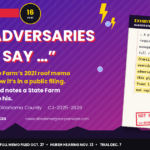
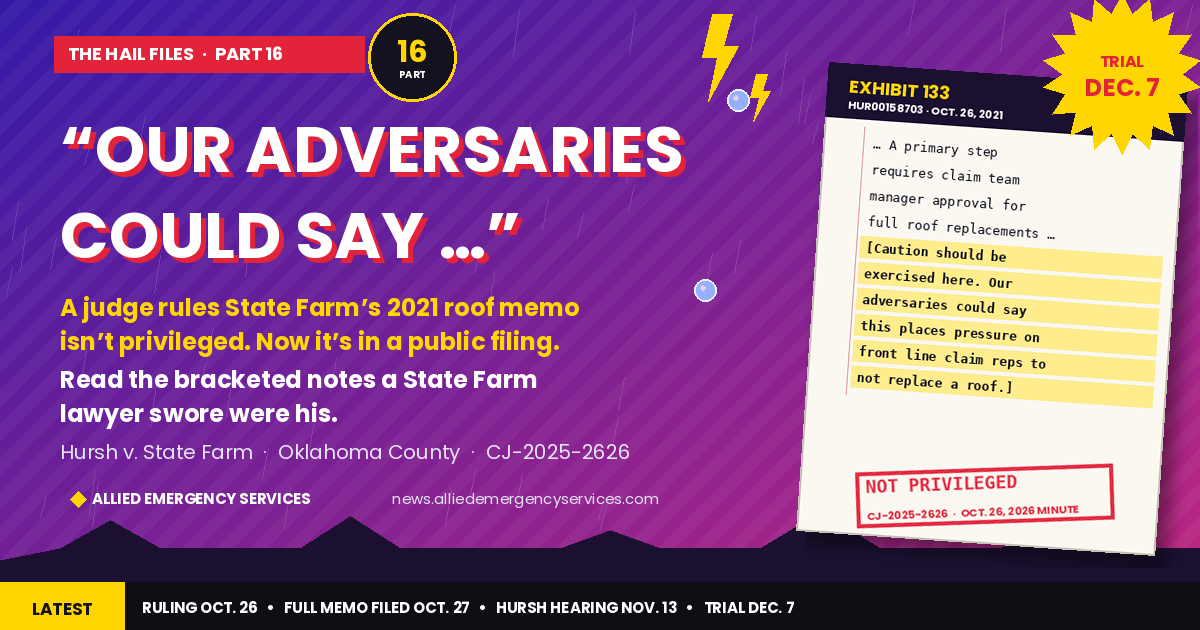
What happened, in one sentence: An Oklahoma County judge ruled October 26 that a 2021 State Farm roof-claims summary prepared for a meeting of the company’s senior executives, the document known in court as “Exhibit 133,” was “not created in anticipation of litigation” and is “not protected work-product, nor attorney-client privileged,” and the next morning the homeowners in Hursh v. State Farm filed all 19 pages publicly, including bracketed comments that a State Farm in-house lawyer has sworn were his, such as: “Our adversaries could say this places pressure on front line claim reps to not replace a roof.”
Status: Judge Amy Palumbo’s handwritten minute says State Farm “is entitled to its appellate rights” and denies its request for a stay pending appeal. The court’s written journal entry had not been posted as of the October 28 docket check. The ruling decides whether State Farm can withhold the document; it does not decide what the document proves. State Farm says the comments are its in-house lawyer’s advice on the draft’s wording and were privileged; the homeowners call them admissions. The homeowners’ allegations are allegations State Farm denies, and nothing described here has been decided unless the report says so.
Key facts
- The case: Billy & Lacy Hursh v. State Farm Fire and Casualty Co., et al., Oklahoma County District Court No. CJ-2025-2626, before Judge Amy Palumbo. A jury trial is set to begin December 7, 2026.
- The ruling: October 26, 2026. “This Court finds HUR00158701-19 was not created in anticipation of litigation and is not protected work-product, nor attorney-client privileged. State Farm is entitled to its appellate rights but the request for a stay pending appeal is denied.”
- The document: 19 pages, Bates-numbered HUR00158701-19: a State Farm claims director’s October 26, 2021 email and two drafts of a summary titled “P&C Claims | Fire Claims Roofs – Quality & Service,” prepared for State Farm’s Senior Executive Offsite, with emails between the director and two in-house lawyers. Marked “Exhibit 133” at a deposition in the companion West case.
- Where it is now: Exhibit 3 to the homeowners’ October 27 motion to enforce the court’s order on the deposition of State Farm’s chief executive, Jon Farney. It is in The Hail Files archive, complete and as filed.
- The comments: In a declaration State Farm filed October 5, one of its in-house lawyers listed eight bracketed passages in the revised draft as his own comments and said the lawyers’ role “was to apply legal judgment to particular language used in the draft.”
- The CEO deposition: Ordered September 1; agreed for October 19; moved by agreement; no new date, the homeowners say. They ask the court to require it within 15 days.
- Next: summary-judgment responses due November 2; hearing November 13; pretrial November 19; trial December 7.
“[Caution should be exercised here. Our adversaries could say this places pressure on front line claim reps to not replace a roof.]”
The bracketed note sits at the end of one bullet in a 2021 State Farm summary written for a meeting of the company’s senior executives. The bullet describes a wind and hail step rolled out to every state in January 2021: “A primary step requires claim team manager approval for full roof replacements for damage potentially caused by small hail and light wind.” In a sworn declaration State Farm filed on October 5, one of the company’s in-house lawyers identified the note as his: one of eight bracketed comments he listed as his that were still in the draft when a claims director sent it to four colleagues late on the afternoon of October 26, 2021. State Farm argued that those comments were privileged legal advice, and it spent weeks trying to claw back the versions that showed them.
On October 26, 2026, Oklahoma County District Judge Amy Palumbo ruled that they are not privileged. In a handwritten minute, she found that HUR00158701-19, the 19 pages the homeowners refer to as Exhibit 133, “was not created in anticipation of litigation and is not protected work-product, nor attorney-client privileged.” She noted that State Farm “is entitled to its appellate rights” and denied its request for a stay pending appeal. At 7:56 the next morning, the homeowners in Hursh v. State Farm filed the document in full as an exhibit to a public motion asking the judge to make State Farm’s chief executive sit for a deposition within 15 days.
What did Judge Palumbo decide?
The minute records a hearing on “State Farm’s Brief in Support of Attorney-Client Priv. & Work Product Protections to HUR00158701-19,” the brief State Farm filed October 5. Its ruling is two sentences: the finding that the document is neither work product nor privileged, and the line on appeal: “State Farm is entitled to its appellate rights but the request for a stay pending appeal is denied.” The minute is signed by the judge and by counsel for both sides.
State Farm had asked for exactly that stay. If the court found any redacted portion not privileged, its brief said, it wanted the ruling put on hold “to prevent further dissemination of State Farm’s privileged materials and allow State Farm a meaningful opportunity to seek Supreme Court review.” The brief also asked the court to strike references, in the case and in depositions, to the versions with incomplete redactions, and to order the homeowners’ lawyers to “return, sequester, or destroy” their copies of those versions. The court’s docket entry for October 26 records the brief as “DENIED AS PER JOURNAL ENTRY.”
The same docket entry lists four other motions set for October 26 as “STRICKEN TO BE RESET”: the homeowners’ motion to compel State Farm to re-produce electronically stored information, State Farm’s motion to partially reconsider the court’s September 28 de-designation order, its motion to reconsider and stay the court’s October 1 minute order, and its emergency motion to strike the homeowners’ supplement to the electronic-records motion. On October 28, a second entry says the court issued rulings on the “REMAINING MOTIONS SET 10/26/2026” under District Court Rule 4(h), which lets a judge decide motions without a hearing, “AS PER JOURNAL ENTRY.” As of the October 28 docket check, neither journal entry had been posted, so what the court decided on those motions is not yet public.
What happened in the courtroom after the ruling comes, for now, from one account. Judge Palumbo cleared the courtroom of all media for the hearing, journalist J.C. Hallman reported on October 28 in his newsletter The Rates of Wrath. According to Hallman, Hannah Whitten, one of the homeowners’ lawyers, said that State Farm’s lawyer Lance Leffel then moved for Judge Palumbo’s recusal. Whitten said State Farm had no valid ground for the request and that the homeowners argued in court that it was a delaying tactic, and she said they hope the issue is resolved quickly enough to avoid a trial delay. Three State Farm lawyers declined to comment as they left the courtroom, Hallman reported. As of the October 28 docket check, the Hursh docket shows no written recusal motion, and the October 26 minute does not mention one.
What is Exhibit 133?
It is a family of documents from one day in October 2021. According to State Farm’s October 5 brief and the declarations filed with it, a State Farm claims director sent a draft summary to the company’s law department on October 22, 2021, for legal review. Two in-house lawyers returned it on October 26 with their comments. At 5:43 that afternoon, the director emailed four colleagues “the revised version of the summary for use at the SEO,” pointing out edits the law department recommended and attaching “the draft containing their comments” so the recipients could see the reasons for the changes.
The 19 pages contain that cover email (HUR00158701), the revised draft (HUR00158702-09), the email chain between the director and the two lawyers (HUR00158710-11), and the earlier draft carrying the lawyers’ comment bubbles and tracked changes (HUR00158712-19). Every page is stamped “Confidential Produced Pursuant to Protective Order.” The copy the homeowners filed is the version State Farm originally produced and later clawed back, so some passages, including most of the lawyers’ emails, are still covered by boxes reading “Redacted – AC.” The minute does not say whether or when State Farm must produce the document without them.
The summary itself is titled “P&C Claims | Fire Claims Roofs – Quality & Service” and dated October 26, 2021. “SEO” stands for Senior Executive Offsite. The homeowners say State Farm’s senior claims executive “confirmed under oath that SEO goes to the CEO, CFO, and all senior executives at State Farm”; State Farm’s filings reviewed for this report do not say who attended the 2021 offsite. An October 9 agreed order in Hursh lists “SEO (Senior Offsite Executive) meetings” among the subjects State Farm agreed to search for documents on before its chief executive’s deposition.
According to a declaration from State Farm’s e-discovery vendor, filed with State Farm’s October 5 brief, the documents were produced in West v. State Farm in June 2026 and in Hursh in July 2026 “with the same privilege claims.” On September 17, at a deposition of State Farm’s senior claims executive in West, the homeowners’ lawyers marked the cover email and revised draft (WEST00158701-09, according to State Farm) as Exhibit 133; the label has since been used for the whole 19-page family. By the homeowners’ account, they questioned the executive about the bracketed comments “for seventeen pages” without a privilege objection. State Farm says its lawyer notified them during the deposition that the exhibit “might contain inadvertently disclosed privileged communications and information” and that State Farm was investigating; the homeowners say that statement came only after the questioning ended. State Farm sent clawback letters, in West on September 22 and in Hursh on September 29. Its October 5 brief explained how its reviewers had missed the comments: the director had deleted the colleague’s comment bubbles and most of the lawyer’s in-line comments before sending the revised draft, so that draft “viewed in isolation does not clearly attribute the legal advice to an attorney,” and in one instance a deleted comment “remained visible but appeared to be struck through.” (Part 8 covers the clawback; Part 10 covers the October privilege fight.)
What do the bracketed comments say?
In paragraph 12 of his declaration, the in-house lawyer listed, by page and position, eight bracketed passages in the revised draft that he said were his comments. Here they are in the order they appear, each with the text it sits beside. Strikethrough shows the draft’s tracked deletions.
1. Manager approval for full roof replacements (HUR00158703). Under the heading “What did we change in our wind/hail quality claim handling?”, the revised draft reads: “Wind/Hail quality tactics action steps were implemented in Jan. 2021 for all states after a 6-month approach in the state of Texas. A primary tactic step requires claim team manager approval for full roof replacements for damage potentially caused by small hail and light wind. [Caution should be exercised here. Our adversaries could say this places pressure on front line claim reps to not replace a roof.]”
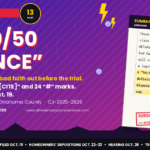
2. The total-roof ratio (HUR00158704). Under “Total Roof to Partial Roof Trends,” after a sentence saying improved quality claim handling “is being realized over time” in the proportion of total roof replacements to partial replacements or repairs: “[Accuracy is not necessarily improved by a lower TR to PRR ratio. If the facts of each TR claim support a TR, then our accuracy needs no improvement.]” The draft then gives the trend: “From April to Dec 2020, the rate of Total Roof Replacements to Partial Roof replacements was 3.21 to 1. From Jan to Sept 2021, the rate of Total Roof Replacements to Partial Roof replacements is 1.95 to 1.” It adds that the analysis “does not account for the severity of events and included catastrophe and non-catastrophe roof payments.”
3. Claims closed without payment (HUR00158704). Under “Wind & Hail Loss Trends (September 2021)”: “YOY R12 Cat and NCAT Wind Closed Without Payment (CWP) to Reported ratio is up 17 points (39.5), and R12 Cat and NCAT Hail CWP to Reported Ratio is up 13 points (39.3). [Does this suggest that CWP is a positive – that we consider this improvement? A higher CWP should be considered evidence of greater accuracy – the implication is that we are intentionally reducing indemnity dollars and celebrating greater numbers of CWP.]”
4. “A historical 2020” (HUR00158704). On a partnership with agency leadership formed “following a historical 2020”: “[Some context necessary here. Why was it “historical”? COVID?]”
5. The agents’ video (HUR00158705). After the draft says a “Wind/Hail Quality Claim Handling video was released to agents and their teams in May 2021”: “[Question to FCC – did we review the script/video?]”
6. Industry standards (HUR00158705). On meetings in which claims leadership educated agents on “industry standards of reparability”: “[Again caution – industry standards are not our standard of performance. Paying what we owe on each claim is.]”
7. What customers were saying (HUR00158707). In the revised draft, three bullets under “Customers are telling us” are rewritten in tracked changes: “They do not know want more information on what to expect throughout the entire claim process”; “They are confused by the would like more information on the inspection options to resolve their claim”; and “Theyre is a lack of ongoing would like more frequent communication and follow-up throughout the life of the claim.” Below them is a bracketed comment, struck through: “[These bullets potentially implicate Unfair Claims Practices Act, potentially. Can we claim Self-Evaluative Privilege on this document, and if so, let’s label this accordingly].” The homeowners’ motion quotes the first sentence; the page image shows the whole comment and the strikethrough.
8. New wind-damage guidance (HUR00158708). After new operations-guide language on scattered wind damage and an upcoming survey of “claim files using engineers and those with appraisals”: “[Has FCC reviewed and approved this language?]”
The earlier draft, which the lawyer’s declaration says carries “all the comments” from both lawyers “in comment bubbles, redline, and in-line text,” shows two more passages that are redacted in the revised one. After a bullet stating that “Industry Best FRR on light wind and small hail averages a 5-10% frequency, therefore an internal quality improvement opportunity of 53-58% for light wind and 80-85% for small hail (Source: Accenture Consulting Services),” a bracketed comment reads: “[“Industry Best” does not necessarily mean replacing fewer roofs. Quality improvement should not be measured by reducing number of roof replacements. Other measures, such as estimates more closely matching reinspections, should be the measure. This language is similar to what we’ve seen with indemnity metrics on Auto side. We measure quality based on the facts of each individual claim, not based on how we do versus industry and especially not based on totalling fewer roofs.]” (HUR00158712). And on the next page, after “Our focus is on improving towards with industry recognized standards for causation and repair/replace estimates”: “[Our focus should be on improving accuracy of our estimates and damage assessments, not on getting closer to industry averages. We assess damage based on mertis of each claim.]” (HUR00158713, as written).
| What the draft says | The bracketed comment beside it |
| A primary step “requires claim team manager approval for full roof replacements for damage potentially caused by small hail and light wind.” | “Caution should be exercised here. Our adversaries could say this places pressure on front line claim reps to not replace a roof.” |
| Total roof replacements to partial replacements: 3.21 to 1 in April-December 2020; 1.95 to 1 in January-September 2021. | “Accuracy is not necessarily improved by a lower TR to PRR ratio.” |
| Wind claims closed without payment, as a share of reported claims, up 17 points; hail up 13 points. | “Does this suggest that CWP is a positive – that we consider this improvement? A higher CWP should be considered evidence of greater accuracy – the implication is that we are intentionally reducing indemnity dollars and celebrating greater numbers of CWP.” |
| Claims leaders educated agents on “industry standards of reparability.” | “Again caution – industry standards are not our standard of performance. Paying what we owe on each claim is.” |
| “Customers are telling us”: they do not know what to expect; they are confused by the options; there is a lack of ongoing communication (rewritten in tracked changes). | Struck through: “These bullets potentially implicate Unfair Claims Practices Act, potentially. Can we claim Self-Evaluative Privilege on this document …” |
| Earlier draft: “Industry Best FRR” averages “a 5-10% frequency” (source: Accenture). | “‘Industry Best’ does not necessarily mean replacing fewer roofs. Quality improvement should not be measured by reducing number of roof replacements.” |
Who wrote the comments, and what does State Farm say they mean?
State Farm says its lawyers did, and that is the basis of its privilege claim. The in-house lawyer’s declaration says he and a colleague “reviewed the draft memorandum and provided our legal advice within the memorandum itself as comments in Word comment bubbles, Word track changes, and as in-line comments primarily in brackets.” The colleague used comment bubbles, he says, while he worked primarily in tracked changes and “in-line comments that I bracketed and put in red.” According to State Farm’s brief, the revised draft the director sent that afternoon “still included certain legal advice and explicit comments from the attorneys.” This report does not name the State Farm employees in the emails or the declarations.
The lawyer also swore to the limits of the lawyers’ role: neither he nor his colleague, he said, was responsible for setting the underlying claim practices or the memo’s business objectives. “Our role was to apply legal judgment to particular language used in the draft.” The comments covered by State Farm’s redactions, his declaration says, “reflect that legal analysis and advice. They do not establish or direct the underlying claim handling practices.” State Farm’s brief says its redactions “do not conceal the underlying memorandum, which State Farm has produced.” In an October 23 reply, State Farm said the redactions “cover legal advice from counsel and recitations of that legal advice,” and that the two drafts “are near duplicate documents—they are not the same.”
The homeowners read the same comments as proof. In their October 23 response they wrote that “State Farm leadership was circulating a document admitting that its tactics implicate improper reductions of indemnity and potential Unfair Claims Settlement Practices Act violations.” The memo, they argued, was “an ordinary business document,” a set of executive talking points written before any lawyer saw it, and State Farm waived any protection by producing it repeatedly with inconsistent redactions. They also invoked the crime-fraud exception. The judge’s minute does not say which arguments she accepted.
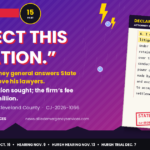
Several of the comments are phrased as cautions (“Our adversaries could say,” “the implication is”); others are questions, such as “Why was it “historical”? COVID?” and “Has FCC reviewed and approved this language?” The October 26 ruling addressed only privilege and work product, not what the comments show. State Farm has long denied the homeowners’ central accusation. Opposing their first motion to compel, in October 2025, it told the court that it “never attempts to arbitrarily reduce total roof replacements or indemnity payments to meet industry standards,” a statement the homeowners now set against the memo.
What does the memo itself say about roofs, agents and contractors?
The draft, apart from the comments, is a status report on what it calls quality claim handling in wind and hail roof claims. Under “State Farm and Industry Trends,” it says: “State Farm has been trending significantly above the industry the percentage of roof replacements for small hail and light wind, meaning we have been totaling more roofs than the other carriers across the insurance industry.” It gives a Texas baseline: “Analysis of 3-year data validated Full Roof Replacements were paid at 63% frequency for Severity 3 Wind and 90% frequency for Severity 3 Hail.”
It also reports what agents were saying, and it frames their input critically: agents, it says, have been engaging in claim decisions “separate from” a State Farm policy under which “State Farm prohibits [agents] from attempting to influence the amount or timing of claim payment.” “General sentiments gathered from thousands of conversations with agents,” it says, revolve around five themes, including: “Agents prefer State Farm replace roofs instead of repair based on the value of the State Farm policy they sold to customers and remove the disruption to their agency and loss of customers related to the roofing coverage decisions”; “Neighbor’s insurance companies replace roofs, yet State Farm did not identify covered damage or covered damage is less than the deductible making it a difficult conversation for the agent”; “Roofing contractors are negatively portraying State Farm to customers and agents impacting the State Farm brand in the local markets; State Farm agents indicate “reputable roofing contractors” do not agree with our damage investigation and evaluation”; and “In some cases, findings of damage or the scope of damage changes from the original decision when engineers are engaged or appraisal provision pursued, creating a lack of confidence.”
The memo presents its measures as accuracy, and it says so in State Farm’s own terms. Its 2021 targeted surveys found “94-95% accuracy in scoping to repair or replace” and that “5-6% on totaling roofs is not supported in the claim file indicating opportunity to improve.” It reports that “4.5% of the roofs YTD move from a CWP to Total Roof paid status,” adding that such a change “may not indicate that the initial call was incorrect.” And it repeats the company’s guidance to adjusting staff: “We are committed to diligently investigating, reasonably evaluating and acting promptly to resolve the claim to ensure the policyholders obtain all benefits available and provided by the insurance policy.”
Why does the CEO’s deposition matter now?
Because the homeowners’ motion uses this document to argue that they need the deposition before pretrial. On September 1, Judge Palumbo denied State Farm’s motion to quash the deposition of its chief executive, Jon Farney, ordering that it take place within 30 days and be limited to four hours, with the parties able to request more time if needed. An agreed order entered October 9 set one deposition for both Hursh and West, to be completed “on October 19, 2026, in Bloomington, Illinois, or on any other date mutually agreed to by the Parties,” and committed State Farm to search for documents involving Farney about the “Fix Profit Task Force; Fire Model Enhancement and SEO (Senior Offsite Executive) meetings” and produce them a week ahead.
The deposition did not happen. “Thereafter, the parties agreed to move the deposition from October 19, 2026,” the homeowners’ October 27 motion says, and “despite numerous emails discussing resetting the deposition before this case goes to trial,” they “have been unable to receive any new dates.” They ask the court, without a hearing, to order that Farney “must be deposed in fifteen (15) days,” so they can add his testimony to their responses to State Farm’s and the agent’s summary-judgment motions, which are due November 2 and set for hearing November 13.
The motion’s argument rests on the memo. “Farney was presented with information that State Farm was intentionally reducing indemnity, putting pressure on front line claim reps not to replace roofs, and engaging in Unfair Settlement Practices Act Violations, yet did nothing to stop State Farm from engaging in these tactics,” it says, and the homeowners “are entitled to ask the CEO under oath why he failed to prevent these tactics from being implemented.” That is the homeowners’ allegation. State Farm has not filed a response to the motion as of the October 28 docket check, and its filings reviewed for this report do not say whether Farney saw the 2021 summary.
Is Exhibit 133 public now?
It is in the public court record. The homeowners attached it, unsealed, to their October 27 motion, and The Hail Files publishes public court filings complete and as filed. But each page still carries the protective-order stamp, and its confidentiality status is a separate question from privilege. The protective order in the case says it “shall not be deemed a violation” for counsel to disseminate designated documents “at deposition or as part of their filings with the Court,” and that such material “shall not lose its ‘Confidential’ status through such use.” It also says that material “specifically designated as ‘Confidential'” shall, “when filed with the Court, be submitted in a sealed envelope.”
The court’s September 28 ruling on the homeowners’ motion to de-designate lifted the confidential label from 11 documents, and HUR00158701-19 was not among those it listed. State Farm’s October 23 reply describes that ruling as “declining to de-designate” the document; the homeowners’ October 23 response described it as a document “which this Court is currently reviewing in-camera.” The October 26 minute addresses privilege and work product. As of the October 28 docket check, the docket shows no motion by State Farm to seal the October 27 filing.
What does State Farm say about the case?
State Farm denies the homeowners’ claims and says their bad-faith case should be decided on their own claim file, not on company-wide documents. On October 27 it filed a notice in Hursh pointing to an October 22 ruling by U.S. District Judge Claire Eagan in Tulsa, in Moore v. State Farm (N.D. Okla. No. 25-CV-0417-CVE-JFJ), which granted State Farm summary judgment on a homeowner’s bad-faith claim over a partly denied wind and hail claim. Judge Eagan held that “State Farm relied on a legitimate coverage dispute as a basis to partially deny plaintiff’s claims for wind and hail damage.” State Farm’s notice asks Judge Palumbo to adopt that analysis at the November 13 hearing, arguing that the homeowners’ “proposed institutional evidence is likewise irrelevant here because Plaintiffs cannot connect it to the facts of their individual claim file.”
The Moore court did not weigh evidence of an alleged company-wide scheme on its merits. The plaintiff there had not pleaded one, and the exhibits she offered to prove it came from other State Farm cases and had not been produced in discovery, so Judge Eagan did not consider them. State Farm’s own notice in West acknowledges that Judge Eagan “did not consider the scheme allegations urged here due to discovery failures by counsel for Plaintiff.” The breach-of-contract claim in Moore “remains pending for trial.”
On the privilege fight, State Farm’s position was that the homeowners should not have used the document while its privilege claim was pending. Its October 23 reply argues that once State Farm claimed privilege, Oklahoma law, 12 O.S. § 3226(B)(5)(b), required the homeowners to return, sequester or destroy it and barred them from using or disclosing it until the claim was resolved, and that filing it under seal did not cure that. The trial court has now rejected State Farm’s privilege and work-product claims; the minute recognizes its appellate rights and denies a stay.
What happens next?
- The journal entries. The written order behind the October 26 docket entry should set out the privilege ruling. The one behind the October 28 entry should show what the court decided on the “remaining motions” set for October 26, which included State Farm’s motion to reconsider the October 1 order that extended its corporate representative’s deposition.
- An appeal. The minute recognizes State Farm’s appellate rights but denies a stay. As of the October 28 docket check, the Hursh docket does not show whether State Farm has asked a higher court to intervene.
- The recusal question. If State Farm files a written recusal motion, it would appear on the docket; none had by the October 28 check. Whitten said that once one is filed, “everything will go on a kind of stay for right now,” Hallman reported.
- The CEO deposition. The homeowners’ motion asks for a ruling without a hearing and a deposition within 15 days.
- November 2: the homeowners’ responses to the two summary-judgment motions. On October 26 they applied to file unredacted versions under seal, so redacted public versions may follow on the docket.
- November 13: hearing on four motions listed in State Farm’s October 22 notice of hearing, including both summary-judgment motions.
- November 19: pretrial conference. December 7: trial.
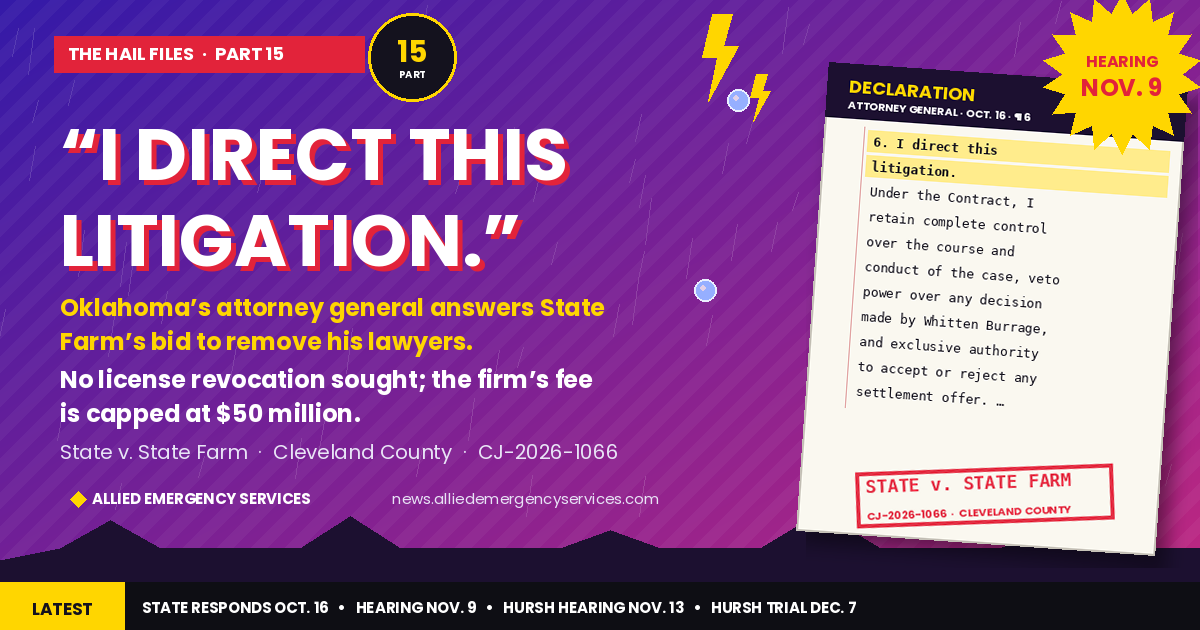
In the companion case, West v. State Farm (Comanche County), October 22 orders by Judge Grant Sheperd are docketed as requiring the court “TO RENDER A DECISION NO LATER THAN 10-30-2026” and as continuing the trial to February 2027, with a pretrial conference January 14. According to the Cleveland County docket, the attorney general’s separate lawsuit has a hearing November 9 on State Farm’s motion to disqualify the State’s lawyers (Part 15). Trial Watch tracks every date.
What is the timeline?
- October 22, 2021: A State Farm claims director sends the draft offsite summary to the law department for review (State Farm’s October 5 brief).
- October 26, 2021: The in-house lawyers return their comments; at 5:43 p.m. the director sends four colleagues “the revised version of the summary for use at the SEO.”
- June and July 2026: State Farm produces the documents in West and then in Hursh (State Farm’s e-discovery vendor’s declaration).
- September 1, 2026: Judge Palumbo denies State Farm’s motion to quash the CEO’s deposition.
- September 17, 2026: The cover email and revised draft are marked Exhibit 133 at a deposition in West.
- September 22, 2026: State Farm’s clawback letter in West.
- September 28, 2026: The court de-designates 11 documents; this one is not on the list.
- September 29, 2026: State Farm’s clawback letter in Hursh.
- October 5, 2026: State Farm’s privilege brief, with the in-house lawyer’s declaration.
- October 9, 2026: An agreed order sets the CEO’s deposition for October 19.
- October 23, 2026: The homeowners’ response; State Farm’s replies.
- October 26, 2026: The ruling: not work product, not privileged, no stay.
- October 27, 2026: The homeowners’ motion to enforce, with the full document; State Farm’s notice of the Moore ruling.
- October 28, 2026: A docket entry records Rule 4(h) rulings on the remaining October 26 motions.
- November 2, 13 and 19; December 7, 2026: responses, hearing, pretrial, trial.
What does this mean for Oklahoma homeowners and contractors?
The ruling is about evidence, not liability. It rejects State Farm’s claim that the document and its comments are privileged or work product; it does not decide what a jury will see or what the document proves. It does not mean State Farm underpaid the Hurshes or anyone else. State Farm’s position is that the comments are a lawyer’s advice on wording, not a description of company practice; the homeowners say they show the company knew what its program implied.
For people who have had a roof claim denied or reduced, the memo is a rare look at how State Farm measured its own wind and hail claim handling in 2021: the manager sign-off for full roof replacements on small hail and light wind, the falling ratio of total to partial roof replacements, the rising share of claims closed without payment, and agents relaying that “reputable roofing contractors” disagreed with State Farm’s damage findings. The full document is linked below, so anyone can read it and decide for themselves.
Read the documents
The homeowners’ October 27 motion to enforce the CEO-deposition order (32 pages; Exhibit 3 is HUR00158701-19, the full Exhibit 133 document; with the September 1 minute, the October 9 agreed order and the October 26 minute) · Judge Palumbo’s October 26 minute · State Farm’s October 5 privilege brief, with the in-house lawyer’s declaration · The homeowners’ October 23 response on the privilege brief (66 pages) · State Farm’s October 23 reply · The September 28 de-designation minute · State Farm’s October 22 notice of the November 13 hearing · State Farm’s October 27 notice of the Moore ruling · State Farm’s West notice, with the full Moore opinion · Search the full archive.
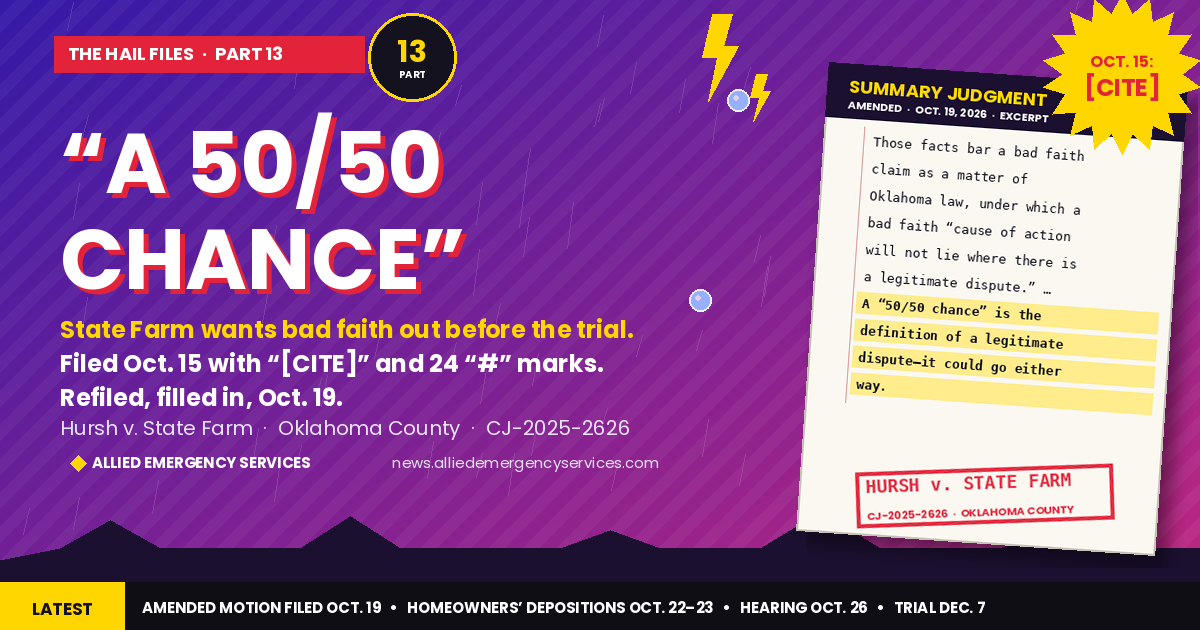
More from The Hail Files: Part 8: the Exhibit 133 clawback · Part 10: ‘Legal Implications of Language’ · Part 13: the summary-judgment motions · Part 14: ‘Higher Rewards’ · the trial guide · Get an email when new documents are filed.
Frequently asked questions
Exhibit 133 is the exhibit number the homeowners’ lawyers gave, at a September 17, 2026 deposition in West v. State Farm (Comanche County No. CJ-2025-135), to a State Farm cover email and draft summary (numbered WEST00158701-09, according to State Farm). The label is now used for the full 19-page family, Bates-numbered HUR00158701-19 in Hursh v. State Farm (Oklahoma County No. CJ-2025-2626) and WEST00158701-19 in West. It contains a State Farm claims director’s October 26, 2021 email, two drafts of a summary titled “P&C Claims | Fire Claims Roofs – Quality & Service” prepared for State Farm’s Senior Executive Offsite, and emails with two in-house lawyers. The drafts include bracketed comments that one of the lawyers identified in an October 5, 2026 sworn declaration as his legal comments. On October 27, 2026, the Hursh homeowners filed the full HUR00158701-19 as Exhibit 3 to a public motion.
No. On October 26, 2026, Oklahoma County District Judge Amy Palumbo ruled in Hursh v. State Farm (No. CJ-2025-2626): “This Court finds HUR00158701-19 was not created in anticipation of litigation and is not protected work-product, nor attorney-client privileged. State Farm is entitled to its appellate rights but the request for a stay pending appeal is denied.” State Farm had argued that the bracketed comments were its in-house lawyers’ privileged legal advice and had asked for a stay so it could seek Oklahoma Supreme Court review. As of the October 28, 2026 docket check, the court’s written journal entry had not been posted.
The comments in the revised draft of State Farm’s October 26, 2021 offsite summary include: “[Caution should be exercised here. Our adversaries could say this places pressure on front line claim reps to not replace a roof.]”, beside a step requiring claim team manager approval for full roof replacements for small hail and light wind; “[Accuracy is not necessarily improved by a lower TR to PRR ratio…]”, beside a drop in the total-to-partial roof replacement ratio from 3.21 to 1 to 1.95 to 1; “[Does this suggest that CWP is a positive – that we consider this improvement? A higher CWP should be considered evidence of greater accuracy – the implication is that we are intentionally reducing indemnity dollars and celebrating greater numbers of CWP.]”, beside rises in claims closed without payment; “[Again caution – industry standards are not our standard of performance. Paying what we owe on each claim is.]”; and a struck-through note: “[These bullets potentially implicate Unfair Claims Practices Act, potentially. Can we claim Self-Evaluative Privilege on this document, and if so, let’s label this accordingly].” The homeowners call them admissions; State Farm calls them legal advice.
State Farm says its in-house lawyers did. In a sworn declaration filed October 5, 2026 in Hursh v. State Farm (Oklahoma County No. CJ-2025-2626), one of the company’s in-house lawyers said he and a colleague reviewed the draft between October 22 and October 26, 2021, and gave their advice “as comments in Word comment bubbles, Word track changes, and as in-line comments primarily in brackets,” and he listed eight bracketed passages in the revised draft as his. He said the lawyers’ role “was to apply legal judgment to particular language used in the draft” and that the comments “do not establish or direct the underlying claim handling practices.” The court ruled on October 26, 2026 that the document is not privileged.
It is in the public court record. The Hursh homeowners attached HUR00158701-19, unsealed, as Exhibit 3 to their October 27, 2026 motion to enforce the court’s order on the deposition of State Farm’s chief executive, the day after Judge Amy Palumbo ruled it is not privileged. Each page still carries a stamp reading “Confidential Produced Pursuant to Protective Order,” and the protective order says designated material filed with the court is to be submitted sealed; the court’s September 28, 2026 de-designation ruling did not list this document. As of the October 28, 2026 docket check, State Farm had not moved to seal the filing. The Hail Files archive has the filing complete and as filed.
A judge has ordered it, but it has not happened. On September 1, 2026, Judge Amy Palumbo denied State Farm’s motion to quash the deposition of chief executive Jon Farney in Hursh v. State Farm (Oklahoma County No. CJ-2025-2626). An October 9, 2026 agreed order set a single four-hour deposition for Hursh and West on October 19 in Bloomington, Illinois, “or on any other date mutually agreed.” The homeowners say the parties agreed to move it and they have not received new dates; on October 27, 2026 they asked the court to order the deposition within 15 days. As of the October 28, 2026 docket check, State Farm had not responded and the court had not ruled on that motion.
Hursh v. State Farm (Oklahoma County District Court No. CJ-2025-2626) is set for a jury trial beginning December 7, 2026, before Judge Amy Palumbo, with the homeowners’ responses to two summary-judgment motions due November 2, a hearing November 13 on four motions listed in State Farm’s October 22 notice of hearing, including both summary-judgment motions, and a pretrial conference November 19. The homeowners’ lawyer Hannah Whitten has said, according to an October 28 report in the newsletter The Rates of Wrath, that State Farm asked the judge to recuse after the October 26 ruling; as of the October 28, 2026 docket check, no written recusal motion had been filed. The companion case, West v. State Farm (Comanche County No. CJ-2025-135), was continued to February 2027.
About this report. Except where a news outlet is named, everything above is drawn from public court records, chiefly in Hursh v. State Farm Fire and Casualty Co. (Oklahoma County No. CJ-2025-2626): Judge Amy Palumbo’s October 26, 2026 minute; the homeowners’ October 27, 2026 motion to enforce and its four exhibits, including HUR00158701-19 in full; State Farm’s October 5, 2026 privilege brief and the declarations filed with it; the homeowners’ October 23, 2026 response and State Farm’s October 23 replies; the homeowners’ October 23, 2026 response on partial reconsideration, with the September 28, 2026 minute; State Farm’s October 27, 2026 notice of supplemental authority and its October 23, 2026 notice in West v. State Farm (Comanche County No. CJ-2025-135) with the October 22, 2026 opinion in Moore v. State Farm (N.D. Okla. No. 25-CV-0417-CVE-JFJ); the October 26, 2026 sealing applications; State Farm’s October 22, 2026 notice of hearing; the Hursh and West dockets as read October 28, 2026; and, for the attorney general’s case, the Cleveland County docket as described in Part 15. The filings are image scans; every quotation from the 2021 summary and its comments was checked against the page images, and the strikethrough and tracked changes are shown as they appear there. The account of the recusal request is Hannah Whitten’s, as reported by J.C. Hallman in The Rates of Wrath on October 28, 2026; news searches on October 28 found no other published report on the ruling. Apart from case names, individuals named in the filings other than the judges, the lawyers of record and State Farm’s chief executive are not named here. Where a filing makes an allegation, this report attributes it; nothing here is a finding by any court unless the report says so.
About the host. Allied Emergency Services is a licensed storm-damage restoration contractor serving Illinois, Wisconsin, Indiana and Michigan — not a law firm, insurance adjuster or public adjuster, and this report is not legal or insurance advice. We inspect, document, provide insurance-ready repair estimates and complete repairs; coverage decisions always belong to you and your insurer. Founded 2015; in the building trades since 1999; Illinois-licensed. 24/7: (800) 792-0212.
⚡ Storm or Roof Damage? Get a FREE Estimate
Text ESTIMATE to (844) 907-2546
Or call (800) 792-0212 for 24/7 emergency response
AI-powered • No obligation • Licensed IL & WI
Storm damage? Start with the documentation
Allied Emergency Services — IL-Licensed Storm Damage Restoration Contractor
Founded 2015, in the building trades since 1999. Allied inspects and documents storm damage, writes the scope and estimate, and does the repairs. We do not adjust or negotiate insurance claims — that is the job of your insurer, a licensed public adjuster, or an attorney. IICRC-certified, EPA Lead-Safe, IL Licensed Roofing Contractor #104.019029. 24/7 emergency response.
How the storm-damage insurance claim process works →Free inspection within 24 hours · No obligation · Photo-documented findings you can share with your insurer
Attorneys: forensic storm damage documentation & construction expert consultation for counsel →