⚡ Storm or Roof Damage? Get a FREE Estimate
Text ESTIMATE to (844) 907-2546
Or call (800) 792-0212 for 24/7 emergency response
AI-powered • No obligation • Licensed IL & WI
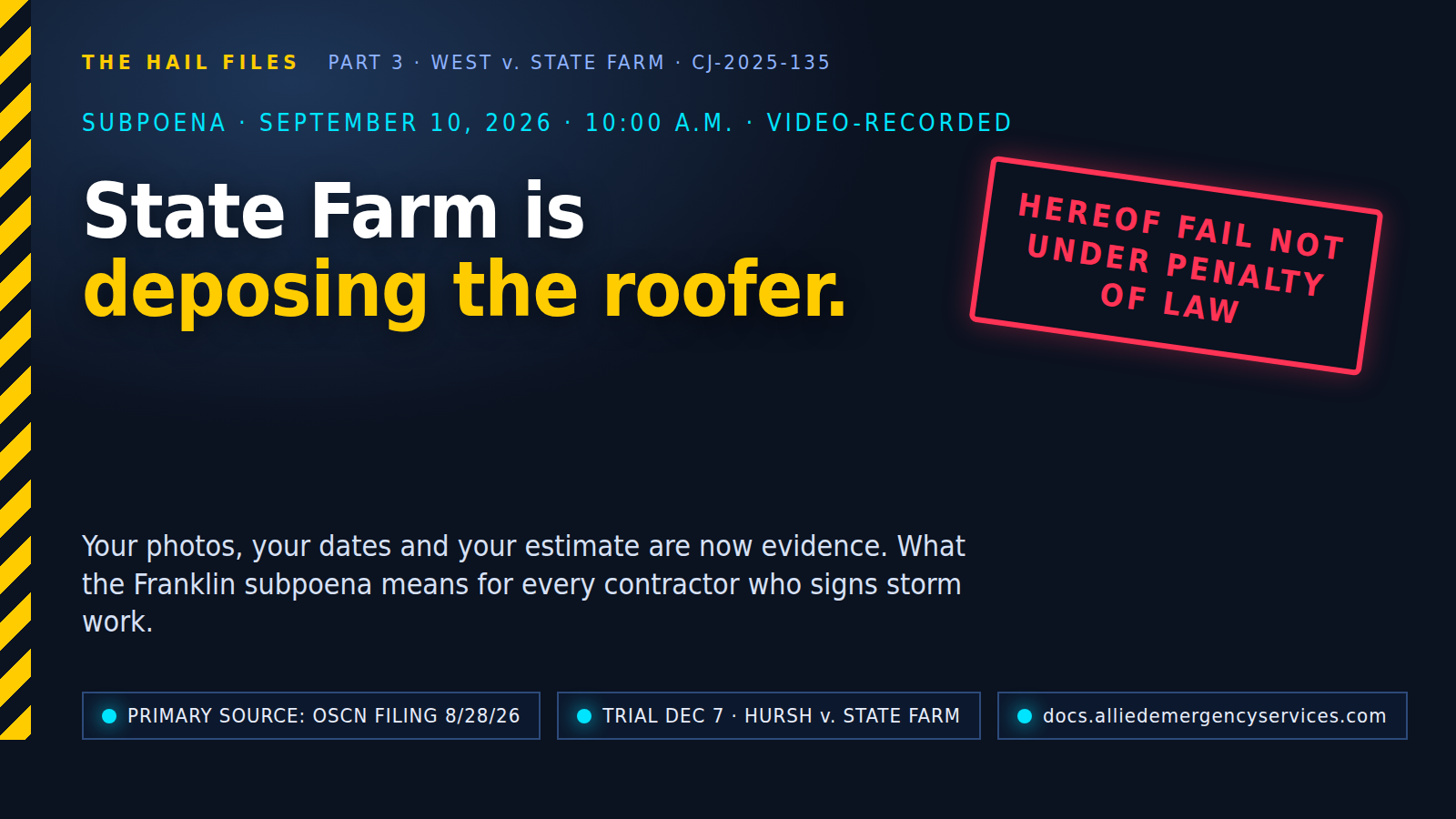
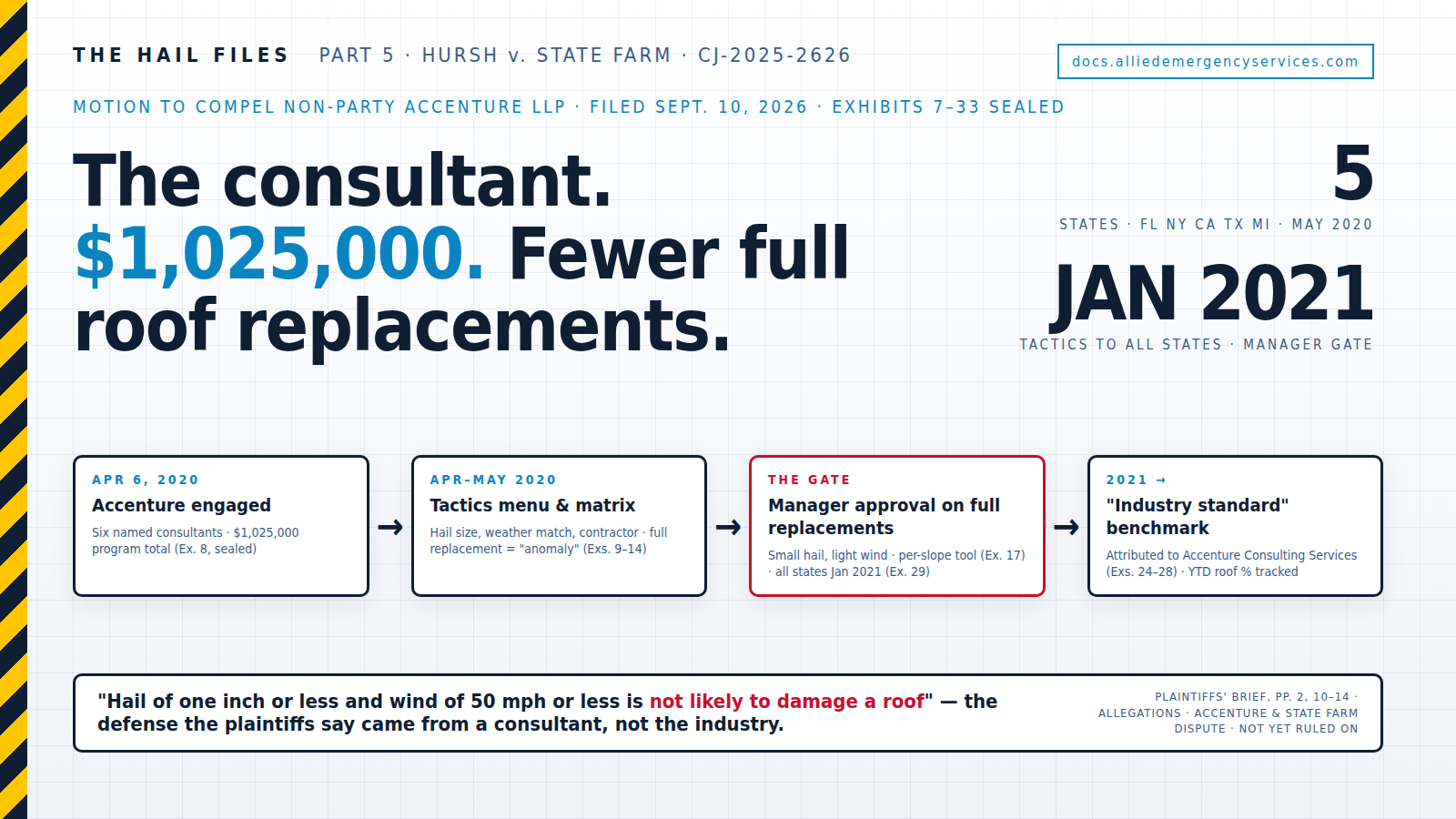
TL;DR — On September 10, the Hursh plaintiffs asked Judge Amy Palumbo to force Accenture LLP, the global consulting firm, to turn over its files on State Farm’s wind-and-hail roof program. The public, redacted version of that motion — 89 pages, now in The Hail Files — is the first document in this litigation to lay out, in the plaintiffs’ words, who allegedly designed the program that every roofer has been arguing against on a driveway since 2021. According to the motion: an April 2020 Accenture engagement with a $1,025,000 program total; a tactics menu drafted by an Accenture consultant; a claim-type matrix that treated a full roof replacement as an “anomaly”; a five-state indemnity program that “defined success as fewer full roof replacements”; a manager-approval gate on full replacements for small-hail and light-wind claims, rolled out to all states in January 2021; and an Accenture consultant working from a State Farm email address. Accenture has produced nothing, says it was never properly served, and says it does not understand terms the plaintiffs say it wrote. State Farm disputes the plaintiffs’ account. Nothing has been ruled on. Read it and decide for yourself.
What the plaintiffs filed
The motion is a request that the court overrule Accenture’s objections to a subpoena duces tecum — a subpoena for documents — served on Accenture’s Oklahoma City office on July 2, 2026, and order production within fourteen days, with a privilege log, a sworn statement of what was searched, and fees. Twenty pages of brief, the subpoena itself, Accenture’s July 17 objections, two prior orders compelling State Farm, and the Oklahoma Supreme Court’s June 23 refusal to intervene are public. Exhibits 7 through 33 — the Accenture decks, emails and analyses the brief quotes — are filed under seal, and the brief’s quotations from them are blacked out in the public copy. What follows is what survives redaction, attributed to the plaintiffs’ brief throughout; the underlying documents are not public and the court has not ruled on any of it.
The eleven requests, reproduced in full in the archive, ask for Accenture’s work on what the subpoena calls State Farm’s “Fire Model Enhancement – Wind/Hail,” its “Wind and Hail Fire Model Enhancement Team,” its “Hail Focus Initiative”; the “industry standards” or benchmarks on full roof replacements that Accenture relied on or produced; the data and methodology behind those benchmarks; the contracts and scopes of work; documents “referring to full roof replacements as the biggest bucket of opportunity”; and documents on “potential reductions in indemnity on full roof replacements.” All from January 1, 2018 to the present.
The “industry standard” every roofer has heard
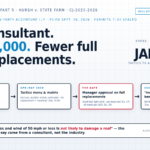
The brief opens with the sentence contractors will recognize. State Farm, it says, has defended its wind/hail tactics in open court by asserting that “industry data” and “industry studies” show that hail of one inch or less and wind of 50 miles per hour or less is “not likely to damage a roof.” In a related Oklahoma County case, Black v. State Farm, the brief quotes Judge Mai’s response from the bench: “if you are going to talk about industry standards, you should produce that or else you won’t be able to talk about it, period.”
The plaintiffs’ theory is that the “industry standard” was not an industry standard at all but a benchmark Accenture supplied — a target rate of full roof replacements that State Farm’s own materials, they say, attribute “on the face of the documents to Accenture Consulting Services.” The brief says State Farm’s Wind/Hail Fire Model Enhancement Team leader, Nicole Manduca, testified in her June 23 deposition in West that Accenture “developed the theory” and that the phrase “biggest bucket of opportunity” came from Accenture. That testimony is Exhibit 7. It is sealed.
What the brief says Accenture built, step by step
Each of the following is the plaintiffs’ characterization of a sealed exhibit, as stated in the public brief.
The engagement. An Accenture deck dated April 6, 2020 defines the workstream, names six Accenture personnel to the team — including Andrew Larsen on “Fire” (State Farm’s term for its homeowners line) — and lists a program total of $1,025,000 (Exhibit 8).
The tactics menu. On April 29, 2020, Larsen circulated a document the brief describes as identifying tactics by claim type, jurisdiction, contractor, damage identification, hail size, and weather/loss matching (Exhibit 9). On May 11 he sent a further document to Manduca (Exhibit 10).
Normal versus anomaly. The brief’s own heading: “Accenture Classified Partial Roof Outcomes as Normal and Full Roof Replacement as an Anomaly.” It describes a claim-type matrix defining the expected outcome and the anomalies to be identified against it, with the stated normal condition including “a higher likelihood of closing the claim without payment” (Exhibits 12–14).
The price. “Accenture Priced Full Roof Replacement Reduction in Tens of Millions of Dollars” (Exhibits 15–16). Elsewhere the brief says an Accenture page “quantifies a $169 million Texas” figure — the label is redacted.
The gate. “Accenture Recommended Management Approval of Full Roof Replacements,” and, the brief says, built the file-level mechanics, including a tool “the claim specialist must use for each damaged slope” (Exhibit 17). State Farm’s materials, per the brief, state that the wind/hail quality tactics were implemented in January 2021 in all states after a six-month approach in Texas, “with team-manager approval required for full roof replacements on damage potentially caused by small hail and light wind.” The Hurshes’ claim, the brief says, was handled under those rules (Exhibit 29).
Five states. A May 20, 2020 status deck “places the Fire wind/hail work inside a five-state program across Florida, New York, California, Texas, and Michigan” (Exhibit 18); a May 29 deck states the Texas pilot’s objective (Exhibit 19). The brief’s heading: “Defined Success as Fewer Full Roof Replacements.”
The handoff. On July 30, 2020, Accenture’s Michael Massa emailed the final deliverables package to State Farm’s Wensley J. Herbert, Michael Arnold and Schuyler Schupbach (Exhibit 20). The attached deck, per the brief, assigned execution accountability to State Farm’s operations vice presidents and proposed a continuing control system — measurement reports, claim prioritization, early-signal monitoring, root-cause analysis to define new tactics (Exhibit 21). Massa, the brief says, “used an assigned State Farm email account” and “functioned as embedded Accenture leadership inside State Farm’s State Model work” (Exhibit 33, an address ending in @statefarm.com).
The benchmark, still in use in 2021. In October 2021, the brief says, Kathy Ress asked how State Farm’s year-to-date total-roof percentages compared against the Accenture-sourced benchmark, and Scott Welsh directed that the wind/hail slide be updated (Exhibits 27–28). An April 2021 quarterly business review under Herbert’s name reported the roof tactics as an accomplishment (Exhibit 30).
Why the names matter this week
Herbert, Ress and Welsh are three of the four State Farm witnesses being deposed in Bloomington, Illinois this week, September 15–17, in West v. State Farm; the fourth, Thomas Moss, is copied on the October 2021 email. State Farm has asked the Comanche County court to consolidate those depositions across cases; the West plaintiffs oppose it. In other words, the people whose names sit on the Accenture emails are the people answering questions under oath right now, and the consultant whose files would corroborate or contradict them has produced nothing.
Accenture’s answer
Accenture’s July 17 objections are public and in the archive. Its positions, as the brief summarizes and the objections show: that “effective service” never occurred because “the subpoena powers of Oklahoma courts stop at the state line”; that the requests are vague, ambiguous, overbroad and not limited to Oklahoma; that terms such as “Fire Model Enhancement – Wind/Hail” and “biggest bucket of opportunity” are undefined; that the information “should, in the first instance, be sought from Defendant”; that its materials are confidential and proprietary; and that it “is willing to meet and confer.” The plaintiffs’ reply to the service point is a process server’s affidavit showing personal delivery at Accenture’s Oklahoma City office on July 2 at 3:51 p.m. Their reply to the vocabulary point is the brief’s sharpest line: “A consultant may not author the vocabulary of a nationwide claim-handling initiative, invoice more than one million dollars for the work, and then tell an Oklahoma court that it does not know what the words mean.”
State Farm, for its part, has objected in discovery that the plaintiffs “have not established — or even alleged that Accenture played any role in the handling of the claim at issue,” and that it cannot produce documents “authored and/or copyrighted by entities that are not parties.” State Farm disputes the plaintiffs’ characterization of the program and maintains that it evaluates each claim on its own facts. Accenture has not been found to have done anything improper. The motion is pending.
Why a contractor is writing this
Because the “industry standard” is the argument. When an adjuster says one-inch hail doesn’t damage a roof, the contractor’s only answer is the roof itself — the fractured mat, the exposed granules, the creased tab, photographed, measured and dated. This motion is the first public document to say, in a plaintiff’s words, where that argument may have come from and what it was allegedly worth. Whether a jury agrees is for November 2 and December 7. What it changes today is what a well-built file has to be prepared to meet: not one adjuster’s opinion, but a program with a benchmark, a manager-approval gate and a per-slope tool behind it. Allied is an Illinois-licensed restoration contractor, not a party, not a law firm and not a public adjuster; we do not adjust or negotiate claims, and coverage decisions belong to the homeowner and the insurer. We publish the primary sources so that anyone — homeowner, attorney, reporter, adjuster — can read them without our summary in the way.
What happens next
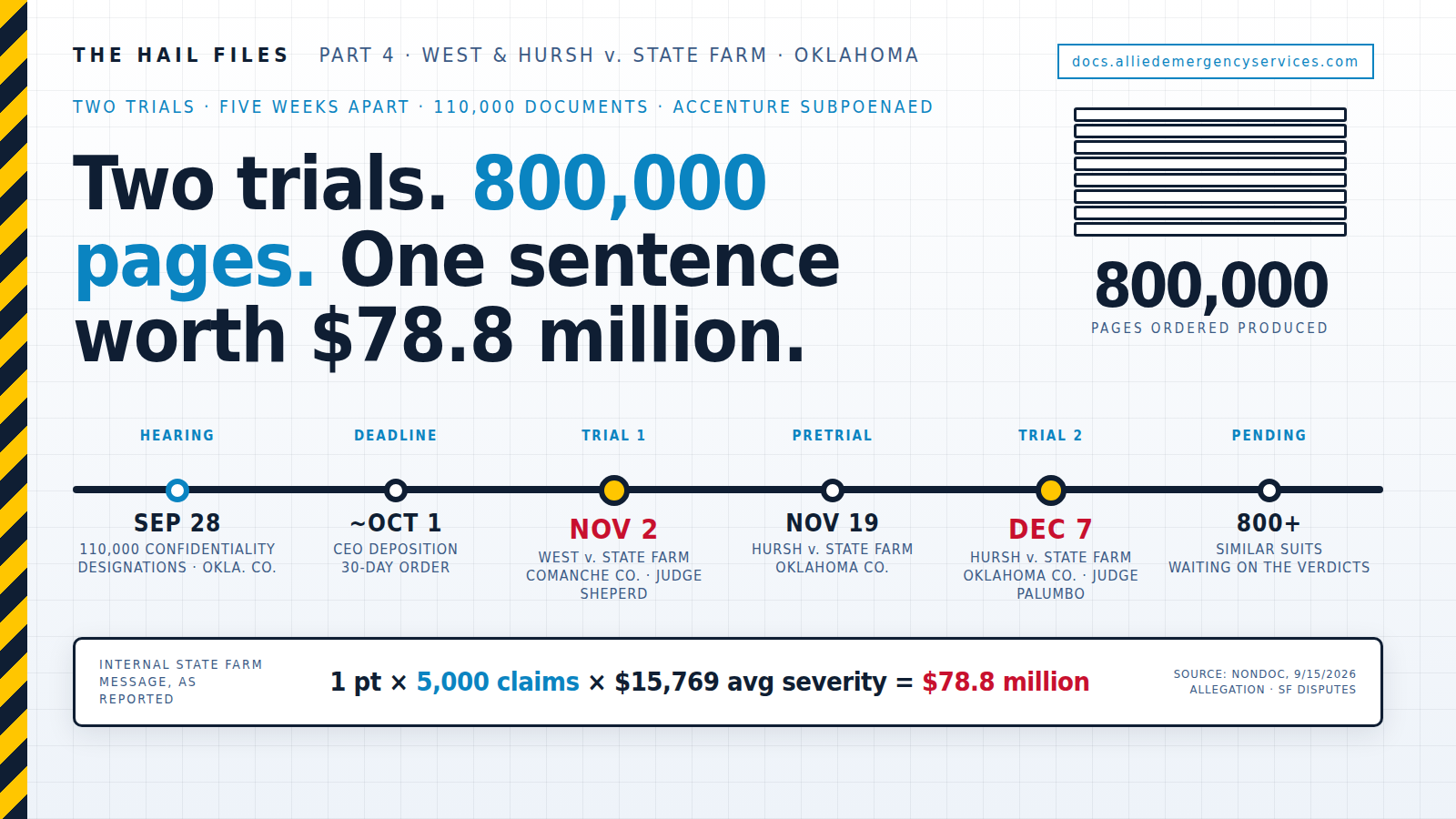
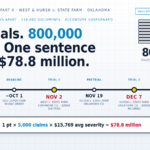
Accenture may respond; the court sets the hearing. The September 28 hearing on 110,000 confidentiality designations decides whether material like Exhibits 7–33 stays sealed before trial. West goes to trial November 2, Hursh December 7. The Trial Watch page carries every date with its source. New filings reach archive subscribers the day they are added — one email per development, no marketing.
Frequently asked questions
What is Accenture’s alleged role in the State Farm hail litigation?
According to the Hursh plaintiffs’ September 10, 2026 motion, Accenture was engaged by State Farm in April 2020 for a program total of $1,025,000 to define wind/hail claim tactics, supplied the full-roof-replacement benchmark State Farm called an “industry standard,” priced the reduction in full replacements, and recommended the manager-approval control. Accenture disputes the subpoena and has produced nothing; State Farm disputes the characterization; the court has not ruled.
What does the subpoena ask Accenture to produce?
Eleven categories: its work on State Farm’s “Fire Model Enhancement – Wind/Hail” and “Hail Focus Initiative,” the industry standards or benchmarks on full roof replacements it relied on or produced, the data and methodology behind them, contracts and scopes of work, and documents on reductions in indemnity on full roof replacements, from January 1, 2018 to the present.
Are the Accenture documents public?
Not yet. Exhibits 7 through 33 to the motion — the decks, emails and analyses — are filed under seal, and the brief’s quotations from them are redacted in the public copy. The brief, the subpoena, Accenture’s objections and the prior orders are public and in The Hail Files.
What is the “one inch of hail, 50 mph wind” standard?
Per the plaintiffs’ brief, State Farm has argued in court that industry data shows hail of one inch or less and wind of 50 mph or less is “not likely to damage a roof.” The plaintiffs contend the underlying benchmark came from Accenture, not from industry studies, and have twice obtained orders compelling State Farm to produce the material behind it.
Where can I read the motion?
In The Hail Files, the free public archive of the Oklahoma State Farm litigation, with every page OCR’d and searchable: docs.alliedemergencyservices.com.
All allegations described in this article are drawn from the plaintiffs’ public court filing and are the plaintiffs’ characterizations of documents that are under seal and have not been ruled on. Accenture has not been found to have done anything improper. State Farm denies the allegations and states that it evaluates each claim individually under the terms of the policy. Nothing is decided until a jury decides it.
About the author. Curt Testa is the founder and president of Allied Emergency Services, Inc., an Illinois-licensed storm damage restoration contractor serving Illinois, Wisconsin, Indiana and Michigan. He has worked in the building trades since 1999, founded Allied in 2015, has been disclosed as a controlled expert witness under Illinois Supreme Court Rule 213(f)(3), has testified at trial in Illinois circuit court and has given sworn deposition testimony more than forty times. He publishes The Hail Files and provides forensic storm damage documentation and construction expert consultation for attorneys. Allied is not a law firm, insurance adjuster or public adjuster; this article is general information, not legal advice.
⚡ Storm or Roof Damage? Get a FREE Estimate
Text ESTIMATE to (844) 907-2546
Or call (800) 792-0212 for 24/7 emergency response
AI-powered • No obligation • Licensed IL & WI
Need insurance claims help?
Allied Emergency Services — Licensed IL & WI Insurance Claims Specialists
For more than a decade, Allied has been managing insurance claims across Illinois and Wisconsin. IICRC-certified, EPA Lead-Safe, IL Licensed Roofing Contractor #104.019029. 24/7 emergency response.
Learn about our Insurance Claims service →Free property assessment within 24 hours · No obligation · Insurance claim support
Attorneys: forensic storm damage documentation & construction expert consultation for counsel →