⚡ Storm or Roof Damage? Get a FREE Estimate
Text ESTIMATE to (844) 907-2546
Or call (800) 792-0212 for 24/7 emergency response
AI-powered • No obligation • Licensed IL & WI
Oklahoma City — October 9, 2026
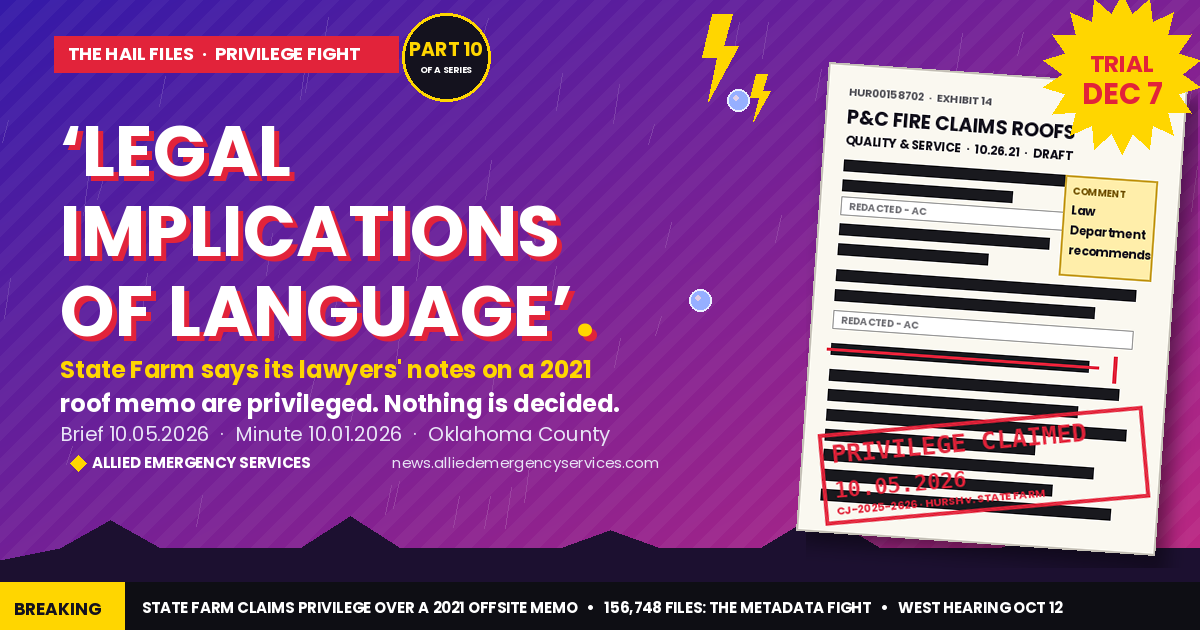
What happened, in one sentence: State Farm has asked Oklahoma County Judge Amy Palumbo to rule that the blacked-out passages in 19 pages of emails and drafts of an October 2021 roof-claims memo, prepared “for a Senior Executive Offsite meeting,” are protected attorney-client communications and attorney work product, and to strike the homeowners’ use of versions it says it produced with incomplete redactions by mistake. Four days earlier, the judge wrote in a court minute in the same case that “Discovery continues to be an issue” and that the court “has been presented with evidence of white box redactions, no meta data, no privilege log, and others.” The minute does not say who presented that evidence or whose documents it concerns.
Status: Nothing has been decided. State Farm says the judge has had unredacted copies for private review since September 30. The homeowners, who say the memo “went directly to the CEO and C-suite,” have separately asked the court to make State Farm re-produce its electronic records with the metadata they say is missing. Asked about the discovery disputes, State Farm told KOKH FOX 25 that “the characterizations by the plaintiffs’ attorneys are false.” Trial is set for December 7. State Farm’s brief, the October 1 minute and the metadata motion are hosted in the Hail Files archive.
On October 22, 2021, Scott Welsh, a State Farm director of P&C claims consulting, sent a draft memo to one of the company’s in-house lawyers. It was titled “P&C Fire Claims Roofs — Quality & Service,” and it was being written, according to State Farm, “for a Senior Executive Offsite meeting.”
With litigation over State Farm’s handling of wind and hail claims pending, the company says, Welsh “asked counsel to evaluate the legal implications of language used in the draft to describe those practices.” Two lawyers commented. On October 26, Welsh sent a revised draft to four colleagues, a version that State Farm says still carried some of the lawyers’ comments and a margin comment conveying what the “Law Department recommends.”
Five years later, those comments are the subject of a privilege fight in Hursh v. State Farm, the lead case among more than 800 Oklahoma hail-claim lawsuits against the company. State Farm produced the memo in discovery. What it blacked out, it says, is privileged: requests for legal advice, the advice itself and messages relaying it. What it failed to black out, by mistake, it says, the homeowners’ lawyers have used at depositions and in court filings. On October 5, State Farm asked Judge Palumbo to uphold its redactions, strike the homeowners’ use of the versions it says were produced with incomplete redactions, and order every copy returned or destroyed.
The homeowners say the fight is about more than a few comment bubbles. In a motion filed October 2, they say State Farm produced most of its electronic records as flat pictures, stripped of the data that would show who sent what to whom, and they use the same memo as their example: “Which executives received it, in which version, with which attachments, and what followed the offsite are facts that exist only in the metadata State Farm removed.”
What is the Senior Executive Offsite memo?
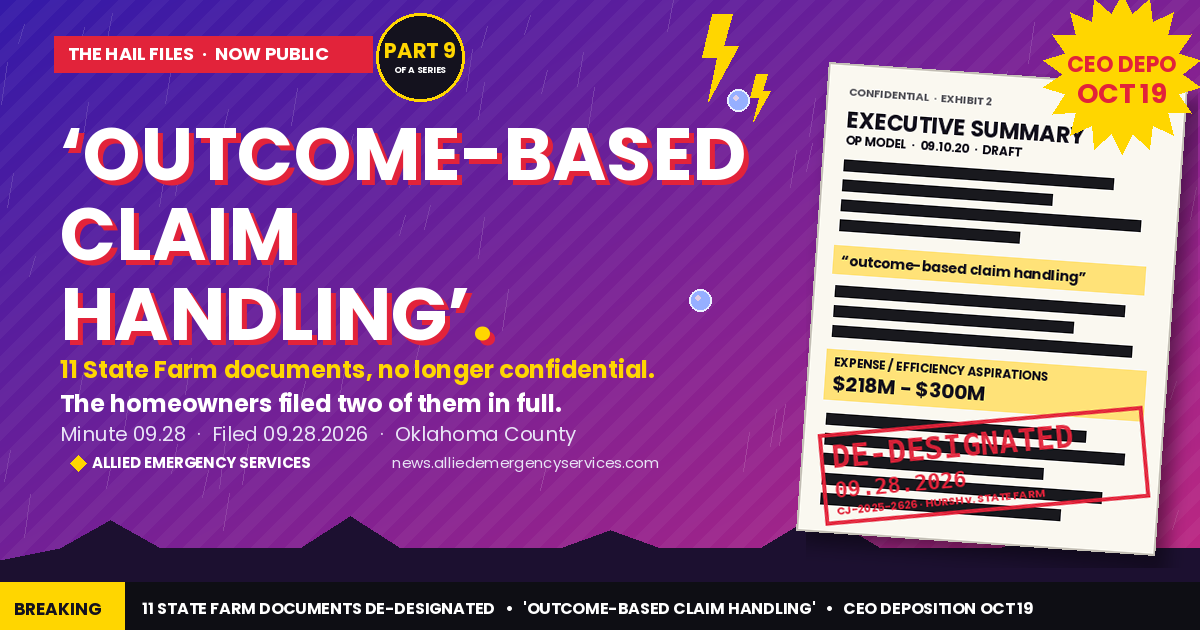
According to State Farm’s October 5 brief and Welsh’s declaration, the memo is “P&C Fire Claims Roofs — Quality & Service; October 26, 2021,” prepared for a Senior Executive Offsite. The 19 disputed pages, numbered HUR00158701-19, contain “two email chains and two versions of the same draft SEO Memo.” One version shows the lawyers’ comments “primarily in comment bubbles and tracked changes”; the other “is a later draft circulated by State Farm employee Scott Welsh.” State Farm says it “has produced the underlying Senior Executive Offsite Memo” and “all nonprivileged portions of the related documents,” and that its redactions “do not conceal the underlying memorandum.”
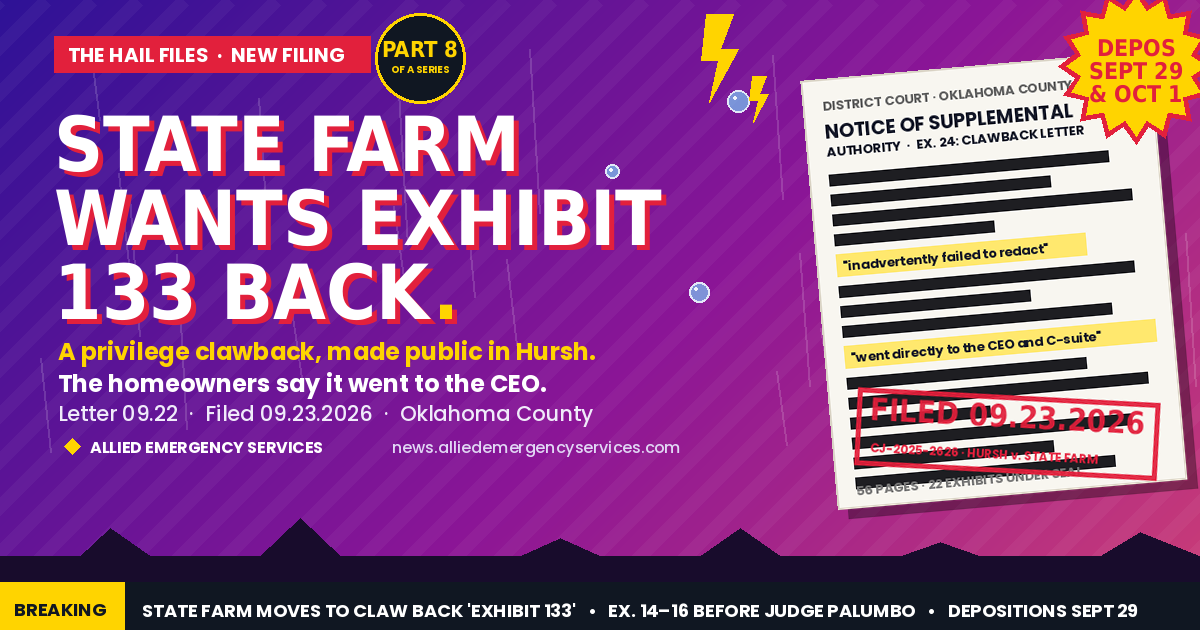
The homeowners filed the document as Exhibit 14 to a September 23 supplement. They say it is the Hursh copy of “Exhibit 133,” the document State Farm is also clawing back in the companion West case in Comanche County (Part 8). They say it “went directly to the CEO and C-suite,” and, citing redacted testimony from senior vice president Wensley Herbert in West, that “SEO stands for Senior Executive Offsite and the CEO, CFO, and COO attend and review SEO material.” State Farm’s brief does not say who attended the 2021 offsite.
What State Farm says its lawyers did
The brief tells the story this way. On October 22, 2021, Welsh sent the draft to Tim Marron, then an in-house State Farm attorney, “for legal review and advice.” At that time, State Farm says, “litigation concerning State Farm’s handling of wind or hail claims was pending, and other potential litigation was reasonably anticipated.” On October 26, Marron sent the draft back with his comments and those of a second in-house lawyer, Mark Cavanaugh, under a cover email marked “Privileged and confidential Attorney client communication.”
The same day, Welsh emailed four peers. He attached a revised draft that “still included certain legal advice and explicit comments from the attorneys,” along with the email carrying the lawyers’ comments, and told them the draft contained recommendations from the Law Department, according to the brief. Welsh’s declaration says: “I implemented the Law Department’s legal advice to reinforce and more accurately describe within the SEO Memo claim handling expectations and State Farm standards.”
The brief also explains how its reviewers missed the comments. Before forwarding the draft, Welsh had deleted the lawyers’ comment bubbles and most of their in-line comments, but some remained; in one instance, a deleted comment tracked as a change “remained visible but appeared to be struck through by Welsh.” So, State Farm says, “a reviewer could have mistaken the deleted comments as having been made by non-attorney Welsh.” In re-checking the family, State Farm says, it found that its reviewers had applied “potentially overbroad redactions” to the other draft and missed two attorney comments, so it “clawed back HUR00158712-19 to more narrowly tailor the redactions, and to add two redactions to privileged material.”
State Farm says it learned of the problem on September 17, when the homeowners’ lawyers, who also represent the West plaintiffs, marked the West copy as Exhibit 133 at Herbert’s deposition and State Farm’s counsel “promptly notified” them it might contain privileged material. “The very next day,” the brief says, the homeowners’ lawyers attached it to a court filing “wholly unrelated to the document.” It says State Farm redacted the same content in three versions of the memo produced in another Oklahoma case, Foster v. State Farm, and that it has produced “over 117,000 documents” in Hursh, “in addition to more than 600,000 documents that State Farm reproduced from prior cases that settled.”
What State Farm wants the judge to do
State Farm asks Judge Palumbo to uphold its redactions, both the original ones and the corrected ones; to strike references to the incompletely redacted versions in the case and in depositions, including the related part of a State Farm corporate representative’s September 29 deposition and the exhibit itself; to strike the homeowners’ September 23 notice and have it refiled without the privileged material; and to order the homeowners’ lawyers to “return, sequester, or destroy” every copy and “cease further use or disclosure.” If she finds any redacted passage is not privileged, State Farm asks her to stay that ruling “to prevent further dissemination of State Farm’s privileged materials and allow State Farm a meaningful opportunity to seek Supreme Court review.”
“Plaintiffs’ improper use of State Farm’s inadvertently disclosed privileged documents is egregious,” the brief says. It says the court let the homeowners use the document at that courtroom deposition “with the understanding that the material would be excised from the record should the Court uphold State Farm’s privilege claims,” that State Farm gave the judge unredacted copies for in camera review on September 30 at her direction, and that its formal clawback letter in Hursh went out September 29.
What the homeowners say
The homeowners’ side of the dispute is in their September 23 supplement, filed before State Farm’s brief, most of it under seal. They argue that a passage marked “Redacted – AC” (attorney-client) in Exhibit 14 appears unredacted in another document, Exhibit 15, and is an industry benchmark sourced to “Accenture Consulting Services,” which they say cannot be privileged. In the alternative, they invoke the crime-fraud exception, which removes privilege from communications made to further a crime or fraud. They asked the judge to rule on Exhibit 14 or review it privately.
State Farm answers that the exception “applies only when a client seeks or obtains a lawyer’s services to help commit or plan a crime or fraud,” and that the homeowners “offer no evidence that State Farm sought legal advice for that purpose, which of course it did not.” In a footnote it adds that “several courts have held” that bad faith denial of an insurance claim does not count as fraud for that exception. No written response from the homeowners to the brief appeared in the docket text as of October 9.
‘Presented with evidence’: the October 1 minute
The brief arrived four days after a hearing on “Discovery, Witnesses, and media,” at which Judge Palumbo wrote, in a handwritten minute signed by lawyers for both sides: “Discovery continues to be an issue. This Court ordered full and flawless compliance with production. This court has been presented with evidence of white box redactions, no meta data, no privilege log, and others.” The minute does not say who presented the evidence or which documents it concerns; State Farm’s brief, for its part, describes reviewing documents “before logging documents on its privilege log.” The docket entry for the hearing adds that the parties “understand discovery and actions faced for continued noncompliance.”
The minute also orders that Nicole Manduca, whom the homeowners describe as leader of State Farm’s Wind/Hail Fire Model Enhancement Team and State Farm calls “a Director in State Farm’s Property & Casualty department,” “must testify as a corporate representative in a non-evasive manner.” It says: “This Court expects witnesses to appear live.” On the media, the parties are to file “briefs 10 pages or less about positions on the media” after meeting to see what they agree on, and the minute reads: “Court put media guardrails now, and allow media potentially at trial.” The docket entry sets the brief deadline at “no later than 40 days from today,” which falls on November 10.
Hannah Whitten, one of the homeowners’ lawyers, told KOKH the homeowners had “presented to the court that metadata has been removed from some of this production.” State Farm, asked by the station about the discovery issues, said in a statement that “the characterizations by the plaintiffs’ attorneys are false.”
The metadata motion
The next day, October 2, the homeowners filed their motion “to compel re-production of electronically stored information in the form defendant State Farm elected.” It opens: “State Farm failed to produce critical metadata for the electronic records at the center of this case.” And: “State Farm elected, in writing, to produce it and then simply did not.”
In discovery responses in September 2025 and January 2026, State Farm said it would produce page images with searchable text and that, “where applicable, metadata load files will be produced in .DAT file format and image load files in .OPT format,” the industry-standard files that tie each page to its document and each attachment to its email, the homeowners say. Instead: “State Farm has produced 156,748 files to date. Approximately ninety percent of them are flattened PDF renderings carrying substantially no native file metadata,” with no load files, and attachments that “cannot be matched to the Microsoft Outlook (‘MS Outlook’) emails they came from.”
Their example is the offsite memo. HUR00158701, the first of the 19 disputed pages, is Welsh’s October 26, 2021 email, subject “SEO Fire Claims Service & Quality Update.” Its header names two attachments, “10.26.21 SEO Fire Claims Service Quality Updated.docx” and “Law Department Feedback.msg.” The email, the motion says, “names two attachments, only one of which can be located in the production,” and the Word draft’s “legal-department comments and tracked changes survive as pictures stripped of their authors, dates, and sequence.” As the motion puts it: “A picture of a tracked change is not a tracked change.”
The homeowners ask the court to “hold State Farm to the form it chose.” That means re-production with load files and native email properties, logs showing who was invited to and attended meetings, the native memo files from five State Farm mailboxes, a declaration from State Farm’s processing vendor, and State Farm bearing the cost of re-production, plus fees. These are the homeowners’ claims. State Farm had not responded on the docket as of October 9, and the homeowners filed a sealed supplement to the motion on October 8.
From ‘targets’ to ‘selections’
Also on October 2, the homeowners answered State Farm’s motion to block the deposition of Michael Keating, the operations vice president who testified for State Farm before a U.S. Senate subcommittee in May 2025 (Part 9). State Farm says Keating “was not involved in the handling of Plaintiffs’ claims, nor did he directly supervise any person who was involved,” and his declaration says: “I was not involved in the FME,” the Fire Model Enhancement. The homeowners say that while they do not allege he personally handled their claims, he “directly and materially contributed to the implementation and oversight of State Farm’s Scheme tactics to reduce indemnity payments on roof claims.” Citing his Senate testimony, they note he “joined State Farm in 1993 as a Homeowners Claim Representative.”
Their Exhibit 1 is an October 2023 State Farm email titled “Meeting Recap – Quality Slide Decks.” It says three decks, the “Simplified Deck,” the “Keating Quality Deck” and an average estimate value deck, “were consolidated into one new deck named ‘Fix Profit Task Force Deck.'” For one slide it lists “Changed Target to Selection.” For another, it says “any reference to ‘targets’ need replaced with ‘selections’.” The homeowners argue the change shows State Farm “knew its tactics to achieve ‘target’ goals on roof claims constituted bad faith.” The email does not say why the word was changed. State Farm has told the court the Fix Profit Task Force “has nothing to do with the allegations in this case or the FME.” The homeowners asked Judge Palumbo to decide the motion on the papers, without a hearing, under District Court Rule 4(h); no ruling appeared in the docket text as of October 9.
Accenture takes the subpoena fight to Illinois
Accenture LLP, the consulting firm the homeowners tie to State Farm’s 2020 roof-claim work (Part 5), is not a party to the case, and it has hired Gibson, Dunn & Crutcher; its October 5 motion asks to admit Douglas Fuchs of the firm’s Los Angeles office. The homeowners’ October 2 reply says that “On September 23, 2026, two days before its opposition was due, Accenture also asked the Circuit Court of Cook County, Illinois, to quash this Court’s subpoena,” in Accenture LLP v. Hursh, and that it filed a second Cook County petition over a subpoena in the Foster case. The homeowners say they have not been served in Illinois, object to that court’s jurisdiction, and argue that “Accenture accepts the Oklahoma courts’ authority when they rule in its favor, and disputes it only when they are asked to enforce a subpoena against it.” Accenture, in its September 25 response, says its wind and hail work “lasted only a few months from April to July 2020” and that it “was not involved in some kind of conspiracy to reduce payouts to policyholders.”
In Lawton, a judge adopts a deposition protocol
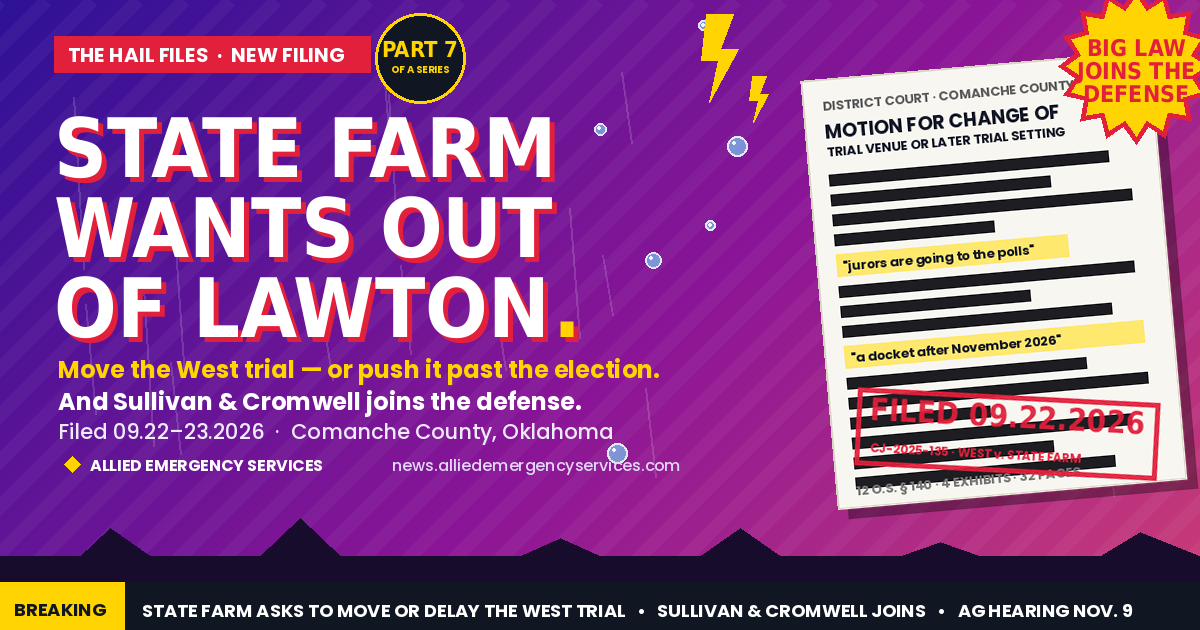
In the companion case, West v. State Farm in Comanche County, the fight is over how depositions are run. At a September 24 hearing, Judge Grant Sheperd granted State Farm’s motion for a protocol governing lawyers’ conduct at depositions. “This has been the most contentious and litigious case I’ve ever dealt with, and so I think anything we can get to keep us on the rails is beneficial, so I’m going to adopt the protective order for deposition protocol,” he said, according to the transcript. His written order reserved two homeowners’ sanctions motions “for later date,” including one against State Farm for “obstructive depo conduct.” The order is on paper at the clerk’s office and became available online as an exhibit to a State Farm filing.
The homeowners asked him to reconsider the next day. On October 8, State Farm’s trial counsel at Crowe Dunlevy opposed. They called the homeowners’ proposed “Alternative Protocol” “self-serving” and said the dispute is “effectively moot” because the only depositions left in that case are the experts’ and “the four-hour deposition of Jon Farney,” State Farm’s CEO. The homeowners’ motion is not online; as State Farm quotes it, the motion frames the question as “whether the examination broke down because counsel was abusive or because the witness would not answer.” According to State Farm’s brief, the court has set a hearing on the motion for Monday, October 12. State Farm also says the judge told the lawyers he would rule by October 9, without a hearing, on the homeowners’ emergency motion over sanctions and Manduca’s resumed deposition; no ruling had appeared in the docket text by midday October 9.
What does this mean for Oklahoma homeowners?
A privilege ruling will decide whether the homeowners can use the lawyers’ notes on a 2021 roof memo at all; it will not decide whether State Farm handled anyone’s claim in bad faith. The metadata motion is about the form of State Farm’s records, not what they mean. In these filings, both sides’ descriptions are arguments, and none of the pending motions described here has been decided.
For policyholders with their own storm claims, the practical facts are unchanged: the allegations in these cases are allegations, State Farm disputes them, and a policyholder’s own claim is governed by their own policy and their own insurer’s decisions.
What happens next
Pending in Hursh: State Farm’s privilege claim over Exhibit 14, the metadata motion, the Keating deposition, Accenture’s challenge to the subpoena, and the 13 documents The Oklahoman reported were taken under advisement September 28. October 12: the West hearing on the deposition protocol, 3 p.m. October 15: the Hursh deadline for dispositive motions and expert disclosures. October 19: CEO Jon Farney’s deposition, according to the homeowners’ September 28 filing. October 20: the homeowners depose a State Farm expert witness in Tulsa. October 22: the West pretrial conference. November 9: the disqualification hearing in the Attorney General’s case. November 10: the Hursh media briefs and Daubert motions. November 19: the Hursh pretrial conference and a motions setting in West. December 7: the Hursh trial. All of it is on the Trial Watch page.
Read the documents
State Farm’s October 5 brief on the privilege claim over HUR00158701-19 (with the Welsh, Cavanaugh and vendor declarations) · The October 1 court minute · The homeowners’ metadata motion, part 1 and part 2 · The homeowners’ Keating response (Exhibit 1 is the October 2023 email) · The homeowners’ reply on the Accenture subpoena · Accenture’s motion to associate counsel · West: State Farm’s October 2 opposition (with the September 24 order and transcript excerpt) · State Farm’s October 8 response on the deposition protocol and its Exhibit 1 · The homeowners’ September 23 supplement · Search the full archive.
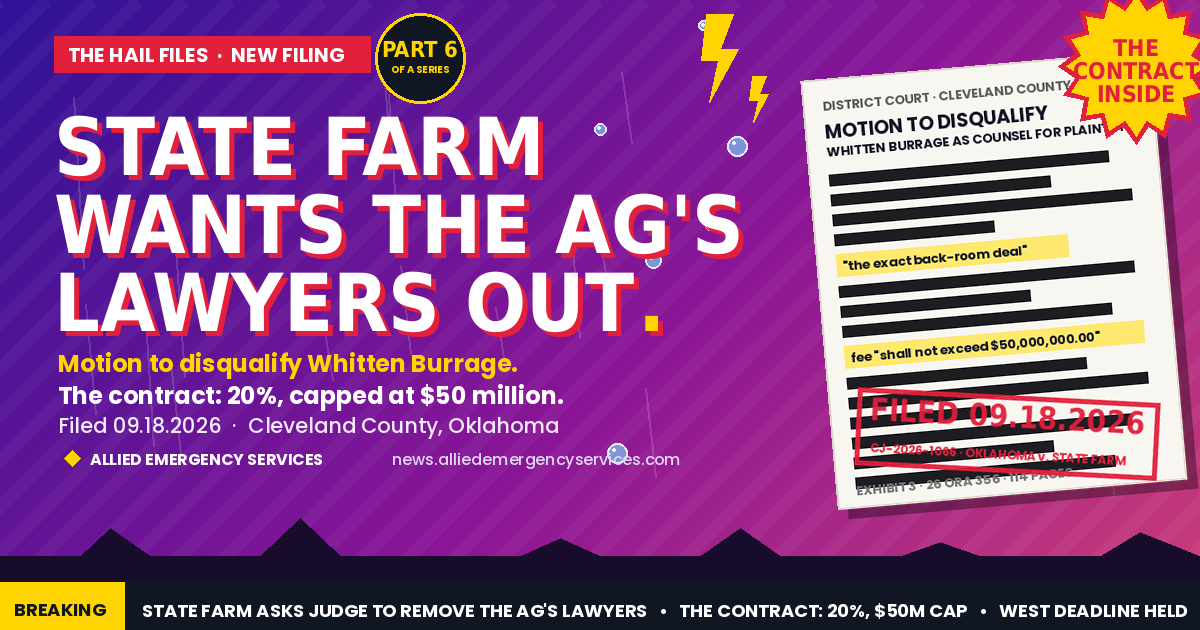
Earlier in this series: “The Denial Enterprise” · Part 3: State Farm is deposing the roofer · Part 4: Two Trials, 800,000 Pages · Part 5: The Accenture Motion · Part 6: State Farm Asks a Judge to Throw the Attorney General’s Lawyers Off the Case · Part 7: State Farm Wants Out of Lawton · Part 8: “A Little Worried” · Part 9: ‘Outcome-Based Claim Handling’.
Frequently asked questions
In Hursh v. State Farm (Oklahoma County, CJ-2025-2626), State Farm says the document the homeowners filed as Exhibit 14 (HUR00158701-19) consists of two email chains and two versions of a draft memo titled “P&C Fire Claims Roofs — Quality & Service,” dated October 26, 2021 and prepared for a Senior Executive Offsite meeting. State Farm says it has produced the memo and redacted only communications requesting, giving or relaying its lawyers’ advice. The homeowners say the document “went directly to the CEO and C-suite” and, citing testimony in the companion West case, that the CEO, CFO and COO attend and review Senior Executive Offsite material. State Farm disputes the homeowners’ allegations, and no ruling on the privilege dispute had appeared in the docket text as of October 9, 2026.
State Farm’s October 5, 2026 brief says the redacted passages are requests for, delivery of and messages relaying legal advice, and attorney work product: with litigation over its handling of wind and hail claims pending, a State Farm claims-consulting director sent the draft memo to an in-house lawyer on October 22, 2021 and asked counsel “to evaluate the legal implications of language used in the draft to describe those practices.” State Farm says two versions were produced with incomplete redactions by mistake. It asks Judge Amy Palumbo to uphold the redactions, strike the homeowners’ use of those versions, order copies returned or destroyed, and stay any adverse ruling so it can seek Supreme Court review. The homeowners argue a redacted passage is an Accenture industry benchmark that cannot be privileged and, in the alternative, invoke the crime-fraud exception.
The handwritten minute in Hursh v. State Farm reads: “Discovery continues to be an issue. This Court ordered full and flawless compliance with production. This court has been presented with evidence of white box redactions, no meta data, no privilege log, and others.” It orders that State Farm’s Nicole Manduca “must testify as a corporate representative in a non-evasive manner,” says the court expects witnesses to appear live, and orders briefs of 10 pages or less on the media; the docket entry sets the deadline at no later than 40 days from October 1, which is November 10, 2026. The minute does not say who presented the evidence. Asked by KOKH about the discovery issues, State Farm said in a statement that the plaintiffs’ attorneys’ characterizations are false.
On October 2, 2026, the homeowners moved to compel State Farm to re-produce its electronic records in the form they say it elected in its discovery responses: page images with searchable text plus, “where applicable,” .DAT and .OPT load files. They say State Farm has produced 156,748 files, about 90 percent of them flattened PDFs carrying substantially no native metadata, so attachments cannot be matched to emails and tracked changes appear only as pictures. They ask for re-production at State Farm’s cost, meeting logs, native files from five mailboxes and a declaration from State Farm’s processing vendor. State Farm had not responded on the docket as of October 9, 2026.
An October 2023 State Farm email recapping a meeting on “Quality Slide Decks,” filed by the Hursh homeowners as Exhibit 1 to their October 2, 2026 response on Michael Keating’s deposition, says three decks including a “Keating Quality Deck” were consolidated into a “Fix Profit Task Force Deck,” lists “Changed Target to Selection,” and says “any reference to ‘targets’ need replaced with ‘selections’.” The homeowners argue it shows State Farm “knew its tactics to achieve ‘target’ goals on roof claims constituted bad faith.” The email does not explain the change, and State Farm has told the court the Fix Profit Task Force has nothing to do with the allegations in the case.
Hursh v. State Farm is set for a seven-day jury trial beginning December 7, 2026, before Judge Amy Palumbo in Oklahoma County District Court. Before then: a West v. State Farm hearing on October 12, the Hursh dispositive-motion and expert deadline October 15, CEO Jon Farney’s deposition October 19 according to the homeowners’ filing, the West pretrial conference October 22, the media briefs and Daubert motions November 10, and the Hursh pretrial conference November 19.
About this report. Except where a news outlet is named, everything above is drawn from public court records: in Oklahoma County No. CJ-2025-2626, State Farm’s October 5 brief and its declarations, the October 1 court minute (transcribed from an image of the handwritten original) and docket entry, the homeowners’ October 2 metadata motion, Keating response and Accenture reply, State Farm’s September 28 and 29 Keating motions with Keating’s declaration, Accenture’s September 25 response and October 5 motion, the homeowners’ September 23 supplement and September 28 notice, the September 22 scheduling order and the October 6 deposition notice; in Comanche County No. CJ-2025-135, State Farm’s October 2 and October 8 filings with the September 24 order and hearing transcript excerpt attached. All are hosted, unaltered, in the Hail Files archive, and every quotation was checked against the filings’ text. The statements to KOKH FOX 25 are from its October 5 report; the 13 documents under advisement are as The Oklahoman reported. Where the report describes what the homeowners say, those are their characterizations; where it describes State Farm’s or Accenture’s positions, it quotes their filings. Nothing described here has been ruled on unless the report says so. Allegations in the underlying lawsuits are allegations that State Farm disputes.
About the host. Allied Emergency Services is a licensed storm-damage restoration contractor serving Illinois, Wisconsin, Indiana and Michigan — not a law firm, insurance adjuster or public adjuster, and this report is not legal or insurance advice. We inspect, document, provide insurance-ready repair estimates and complete repairs; coverage decisions always belong to you and your insurer. Founded 2015; in the building trades since 1999; Illinois-licensed. 24/7: (800) 792-0212.
⚡ Storm or Roof Damage? Get a FREE Estimate
Text ESTIMATE to (844) 907-2546
Or call (800) 792-0212 for 24/7 emergency response
AI-powered • No obligation • Licensed IL & WI
Storm damage? Start with the documentation
Allied Emergency Services — IL-Licensed Storm Damage Restoration Contractor
Founded 2015, in the building trades since 1999. Allied inspects and documents storm damage, writes the scope and estimate, and does the repairs. We do not adjust or negotiate insurance claims — that is the job of your insurer, a licensed public adjuster, or an attorney. IICRC-certified, EPA Lead-Safe, IL Licensed Roofing Contractor #104.019029. 24/7 emergency response.
How the storm-damage insurance claim process works →Free inspection within 24 hours · No obligation · Photo-documented findings you can share with your insurer
Attorneys: forensic storm damage documentation & construction expert consultation for counsel →