
⚡ Storm or Roof Damage? Get a FREE Estimate
Text ESTIMATE to (844) 907-2546
Or call (800) 792-0212 for 24/7 emergency response
AI-powered • No obligation • Licensed IL & WI
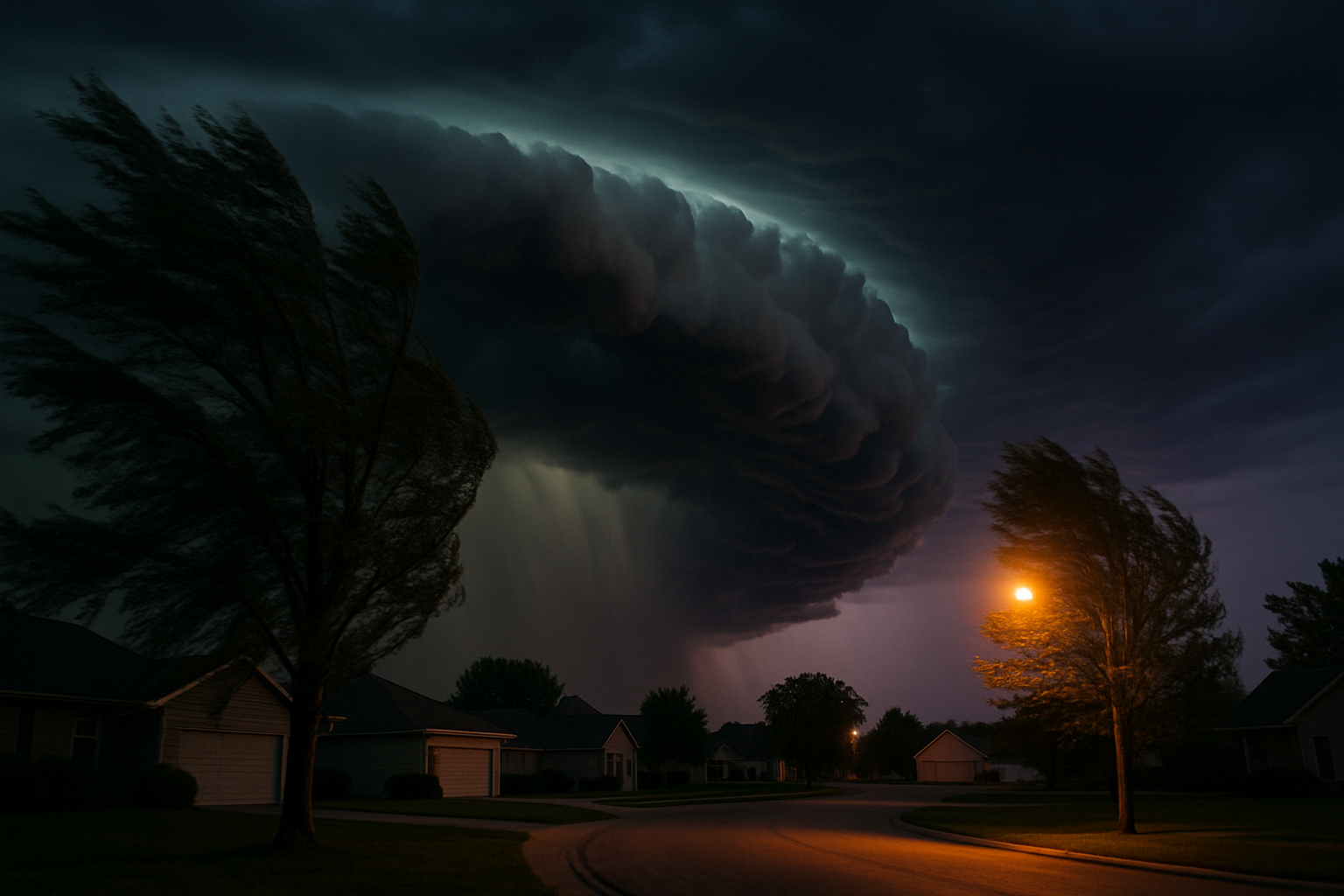
The National Weather Service in Milwaukee has confirmed an EF0 tornado touched down in Hubertus, Washington County, Wisconsin, on August 19, 2026, producing maximum winds of 80 MPH. The brief but impactful storm was part of a larger weather complex that left a trail of tree damage and structural impacts across Washington, Waukesha, Ozaukee, and Milwaukee counties before the evening was over.
NWS Milwaukee storm survey teams traced the tornado’s origin to the intersection of Elmwood Road and Timber Stone Way in Hubertus. The same system generated confirmed wind damage reports stretching southeast through Richfield, Sussex, Menomonee Falls, Bayside, West Milwaukee, and Butler. If your home sits in any of these communities — or anywhere in the surrounding Waukesha and Washington County corridor — a careful post-storm inspection is worth completing before additional weather moves through the region.
What the National Weather Service Confirmed
All of the following reports were officially issued by NWS Milwaukee (MKX) and are cataloged by the NOAA Storm Prediction Center local storm report database.
EF0 Tornado — Hubertus, Washington County
- Classification: EF0 (Enhanced Fujita Scale — the entry-level tornado classification)
- Maximum wind speed: 80 MPH
- Origin point: Near the intersection of Elmwood Road and Timber Stone Way, Hubertus, WI
- Date: August 19, 2026
- Confirmed by: NWS Milwaukee post-event storm survey
Confirmed Wind Damage Reports — Surrounding Counties
Washington County (Richfield): NWS Milwaukee documented numerous trees down, along with minor roof damage reported on Cherokee Trail and Winnebago Road.
Waukesha County — Sussex: Large tree limbs were snapped at the intersection of Good Hope Road and Highway 164.
Waukesha County — Menomonee Falls: A large pine tree came down on a camper; additional trees were snapped in the area.
Ozaukee County (Bayside): Large downed trees were confirmed by NWS Milwaukee survey personnel.
Milwaukee County — West Milwaukee: Ten-inch diameter branches were downed in a report confirmed directly by an NWS employee.
Milwaukee County — Butler: Trees were snapped inside Pinelawn Memorial Park.
An EF0 classification means the tornado was brief and at the lower end of the intensity scale — but 80 MPH winds are more than sufficient to lift shingles, dislodge flashing, snap mature trees, and expose roof decking to whatever comes next. In many cases, the secondary water damage from an unaddressed breach is more costly than the original wind event.
What Homeowners in Hubertus, Richfield, Sussex, Menomonee Falls, Bayside, West Milwaukee, Butler, and Waukesha Should Check Now
Wind events don’t always announce themselves through obvious exterior damage. Some of the most expensive problems — lifted shingles, cracked flashing, loosened siding seams — are easy to miss from the ground and easy to overlook until water shows up inside. Work through this checklist before conditions change.
Roof
- From the ground (do not climb onto a wet or storm-compromised roof), scan the full roofline for missing, lifted, or visibly displaced shingles
- Pay close attention to ridge caps — they take the brunt of straight-line and rotating winds
- Look for dark patches or bare spots where granule loss has exposed the underlying mat
- Check metal flashing around chimneys, pipe boots, vents, and skylights for separation or bending
Siding and Exterior
- Walk a full perimeter pass — look for cracked, dented, or missing siding panels, particularly on the windward face
- Inspect window frames, trim, and casing for impact dents or cracks from airborne debris
- Check garage doors for panel warping and compromised weatherstripping along the bottom seal
Trees and Overhanging Limbs
- Do not approach leaning trees or large limbs that may be hanging in the canopy — “widow makers” are a serious post-storm hazard
- If a tree or major limb is in contact with or directly over your roof, treat it as a structural emergency requiring professional assessment
- Have a qualified arborist evaluate any tree that shows root heaving, major crown damage, or leans toward a structure
Gutters and Downspouts
- Inspect gutters for visible dents, separation from the fascia board, and debris blockage from fallen leaves and twigs
- Confirm downspouts are still firmly attached and routing water well away from your foundation
Interior — Water Intrusion
- Check ceilings and the attic space for water staining, soft drywall, or any active dripping
- In the attic, look for daylight showing through the roof deck — a reliable indicator of missing shingles or a breached field
- Water intrusion often does not appear immediately; revisit these checks over the next 48 to 72 hours, especially before the next rain
If You Find Damage
Discovering storm damage can feel overwhelming, but the steps forward are straightforward. Follow these in order.
1. Document everything before any cleanup begins. Walk your property and photograph all visible damage from multiple angles — wide establishing shots for context, and tight close-ups for detail. Your phone’s timestamp is sufficient. Video walkthroughs add useful continuity. This documentation is the foundation of your insurance claim, so don’t skip it.
2. Stop the bleeding — protect from further damage. If you have an active breach in your roof or a compromised exterior wall, emergency tarping or boarding prevents water from turning a manageable repair into a mold remediation project. Act on this before the next weather system moves through. In August in Wisconsin, that window can be short.
3. Notify your insurance carrier and open a claim promptly. Timeliness matters. Your insurer will assign an adjuster and schedule an on-site inspection. Keep a record of every conversation, including the date, representative name, and claim number.
4. Choose a licensed restoration contractor — not a door-to-door storm chaser. After events like this, unlicensed or out-of-state contractors sometimes appear quickly, pressuring homeowners to sign documents before an adjuster has seen the property. A licensed restoration contractor will document the damage accurately, provide a detailed written scope of repairs, and be available to meet with your insurance adjuster on-site. Allied Emergency Services does not negotiate, settle, or adjust insurance claims on your behalf — that is the adjuster’s role. What we do is deliver accurate damage documentation, honest repair estimates, and permitted work completed to code.
Allied Emergency Services has been serving the Greater Midwest for more than a decade. We are an Illinois licensed roofing contractor and an IICRC certified restoration firm, and we have direct experience with the damage signatures that Washington and Waukesha County wind events produce. You can learn more about our storm damage restoration services or see specifically how we serve Waukesha-area homeowners after storm events.
This article is provided as general information only and does not constitute legal or insurance advice. Coverage and claim procedures vary by policy; consult your insurance carrier and policy documents for guidance specific to your situation.
Contact Allied Emergency Services — 24/7
If you are a homeowner or property manager in Hubertus, Richfield, Sussex, Menomonee Falls, Bayside, West Milwaukee, Butler, Waukesha, or any of the surrounding communities affected by last night’s storm, Allied’s team is available around the clock.
- Call: (800) 792-0212 — 24/7 emergency line
- Text: ESTIMATE to (844) 907-2546
There is no cost to a damage assessment. The sooner a trained eye gets on your roof, the sooner you know what you are dealing with — and the better positioned you are if a claim becomes necessary.
⚡ Storm or Roof Damage? Get a FREE Estimate
Text ESTIMATE to (844) 907-2546
Or call (800) 792-0212 for 24/7 emergency response
AI-powered • No obligation • Licensed IL & WI
Need tornado damage help?
Allied Emergency Services — Licensed IL & WI Tornado Damage Specialists
For more than a decade, Allied has been restoring tornado damage across Illinois and Wisconsin. IICRC-certified, EPA Lead-Safe, IL Licensed Roofing Contractor #104.019029. 24/7 emergency response.
Learn about our Tornado Damage service →Free property assessment within 24 hours · No obligation · Photo-documented findings you can share with your insurer
Attorneys: forensic storm damage documentation & construction expert consultation for counsel →