⚡ Storm or Roof Damage? Get a FREE Estimate
Text ESTIMATE to (844) 907-2546
Or call (800) 792-0212 for 24/7 emergency response
AI-powered • No obligation • Licensed IL & WI
Oklahoma City — October 1, 2026
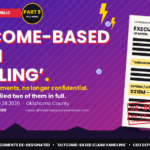
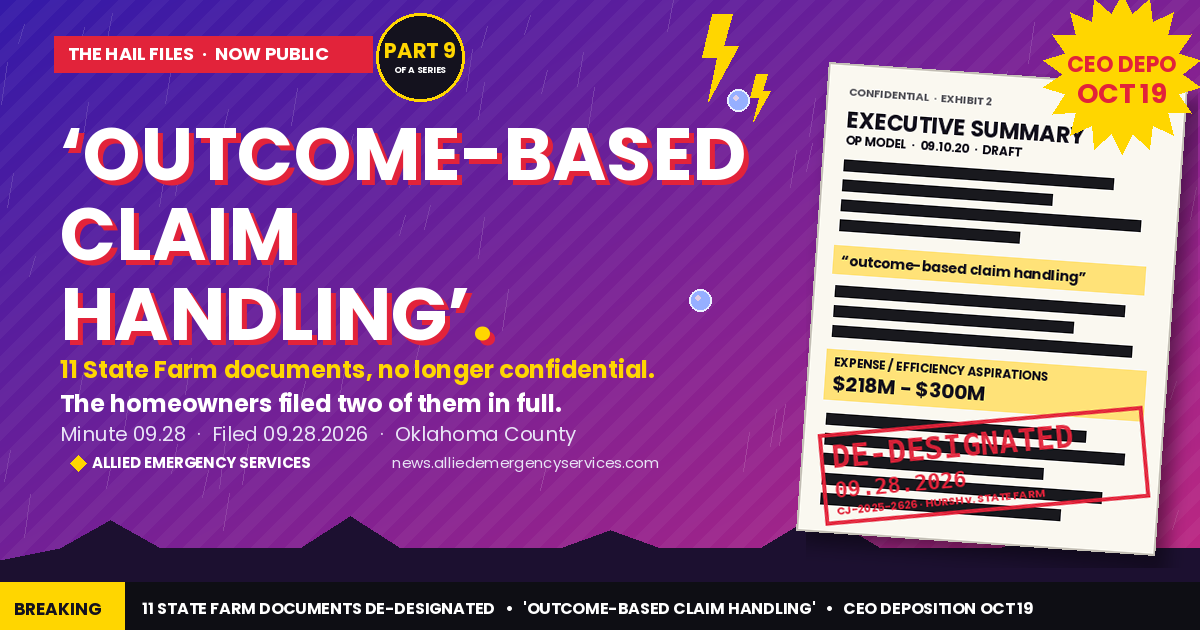
What happened, in one sentence: On September 28, Oklahoma County Judge Amy Palumbo removed the “confidential” label from 11 State Farm documents in Hursh v. State Farm, and by 4:59 that afternoon the homeowners had filed two of them in full — a September 2020 “Executive Summary — Op Model” that lists “outcome-based claim handling” and “expense / efficiency aspirations” of $218 million to $300 million, and a June 2021 claims-quality report that counts a falling ratio of total to partial roof replacements among “quality indicators trending positively.”
Status: De-designation means the documents are no longer confidential; it is not a ruling on what they mean. State Farm, in a filing that does not address these documents, calls the homeowners’ theory false and says its roof-claim initiative was about accuracy and quality. Thirteen more documents are under advisement, according to The Oklahoman, and trial is set for December 7. The homeowners’ filing, with both documents attached, is hosted in the Hail Files archive, along with the court minute and State Farm’s newest motion.
For months, the homeowners in Hursh v. State Farm have described State Farm’s internal documents from behind black boxes and sealing orders. On Monday afternoon, two of them came out whole.
The first is a 31-page deck stamped “DRAFT – For Discussion Purposes Only,” circulated by email to State Farm’s claims operations vice presidents in September 2020, laying out a new operating model for property and casualty claims. One page sets out three “horizons” of change. Under the first: “Claim classification informs skill-based routing and outcome-based claim handling.” At the bottom, in a row labeled “EXPENSE / EFFICIENCY ASPIRATIONS”: “$218M – $300M.”
The second is a three-page State Farm report titled “P&C Claims Fire Claim Quality,” dated June 2021. Under “Other quality indicators trending positively,” it lists: “May 2021 Total Roof to Partial Roof Replacement down from 4.1 in June 2020 to 2.3 in May 2021” and “Wind/Hail estimate payment bands over $10,000 decreased 13% YOY.”
The homeowners say the two documents show State Farm’s executives planned and then measured a program to pay less on roof claims. State Farm had not responded to the filing as of September 30. In a motion filed the same minute, which does not address these two documents, it calls the homeowners’ theory of a “scheme” wrong and describes the roof-claim initiative they tie to the numbers as an effort to make wind and hail claims more accurate. What follows is what the documents say, what each side says they mean, and what happened in the same 48 hours: a fight over another executive’s deposition, a new date for the CEO’s, and four more roofing subpoenas State Farm withdrew.
What did the judge make public?
The ruling is a one-page court minute, handwritten and signed by lawyers for both sides and by the judge after the September 28 hearing on the homeowners’ motion to strike State Farm’s blanket confidentiality designations. It reads: “This Court de-designates 11 documents: Exhibits 10, 11, 12, 15, 17, and 19; Exhibits 4-6 and 12 to Plaintiffs’ Reply ISO De-Designation; and Exhibit 16 to Plaintiffs’ Supplemental Authority Regarding Plaintiffs’ Motion to De-Designate.” The docket records the motion as “granted in part as per journal entry and court minute.” Read the minute.
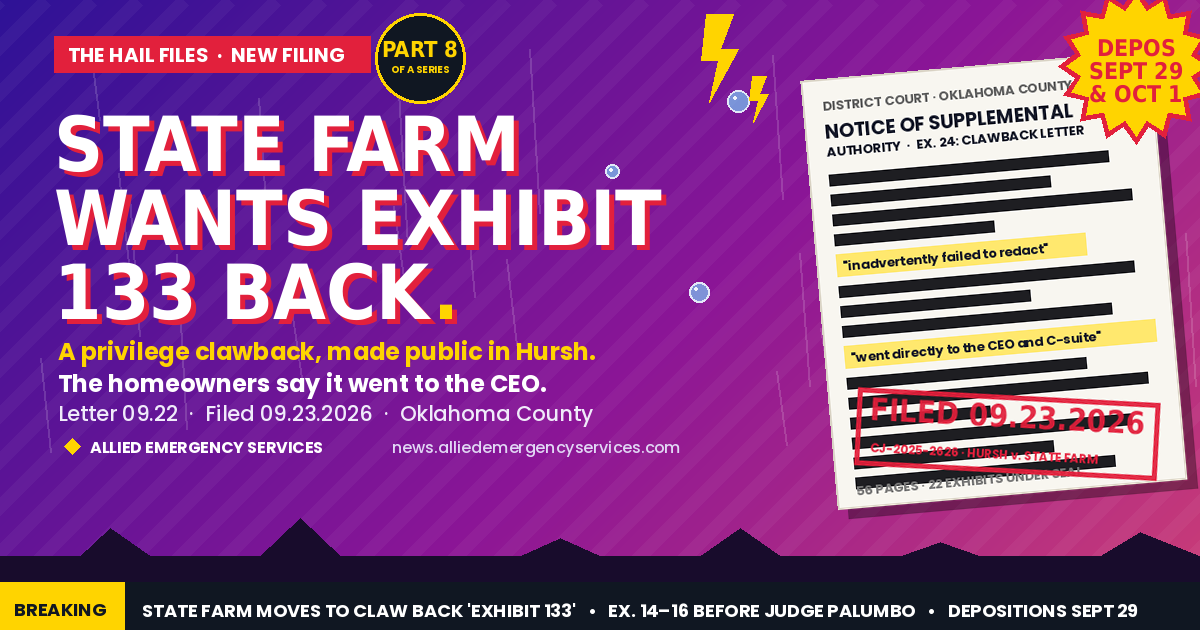
The homeowners’ September 23 filing had narrowed the fight to 24 documents: eight exhibits left from their original August 4 motion, thirteen from their reply brief and three new ones, Exhibits 14, 15 and 16 (Part 8). The minute frees six of the eight, four of the thirteen and one of the three. That one is Exhibit 16, the operations model behind the homeowners’ “$218-$300 million” figure. Supplement Exhibits 14 and 15 are not on the list. Exhibit 14, the homeowners say, is the Hursh copy of the document State Farm is clawing back as privileged in the Comanche County case, where it was marked Exhibit 133.
The Oklahoman reported that Judge Palumbo took the other 13 documents under advisement and warned State Farm: “From this point forward, every time we’re together, I’m going to be asking about this, because as far as I’m concerned, State Farm’s inability or unwillingness to comply with the orders of this court is putting you in very dangerous sanction territory.” State Farm’s lawyer, Lance Leffel, told the court: “There’s no ill will. This idea that this is all being done for delay is just not true.”
De-designation removes the confidential label so a document can be used in open court and in public filings. It is not a finding about what the document proves, and it does not decide whether a jury will see it.
What is the 2020 “Op Model” document?
It arrives with a cover email. On Friday, September 11, 2020, Wensley Herbert — then one of State Farm’s operations vice presidents, now its senior vice president over property and casualty claims (he testified he took that role in October 2021), and deposed in both Oklahoma cases — wrote to a distribution list of claims operations vice presidents and to the senior vice president he then reported to: “Since our last showcase which focused on the conceptual view of the Op Model, we have been working on the next two phases and have started Phase 3.” The following Tuesday’s meeting would review “the strategy refinement and the initiative view by horizon,” and “The Exec leads (Carol, Kathy, Cheryl and Matt) will join us for that discussion.”
Six days later, on September 17, Kathy Ress, a State Farm vice president copied on that email, forwarded it to Nicole Manduca with the attachment “Next Phase of Claims OVP Check In 9112020.pdf” and one line: “Please do not forward.” Manduca, then a claim manager and now a director, says in a declaration that she was part of State Farm’s Wind/Hail Fire Model Enhancement; the homeowners call her its leader. She is one of the two people the homeowners’ September 23 filing said would testify as State Farm’s corporate representatives in Judge Palumbo’s courtroom this week.
The attachment is titled “Executive Summary — Op Model — 09.10.20,” and its pages are stamped “STATE FARM CONFIDENTIAL INFORMATION.” The page the homeowners quote, Bates-numbered HUR00156103, is headed “The three ‘Landing Points’ were leveraged to assess detailed work packages & initiatives and ensure iterative progress through execution.” It reads, in part:
| Horizon 1 | “Move coverage (and liability) decisions earlier in the lifecycle through insights acceleration and workflow integration” · “Claim classification informs skill-based routing and outcome-based claim handling.” · “Auto & Fire Model Enhancement teams are optimized for ‘specialized handling’ footprint” · “Claim characteristics are analyzed at intake to predict exposure & path” |
| Horizon 2 | “Vendors are empowered to make decisions and pass conclusions along to move claim forward” · “Estimators and vendor footprint is optimized to maintain and increase virtual inspection %” · “Leadership intervention and escalation will be surfaced based on claim characteristics to allow narrowed yet prioritized management structure” |
| Horizon 3 | “Delivery of instant claim valuation greatly reduces manual evaluation” · “Coverage and liability decisions not requiring specialization are automated” |
| “Expense / Efficiency Aspirations” | Horizon 1: “$218M – $300M” · Horizon 2: “$325M – $500M” · Horizon 3: “TBD” — with the note “Horizon 1 $ are relative to 2020 budget” |
Other pages fill in the strategy. An intake page says “Core claim decisions (coverage, liability, damage repair, etc.) will be made at 1st interaction,” lists “Labor expense reduction through increased STP” as an outcome and sets a target of “35-40% touchless claims.” A damage-and-repair page covering vehicles and homes plans a “Contractor/Vendor Network for Home/Business,” aims to “Increase Preferred contractor utilization” and sets the objective “95% of repairs go through virtual or preferred vendor options.” A vendor page targets a “20-50% unit cost reduction for field inspection.” A roadmap lists “Hail Damage Analysis” and “Automated Wind/Hail Workflow” among first-horizon projects. And a goals page sets claims headcount of 26,880 under “Current” against 13,500 to 16,500 under “Future Potential,” with field staff (“Field / Proximity”) going from 4,000 to 500.
The deck itself does not mention Accenture. The homeowners say the consulting firm was involved in developing it (an earlier filing said Ress testified as much), and that the email’s “Exec leads” line shows Ress “was one of four Vice Presidents who served as an executive lead on State Farm’s work with Accenture.”
Whose money is the $218 million to $300 million?
This is the question the trial may turn on, and the page does not answer it directly.
The homeowners’ reading: Their September 28 notice calls the deck “blatant bad faith plotting to reduce claim payouts.” They argue that “this same operations model is where the ‘Fire Model Enhancement’ or ‘FME’ is developed and implemented to reduce claim payments for an ‘efficiency aspiration’ to the tune of ‘$218M-$300M’ in the pockets of State Farm,” and that the Horizon 2 bullet on “leadership intervention” is “what becomes team manager review required of full roof replacements,” tied to the “$325M-$500M” figure. “Engaging in outcome-based claim handling to save State Farm $218-$300 million dollars on claims that have not happened yet,” they write, “is the most adversarial conduct an insurance company could engage in.” They also argue that a plan like this “cannot be considered privileged.”
What the deck itself says: The figures sit in a row labeled “Expense / Efficiency Aspirations,” with a note that the Horizon 1 dollars are “relative to 2020 budget.” Another page defines the deck’s “EXPENSE / EFFICIENCY” goal as “Market Leading Loss Adjustment Expense (LAE) & Operating Excellence,” broken into “Reduce Direct Labor Expense,” “Increase Productivity / Speed of Delivery” and “Reduce Non-Labor Expense,” and puts loss adjustment expense — the cost of handling claims — at about $7 billion now (“LAE: 11 (~$7B)”) against a “Future Potential” of $4.4 billion to $5.5 billion. A separate goal on the same page reads “ACCURACY — Pay What We Owe.” No page breaks down the $218 million to $300 million, and the deck does not say whether any part of it is money not paid on claims, as opposed to money not spent handling them. “Outcome-based” appears once on the page, in a bullet about how claims are classified and routed, and the deck does not define it.
State Farm’s position: In a motion filed the same afternoon, which does not address the two documents, State Farm described the Fire Model Enhancement as “an effort by State Farm to improve the accuracy and quality of its wind/hail claim handling by conducting additional training, increasing management involvement, and improving file documentation.” It wrote that the homeowners “(wrongly) allege” a “scheme” “to lower indemnity payments by, inter alia, misattributing roof damage from storms to non-covered ‘wear and tear,'” and called their theories “false.” A declaration from Manduca attached to that motion says “The FME focused on quality claim handling and ways to improve consistency in handling wind/hail claims through training and documentation.” Ress testified in August, in excerpts State Farm filed on September 14, that she did not believe State Farm engaged in the “outcome-based claims handling” the homeowners’ lawyer described, and that the 2020 manager-review step for roof claims was added for accuracy during Covid-era staffing shortages and record catastrophe volume (read those excerpts). In a statement to The Oklahoman, State Farm said it evaluates each claim based on the facts and coverage purchased and that “From 2024 through 2025, we have paid more than $1 billion to Oklahoma customers for wind and hail damage.”
What does the June 2021 roof report say?
The second document, Bates-numbered HUR00031476-78, is a June 2021 update on State Farm’s “2021 Fire Property Claims Quality Plan,” which it says “outlines specific tactics to address quality opportunities” and aims “to improve accuracy across fire claims.” (In State Farm’s usage, “fire” claims include homeowners wind and hail claims, as Herbert confirmed in testimony State Farm filed this week.) Its sections are organized by operations leader; the first is headed “Fire Weather: Ress.”
That section opens: “Coverage analysis is the strongest area of improvement, yet remains the largest area of opportunity related to FED $.” It reports a reinspection error target of “7.8%, or a 20% improvement from 9.75%.” Then:
| “Other quality indicators trending positively” | “May 2021 Total Roof to Partial Roof Replacement down from 4.1 in June 2020 to 2.3 in May 2021” · “Wind/Hail estimate payment bands over $10,000 decreased 13% YOY” · “Wind Cat/NCAT CWP/Reported ratio is up 7.7 at 32.3 R12 … Hail Cat/NCAT CWP/Reported ratio is up 15.7 at 34.7 R12” · “Virtual Inspection” |
| Top drivers of errors (staff) | “Paying for non-covered roof damage” · “Reconciling the contractor’s estimate related to finish carpentry (freeze losses)” · “Roof estimates reflect covered damages per the scope” |
| “Roofing Skills Assessment” gaps | “Xactimate Category/Selector Codes (e.g. skylight trim)” · “Application of Appropriate Roof Waste Factor” · “Identifying Hail Resistive Roofing Material” |
| Actions under “Fire Model Enhancement” | “Wind/Hail guidelines with TM intervention for total roof replacements on small hail/light wind.” · “Fire Data Accuracy Dashboard spot-check reviews for ‘TM Approvals’ on small hail, light wind and age & condition (specified states).” · recalibration sessions “on repair/replace and reasonable consistent appearance” |
| Leadership reviews | Spot-checks “with focus on CWP to Payments ≥ $2500 (5 reviews) and Total Roof Reason Codes (5 reviews)” · a monthly meeting “to review overturned roof calls” |
| Another operations area | “Primary focus is on coverage and repair versus replacement damage evaluations” · “TM authority required on wind less than 50 MPH and hail less than 1″” |
The homeowners’ reading: “State Farm leadership is openly bragging about total roof payments decreasing, and calling that positive, including tracking how many claims closed without payment (‘CWP’).”
The report’s own framing is a quality plan measured by reinspection results. It lists “Paying for non-covered roof damage” first among the drivers of its error results, but it also schedules training “based on under-scoping reinspection analysis” and says “Scoping covered damages needs improvement.” It does not define “FED,” “CWP” or the total-to-partial roof ratio; “closed without payment” is the homeowners’ reading of CWP. Whether falling full-roof ratios and fewer large wind and hail estimates reflect more accurate claim handling or underpayment is exactly what the two sides dispute.
Why did the homeowners file them now?
The notice says it is meant “to bring clarity to and correct the records at multiple hearings before this Court.” That includes the September 1 hearing on State Farm’s bid to keep CEO Jon Farney from being deposed, where, in the homeowners’ words, State Farm argued its CEO “has no knowledge of State Farm’s bad faith tactics and outcome-based claim handling.” (State Farm’s own evidence is narrower: a Manduca declaration says “Mr. Farney also did not attend FME meetings, which were held regularly.”) Judge Palumbo ordered the Farney deposition anyway, within 30 days. The notice gives a newly disclosed date, later than that window, without saying why: Farney’s deposition “is currently scheduled to take place on October 19, 2026.”
The documents, the notice says, are “crucial due to numerous State Farm executives’ depositions taking place in Judge Palumbo’s courtroom,” and the homeowners intend to use them “to shed light on contradictory statements made by State Farm’s attorneys in court and by the State Farm executives whose testimony has differed greatly between this case and the West case in Comanche County.” It points to an October 2025 State Farm motion that said “Ms. Ress has no unique knowledge of the facts and circumstances surrounding Plaintiffs’ insurance claims,” and sets it against the 2020 email naming “Kathy” as an “Exec lead.”
State Farm wants to stop another executive’s deposition
Filed at the same minute as the homeowners’ notice, 4:59 p.m. on September 28, State Farm’s motion asks Judge Palumbo for a protective order and to quash the homeowners’ notice to depose Michael Keating, a State Farm operations vice president. State Farm says Keating “was not involved in the handling of Plaintiffs’ claims, nor did he directly supervise any person who was involved in the insurance claims,” and that an executive at his level cannot be deposed unless he has unique personal knowledge that is not available some other way. It notes the case “arises from two insurance claims for approximately $22,000.00 in combined alleged damages to a single insured property,” that the homeowners have received “over 110,000 State Farm documents (along with over 600,000 documents State Farm produced in other cases),” and that the court has already ordered a 30-topic corporate deposition and depositions of eight current and former employees, the CEO among them. A deposition, it says, would take Keating “multiple days to prepare for and attend,” and the demand “appears intended to harass State Farm and coerce abusive settlements.”
In a declaration, Keating says he is an operations vice president “with responsibility for fire property claims” and has held his current position since October 2021 (State Farm’s brief says he did not have responsibility for fire property claims until June 2023); that “There are multiple levels of management between my position and the claims teams that adjust claims”; and: “I was not involved in the FME. For nearly a decade prior to June 2023, my roles involved only auto claims.” State Farm says the one subject the homeowners have tied to Keating, a group it calls the Fix Profit Task Force, is “a group created to monitor enterprise-wide trends on a monthly basis that has nothing to do with the allegations in this case or the FME.”
State Farm filed two amended versions on September 29, at 12:01 p.m. and 2:59 p.m. Both add an exhibit the original lacked, an excerpt of Herbert’s deposition in the Comanche County case, and the second also corrects a transcript citation. In the excerpt, Herbert testifies that Keating was part of the task force (whose meetings, State Farm’s brief acknowledges, Farney attended) and, asked about Keating’s role in homeowners wind and hail claims over the last five years: “He just has operational responsibilities for fire claims.” Asked whether that includes wind and hail claims on homeowners: “Yes, all fire claims.” State Farm cites the excerpt to show the homeowners asked Herbert about Keating only in connection with the task force.
Keating testified for State Farm, as its operations vice president, before a U.S. Senate subcommittee on May 13, 2025, at a hearing examining insurers’ claims practices after natural disasters (his written testimony). As of September 30 the homeowners had not responded on the docket, and the court had not ruled. Read the amended motion · the original.
State Farm subpoenaed four more roofing and gutter witnesses — and withdrew
On September 29, State Farm filed four notices withdrawing subpoenas it had issued on September 11. They went to Diamond Gutter Company, LLC (for a deposition and records), R Turley Roofing, Inc., Republic Roofing Company, Inc., and a roofer at an Oklahoma City roofing company (for a deposition and records). Three withdrawals are dated September 24 and one September 29. Each says State Farm “reserves the right to re-issue in the future, if necessary.” None gives a reason. It is the second round in this case: on September 15, State Farm withdrew a subpoena it had served on another roofing company in August. In the Comanche County case, State Farm deposed a roofing contractor on September 10 (Part 3).
For contractors, the practical point: roofers’ estimates, photos and inspection notes can become evidence in these cases, and either side can seek them by subpoena.
What Accenture told the court
Accenture, the consulting firm the homeowners have subpoenaed (Part 5), filed its opposition on September 25. It says it “was retained to help State Farm analyze and improve its claims handling processes for several different types of insurance claims as part of State Farm’s Fire Model Enhancement,” that its wind and hail work “was a very small part of this engagement and lasted only a few months from April to July 2020,” and that “Contrary to Plaintiffs’ inflammatory assertions, Non-Party Accenture was not involved in some kind of conspiracy to reduce payouts to policyholders.” It says it “did not handle any of State Farm’s claims” and understood “that all claims were and would be handled by State Farm based on the merits of the claims.”
On the “Industry Best” benchmark at the center of the homeowners’ privilege argument in Part 8, Accenture says that kind of analysis “was not within the scope of Accenture’s engagement and therefore Non-Party Accenture does not have any responsive material.” Its filing acknowledges the homeowners’ claim that Manduca testified she received industry best benchmarks from Accenture, saying that even if true it doesn’t show Accenture has the underlying data, and a September 21 email from Accenture’s counsel, attached to the filing, says Accenture “provided information that was incorporated in certain PowerPoint presentations relating to the frequency of full roof replacement resulting from hail damage.” It also argues the subpoena was served in the wrong state: Accenture is incorporated in Illinois, where it has filed its own motion to quash, and most of its State Farm work product sits on State Farm’s systems. The motion to compel has not been ruled on. Read Accenture’s response.
Meanwhile, the Attorney General’s case survives
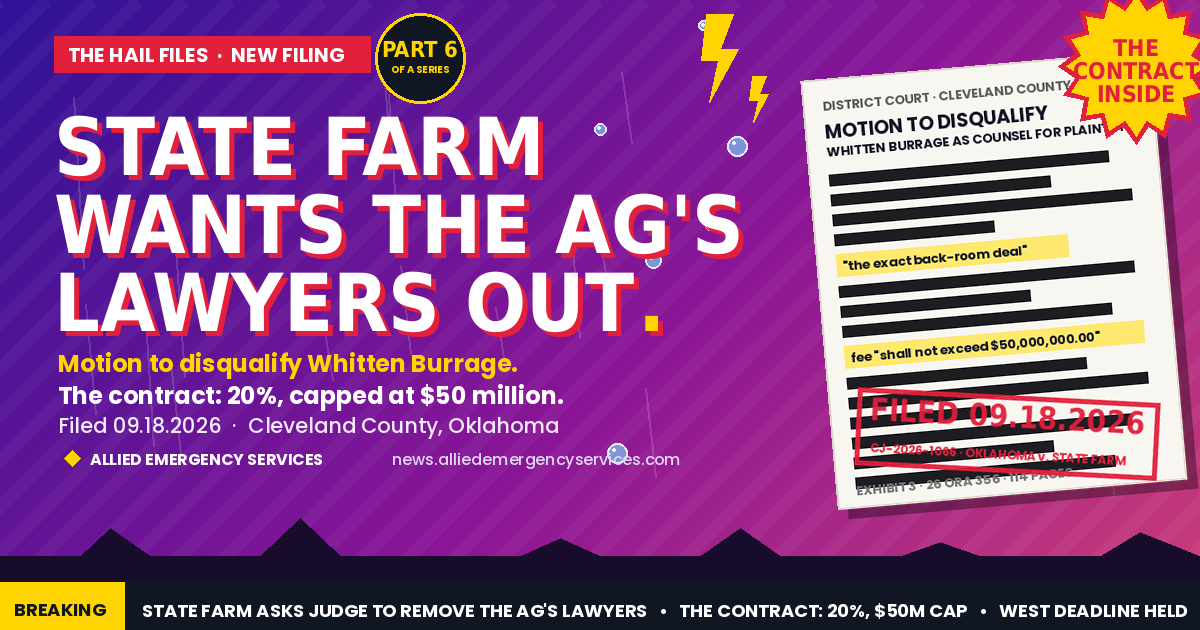
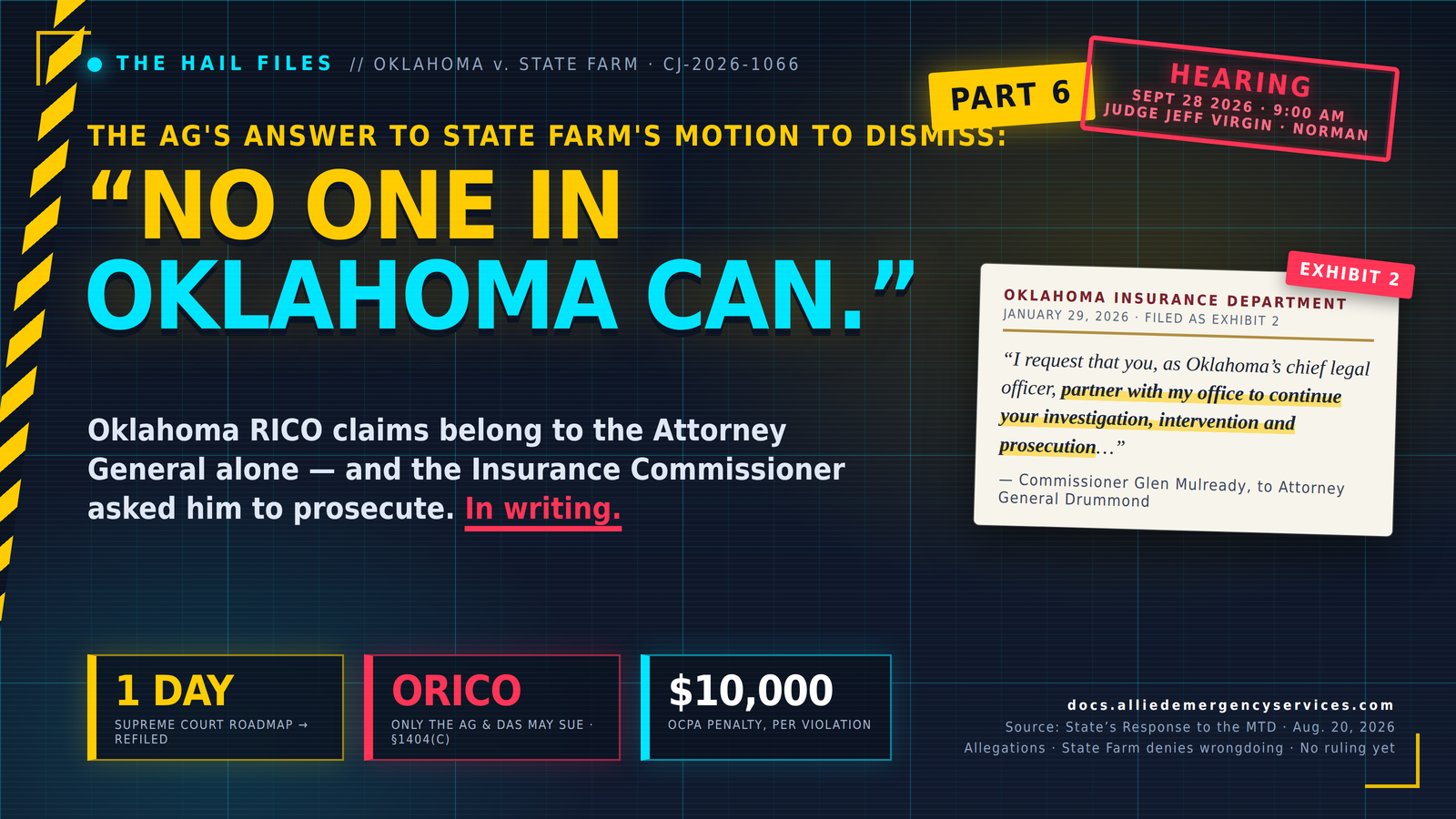
The same Monday in Norman, Cleveland County District Judge Jeff Virgin denied State Farm’s motion to dismiss the State of Oklahoma’s lawsuit, according to The Journal Record and the Property Insurance Coverage Law Blog; the written order had not reached the public docket as of September 30. The suit alleges violations of the Oklahoma Consumer Protection Act and the state’s racketeering law, along with civil conspiracy and unjust enrichment. A denial lets the case go forward; it is not a finding that the allegations are true, and State Farm denies them. State Farm’s motion to disqualify the Attorney General’s outside lawyers, Whitten Burrage, who also represent the Hursh homeowners, is set for November 9 (Part 6).
What does this mean for Oklahoma homeowners?
Two State Farm documents are now public, and both sides may argue about them at trial, if the judge allows it, starting December 7. Until then they are exhibits, not verdicts: the homeowners’ descriptions are arguments, State Farm’s are too, and the judge has ruled only that the documents are not confidential.
For policyholders with their own storm claims, the practical facts are unchanged: the allegations in these cases are allegations, State Farm disputes them, and a policyholder’s own claim is governed by their own policy and their own insurer’s decisions.
What happens next
This week: the courtroom depositions of State Farm’s corporate representatives, scheduled for September 29 and October 1 (no public account of the first session yet). Pending: the 13 documents under advisement, State Farm’s motion to block the Keating deposition, Accenture’s challenge to the subpoena, and the Exhibit 133 clawback. October 15: the Hursh deadline for dispositive motions and expert disclosures. October 19: CEO Jon Farney’s deposition, according to the homeowners’ filing. October 22: the West pretrial conference in Comanche County. November 9: the disqualification hearing in the Attorney General’s case. November 19: the Hursh pretrial conference. December 7: the Hursh trial. All of it is on the Trial Watch page.
Read the documents
The homeowners’ September 28 notice, with both de-designated documents attached in full (Exhibit 1: the June 2021 “P&C Claims Fire Claim Quality” report, HUR00031476-78; Exhibit 2: the September 2020 email and “Executive Summary — Op Model,” HUR00156099 onward) · The September 28 court minute · State Farm’s amended motion to quash the Keating deposition (with the Keating and Manduca declarations and the Herbert excerpt) · the original motion · Accenture’s response to the motion to compel · State Farm’s withdrawal notices: Diamond Gutter, R Turley Roofing, Republic Roofing (a fourth, to an individual roofer, is in the archive) · Motion to admit another Alston & Bird lawyer for State Farm · The homeowners’ September 23 supplement · Search the full archive.
Earlier in this series: “The Denial Enterprise” · Part 3: State Farm is deposing the roofer · Part 4: Two Trials, 800,000 Pages · Part 5: The Accenture Motion · Part 6: State Farm Asks a Judge to Throw the Attorney General’s Lawyers Off the Case · Part 7: State Farm Wants Out of Lawton · Part 8: “A Little Worried”.
Frequently asked questions
In a handwritten court minute in Hursh v. State Farm (Oklahoma County, CJ-2025-2626), Judge Amy Palumbo de-designated 11 documents, removing their confidential status: Exhibits 10, 11, 12, 15, 17 and 19 to the homeowners’ August 4 motion; Exhibits 4-6 and 12 to their reply; and Exhibit 16 to their September 23 supplemental filing. The same afternoon the homeowners filed two of them in full: a June 2021 State Farm “Fire Claim Quality” report and a September 2020 “Executive Summary — Op Model.” Exhibits 14 and 15 to the supplement, including the document State Farm is clawing back as privileged in West v. State Farm, were not on the list; The Oklahoman reported 13 documents were taken under advisement.
The phrase appears in a September 2020 State Farm operations-model deck, in the bullet “Claim classification informs skill-based routing and outcome-based claim handling.” The deck does not define it. The Hursh homeowners argue it shows State Farm planned to reduce claim payouts before claims occurred. State Farm disputes that, describes its roof-claim initiative as an effort to improve accuracy and quality through training, management involvement and documentation, and a State Farm vice president has testified she did not believe the company engaged in outcome-based claims handling.
It is the first of three “Expense / Efficiency Aspirations” on a page of State Farm’s September 2020 “Executive Summary — Op Model”: $218M to $300M for Horizon 1, $325M to $500M for Horizon 2 and “TBD” for Horizon 3, with a note that Horizon 1 dollars are “relative to 2020 budget.” Another page defines the deck’s expense and efficiency goal as “Market Leading Loss Adjustment Expense (LAE) & Operating Excellence” — loss adjustment expense being the cost of handling claims — next to a separate goal, “Pay What We Owe.” The homeowners in Hursh v. State Farm say the figures represent planned reductions in claim payments; no page of the deck breaks them down. State Farm disputes the homeowners’ allegations.
The report, titled “P&C Claims Fire Claim Quality,” lists among “quality indicators trending positively” that a total roof to partial roof replacement measure fell “from 4.1 in June 2020 to 2.3 in May 2021” and that “Wind/Hail estimate payment bands over $10,000 decreased 13% YOY.” It describes team-manager intervention for total roof replacements on small hail and light wind, and one section requires team-manager authority on wind under 50 mph and hail under 1 inch. The homeowners say it shows State Farm celebrating lower roof payments; the report presents the figures as part of a quality and accuracy plan that also targets under-scoped estimates.
According to the homeowners’ September 28, 2026 filing in Hursh v. State Farm, CEO Jon Farney’s court-ordered deposition is scheduled for October 19, 2026. Judge Amy Palumbo denied State Farm’s motion to excuse him from deposition on September 1, 2026, limiting it to four hours. State Farm has separately moved to block the deposition of operations vice president Michael Keating; that motion has not been ruled on.
Yes. Court filings show State Farm issued deposition subpoenas on September 11, 2026 to Diamond Gutter Company, R Turley Roofing, Republic Roofing Company and an individual roofer in Oklahoma City, then withdrew all four in notices filed September 29, reserving the right to re-issue them. State Farm also withdrew a subpoena to another roofing company on September 15. No reason was given in the notices.
About this report. Everything above is drawn from public court records in Oklahoma County No. CJ-2025-2626: the September 28 court minute; the homeowners’ September 28 notice of supplemental authority and its two exhibits, quoted from the documents themselves; State Farm’s September 28 and 29 motions on the Keating deposition, with the Keating and Manduca declarations and the Herbert excerpt; Accenture’s September 25 response; and State Farm’s subpoena withdrawal notices. All are read in full and hosted, unaltered, in the Hail Files archive. Background comes from State Farm’s September 14 filing in Comanche County No. CJ-2025-135 (the Ress excerpts), Keating’s May 13, 2025 Senate testimony and earlier reports in this series. The hearing remarks and State Farm’s statement are from The Oklahoman; the Cleveland County ruling is from The Journal Record and the Property Insurance Coverage Law Blog. Where the report describes what the homeowners say, those are their characterizations; where it describes State Farm’s or Accenture’s positions, it quotes their filings. De-designation is not a finding on the merits. Allegations in the underlying lawsuits are allegations that State Farm disputes.
About the host. Allied Emergency Services is a licensed storm-damage restoration contractor serving Illinois, Wisconsin, Indiana and Michigan — not a law firm, insurance adjuster or public adjuster, and this report is not legal or insurance advice. We inspect, document, provide insurance-ready repair estimates and complete repairs; coverage decisions always belong to you and your insurer. Founded 2015; in the building trades since 1999; Illinois-licensed. 24/7: (800) 792-0212.
⚡ Storm or Roof Damage? Get a FREE Estimate
Text ESTIMATE to (844) 907-2546
Or call (800) 792-0212 for 24/7 emergency response
AI-powered • No obligation • Licensed IL & WI
Storm damage? Start with the documentation
Allied Emergency Services — IL-Licensed Storm Damage Restoration Contractor
Founded 2015, in the building trades since 1999. Allied inspects and documents storm damage, writes the scope and estimate, and does the repairs. We do not adjust or negotiate insurance claims — that is the job of your insurer, a licensed public adjuster, or an attorney. IICRC-certified, EPA Lead-Safe, IL Licensed Roofing Contractor #104.019029. 24/7 emergency response.
How the storm-damage insurance claim process works →Free inspection within 24 hours · No obligation · Photo-documented findings you can share with your insurer
Attorneys: forensic storm damage documentation & construction expert consultation for counsel →