

⚡ Storm or Roof Damage? Get a FREE Estimate
Text ESTIMATE to (844) 907-2546
Or call (800) 792-0212 for 24/7 emergency response
AI-powered • No obligation • Licensed IL & WI
Oklahoma City — October 23, 2026 · The Hail Files, Part 14
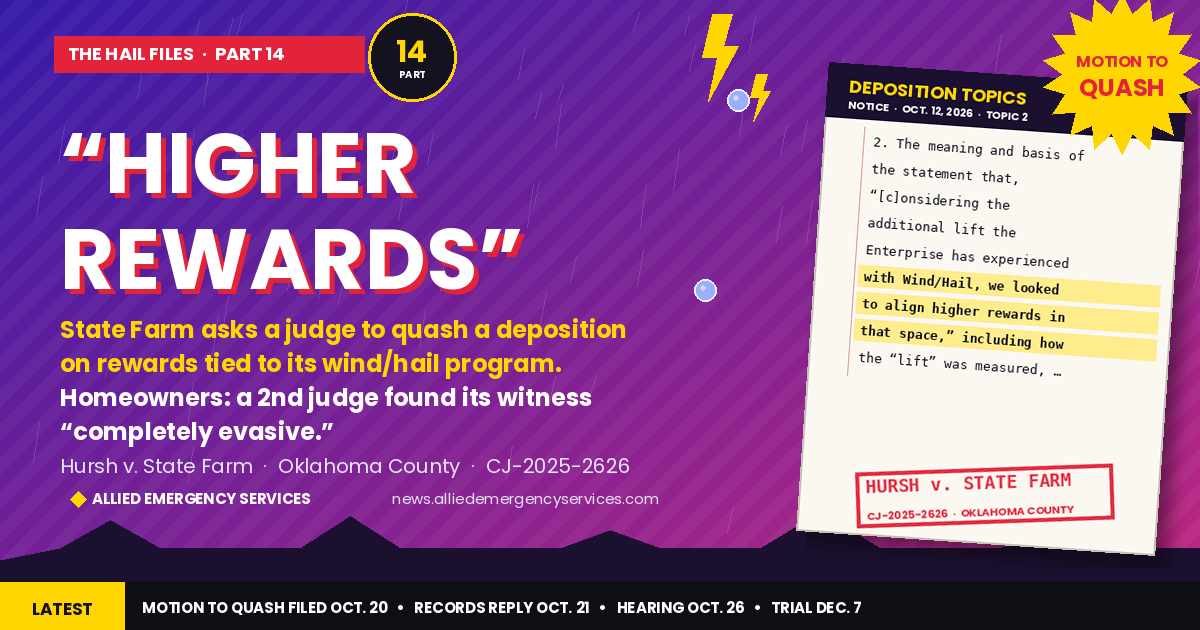
What happened, in one sentence: State Farm has asked Oklahoma County District Judge Amy Palumbo to quash a deposition notice in Hursh v. State Farm that seeks sworn testimony about “rewards” tied to its wind and hail claims program, a notice that cites November 2021 State Farm “Reward Recommendations” for wind/hail and asks what was meant by the statement “we looked to align higher rewards in that space”; State Farm says it “does not compensate its employees based on claim outcomes or payments to insureds” and calls the notice an attempt to “harass, intimidate, and needlessly burden” the company.
Status: State Farm filed the motion October 20, the day the deposition was noticed to begin, together with its opposition to the homeowners’ motion over its electronic records; the homeowners replied on the records motion October 21, and the judge let them file two responses under seal. In an October 19 filing, the homeowners told the court that a Comanche County judge had found “completely evasive” the same State Farm corporate witness whose answers Judge Palumbo called “absolutely evasive behavior” on October 1. As of the October 22 docket check, the judge had not ruled on the motion to quash or the records motion. The filings give each side’s arguments; the homeowners’ allegations are allegations State Farm denies, and nothing described here has been decided unless the report says so.
Key facts
- The case: Hursh v. State Farm Fire and Casualty Co., Oklahoma County District Court No. CJ-2025-2626, before Judge Amy Palumbo. As of the October 22 docket check, a seven-day jury trial is set to begin December 7, 2026.
- October 12, 2026: The homeowners notice a new deposition of a State Farm corporate representative on 13 topics about rewards connected to State Farm’s Fire Model Enhancement (FME) wind/hail program.
- October 16, in another case: According to the homeowners, Comanche County Judge Grant Sheperd found in West v. State Farm that State Farm’s corporate witness “was completely evasive [and] non-responsive to a majority of [c]ounsel[‘s] questions.”
- October 20: State Farm moves to quash the notice and for a protective order, and asks that any such deposition wait until it has “exhausted its appellate remedies.”
- The records fight: State Farm says it produced 110,918 documents with load files and metadata; the homeowners say “State Farm’s declarations contradict themselves.”
- Next: As of the October 22 docket check, State Farm’s motion to reconsider the October 1 order extending its corporate representative’s deposition is set for a hearing October 26 at 10 a.m.
The question is Topic 12 of a deposition notice that State Farm has now asked a judge to throw out: whether State Farm “maintained any metric, reward, goal, or recognition for correctly paying or fully paying a meritorious wind/hail roof claim, or for underpayment identified and corrected — and if not, the reason none existed.”
The notice, served October 12 by lawyers for Billy and Lacy Hursh, asks State Farm to produce a corporate representative to testify about “rewards” connected to the Fire Model Enhancement, the wind and hail claims program at the center of the Hursh case and the other Oklahoma lawsuits against the company. It points to a set of State Farm communications dated November 24, 2021, titled “FME – Wind/Hail and Water – Our Reward Recommendations,” and it asks for “[t]he meaning and basis” of a statement it quotes: “[C]onsidering the additional lift the Enterprise has experienced with Wind/Hail, we looked to align higher rewards in that space.”
State Farm answered on October 20 at 4:43 p.m., the day the deposition was noticed to begin at 9 a.m., with a motion asking Oklahoma County District Judge Amy Palumbo to quash the notice and enter a protective order. “State Farm does not compensate its employees based on claim outcomes or payments to insureds,” the motion says. It calls the notice the homeowners’ “latest attempt to harass, intimidate, and needlessly burden State Farm,” and it says the discovery “is about harassing State Farm to force it into settling for an exorbitant amount—one that far exceeds the actual case value.” The motion does not say whether anyone appeared for the deposition that morning.
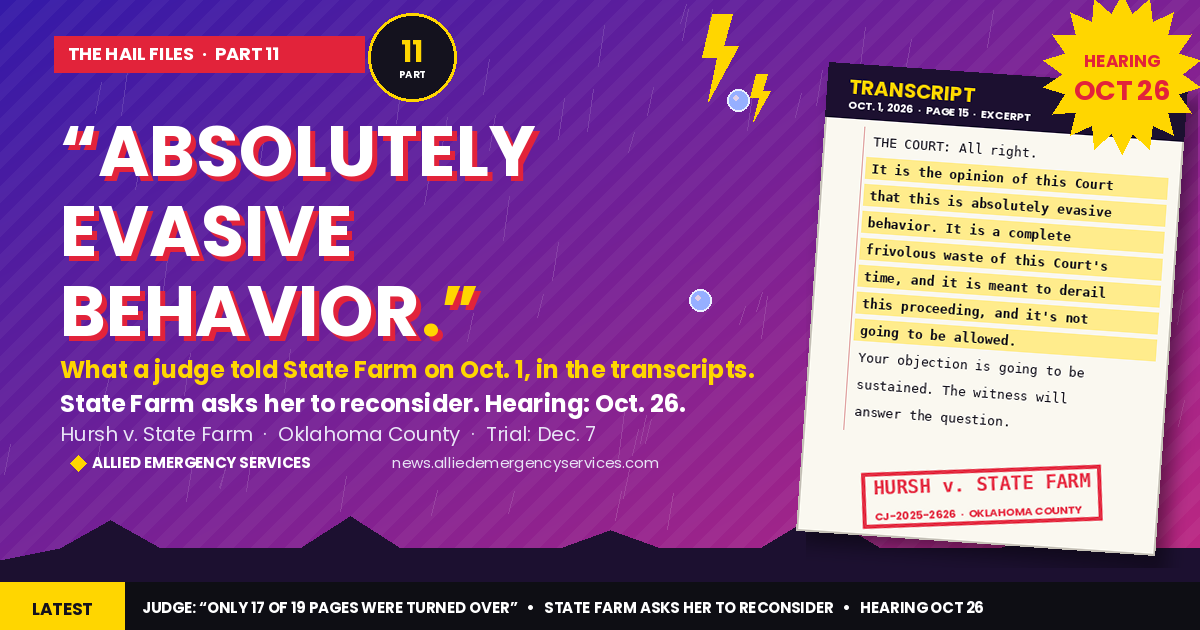
The fight over the notice comes as the homeowners press State Farm on a second front: the testimony of the corporate representative it has already produced. In an October 19 filing opposing State Farm’s bid to undo an October 1 order that extended that witness’s deposition, they told Judge Palumbo that a judge in Comanche County, “after reviewing the deposition of [the witness] via audio/video,” found on October 16 that “[t]he witness was completely evasive [and] non-responsive to a majority of [c]ounsel[‘s] questions during the deposition.” Judge Palumbo herself called the same witness’s answers “absolutely evasive behavior” at an October 1 hearing, according to transcripts State Farm filed. State Farm told the court there was “nothing at all ‘evasive'” about them.
Ten filings from October 19 to 21, including both of State Farm’s October 20 filings and the homeowners’ two October 19 responses, were added to The Hail Files archive on October 22, complete and as filed (links below).
What do the Hursh homeowners want State Farm to testify about?
Oklahoma’s discovery code, like the federal rules it mirrors, lets a party require a company to designate one or more people to testify on its behalf about listed topics; the company must prepare them with what it knows or can reasonably find out. The October 12 notice set that deposition for Tuesday, October 20, at 9 a.m., at a hotel in Normal, Illinois, near State Farm’s Bloomington headquarters, or at a court-reporting office in Oklahoma City. It lists 13 topics and asks for the documents the witness reviews to prepare. The topics include:
- The November 2021 reward recommendations (Topic 1): “[t]he creation, content, approval, and implementation of the November 24, 2021 ‘FME – Wind/Hail and Water – Our Reward Recommendations’ communications,” “including each recommended recipient, role, and amount, and who approved, modified, or paid each reward.”
- The “higher rewards” line (Topic 2): “[t]he meaning and basis” of the statement quoted above, “including how the ‘lift’ was measured, who measured it, and how it factored into reward amounts.”
- Every recipient (Topic 3): the identity of every State Farm “employee, manager, executive, officer, or vendor who received any reward connected to FME Wind/Hail,” with the amount, date, approver, funding source and stated reason, “from 2020 until the present.”
- The reward history (Topic 4): “[t]he full history of rewards provided to FME personnel,” citing a State Farm executive’s statement that “many have been provided” and that amounts should be considered “holistically.”
- Lawyers (Topic 5): “[a]ny consideration, discussion, bonus, or provision of a reward to in-house or outside counsel in connection with FME Wind/Hail,” including any “referenced in the November 24, 2021 reply,” “who proposed it, the outcome, and any amounts paid.”
- Payment metrics (Topic 6): “[t]he relationship, if any, between FME rewards and any metric measuring reduction in claim payments or indemnity, including the Fire Estimatic Difference (FED), net paid indemnity, severity, roof payment volume, the full-roof-replacement rate, and the total-to-partial (replace-to-repair) roof ratio.”
- Goals, quotas and pay (Topics 7–9): the policies, criteria and budget “for rewards tied to FME or to claims-handling outcomes”; “[a]ny goals, targets, quotas, scorecards, dashboards, or performance evaluations” for wind/hail claims personnel or managers “that measured, rewarded, or penalized indemnity reduction, roof-replacement rates, severity, or estimate size”; and “[a]ll communications” linking “FME savings, indemnity reduction, or claims-outcome metrics” to “compensation, rewards, bonuses, promotions, or recognition of claims personnel.”
- People and the Hursh claim (Topics 10–11): the reward history of four people named in the notice “and any others shown on the reward tables,” and whether anyone involved in “handling, reviewing, supervising, or deciding the Hursh wind/hail roof claim (or the unit/region that did)” received, was eligible for, or was evaluated under any FME-related reward, goal or metric. The notice names a State Farm section manager.
- Paying claims in full (Topic 12): the question that opens this report.
- The records (Topic 13): where the documents about FME rewards, budgets, approvals and metrics are kept, including “spreadsheets, dashboards, HR/compensation records, and personnel files.”
The November 24, 2021 communications are not attached to the notice or to State Farm’s motion. The notice identifies them by the numbers State Farm stamped on them when it produced them in discovery, and beyond the phrases it quotes, their contents do not appear in any filing reviewed for this report. The notice does not say which document contains the “higher rewards” statement or what “the additional lift the Enterprise has experienced with Wind/Hail” measured; that is what Topic 2 asks State Farm to explain.
What does State Farm say about rewards and bonuses?
State Farm’s motion describes the notice as “seeking exhaustive, wholly irrelevant information regarding purported employee bonuses and rewards tied to the Fire Model Enhancement (‘FME’) quality initiative that Plaintiffs pejoratively characterize as a corporate plan to pre-deny wind/hail claims.” It denies that any rewards touched the Hursh claim: “none of the individuals who handled Plaintiffs’ claim were involved with the FME or received any FME-related rewards or compensation.” And even if rewards had encouraged denials, which it says they did not, “it defies logic how payments that the individuals involved in Plaintiffs’ claim handling did not even receive could create any incentive that impacted Plaintiffs’ claim.”
The motion makes four main arguments:
- No permission for a second deposition. Oklahoma law requires leave of court, absent the parties’ written stipulation, to depose a person who “already has been deposed in the case,” and State Farm says that applies to companies too. According to State Farm, the homeowners have already questioned two State Farm corporate representatives for eleven hours on thirty topics, under a September 2, 2025 notice that State Farm says had “30 topics with 101 subparts, spanning 15 years of corporate operations,” and that notice’s Topic 13 already asked about “recommendations, compensation or bonuses” connected to tracking full roof replacements. The homeowners did not ask for leave, State Farm says, and “[t]he Court should quash the Notice for this reason alone.”
- Not relevant, not proportional. Citing the Oklahoma Supreme Court’s 2026 decision in Chick-fil-A, Inc. v. Ogden, State Farm argues that discovery must be tied to the parties’ actual claims and defenses, and that rewards to people who did not handle the claim are not. “Plaintiffs cannot simply say this case involves a roof claim and a purported scheme to deny claims and then seek any and all discovery about bonuses and rewards to State Farm personnel,” the motion says. It also calls Topic 13, on where the records are kept, improper “discovery on discovery.”
- Too vague. It calls terms such as “FME savings, indemnity reduction, or claims-outcome metrics,” “roof-replacement rates,” “full history of rewards” and “meritorious wind/hail claim” too vague to prepare a witness on.
- A stay. It asks the judge to stay the deposition “until after this Court resolves State Farm’s motion and State Farm has exhausted its appellate remedies,” because the cost of preparing a witness “cannot be undone if the Court later quashes the Topics.”
The motion also describes what the homeowners have already received: their claim files and policy documents, claims training materials since 2015, information from 2019 onward on the FME and wind/hail initiatives “including purported tracking of roof replacements, indemnity savings, and payment volumes,” six years of documents on “managerial approval requirements for full roof replacements,” and all documents previously produced or ordered in six other lawsuits. State Farm says it has produced “five witnesses totaling over thirty hours of testimony.” It describes the homeowners’ theory as a “purported ‘scheme’ within State Farm to lower indemnity payments by underpaying roof claims through the FME, focusing in particular on the requirement of managerial approval for recommendations of total roof replacement in certain situations,” and says that it “denies any such plan and disputes Plaintiffs’ mischaracterizations of the FME program and State Farm’s documents.”
The parties “have discussed the Notice and reached an impasse,” the motion says. As of the October 22 docket check, the homeowners had not filed a response and the judge had not ruled; the docket entry for the motion lists no hearing date.
What did a second judge say about State Farm’s corporate witness?
The witness at the center of the other fight is the State Farm corporate representative the homeowners questioned on October 1 in Judge Palumbo’s own courtroom, so the judge could rule on objections as they came up. That day, according to transcripts State Farm later filed, the judge told the lawyers, “It is the opinion of this Court that this is absolutely evasive behavior,” and signed a minute order that, according to the transcripts, the homeowners’ lawyers had prepared, allowing the deposition to continue “beyond six hours, as needed.” Part 11 has the transcripts.
State Farm asked the judge on October 14 to reconsider and stay that order. Its motion argues that the court never made the finding State Farm says the statute requires, that the witness or counsel had been “obstructive or uncooperative” (the statute also allows an extension “in the interest of justice”); that “there was nothing at all ‘evasive'” about her answers; and that the proper remedy for an evasive answer is an order compelling an answer, not a second deposition.
The homeowners’ October 19 response adds a second judge. Comanche County Judge Grant Sheperd, who is presiding over West v. State Farm, reviewed “the deposition of [the witness] via audio/video” and, in a written order dated October 16, 2026, found that “[t]he witness was completely evasive [and] non-responsive to a majority of [c]ounsel[‘s] questions during the deposition,” according to the response. The homeowners asked Judge Palumbo to take judicial notice of the order. “Plaintiffs do not ask the Court to adopt Judge Sheperd’s findings as binding,” they wrote; “they ask only that the Court recognize that a second Oklahoma court, reviewing a deposition of the same witness, reached the same conclusion this Court did.”
The copy of the West order attached to the response is partly illegible: much of its right side is black. Its legible fragments are consistent with the quoted sentence; they also mention a deposition protocol, the word “vacated,” the court’s availability by phone or Microsoft Teams, and a deposition on October 22, 2026, but not enough is legible to say what else the order decides. The West docket lists the order as available at the Comanche County court clerk’s office.
The response makes other points against reconsideration. It says the ruling rested on testimony read back to the judge and on her own questions, not on “attorney argument”; that after the judge’s directive the witness answered the disputed question directly; and that State Farm’s own emphasis on her preparation, roughly “75 hours,” “cuts against State Farm.” It offers to limit any further questioning to “an additional 3-4 hours” on her designated topics and opposes a stay of a case the court has described as “of paramount importance.” The response, citing her testimony, says State Farm expanded the Fire Model Enhancement to all states in December 2020.
The court’s October 15 minute set noon on October 23 as State Farm’s deadline to reply and October 26 at 10 a.m. for the hearing on its motion to reconsider.
Why are State Farm and the homeowners fighting over metadata?
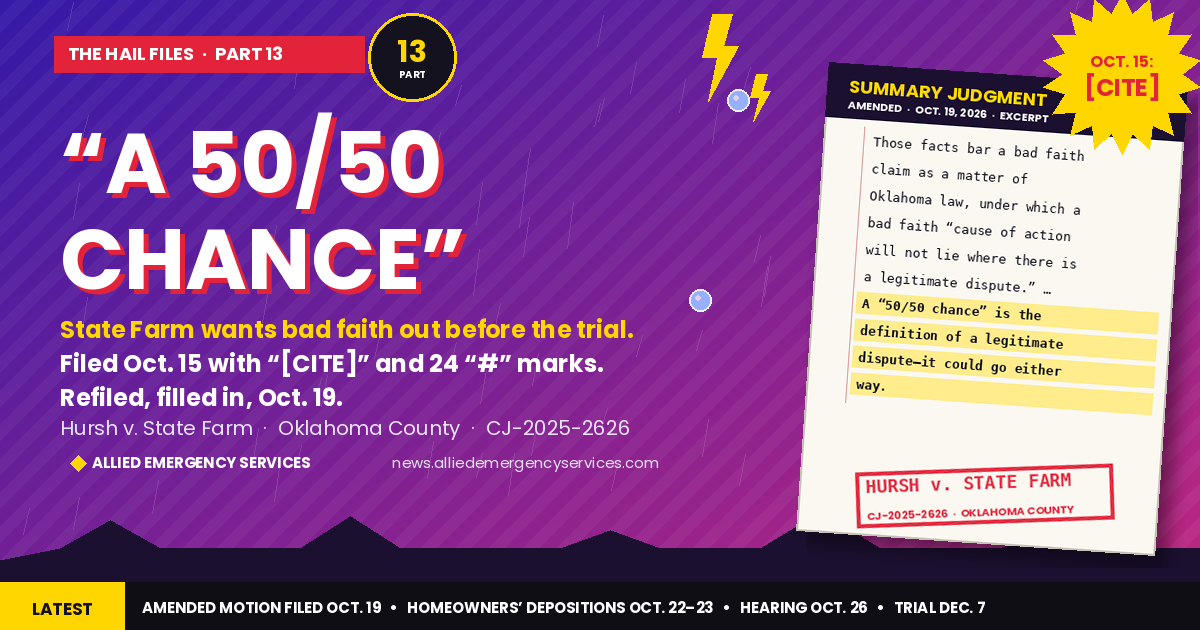
Behind much of the Hursh case is a dispute about how State Farm handed over its internal records. In a motion filed October 2 and re-filed as an emergency motion October 19, the homeowners say about 90 percent of the 156,748 files State Farm has produced came as “flattened” images without the data that shows who sent a document, who received it and when (Part 13 explains the motion). State Farm’s October 20 response says the motion “rests on a false premise.”
“Plaintiffs appear to either misunderstand or mischaracterize the productions in an attempt to generate a public dispute over State Farm’s discovery efforts,” the response says. According to State Farm and its e-discovery vendor, it has produced 110,918 documents in ten volumes between June 29 and September 29, 2026, mostly as single-page TIFF images (its expert says 15,725 spreadsheets and presentations went out as native files), with the two standard “load files” review software uses to rebuild a production, including, for documents without redactions, fields for custodian, author, sender, recipients and dates “where such information was available,” and text files for searching. Documents reproduced from earlier lawsuits came separately. State Farm says the homeowners never told it about the supposedly missing load files and text files before raising them with the court, and it attacks their expert’s declaration as resting on what their lawyers told him, quoting a federal court: “Garbage in, garbage out.”
On the homeowners’ example documents, State Farm says the answers are on the face of documents it produced, if the homeowners load the production into review software. “It should be self-evident that you cannot see the attachment to an email by looking at a reply that does not include the attachment,” the response says. “They appear not to understand what metadata is, let alone why they purportedly need ‘more’ metadata than State Farm has already produced.” It says the October 1 minute’s finding of “white box redactions, no metadata, [and] no privilege log” rested on “uninformed attorney argument.” It asks the court to deny the motion, to make the homeowners pay for any re-production, and to award State Farm its costs.
The homeowners’ October 21 reply answers point by point. Its central charge: “State Farm’s declarations contradict themselves.”
| State Farm (October 20 response) | The homeowners (October 21 reply) | |
| Redacted documents | Produced with the redacted image, a searchable text file and family data; no other metadata, because “the information necessary to assess the applicability of privilege appears on the face of the document.” A privilege log for redacted documents is coming “in the coming days.” | State Farm’s vendor identifies “only three fields” for those documents, while its expert lists roughly twenty, “drawing no distinction between redacted and unredacted documents. … Both cannot be true.” |
| Earlier emails in a thread | Not produced separately when contained in later emails; State Farm is “unaware of any instance where it withheld unique email message content or attachments.” | State Farm’s expert says the authors and recipients “are readily apparent on the face of the email.” The reply: “A message not produced has no face.” |
| The experts | The homeowners’ expert relied on their lawyers’ representations, not “an actual review of the evidence.” | State Farm’s expert “examined no production package” and reviewed “four documents bearing Bates numbers that do not exist in this production”; theirs was given the produced documents themselves. |
| Cost | Re-producing “just a portion of the documents at issue would take multiple weeks.” Its vendor estimates $43,000 to $50,000 and two weeks to re-produce the documents as native files. | That estimate prices native re-production of the whole range, HUR00000001 through HUR00346767, not “a portion”; the homeowners ask for the fields State Farm elected to provide, exported into its load file, not a native re-production of the whole range. |
| Privilege | Oklahoma law does not require a privilege log unless the court orders one; native versions of privileged documents cannot be redacted. | “Privilege governs withholdings, not production”: the author, recipient and date that must be disclosed for a document withheld in full “are not privileged for a document produced in part.” |
Why the data matters, in the homeowners’ telling, is a question of what State Farm knew and when. Their reply quotes the Oklahoma Supreme Court that “[t]he knowledge and belief of the insurer during the time period the claim is being reviewed is the focus of a bad-faith claim,” and notes that the state’s punitive-damages statute directs juries to weigh “the duration of the misconduct and any concealment of it” and “the number and level of employees involved in causing or concealing the misconduct.” “Neither can be answered from a flattened image bearing three fields,” it says. The homeowners withdraw no part of their motion, but ask the court to start with three document families: the “SEO” email chains, about an October 2021 memo for a State Farm Senior Executive Offsite (Part 10); the “Fix Profit Task Force” materials; and Exhibit 133 together with what they call the “Industry Best” communications. They also ask that any field withheld as privileged be listed in a log, with the documents lodged under seal for the court, and for their expenses. Exhibit 133, the subject of Part 8, is under the judge’s private review, State Farm’s response says.
What is MyBlock, and what do the homeowners say happened to its records?
A declaration attached to the reply by Hannah Whitten, one of the homeowners’ lawyers, previews another fight. She says she deposed State Farm’s other corporate representative on September 29, 2026, on a topic about “a State Farm system identified as MyBlock,” which State Farm documents identify as an internal system. A memorandum in State Farm’s production describes “a specific MyBlock assessment item” and reporting and follow-up connected to it, she says.
According to the declaration, the representative testified that State Farm no longer uses MyBlock, that he does not have access to it, that he reviewed nothing from it to prepare for the topic he was designated on, and that he does not know what the system contained. He testified that the information formerly in MyBlock is now housed in a different application, Workday, that MyBlock would have included performance evaluations while it was in use, and that he does not know when State Farm began or stopped using it. To her knowledge, she says, State Farm has not produced the assessment item or the reports the memorandum describes, and has not identified which MyBlock records were moved to Workday, archived or no longer exist. “Plaintiffs intend to raise this deficiency with the Court,” the declaration says. As of the October 22 docket check, State Farm had not responded to it in the public record.
What did the judge seal?
On October 21, Judge Palumbo signed two orders granting the homeowners’ unopposed applications to file unredacted copies of their two October 19 responses under seal: the response to State Farm’s motion to reconsider and stay the October 1 minute, and the response to State Farm’s emergency motion to strike their metadata supplement. Each order finds it “necessary in the interests of justice to permit the filing of the requested materials under seal to prevent the materials from being public record,” and allows a redacted version to be filed publicly. The October 22 docket shows both responses re-filed under seal. A docket note dated October 21 says the judge also signed an order granting a State Farm application to file under seal; the note does not say which application.
One application says the response relies on lines of the corporate representative’s testimony that State Farm designated confidential, and that in filing them under seal the homeowners “do not concede and/or admit that the lines of testimony designated by State Farm are confidential,” reserving “the right to challenge” every designated line. The public versions of the homeowners’ October 19 filings are in the archive as filed.
What else did the parties file?
- A candor accusation. In an October 19 motion, State Farm asks the judge to strike the homeowners’ notices of supplemental authority, which the motion’s docket title describes as being on State Farm executives’ knowledge of bad-faith tactics and “outcome based” claims handling (Part 9 covers the documents behind them). It says the notices contain no new authority and repeat earlier arguments, invokes the professional rule requiring candor toward the court, and says “[t]he framing of the submission as a ‘Notice of Supplemental Authority’ is itself a materially false statement to the Court.” It asks for a sanction, “including at least an award of attorneys’ fees.”
- Exhibit 133, again. The homeowners’ October 19 objection to State Farm’s motion to strike their metadata supplement argues that the protective order in the case excludes the handling of their own claim from “trade secret” protection, that copying a lawyer does not make a document privileged, and that the burden is on State Farm. According to the filing, it “came out” during a September 29 discussion with the judge that State Farm had produced five versions of Exhibit 133 “with different redactions.” After the judge ruled that the witness had to answer questions about Exhibit 133, State Farm’s counsel said, “I understood that to be the ruling,” according to the filing.
What happens next in the Hursh case?
October 23, noon: State Farm’s deadline to reply on its motion to reconsider and stay the October 1 minute and its emergency motions, under the October 15 court minute.
October 26, 10 a.m.: The hearing on those motions, under the same minute.
The motion to quash and the records motion: As of the October 22 docket check, the judge had not ruled on either, and the docket listed no hearing date for the motion to quash. The homeowners’ responses to the October 15 summary-judgment motions, the subject of Part 13, had not been filed.
November 1, November 10 and November 19: Under the agreed amended scheduling order of September 22, motions in limine are due November 1 and challenges to expert witnesses November 10, and the pretrial conference is November 19 at 1:30 p.m.
December 7, 9 a.m.: A seven-day jury trial before Judge Palumbo is set to begin.
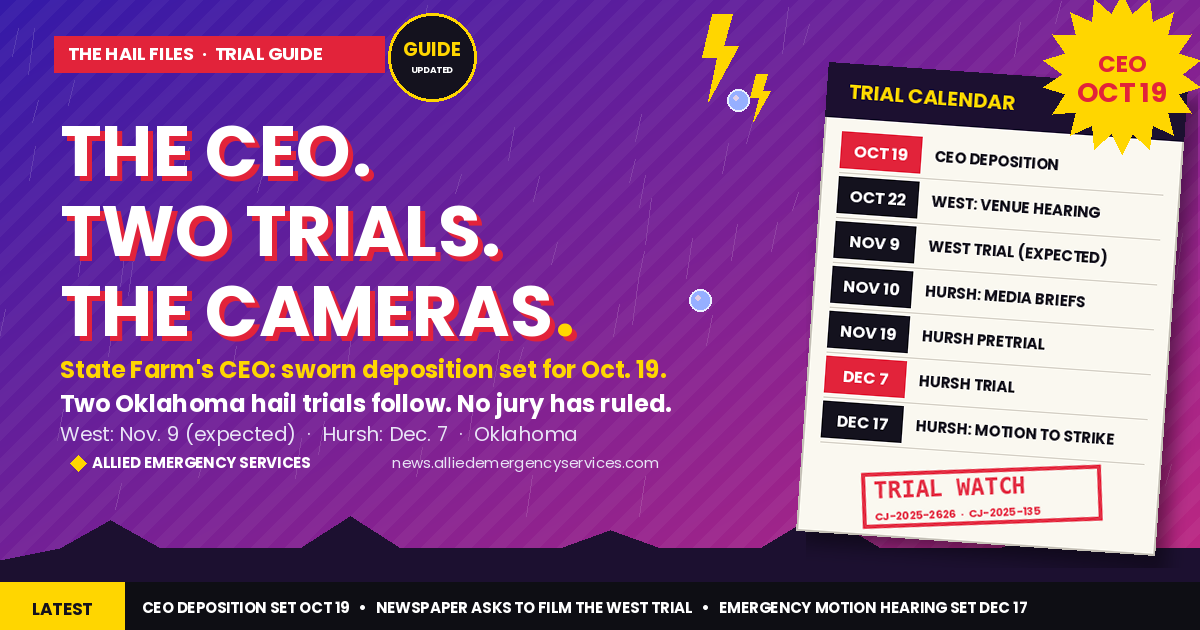
In West, the defendants’ motion to move the trial out of Comanche County or delay it was set for a hearing October 22 (Part 7 explains it). As of the October 22 docket check, the West docket showed no entry from that hearing, and no news report reviewed for this article described the outcome. Every date is on the Trial Watch calendar.
What is the timeline?
- November 24, 2021: The date of the “Our Reward Recommendations” communications, according to the October 12 notice.
- September 2, 2025: The homeowners serve a notice to depose State Farm’s corporate representatives on 30 topics.
- June 29 – September 29, 2026: State Farm produces 110,918 documents in ten volumes, according to its vendor.
- September 29, 2026: The homeowners depose State Farm’s other corporate representative, including on MyBlock.
- October 1: The courtroom deposition; Judge Palumbo calls the witness’s answers “absolutely evasive behavior” and signs a minute extending the deposition.
- October 2: The homeowners move to compel re-production of State Farm’s electronic records.
- October 12: The homeowners serve the notice on FME rewards.
- October 14: State Farm moves to reconsider and stay the October 1 minute.
- October 16: Judge Sheperd’s order in West.
- October 19: The homeowners oppose reconsideration and ask the court to take judicial notice of the West order; they object to State Farm’s motion to strike their metadata supplement; State Farm moves to strike their notices of supplemental authority.
- October 20: State Farm moves to quash the rewards deposition and opposes the records motion.
- October 21: The homeowners reply on the records motion; Judge Palumbo grants their two sealing applications.
- October 22: Both responses are re-filed under seal; the date set for the hearing on State Farm’s West venue motion.
- October 26: Hearing on State Farm’s motion to reconsider.
- December 7: Trial is set to begin.
What does State Farm say?
State Farm denies wrongdoing. In these filings, its position is that it “does not compensate its employees based on claim outcomes or payments to insureds,” that no one who handled the Hursh claim was involved with the FME or received FME-related rewards, that the rewards discovery is aimed at forcing a settlement, and that it produced its documents in an industry-standard form that meets Oklahoma law. In an October 1 FOX23 report on executives’ depositions in Hursh, it said that “neither selectively cited documents nor portrayals of testimony from recent depositions change the truth: State Farm evaluates each claim based on the facts of the loss and the coverage purchased and pays the benefits available under the policy.”
What does this mean for Oklahoma homeowners and contractors?
Neither the motion to quash nor the records motion has been decided. If Judge Palumbo grants State Farm’s motion to quash, no State Farm witness would have to answer the October 12 reward questions under that notice; if she denies or narrows it, a corporate representative could be questioned under oath about some or all of them before the December trial. Either way, the notice has put on the public record the title of November 2021 State Farm “Reward Recommendations” for wind/hail and a line about “higher rewards,” and State Farm has put on the record its statement that it “does not compensate its employees based on claim outcomes or payments to insureds.”
The filings also show what a bad-faith case turns on. The homeowners’ theory, as their filings state it, is that State Farm decided their claims under a program to reduce full roof replacements and claim payments; State Farm says no one who handled their claim was involved with the program and that the homeowners have shown no connection between it and their roof. For contractors, the records fight is a reminder that dates, authors and recipients can matter as much as what a document says, and that the paperwork around a claim can end up as evidence.
Read the documents
State Farm’s October 20 motion for a protective order and to quash the deposition notice (48 pages, with the October 12, 2026 and September 2, 2025 notices) · State Farm’s October 20 response to the records motion (102 pages, with its vendor’s and experts’ declarations) · The homeowners’ October 21 reply (14 pages, with the MyBlock declaration) · The homeowners’ October 19 response opposing reconsideration, with the October 16 West order · The homeowners’ October 19 objection on Exhibit 133 · State Farm’s October 19 motion to strike the notices of supplemental authority · Sealing applications (reconsideration response, metadata response) and orders (reconsideration response, metadata response) · State Farm’s October 14 motion to reconsider and stay, with the October 1 transcripts · The homeowners’ October 19 corrected emergency records motion · The October 15 court minute · Search the full archive.
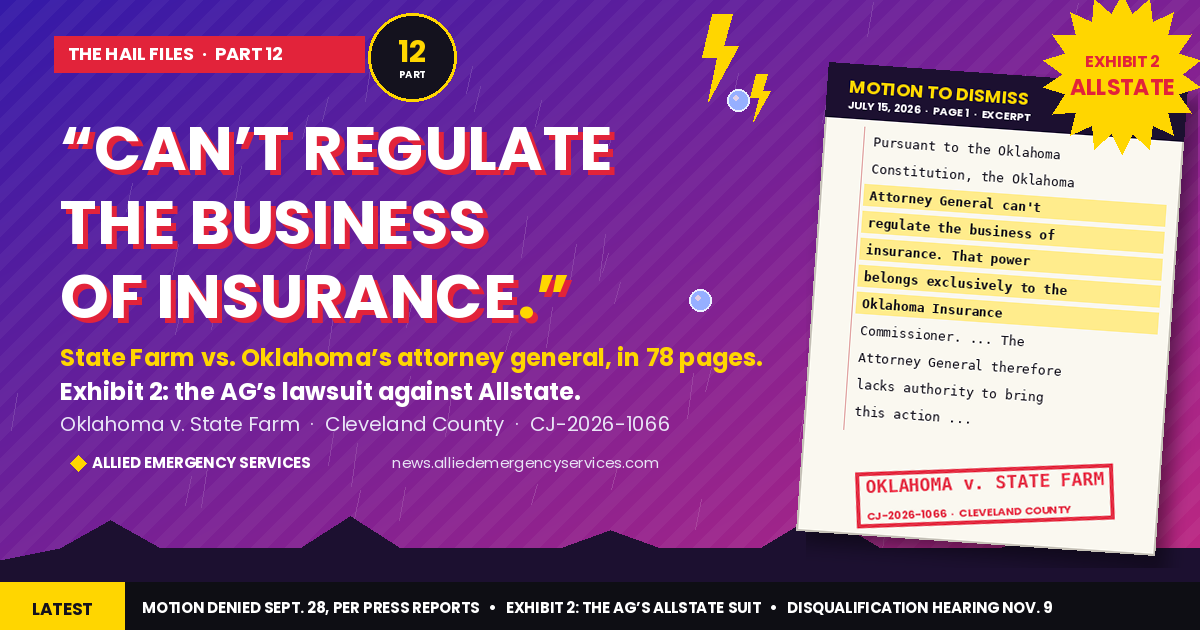
More from The Hail Files: the trial guide · “The Denial Enterprise” · Part 10: ‘Legal Implications of Language’ · Part 11: ‘Absolutely Evasive Behavior’ · Part 12: ‘Can’t Regulate the Business of Insurance’ · Part 13: ‘A 50/50 Chance’.
Frequently asked questions
State Farm says it does not. In an October 20, 2026 motion in Hursh v. State Farm (Oklahoma County District Court No. CJ-2025-2626), it told the court that it “does not compensate its employees based on claim outcomes or payments to insureds” and that none of the people who handled the Hursh claim were involved with its Fire Model Enhancement (FME) wind/hail program or received FME-related rewards. The homeowners’ October 12 deposition notice seeks testimony about rewards connected to the FME, including November 24, 2021 State Farm communications titled “FME – Wind/Hail and Water – Our Reward Recommendations” and the statement “[c]onsidering the additional lift the Enterprise has experienced with Wind/Hail, we looked to align higher rewards in that space.” No court has decided the question; as of the October 22, 2026 docket check, the judge had not ruled on State Farm’s motion to quash the notice.
The Fire Model Enhancement is a State Farm wind and hail claims initiative at the center of the Oklahoma hail lawsuits. State Farm’s court filings call it a “quality initiative” and deny any plan to underpay claims. The homeowners in Hursh v. State Farm allege it was a program to reduce full roof replacements and claim payments, and State Farm’s October 20, 2026 motion describes their focus as “the requirement of managerial approval for recommendations of total roof replacement in certain situations.” The homeowners’ October 19, 2026 filing, citing the testimony of State Farm’s corporate representative, says State Farm expanded the Fire Model Enhancement to all states in December 2020.
According to an October 19, 2026 filing by the homeowners in Hursh v. State Farm, Comanche County District Judge Grant Sheperd, presiding over West v. State Farm (No. CJ-2025-135), reviewed an audio/video recording of a deposition of State Farm’s corporate representative and found in an October 16, 2026 order that “[t]he witness was completely evasive [and] non-responsive to a majority of [c]ounsel[‘s] questions during the deposition.” On October 1, Oklahoma County Judge Amy Palumbo had called the same witness’s answers “absolutely evasive behavior.” State Farm says there was “nothing at all ‘evasive'” about the answers and has asked Judge Palumbo to reconsider the order extending the deposition; as of the October 22, 2026 docket check, that motion was set for a hearing October 26, 2026.
State Farm’s October 20, 2026 motion argues that the homeowners needed but did not get court permission for a second corporate-representative deposition, after questioning two State Farm representatives for eleven hours on thirty topics; that rewards to employees who did not handle the Hursh claim are irrelevant under the Oklahoma Supreme Court’s 2026 decision in Chick-fil-A, Inc. v. Ogden; that the 13 topics are too vague; and that the notice is an attempt to “harass, intimidate, and needlessly burden State Farm” and “force it into settling for an exorbitant amount.” It asks for a protective order and a stay until it has exhausted its appeals. The homeowners had not responded as of the October 22, 2026 docket check.
The homeowners say about 90 percent of the 156,748 files State Farm produced came as flattened images without data showing who sent and received documents and when, and they ask the court to order the data produced in the form they say State Farm elected in its discovery responses. State Farm’s October 20, 2026 response says it produced 110,918 documents, mostly as TIFF images, with load files and metadata and that the homeowners misunderstand the production; its vendor estimates that re-producing the documents as native files would cost $43,000 to $50,000. The homeowners’ October 21 reply says “State Farm’s declarations contradict themselves” and asks the court to start with three document families. As of the October 22, 2026 docket check, the judge had not ruled.
MyBlock is an internal State Farm system, according to State Farm documents cited by the Hursh homeowners’ lawyers. In an October 21, 2026 declaration, one of those lawyers says a State Farm corporate representative testified on September 29, 2026 that State Farm no longer uses MyBlock, that its information is now housed in Workday, that MyBlock would have included performance evaluations, and that he reviewed nothing from it to prepare. The homeowners say State Farm has not produced a MyBlock assessment item described in its own documents or identified which records were migrated, and they intend to raise the issue with the court.
A seven-day jury trial in Hursh v. State Farm (Oklahoma County District Court No. CJ-2025-2626) is set to begin December 7, 2026, at 9 a.m. before Judge Amy Palumbo. Before then, State Farm’s motion to reconsider the October 1 order extending its corporate representative’s deposition is set for a hearing October 26, motions in limine are due November 1, expert-witness challenges are due November 10, and the pretrial conference is November 19. State Farm’s motion to quash the rewards deposition and the homeowners’ records motion were awaiting rulings as of the October 22, 2026 docket check.
About this report. Except where a news outlet is named, everything above is drawn from public court records in Hursh v. State Farm Fire and Casualty Co. (Oklahoma County No. CJ-2025-2626): State Farm’s October 20, 2026 motion for a protective order and to quash, with the homeowners’ October 12, 2026 and September 2, 2025 deposition notices; State Farm’s October 20 response to the homeowners’ motion to compel re-production of electronically stored information, with its vendor’s and experts’ declarations; the homeowners’ October 21 reply, with the declaration of Hannah Whitten; the October 21 sealing applications and orders; the homeowners’ October 19 response opposing reconsideration, with the October 16 order in West v. State Farm (Comanche County No. CJ-2025-135) attached as Exhibit A; the homeowners’ October 19 objection on Exhibit 133; State Farm’s October 19 motion to strike; State Farm’s October 14 motion to reconsider and the October 1 transcripts filed with it; the October 15 court minute and the September 22 agreed amended scheduling order; and the Hursh and West dockets as read October 22. The filings are image scans; quotations were checked against the page images. Quotations of the West order are as the homeowners’ filing gives them. Individuals named in the filings other than the homeowners, the judges and the lawyers are not named here. State Farm’s statement is as reported by FOX23 (October 1). Where the report describes what the homeowners say, those are their characterizations; where it describes State Farm’s positions, it quotes its filings. Allegations in this lawsuit are allegations that State Farm denies; nothing described here has been decided unless the report says so. Get an email when new filings are added to The Hail Files: sign up for alerts.
About the host. Allied Emergency Services is a licensed storm-damage restoration contractor serving Illinois, Wisconsin, Indiana and Michigan — not a law firm, insurance adjuster or public adjuster, and this report is not legal or insurance advice. We inspect, document, provide insurance-ready repair estimates and complete repairs; coverage decisions always belong to you and your insurer. Founded 2015; in the building trades since 1999; Illinois-licensed. 24/7: (800) 792-0212.
⚡ Storm or Roof Damage? Get a FREE Estimate
Text ESTIMATE to (844) 907-2546
Or call (800) 792-0212 for 24/7 emergency response
AI-powered • No obligation • Licensed IL & WI
Storm damage? Start with the documentation
Allied Emergency Services — IL-Licensed Storm Damage Restoration Contractor
Founded 2015, in the building trades since 1999. Allied inspects and documents storm damage, writes the scope and estimate, and does the repairs. We do not adjust or negotiate insurance claims — that is the job of your insurer, a licensed public adjuster, or an attorney. IICRC-certified, EPA Lead-Safe, IL Licensed Roofing Contractor #104.019029. 24/7 emergency response.
How the storm-damage insurance claim process works →Free inspection within 24 hours · No obligation · Photo-documented findings you can share with your insurer
Attorneys: forensic storm damage documentation & construction expert consultation for counsel →