
⚡ Storm or Roof Damage? Get a FREE Estimate
Text ESTIMATE to (844) 907-2546
Or call (800) 792-0212 for 24/7 emergency response
AI-powered • No obligation • Licensed IL & WI
Cleveland County, Oklahoma — October 26, 2026 · The Hail Files, Part 15
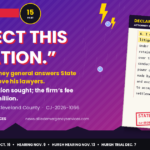
What happened, in one sentence: The State of Oklahoma has asked a Cleveland County judge to deny State Farm’s motion to remove Whitten Burrage, the private law firm helping Attorney General Gentner Drummond sue the insurer, arguing that the firm’s contract leaves the attorney general “complete control over the course and conduct of the case” and that the motion “can be denied on its face” — and in a sworn declaration filed with the response, Drummond says: “I direct this litigation.”
Status: The State’s 54-page response is dated October 16, 2026. It was not viewable on the court’s online docket as of October 21; the docket showed it available at the next successful check, October 25, and it was added to The Hail Files archive on October 26, complete and as filed. State Farm’s motion is set for a hearing November 9, 2026, at 9 a.m. before District Judge Jeff Virgin. As of the October 26 docket check, the court had not ruled. The filings give each side’s arguments; the State’s allegations against State Farm are allegations State Farm denies, and nothing described here has been decided unless the report says so.
Key facts
- The case: State of Oklahoma ex rel. Drummond v. State Farm Fire and Casualty Co., Cleveland County District Court No. CJ-2026-1066, before Judge Jeff Virgin. The attorney general filed it June 24, 2026, with claims under the Oklahoma Consumer Protection Act and the state’s racketeering law (ORICO), plus civil conspiracy and unjust enrichment. State Farm denies the claims.
- The motion: On September 18, 2026, State Farm asked the court to disqualify Whitten Burrage, which also represents individual policyholders suing State Farm, including the homeowners in Hursh and West.
- The response: Filed October 16, with the firm’s contract and four sworn declarations: from the attorney general, a deputy attorney general, and the firm’s two name partners, Reggie Whitten and Michael Burrage.
- The fee: capped at 20 percent of the first $10 million recovered, stepping down to 4 percent, with a total cap of $50 million. The firm advances the costs and is paid nothing if there is no recovery.
- Not sought: The attorney general swears the State “does not seek, in this action, the dissolution or reorganization” of State Farm “or the suspension or revocation of its license.”
- Next: Hearing on the motion November 9, 2026, 9 a.m., Cleveland County Courthouse, Norman.
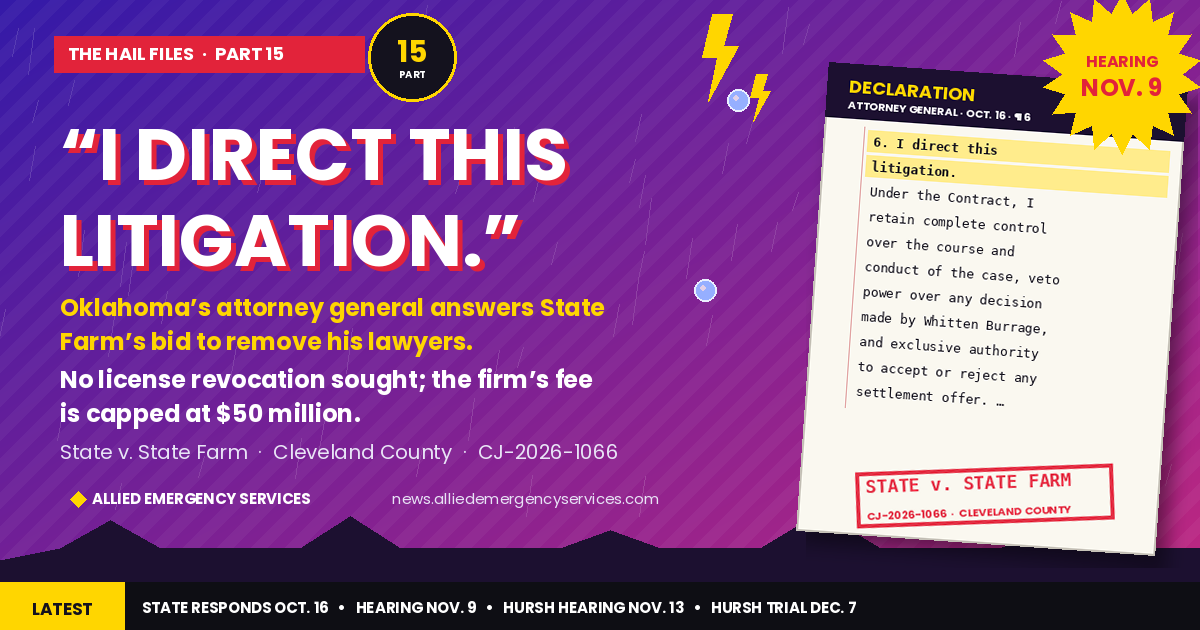
“I direct this litigation.”
The sentence opens paragraph 6 of a sworn declaration by Oklahoma Attorney General Gentner Drummond, and it is the heart of the State’s answer to State Farm’s bid to take away the lawyers he hired to help sue the company. “Under the Contract,” the declaration continues, “I retain complete control over the course and conduct of the case, veto power over any decision made by Whitten Burrage, and exclusive authority to accept or reject any settlement offer.”
State Farm’s motion, filed September 18, argued that a firm with its own contingency-fee cases against State Farm cannot constitutionally prosecute the State’s racketeering claim, that the State’s contract with the firm is void because it had not been posted on the attorney general’s website as Oklahoma law requires, and that the arrangement is “the exact back-room deal” Drummond once condemned. (The Hail Files, Part 6, covers the motion and its exhibits.)
The State’s response, dated October 16, says none of it meets Oklahoma’s test. Disqualification, it says, quoting the Oklahoma Supreme Court, is “such a drastic measure that it should be invoked if, and only if, the Court is satisfied that real harm is likely to result,” and State Farm “has not shown that any harm to the integrity of this proceeding is likely.” Along the way, the response puts new statements on the public record: the attorney general’s sworn statement that the State does not seek, in this lawsuit, State Farm’s dissolution or the loss of its license to do business in Oklahoma, and sworn statements from the firm’s two name partners that they know of no pending criminal investigation arising from the conduct the case alleges. It also cites a 2008 ruling from the Hurricane Katrina litigation, in which a federal judge rejected a conflict-of-interest argument that State Farm and other insurers made against Louisiana’s private lawyers.
What is State Farm asking the court to do?
State Farm wants Judge Virgin to remove Whitten Burrage as counsel for the State. The motion does not ask the court to dismiss the attorney general’s lawsuit; State Farm sought that separately, and Judge Virgin denied the motion to dismiss September 28. On October 19 State Farm answered the petition, denying or declining to admit all but one of its 80 numbered paragraphs and raising 18 defenses, one of which says the attorney general’s “use of private counsel on a contingency fee basis in this action violates State Farm’s due process rights.”
Whitten Burrage is the Oklahoma City firm that represents the homeowners in Hursh v. State Farm and West v. State Farm and other policyholders suing the company over hail claims. State Farm’s motion argues that the firm’s loyalty is divided. “The firm might resist a settlement that includes broad injunctive relief but limited monetary damages—even though such a result would serve the public interest—because it would provide no benefit to its private clients,” it says. “It might prioritize discovery channels that advance its private case theories rather than the State’s enforcement objectives.” And it argues that “the dual role itself creates a structural opportunity for private interests to affect decisions about litigation scope, evidence, settlement, and the use of coercive governmental tools.”
The motion also casts the arrangement as a way around the Oklahoma Supreme Court. In June, in State Farm Fire & Casualty Co. v. Palumbo (2026 OK 51), the Supreme Court barred the attorney general from intervening in Hursh, the homeowners’ private case. State Farm says the attorney general “now attempts to flip the order of operations to do here what the Supreme Court previously denied,” and puts it in algebraic terms: “In algebra, A + B equals the same thing as B + A.”
Who controls the State’s case against State Farm?
The attorney general does, the State says, pointing to the contract. Its terms, quoted in the response, give him “complete control over the course and conduct of the case” and “veto power over any decision made by Law Firm related to the case”; reserve settlement decisions “exclusively to the discretion of the Attorney General”; bar the firm from filing suit or making “any offer, settlement, or compromise without the written consent of the Attorney General”; and require the firm to “seek and receive approval from the Attorney General for all significant documents” before they go to third parties. The firm may not talk to the news media about the work without the attorney general’s office approving it first.
Drummond’s declaration adds his own sworn account. He says his office, not the firm, wrote and filed the petition: “Whitten Burrage did not participate in preparing the Petition and was not counsel of record when it was filed.” He says he hired the firm knowing about the private cases State Farm now objects to: “Before I signed the Contract, I knew that Whitten Burrage represents individual policyholders in lawsuits against State Farm Fire and Casualty Company. I considered those representations and engaged the firm with that knowledge.” And he says the important calls are his: “Decisions about the claims asserted, the relief sought, and whether this action continues are mine. I may settle this action for non-monetary relief alone, and I may terminate the Contract at any time, with or without cause, in which event Whitten Burrage is owed no fee.”
The deputy attorney general he assigned to oversee the case swears that the firm has submitted every significant document for review and approval before it was filed or served, including the response itself, and that “[t]o my knowledge, Whitten Burrage has not taken any significant step in this case without the OAG’s authorization.” Both declarations say State Farm’s lawyers may contact the attorney general’s office directly, without going through the firm.
The response turns State Farm’s own hypotheticals back on it. The firm cannot resist a settlement, it says, because the attorney general alone accepts or rejects offers and may settle for non-monetary relief alone. It cannot steer discovery, because it may not serve any significant document without his approval and must carry out his directions on strategy and tactics. And it cannot prolong the case, because he can end it, or end the firm’s role, at any time, and the firm is owed no fee if he does so before any monetary recovery. The firm “does not occupy the prosecutor’s chair,” the response says; “it advises the officer who does.”
How much can Whitten Burrage be paid?
Only a share of what the State recovers, and only if it recovers something. Under the contract’s fee schedule, the fee may not exceed 20 percent of any recovery under $10 million, plus 16 percent of the amount between $10 million and $15 million, 12 percent between $15 million and $20 million, 8 percent between $20 million and $25 million, and 4 percent of anything above $25 million; and “the total contingency fee payable shall not exceed $50,000,000.00.” By the schedule’s own arithmetic, the cap would be reached only on a recovery of about $1.18 billion.
Any attorneys’ fees the court orders State Farm to pay are credited against the firm’s fee. The firm advances the litigation costs and gets “no compensation or cost reimbursement if there is no recovery,” and “[i]n no event shall the State be responsible to advance any of the costs or expenses of the Litigation.” If the attorney general settles for non-monetary relief, the firm can be paid only from any fee award against the defendant, and the attorney general has “sole discretion as to the amount of fees sought.” The response says the contract’s percentages are below each tier of the fee schedule in the 2021 law that governs such contracts, 74 O.S. § 20i.
Is Oklahoma trying to put State Farm out of business in the state?
Not in this lawsuit, according to the attorney general’s sworn declaration. “The State does not seek, in this action, the dissolution or reorganization of State Farm Fire and Casualty Company or the suspension or revocation of its license or certificate of authority to do business in Oklahoma,” it says.
The response says the lawsuit’s injunctive relief “is directed at a claims-handling program—the Hail Focus Initiative—and at the practices it describes, not at State Farm’s ability to write or adjust homeowners policies in Oklahoma.” As the response quotes it, the petition alleges that State Farm implemented an internal program “commonly referred to as the ‘Hail Focus Initiative’ to drastically reduce aggregate roof indemnity payments in Oklahoma,” and it asks for “injunctive relief to dismantle the scheme, civil penalties to deter future violations, disgorgement of ill-gotten gains, and ancillary restitution.” State Farm denies the allegations.
The point matters to the legal argument. A 1985 California decision State Farm relies on barred a contingency-fee lawyer from a city’s effort to shut down a bookstore; the California Supreme Court later limited that absolute bar, the response says, to cases implicating interests akin to a criminal prosecution, and weighed whether a case threatened “the continued operation of an existing business.” By swearing that the State seeks neither State Farm’s dissolution nor the revocation of its license, the State argues, the attorney general puts this case on the other side of that line.
Is the racketeering claim a criminal case?
State Farm says it is close to one. To prove the ORICO claim, its motion argues, the attorney general “will have to show the commission of two or more enumerated felonies,” and “[i]n essence, the AG must conduct a criminal investigation in order to prosecute his suit against State Farm.” In a footnote, the motion says “[t]he AG has also threatened a criminal prosecution,” quoting an NBC News report from March in which Drummond said “[t]here may be a scheme inside of State Farm’s leadership to intentionally defraud Oklahomans, and if that can be proven,” and “that RICO will cross into the criminal world.”
The State answers that the case is civil. ORICO lets the attorney general bring civil proceedings, decided by a preponderance of the evidence, with a jury on request; “[t]hat is civil litigation,” the response says. “The Contract delegates no criminal authority,” and Drummond’s declaration says that “[i]f any criminal matter arises from the conduct alleged in this action, it will be handled by OAG attorneys assigned to criminal matters or by a district attorney, and Whitten Burrage will have no role in it.” The response reads the NBC quotation the same way: civil enforcement in this court, and any criminal matter elsewhere, through public prosecutors.
Whitten and Burrage each swear that the firm “has not been retained to investigate, initiate, prosecute, or otherwise address any criminal matter,” and each says: “I am not aware of any pending criminal prosecution, criminal investigation, or grand jury proceeding concerning State Farm or any other person arising from the conduct alleged in the Petition.” Each also swears the firm has received no materials from any criminal or grand jury proceeding, and no records subpoenaed under 22 O.S. § 1415, the ORICO investigative-subpoena statute.
That statute is central to State Farm’s confidentiality argument: it limits who may examine records the attorney general subpoenas in an ORICO investigation, and State Farm says the firm “would otherwise be prohibited” from seeing them. “No § 1415 subpoenas have issued in this matter,” the response replies, adding that “State Farm knows this.” Discovery in a pending civil case runs under the ordinary rules and any protective order the court enters, it says, and the State offers to stipulate to an order that anything produced under compulsory process, and any § 1415 materials, be used only in this case “and not in any private matter.”
Does it matter whether the contract was posted online?
Not legally, the State argues. The 2021 law requires every state contingency-fee contract to be posted on the attorney general’s website “within five (5) business days after the date the contract is executed.” State Farm says the office had posted nothing when it filed its motion, and that the failure “renders the agreement illegal, and therefore, void.” The response does not say when, or whether, the contract was posted. Instead it argues that the statute “contains no voidness clause”; that a duty arising after a contract is signed “cannot be a precondition to formation”; that a contract made for the State’s protection is at most voidable by the State, which “affirms it”; and that State Farm has no standing to enforce the State’s contracting rules. “[N]othing in 74 O.S. § 20i makes an unposted contract void,” it says, “much less gives an opposing party a remedy for the State’s recordkeeping.”
On State Farm’s related point, that the law required a request for proposals from at least three firms for a matter expected to cost $1 million or more, the response says that requirement covers a contract “to initiate a legal action on behalf of the state,” and the attorney general initiated this one himself, through his own lawyers, six weeks before he signed the contract. Drummond “signed the Contract himself,” it says, “and he stands behind it.”
Has State Farm tried to disqualify a state’s lawyers before?
Yes, according to the response, and it lost on the conflict question. After Hurricane Katrina, the State of Louisiana, through its attorney general and private counsel, sued insurers in a proposed class action tied to the state’s Road Home program. In In re Katrina Canal Breaches Consolidated Litigation, State Farm and other insurer defendants moved in federal court in Louisiana to disqualify the State’s private counsel, arguing conflicts of interest, that the attorney general had not complied with Louisiana’s law on hiring private lawyers, and that paying those lawyers lacked legislative approval.
On August 13, 2008, U.S. District Judge Stanwood R. Duval Jr. denied the motion on the conflict ground. A conflict that “has yet to manifest itself” is “simply a potential conflict of interest,” the order says, quoting an earlier federal decision, and a court must “ensure that any disqualification is linked to an actual, real conflict rather than an imaginary one.” He also held that the insurers lacked standing to challenge the attorney general’s compliance with the hiring statute, because invalidating the contract “would simply prompt the Attorney General to either properly hire these private attorneys, or carry out the litigation through his own appointed assistants.” The ruling was not a complete win for Louisiana: Judge Duval deferred the compliance question, gave the state’s commissioner of administration 45 days to say whether the commissioner concurred in the appointment, said he would disqualify the private counsel if the commissioner disapproved or did not respond, left the insurers’ challenge to the lawyers’ pay undecided, and stayed the State’s case pending resolution of the motion. (Read the 2008 order.)
The Oklahoma response cites the ruling for both points. It also cites a 2018 decision by what it calls the first federal appeals court to decide the question, which held that a prosecutor’s use of contingency-fee counsel to pursue civil penalties does not violate due process, and the state supreme courts of Rhode Island, California, Maryland, North Dakota and New Hampshire, which, it says, upheld similar arrangements where the government kept control. Oklahoma attorneys general have hired outside counsel before, it adds, citing a 1973 Oklahoma Supreme Court decision involving Kerr-McGee.
What does the State say about the campaign money and the “back-room deal” charge?
Very little, by design. State Farm’s motion says the attorney general “hides his retention of Whitten Burrage,” that he “now seeks to capitalize on Whitten Burrage’s private homeowner lawsuits for his political benefit,” and that the firm’s lawyers “again donated the maximum amount allowable by law, mere weeks before” he hired them, citing a KFOR report. It quotes Drummond’s own February 2023 letter to the firm, which called a predecessor’s opioid-litigation contract with it a “back-room deal,” and concludes that the new arrangement “is the exact back-room deal he sought publicly to eliminate.”
“The State will not respond in kind,” the response says, “and the Court need not resolve any of it.” None of those assertions is evidence that the integrity of the proceeding is at risk, it argues, and the motion does not contend that any contribution was unlawful or connected to the contract. The contract itself contains the firm’s certification that it gave nothing of value to any state officer or employee “in procuring this Contract” and was not party to any collusion over its terms. As for the 2023 letter, the response says this contract has the features the Legislature prescribed in the 2021 law: a fee capped below the statutory schedule, a credit for fee awards, the full cost risk on the firm, and every critical decision reserved to the attorney general. “The Attorney General retained counsel on the terms the Legislature prescribed.”
| State Farm (September 18 motion) | The State (October 16 response) | |
| Due process | A firm with private contingency-fee cases against State Farm cannot act as a neutral government lawyer in a “quasi-criminal” racketeering case. | The firm assists; the attorney general decides. Courts “generally uphold” such engagements “when the government retains control.” |
| Conflict of interest | The firm’s loyalty is divided between the State and its private clients (Rule 1.7). | Rule 1.7 “protects clients, not their adversaries,” and State Farm is not the firm’s client. The attorney general hired the firm knowing its other cases and consents. |
| The unposted contract | Not posted as the 2021 law requires, so “illegal, and therefore, void.” | No voidness clause; posting comes after signing; only the State could void it, and it affirms it; State Farm lacks standing. |
| Racketeering records | The firm would see ORICO investigative records it may not lawfully examine. | “No § 1415 subpoenas have issued in this matter”; the State offers a protective order limiting use to this case. |
| Politics | Campaign contributions, an endorsement and the 2023 “back-room deal” letter. | “The State will not respond in kind”; the contract has the fee caps, cost terms and control the Legislature required. |
| What it asks | Disqualify Whitten Burrage. | Deny the motion “on its face,” in an order with specific findings. |
What happens next?
Judge Virgin is set to hear the motion November 9, 2026, at 9 a.m. at the Cleveland County Courthouse in Norman. The State asks him to deny it on its face. If he is inclined to consider disqualification based on a conflict of interest or confidential information, the response says, Oklahoma law requires an evidentiary hearing first, and any order must set out its factual and legal support, including whether State Farm has standing to raise the conflicts it alleges. The State asks for findings on each ground. As of the October 26 docket check, the docket showed no reply from State Farm.
The fight over the State’s lawyers is unfolding alongside the two private cases furthest along, and their calendars shifted in October. In West v. State Farm (Comanche County), two October 22 orders by Judge Grant Sheperd are docketed as continuing the trial to February 2027, with a pretrial conference January 14, and as setting a deadline of October 30 for a court decision; the docket text does not say on what. The Lawton Constitution reported that Judge Sheperd said the trial is scheduled for February 1 through 12, 2027. With West moved, Hursh v. State Farm (Oklahoma County), whose seven-day jury trial is set to begin December 7, 2026, is now scheduled to go first. Before it, a notice filed by State Farm October 22 sets four motions for a hearing before Judge Amy Palumbo on November 13, including both summary-judgment motions. Trial Watch tracks every date.
What is the timeline?
- February 14, 2023: Drummond, newly in office, writes to Whitten Burrage calling a predecessor’s opioid-litigation contract with the firm a “back-room deal” (as State Farm’s motion quotes it).
- January 29, 2026: Oklahoma Insurance Commissioner Glen Mulready asks the attorney general to “partner with my office to continue your investigation, intervention and prosecution in Hursh v. State Farm” (Exhibit 1 to the response).
- June 23, 2026: The Oklahoma Supreme Court bars the attorney general from intervening in Hursh, saying “[t]he proper recourse could be” a separate lawsuit.
- June 24, 2026: The attorney general’s own lawyers file State v. State Farm in Cleveland County.
- July 31 / August 4, 2026: The contingency-fee contract with Whitten Burrage takes effect and is signed; the firm enters its appearance August 5.
- September 18, 2026: State Farm moves to disqualify the firm; a notice filed September 22 sets the hearing for November 9.
- September 28, 2026: Judge Virgin denies State Farm’s motion to dismiss the case.
- October 16, 2026: The State files its response, with the contract and four declarations.
- October 19, 2026: State Farm answers the petition, with 18 defenses.
- October 22, 2026: The West trial is continued to February 2027; State Farm notices a November 13 hearing in Hursh.
- November 9, 2026: Hearing on the motion to disqualify.
- November 13, 2026: Hearing in Hursh on both summary-judgment motions and two other State Farm motions.
- December 7, 2026: Hursh v. State Farm trial is set to begin.
What does State Farm say?
State Farm denies the State’s allegations. In its September 18 motion it said it “vehemently denies the validity of any such claim” under ORICO, and its October 19 answer denies the petition’s allegations and raises 18 defenses, including that the State’s use of contingency-fee counsel violates its due process rights. Its position on the firm is the motion’s: that Whitten Burrage’s private cases against State Farm give it a financial stake that disqualifies it from representing the State, and that the contract is void because it was not posted. State Farm had not filed a reply to the State’s response as of the October 26 docket check.
What does this mean for Oklahoma homeowners and contractors?
The motion to be heard November 9 is about who argues the State’s side, not whether the State’s allegations are true. If Judge Virgin denies the motion, Whitten Burrage stays on the case; if he grants it, the attorney general’s own lawyers, or other counsel he hires, could carry the case forward. Either way, the State’s lawsuit is separate from the homeowners’ own cases: the petition says it is brought “on behalf of the general public and the State of Oklahoma itself, not on behalf of any individual insured, group of insureds, or putative class of private claimants.”
The attorney general’s sworn declaration also puts on the record what the State is not asking for: State Farm’s dissolution or the loss of its license to do business in Oklahoma. The injunctive relief it seeks is aimed at a claims program it calls the Hail Focus Initiative, the response says; the petition also seeks civil penalties, disgorgement and restitution. The private cases keep their own calendar: Hursh on December 7, and West in February.
Read the documents
The State’s October 16 response opposing disqualification (54 pages: the brief; the Insurance Commissioner’s January 29, 2026 letter; the contingency-fee contract; and the declarations of the attorney general, a deputy attorney general, Reggie Whitten and Michael Burrage) · State Farm’s September 18 motion to disqualify Whitten Burrage (114 pages, with the contract and the open-records production) · The notice setting the November 9 hearing · The attorney general’s June 24 petition · The September 28 order denying State Farm’s motion to dismiss · State Farm’s October 19 answer · State Farm’s notice of the November 13 Hursh hearing · The August 13, 2008 Katrina Canal Breaches order (U.S. District Court, Eastern District of Louisiana) · Search the full archive.
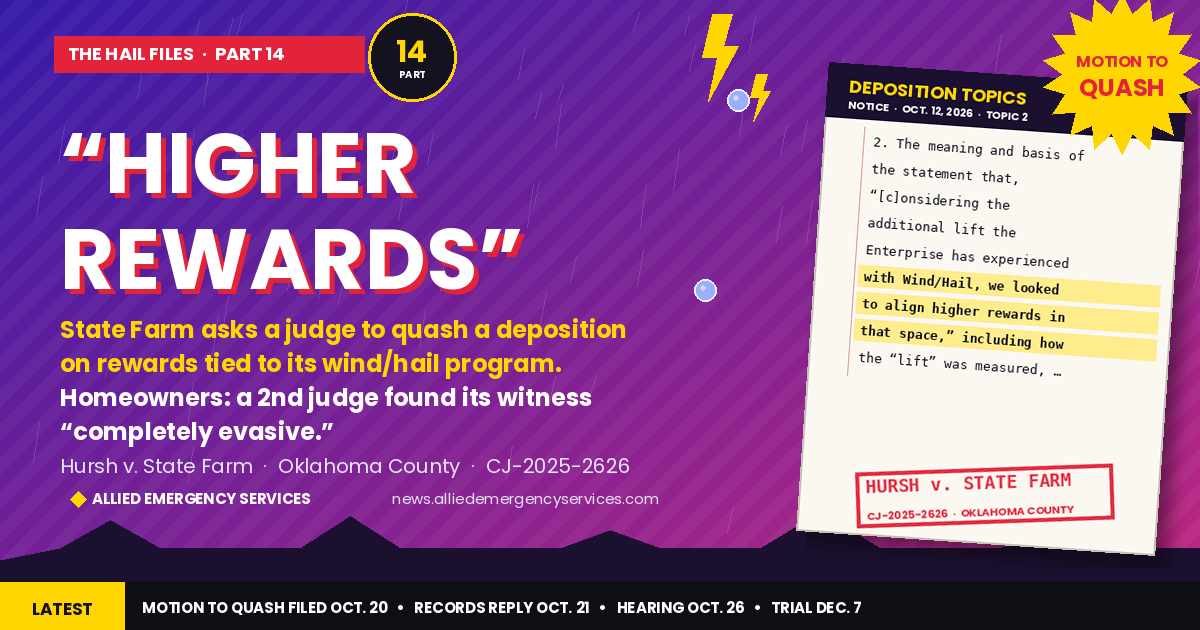
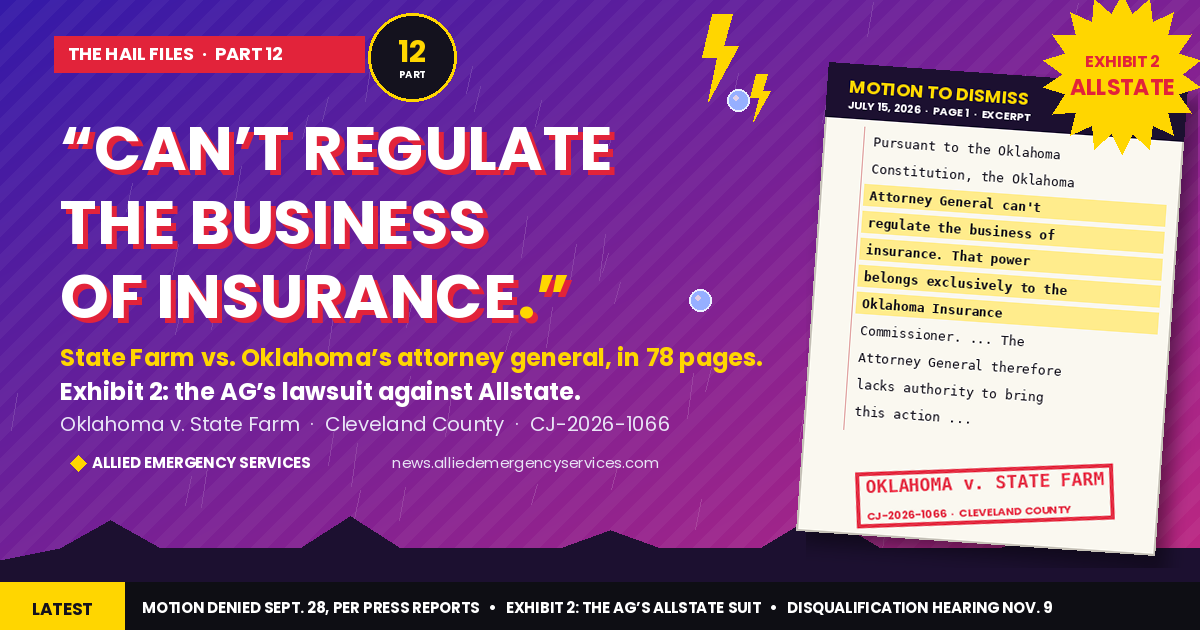
More from The Hail Files: the trial guide · Part 6: ‘The Exact Back-Room Deal’ · Part 12: ‘Can’t Regulate the Business of Insurance’ · Part 14: ‘Higher Rewards’ · Get an email when new documents are filed.
Frequently asked questions
Only if a judge grants its motion. On September 18, 2026, State Farm Fire and Casualty Company asked Cleveland County District Judge Jeff Virgin to disqualify Whitten Burrage, the private firm helping Attorney General Gentner Drummond prosecute State of Oklahoma ex rel. Drummond v. State Farm (No. CJ-2026-1066), arguing that the firm’s own contingency-fee cases against State Farm create a conflict and a due-process problem and that its contract is void because it was not posted online. The State’s October 16, 2026 response asks the court to deny the motion on its face, saying the attorney general controls the case and disqualification requires a showing that “real harm is likely to result.” A hearing is set for November 9, 2026, at 9 a.m.; as of the October 26, 2026 docket check, the court had not ruled.
The attorney general, according to the State’s contract with Whitten Burrage and his sworn declaration filed October 16, 2026 in State of Oklahoma ex rel. Drummond v. State Farm (Cleveland County No. CJ-2026-1066). “I direct this litigation,” Gentner Drummond declared, adding that under the contract he retains “complete control over the course and conduct of the case, veto power over any decision made by Whitten Burrage, and exclusive authority to accept or reject any settlement offer.” The contract bars the firm from settling or filing significant documents without his approval, and he may end its engagement at any time; if he does so before any monetary recovery, the firm is owed no fee. State Farm argues the firm’s private cases against it make the arrangement improper.
Under the firm’s contingency-fee contract with the Oklahoma attorney general (effective July 31, 2026, signed August 4, 2026), the fee may not exceed 20 percent of any recovery under $10 million, 16 percent of the amount from $10 million to $15 million, 12 percent from $15 million to $20 million, 8 percent from $20 million to $25 million and 4 percent above $25 million, with a total cap of $50 million; by that schedule, the cap would be reached only on a recovery of about $1.18 billion. Fee awards against State Farm are credited against the fee, the firm advances the costs, and it receives nothing if there is no recovery. If the attorney general settles for non-monetary relief, the firm can be paid only from any fee award against the defendant, and the attorney general has “sole discretion as to the amount of fees sought.”
Not in this lawsuit, according to Attorney General Gentner Drummond’s sworn declaration filed October 16, 2026 in State of Oklahoma ex rel. Drummond v. State Farm (Cleveland County No. CJ-2026-1066): “The State does not seek, in this action, the dissolution or reorganization of State Farm Fire and Casualty Company or the suspension or revocation of its license or certificate of authority to do business in Oklahoma.” The State’s response says the injunctive relief it seeks is aimed at a claims-handling program it calls the Hail Focus Initiative and the practices it describes, “not at State Farm’s ability to write or adjust homeowners policies in Oklahoma.” State Farm denies the State’s allegations.
None appears in the court filings. In sworn declarations filed October 16, 2026 in State of Oklahoma ex rel. Drummond v. State Farm (Cleveland County No. CJ-2026-1066), Reggie Whitten and Michael Burrage, the name partners of the firm assisting the attorney general, each said: “I am not aware of any pending criminal prosecution, criminal investigation, or grand jury proceeding concerning State Farm or any other person arising from the conduct alleged in the Petition.” A deputy attorney general declared that no investigative subpoena has been issued in the matter under 22 O.S. § 1415. Attorney General Gentner Drummond declared that any criminal matter arising from the alleged conduct would be handled by his office’s criminal attorneys or a district attorney, not the firm. State Farm’s motion quotes a March 2026 NBC News report in which Drummond said that if a scheme to defraud Oklahomans “can be proven,” “that RICO will cross into the criminal world.” State Farm denies wrongdoing.
Yes. After Hurricane Katrina, State Farm and other insurer defendants moved in federal court in Louisiana to disqualify the private counsel representing the State of Louisiana in insurance litigation tied to the state’s Road Home program. On August 13, 2008, U.S. District Judge Stanwood R. Duval Jr. denied the motion on the conflict-of-interest ground, finding the alleged conflict only a potential one, and held that the insurers lacked standing to challenge the attorney general’s compliance with Louisiana’s hiring law. But he deferred that compliance question, gave the state’s commissioner of administration 45 days to say whether the commissioner concurred in the appointment, said he would disqualify the private counsel if the commissioner disapproved or did not respond, and stayed the State’s case pending resolution of the motion. Oklahoma’s October 16, 2026 response in State of Oklahoma ex rel. Drummond v. State Farm cites the ruling.
Hursh v. State Farm (Oklahoma County District Court No. CJ-2025-2626) is set for a seven-day jury trial beginning December 7, 2026, before Judge Amy Palumbo, with a hearing on both summary-judgment motions and two other State Farm motions set for November 13, 2026. West v. State Farm (Comanche County No. CJ-2025-135), once expected to be tried first in November, was continued by an October 22, 2026 order to February 2027; The Lawton Constitution reported that Judge Grant Sheperd said the trial is scheduled for February 1 through 12, 2027. The attorney general’s separate lawsuit, State of Oklahoma ex rel. Drummond v. State Farm (Cleveland County No. CJ-2026-1066), has a hearing on State Farm’s motion to disqualify the State’s lawyers on November 9, 2026. Dates are as of the October 26, 2026 docket check.
About this report. Except where a news outlet is named, everything above is drawn from public court records: the State of Oklahoma’s October 16, 2026 response opposing disqualification in State of Oklahoma ex rel. Drummond v. State Farm Fire and Casualty Co. (Cleveland County No. CJ-2026-1066), with its six exhibits (the Insurance Commissioner’s January 29, 2026 letter, the contingency-fee contract, and the declarations of the attorney general, a deputy attorney general, Reggie Whitten and Michael Burrage); State Farm’s September 18, 2026 motion to disqualify; the September 22, 2026 notice of hearing, the September 28, 2026 order denying State Farm’s motion to dismiss and State Farm’s October 19, 2026 answer in the same case; the August 13, 2008 order in In re Katrina Canal Breaches Consolidated Litigation (E.D. La., Rec. Doc. 14450); State Farm’s October 22, 2026 notice of hearing in Hursh v. State Farm (Oklahoma County No. CJ-2025-2626); and the Cleveland County, Comanche County and Oklahoma County dockets as read October 25-26, 2026. The Oklahoma filings are image scans; quotations from them were checked against the page images. Quotations from the 2008 Louisiana order were checked against extracts of the court’s PDF and match the Oklahoma brief’s quotations of it. Drummond’s NBC News statement is quoted as State Farm’s motion quotes it; the West trial dates are as The Lawton Constitution reported them (October 22-23, 2026). Searches on October 26 found no news report on the State’s response. Apart from case names, individuals named in the filings other than the judges, the attorney general, the insurance commissioner and the lawyers are not named here. Where a filing makes an allegation, this report attributes it; nothing here is a finding by any court unless the report says so.
About the host. Allied Emergency Services is a licensed storm-damage restoration contractor serving Illinois, Wisconsin, Indiana and Michigan — not a law firm, insurance adjuster or public adjuster, and this report is not legal or insurance advice. We inspect, document, provide insurance-ready repair estimates and complete repairs; coverage decisions always belong to you and your insurer. Founded 2015; in the building trades since 1999; Illinois-licensed. 24/7: (800) 792-0212.
⚡ Storm or Roof Damage? Get a FREE Estimate
Text ESTIMATE to (844) 907-2546
Or call (800) 792-0212 for 24/7 emergency response
AI-powered • No obligation • Licensed IL & WI
Storm damage? Start with the documentation
Allied Emergency Services — IL-Licensed Storm Damage Restoration Contractor
Founded 2015, in the building trades since 1999. Allied inspects and documents storm damage, writes the scope and estimate, and does the repairs. We do not adjust or negotiate insurance claims — that is the job of your insurer, a licensed public adjuster, or an attorney. IICRC-certified, EPA Lead-Safe, IL Licensed Roofing Contractor #104.019029. 24/7 emergency response.
How the storm-damage insurance claim process works →Free inspection within 24 hours · No obligation · Photo-documented findings you can share with your insurer
Attorneys: forensic storm damage documentation & construction expert consultation for counsel →