

⚡ Storm or Roof Damage? Get a FREE Estimate
Text ESTIMATE to (844) 907-2546
Or call (800) 792-0212 for 24/7 emergency response
AI-powered • No obligation • Licensed IL & WI
Norman, Oklahoma — November 23, 2026 · The Hail Files, Part 21
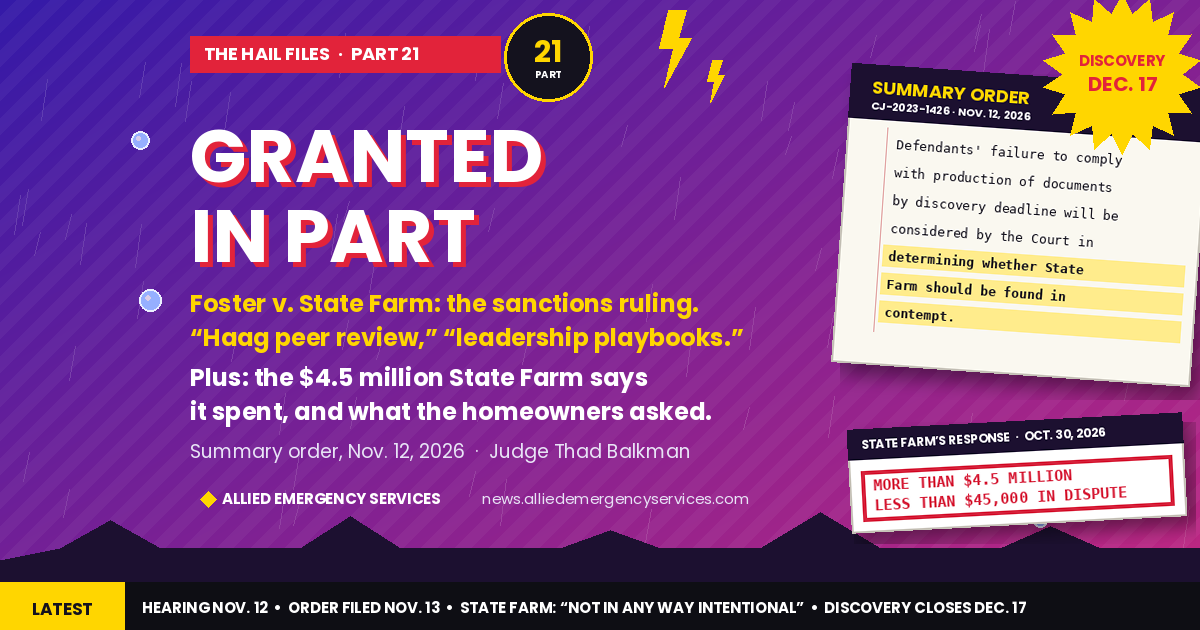
What happened, in one sentence: In a handwritten summary order dated November 12, 2026, Cleveland County District Judge Thad Balkman granted in part the homeowners’ renewed motion for sanctions against State Farm Fire and Casualty Company in Foster v. State Farm (No. CJ-2023-1426), ordering that the defendants “shall produce all previously ordered production,” naming a “2013 Haag response, Haag peer review, leadership playbooks,” that three State Farm witnesses named in the order “shall be made available to testify live at trial,” and that the defendants’ failure to produce documents by the discovery deadline “will be considered by the Court in determining whether State Farm should be found in contempt.”
Status: The order does not find State Farm in contempt, and it does not mention the daily fine, the fee shifting or the admonishment the homeowners asked for. It says the homeowners’ counsel is to prepare a final journal entry; as of the docket read November 20, 2026, none had been filed. The order does not give a date for the discovery deadline; when it was signed, the deadline was November 20, according to State Farm’s October 30 response, and on November 17, on the parties’ joint motion, the judge moved it to December 17, 2026. State Farm had told the court on October 30 that it had acted in good faith, had spent more than $4.5 million to comply in a case with “less than $45,000 in dispute,” apologized for missing the July 30 deadline, and expected to complete its production by November 3. Among what it calls continuing violations, the homeowners’ November 6 reply lists items under the headings “The 2013 Haag response,” “The Haag peer review” and “The weekly leadership playbooks.”
Key facts
- The case: Foster v. State Farm Fire and Casualty Co., Cleveland County District Court No. CJ-2023-1426, filed November 20, 2023, before Judge Thad Balkman. The court’s January 28, 2026 order calls it “an insurance bad faith and breach of contract case” against State Farm, an adjuster and an insurance agency, and says the homeowners’ home “was damaged in a hail and windstorm” on July 18, 2021.
- The ruling: granted in part, in a summary order dated November 12, 2026 and filed November 13. The defendants are to produce all previously ordered production, and the order names a “2013 Haag response, Haag peer review, leadership playbooks.” Three State Farm witnesses are to be made available to testify live at trial. The defendants’ failure to produce documents by the discovery deadline “will be considered by the Court in determining whether State Farm should be found in contempt.”
- What the homeowners asked for (October 12 motion): a daily monetary sanction from July 31, 2026 until State Farm certifies its production is complete, “in an amount to be determined by the Court considering State Farm’s average annual marketing budget from 2019 to 2025”; fees and costs for depositions after July 30; State Farm’s deponents and corporate representatives at trial; fees for the motion; a finding of direct contempt; and an admonishment.
- What State Farm says it spent (October 30 response): more than $4.5 million, invoiced through September 2026 by its review vendor, Consilio; more than 230 attorneys and more than 52,000 review hours; about 148,000 documents produced, over 118,000 of them by July 30. It calls the case “a single weather-related roof damage claim with less than $45,000 in dispute.”
- The deadline: July 30, 2026, the date State Farm asked for in a May 1 motion after an April 1 deadline passed. “State Farm apologizes to the Court for its inability to meet that deadline, which was not in any way intentional,” its October 30 response says.
- Accenture: a second summary order the same day grants the homeowners’ motion to compel testimony from non-party Accenture LLP, which “is subject to Oklahoma process, but is not obligated to send a live witness to Oklahoma for deposition.”
- Next dates: the defendants’ final witness and exhibit lists, November 30; the close of discovery and the deadline for dispositive motions, December 17, with a status conference at 9 a.m. that day; the trial, January 25, 2027, according to State Farm’s October 30 response.
State Farm told an Oklahoma judge in an October 30 filing that it had spent more than $4.5 million, put more than 230 attorneys on a document review that ran past 52,000 hours, and produced about 148,000 documents in a homeowners’ lawsuit over a roof claim it says has “less than $45,000 in dispute.” It also told him that it had missed his deadline, a date it had asked for, and it apologized.
The homeowners, in an October 12 motion, asked the judge for a monetary sanction “for each day State Farm is (and has been) in violation of the Court’s Order,” “in an amount to be determined by the Court considering State Farm’s average annual marketing budget from 2019 to 2025.”
On November 12, 2026, Cleveland County District Judge Thad Balkman ruled in a handwritten, one-page summary order that he signed: “The Motion is granted in part.”
The order does not find State Farm in contempt, and it does not mention the daily fine. It orders the defendants to produce everything the court had already ordered, and it names three things: a “2013 Haag response,” a “Haag peer review” and “leadership playbooks.” It orders three State Farm witnesses to be made available to testify live at trial. And it ties the question of contempt to the discovery deadline: the defendants’ failure to produce documents by that deadline “will be considered by the Court in determining whether State Farm should be found in contempt.”
The order does not give a date for that deadline. When it was signed, the discovery deadline was November 20, according to State Farm’s October 30 response; five days later, on a joint motion by the parties, the judge moved it to December 17, 2026.
Here is how the case got to this point, what each side told the court, and what the public record does and does not show. The filings are in The Hail Files archive, as the court’s public docket carries them (links below).
What did the judge order?
Two handwritten summary orders, both dated November 12 and filed November 13, came out of the November 12 hearing. The first, on the homeowners’ renewed motion to enforce and for sanctions, reads in full, except for the names:
“Counsel for Plaintiffs and for Defendants appear for hearing on Plaintiffs’ Renewed Motion for Sanctions. After consideration of the written briefs and oral presentations by counsel The Motion is granted in part. Defendants shall produce all previously ordered production — 2013 Haag response, Haag peer review, leadership playbooks. [Three names] shall be made available to testify live at trial. Defendants’ failure to comply with production of documents by discovery deadline will be considered by the Court in determining whether State Farm should be found in contempt. [The homeowners’ counsel] to prepare final journal entry.”
The order names the three witnesses; this report does not. The homeowners’ motion had asked for an order requiring State Farm “to make its deponents” — the motion names two — “and all corporate representative witnesses available to testify at trial.”
The order sets no production date of its own, and it does not say which date it means by the discovery deadline (above). On November 17, on the parties’ joint motion to extend scheduling-order deadlines, the judge signed an order setting December 17, 2026 for the completion of discovery and for dispositive motions. That order does not mention the trial date.
The ruling came “After consideration of the written briefs and oral presentations by counsel,” the order says. What the lawyers said at the hearing is not in the docket. A court exhibit that the docket ties to the motion-to-compel hearing on November 12 was filed under seal on November 16, “for good cause shown,” according to the docket.
What is the lawsuit about?
An insurance claim after a July 2021 storm. The homeowners, the Fosters, sued State Farm in Cleveland County on November 20, 2023, according to the docket. The court’s January 28, 2026 order describes the case as “an insurance bad faith and breach of contract case against State Farm,” an adjuster and an insurance agency, and says: “On July 18, 2021, Plaintiffs’ home was damaged in a hail and windstorm.”
State Farm’s account, in its October 30 response: “The parties disagree as to whether State Farm correctly attributed certain claimed damage to the roof of Plaintiffs’ house to pre-existing, non-covered issues rather than a July 2021 storm.” After an investigation that included “an independent engineer’s evaluation,” the response says, State Farm “concluded that most of the claimed damages were the result of pre-existing issues that Plaintiffs’ Policy did not cover, including age-related deterioration and mechanical damage,” estimated the cost to repair the covered damage and paid it.
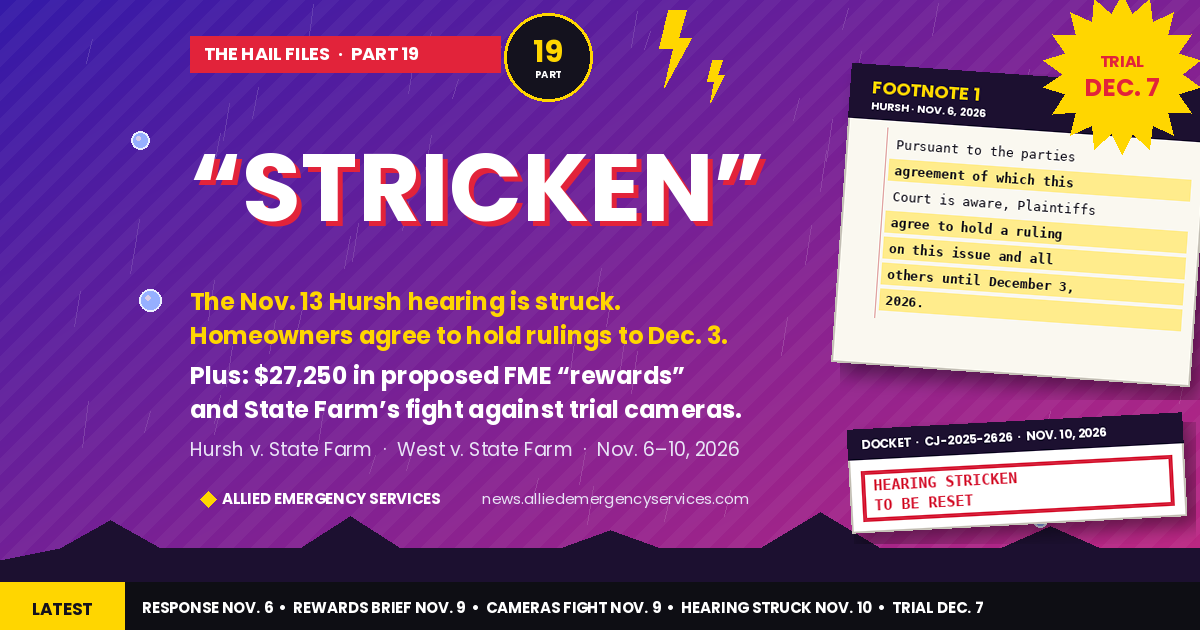
The homeowners claim breach of contract and breach of the duty of good faith and fair dealing. State Farm’s response says those claims are “premised in part on an alleged ‘scheme to deny Oklahomans insurance benefits associated with wind and hail storms.'” The homeowners’ “scheme” theory, the response says, centers on State Farm’s “Fire Model Enhancement (‘FME’) efforts,” the wind and hail claims initiative also at issue in Hursh v. State Farm (Part 19).
The homeowners’ May 1 motion describes the discovery they won as “documents related to State Farm’s institutional practices to systematically underpay claims for storm damage in Oklahoma, including documents and communications related to State Farm’s Wind/Hail Fire Model Enhancement team (‘FME’).” State Farm’s response calls the scheme “alleged.”
What had the court ordered State Farm to produce?
A great deal, according to State Farm, whose October 30 response says “the scale of the ordered discovery is enormous.” The homeowners’ June 19 reply says State Farm seeks “safe harbor on manufactured claims of burden that this Court has repeatedly rejected.” The judge granted the homeowners’ motion to compel in part from the bench on November 13, 2025; a summary order followed on November 17, and a formal written order on January 28, 2026, according to State Farm’s May 19 response, which refers to all three together as “the Order.”
The January 28 order says the court “made specific rulings on relevance and proportionality on a request by request basis and found the discovery sought to be relevant, proportional, and not unduly burdensome.” It also says: “As it concerns all the discovery requests at issue herein, it is the Court’s understanding that many, if not all, of the responsive documents have been produced by State Farm in other litigations.”
State Farm’s October 30 response, answering the homeowners’ suggestion that it had already produced the ordered discovery in other cases, says: “Although State Farm produced some of the same responsive documents in other matters, the Court’s Order covers different discovery requests and numerous new categories of documents, as well as different time periods, which have required additional searches and collections that State Farm has not previously conducted.” It describes the requests as “often spanning 15 years across dozens of categories of information, including institutional communications, training materials, personnel files, third-party vendor contracts, and documents from State Farm’s P&C Claims division—the vast majority of which State Farm has never collected, reviewed, or produced before in any Oklahoma matter.”
Among the categories in the January 28 order:
- Haag training. Requests 33 to 37, which the order says “generally seek documents relating to” training materials for claims handlers on wind and hail claims, “communications from P&C Claims related to HAAG training,” “State Farm’s adoption of HAAG’s definition of wind and/or hail damage,” and “any review or investigation conducted by or on behalf of State Farm into HAAG’s objectivity and State Farm’s relationship with HAAG following the jury verdict” in another case against State Farm. “The Court hereby ORDERS State Farm to produce all documents responsive to these discovery requests.”
- The FME. Among the “Hail Quality Focus” requests, “recommendations to or from State Farm’s Wind and Hail Fire Model Enhancement Team concerning homeowners’ claims,” ordered produced “from January 1, 2016, to present.”
- Cost and benefit. “State Farm’s analyses regarding its cost/benefit, return on investment, financial impact, and synonymous documents” relating to roof wind and hail claims in Oklahoma, and “recommendations made by State Farm regarding reduction in indemnity payments or spending on roof wind and/or hail claims.” The order says: “The Court hereby FINDS Plaintiffs have far exceeded any speculation threshold that would bar this discovery,” and it orders production “from January 1, 2009 to present.”
The January 28 order is in The Hail Files archive as Exhibit 3 to the homeowners’ May 1 motion (below).
How did the deadline become July 30?
In steps, each one in the record:
- December 16, 2025: State Farm asked for 150 days to comply, and the court granted the request, according to the homeowners’ May 1 motion. “At a subsequent hearing, the Court set a production deadline of April 1, 2026,” State Farm’s October 30 response says.
- December 17, 2025: State Farm moved to reconsider, clarify and stay the order. The homeowners’ May 1 motion says the court denied it after a January 23, 2026 hearing; State Farm’s response says “The Court denied State Farm’s stay request.”
- March 6, 2026: State Farm asked the Oklahoma Supreme Court to assume original jurisdiction and issue a writ of prohibition, and four days later it asked that court for a stay, its October 30 response says. A referee’s hearing set for April 1 was moved to April 7 “due to the referee being ill,” and the Supreme Court denied the application on April 28.
- April 1, 2026: the deadline. State Farm “produced documents not at issue in the Writ request on the April 1 deadline,” its October 30 response says; its May 19 response counts “an additional 935 documents.” The homeowners’ May 1 motion says the production “falls woefully short of the Order’s mandate.”
- May 1, 2026: three days after the Supreme Court’s ruling, State Farm asked the court for until July 30 to finish. The same day, the homeowners moved for an order to show cause and for sanctions; their motion says “State Farm has been in contempt of the Court’s Order for a month.” State Farm’s May 19 response says compliance “has already cost more than $2.5 million” and that the homeowners “seek to punish State Farm for pursuing its right to appellate review.”
- June 23, 2026: after a hearing, the judge granted the extension, with conditions, and deferred the sanctions motion. The journal entry, signed and filed July 20, says: “State Farm shall complete its discovery obligations in good faith by making timely and complete production as ordered and set forth by the Court in its January 28, 2026 Order no later than July 30, 2026.” It deferred the sanctions motion “until after the July 30, 2026, production deadline expires,” when “the Court will consider whether sanctions against State Farm are warranted, including attorneys’ fees, appearance of a State Farm representative at discovery hearings, fee shifting and/or any such other relief that Plaintiffs may request in an re-urged motion.”
- July 8 and August 6, 2026: the parties, “recognizing that State Farm would need additional time to complete its production,” jointly asked the court to extend the scheduling deadlines by sixty days, State Farm’s October 30 response says. The amended scheduling order entered August 6 set the discovery deadline at November 20 and the trial for January 25, 2027, according to the same response.
What happened after July 30?
By State Farm’s own account, it did not finish. “Due to the tremendous volume of documents and data to be reviewed and produced, State Farm was unable to complete its production by July 30, 2026, but continues to work to comply with the Court’s Order,” its October 30 response says. By July 30, the response says, State Farm had produced “over 118,000 documents responsive to the Court’s Order,” and it supplemented that production on September 9, September 17, September 29 and October 19: “In total, State Farm has produced 29,248 documents since July 30.”
The homeowners’ renewed motion, filed October 12, counts about 22,915 documents produced on September 9, 4,607 on September 17 and 1,137 on September 29: “nearly 29,000 additional documents in September alone—many directly relevant to its FME program.” It says State Farm “refuses to confirm whether its production is complete.” And it says the homeowners’ August 19 letter identified a gap: State Farm “had produced documents in a parallel case that were responsive to Plaintiffs’ requests, but never produced here.”
THE HAIL FILES · FREE DOCUMENT ALERTS
Get an email when new court documents are filed or unsealed
One email per development in the Oklahoma State Farm hail cases, with a link to every new filing in the archive. No marketing; unsubscribe in one click.
Your address is used only for these alerts and is never shared or added to any sales list.
What sanctions did the homeowners ask for?
Six, in their October 12 renewed motion, which says “State Farm remains in contempt”:
- “a monetary sanction for each day State Farm is (and has been) in violation of the Court’s Order accruing from July 31, 2026 until State Farm certifies (via sworn statement) its court-ordered production is full and complete, in an amount to be determined by the Court considering State Farm’s average annual marketing budget from 2019 to 2025”;
- “a shift of fees and costs for any depositions that have been either scheduled or conducted following the Court’s July 30, 2026 production deadline”;
- an order requiring State Farm to make two named deponents “and all corporate representative witnesses available to testify at trial”;
- fees and costs for the motion and the proceedings that follow it;
- “an order finding State Farm in direct contempt of court”; and
- “an admonishment against State Farm for its knowing violation of the Court’s Order.”
The motion quotes Oklahoma’s discovery statute, 12 O.S. § 3237(B)(2), which lists among the orders a court may make “an order treating as a contempt of court the failure to obey any orders ….” It says the homeowners “do not seek an extension of their trial date—in fact, Plaintiffs believe State Farm’s delay may be manufactured in an effort to stall trial.” And: “Discovery orders are not suggestions, and State Farm cannot substitute its preferred schedule for the Court’s deadlines.”
What does State Farm say?
That it has worked “around the clock,” in what its October 30 response calls a “herculean effort vastly disproportionate to the insurance claim at issue.” The response opens: “In this case—which involves a single weather-related roof damage claim with less than $45,000 in dispute—State Farm has spent more than $4.5 million to comply with the Court’s November 17, 2025 Order.”
- The effort. A sworn declaration attached to the response, from an associate director at Consilio, the vendor State Farm engaged to help host, process, review and produce the documents, says Consilio “has employed more than 230 attorneys, who have spent more than 52,000 hours on first-level responsiveness, redaction and privilege reviews,” that members of the team have worked weeks of more than 40 hours and weekends, and that “Through September 2026, Consilio has invoiced total costs of more than $4.5 million to State Farm.” The response adds that State Farm’s outside counsel “has dedicated more than 30 attorneys to second-level review and quality control.”
- The apology. “State Farm apologizes to the Court for its inability to meet that deadline, which was not in any way intentional. In truth, the sheer volume of the documents and data to be reviewed made it impossible to complete the production by July 30.” It said it expected to make its final production by November 3, 2026, “well before the November 20, 2026 discovery deadline and the January 25, 2027 trial date.” The filings reviewed for this report do not say whether it did; the homeowners’ November 6 reply lists items it says State Farm had not produced.
- Not contempt. “State Farm’s extraordinary document review and production efforts are not the actions of a party in contempt.” The cases the homeowners cite, it says, involve “willful and intentionally deceptive conduct,” and “None of these cases awarded sanctions based on a party’s good faith but incomplete attempts to comply with a Court Order.”
- The standard. Under a 1999 Oklahoma Supreme Court decision, the response says, discovery sanctions “must be both fair and related to the particular claim (or defense) at issue in the discovery order,” and it argues the proof of sanctionable conduct should meet a “clear and convincing evidence” standard.
- No harm. “Plaintiffs have not identified a single specific document that they need but do not have; nor have they explained how the timing of State Farm’s production has prejudiced their claims.” State Farm says it produced “more than 31,000 documents related to the FME before the deadline,” and that it produced “3,200 additional FME documents after the deadline” before the homeowners deposed the witness they say led the FME. “There can be no prejudice resulting from additional, supplementary productions of FME documents over a month before the discovery deadline and over three months before the trial date.”
- The remedy. The sanctions the homeowners suggest “are intensely punitive and not at all ‘fair and related’ to any purported prejudice Plaintiffs have incurred,” the response says. The more than $4.5 million State Farm has spent, it says, “exceeds by a factor of 100 the $45,000 Plaintiffs alleged State Farm should have paid on their insurance claim.” On the request for deponents at trial and for deposition fees, it says the homeowners “chose to proceed with those depositions and have failed to identify any document State Farm produced following July 30 that would have substantively altered their examination of any of State Farm’s deponents. Plaintiffs cite no case supporting such extraordinary sanctions, nor is there any.” And: “State Farm’s inability to produce documents by July 30 does not give Plaintiffs a license to demand sanctions solely for Plaintiffs’ own benefit.”
Its conclusion: “Sanctions are neither warranted nor necessary.”
What did the homeowners say in reply?
That State Farm had admitted the violation. “Nothing is clearer or more convincing than State Farm’s own admission,” their November 6 reply says. “State Farm’s sanctionable conduct is not in question. The only question is the remedy.”
- Another extension. “Though it has since apologized, State Farm never sought relief that might have kept it in compliance,” the reply says. It says State Farm “did not ask the Court for another extension” and “has pointedly ignored Plaintiffs’ letter and no less than six emails asking when production will be complete.”
- Intent. Quoting a 2008 Oklahoma Supreme Court decision: “The suggestion that sanctions cannot be imposed absent a showing of willful refusal to produce is ‘clearly wrong.'” The reply says “State Farm’s failure was neither accidental nor involuntary.”
- The hours. “State Farm reports more than 52,000 review hours overall but only about 6,500 since July 30,” the reply says. “Spread across its 230-attorney review team, that is roughly two hours per attorney per week for three months—not exactly working ‘around the clock,’ as State Farm would have the Court believe.”
- The harm. State Farm’s position, the reply says, is that the homeowners should have waited for a late production and then “conducted all depositions in a 17-day window,” which it says “ignores common sense and published authority alike.”
- What it calls continuing violations. Under the heading “State Farm’s Discovery Violations Continue,” the reply gives examples under the headings “The 2013 Haag response,” “The Haag peer review” and “The weekly leadership playbooks”; key words in each are blacked out in the public copy (below). It ends with an account of a deposition.
The reply also gives the homeowners’ account of a deposition. It says that during a court-ordered deposition, the homeowners showed State Farm’s corporate representative documents that, the reply says, “starkly contradicted” an earlier representation; that the witness “demanded a break before Plaintiffs’ counsel completed questioning on the exhibit” and “never returned to the Court-ordered deposition”; and that “After a 45-minute break, counsel for State Farm returned to state its refusal to complete the deposition, despite the Court’s order.” The reply argues that this “precisely demonstrates the need for a sanction requiring State Farm’s previously-deposed witnesses to appear live at trial.” State Farm’s response was filed before the reply, and the docket text does not record what was said about this at the hearing.
What are the “Haag response,” the “Haag peer review” and the “leadership playbooks”?
The public record does not say what they contain. The court’s order names them. The homeowners’ reply, the filing that argued about them, is redacted for public filing, and key words in its descriptions of all three are blacked out:
- “The 2013 Haag response.” The reply says State Farm’s existing production includes something, blacked out, citing an exhibit, and that “State Farm has failed to produce its” — the rest of the sentence is blacked out.
- “The Haag peer review.” The reply says “State Farm and its witnesses have mentioned the existence of” something, blacked out, after a jury verdict in another case, citing deposition testimony, and that “State Farm has failed to produce any such” — the rest is blacked out.
- “The weekly leadership playbooks.” The reply says State Farm’s internal communications mention a quoted phrase, blacked out, “concerning wind/hail claims,” citing an exhibit, and that “State Farm has failed to produce any such” — again, the rest is blacked out.
Haag appears elsewhere in the public record. The court’s January 28 order covers Haag training and any review of “HAAG’s objectivity” (above). And the Oklahoma Insurance Department’s examination report, made public November 13, attaches a March 2020 State Farm email chain in which a draft memo refers to “material being delivered by Haag Education” (Part 20).
What did the judge decide about Accenture?
The second summary order dated November 12 grants the homeowners’ motion to compel testimony from Accenture LLP, which is not a party to the case. Except for a name, it reads:
“Counsel for Plaintiffs and for Non-party Accenture LLP appear for hearing on Plaintiffs’ Motion to Compel Testimony. After review of the written briefs and oral presentations by counsel, The Motion to Compel Testimony is granted. Accenture is subject to Oklahoma process, but is not obligated to send a live witness to Oklahoma for deposition. The notice topics are relevant and discoverable. [The homeowners’ counsel] will prepare a final journal entry.”
Accenture had opposed the motion in an October 6 response, redacted for public filing, according to the docket. Earlier in the case the court had ruled on an Accenture subpoena: according to the docket text of a summary order docketed May 15, 2026, after a May 14 hearing, the court granted State Farm’s motion to quash, denied the homeowners’ motion to compel a third-party subpoena to Accenture, and granted in part and denied in part the homeowners’ motion to compel Accenture-related documents from State Farm.
Accenture is also a non-party in Hursh v. State Farm, where the homeowners moved to compel it to comply with a subpoena (Part 5).
Is State Farm in contempt?
Not as of the docket read November 20, 2026: the docket shows no finding of contempt. The November 12 order says the defendants’ failure to produce documents by the discovery deadline “will be considered by the Court in determining whether State Farm should be found in contempt.” The homeowners had asked for “an order finding State Farm in direct contempt of court.” State Farm told the court its efforts “are not the actions of a party in contempt.”
In its journal entry on the June 23 hearing, signed July 20, the court had listed what it would consider once the July 30 deadline passed: “attorneys’ fees, appearance of a State Farm representative at discovery hearings, fee shifting and/or any such other relief.” The November 12 order does not mention fees or fee shifting. It says the homeowners’ counsel is to prepare a final journal entry; as of the November 20 read, the docket showed none.
| Question | The homeowners (October 12 motion, November 6 reply) | State Farm (October 30 response) |
|---|---|---|
| Did State Farm meet the July 30 deadline? | No. The response “admits it failed to comply with the Court’s orders—with the deadline State Farm itself requested.” | No. It “was unable to complete its production by July 30, 2026,” and it “apologizes to the Court.” |
| Was it intentional? | “State Farm’s failure was neither accidental nor involuntary.” | The failure “was not in any way intentional.” |
| Were the homeowners harmed? | “The prejudice is apparent.” | “Plaintiffs have not identified a single specific document that they need but do not have.” |
| What did the effort cost? | State Farm’s own figure, over 6,500 review hours since July 30, is “roughly two hours per attorney per week for three months.” | It has spent “more than $4.5 million” in a case with “less than $45,000 in dispute.” |
| What should the court do? | A daily monetary sanction, fee shifting, witnesses at trial, fees, a finding of direct contempt and an admonishment. | “Sanctions are neither warranted nor necessary.” |
The court’s answer, on November 12: “The Motion is granted in part.”
What happens next?
- November 30, 2026: the defendants’ final lists of witnesses and exhibits, under the November 17 order. The homeowners’ were due November 17.
- December 17, 2026: discovery closes and dispositive motions are due, under the same order. The docket’s list of events, as of the November 20 read, shows a status conference that morning at 9 a.m. before Judge Balkman.
- The journal entries: both November 12 summary orders say the homeowners’ counsel is to prepare a final journal entry.
- January 25, 2027: the trial, according to State Farm’s October 30 response, which says the August 6 amended scheduling order set that date. The homeowners’ November 6 reply says: “This case is set for trial in two months.” The November 17 order changes other deadlines and does not mention the trial date.
Trial Watch tracks every date across the Oklahoma cases.
What is the timeline?
- July 18, 2021: the hail and windstorm, according to the court’s January 28, 2026 order.
- November 20, 2023: the homeowners sue in Cleveland County.
- November 13, 2025: the hearing on the homeowners’ motion to compel; granted in part (summary order filed November 17).
- December 16, 2025: State Farm asks for 150 days to comply, and the court grants the request, according to the homeowners’ May 1 motion; the January 28 order sets April 1, 2026.
- December 17, 2025: State Farm moves to reconsider, clarify and stay the order.
- January 23, 2026: the hearing on that motion, which the court denied, according to the homeowners’ May 1 motion.
- January 28, 2026: the formal written order on the motion to compel.
- March 6, 2026: State Farm applies to the Oklahoma Supreme Court.
- April 1, 2026: the first production deadline.
- April 28, 2026: the Supreme Court denies State Farm’s application.
- May 1, 2026: State Farm moves for more time; the homeowners move for sanctions.
- June 23, 2026: the hearing; the extension to July 30 is granted on conditions and the sanctions motion is deferred (journal entry signed and filed July 20).
- July 8, 2026: the parties’ joint motion to extend the scheduling order.
- July 30, 2026: the extended deadline. State Farm says it had produced over 118,000 documents by then.
- August 6, 2026: the amended scheduling order.
- August 19, 2026: the homeowners’ letter on documents produced in a parallel case.
- September 9, 17 and 29 and October 19, 2026: State Farm’s supplemental productions.
- October 12, 2026: the homeowners’ renewed motion to enforce and for sanctions.
- October 28, 2026: the court sets the motion, and the Accenture motion, for November 12 at 8:30 a.m. (docket text).
- October 30, 2026: State Farm’s response and opposition.
- November 3, 2026: the date by which State Farm said it expected to finish.
- November 6, 2026: the homeowners’ reply.
- November 12, 2026: the hearing and both summary orders (filed November 13).
- November 16, 2026: the parties’ joint motion to extend deadlines; a court exhibit from the November 12 motion-to-compel hearing is filed under seal.
- November 17, 2026: the order setting December 17 for discovery and dispositive motions (filed November 18).
How does Foster fit with the other Oklahoma cases?
It is one of many. In a November 9 filing in West v. State Farm, State Farm counted “approximately 300” pending Oklahoma homeowners’ cases against it (Part 19). As of the November 20 docket read, Hursh v. State Farm (Oklahoma County No. CJ-2025-2626) is set for a jury trial beginning December 7, 2026.
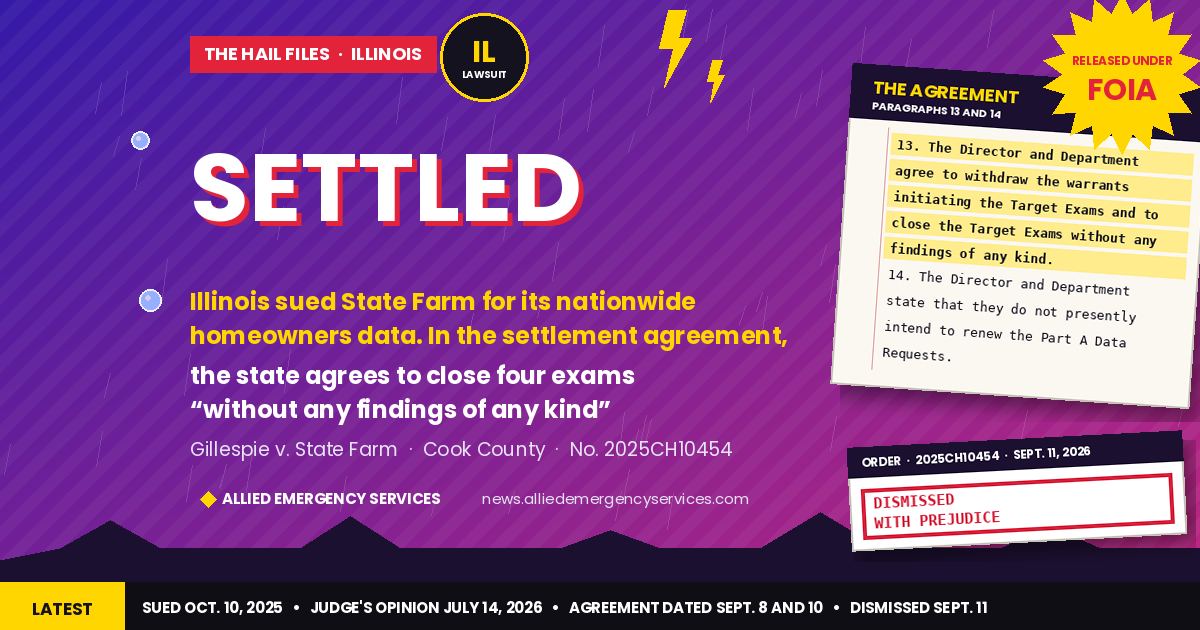
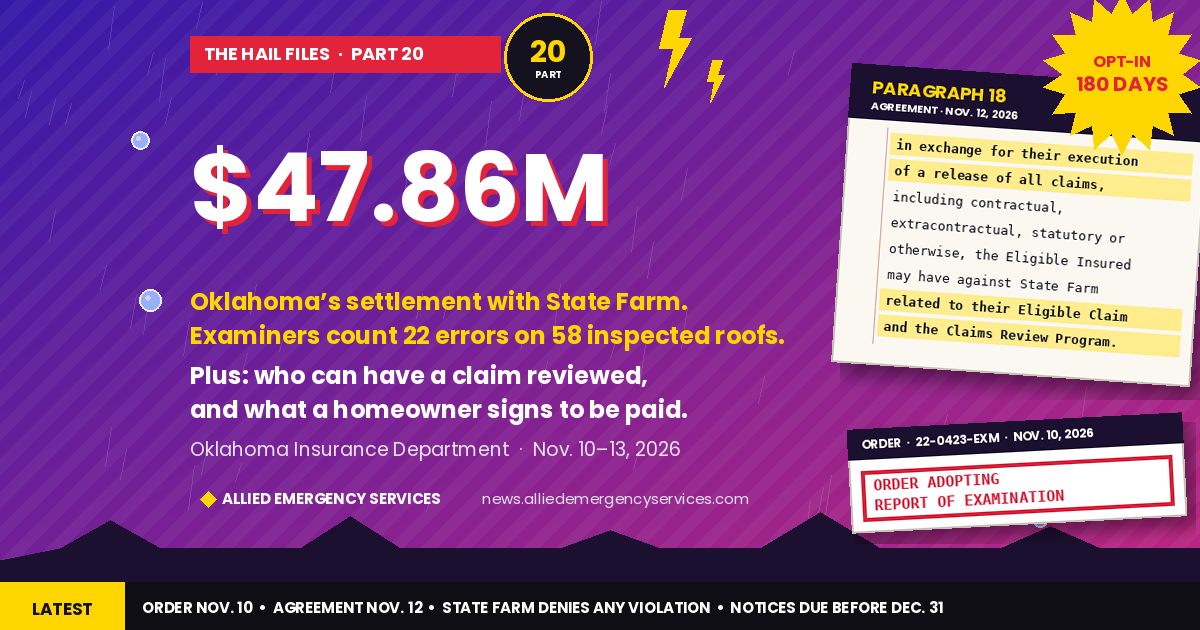
The Oklahoma Insurance Department announced a $47.86 million settlement with State Farm on November 13, 2026, which the department, in an email quoted by the Tulsa World, called “a completely separate action from any policyholders’ individual lawsuits against State Farm.” In the settlement agreement, signed November 12, State Farm disputes the examination’s findings and denies any violation (Part 20).
The same subjects run through the cases. The FME is at issue in Hursh (Part 19), and so is Accenture (Part 5). Haag appears in an attachment to the department’s examination report (Part 20).
Read the documents
The November 12 summary order on the renewed sanctions motion (filed November 13, 2026, 1 page) · The November 12 summary order on Accenture (filed November 13, 2026, 1 page) · The homeowners’ renewed motion to enforce and for sanctions (October 12, 2026, 10 pages) · State Farm’s response and opposition, with the vendor’s declaration (October 30, 2026, 15 pages) · The homeowners’ reply, redacted for public filing (November 6, 2026, 48 pages) · The order setting December 17 (signed November 17, filed November 18, 2026, 3 pages) · The June 23, 2026 summary order · The journal entry extending the deadline to July 30 and deferring sanctions (filed July 20, 2026, 3 pages) · The homeowners’ May 1 motion to show cause and for sanctions, with the court’s January 28, 2026 order as Exhibit 3 (29 pages) · State Farm’s May 19 response (28 pages) · The homeowners’ June 19 reply (24 pages) · The October 28 summary order setting the hearing · Search the full archive · Get an email when new documents are filed
More from The Hail Files: Part 20: ‘Contrary to State Farm’s Determinations’ · Part 19: ‘Stricken to Be Reset’ · Part 5: The Accenture Motion · The trial guide
FOLLOW THE CASES
Free alerts when new filings land in The Hail Files archive
Your address is used only for these alerts and is never shared or added to any sales list.
FOR ATTORNEYS, REPORTERS AND RESEARCHERS
The Docket Index: every filing in the archive in one spreadsheet, with dates, case numbers, OSCN document numbers, page counts and links. Free, by email.
Get the Docket Index (Excel) →
Download the complete archive (.zip) →
STORM DAMAGE IN IL, WI, IN OR MI?
Allied Emergency Services inspects, documents and repairs hail and wind damage across Illinois, Wisconsin, Indiana and Michigan. We are a licensed restoration contractor, not an insurance adjuster or a law firm; coverage decisions belong to you and your insurer.
Frequently asked questions
Foster v. State Farm Fire and Casualty Co. (Cleveland County District Court No. CJ-2023-1426) is an Oklahoma homeowners’ lawsuit against State Farm, an adjuster and an insurance agency, filed November 20, 2023 and assigned to Judge Thad Balkman. The court’s January 28, 2026 order describes it as an insurance bad faith and breach of contract case and says the home was damaged in a hail and windstorm on July 18, 2021. State Farm says less than $45,000 is in dispute and that it concluded most of the claimed damage was pre-existing and not covered. The trial is set for January 25, 2027, according to State Farm’s October 30, 2026 response.
In part. In a summary order dated November 12, 2026, Judge Thad Balkman granted in part the homeowners’ renewed motion to enforce and for sanctions. The order requires the defendants to produce all previously ordered production, naming a “2013 Haag response, Haag peer review, leadership playbooks,” and requires three State Farm witnesses to be made available to testify live at trial. It does not find State Farm in contempt and does not mention the daily monetary sanction the homeowners asked for. The homeowners’ counsel is to prepare a final journal entry.
Not as of the docket read November 20, 2026. The November 12, 2026 order says the defendants’ failure to produce documents by the discovery deadline “will be considered by the Court in determining whether State Farm should be found in contempt.” The order does not give a date; when it was signed, the discovery deadline was November 20, according to State Farm’s October 30 response, and a November 17 order moved it to December 17, 2026. The homeowners had asked for a finding of direct contempt; State Farm told the court its efforts “are not the actions of a party in contempt.”
Their October 12, 2026 renewed motion asked for a daily monetary sanction from July 31, 2026 until State Farm certifies under oath that its production is complete, “in an amount to be determined by the Court considering State Farm’s average annual marketing budget from 2019 to 2025”; a shift of fees and costs for depositions after the July 30 deadline; an order making State Farm’s deponents and corporate representative witnesses available to testify at trial; fees and costs for the motion; a finding of direct contempt; and an admonishment. The court’s November 12 order grants the motion in part.
More than $4.5 million. State Farm’s October 30, 2026 response says it has spent more than $4.5 million to comply with the court’s discovery order, and a declaration from its review vendor, Consilio, says Consilio invoiced more than $4.5 million through September 2026, with more than 230 attorneys spending more than 52,000 hours on first-level review. State Farm says it has produced about 148,000 documents, over 118,000 of them by July 30, 2026, in a case it says has less than $45,000 in dispute. State Farm’s response says its review attorneys worked over 6,500 hours after July 30; the homeowners’ reply says that is “roughly two hours per attorney per week for three months.”
They are items Judge Thad Balkman’s November 12, 2026 order names in requiring the defendants in Foster v. State Farm to produce all previously ordered production: a “2013 Haag response,” a “Haag peer review” and “leadership playbooks.” The public record does not say what they contain. The homeowners’ November 6 reply lists them as examples of what it calls continuing discovery violations, but it is redacted for public filing, and key words in its descriptions are blacked out. The court’s January 28, 2026 order had required State Farm to produce documents about Haag training, “State Farm’s adoption of HAAG’s definition of wind and/or hail damage,” and any review of “HAAG’s objectivity.”
State Farm’s October 30, 2026 response says “the sheer volume of the documents and data to be reviewed made it impossible to complete the production by July 30,” that the failure “was not in any way intentional,” and it apologizes to the court. July 30 was the date State Farm asked for in a May 1, 2026 motion, after the first deadline of April 1, 2026 passed while it sought review in the Oklahoma Supreme Court, which denied its application on April 28. The homeowners’ reply says State Farm never asked for another extension and that its failure was “neither accidental nor involuntary.”
In a second summary order dated November 12, 2026, Judge Thad Balkman granted the homeowners’ motion to compel testimony from non-party Accenture LLP. The order says Accenture “is subject to Oklahoma process, but is not obligated to send a live witness to Oklahoma for deposition,” and that “The notice topics are relevant and discoverable.” Accenture had opposed the motion in an October 6 response, according to the docket. In May 2026, according to the docket text, the court had granted State Farm’s motion to quash and denied the homeowners’ motion to compel a third-party subpoena to Accenture.
January 25, 2027, according to State Farm’s October 30, 2026 response, which says an amended scheduling order entered August 6, 2026 set that date; the homeowners’ November 6 reply says the case “is set for trial in two months.” A November 17, 2026 order moved the deadlines to complete discovery and file dispositive motions to December 17, 2026; it does not mention the trial date. As of the November 20 docket read, the docket also lists a status conference on December 17 at 9 a.m.
They are separate matters. Foster is in Cleveland County before Judge Thad Balkman; Hursh v. State Farm (Oklahoma County No. CJ-2025-2626) is set for a jury trial beginning December 7, 2026, as of the November 20 docket read. The Oklahoma Insurance Department’s $47.86 million settlement with State Farm, announced November 13, 2026, is “a completely separate action from any policyholders’ individual lawsuits against State Farm,” the department told the Tulsa World. Some of the same subjects, including State Farm’s Fire Model Enhancement and Accenture, come up in both Foster and Hursh.
About this report. Everything above is drawn from the public record in Foster v. State Farm Fire and Casualty Co., Cleveland County District Court No. CJ-2023-1426: the docket as read November 20, 2026; the court’s summary orders, journal entry and orders; and the parties’ motions, responses and replies, with their exhibits, as the court’s public docket carries them. Background on other cases comes from earlier parts of The Hail Files, as linked. The two November 12 summary orders are handwritten; quotations follow the page images, and the docket’s typed transcription of them is in capital letters. Statements in the parties’ filings are their arguments and allegations; the court’s rulings are in its orders. The figures on cost and hours are State Farm’s and its vendor’s, and the document counts are the parties’; no court has ruled on them. The homeowners’ November 6 reply is redacted for public filing, and the pages after its certificate of mailing are blacked out in the public copy; a court exhibit from the November 12 motion-to-compel hearing is under seal. State Farm’s October 30 response and the homeowners’ May 1 motion and June 19 reply are captioned “In the District Court of Oklahoma County”; each carries the Cleveland County court clerk’s file stamp for this case. The filings name the homeowners, the individual defendants, State Farm employees, the vendor’s declarant and the lawyers; this report names no individual except the judge and refers to the homeowners by the case name.
About the host. Allied Emergency Services is a licensed storm-damage restoration contractor serving Illinois, Wisconsin, Indiana and Michigan — not a law firm, insurance adjuster or public adjuster, and this report is not legal or insurance advice. We inspect, document, provide insurance-ready repair estimates and complete repairs; coverage decisions always belong to you and your insurer. Founded 2015; in the building trades since 1999; Illinois-licensed. 24/7: (800) 792-0212.
⚡ Storm or Roof Damage? Get a FREE Estimate
Text ESTIMATE to (844) 907-2546
Or call (800) 792-0212 for 24/7 emergency response
AI-powered • No obligation • Licensed IL & WI
Storm damage? Start with the documentation
Allied Emergency Services — IL-Licensed Storm Damage Restoration Contractor
Founded 2015, in the building trades since 1999. Allied inspects and documents storm damage, writes the scope and estimate, and does the repairs. We do not adjust or negotiate insurance claims — that is the job of your insurer, a licensed public adjuster, or an attorney. IICRC-certified, EPA Lead-Safe, IL Licensed Roofing Contractor #104.019029. 24/7 emergency response.
How the storm-damage insurance claim process works →Free inspection within 24 hours · No obligation · Photo-documented findings you can share with your insurer
Attorneys: forensic storm damage documentation & construction expert consultation for counsel →