

⚡ Storm or Roof Damage? Get a FREE Estimate
Text ESTIMATE to (844) 907-2546
Or call (800) 792-0212 for 24/7 emergency response
AI-powered • No obligation • Licensed IL & WI
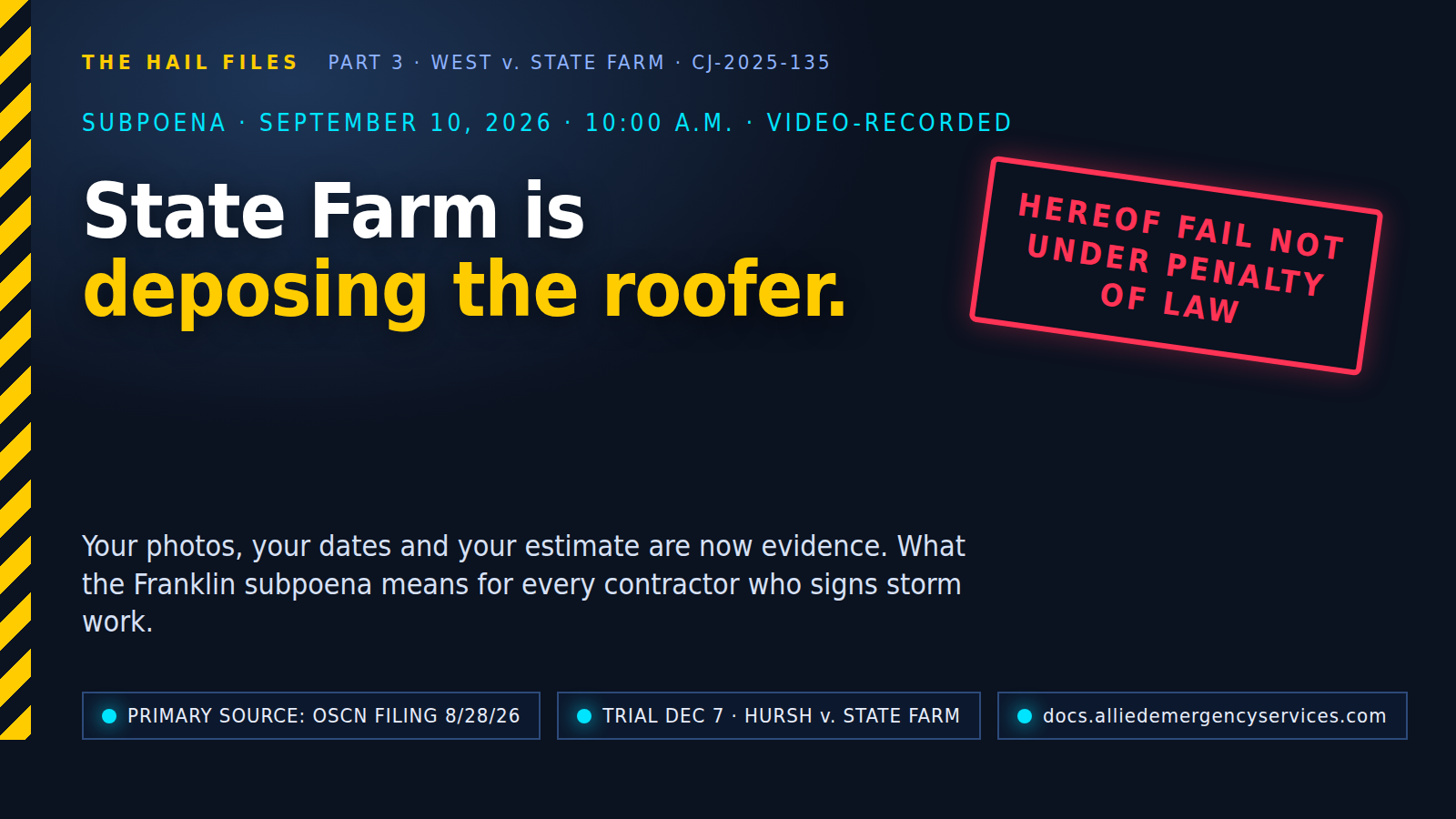
TL;DR — On September 10, 2026, State Farm’s lawyers took the sworn, video-recorded deposition of Derek Franklin of Legacy Roofing & Construction in Lindsay, Oklahoma — the roofer on the West family’s hail claim. He was there under subpoena. He is not a party to the case. He is a contractor who inspected a roof, wrote an estimate and did the work — and now his photographs, his dates and his recollection are evidence in a lawsuit that could reach trial on December 7. If you are a roofer, a restoration contractor, or a homeowner who ever signed one, this is the filing to read. The notice and subpoena are in The Hail Files.
What happened on September 10?
On August 28, State Farm’s counsel at Crowe Dunlevy filed an Amended Notice to Take Deposition in West v. State Farm Fire and Casualty Co., Comanche County District Court, Case No. CJ-2025-135. It gave notice that State Farm “will take the deposition upon oral examination of Derek Franklin” on Thursday, September 10, 2026 at 10:00 a.m., at Crowe Dunlevy’s offices in Oklahoma City “and/or via virtual means,” recorded “by stenographic and videographic means.” Attached as Exhibit 1 was a deposition subpoena addressed to Mr. Franklin at Legacy Roofing & Construction, LLC, 12094 State Highway 76, Lindsay, Oklahoma, commanding him to appear “to testify as a witness” — with the traditional closing line of every subpoena: “Hereof fail not under penalty of law.”
Two things about that filing matter more than they look. First, the subpoena is for testimony only — it does not list documents Mr. Franklin was required to bring — which tells you State Farm already has his file, most likely through the homeowners’ production. Second, the notice says “All parties are invited to attend and cross-examine.” The Wests’ lawyers at Whitten Burrage and Burgess & Hightower were in the room, on the record, for every question.
What Mr. Franklin said is not public. Deposition transcripts in this case are not filed with the court unless a party attaches one to a motion, and nothing has been filed. What we can say is why an insurer deposes the roofer, because it is the same reason every time.
Why does an insurance company depose the contractor?
In a first-party wind or hail case, the homeowner’s claim rests on three things the contractor usually supplied: the inspection that found the damage, the photographs that documented it, and the estimate that priced the repair. The insurer’s defense usually rests on attacking one or more of them. So the contractor’s deposition is where the insurer’s lawyers try to establish, under oath, that the roof was old or poorly installed before the storm; that the damage in the photos is foot traffic, blistering or mechanical rather than hail; that the storm date in the claim does not match the weather record; that the contractor found the customer by canvassing after the storm rather than being called; that the estimate was written to the insurer’s payment rather than to the damage; and that the contractor has a financial interest in the outcome.
None of those questions is improper. They are the questions any competent defense lawyer asks, and the questions a competent contractor should be able to answer from his own file without hesitation. The problem is that most contractors’ files were never built to be read by opposing counsel.
What a roofer’s deposition actually looks like
A deposition is a sworn examination, usually three to six hours, in a conference room or on Zoom, with a court reporter typing every word and, as here, a videographer recording every expression. The insurer’s lawyer asks the questions; the homeowner’s lawyer can object and cross-examine. There is no judge in the room. Everything you say can be read to a jury, and the video can be played to one.
For a contractor the examination typically runs through licensing and training; how the customer was acquired; the date and conditions of the first inspection; who took which photographs, with what device, and whether the originals with metadata still exist; how the storm date was determined; how the estimate was built (Xactimate line items, waste factors, overhead and profit, code items); every communication with the adjuster; the contract and any assignment of benefits; and what the contractor was paid. Then the hard part: the lawyer hands you your own photographs, one at a time, and asks you to explain what each one shows.
What this means for every contractor who signs storm work
The lesson of the Franklin subpoena is not that contractors should avoid insurance work. It is that on any storm job the file you build on day one is the file you will be handed in a deposition two years later. In our practice that means a documentation standard we would be comfortable defending under oath: every slope and elevation photographed overview-to-close-up with a scale reference and intact metadata, test squares chalked and counted, the soft-metal collateral indicators recorded, pre-existing conditions documented with the same care as storm damage, the NOAA storm record for the date of loss pulled and saved before anyone argues about it, and an estimate whose every line traces to a measurement or a specification. A file like that does not need a lawyer to explain it. A file that is forty phone photos and a one-page estimate does.
It also means being honest with yourself about your role. A contractor who inspected, estimated and repaired a roof is a fact witness with a financial interest — the insurer’s lawyer will say so in the first ten minutes — and that is different from an independent expert retained by counsel who has no stake in the repair. Both roles are legitimate. Confusing them is how contractors get hurt on the stand.
Update, September 15: West v. State Farm is now set for trial November 2, 2026 in Comanche County — five weeks before Hursh — and the Hursh plaintiffs have moved to compel Accenture LLP to comply with a document subpoena. Both developments are covered in The Hail Files, Part 4: Two Trials, 800,000 Pages.
Where the cases stand
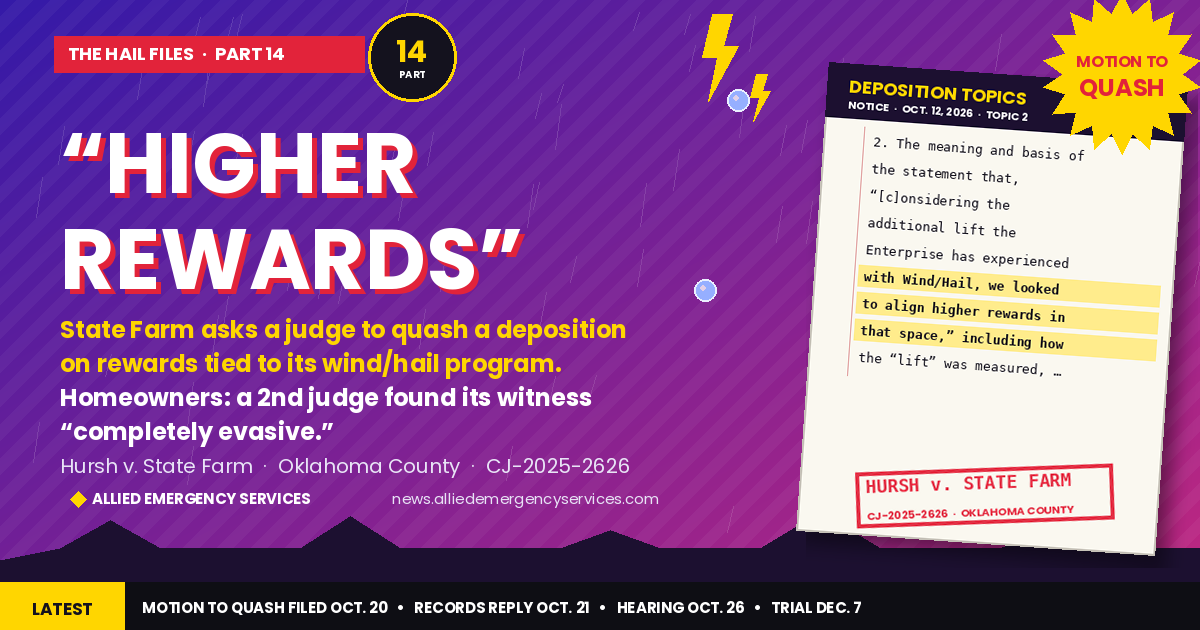
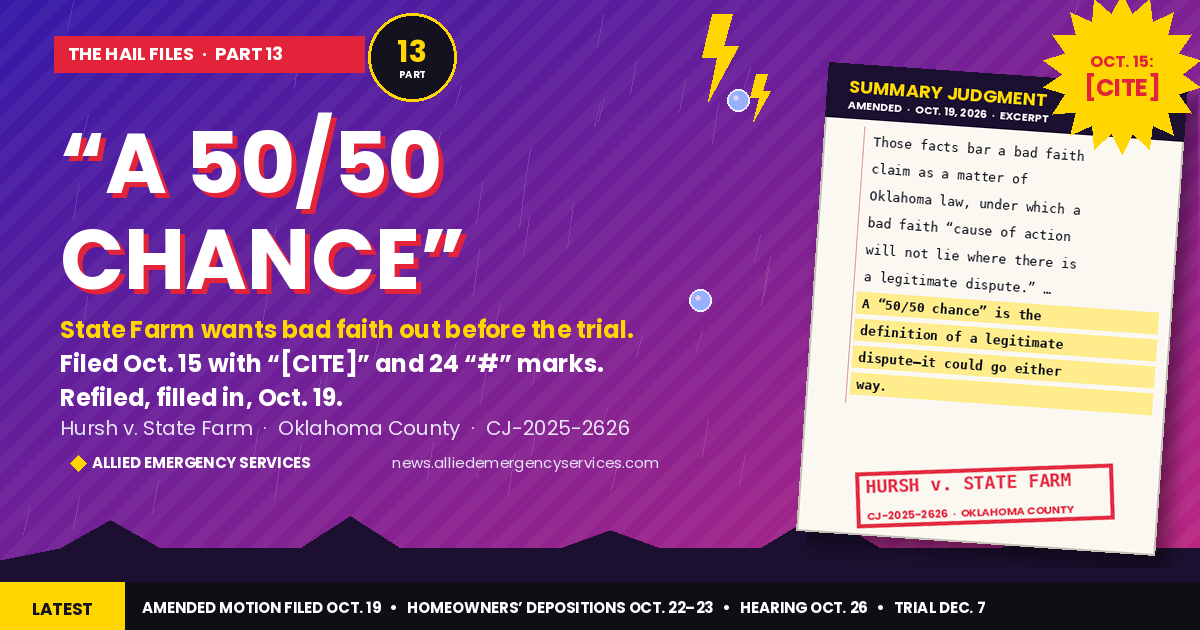
The Franklin deposition is one entry in a September that is unusually dense. State Farm’s September 10 reply on consolidating depositions is on the docket. Three State Farm employees — Herbert, Ress and Welsh — are scheduled for deposition in Bloomington, Illinois, September 15 through 17. September 21 is the deadline in West for State Farm to re-designate the documents it wants to keep confidential; State Farm has asked for roughly another month, saying 55,913 documents are involved, and the plaintiffs oppose the extension. On September 28 at 9:00 a.m., Judge Amy Palumbo in Oklahoma County hears the motion in Hursh v. State Farm to strike State Farm’s blanket confidentiality designations. And under Judge Palumbo’s September 1 order, State Farm CEO Jon Farney’s four-hour deposition must be taken within thirty days — on or about October 1. The trial in Hursh remains set for December 7, though State Farm has told the court that the discovery extension it sought “will necessarily extend beyond” that date.
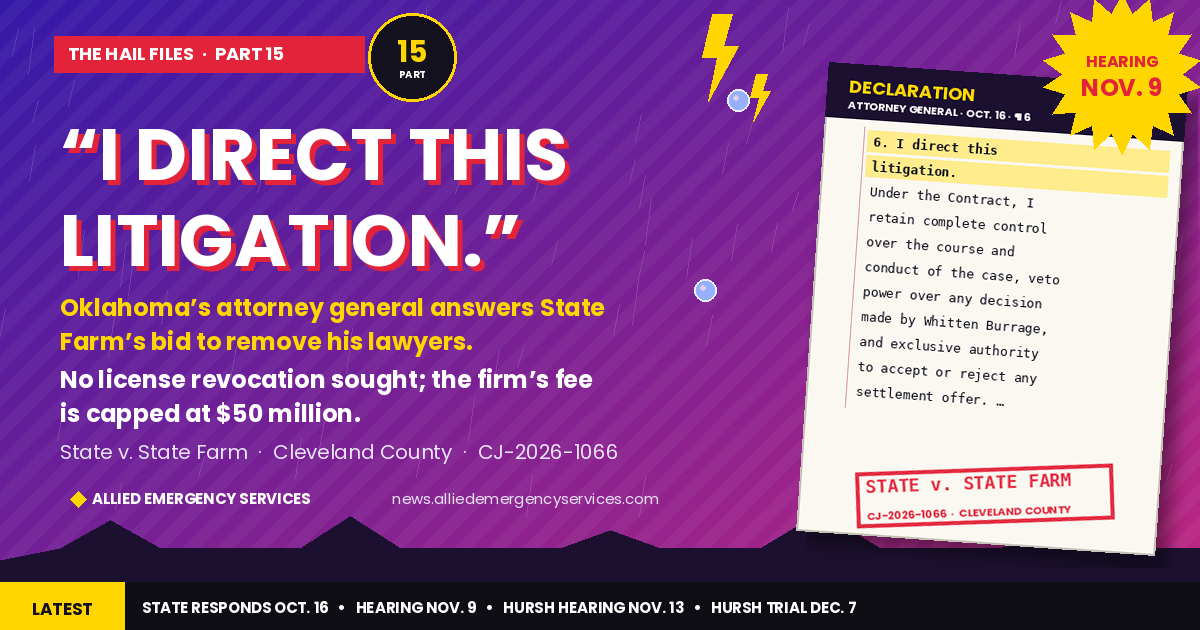
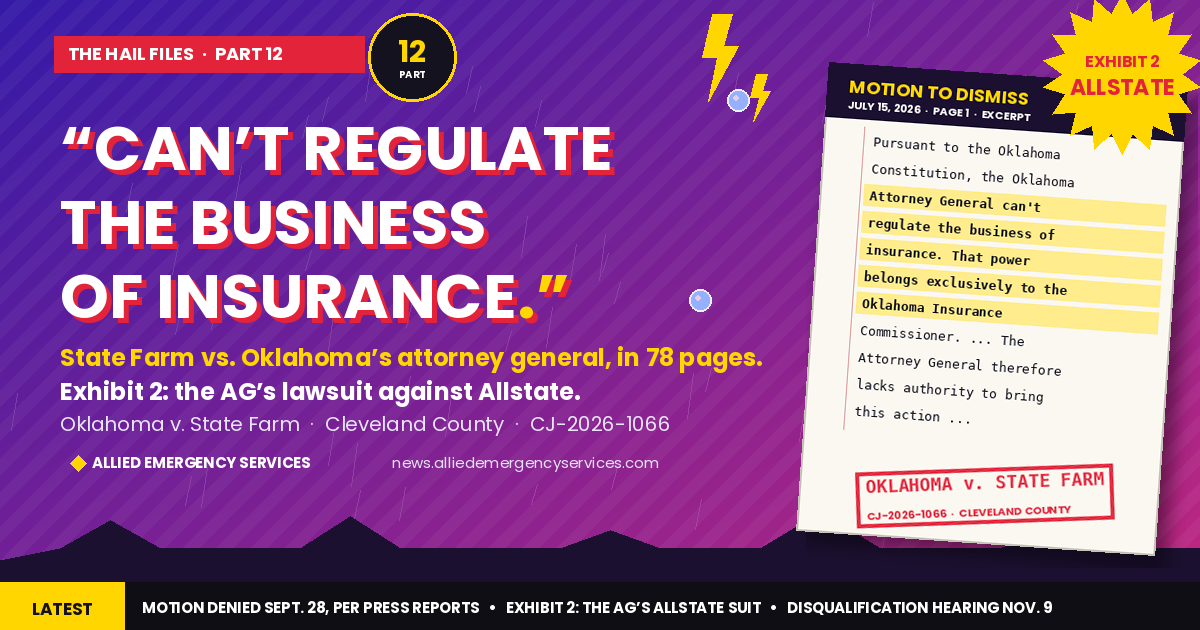
One political development changes the picture around the Attorney General’s separate case, State of Oklahoma ex rel. Drummond v. State Farm. Attorney General Gentner Drummond lost the Republican runoff for governor on August 25 by about 2,000 votes. He remains Attorney General through the end of his term, and the office’s lawsuit continues — but the case’s most prominent political sponsor will not be in the governor’s office next year, and who succeeds him as Attorney General in November will decide how hard the state pushes it.
The Trial Watch page carries every date above with its source, and it is updated as filings post.
Get the next filing the day it lands
The Hail Files archive now sends an alert when new documents are added — one email per development, no marketing. Contractors, adjusters and attorneys are the largest groups on the list. Subscribe on the archive landing page, and read every document in this case, page by page, for free.
Frequently asked questions
Did State Farm really depose a roofing contractor in the Oklahoma hail litigation?
Yes. State Farm’s Amended Notice to Take Deposition, filed August 28, 2026 in West v. State Farm (Comanche County CJ-2025-135), set the deposition of Derek Franklin of Legacy Roofing & Construction, LLC for September 10, 2026, under subpoena, recorded by stenographic and videographic means.
Can a contractor be forced to testify in a homeowner’s insurance lawsuit?
Yes. A deposition subpoena compels a non-party witness to appear and testify under oath. The contractor’s inspection, photographs, estimate and communications are routinely the central evidence in a first-party storm claim.
What does the insurer’s lawyer ask the roofer?
Licensing and training; how the customer was found; inspection dates and conditions; who took the photographs and whether the originals exist; how the storm date was determined; how the estimate was built; communications with the adjuster; the contract and any assignment; and payment. Then the photographs, one by one.
When is the State Farm trial?
Hursh v. State Farm is set for trial December 7, 2026 in Oklahoma County before Judge Amy Palumbo. State Farm has told the court a discovery extension would push past that date; no continuance has been entered as of this writing.
Where can I read the deposition notice?
In The Hail Files, the free public archive of the State Farm litigation, with every page OCR’d and searchable: docs.alliedemergencyservices.com.
All allegations described in this article are drawn from public court filings and are attributed to the parties making them. State Farm denies the allegations and states that it evaluates each claim individually under the terms of the policy. No deposition transcript has been made public.
About the author. Curt Testa is the founder and president of Allied Emergency Services, Inc., an Illinois-licensed storm damage restoration contractor serving Illinois, Wisconsin, Indiana and Michigan. He has worked in the building trades since 1999, founded Allied in 2015, has been disclosed as a controlled expert witness under Illinois Supreme Court Rule 213(f)(3), has testified at trial in Illinois circuit court and has given sworn deposition testimony more than forty times. He publishes The Hail Files and provides forensic storm damage documentation and construction expert consultation for attorneys. Allied is not a law firm, insurance adjuster or public adjuster; this article is general information, not legal advice.
⚡ Storm or Roof Damage? Get a FREE Estimate
Text ESTIMATE to (844) 907-2546
Or call (800) 792-0212 for 24/7 emergency response
AI-powered • No obligation • Licensed IL & WI
Storm damage? Start with the documentation
Allied Emergency Services — IL-Licensed Storm Damage Restoration Contractor
Founded 2015, in the building trades since 1999. Allied inspects and documents storm damage, writes the scope and estimate, and does the repairs. We do not adjust or negotiate insurance claims — that is the job of your insurer, a licensed public adjuster, or an attorney. IICRC-certified, EPA Lead-Safe, IL Licensed Roofing Contractor #104.019029. 24/7 emergency response.
How the storm-damage insurance claim process works →Free inspection within 24 hours · No obligation · Photo-documented findings you can share with your insurer
Attorneys: forensic storm damage documentation & construction expert consultation for counsel →