⚡ Storm or Roof Damage? Get a FREE Estimate
Text ESTIMATE to (844) 907-2546
Or call (800) 792-0212 for 24/7 emergency response
AI-powered • No obligation • Licensed IL & WI
Chicago — November 20, 2026 · The Hail Files: Illinois
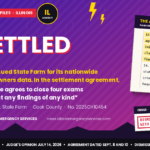
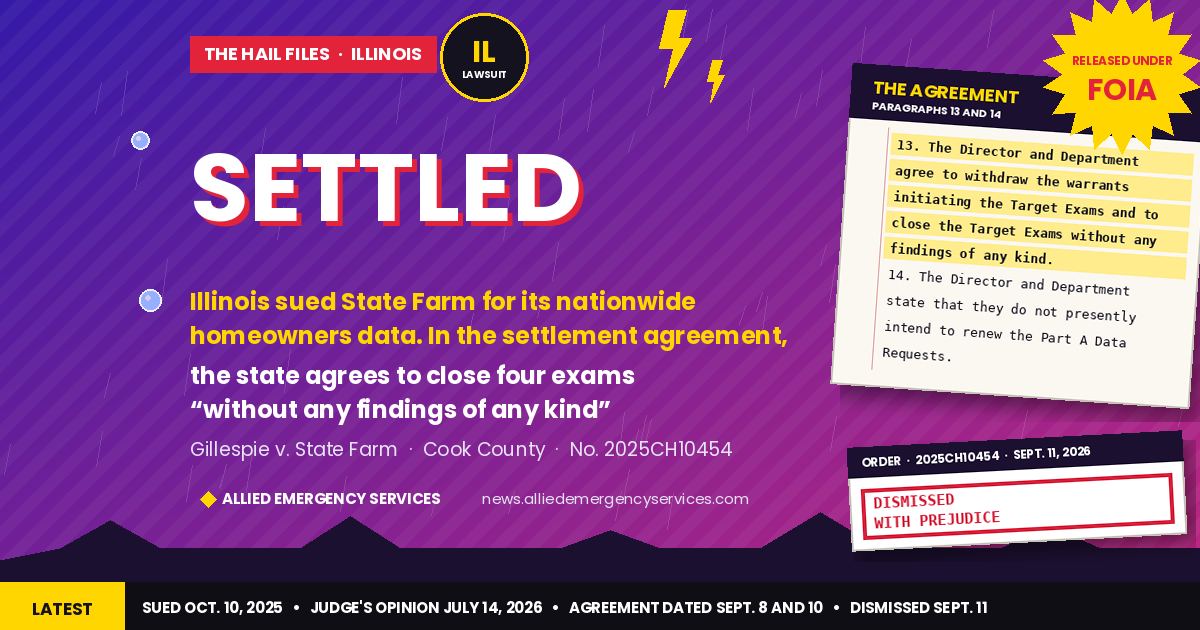
What happened, in one sentence: Illinois’ lawsuit to force State Farm to hand over homeowners insurance data for every state ended in a settlement in which the Illinois Department of Insurance agreed to withdraw its warrants and close four examinations of State Farm companies “without any findings of any kind,” according to the agreement, which the Illinois Attorney General’s office and the Department released on November 10, 2026, in response to Allied’s Freedom of Information Act requests.
Status: The agreement’s signature blocks are dated September 8, 2026, for Director of Insurance Ann Gillespie and the Department, and September 10 for the State Farm companies. On September 11 the Cook County court dismissed the case “with prejudice” and kept jurisdiction to enforce the agreement. The Department states in the agreement that it does “not presently intend to renew” the data requests. The agreement provides for no payment, says nothing in it is an admission of any violation, fact, liability or wrongdoing, requires State Farm to produce no data and has no confidentiality clause. As of November 12, 2026, we found no announcement of the settlement by the Attorney General’s office, the Department or State Farm, and no news report of it. Allied put questions about the settlement to all three that day; none had answered when this report was published, and it will be updated with what they provide.
Key facts
- The case: Gillespie v. State Farm Fire and Casualty Insurance Co. et al., Circuit Court of Cook County, Chancery Division, No. 2025CH10454, filed October 10, 2025, by Attorney General Kwame Raoul on behalf of Illinois Director of Insurance Ann Gillespie, against State Farm Mutual Automobile Insurance Company, State Farm Fire and Casualty Company, State Farm General Insurance Company and Oglesby Reinsurance Company. It sought no money: the docket lists the ad damnum as 0.
- What Illinois wanted: zip-code-level figures for every state, 2018 through 2024, according to the complaint. The agreement describes what was in dispute as the “Part A Data Requests”: “the homeowners insurance transaction data the Director sought from State Farm for all states through the Target Exams.”
- What Illinois agreed to: “to withdraw the warrants initiating the Target Exams and to close the Target Exams without any findings of any kind.” The Director and the Department also “state that they do not presently intend to renew the Part A Data Requests.”
- What State Farm agreed to: five statements about the Director’s examination powers, including that she “may examine an insurer’s practices outside of Illinois if those practices relate to an appropriate subject for examination under the statutes conferring examination powers on the Director,” as “correct statements of law applicable to future actions or proceedings arising under the Illinois Insurance Code.”
- Not in the agreement: any payment, any requirement that State Farm produce data, any confidentiality clause. The agreement says nothing in it is an admission of any violation, fact, liability or wrongdoing.
- Before the settlement: on July 14, 2026, Judge Thomas More Donnelly struck ten of State Farm’s twelve affirmative defenses, struck the other two with leave to replead, and denied State Farm’s request for discovery before summary judgment. The court never ruled on the Director’s summary-judgment motion.
- Meanwhile: State Farm raised Illinois homeowners rates 27.2% in 2025 and about 8% more in 2026 (renewals from December 1); rate-review laws signed August 4, 2026, take effect July 1, 2027.
The lawsuit Illinois filed in October 2025 to make State Farm, the nation’s largest homeowners insurer, show its regulator the numbers behind the homeowners policies it writes across the country ended in September 2026 with a settlement. As of November 12, 2026, we had found no announcement of it by either side. The agreement, released to Allied on November 10 under the Illinois Freedom of Information Act, shows what each side agreed to.
The Illinois Department of Insurance agreed to withdraw the warrants that opened four examinations of State Farm companies in November 2024 and “to close the Target Exams without any findings of any kind.” It also stated that it does “not presently intend to renew” its requests for State Farm’s homeowners insurance transaction data for all states, the requests the lawsuit was filed to enforce. State Farm, for its part, agreed to five statements about the Director of Insurance’s examination powers, among them that she “may examine an insurer’s practices outside of Illinois if those practices relate to an appropriate subject for examination under the statutes conferring examination powers on the Director.”
The agreement provides for no payment by either side. It says nothing in it “may be taken or construed to be an admission of a violation of any state or federal law or regulation,” or of “any matter of fact, or any liability or wrongdoing whatsoever,” in its words. Nothing in it requires State Farm to produce data. And it contains no confidentiality clause.
The agreement’s signature blocks are dated September 8, 2026, for Director Ann Gillespie and the Department, and September 10 for the four State Farm companies. On September 11, Cook County Circuit Judge Thomas More Donnelly entered an agreed order dismissing the case “with prejudice, with the Court to retain jurisdiction to enforce the settlement agreement, and with all parties to bear their own costs and expenses.”
Two months earlier, the same judge had granted in part the Director’s motion to strike State Farm’s affirmative defenses and denied State Farm’s motion for discovery. In a July 14 memorandum opinion, he struck ten of State Farm’s twelve affirmative defenses and the other two with leave to replead, and he denied State Farm’s request to take discovery before answering the Director’s motion for summary judgment. The court never ruled on that motion, so it never decided the question at the center of the case: whether Illinois’ insurance regulator can demand an Illinois-based insurer’s data on homes in other states.
The Attorney General’s office and the Department each released the agreement, the July 14 opinion, an August 13 agreed order and the September 11 dismissal order on November 10, 2026, in response to Freedom of Information Act requests Allied sent on October 23 (both offices logged them as received October 26). The Attorney General’s office wrote that it had “withheld no records” and had redacted only signatures; the Department cited the same exemption for its redactions, “including signatures.” The four records are linked below.
What does the settlement agreement say?
The released PDF runs five pages: pages 1 through 3, then two copies of page 4, signed in counterparts. Page 4 carries the last two paragraphs and the signature blocks. The recitals give each side’s position in a sentence. The Director “asserted in that lawsuit that State Farm had failed properly to respond to her requests for homeowners insurance transaction data for all states through the Target Exams.” State Farm “asserted the Director did not have the authority to request extraterritorial data pursuant to the specific circumstances of the Target Exams” and “raised additional defenses to the Director’s claims.” Then: “the Parties now wish to move beyond the pending litigation.”
| Subject | What the agreement says | Paragraph |
| The examinations | The Director and the Department “agree to withdraw the warrants initiating the Target Exams and to close the Target Exams without any findings of any kind.” The Target Exams were “four Target Financial Examinations” begun by warrants that then-Acting Director Gillespie issued on November 15, 2024. | 9, 13 |
| The data requests | The Director and the Department “state that they do not presently intend to renew the Part A Data Requests,” defined as “the homeowners insurance transaction data the Director sought from State Farm for all states through the Target Exams.” | 10, 14 |
| The Director’s authority | The parties agree to five statements (listed below) as “correct statements of law applicable to future actions or proceedings arising under the Illinois Insurance Code.” | 12 |
| No admission | Nothing in the agreement “may be taken or construed to be an admission of any matter of fact, or any liability or wrongdoing whatsoever,” or is “any evidence or finding supporting any of the allegations in this case” by the Director or the Attorney General. | 7 |
| The lawsuit | The parties are to submit an agreed order of dismissal “with prejudice, with all Parties to bear their own costs and expenses, and with the court to retain jurisdiction to enforce the Agreement.” | 15 |
| The whole deal | The agreement “constitutes the entire understanding and agreement among the Parties with respect to the Litigation.” | 17 |
Paragraph 12 is headed “Acknowledgement of Department’s Regulatory Authority.” In it the parties agree that:
- the Director “has broad powers, authorized by and subject to laws such as and including” four named sections of the Illinois Insurance Code, “and subject to” the federal McCarran-Ferguson Act, “to examine or investigate insurance companies registered to do business in the State of Illinois”;
- in “scheduling and determining the nature, scope, and frequency of financial examinations,” she may consider financial statement analysis, changes in management or ownership, actuarial opinions and accountants’ reports;
- she “may examine an insurer’s practices outside of Illinois if those practices relate to an appropriate subject for examination under the statutes conferring examination powers on the Director”;
- within “the scope of an authorized financial examination, and as provided by law,” she “may demand access to all books, records, accounts, papers, documents, and any or all computer or other recordings relating to the property, assets, business, and affairs of the company being examined,” including an insurer’s practices outside Illinois to the extent just described;
- within “the scope of an authorized insurance holding company system examination, and as provided by law,” she may order a registered company “to produce information not in the possession of the company if the company can obtain access to such information,” again including practices outside Illinois to that extent.
The paragraph ends: “This Agreement does not limit or waive any authority otherwise conferred on the Director by law.” The five statements are general. They do not say whether the Target Exams’ requests for all-states homeowners data fell within that authority, which is the point the two sides disputed.
Did State Farm hand over the data?
Nothing in the agreement requires it to. The agreement contains no term under which State Farm produces data, and the Department states that it does “not presently intend to renew” the requests. That statement is about present intent; the agreement also says it “does not limit or waive any authority otherwise conferred on the Director by law.”
Whether State Farm gave the Department any of the all-states data outside the agreement, before or after it was signed, the released records do not say. State Farm’s Illinois page, in a section headed “Working with Illinois” that was still posted on November 12, 2026, says of the nationwide demand: “State Farm has, therefore, not provided this data.” The page, as we read it that day, does not mention a settlement. We have asked all three whether State Farm provided any of the data.
The fight also has a national backdrop. State Farm’s Illinois page says the Department “in March 2024 demanded nationwide data of State Farm” (the complaint dates the examination to November 2024). That same month, state insurance regulators, coordinated by the National Association of Insurance Commissioners, announced a data call asking property insurers for zip-code-level data across the U.S. “on premiums, policies, claims, losses, limits, deductibles,” non-renewals and coverage types, covering “more than 80% of the U.S. property insurance market by premium volume,” according to the NAIC. In 2026, the NAIC issued a new homeowners data call for policy years 2018 through 2025, at the zip-code level, due June 15, with a report planned for early 2027, Insurance Journal reported April 1; E&E News reported that Alabama and Tennessee opted out. No public record we found connects the Illinois examination or the lawsuit to either data call, and the July 14 opinion does not mention them.
What did the judge decide in July?
By July 2026 two motions were ready for a ruling: the Director’s motion to strike State Farm’s affirmative defenses, and State Farm’s motion under Illinois Supreme Court Rule 191(b) for time to take discovery before answering the Director’s motion for summary judgment. Judge Donnelly decided both in a five-page memorandum opinion and order entered July 14, 2026.
The defenses. The court struck ten of State Farm’s twelve affirmative defenses and struck the other two “with leave to replead in fourteen days,” with the Director to respond fourteen days after that. State Farm had conceded that three of them raised no affirmative matter, the opinion says. The reasoning was about pleading rules, not about which side was right on the Director’s authority: several of the defenses, the court said, only denied what the Director herself has to prove. On State Farm’s defense that the McCarran-Ferguson Act bars the claim, for example, the court wrote: “Gillespie pleads and must show her authority. However, this forms a legal question. Thus, her lack of authority may form a defense, but not an affirmative defense.” Earlier in the opinion, on two defenses that the court said assumed the Director “must exhaust administrative remedies,” it wrote: “State Farm may advance legal arguments about her authority. These may be defenses, but not affirmative defenses.” It added: “Although State Farm cites no authority supporting its argument that she lacks authority, it may find some before it responds to her summary judgment motion.”
The discovery request. The court denied it. “Since it appeared six months ago, State Farm propounded no discovery,” the opinion says. “Although entitled to discovery, it asked for nothing.” Of State Farm’s supporting affidavit, the court wrote that it “states no material facts that State Farm expects further discovery will produce,” and of State Farm: “State Farm states no material facts it requires to oppose summary judgment. It merely raises legal issues.” The opinion lists five legal issues that State Farm said required discovery: the Director’s “statutory authority to demand the data, including what State Farm calls ‘extraterritorial’ data”; “preemption by the federal McCarran-Ferguson Act”; “defenses based on Gillespie’s earlier dismissal of a notice of apparent liability that she issued to State Farm”; “confidentiality protections for the data in question”; and “State Farm’s unclean hands defense.”
The opinion also records how State Farm described the Director’s aim. State Farm claimed, the court wrote, that the “Director sought this data as part of an attempt to regulate on behalf of other states—i.e., to collect, aggregate, and analyze State Farm’s transaction data for every jurisdiction nationwide,” and that her request for non-Illinois transaction data “is not the sort of data needed or ever previously requested as part of a financial examination.” The court answered that State Farm had offered no authority making her purpose material. It wrote that “statute dictates her authority” and that “Whether Gillespie previously exercised her authority does not limit her legal authority.”
The order then set a schedule for the summary-judgment motion: State Farm’s response by August 14, the Director’s reply by August 27 and oral argument on September 17, 2026. The schedule did not hold. The August 13 agreed order deferred the deadlines, and the September 11 dismissal order struck “the briefing schedule for Plaintiff’s Motion for Summary Judgment.” The court never ruled on the motion.
How did the case end?
On August 13, the day before State Farm’s response was due, the court entered an agreed order. It says both sides asked that the briefing deadlines “be deferred to facilitate ongoing settlement negotiations,” and it moved oral argument to October 20. Four weeks later the case was over.
| Date | What happened | Source |
| November 15, 2024 | Then-Acting Director Gillespie issues warrants opening four “Target Financial Examinations” of the State Farm companies. | The agreement, paragraph 9 |
| October 10, 2025 | The Attorney General files the Director’s lawsuit for declaratory and injunctive relief. | The agreement; the docket |
| December 12 and 16, 2025 | The Director moves for summary judgment; State Farm answers with affirmative defenses. | The docket |
| January 12 and 26, 2026 | The Director moves to strike the defenses; State Farm moves for discovery under Rule 191(b). | The docket |
| July 14, 2026 | The court strikes the affirmative defenses, two with leave to replead, denies the discovery request and sets oral argument on summary judgment for September 17. | The opinion |
| July 28, 2026 | An amended answer is filed; the Director’s August 11 reply identifies it as the defendants’. | The docket |
| August 13, 2026 | Agreed order: at both sides’ request, the summary-judgment deadlines are “deferred to facilitate ongoing settlement negotiations,” and oral argument is moved to October 20. | The agreed order |
| September 4, 2026 | The docket records a further continuance. | The docket |
| September 8 and 10, 2026 | The dates on the agreement’s signature blocks: September 8 for the Director and the Department, September 10 for the State Farm companies. | The agreement |
| September 11, 2026 | Agreed dismissal order: the case “has been settled by agreement of the parties” and is dismissed with prejudice; the court keeps jurisdiction to enforce the agreement. The order strikes an oral argument date of November 12, 2026; the order that set that date is not among the released records. | The dismissal order |
| October 23, 2026 | Allied asks the Attorney General’s office, the Department and State Farm about the dismissal and sends Freedom of Information Act requests to the two state offices. | Allied’s requests |
| November 10, 2026 | The Attorney General’s office and the Department release the four records. | Their response letters |
The records do not say why the parties settled or who proposed it.
Was the settlement announced?
As of November 12, 2026, we found no announcement of it by the Attorney General’s office, the Department or State Farm, and no news report of the settlement, the July 14 opinion or the dismissal. The Attorney General’s office announced the lawsuit in a news release on October 14, 2025. The agreement has no confidentiality clause.
Allied first asked all three about the dismissal on October 23, 2026, when the docket showed only that the case had been dismissed. The Attorney General’s press office replied with a question about where the answers would be published; none of the three answered the questions before the records were released. On November 12, with the agreement in hand, Allied sent all three a second set of questions. They included why the settlement was not announced, why the Department agreed to close the examinations without findings, whether State Farm provided any of the all-states data, and whether the warrants have been withdrawn and the examinations closed. None had answered when this report was published; it will be updated with their answers.
What did each side argue?
The Director’s complaint says State Farm refused to produce data the Department demanded in an examination it opened in November 2024. (The complaint speaks of “the November 2024 examination” and of warrants issued to each of the four companies; the agreement counts four examinations.) “State Farm has spurned the examination, flouting its legal obligations under multiple provisions of the Illinois Insurance Code,” it says, and “State Farm’s refusal to provide data regarding all the policies that it issues has no basis in law.” Its case for the data: “A complete understanding of the affordability crisis in homeowners insurance requires comprehensive data on the financial condition of State Farm, the market and nonfinancial practices of State Farm, and the enterprise risks faced by State Farm.” When the suit was announced, Raoul said, “State Farm’s obstruction does not just violate the law. It prevents the Department of Insurance from obtaining information to help make sure all Illinois homeowners are being treated fairly.”
State Farm’s answer is not online; the July 14 opinion addresses its twelve affirmative defenses, and the agreement’s recitals give its position. E&E News reported on December 23, 2025, that State Farm said in a recent court filing that Gillespie had interfered with other state regulators who sought data from the company, saying she was trying “to take on the role of a nationwide insurance regulator” and describing “improper efforts over the last 21 months to supplant the exclusive regulatory authority” of each state’s regulator; a Department spokesperson declined to comment, citing the ongoing litigation, E&E reported. State Farm’s Illinois issues page, in a section headed “Working with Illinois” that was still posted on November 12, 2026, says: “This demand exceeds the legal authority of the Illinois Department of Insurance. State Farm has, therefore, not provided this data, but has asked the Illinois DOI to engage in a process that would allow an independent third-party/judge to resolve this dispute.” When the suit was filed, the company said: “State Farm did not violate the law. This lawsuit is without merit and has nothing to do with Illinois customers or the cost of their insurance,” as reported by The State Journal-Register.
| The Director (complaint, October 10, 2025) | State Farm (its statements and Illinois page; its filing as E&E News reported it) | |
| Authority | “State Farm’s refusal to provide data regarding all the policies that it issues has no basis in law.” | “This demand exceeds the legal authority of the Illinois Department of Insurance.” |
| Whose job it is | The Director “regulates and examines the business records of all insurers doing business in Illinois.” | The Director was trying “to take on the role of a nationwide insurance regulator.” |
| Relevance | “A complete understanding of the affordability crisis in homeowners insurance requires comprehensive data on the financial condition of State Farm …” | The lawsuit “has nothing to do with Illinois customers or the cost of their insurance.” |
| Confidentiality | The Department confirmed the Code’s confidentiality provisions “will apply”; the complaint says the Director “is not obligated to promise” to follow confidentiality protections “before the regulated entity cooperates with an examination.” | Asked for written assurance that the data would not be shared with the National Association of Insurance Commissioners or other third parties (as the complaint describes it). |
| What it offered or wanted | A court order to complete the Department’s updated spreadsheet, nationwide, by a date certain. | Only “Illinois data to the Illinois Department of Insurance” (as the complaint quotes State Farm), and “a process that would allow an independent third-party/judge to resolve this dispute.” |
Why does the case matter to Illinois homeowners?
Because of the question underneath it. Gov. JB Pritzker charged when the 2025 increase was announced that “Hard-working Illinoisans should not be paying more to protect beach houses in Florida.” State Farm says “Illinois premiums are priced for the risk in this state – not for losses in other states.” The complaint did not make the governor’s allegation, but, as Live Insurance News put it in July 2026, the governor’s position “rests on the data the company refused to produce for the DOI examination.” The lawsuit was the state’s attempt to get that data from State Farm in court.
The question outlives the lawsuit. In August 2026, Pritzker signed a law that, starting July 1, 2027, bars insurers from shifting the cost of losses in other states onto Illinois consumers. And on October 1, 2026, State Farm began charging new Illinois homeowners customers about 8% more, an increase that reaches existing customers at renewal starting December 1, on top of a 27.2% average increase in 2025.
How much have State Farm’s Illinois home insurance rates gone up?
| Year | Increase | When | Reported impact |
| 2025 | 27.2% average statewide (Capitol News Illinois) | New policies from July 15, 2025; renewals from August 15, 2025 (NBC Chicago) | 1.5 million policyholders, about $750 a year on average (as Live Insurance News reported, citing WGLT) |
| 2026 | About 8%; 7.9% overall for the homeowners program in the filing: 8.5% for standard homeowners, 5.8% for renters, a 3% reduction for condominium unit owners (Insurance Business) | New policies from October 1, 2026; renewals from December 1, 2026 | Affects 1,483,264 policies and adds $190.3 million in written premium, per the filing (Insurance Business); about $10 a month for the average customer, per State Farm |
In a July 10, 2025 statement, Pritzker called the 2025 increase “unfair and arbitrary.” State Farm’s Illinois page says its June 2025 filing was “more than 32-pages long and is available publicly on the National Association of Insurance Commissioners (NAIC) SERFF site,” that it answered the Department’s questions on June 23, and that “the filing was closed out by the Department of Insurance on June 27.” It also says, “State Farm first learned of concerns with the rate filing through the Governor’s press release in July.”
For the 2026 increase, State Farm cited “the effects of severe weather trends that are more frequent and severe” and rising “related repair costs,” according to WGLT, and said it “paid out $1.22 in claims and expenses for every $1 in premium collected the past three years in Illinois.” “As a mutual company, State Farm serves policyholders on Main Street, not shareholders on Wall Street,” the company said. According to Insurance Business, State Farm’s actuaries indicated a need for a 12.5% increase. The company’s Illinois page and statements add: more than $799 million paid for Illinois storm losses in 2026 through July; more than 96,000 catastrophe weather-related home and auto claims in 2026; and “more hail damage claims than any other state except Texas in 2024.” (Our county-by-county look at Illinois’ spring 2026 storms and the self-updating Illinois Tornado Tracker show what those storms looked like on the ground.)
After the 2026 increase was announced, state Sen. Michael Hastings, D-Frankfort, called for a bill that would look at insurers that raise rates 8% or more over three years. “Show the department the math,” he said, according to WAND-TV.
What is State Farm’s 1% wind/hail deductible in Illinois?
State Farm’s Illinois page says: “Illinois customers will now be required to have a minimum 1% Wind/Hail deductible as part of their home insurance policy.” It adds that the deductible “will apply in instances where the cause of loss is deemed to be wind or hail,” and explains: “One of the ways we are limiting rising premiums is through the introduction of a Wind/Hail Deductible.” Insurance Business reported that the 1% minimum came with the 2025 increase.
State Farm’s page does not say what the 1% is applied to. Percentage deductibles are typically figured on the home’s dwelling coverage limit (Coverage A on the declarations page), not on the amount of damage, as Westfield Insurance’s consumer guide explains: on a home insured for $300,000, a 1% wind and hail deductible would be $3,000. Your declarations page shows which wind/hail deductible applies to your policy; your agent can tell you what it means in dollars for your home.
What does Illinois’ new insurance rate law do, and when does it take effect?
House Bill 4273 (homeowners insurance) and Senate Bill 714 (auto insurance), which Pritzker signed August 4, 2026, take effect July 1, 2027, according to Capitol News Illinois. Before them, Illinois was one of only two states, with Wyoming, that did not exercise regulatory control over insurance rates. Under the new laws:
- rates may not be “excessive, inadequate, or unfairly discriminatory”;
- insurers may not shift the cost of losses in other states onto Illinois consumers;
- homeowners rates must use credible Illinois-specific claims data when it is available, supplemented if necessary with national, regional or out-of-state data to meet actuarial credibility standards;
- homeowners insurers must give 60 days’ notice before a premium increase of more than 10% (30 days for auto);
- insurers can still charge new rates once they are filed, but the Department can review them and order rebates of excess premiums if it finds the rates excessive or unfairly discriminatory.
Gillespie said the laws “hold insurance companies accountable for addressing their cost increases by requiring rates to reflect Illinois-specific losses and considerations.” Three industry groups, the Illinois Insurance Association, the American Property Casualty Insurance Association and the National Association of Mutual Insurance Companies, warned in a joint statement of higher costs and fewer choices, and of “moving the state toward a more rigid rate approval system similar to struggling insurance markets like California,” Capitol News Illinois reported. State Farm’s Illinois page, in a May 19, 2026 update about two insurance bills then before lawmakers, said: “We understand there’s a desire to address affordability for Illinoisans—but the legislation proposed will not deliver cost savings and may very well reduce competition for consumers.” An earlier rate-oversight bill cleared the Illinois Senate 41 to 15 in October 2025 but fell four votes short in the House, according to Live Insurance News.
Is any other state taking State Farm to court?
Yes. In Oklahoma, the attorney general sued State Farm in June 2026 over its handling of hail and roof damage claims (State of Oklahoma ex rel. Drummond v. State Farm, Cleveland County No. CJ-2026-1066). State Farm argued there that “the Oklahoma Attorney General can’t regulate the business of insurance,” because that power “belongs exclusively to the Oklahoma Insurance Commissioner.” On September 28, 2026, District Judge Jeff Virgin denied State Farm’s motion to dismiss in a one-page order (The Hail Files, Part 12, covers the motion and the order), and on October 19 State Farm filed an answer listing among its defenses that “the Attorney General lacks authority to bring any claims in this action.” A homeowners’ bad-faith lawsuit over a hail claim there, Hursh v. State Farm, was set for a December 7 trial as of our November 11 docket read (the trial guide).
The Illinois case was a different kind of fight. Its plaintiff was the insurance regulator itself; the dispute was over how far her examination power reaches, which State Farm argued stops where other states’ regulators have exclusive authority: whether an Illinois-headquartered insurer must open its books on homes in other states to the Illinois Director of Insurance. The settlement leaves that question without a ruling: the agreement states the Director’s powers in general terms, and the court never decided whether they reach the data she asked for.
What happens next?
The agreement: The court kept jurisdiction to enforce it. If the Department, the Attorney General’s office or State Farm answers our questions, this report will be updated.
The examinations: The agreement commits the Director and the Department to withdraw the warrants and close the four examinations. We have asked whether that has been done.
December 1, 2026: The 2026 increase reaches existing State Farm homeowners customers at renewal.
July 1, 2027: The rate-review laws take effect.
What does this mean for Illinois homeowners?
Three things are worth doing before the next storm season. Read your renewal notice for the premium change. Check the wind/hail deductible on your declarations page and ask your agent what it means in dollars. And keep dated photos of your roof and a record of repairs.
Questions about a premium, a deductible or a claim belong with your agent or insurer; the Illinois Department of Insurance takes consumer complaints, and an attorney can advise on legal questions. State Farm’s Illinois page also points to resilience: “Impact-resistant roofing is one practical way homeowners can make their homes more resilient and help reduce hail damage.”
Read the documents
The settlement agreement in Gillespie v. State Farm, Cook County No. 2025CH10454 (signature blocks dated September 8 and 10, 2026; 5 pages) · The July 14, 2026 memorandum opinion and order (5 pages) · The August 13, 2026 agreed order (2 pages) · The September 11, 2026 agreed dismissal order (2 pages). These are the copies the Illinois Attorney General’s office released on November 10, 2026 (2026 FOIA 079932); that office wrote that it redacted signatures.
The complaint, October 10, 2025 (posted by the Illinois Attorney General; 15 pages plus the four examination warrants) · The docket: search case 2025CH10454 on the Cook County Clerk of the Circuit Court’s online case search · The Attorney General’s announcement of the lawsuit · State Farm’s “Understanding the issues in Illinois” · Capitol News Illinois on the rate-review laws · The September 28, 2026 Oklahoma order denying State Farm’s motion to dismiss · State Farm’s October 19, 2026 answer in the Oklahoma case · Search The Hail Files archive.
More from The Hail Files: Part 12: ‘Can’t Regulate the Business of Insurance’ · the trial guide · “The Denial Enterprise” · Part 14: ‘Higher Rewards’ · Trial Watch.
Frequently asked questions
Yes. Gillespie v. State Farm Fire and Casualty Insurance Co. et al. (Cook County No. 2025CH10454), the lawsuit Illinois filed October 10, 2025, to obtain State Farm’s nationwide homeowners data, ended with a settlement agreement whose signature blocks are dated September 8 and September 10, 2026. On September 11, 2026, the court dismissed the case with prejudice, with each side bearing its own costs, and kept jurisdiction to enforce the agreement. The Illinois Attorney General’s office and the Illinois Department of Insurance released the agreement on November 10, 2026, under the Freedom of Information Act. As of November 12, 2026, we found no public announcement of the settlement.
The Illinois Director of Insurance and the Department agreed “to withdraw the warrants initiating the Target Exams and to close the Target Exams without any findings of any kind,” and stated that they “do not presently intend to renew the Part A Data Requests,” their requests for State Farm’s homeowners insurance transaction data for all states. The Target Exams were four examinations of State Farm companies begun by warrants issued November 15, 2024. The parties also agreed to the dismissal of the lawsuit with prejudice.
State Farm agreed to five statements about the Illinois Director of Insurance’s examination powers as “correct statements of law applicable to future actions or proceedings arising under the Illinois Insurance Code.” One says the Director “may examine an insurer’s practices outside of Illinois if those practices relate to an appropriate subject for examination under the statutes conferring examination powers on the Director.” The agreement requires no payment and says nothing in it is an admission of any violation, fact, liability or wrongdoing.
The settlement agreement does not require State Farm to produce any data, and the Department states in it that it does “not presently intend to renew” the requests. Whether State Farm provided any of the all-states data outside the agreement, the released records do not say. State Farm’s Illinois page, in a section headed “Working with Illinois” still posted on November 12, 2026, says it has “not provided this data.”
On July 14, 2026, Cook County Circuit Judge Thomas More Donnelly struck ten of State Farm’s twelve affirmative defenses, struck the other two with leave to replead, and denied State Farm’s Rule 191(b) motion for discovery before it answered the Director’s motion for summary judgment. The court wrote that State Farm “states no material facts it requires to oppose summary judgment. It merely raises legal issues.” It also wrote that State Farm “may advance legal arguments about her authority,” which “may be defenses, but not affirmative defenses.” The court never ruled on the summary-judgment motion; the case settled first.
Illinois sued to force State Farm to complete a Department of Insurance examination. The complaint, filed by Attorney General Kwame Raoul on behalf of Director of Insurance Ann Gillespie, says State Farm refused to produce zip-code-level homeowners data for every state, 2018 through 2024, that the Department demanded in an examination opened in November 2024 (the settlement agreement counts four examinations), and that “State Farm has spurned the examination, flouting its legal obligations,” which State Farm denies. State Farm said the demand “exceeds the legal authority of the Illinois Department of Insurance” and called the lawsuit “without merit” and unrelated to its Illinois rates.
State Farm raised Illinois homeowners rates an average of 27.2% statewide in 2025, effective July 15, 2025, for new policies and August 15, 2025, at renewal. In 2026 it filed another increase of about 8% (7.9% overall for its homeowners program, with 8.5% for standard homeowners policies, according to Insurance Business), effective October 1, 2026, for new policies and December 1, 2026, at renewal, covering 1,483,264 policies. State Farm says the 2026 increase adds about $10 a month for the average customer and cites more frequent and severe weather and rising repair costs; it says it paid $1.22 in claims and expenses for every $1 of Illinois premium over the past three years.
Illinois’ rate review laws, House Bill 4273 (homeowners) and Senate Bill 714 (auto), signed by Gov. JB Pritzker on August 4, 2026, take effect July 1, 2027. They prohibit rates that are “excessive, inadequate, or unfairly discriminatory,” bar insurers from shifting the cost of losses in other states onto Illinois consumers, require credible Illinois-specific claims data for homeowners rates when available, require 60 days’ notice before a homeowners premium increase of more than 10%, and let the Department of Insurance order rebates of excess premiums. Insurers can still charge new rates once filed. Before the laws, Illinois and Wyoming were the only states without regulatory control over insurance rates, according to Capitol News Illinois.
About this report. The settlement’s terms, the court’s rulings and the end of the case are drawn from four records in Gillespie v. State Farm Fire and Casualty Insurance Co. et al. (Circuit Court of Cook County, Chancery Division, No. 2025CH10454) that the Illinois Attorney General’s office (2026 FOIA 079932) and the Illinois Department of Insurance (26-FO-1055) released on November 10, 2026, in response to Freedom of Information Act requests Allied sent on October 23, 2026 (logged by both offices as received October 26): the settlement agreement, the July 14, 2026 memorandum opinion and order, the August 13, 2026 agreed order and the September 11, 2026 agreed dismissal order. Quotations are from the Attorney General’s copies, linked above; both offices wrote that they redacted signatures. A footnote in the agreement, repeated in the dismissal order, says the Director named “State Farm Fire and Casualty Insurance Company” but intended State Farm Fire and Casualty Company. Dates of filings that are not in those records are from the Cook County Clerk of the Circuit Court’s online docket as Allied printed it on October 23, 2026 (83 entries). The Director’s case is drawn from the October 10, 2025 complaint, as posted by the Illinois Attorney General, and the Attorney General’s October 14, 2025 announcement; quotations of State Farm’s letters are as the complaint gives them. State Farm’s positions are quoted from the court’s July 14 opinion, from its statement as reported by The State Journal-Register (October 17, 2025), from its “Understanding the issues in Illinois” newsroom page (as read November 12, 2026, when its dateline was November 2, 2026; its statements on the data demand are in a section headed “Working with Illinois,” its statement on the rate bills in a May 19, 2026 update) and from a court filing as E&E News reported it (December 23, 2025). Gov. Pritzker’s words are from his July 10, 2025 statement. The data calls are described from the NAIC’s March 8, 2024 announcement, Insurance Journal (April 1, 2026) and E&E News (April 30, 2026). Rate figures are from Capitol News Illinois (August 4, 2026), NBC Chicago (July 10, 2025), Insurance Business (October 6, 2026), WGLT (October 7, 2026), WAND-TV (October 9, 2026) and Live Insurance News (July 2, 2026); the rate-review laws are as Capitol News Illinois and WTTW described them; the deductible example follows Westfield Insurance’s consumer guide. The Oklahoma case is described from its court record in The Hail Files archive. Individuals named in the records other than the parties’ officials and the judge are not named here. The complaint’s allegations are the Director’s; State Farm denies violating the law; the agreement says nothing in it is an admission, and no court decided the merits. Get an email when new filings are added to The Hail Files: sign up for alerts.
About the host. Allied Emergency Services is a licensed storm-damage restoration contractor serving Illinois, Wisconsin, Indiana and Michigan — not a law firm, insurance adjuster or public adjuster, and this report is not legal or insurance advice. We inspect, document, provide insurance-ready repair estimates and complete repairs; coverage decisions always belong to you and your insurer. Founded 2015; in the building trades since 1999; Illinois-licensed. 24/7: (800) 792-0212.
⚡ Storm or Roof Damage? Get a FREE Estimate
Text ESTIMATE to (844) 907-2546
Or call (800) 792-0212 for 24/7 emergency response
AI-powered • No obligation • Licensed IL & WI
Storm damage? Start with the documentation
Allied Emergency Services — IL-Licensed Storm Damage Restoration Contractor
Founded 2015, in the building trades since 1999. Allied inspects and documents storm damage, writes the scope and estimate, and does the repairs. We do not adjust or negotiate insurance claims — that is the job of your insurer, a licensed public adjuster, or an attorney. IICRC-certified, EPA Lead-Safe, IL Licensed Roofing Contractor #104.019029. 24/7 emergency response.
How the storm-damage insurance claim process works →Free inspection within 24 hours · No obligation · Photo-documented findings you can share with your insurer
Attorneys: forensic storm damage documentation & construction expert consultation for counsel →