





⚡ Storm or Roof Damage? Get a FREE Estimate
Text ESTIMATE to (844) 907-2546
Or call (800) 792-0212 for 24/7 emergency response
AI-powered • No obligation • Licensed IL & WI
Published July 28, 2026 | Status: Preliminary and subject to official updates
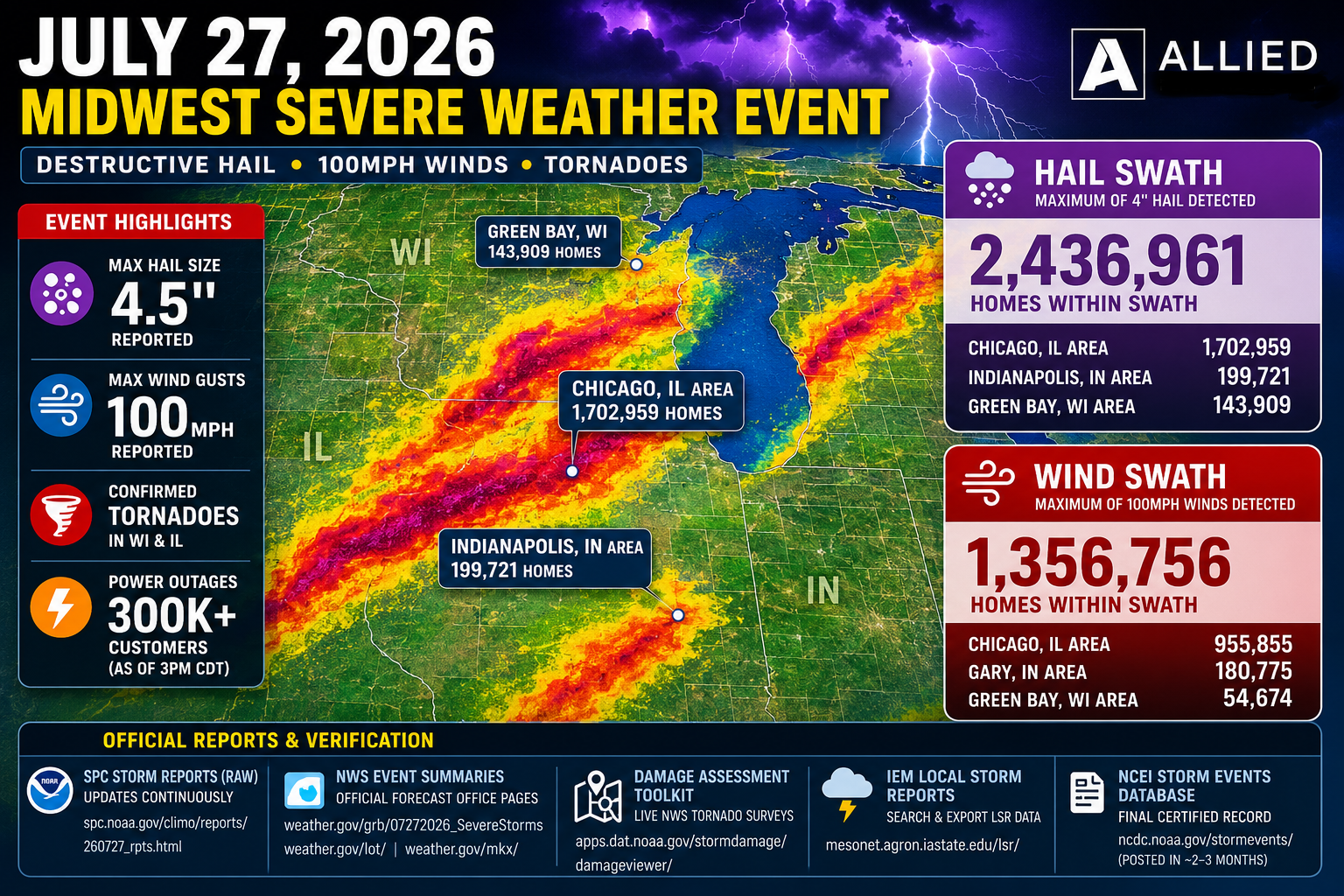
The July 27, 2026 Midwest storm placed an estimated 2,436,961 homes inside a hail swath with a modeled maximum hail size of 4 inches. An estimated 1,356,756 homes were inside a destructive-wind swath with maximum indicated winds of 100 mph. In the Chicago area alone, 1,702,959 homes were within the hail swath and 955,855 were within the wind swath.
These figures describe potential storm exposure, not confirmed property damage. The hail and wind footprints also overlap, so the two totals should not be added together to calculate unique homes affected.
The July 27, 2026 Midwest storm produced an extraordinary combination of giant hail, tornado-warned rotation, extreme straight-line wind and widespread power and transportation disruption across northern Illinois, Wisconsin and northwest Indiana. Preliminary reports include baseball-size and larger hail, warnings for life-threatening wind, and a confirmed Wisconsin tornado described by the National Weather Service as at least EF-2.
July 27, 2026 Midwest Storm Numbers at a Glance
| Storm hazard | Estimated homes within Midwest swath | Chicago area | Other major listed areas | Maximum indicated intensity |
|---|---|---|---|---|
| Hail | 2,436,961 | 1,702,959 | Indianapolis: 199,721; Green Bay: 143,909 | 4-inch modeled hail maximum |
| Wind | 1,356,756 | 955,855 | Gary: 180,775; Green Bay: 54,674 | 100 mph indicated wind maximum |
Chicago represented approximately 70% of the modeled residential exposure in both the hail and wind datasets.
The listed metropolitan figures do not equal the complete Midwest totals because additional communities were included in the broader swaths. A home also may appear in both the hail and wind estimates.
What “homes within the swath” actually means
A storm swath is a mapped corridor where radar analysis, meteorological modeling, observations or a combination of those data indicate that hail or destructive wind may have occurred.
Being inside a swath does not mean every home sustained damage. It means the property may warrant further evaluation based on its exact location, construction, roof age, surrounding terrain, tree cover and the storm’s localized intensity.
Likewise, being outside a modeled swath does not conclusively establish that a property escaped damage. Severe weather boundaries are not perfectly uniform, and isolated damage may occur beyond a generalized map.
A Violent Midday Storm Corridor Crossed Chicagoland
The primary impact window supplied for the Chicago and Wisconsin event was approximately 10:45 a.m. through 1:30 p.m. CDT on July 27, with an additional severe-weather threat continuing later in the day.
A tornado-warned supercell and squall-line complex moved southeast across Chicagoland around midday. At nearly the same time, a separate confirmed tornado affected the Fox Valley region of Wisconsin.
The Chicago-area storm produced a concentrated giant-hail corridor through portions of southwest DuPage County and northwest Will County. It also generated intense rotation and warnings for destructive straight-line wind through heavily populated suburbs.
Preliminary Chicago-area hail reports
The early location-based hail reports supplied for the July 27, 2026 Midwest storm include:
| Location | Preliminary hail description | Approximate diameter |
|---|---|---|
| Lemont, Illinois | Possible extreme hail report | Up to 5 inches reported by media; not yet final |
| Bolingbrook, Illinois | Potentially baseball-size | Approximately 2.75 inches |
| Westmont, Illinois | Tennis-ball-size | Approximately 2.5 inches |
| Downers Grove, Illinois | Quarter- to golf-ball-size reports | Approximately 1 to 1.75 inches |
| Oak Brook, Illinois | Quarter- to golf-ball-size reports | Approximately 1 to 1.75 inches |
| Willowbrook, Illinois | Quarter- to golf-ball-size reports | Approximately 1 to 1.75 inches |
| Elmhurst, Illinois | Quarter- to golf-ball-size reports | Approximately 1 to 1.75 inches |
| Clarendon Hills, Illinois | Quarter- to golf-ball-size reports | Approximately 1 to 1.75 inches |
| Kenosha County, Wisconsin | Baseball-size | Approximately 2.75 inches |
| Gresham, Wisconsin | Giant hail listed in the supplied NWS summary | Approximately 4.5 inches |
The possible 5-inch Lemont report should not yet be presented as a final certified measurement. The supplied storm analysis identified a modeled maximum of 4 inches, while the linked National Weather Service Green Bay summary reportedly identified 4.5-inch hail in Gresham.
Those values are not necessarily contradictory. A modeled hail swath and an individual point observation are different types of evidence. Both remain subject to quality control and later official documentation.
Tornado Warnings and Rotation Across the Chicago Suburbs
Early storm information identified radar-confirmed or strongly indicated rotation near Downers Grove at approximately 12:10 p.m. A later warning near Frankfort Square and Tinley Park at approximately 12:44 p.m. reportedly carried an 80 mph wind tag.
Reports of possible touchdowns in Orland Park and Glen Ellyn should remain labeled unconfirmed unless the National Weather Service verifies tornado damage through an official survey.
A tornado warning, radar velocity signature or debris indication is important evidence, but it is not the same as a finalized tornado track and rating. The National Weather Service Chicago office may publish an event summary after completing damage assessments and reviewing radar, photographs, videos and ground reports.
Property owners and news publishers can monitor the National Weather Service Chicago forecast office for an official event summary.
Menasha and the Wisconsin Fox Valley Tornado
A confirmed tornado moved through the Fox Valley region of Wisconsin at approximately 12:15 p.m., affecting areas around Appleton, Menasha, Fox Crossing and Neenah before continuing toward communities along the eastern side of Lake Winnebago.
The supplied National Weather Service Green Bay event summary described the Menasha-area tornado as at least EF-2.
Preliminary damage information included roofs and siding removed from homes, overturned vehicles and extensive utility disruption. Additional affected communities reportedly included Sherwood, Harrison, Stockbridge and Brothertown.
The phrase “at least EF-2” is important. It indicates that surveyors found damage supporting an EF-2 classification, but the rating or track details may still be refined as additional locations are inspected.
Official survey points and updated tornado assessments may appear first in NOAA’s Damage Assessment Toolkit.
Destructive Wind Extended From Chicago Toward Gary and Green Bay
The supplied wind analysis placed 1,356,756 homes inside the July 27 destructive-wind swath, including:
- 955,855 homes in the Chicago area
- 180,775 homes in the Gary, Indiana area
- 54,674 homes in the Green Bay area
Warnings associated with the storm described the potential for life-threatening wind near or above 100 mph. The supplied swath analysis indicated a maximum of 100 mph.
A warning tag describes the wind intensity a storm may be capable of producing. It should not automatically be interpreted as a measured 100 mph gust at every address in the warned area.
An early operational snapshot supplied for this article cited approximately 300,000 ComEd customers without power, approximately 30,000 NIPSCO outages in northwest Indiana and 440 canceled flights at O’Hare International Airport. Those figures were time-sensitive preliminary totals and should not be treated as the final event record.
Why 100 MPH Wind Can Cause Damage That Is Easy to Miss
Extreme straight-line wind can damage a building without removing the entire roof. Potential wind-related conditions include:
- Lifted or creased asphalt shingles
- Broken adhesive seals
- Displaced ridge caps
- Bent or detached flashing
- Loosened roof vents
- Damaged soffit and fascia
- Detached siding
- Broken window seals or glazing
- Garage-door failure
- Tree and limb impacts
- Roof-deck or framing movement
- Openings that permit rainwater intrusion
Wind damage can be directional. One roof slope may show substantial uplift while another appears relatively intact.
A roof should not be declared damage-free solely because no shingles are visible on the ground.
What Giant Hail Can Do to Roofing, Siding, Gutters and Windows
Hail in the 2.5- to 4-inch range can strike a building with enough force to fracture roof materials, puncture soft metals and break exterior components.
Potential signs of July 27, 2026 Midwest storm damage include:
Asphalt roofing
Hail may dislodge granules, bruise the asphalt layer, fracture the reinforcement mat or expose underlying material. Some functional damage is difficult to identify from the ground.
Random discoloration is not, by itself, proof of hail damage. A qualified inspection should evaluate impact shape, mat condition, roof slope, collateral metal damage, installation conditions and the storm’s direction.
Siding
Vinyl siding may crack, split or develop holes. Aluminum and steel siding may dent or lose coating. Fiber-cement products can fracture along edges, fasteners or unsupported areas.
Replacement work should also restore the water-resistive barrier, flashing and drainage details behind the visible siding.
Gutters, downspouts and roof accessories
Gutters, downspouts, vents, metal flashing and air-conditioning components may retain impact marks that help document the storm’s direction and hail size.
Collateral metal dents can support an inspection, but they do not automatically establish that every roof component requires replacement.
Windows and doors
Large hail can break glazing, damage screens, dent cladding and compromise seals. Wind-driven debris may also damage frames and weather barriers surrounding the opening.
Water around a window does not always mean the window itself failed. The entry point may be higher in the wall or roof assembly.
What Property Owners Should Do After the July 27 Storm
1. Address immediate safety hazards
Stay away from downed electrical lines, unstable trees, damaged ceilings, standing water near electrical equipment and buildings with visible structural movement.
Do not climb onto a wet, steep or storm-damaged roof.
Call emergency services when there is an immediate threat to life, fire, a suspected gas leak or a structural-collapse risk.
2. Document conditions before temporary work
Photograph and record:
- Missing or displaced roofing
- Hail accumulation
- Damaged siding and windows
- Fallen trees and branches
- Interior water entry
- Wet ceilings, walls and flooring
- Damaged personal property
- Temporary tarps, board-up work and water extraction
- Contractor invoices and material receipts
Wide-angle photographs should establish location and context. Close-up images should document specific damage.
3. Prevent additional damage when safe
Insurance policies commonly require reasonable steps to prevent additional loss, although exact policy duties differ.
Emergency measures may include temporary roof covering, board-up, water extraction, structural drying and removal of immediate hazards. Temporary work should be documented before, during and after completion.
4. Report the loss and retain records
Notify the insurance carrier according to the policy’s notice requirements. Maintain a written log of claim numbers, representatives, inspection dates, communications, photographs and submitted documents.
Preserve damaged materials or representative samples when practical and safe. Do not discard evidence that may be relevant to the claim without first documenting it.
5. Request a complete building-envelope inspection
A storm inspection should not stop at the shingles. The evaluation may need to include:
- Roof covering and underlayment
- Flashing and penetrations
- Roof deck and framing
- Attic ventilation
- Gutters and drainage
- Siding and wall flashing
- Windows and doors
- Garage doors
- Interior moisture
- Insulation and drywall
- Mechanical equipment
- Trees and site drainage
Building-Code Compliance After Midwest Storm Damage
Storm restoration must comply with the code legally adopted by the local jurisdiction. Replacing damaged materials “the way they were” is not always sufficient when current permit requirements, manufacturer instructions or code-triggered upgrades apply.
Within Chicago city limits, the Chicago Construction Codes and city permit requirements control. In suburban Illinois, Wisconsin and Indiana, the applicable municipality or county may enforce a locally adopted edition of the International Residential Code, International Building Code, International Existing Building Code or another code with local amendments.
The governing code edition should be confirmed before a final restoration estimate is prepared.
Common code sections affecting storm restoration
Depending on the adopted code edition and local amendments, the following IRC topics may be relevant:
- IRC R301: Structural design criteria, including wind loading
- IRC R609: Exterior windows and doors
- IRC R703: Exterior wall coverings, flashing and water-resistive barriers
- IRC R802 and R803: Roof framing and roof sheathing
- IRC R903: Roof assembly weather protection and flashing
- IRC R905: Roof-covering installation requirements
- IRC R908: Reroofing requirements and limitations
Section numbering can vary by code edition. Local amendments may also be more restrictive than the model code.
Roof deck and fastening requirements
After extreme wind, the roof deck should be evaluated for displaced panels, failed fasteners, damaged edges, moisture deterioration and loss of structural attachment.
A compliant replacement may require correction of unsuitable decking, fastening deficiencies or damaged framing before new roofing is installed.
The wind rating and fastening schedule for the new roof system must be appropriate for the building’s design conditions, exposure and product approval.
Flashing, underlayment and ice-barrier requirements
Roof replacement may involve more than installing new shingles. Code, manufacturer instructions and local inspection requirements can affect:
- Drip edge
- Valley lining
- Step flashing
- Chimney flashing
- Wall-to-roof transitions
- Underlayment
- Ice-barrier membranes
- Ventilation
- Roof penetrations
- Fastener type and placement
Existing flashing should not automatically be reused if it is damaged, improperly integrated or incompatible with the replacement assembly.
Siding and exterior-wall compliance
Siding repairs should preserve or restore the wall’s drainage system. That may require proper integration of siding with the water-resistive barrier, window flashing, door flashing and roof-to-wall intersections.
Installing replacement panels over damaged or missing weather protection can leave the building vulnerable to future water intrusion.
Window and door requirements
Replacement windows and doors may need to satisfy structural, safety-glazing, flashing and energy-performance requirements. Local code provisions and the opening’s location determine what is required.
Large hail and wind-driven debris can also damage the rough-opening flashing even when the glass remains intact.
Permit and inspection programs
Emergency stabilization may be permitted before a full restoration permit is issued, but permanent reconstruction generally remains subject to local approval.
Property owners and contractors should confirm:
- Whether a permit is required
- Which code edition applies
- Required product approvals
- Inspection stages
- Structural-engineering requirements
- Historic-district restrictions
- Disposal requirements
- Contractor licensing or registration requirements
A permit is not merely paperwork. It creates an inspection record and helps verify that the completed work meets the jurisdiction’s minimum safety standards.
Insurance Restoration and Code-Upgrade Questions
Storm damage coverage depends on the policy, endorsements, exclusions, deductibles, depreciation provisions and applicable law.
A qualified restoration scope should separate:
- Direct physical storm damage
- Emergency mitigation
- Tear-out required to access damaged materials
- Debris removal
- Water mitigation
- Structural repairs
- Code-required work
- Non-covered maintenance or pre-existing deterioration
Ordinance or law coverage
Some policies include additional coverage for increased costs caused by enforcement of current building codes. This is commonly called ordinance or law coverage.
Potential examples include code-required deck replacement, updated flashing, ice barrier, ventilation correction, structural attachment or other mandatory upgrades. Whether a particular cost is covered depends on the policy language and the jurisdiction’s written requirements.
A code provision does not automatically create insurance coverage. Likewise, the absence of coverage does not remove the obligation to comply with an applicable building code.
Do not rely on a storm map alone
A hail or wind map can establish that damaging weather may have occurred near a property, but it cannot establish the complete scope or cause of damage by itself.
A property-specific conclusion should consider:
- Exact address and storm path
- Time-stamped photographs or video
- Radar and report data
- Roof and exterior conditions
- Directional damage patterns
- Age and installation of materials
- Maintenance history
- Interior water evidence
- Nearby verified observations
- Qualified physical inspection findings
How to Verify July 27, 2026 Storm Reports
Because storm records are still developing, the best approach is to use multiple official and archival sources.
NOAA Storm Prediction Center preliminary reports
The SPC July 27 preliminary storm-report page provides the raw spotter and local storm report log for the Chicago and Wisconsin event. It may change as reports are added, corrected or filtered.
Mapping files are available through:
The SPC July 26 report page should be reviewed separately for the preceding downstate Illinois round, including the Effingham-area tornado and Aviston-area hail reports.
Keeping the July 26 and July 27 report groups separate helps prevent locations or storm times from being attributed to the wrong severe-weather episode.
National Weather Service event pages
The supplied official event and office pages include:
NWS office event summaries generally provide stronger official context than isolated social-media posts because they incorporate surveys, radar review and local storm reports.
NOAA Damage Assessment Toolkit
The Damage Assessment Toolkit displays tornado survey points as National Weather Service teams upload and revise them.
Early ratings and track details may change as surveyors find more severe damage or determine that a location was affected by straight-line wind rather than a tornado.
Iowa Environmental Mesonet Local Storm Reports
The IEM Local Storm Reports application allows users to search and export local storm reports by National Weather Service office and date.
For this event, relevant offices may include Chicago/Romeoville, Green Bay and Milwaukee/Sullivan.
NCEI Storm Events Database
The NCEI Storm Events Database is the long-term official archive used for certified storm-event research.
The final record may not appear immediately. It can include corrected hail sizes, event narratives, injuries, property-loss estimates and finalized location information.
What Is Confirmed, Preliminary and Still Unknown?
| Issue | Current treatment |
|---|---|
| 2,436,961 homes in hail swath | Supplied exposure estimate; not a confirmed damage count |
| 1,356,756 homes in wind swath | Supplied exposure estimate; not a confirmed damage count |
| 4-inch modeled hail maximum | Supplied swath-analysis maximum |
| 4.5-inch Gresham hail | Reportedly included in supplied NWS Green Bay event summary |
| Possible 5-inch Lemont hail | Preliminary media report; final verification pending |
| Menasha tornado | Confirmed in supplied NWS Green Bay information |
| Menasha rating | Described as at least EF-2; may be refined |
| Chicago suburban tornado touchdowns | Not final unless confirmed through NWS survey findings |
| Final hail sizes and event record | Pending later NCEI certification |
| Number of unique damaged homes | Unknown; swaths overlap and exposure is not proof of damage |
Frequently Asked Questions About the July 27, 2026 Midwest Storm
How many homes were within the July 27 hail swath?
The supplied analysis placed 2,436,961 homes within the Midwest hail swath.
That number estimates potential exposure. It does not mean 2,436,961 homes sustained roof, siding, window or vehicle damage.
How many Chicago-area homes were potentially exposed?
The supplied data placed 1,702,959 Chicago-area homes within the hail swath and 955,855 within the wind swath.
Because the two storm footprints overlap, those numbers should not be added to create a unique Chicago property count.
Was the July 27 Chicago hail really four or five inches?
The supplied modeled hail swath indicated a maximum of 4 inches. A possible 5-inch hailstone was reported in Lemont through early media information, while the supplied NWS Green Bay summary reportedly listed 4.5-inch hail in Gresham, Wisconsin.
The Lemont report should remain labeled possible or preliminary until officially verified.
Did a tornado hit Downers Grove, Orland Park or Glen Ellyn?
The Chicago-area storms produced tornado warnings and significant radar rotation. Possible touchdowns were reported, but an official National Weather Service survey is needed before any specific Chicago-suburban tornado track or rating is treated as confirmed.
Was the Menasha tornado an EF-2?
The supplied NWS Green Bay event information described the tornado as at least EF-2. That wording indicates the survey had identified damage supporting EF-2 intensity, while further assessment could refine the rating or track.
Does hail damage always create an immediate roof leak?
No. Hail may fracture or bruise roofing without producing an immediate opening. Leakage may begin later as damaged material ages or after another rain event.
Conversely, a roof leak after a storm is not automatically proof of hail damage. Wind displacement, failed flashing, debris impact, installation defects or pre-existing deterioration may also be involved.
Can wind damage exist when no shingles are missing?
Yes. Wind may break adhesive seals, crease shingles, loosen fasteners, displace flashing or damage the roof deck without leaving obvious debris on the ground.
A qualified inspection may be necessary to evaluate uplift and attachment.
Should a storm-damaged roof be repaired or replaced?
The appropriate scope depends on the type and extent of damage, material availability, roof age, repairability, manufacturer requirements, code provisions and policy coverage.
A small number of isolated damaged components may be repairable. Broad functional damage, discontinued materials, damaged decking or code-triggered conditions may require a larger scope.
How soon should storm damage be inspected?
Potential water openings and safety hazards should be addressed immediately. Other suspected damage should be documented and evaluated promptly because weather exposure, additional storms, repairs and normal aging can make the original cause more difficult to establish later.
Does the final NCEI storm record prove an insurance claim?
The NCEI record can provide important evidence that severe weather occurred in an area, but it does not determine whether a particular property was damaged or whether a policy covers the loss.
Coverage and causation require property-specific evidence and policy review.
Allied Emergency Services’ Code-Aware Storm Response
After a storm involving giant hail, destructive wind or possible tornado damage, the immediate objective is to stabilize the property without compromising documentation or long-term code compliance.
A complete storm-restoration process may include:
- Emergency roof tarping and temporary weather protection
- Window and door board-up
- Water extraction and structural drying
- Moisture inspection
- Roof, siding, gutter and window documentation
- Structural-damage evaluation
- Permit and code research
- Restoration estimating
- Coordination of code-compliant repairs
- Documentation for insurance review
Permanent repairs should not begin with assumptions based solely on a storm map. The building should be evaluated as an interconnected enclosure consisting of the roof, walls, openings, flashing, drainage and interior moisture-control systems.
Official Sources and Continuing Updates
This article should be updated as the National Weather Service releases additional surveys and as preliminary reports are corrected.
Primary reference links:
- SPC July 27, 2026 preliminary storm reports
- SPC July 26, 2026 preliminary storm reports
- SPC July 27 raw report CSV
- SPC July 27 filtered report CSV
- NWS Green Bay July 27 severe-storm summary
- NWS Chicago
- NWS Milwaukee/Sullivan
- NOAA Damage Assessment Toolkit
- IEM Local Storm Reports archive
- NCEI Storm Events Database
For immediate service or consultation, you may contact us at Allied Emergency Services, INC.
Contact Information:
Phone: 1-800-792-0212
Email: Info@AlliedEmergencyServices.com
Location: Serving Illinois, Wisconsin, and Indiana with a focus on the greater Chicago area.
If you require immediate assistance or have specific questions, our human support is readily available to help you.
Disclaimer: This article is intended for informational purposes only. For professional advice, consult experts in the field.
⚡ Storm or Roof Damage? Get a FREE Estimate
Text ESTIMATE to (844) 907-2546
Or call (800) 792-0212 for 24/7 emergency response
AI-powered • No obligation • Licensed IL & WI
Need storm damage help?
Allied Emergency Services — Licensed IL & WI Storm Damage Specialists
For more than a decade, Allied has been restoring storm damage across Illinois and Wisconsin. IICRC-certified, EPA Lead-Safe, IL Licensed Roofing Contractor #104.019029. 24/7 emergency response.
Learn about our Storm Damage service →Free property assessment within 24 hours · No obligation · Photo-documented findings you can share with your insurer
Attorneys: forensic storm damage documentation & construction expert consultation for counsel →