⚡ Storm or Roof Damage? Get a FREE Estimate
Text ESTIMATE to (844) 907-2546
Or call (800) 792-0212 for 24/7 emergency response
AI-powered • No obligation • Licensed IL & WI
Spring 2026 Illinois Storm Season: County-by-County Damage Patterns From a Licensed Roofing Contractor’s Perspective
Coverage period: March 1 through May 31, 2026
Geographic focus: Northern and northeastern Illinois
Professional perspective: Illinois-licensed roofing contractor and NWS SKYWARN-trained storm spotter
Article updated: August 2, 2026
Spring 2026 Illinois storm damage should be evaluated county by county rather than treated as one uniform statewide event. Storm paths can be narrow, and roofing systems, tree cover, building density, terrain and construction types differ substantially between Chicago, the suburbs, the Fox Valley, rural northern Illinois and the Rockford region.
From a licensed roofing contractor’s perspective, the main spring storm inspection categories are hail impact, wind uplift, windborne debris, falling-tree damage, wind-driven rain and interior water intrusion. Cook and DuPage counties require attention to both steep-slope residential roofs and low-slope commercial systems. Will, Kendall, Grundy and DeKalb counties often require close inspection of roof edges and large elevations exposed to open terrain. Lake, McHenry, Boone and Winnebago county inspections should include windward slopes, detached structures, metal components and tree-related damage.
The county descriptions below are field inspection priorities, not official declarations that every community or property experienced damage. Verified storm dates, tornado tracks, hail measurements and wind reports should be obtained from NOAA and the applicable National Weather Service office.
Spring 2026 Illinois storm damage at a glance
| County | Communities and local search areas | Primary inspection emphasis |
|---|---|---|
| Cook County | Chicago, Orland Park, Schaumburg, Palatine, Oak Lawn, Homewood | Tree impact, shingle uplift, low-slope roofs, drains, flashing and wind-driven rain |
| DuPage County | Wheaton, Downers Grove, Glen Ellyn, Elmhurst, Naperville | Hail collateral, asphalt shingles, skylights, gutters and mature-tree damage |
| Will County | Joliet, Plainfield, Bolingbrook, Romeoville, New Lenox, Frankfort | Eave and ridge uplift, siding, garage doors, large roof planes and hail |
| Kane County | Aurora, Elgin, St. Charles, Geneva, Batavia | Hail impact, wind exposure, step flashing, masonry intersections and gutters |
| Lake County | Waukegan, Gurnee, Libertyville, Mundelein, Lake Zurich | Windward slopes, fascia, soffits, siding, roof edges and moisture entry |
| McHenry County | Crystal Lake, Algonquin, Huntley, Woodstock, McHenry | Hail, tree impact, outbuildings, metal roofing and wind-driven debris |
| Kendall County | Yorkville, Oswego, Plano | Open-exposure wind, siding displacement, garage doors and roof-edge damage |
| DeKalb County | DeKalb, Sycamore, Sandwich, Genoa | Wind uplift, agricultural structures, metal panels, debris and hail |
| Grundy County | Morris, Minooka, Coal City | Residential and industrial roof edges, fasteners, hail and wind uplift |
| LaSalle County | Ottawa, Peru, LaSalle, Streator, Marseilles | Mixed-age roofs, flashing, drainage, wind-driven rain and hail |
| Kankakee County | Kankakee, Bourbonnais, Bradley, Manteno, Momence | Tree damage, open-terrain wind, shingles, siding and water intrusion |
| Winnebago County | Rockford, Loves Park, Machesney Park | Low-slope commercial roofs, rooftop equipment, hail collateral and trees |
| Boone County | Belvidere, Poplar Grove | Metal roofs, outbuildings, overhead doors, wind exposure and hail |
A nearby severe-weather report does not establish damage at every address in the county. The physical evidence must be consistent with the reported storm direction, date, material and location.
| Spring 2026 Illinois storm statistic | Verified value |
|---|---|
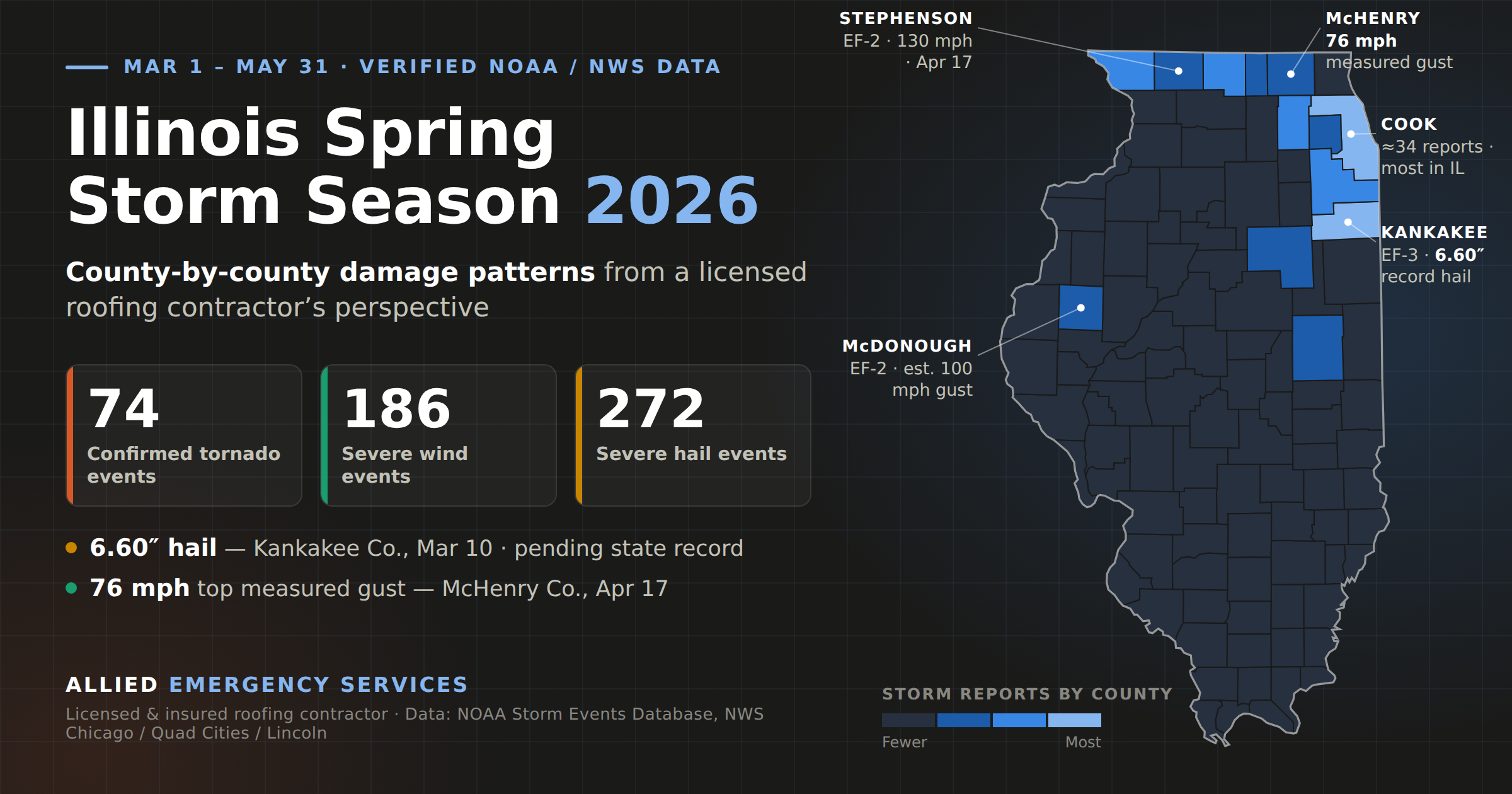
| Confirmed Illinois tornado events | 74 — 73 finalized tornado event entries in the NOAA Storm Events Database (March–April 2026), plus 1 NWS-confirmed May tornado (EF-0, Ford County, May 18) not yet entered in the database. Event entries are county segments, so a tornado crossing county lines is counted more than once; the number of distinct tornado tracks is somewhat lower. |
| Severe wind reports | 186 finalized thunderstorm wind events — NOAA Storm Events Database (finalized records, March–April 2026; May 2026 records had not yet been published as of August 3, 2026). |
| Severe hail reports | 272 finalized hail events — NOAA Storm Events Database (finalized records, March–April 2026; May 2026 records had not yet been published as of August 3, 2026). |
| Largest confirmed hail measurement | 6.60 inches — March 10, 2026, Kankakee County (West Kankakee). Under review as a potential Illinois state record; the previous record was 4.75 inches (2015). |
| Highest confirmed wind measurement | 76 mph measured gust (66 knots) — April 17, 2026, McHenry County (Riley, IDOT weather station). Estimated (unmeasured) gusts reached about 100 mph in McDonough County the same day. |
| Counties with the most reports | Kankakee (33) and Cook (≈34), followed by Will (≈22) — counted as finalized NOAA Storm Events Database entries for tornado, thunderstorm wind and hail combined, March–April 2026. Kankakee and Cook are statistically tied. |
Spring was only one chapter of a record-shattering year. By August 1, 2026, the NWS had confirmed 191 tornadoes in Illinois for the year — an all-time state record, surpassing the 142 set in 2024. The spring figures on this page count finalized NOAA Storm Events entries for March–May specifically; the statewide record count tallies distinct confirmed tornadoes across the full year.
About these numbers: Figures come from the finalized NOAA Storm Events Database, which as of August 3, 2026 covered events through April 2026; May 2026 records are typically published on a two-to-four-month lag, so spring totals will rise slightly once May is added (the National Weather Service confirmed one May tornado and additional wind damage on May 18). We did not mix preliminary Storm Prediction Center reports into these counts. A report or event entry is one dated, located observation — multiple entries can describe the same storm, and a report count does not equal the number of damaged buildings. No official aggregate estimate of insured or public damage for these storms had been published as of August 3, 2026: the State of Illinois disaster proclamation (June 30, 2026) and IEMA-OHS damage assessments include no statewide dollar figure, there is no FEMA major disaster declaration for these events, and the U.S. Small Business Administration issued disaster declarations for the March 10 (Kankakee-area) and April 17 (Stephenson-area) storms without publishing loss totals. Sources: NOAA Storm Events Database, NWS Chicago, NWS Quad Cities, NWS Chicago (April 17 outbreak), NWS Chicago (May 18).
How the spring 2026 county analysis should be documented
Official data for the Spring 2026 Illinois storm season should be collected from the NOAA Storm Events Database and local National Weather Service event summaries. Preliminary reports from the Storm Prediction Center can support early research, but preliminary reports may later be corrected, consolidated or supplemented.
A defensible county summary should identify:
- The exact data period, such as March 1 through May 31, 2026.
- Whether the totals represent preliminary reports, finalized events or both.
- The source office responsible for each county.
- The event date, time, hazard, reported magnitude and location.
- Whether multiple reports describe one storm or separate storms.
- The difference between a weather report and a confirmed property loss.
County storm-report totals should never be presented as the number of damaged homes. One hail report may represent a narrow observation, while one damaging wind swath may affect many properties without generating a separate report for every street.
Northeastern Illinois storm damage patterns
Cook County storm damage: Chicago, Orland Park, Schaumburg, Palatine and Homewood
Cook County storm damage inspections must account for one of the most diverse building environments in Illinois. The county includes single-family asphalt-shingle roofs, older masonry buildings, multifamily properties, industrial facilities, schools and large low-slope commercial roof systems.
After a spring storm, a Cook County roofing inspection should address shingle creasing, displaced ridge caps, damaged roof edges, tree impact, chimney and wall flashing, low-slope membrane seams, parapet flashing, rooftop equipment and blocked drains. Mature trees create an additional risk of punctures and structural impact even when the primary storm winds did not remove the roof covering.
In Chicago and dense suburban areas, water may enter through a roof-to-wall intersection, deteriorated masonry, damaged coping, a rooftop penetration or an overwhelmed drainage system. The water’s entry point may be some distance from the interior ceiling stain.
Local SEO terms that can be incorporated into supporting pages include Cook County storm damage restoration, Chicago roof storm damage, Orland Park roofing contractor, Schaumburg hail damage inspection and Homewood wind damage repair.
DuPage County hail and wind damage: Wheaton, Downers Grove, Glen Ellyn and Elmhurst
DuPage County storm damage inspections should include the roofing material and surrounding collateral evidence. Gutters, downspouts, metal vents, window screens, aluminum fascia, air-conditioning fins and painted surfaces can help document the direction and distribution of hail or windborne debris.
On asphalt-shingle roofs, a qualified inspector should distinguish possible functional hail damage from manufacturing characteristics, foot traffic, blistering, age-related granule loss and mechanical marks. Hail impact should not be determined from one isolated mark.
DuPage County communities also have established tree canopies. Broken limbs may damage shingles, decking, gutters, skylights and siding without producing widespread roof-covering loss. Attic inspection is important when a branch has contacted the roof or when ceiling staining appears after the storm.
Relevant local phrases include DuPage County hail damage, Wheaton storm damage roofing, Downers Grove roof inspection, Glen Ellyn hail damage contractor and Elmhurst wind damage repair.
Will County wind damage: Joliet, Plainfield, Bolingbrook, Romeoville and New Lenox
Will County includes dense suburban developments, newer subdivisions, rural land, transportation corridors, warehouses and industrial properties. Large roof planes and developments near open land can require particular attention to eaves, rakes, hips, ridges and windward elevations.
A Will County storm inspection should evaluate lifted or creased shingles, missing ridge materials, displaced soffit and fascia, loose vinyl siding, damaged garage doors, bent gutters and water entry around windows and wall penetrations. On commercial properties, the contractor should inspect perimeter securement, membrane seams, flashings, drains, rooftop equipment and areas where wind may have moved insulation or roof components.
Communities such as Joliet, Plainfield, Bolingbrook, Romeoville, Frankfort, Mokena and New Lenox may fall under different local permit authorities. The correct authority having jurisdiction should be confirmed before permanent work begins.
Local search phrases include Will County wind damage, Joliet storm damage restoration, Plainfield roofing contractor, Romeoville hail damage inspection and New Lenox emergency roof repair.
Lake County storm damage: Waukegan, Gurnee, Libertyville and Lake Zurich
Lake County contains lakeshore communities, inland suburban areas, wooded neighborhoods, commercial corridors and open properties. A Lake County inspection should not assume that every roof slope experienced identical weather exposure.
The inspection should document the direction of displaced materials, damage to windward roof edges, lifted shingles, soffit loss, fascia displacement, siding movement and rain entry around windows or wall openings. Hail evaluation should include soft-metal components, roof accessories and all accessible elevations.
Properties near trees should also be checked for branch abrasion, punctures and impact to gutters or roof decking. Moisture readings may be necessary when water entered an attic or wall assembly but the visible interior damage remains limited.
Useful search terms include Lake County storm damage, Waukegan roof damage, Gurnee hail damage contractor, Libertyville wind damage repair and Lake Zurich roof inspection.
McHenry County hail, wind and tree damage: Crystal Lake, Algonquin and Woodstock
McHenry County combines suburban communities, wooded properties, open land, farms and detached structures. The inspection scope may need to include the house, garage, barn, shed, metal roofing, overhead doors and exterior mechanical equipment.
Potential McHenry County storm damage includes shingle impact, unsealed or creased shingles, punctures from branches, dented metal panels, loose trim, damaged gutters and wind-driven rain. Tree-covered lots should be examined for contact damage that may be hidden beneath branches or debris.
Metal outbuildings require a different evaluation from asphalt-shingle homes. Denting may be cosmetic, functional or both depending on panel condition, seam integrity, coating damage, fasteners and water entry.
Local phrases include McHenry County hail damage, Crystal Lake storm damage roofing, Algonquin roof inspection, Huntley wind damage contractor and Woodstock storm restoration.
Fox Valley and western suburban storm damage patterns
Kane County storm damage: Aurora, Elgin, St. Charles, Geneva and Batavia
Kane County includes historic homes, newer subdivisions, commercial districts and properties near the Fox River corridor. Roof types and ages can vary significantly within the same community.
A Kane County storm damage inspection should address hail impact, lifted shingles, ridge and hip materials, chimney flashing, step flashing at walls, skylights, gutters and water entry near masonry intersections. Older roofs may already contain wear or prior repairs, so the contractor should separate storm-created conditions from long-term deterioration.
Commercial and multifamily properties require examination of roof edges, membrane seams, drains, scuppers, coping and rooftop equipment. Interior moisture mapping may be needed when the exterior opening is not obvious.
Local phrases include Kane County storm damage, Aurora hail damage roof inspection, Elgin wind damage repair, St. Charles roofing contractor, Geneva storm restoration and Batavia roof damage.
Kendall County wind damage: Yorkville, Oswego and Plano
Kendall County has experienced substantial residential growth while retaining large open and agricultural areas. Properties near the edge of a development may have different wind exposure than homes surrounded by mature construction and trees.
A Kendall County roof inspection should emphasize eaves, rakes, ridge caps, large uninterrupted roof slopes, siding elevations, garage doors, fences and detached structures. Wind may lift or crease shingles without leaving an obvious gap visible from the ground.
Hail evaluation should include roofing, gutters, downspouts, vents, window screens and other surfaces that can help establish direction and consistency. Damage should be evaluated as a pattern rather than from a single isolated mark.
Local search targets include Kendall County storm damage, Yorkville wind damage roofing, Oswego hail damage inspection and Plano emergency roof repair.
DeKalb County storm damage: DeKalb, Sycamore, Sandwich and Genoa
DeKalb County properties can include residential roofs, agricultural buildings, metal systems, machine sheds and structures exposed to open terrain. Windborne debris and hail can affect different materials in different ways.
A DeKalb County storm inspection should examine asphalt shingles, metal seams, exposed fasteners, ridge components, overhead doors, siding, gutters and rooftop or exterior equipment. Agricultural and commercial buildings may require lift access or other specialized safety procedures.
Wind-driven rain can enter around metal laps, roof transitions, wall panels, penetrations and doors even when the primary roof covering remains in place. Interior documentation should identify wet insulation, staining, damaged contents and the path of water migration.
Search terms include DeKalb County storm damage, DeKalb hail damage contractor, Sycamore wind damage roofing, Sandwich roof repair and Genoa storm restoration.
Grundy County roof and siding damage: Morris, Minooka and Coal City
Grundy County contains residential neighborhoods, rural properties, industrial sites and transportation-related development. The inspection process should account for asphalt roofs, metal roofs, low-slope systems, siding and large overhead openings.
Potential Grundy County storm damage includes lifted roof edges, displaced shingles, loose siding, damaged gutters, dented metal, compromised fasteners and wind-driven moisture. On warehouses and industrial properties, perimeter securement and rooftop equipment deserve particular attention because small openings can permit substantial water entry.
Temporary repairs should be photographed before and after installation. Permanent repairs should be coordinated with the applicable city or county permit authority.
Useful phrases include Grundy County storm damage, Morris hail damage roofing, Minooka wind damage contractor and Coal City emergency roof repair.
LaSalle County storm damage: Ottawa, Peru, LaSalle and Streator
LaSalle County includes older housing, newer construction, commercial properties, agricultural areas and communities near river corridors. Building age, prior repairs and drainage conditions can influence how damage appears after a storm.
A LaSalle County roof inspection should include shingles, valleys, ridges, flashings, roof-to-wall connections, gutters, downspouts and attic conditions. Properties with older roofing systems may have pre-existing wear that must be separated from a recent wind or hail event.
Water near a foundation or basement requires a different investigation from water entering through the roof. Surface water, drainage problems, sewer backup, foundation seepage and roof leakage should not be grouped together without identifying the likely pathway.
Local terms include LaSalle County storm damage, Ottawa roof damage inspection, Peru hail damage contractor, LaSalle wind damage repair and Streator storm restoration.
South suburban and Kankakee County damage patterns
Kankakee County storm damage: Kankakee, Bourbonnais, Bradley and Manteno
Kankakee County includes tree-lined urban areas, suburban development, open land and agricultural properties. Storm inspections may find combinations of tree impact, wind uplift, hail damage, siding loss and water intrusion.
A Kankakee County roofing contractor should examine all accessible roof slopes, roof edges, flashings, vents, gutters, siding, windows and detached structures. Large branches can fracture decking or framing even where the exterior opening appears small.
Open-terrain properties may require close review of the windward elevation, roof perimeter, garage doors and accessory buildings. Water mitigation should begin promptly when insulation, drywall or flooring becomes wet, but emergency work should be photographed and documented.
Search phrases include Kankakee County storm damage, Kankakee roof repair, Bourbonnais hail damage inspection, Bradley wind damage contractor and Manteno storm restoration.
Northern and northwestern Illinois storm damage patterns
Winnebago County hail and roof damage: Rockford, Loves Park and Machesney Park
Winnebago County includes a large urban area, mature residential neighborhoods, industrial buildings and extensive low-slope commercial roofing. A countywide inspection strategy must therefore account for both residential and commercial systems.
Residential inspections should include shingles, ridge materials, gutters, siding, windows and tree impact. Commercial inspections should address roof membranes, seams, perimeters, flashings, drains, rooftop units and equipment curbs.
Hail evidence on metal components can help establish distribution, but metal denting alone does not determine the condition of every roofing material. The roof system must be evaluated according to its material, age, installation and functional performance.
Local search phrases include Winnebago County storm damage, Rockford hail damage roofing, Loves Park wind damage repair and Machesney Park roof inspection.
Boone County storm damage: Belvidere and Poplar Grove
Boone County inspections may involve single-family homes, farms, barns, machine sheds, metal roofing and detached garages. Open exposure can make roof edges, panels, trim and large doors important inspection areas.
Possible Boone County storm damage includes loose metal panels, damaged seams, displaced ridge components, dented or broken siding, overhead door damage, shingle uplift and windborne debris impact. An inspection should also document trees, fencing, exterior equipment and adjacent structures.
Because agricultural and metal-building repairs may involve specialized materials, the estimate should clearly identify panel profiles, coatings, fasteners, trim and manufacturer requirements.
Relevant phrases include Boone County storm damage, Belvidere hail damage contractor, Poplar Grove wind damage repair and Boone County roofing inspection.
What a licensed Illinois roofing contractor should document
A storm inspection should produce more than a general statement that a roof “has damage.” The documentation should identify the material, location, direction, pattern and repair implications.
A complete inspection record may include:
- Date of inspection and reported storm date
- Property address and applicable permit jurisdiction
- Roof type, approximate age, slope and number of layers
- Photographs of every accessible roof slope and exterior elevation
- Close-up and overview photographs of each reported condition
- Directional evidence on gutters, vents, siding and other collateral
- Missing, lifted, creased, fractured or punctured roofing
- Flashing, chimney, skylight and penetration conditions
- Attic moisture, wet insulation and interior water staining
- Temporary mitigation already completed
- Repair quantities, permanent materials and code-related items
Illinois property owners can review roofing contractor licensing information through the Illinois Department of Financial and Professional Regulation. The business name and license status should match the contractor presenting the agreement.
What SKYWARN training contributes to storm documentation
The National Weather Service SKYWARN program trains volunteers to observe and report severe weather to local forecast offices. A SKYWARN-trained spotter may have useful knowledge of severe-weather terminology, storm structure, hail measurement, wind effects and reporting procedures.
That training can improve communication about when and where severe weather was observed. It does not replace a roof inspection, structural evaluation, engineering analysis or insurance investigation.
SKYWARN training also does not mean:
- The National Weather Service endorses the contractor
- The spotter is a meteorologist
- A weather report proves damage at a specific address
- The spotter determines insurance coverage
- Every nearby property experienced the same conditions
A roofing contractor should connect reliable weather information with physical evidence at the building. The storm report provides context; the property inspection documents the actual condition.
Hail damage, wind damage and water damage are not the same
Hail damage
Potential hail evidence may include impact marks on roofing, dents in soft metals, damaged vents, broken skylights, screen damage or coating loss. Asphalt-shingle evaluation should distinguish storm impact from aging, blistering, manufacturing conditions and mechanical damage.
Wind damage
Potential wind damage includes missing shingles, creased tabs, failed seals, displaced ridge caps, loose flashing, damaged siding, soffit loss and movement at roof edges. Damage may be concentrated on one slope or one part of the building.
Tree and debris impact
Branches and windborne debris can puncture roof coverings, fracture decking, damage framing, break windows and displace gutters. Contact damage should be inspected even when no shingles are visibly missing.
Water intrusion and flooding
Water entering through a roof opening is different from surface flooding, foundation seepage or sewer backup. The source matters for mitigation, repair planning and insurance review. A moisture inspection may be necessary to identify concealed wet insulation or wall materials.
Illinois building code and permit considerations
There is no single permit answer that applies to every Illinois county or municipality. Cities, villages and counties may use different adopted code editions, amendments and administrative procedures. Requirements may also differ between incorporated and unincorporated properties.
Before permanent storm repairs begin, the contractor should confirm the authority having jurisdiction and determine whether a permit or inspection is required.
Roofing scope items may include:
- Removal of existing roof layers when required
- Replacement of deteriorated or damaged roof decking
- Underlayment and ice-barrier requirements
- Drip edge at eaves and rakes
- Valley and wall flashing
- Flashing around chimneys, skylights and penetrations
- Roof ventilation
- Fastener type, placement and wind resistance
- Manufacturer installation requirements
- Low-slope drainage and perimeter securement
Siding and exterior wall work may require evaluation of the water-resistive barrier, sheathing, flashing around openings, fastening and required clearances. Window replacement may involve safety glazing, emergency escape requirements, structural openings and water-management details.
A code-required item should be identified separately in the estimate. Whether an insurance policy covers a code upgrade or ordinance-and-law cost depends on the policy language and applicable endorsement.
Spring 2026 Illinois storm damage repair cost guide
The cost of Illinois storm damage restoration cannot be determined from a county storm report, tornado rating or reported hail size. Pricing depends on measured quantities, material, roof pitch, height, access, damage severity, permit requirements, emergency conditions and concealed damage.
The following figures are broad planning ranges only. They are not verified Spring 2026 county averages, project quotes or insurance coverage decisions. Allied should approve or replace them with current local pricing before publication.
| Storm restoration service | Preliminary planning range |
|---|---|
| Emergency roof tarp or limited board-up | $400–$2,500+ |
| Localized asphalt-shingle repair | $750–$4,500+ |
| Full asphalt-shingle roof replacement | $10,000–$30,000+ |
| Low-slope commercial roof repair | $1,500–$15,000+ |
| Localized siding repair | $1,000–$8,000+ |
| Full siding replacement | $15,000–$45,000+ |
| Gutter and downspout replacement | $1,500–$7,000+ |
| Window or exterior opening repair | $500–$2,500+ per opening |
| Water extraction and structural drying | $2,000–$12,000+ |
| Emergency tree and debris removal | $750–$6,000+ |
| Structural framing or major reconstruction | Site-specific estimate required |
A useful estimate should separate emergency mitigation, demolition, disposal, permanent construction, roof decking, concealed damage, water mitigation, permits, code-related work, specialty access and engineering.
Two estimates may have different totals because they contain different quantities and scope. Property owners should compare measurements, materials, repair methods and exclusions rather than comparing only the final price.
Insurance documentation after an Illinois spring storm
A contractor can document building conditions and prepare a repair scope, but insurance coverage depends on the policy, cause of loss, deductible, exclusions and endorsements.
Useful records include:
- Before-and-after photographs
- Date- and time-stamped storm photographs
- Video of each exterior elevation and affected room
- Emergency tarp, board-up and drying invoices
- Moisture readings and drying logs
- Damaged-content inventories
- Contractor measurements and material descriptions
- Permit and building code information
- Written communications with the carrier
- Official NWS or NOAA storm records
An official severe-weather report confirms that weather was observed or recorded at a particular location and time. It does not automatically prove the cause or extent of damage at another address.
How to avoid storm restoration scams
Spring storms can attract contractors who use high-pressure sales tactics or provide incomplete agreements. Illinois property owners should verify credentials before signing a roofing or restoration contract.
Confirm the contractor’s:
- Active Illinois roofing license
- Legal business name and contact information
- General liability insurance
- Workers’ compensation coverage where applicable
- Written scope and material specifications
- Permit responsibility
- Payment schedule
- Warranty terms
- Cancellation provisions
- References and project history
Avoid blank agreements, unexplained assignments, promises that all work will be free, guarantees about insurance coverage and demands for large immediate payments without a documented scope.
A legitimate contractor should be able to explain the inspection findings, repair method, permit process, materials and code considerations in writing.
Frequently asked questions about the Spring 2026 Illinois storm season
Which counties are covered in this Illinois storm damage guide?
The guide focuses on Cook, DuPage, Will, Kane, Lake, McHenry, Kendall, DeKalb, Grundy, LaSalle, Kankakee, Winnebago and Boone counties. These counties provide strong geographic coverage of Chicago, the suburbs, the Fox Valley, northern Illinois and the Rockford region.
Which Illinois county had the most spring 2026 storm damage?
That answer should be based on a defined metric. A county may have the most preliminary storm reports, the greatest insured loss, the most emergency calls or the largest documented damage swath. Those measurements are not interchangeable. Insert a county ranking only after reviewing official 2026 records and explaining the methodology.
Does a nearby hail report prove that my roof has hail damage?
No. A nearby hail report provides weather context but does not prove the hail size or roof condition at a particular property. A property-specific inspection should evaluate the roofing material and consistent collateral evidence.
Can wind damage exist when no shingles are missing?
Yes. Wind can lift, unseal, crease or fracture roofing without completely removing it. Some conditions are difficult to see from the ground.
What does an NWS SKYWARN-trained spotter do?
A SKYWARN-trained spotter observes and reports severe weather to the National Weather Service. The training can improve weather awareness and reporting, but it does not certify a roofing contractor, determine property damage or represent NWS endorsement.
How can a property owner verify an Illinois roofing license?
The contractor’s legal business name and license status should be checked through the Illinois Department of Financial and Professional Regulation. The name on the license should correspond with the company presenting the contract.
Should a homeowner climb onto the roof after a storm?
No. Wet, steep or damaged roofs may be unstable and can create a serious fall hazard. Ground-level documentation, attic inspection when safe and professional roof access are more appropriate.
When should emergency roof tarping begin?
Temporary protection should begin as soon as safely practical when an opening is allowing additional water into the building. Photograph the condition before mitigation when possible and retain photographs, contracts and receipts.
Are permits required for Illinois storm damage repairs?
Permit requirements depend on the municipality, county and scope. The applicable building department should be contacted before permanent work begins.
Does an insurance company have to replace the entire roof?
Not automatically. The decision depends on the physical damage, feasibility of repair, applicable building code, manufacturer requirements, policy language and claim evaluation. A contractor should document the construction scope without guaranteeing insurance coverage.
Spring 2026 Illinois storm season summary
Spring 2026 Illinois storm damage should be analyzed through official weather data and building-specific evidence. County-level geography creates useful local context, but a county report cannot substitute for an inspection at the affected address.
Cook County properties may require evaluation of tree impact, low-slope systems and dense urban construction. DuPage and Kane county inspections should closely document hail collateral, shingles and flashing. Will, Kendall, Grundy and DeKalb county properties may require additional attention to open-exposure wind and large roof planes. Lake, McHenry, Boone and Winnebago county inspections should include windward elevations, detached structures, metal components and mature-tree damage. LaSalle and Kankakee county properties may involve combinations of wind, hail, drainage and water intrusion.
The most reliable recovery process combines verified NOAA or NWS records, safe temporary mitigation, detailed photographs, a licensed roofing contractor’s inspection, current permit information and a clearly written repair scope.
For immediate service or consultation, you may contact us at Allied Emergency Services, INC.
Contact Information:
Phone: 1-800-792-0212
Email: Info@AlliedEmergencyServices.com
Location: Serving Illinois, Wisconsin, and Indiana with a focus on the greater Chicago area.
If you require immediate assistance or have specific questions, our human support is readily available to help you.
Disclaimer: This article is intended for informational purposes only. For professional advice, consult experts in the field.
⚡ Storm or Roof Damage? Get a FREE Estimate
Text ESTIMATE to (844) 907-2546
Or call (800) 792-0212 for 24/7 emergency response
AI-powered • No obligation • Licensed IL & WI
Need storm restoration and roofing help?
Allied Emergency Services — Licensed IL & WI Storm Restoration And Roofing Specialists
For more than a decade, Allied has been serving Illinois and Wisconsin homeowners with storm restoration and roofing across Illinois and Wisconsin. IICRC-certified, EPA Lead-Safe, IL Licensed Roofing Contractor #104.019029. 24/7 emergency response.
Learn about our Storm Restoration And Roofing service →Free property assessment within 24 hours · No obligation · Insurance claim support
Attorneys: forensic storm damage documentation & construction expert consultation for counsel →