
⚡ Storm or Roof Damage? Get a FREE Estimate
Text ESTIMATE to (844) 907-2546
Or call (800) 792-0212 for 24/7 emergency response
AI-powered • No obligation • Licensed IL & WI
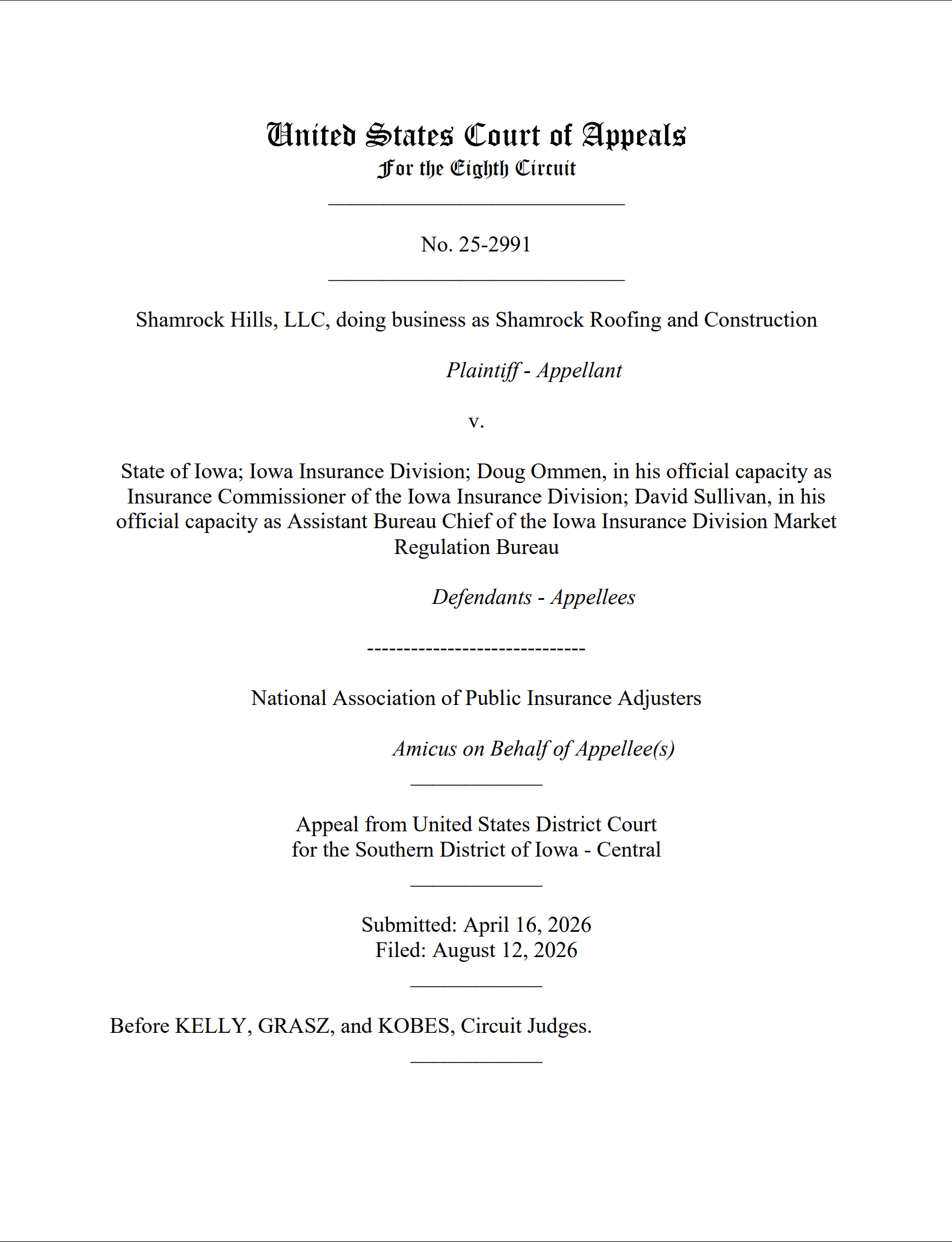
Industry Alert — Federal Court Decision — August 2026. In a decision the restoration industry has been watching for months, the Eighth Circuit just ruled that when a state tells a contractor what it can say to storm-damaged homeowners, the First Amendment has something to say back. Case analyzed: Shamrock Hills, LLC v. State of Iowa, No. 25-2991 (8th Cir. Aug. 12, 2026).
https://law.justia.com/cases/federal/appellate-courts/ca8/25-2991/25-2991-2026-08-12.html
In a decision the restoration industry has been watching for months, the Eighth Circuit just ruled that when a state tells a contractor what it can say to storm-damaged homeowners, the First Amendment has something to say back.
By Allied Emergency Services — Storm Damage Restoration Experts • Published August 16, 2026 • Case analyzed: Shamrock Hills, LLC v. State of Iowa, No. 25-2991 (8th Cir. Aug. 12, 2026)
Key Takeaways (TL;DR)
- The case: Shamrock Hills, LLC v. State of Iowa, No. 25-2991 (8th Cir., decided August 12, 2026). An Iowa roofing contractor sued the State of Iowa, the Iowa Insurance Division, and two state officials after receiving warning notices accusing it of unlicensed public adjusting.
- What survived: Iowa’s public adjuster statutes — Iowa Code § 522C.2(18) and § 103A.71(3) — are facially constitutional and not void for vagueness. The licensing wall between contractors and claim negotiation still stands.
- The bombshell: The court revived the contractor’s as-applied First Amendment challenge, holding that when Iowa barred Shamrock Hills from telling homeowners it would “assist with the claims process” or “help navigate the insurance red tape,” it regulated speech as speech — and that triggers strict scrutiny, the toughest test in constitutional law.
- What it means: Contractors still cannot negotiate insurance claims without a public adjuster license. But states may not have unlimited power to police contractors’ words in advertising and client conversations. The case now heads back to federal district court in Iowa.
The Ruling That Just Shook the Storm Restoration Industry
On August 12, 2026, the United States Court of Appeals for the Eighth Circuit handed down one of the most consequential decisions in years for roofing contractors, storm damage restoration companies, public adjusters, and the millions of homeowners who file property insurance claims after hail, wind, and catastrophic storms.
The case is Shamrock Hills, LLC v. State of Iowa, No. 25-2991. Shamrock Hills, an Iowa residential contractor doing business as Shamrock Roofing and Construction, went toe-to-toe with the State of Iowa, the Iowa Insurance Division, Insurance Commissioner Doug Ommen, and Assistant Bureau Chief David Sullivan — and walked away with a split decision that both sides will be dissecting for years.
Writing for the panel, Judge Grasz delivered a ruling that affirmed in part, reversed in part, and remanded. Translation: Iowa’s public adjuster licensing regime is still standing. But the state’s power to police what contractors say to homeowners just came under the harshest spotlight in constitutional law.
“If speaking to clients is not speech, the world is truly upside down.”
— Justice Clarence Thomas, quoted by the Eighth Circuit in its analysis
How Did a Roofing Company End Up in Federal Court Against an Entire State?
It started with two warning notices.
David Sullivan, Assistant Bureau Chief of the Iowa Insurance Division’s Market Regulation Bureau, sent Shamrock Hills two formal notices alleging the company had engaged in “activity consistent with unlicensed public adjusting.” The second notice listed nearly two dozen examples where, in the Bureau’s view, Shamrock Hills gave Iowa consumers the impression it would “affect the settlement” of their insurance claims.
Among the offending phrases? Statements that the company would:
- “Assist [homeowners] with the claims process”
- “Help [them] navigate the insurance red tape”
- “Assist with insurance claims”
- “Walk [them] through everything with insurance reimbursement”
The state ordered Shamrock Hills to remove all wording from its advertising suggesting it would perform the duties of a public adjuster. Instead of quietly complying, Shamrock Hills sued — alleging that Iowa Code § 522C.2(18) and § 103A.71(3) violate the First Amendment and are unconstitutionally vague, both on their face and as applied to the company.
The federal district court in the Southern District of Iowa dismissed the entire case. Shamrock Hills appealed. And that’s where things got interesting.
What Are Iowa’s Public Adjuster Laws — and Why Do They Hit Contractors So Hard?
Two statutes sit at the center of this legal earthquake, and every contractor working insurance restoration in the Midwest should know them cold:
| Statute | What It Does | Penalty |
|---|---|---|
| Iowa Code § 522C.2(18) (with § 522C.4(1)) | Defines “public adjuster” as anyone who, for compensation, acts for or aids an insured in negotiating or affecting the settlement of a first-party property claim — or advertises/solicits as one. A license is required to practice public adjusting. | Unlicensed adjusting is a class D or class C felony (class C if the violation results in a loss over $10,000). Iowa Code § 522C.14(2)(a). |
| Iowa Code § 103A.71(3) | Prohibits residential contractors from representing, negotiating on behalf of — or even offering or advertising to represent or negotiate on behalf of — a homeowner on any insurance claim connected to roof repair or other exterior restoration work. In short: a contractor cannot be both the contractor and the public adjuster on the same project. | An “unlawful practice” carrying fines of up to $40,000 per violation. Iowa Code §§ 103A.71(5)(b), 714.16(7). |
These aren’t obscure technicalities. They’re the legal architecture that separates two industries — restoration contracting and public adjusting — that collide on virtually every storm-damaged roof in America.
Round One to Iowa: The Statutes Are Constitutional on Their Face
Shamrock Hills swung for the fences with a facial challenge — arguing the statutes are unconstitutional in every application. The Eighth Circuit didn’t bite.
The court held that public adjusting involves plenty of pure, non-expressive conduct that states can freely regulate: attending inspections alongside insurer representatives, preparing and submitting estimates, assessing property damage, reviewing insurance policies, evaluating coverage, and filing claims. Because the Iowa Supreme Court had already construed these statutes to cover exactly that kind of conduct in 33 Carpenters Construction, Inc. v. State Farm, 939 N.W.2d 69 (Iowa 2020), the statutes have a “plainly legitimate sweep” and survive facial attack.
The court also flatly rejected the vagueness challenges. The statutes’ operative terms — negotiate, settle, advertise, solicit, represent — have “well-established meanings,” and the Iowa Supreme Court has provided “a good deal of guidance” on what they cover. No contractor of ordinary intelligence, the court reasoned, is left guessing.
The Bottom Line for Contractors — Nothing About the License Wall Changed
Read that section again before celebrating. The Eighth Circuit upheld the core prohibition: an unlicensed contractor still cannot negotiate, adjust, or affect the settlement of a homeowner’s insurance claim — and in Iowa, a residential contractor can never wear both hats on the same project. The felony exposure and $40,000-per-violation fines are fully intact.
Round Two to the Contractor: “The First Amendment Is No Word Game”
Here’s where the decision becomes a landmark — and why it’s being read closely in all seven states of the Eighth Circuit (Iowa, Minnesota, Missouri, Arkansas, Nebraska, North Dakota, and South Dakota) and beyond.
A decade ago, courts would have shielded these statutes from First Amendment review entirely under the old “professional speech doctrine.” But the Supreme Court killed that doctrine in NIFLA v. Becerra (2018), and drove the point home this year in Chiles v. Salazar (2026): “The First Amendment’s protections extend to licensed professionals much as they do to everyone else.”
Armed with that precedent, the Eighth Circuit ruled the district court committed reversible error when it tossed Shamrock Hills’ as-applied challenge without ever analyzing how Iowa actually enforced the statutes. And how did Iowa enforce them? By ordering a contractor to stop saying things — stop telling homeowners it would “assist with the claims process,” “help navigate the insurance red tape,” and “walk them through everything with insurance reimbursement.”
That, the court held, “regulated speech as speech.” And when a state regulates speech as speech, it must survive strict scrutiny — a test so demanding it’s often described as “strict in theory, fatal in fact.”
“The First Amendment is no word game. And the rights it protects cannot be renamed away or their protections nullified by ‘mere labels.'”
— The Eighth Circuit, quoting Chiles v. Salazar and NAACP v. Button
The court was also openly skeptical of arguments — like the Texas Supreme Court’s reasoning in Stonewater Roofing — that would let states dodge First Amendment review by relabeling client communications as mere “agency status.” That approach, the Eighth Circuit warned, “sounds an awful lot like a watered-down version of the professional speech doctrine” the Supreme Court already rejected.
The Dissent: A Warning Shot for the Remand
Judge Kelly concurred with nearly all of the opinion but dissented on one point: she would not have reached the as-applied challenge at all, because Shamrock Hills never fully developed that argument on appeal. Her dissent is a reminder that the contractor hasn’t won anything yet — it has only won the right to keep fighting.
Notably, the majority itself dropped a footnote cautioning that Iowa “plainly has a compelling interest” in regulating public adjusters to protect its citizens, and that fears of “regulatory impotence” are overblown. The remand will be a genuine battle, not a coronation.
What This Means for Homeowners Filing Storm Damage Claims
At Allied Emergency Services, we’ve spent years responding to hail, wind, and storm catastrophes across Illinois, Wisconsin, Indiana, and the Greater Midwest — and we’ve seen firsthand what happens when the line between contracting and claim negotiation gets blurry. Here’s our read on what this decision means for property owners:
1. The consumer protections still exist — and that’s a good thing
The licensing wall survived for a reason. When an unlicensed party negotiates your insurance claim, you lose the protections that adjuster licensing exists to provide. The Eighth Circuit upheld those guardrails, and reputable contractors support them.
2. Your contractor can still do a lot for you — lawfully
A professional restoration contractor can inspect and document your damage, prepare a detailed scope and estimate of repairs, meet timelines, pull permits, and restore your property to pre-loss condition. What a contractor cannot do — in Iowa and states with similar laws — is negotiate the claim itself with your insurer without a public adjuster license, and in Iowa a contractor can never do both jobs on the same project.
3. Beware of anyone promising to “handle your claim”
Ironically, the case is the best consumer-education tool the industry has seen in years. If a storm-chasing contractor knocks on your door promising to “take care of the insurance company for you,” that promise may be exactly the kind of conduct that carries felony exposure in Iowa. Choose established, licensed, certified restoration professionals who know where the legal lines are — and stay behind them.
What Happens Next in Shamrock Hills v. Iowa?
The case now returns to the U.S. District Court for the Southern District of Iowa, which must run the full three-step as-applied First Amendment analysis it skipped the first time: Is the regulated activity protected speech? Is the restriction content-based or content-neutral? And can Iowa’s enforcement survive the applicable level of scrutiny — here, strict scrutiny?
Whatever happens on remand, expect appeals. With federal circuits openly divided over where professional “conduct” ends and protected “speech” begins — a doctrine one court memorably called “a mind-numbing morass of tangled precedents” — this issue is on a collision course with the U.S. Supreme Court. The Eighth Circuit’s decision in Shamrock Hills just made that collision more likely.
Frequently Asked Questions
What did the Eighth Circuit decide in Shamrock Hills v. Iowa?The court affirmed that Iowa Code §§ 522C.2(18) and 103A.71(3) are facially constitutional and not void for vagueness — but reversed the dismissal of Shamrock Hills’ as-applied First Amendment challenge and remanded it, holding that Iowa regulated speech as speech when it barred the contractor from telling homeowners it would assist with the claims process.Can a roofing contractor negotiate an insurance claim for a homeowner?Not without a public adjuster license. Unlicensed adjusting is a class D or C felony in Iowa, and residential contractors face fines of up to $40,000 per violation for acting as both contractor and adjuster on the same project. This decision left those rules fully intact.What is a public adjuster?A licensed professional who, for compensation, acts for or aids a policyholder in negotiating or affecting the settlement of a first-party insurance claim for property loss or damage. Public adjusters work for the insured — not the insurance company.Did the court strike down Iowa’s public adjuster law?No. The statutes survived both the facial First Amendment challenge and the vagueness challenges. Only the narrower as-applied speech claim — about Iowa’s enforcement against the company’s advertising language — was revived and sent back for further proceedings.What should homeowners with storm damage do right now?Document your damage immediately, notify your insurer promptly, and hire a licensed, certified restoration contractor to inspect, estimate, and repair the damage. Be wary of anyone who promises to negotiate or “handle” your claim without a public adjuster license.
Case citation: Shamrock Hills, LLC, d/b/a Shamrock Roofing and Construction v. State of Iowa, et al., No. 25-2991 (8th Cir. Aug. 12, 2026) (Grasz, J., joined by Kobes, J.; Kelly, J., concurring in part and dissenting in part), on appeal from the U.S. District Court for the Southern District of Iowa. Key authorities discussed: NIFLA v. Becerra, 585 U.S. 755 (2018); Chiles v. Salazar, 146 S. Ct. 1010 (2026); 33 Carpenters Constr., Inc. v. State Farm Life & Cas. Co., 939 N.W.2d 69 (Iowa 2020); Tex. Dep’t of Ins. v. Stonewater Roofing, Ltd., 696 S.W.3d 646 (Tex. 2024).
Disclaimer: This article is provided for general informational purposes only and does not constitute legal advice. Allied Emergency Services is a general contractor, not a law firm or a public adjusting firm; Allied does not negotiate, adjust, or settle insurance claims on behalf of policyholders. Statutes and case outcomes described here may change as litigation proceeds. Consult a licensed attorney regarding your specific circumstances, and consult a licensed public adjuster or your insurance carrier regarding claim negotiations.
⚡ Storm or Roof Damage? Get a FREE Estimate
Text ESTIMATE to (844) 907-2546
Or call (800) 792-0212 for 24/7 emergency response
AI-powered • No obligation • Licensed IL & WI
Need storm damage help?
Allied Emergency Services — Licensed IL & WI Storm Damage Specialists
For more than a decade, Allied has been restoring storm damage across Illinois and Wisconsin. IICRC-certified, EPA Lead-Safe, IL Licensed Roofing Contractor #104.019029. 24/7 emergency response.
Learn about our Storm Damage service →Free property assessment within 24 hours · No obligation · Photo-documented findings you can share with your insurer
Attorneys: forensic storm damage documentation & construction expert consultation for counsel →