
⚡ Storm or Roof Damage? Get a FREE Estimate
Text ESTIMATE to (844) 907-2546
Or call (800) 792-0212 for 24/7 emergency response
AI-powered • No obligation • Licensed IL & WI
Oklahoma City — October 20, 2026 · The Hail Files, Part 13
What happened, in one sentence: State Farm has asked Oklahoma County District Judge Amy Palumbo to rule, before the December 7 trial in Hursh v. State Farm, that the homeowners cannot take their bad-faith, punitive-damages and fraud claims to a jury, arguing that their own report that roofers gave them “a 50/50 chance” of approval proves a “legitimate dispute” over their hail claim, which under Oklahoma law bars a bad-faith claim.
Status: State Farm filed the motion October 15 and refiled it October 19 as an amended motion that fills in the paragraph numbers the first version had left as “#” (21 of the 24; the other three went out with a deleted sentence and a dropped citation) and replaces a “[CITE]” placeholder with a case citation. The State Farm agent whose agency sold the policy, and the agency, filed their own summary-judgment motion October 15. As of the October 19 docket check, the homeowners had not responded to either motion and the judge had not ruled. The motions give the defendants’ side; the homeowners’ allegations are allegations State Farm denies, and nothing has been decided.
Seven weeks before trial, State Farm is asking a judge to turn the Hursh case into a contract dispute. Its motion for partial summary judgment, filed October 15 in Oklahoma County District Court and now in The Hail Files archive with all 23 of its exhibits, asks Judge Amy Palumbo to rule, without a jury, that Billy and Lacy Hursh cannot pursue their claims that State Farm handled their roof claims in bad faith, that it owes them punitive damages, or that it committed constructive fraud or negligent misrepresentation.
“Discovery has revealed that Plaintiffs Billy and Lacy Hursh’s elaborate petition reduces to a weak breach of contract claim about the extent of hail damage—and even that dispute is thin,” the motion begins. It does not ask for judgment on that contract claim. It asks the judge to rule that the homeowners cannot take their bad-faith, punitive-damages and fraud claims to the jury.
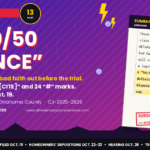
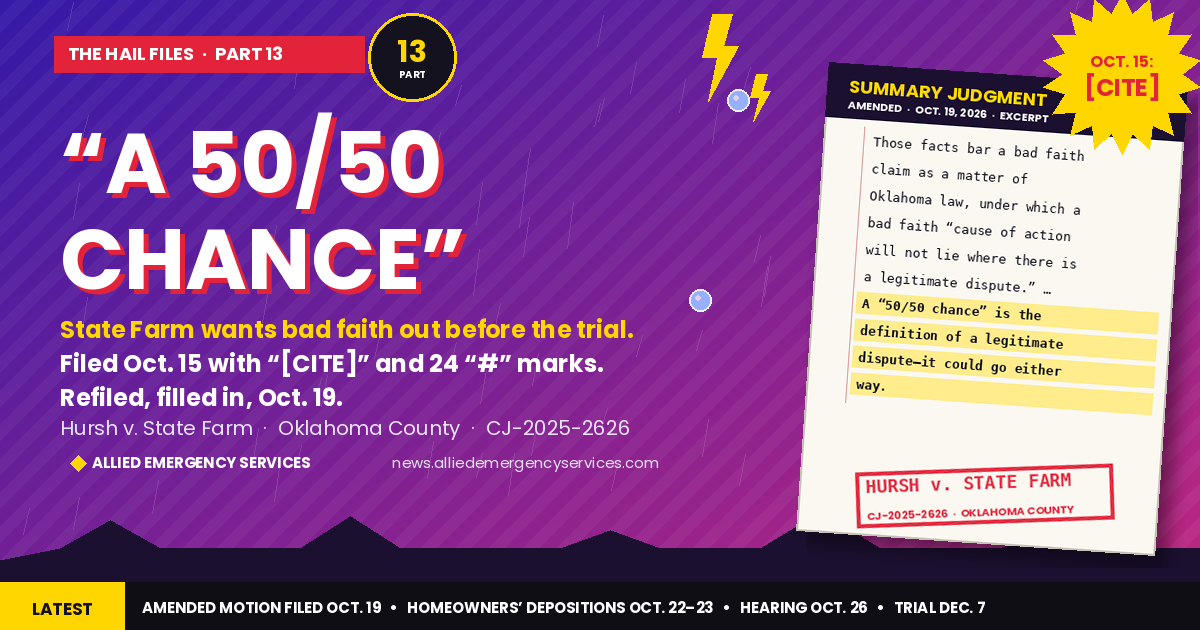
The centerpiece is a text message. “I know all the roofers we had come look had said there was a 50/50 chance w/ whomever came to look at it on if they’d approve or not,” Lacy Hursh wrote to a contractor in July 2024, according to the motion. State Farm’s lawyers draw the conclusion in one line: “A ’50/50 chance’ is the definition of a legitimate dispute—it could go either way.” Under Oklahoma law, they argue, a bad-faith claim “will not lie where there is a legitimate dispute.”
The homeowners have not answered yet. They are scheduled to be deposed October 22 and 23, a timing State Farm complains about in a footnote. Their side of the case, as their filings describe it, is that State Farm “applied a program to reduce full roof replacements and indemnity payments, and that their claim was decided under it.” That claim, they told the court in a separate motion re-filed October 19, depends on internal State Farm records they say were produced stripped of the data showing who sent what to whom, and when.
The motion has a story of its own. The version State Farm filed October 15 left 24 paragraph numbers in its citations to its own statement of facts as “#,” and in one place where a case citation belonged it read “[CITE].” On October 19, State Farm filed an amended motion with the numbers and the citation filled in, one homeowner’s first name corrected, one sentence removed, and a citation dropped: pages of a State Farm executive’s deposition that were not among the exhibits.
What is State Farm asking the judge to decide?
Summary judgment lets a judge decide a claim before trial when the important facts are not genuinely disputed and the law favors one side. State Farm’s motion asks for it on three of the homeowners’ claims:
- Bad faith. State Farm says the “undisputed facts” show a legitimate dispute over what caused the condition of the roof, which, under the Oklahoma Supreme Court’s 1984 decision in Manis v. Hartford Fire Insurance Co., bars a bad-faith claim.
- Punitive damages. Without bad faith, the motion says, the request for punitive damages “fails at the threshold,” and in any event the homeowners have no evidence to meet the standard of “oppression, fraud, malice or gross negligence.”
- Constructive fraud and negligent misrepresentation. “This is a breach of contract case,” the motion says, arguing that the homeowners have identified no false statement, no duty to disclose and no reliance.
The motion leaves the breach-of-contract claim, the homeowners’ claim that State Farm owed them more under the policy, for trial. The judge has not ruled.
What is a “legitimate dispute” in an Oklahoma bad-faith case?
Oklahoma lets a policyholder sue an insurer in tort for breaching its duty of good faith and fair dealing, a claim that can bring damages beyond the policy benefits. But, as State Farm’s brief quotes the Oklahoma Supreme Court’s 1977 decision in Christian v. American Home Assurance Co., “there can be disagreements between insurer and insured on a variety of matters,” and disagreement alone “is not per se bad faith or unfair dealing.” In Manis, as State Farm’s brief describes it, the court reversed a bad-faith verdict against two insurers that had refused to pay for a business fire they believed was arson by the insured, holding that a bad-faith “cause of action will not lie where there is a legitimate dispute.” The insurers, the court said, “had a right to have this dispute settled in a judicial forum.”
Even by State Farm’s account, a legitimate dispute does not automatically end the claim. Once an insurer shows one, its brief says, citing federal appeals decisions applying Oklahoma law, the policyholder can still reach a jury by producing “additional evidence” that the insurer did not actually rely on the dispute, denied the claim for an illegitimate reason, treated the policyholder unfairly, or “performed an inadequate investigation of the claim.” The homeowners’ filings stress that last point. Quoting the Oklahoma Supreme Court’s 2003 decision in Heffron, they write that “[t]he reasonableness of any investigation conducted by the insurer is … oftentimes one of the main issues in the bad faith tort case.”
State Farm leans on a 2022 federal decision from the Northern District of Oklahoma, Phillips v. State Farm, which, its brief says, granted State Farm summary judgment on bad faith “on nearly identical facts”: an inspection followed by a payment for the damage found, a claim specialist’s review of the contractor’s information, and a second claim handler and a supervisor who found no reason for a second inspection. That is State Farm’s description of the case; the homeowners have not yet filed theirs.
What happened with the Hursh roof claims, according to State Farm?
State Farm’s statement of “undisputed material facts,” built from its claim files, the homeowners’ texts and the depositions of two roofing contractors, tells the story this way. The homeowners’ discovery answers dispute key parts of it (see below); their response to the motion has not been filed.
- 2020: The Hurshes bought a State Farm homeowners policy through a State Farm agent’s office. It pays to repair or replace “the damaged part of the property” and does not cover loss that “consists of, or is directly and immediately caused by … wear, tear, decay, marring, scratching, deterioration, inherent vice, latent defect, or mechanical breakdown.”
- On or about October 4, 2023: A wind and hail storm. No claim followed for five months.
- March 5, 2024: A roofing company reported a claim on the homeowners’ behalf. The next day, a State Farm claim specialist wrote in the file that the “Insured noticed several roofs being replaced in the area and had one of the roofing companies doing work there stop and look at their roof.”
- March 9–12, 2024: Because of the roof’s steepness, State Farm sent a third-party inspection company. The claim notes read: “Inspection revealed small impacts to 2 downspouts and rear and left gutters only. Areas marked on the roof by the roofer are not consistent with hail impacts.” State Farm estimated the storm damage at $1,446.87, below the policy’s deductible, and wrote the homeowners that the roof’s damage was caused by wear and tear and a defect in workmanship or materials, not hail.
- May 21–24, 2024: The roofing company sent photos and asked for a second inspection. A State Farm team manager concluded the photos “do not indicate anything was missed during 1st inspection” and that a “[s]econd inspection is not warranted at this time”; if the homeowners were claiming new damage, “they’ll need to file a new claim.”
- May–June 2024: Three more contractors looked at the roof. One, who said he was asked to help decide whether to file a claim, testified that he found no hail or storm damage and advised against filing; another noted “[m]arginal damage.” In July, Lacy Hursh sent the “50/50 chance” text to the contractor the couple hired.
- July 12–29, 2024: The homeowners filed a second claim, for a May 21 storm. A State Farm inspector examined the roof July 24 with their contractor present; the contractor, the motion says, later testified that the inspector was thorough and spent more than an hour on the roof. State Farm found hail damage only to roof vents, vent caps, gutters and window screens, estimated it at $2,452.57, again below the deductible, and closed the claim with a July 29 letter. According to the motion, the homeowners did not appeal or ask for another inspection.
- Later testimony: The contractor testified, according to the motion, that the roof showed wear and tear and aging, that he too put the odds of approval at 50/50, that roofers can disagree about the same roof, and that he had no personal knowledge of any scheme.
The homeowners had the roof replaced and sued State Farm and the agent defendants on April 17, 2025. From those facts, State Farm argues: “At least four different roofers hired by Plaintiffs inspected their roof”; they reached different conclusions; and so “a legitimate dispute existed as to whether Plaintiffs’ damage was covered under their policy.”
The contractor’s own words, in the transcript pages State Farm attached, add context to the number. He testified that he told the homeowners there was “always a chance, 50/50 at least,” of approval. Asked whether that figure depended partly on the insurer, he said: “Part of my percentages I put out there to a client is always — some of it has to be based on the insurance company because they’re the ones making the ultimate decision. But I don’t recommend they file a claim if I don’t think there is a 50/50 chance or greater.”
Why does State Farm say the “scheme” evidence doesn’t apply to the Hursh claims?
The homeowners’ lawsuit, like the Oklahoma attorney general’s separate case, alleges more than a disputed roof: that State Farm ran a program to cut roof-claim payments, and that their claims were decided under it. State Farm’s answer is that none of that evidence reaches their claims. “Plaintiffs cannot transform this ordinary contract dispute into a bad faith case by ignoring the claim file and relying instead on speculation and innuendo about an alleged corporate ‘scheme’ to deny roof replacements,” the motion says.
It makes three arguments against what it calls the homeowners’ “novel theories”:
- That State Farm never inspected the roof in person before issuing the policy cannot support bad faith, because under the Oklahoma Supreme Court’s 1996 decision in Claborn v. Washington National Insurance Co., “the conduct of the insurer and the agent in selling and issuing the policy, cannot give rise to the tort of bad faith breach of an insurance contract.”
- The complaint that State Farm’s “technical standards for evaluating roof damage were not contained in the policy” fails too, it says, because no Oklahoma law requires that, and the policy form was approved by the Oklahoma Insurance Department.
- The alleged corporate scheme is, “under law of the case,” “untethered” to this dispute, State Farm says, citing the Oklahoma Supreme Court’s June 23 opinion in State Farm v. Palumbo (2026 OK 51), the ruling that barred the attorney general from joining the case. The motion describes it as “barring litigation of corporate ‘issues untethered to the Hurshes’ actual loss.'”
To show that no one tied the alleged scheme to the Hursh claims, State Farm attached one transcript page each from the August depositions of two State Farm executives, Wensley Herbert and Scott Welsh. Herbert testified that he does not “look at claim files” and, asked about the Hursh claims, said: “I know the names. I don’t know the specifics of the claim.” Welsh said: “I don’t know that I’ve actually gone into the claim file.” The motion’s statement of facts says the homeowners “deposed three State Farm officials, none of whom had personal knowledge of the investigation, evaluation, or handling of Plaintiffs’ claims.” The motion concludes that the homeowners have produced “no evidence connecting Plaintiffs’ claims to some sort of overarching ‘scheme.'”
The homeowners see those executives differently. In discovery answers served January 8, 2026, which State Farm attached to its motion, they wrote that Judge Palumbo had ordered seven “high-level executives” to testify “as to State Farm’s Scheme and Wind/Hail Focus Initiative designed to pre-textually deny storm damage claims for full roof replacements in bad faith,” and that “the testimony from these executives will further reveal the malicious nature of the Scheme, its effect on thousands of insureds throughout Oklahoma and nationwide, and Plaintiffs’ entitlement to punitive damages.” State Farm’s motion cites those same answers as proof that the homeowners have only “conclusory, unsubstantiated allegations.”
What changed in State Farm’s amended motion?
Briefs are often drafted with placeholders for record citations that are filled in at the end. In the version State Farm filed October 15, that step was not finished. Across five pages of argument, its citations to its own statement of undisputed facts read “¶ #” or “¶¶ #, #”: 24 paragraph numbers in all were left as “#.” One sentence, “The focus of an Oklahoma bad faith claim is the insurer’s handling of the claim in a particular case,” is followed by “[CITE].” The same pages refer to “Plaintiff Lucy Hursh,” and they cite pages of the deposition of Kathy Ress, identified in earlier filings as State Farm’s vice president of operations, which were not among the motion’s 23 exhibits.
On October 19, State Farm filed an amended motion, split into two PDFs that together run 384 pages to the original’s 359. A word-by-word comparison of the two versions by The Hail Files found the argument’s text unchanged except for the following, plus one typo fixed in a quotation (“with[eld]” became “with[held]”) and minor punctuation:
| October 15 motion | October 19 amended motion | |
| Citations to the facts | 24 paragraph numbers left as “#” | Paragraph numbers, for example “¶¶ 13, 15-16, 35-37” (21 filled in; the other three were cut with the sentence and citation below) |
| The focus of a bad-faith claim | “[CITE]” | Newport v. USAA, a 2000 Oklahoma Supreme Court decision |
| The homeowner’s name | “Plaintiff Lucy Hursh reported” | “Plaintiff Lacy Hursh reported” |
| Fair treatment | “And State Farm treated Plaintiffs fairly. It weighed the evidence Plaintiffs submitted, carefully considered their request for reinspection, and told them they could file a new claim with a new date of loss.” | “And State Farm treated Plaintiffs fairly.” The second sentence is gone. |
| Executives’ testimony | Cites the Herbert, Welsh and Ress depositions | Cites Herbert and Welsh only |
| One cross-reference | “Undisputed Facts ¶ 32” | “¶ 45,” the paragraph that holds the cited discovery answers |
| Exhibits | 23 exhibits, no cover sheets | A numbered cover sheet before each of the 23, which accounts for most of the 25 added pages |
| Dates on the filing | File-stamped October 15; certificate of mailing October 15 | File-stamped October 19; certificate of mailing dated October 16 |
The amended motion does not explain the changes; its title adds only the word “Amended.” The agent defendants’ separate motion, filed the same day as the original, has a blank of its own, “Ex. _” where an exhibit number belongs, and it had not been amended as of the October 19 docket check.
What does the State Farm agent’s motion argue?
The homeowners also sued the State Farm agent whose agency sold them the policy, and the agency, for negligent procurement of insurance and for constructive fraud or negligent misrepresentation. Their 262-page motion for summary judgment, signed by the same GableGotwals lawyers who represent State Farm, opens: “This case is not about [the agent] or his insurance agency. It is a coverage dispute between Plaintiffs and State Farm.”
Its arguments, in order:
- The homeowners got what they asked for. They asked for replacement-cost coverage, the motion says, and State Farm issued a replacement-cost policy covering wind and hail; both homeowners admitted they did not believe they were underinsured when they bought it.
- The agency did not cause the loss. State Farm, not the agency, investigated both claims and decided that the covered damage fell below the deductible. “Had the agency procured a different replacement cost policy, or the same policy on a different day, State Farm’s adjusters would have found the same damage and applied the same deductible,” the motion says.
- No duty to inspect or underwrite. State Farm’s underwriting department alone decided whether to issue the policy, the motion says, and no one at the agency inspected the house.
- No misrepresentation, no reliance. The homeowners, the motion says, cannot identify a single statement the agent or anyone at his agency made to them, “much less a false one.” A footnote adds that they “never spoke with” the agent himself. The one specific contact the motion says they describe, a staff member’s referral to roofing contractors after the May 2024 storm, came after the policy was issued, after both storms and after State Farm denied the first claim.
- No basis for punitive damages. Ordinary negligence in a coverage dispute, the motion argues, cannot meet the clear-and-convincing standard of Oklahoma’s punitive-damages statute.
State Farm’s own motion, in a footnote, adopts the agent defendants’ argument that the homeowners cannot show a duty to disclose. The homeowners’ interrogatory answers, as the agent defendants’ motion describes them, say the agent represented that the policy would provide full replacement-cost coverage and that its limits were accurate, and that the agency should have inspected the home and followed State Farm’s underwriting guidelines. The homeowners have not yet responded to the motion.
What do the homeowners say?
Their answer to the summary-judgment motions is not yet on file. What they have told the court so far comes from their petition, their discovery answers and their own motions. They allege that State Farm ran a program, which they call the “Wind/Hail Focus Initiative,” to reduce payments for full roof replacements, and that their claims were decided under it.
Their January 8 discovery answers, attached to State Farm’s own motion, tell the claim story very differently. They say State Farm’s first inspection was “inadequate” and “failed to recognize the vast majority of damage”; that a roofer who inspected the roof May 29, 2024 “determined that Insured Property had suffered serious storm damage that totaled the roof and required full replacement”; that State Farm “arbitrarily and wrongfully concluded that the storm damage to the Insured Property was only minor”; and that its estimates were “inadequate, shoddy, and significantly lower than that of the reputable roofers and contractors that inspected the Insured Property.” (State Farm’s motion says that same roofer, deposed October 6, testified that he found no hail or storm damage and advised against filing a claim.) “State Farm’s claim denial was pre-determined by the Wind/Hail Focus Initiative,” the answers say. “By virtue of the Scheme, State Farm manipulated its loss findings to avoid paying Plaintiffs all amounts owed under the Policy, including a full roof replacement.” They add that neither the agent nor State Farm had told them before the claims that their roof had wear and tear needing attention, which, in their words, “enabled State Farm to ambush Plaintiffs with a denial based on pre-existing damage”; that “Defendants intentionally withheld their knowledge of the Scheme from Plaintiff”; and that the agent himself recommended some of the roofers. The agent defendants’ motion describes the only such contact as a staff member’s referral.
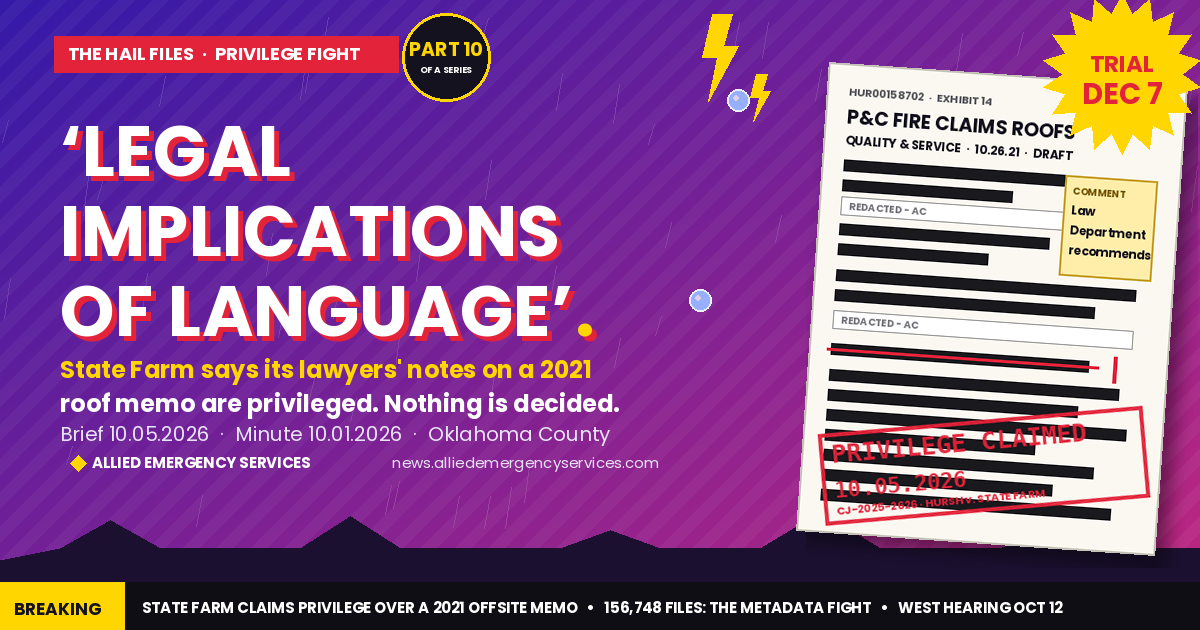
Earlier installments of this series, including Part 9 and Part 10, describe the internal State Farm documents the homeowners have filed to support that theory and State Farm’s responses to them.
State Farm’s motion says the homeowners, asked to identify “all evidence and the factual basis” for the alleged scheme, referred it to their petition and other answers, to “anticipated deposition testimony of State Farm officials,” and to the attorney general’s attempt to intervene. Its first footnote adds that the defendants noticed the homeowners’ depositions in March for early April, that the homeowners “moved to quash those depositions and sought to delay them until after the depositions of various State Farm representatives,” and that, to the extent the homeowners later contend that facts developed at the October 22 and 23 depositions are not addressed in the motion, the defendants “reserve the right to supplement or amend this Motion.”
The homeowners’ broader argument, made in their motion on State Farm’s electronic records, is that a bad-faith case like theirs turns on proof that sits inside State Farm: “Proof turns on sequence and authorship — who circulated what, to whom, on whose behalf, and when.” That motion is described below.
What is the fight over State Farm’s “flattened” documents?
On October 19, the homeowners re-filed their October 2 motion asking the judge to order State Farm to produce its electronic records again, in what they say is the form State Farm itself chose. The re-filed version, labeled “corrected,” changes one thing, according to its first footnote: “Plaintiffs’ only correction is to include ‘Emergency’ in the title. Exhibits and brief remain the same.”
The motion’s core claim: State Farm has produced 156,748 files, and “approximately ninety percent of them are flattened PDF renderings carrying substantially no native file metadata,” with no load files to tie emails to their attachments. Its discovery responses of September 2025 and January 2026, the homeowners say, promised images with searchable text and, “where applicable, metadata load files … in .DAT file format and image load files in .OPT format.” “Plaintiffs do not ask this Court to decide what form State Farm should have chosen,” the motion says. “They ask the Court to hold State Farm to the form it chose.” State Farm’s position, as the motion quotes its 2025 discovery response, was that “[t]he information pertinent to the claims and defenses in this case can be found in the text of the documents and is not generally found in metadata.”
The motion’s main example is an October 26, 2021 email from Scott Welsh, addressed to Kathy Ress and another colleague, transmitting a roof-results presentation prepared for a State Farm Senior Executive Offsite, the 2021 document family at the center of earlier fights in the case. The email names two attachments, “10.26.21 SEO Fire Claims Service Quality Updated.docx” and “Law Department Feedback.msg.” The homeowners say only one can be located in the production, and that the Word document’s legal-department comments and tracked changes “survive as pictures stripped of their authors, dates, and sequence.” “A picture of a tracked change is not a tracked change,” they write.
A second example involves State Farm’s chief executive. A produced email and calendar event “created by Jon Farney (State Farm’s current CEO and CFO at the time) carries the subject ‘Fix Profit Task Force,'” the motion says; the rest of that sentence is redacted in the public copy. Without the native records, the homeowners say, they cannot confirm “the account behind Farney’s name” or who received the invitation, while “State Farm disputes Farney’s involvement and opposes his deposition.” “State Farm has made its flattened production both a sword and a shield,” they write. For that point the brief cites State Farm’s July 20 motion to block the deposition. Judge Palumbo denied that motion September 1, and on October 9 she entered an agreed order for a single four-hour deposition of Farney, to be completed October 19 or on another agreed date. The corrected version re-files the October 2 brief unchanged. State Farm has told the court the Fix Profit Task Force “has nothing to do with the allegations in this case,” as Part 10 reported.
The motion asks for re-production in the form it says State Farm promised, at State Farm’s expense, native copies of the 2021 offsite documents from five State Farm mailboxes, a sworn account of how the production was processed, and the homeowners’ attorney fees. It quotes State Farm’s own earlier statement to the court that complying with a November 2025 discovery order “has cost State Farm millions of dollars.” As of the October 19 docket check, the judge had not ruled on it.
What is State Farm asking to keep under seal?
Also on October 19, State Farm asked for leave to file under seal the unredacted version of its motion to reconsider and stay Judge Palumbo’s October 1 minute order, along with unredacted Exhibits 2, 3 and 4. (Its public filing of the motion was redacted, with a placeholder in place of Exhibit 2.) Exhibit 2, it says, “is an internal memo covering State Farm’s proprietary information,” and Exhibits 3 and 4 are hearing transcripts, “portions of which have been redacted because they discuss that memo.” The documents, State Farm says, “contain and reflect State Farm’s confidential and proprietary claims handling policies, procedures and methodologies.” It cites federal court decisions that kept companies’ internal manuals, including insurers’ claims manuals and procedures, confidential, and it notes: “Plaintiffs object to this Application.”
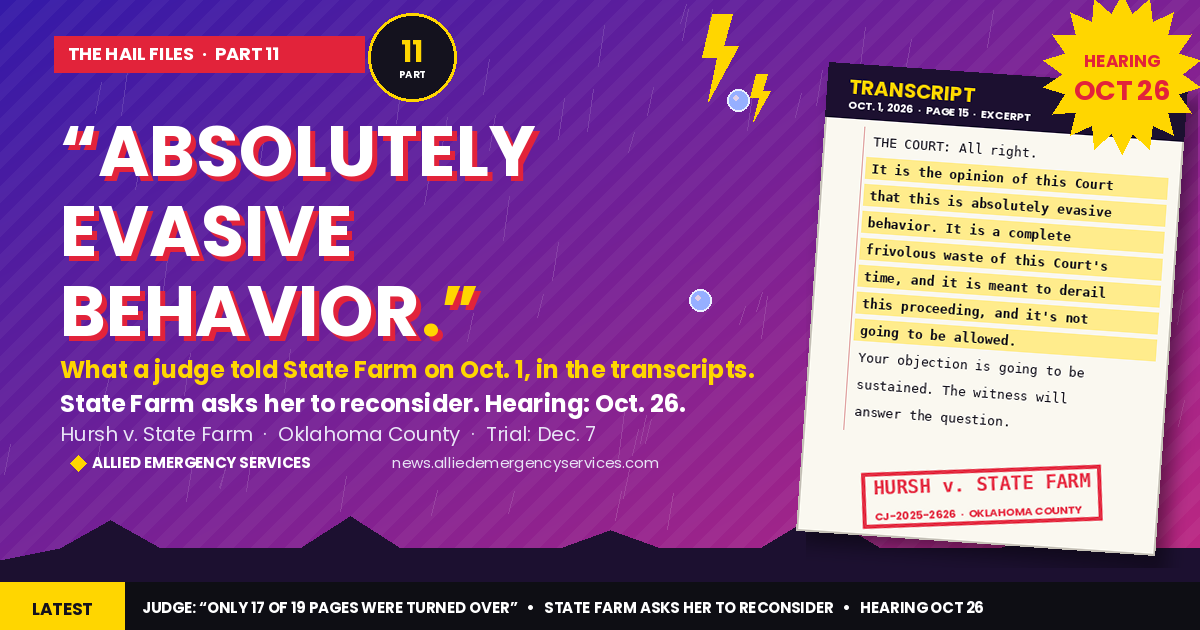
The redacted public version of that motion, with the transcripts of the two October 1 hearings, is in the archive; Part 11 quotes from them. The motion to reconsider is set for a hearing October 26.
What happens next in Hursh v. State Farm?
October 22–23: The homeowners’ depositions, according to State Farm’s motion.
October 23: State Farm’s replies are due by noon on its motion to reconsider or stay the October 1 minute and its emergency motions, under the October 15 court minute.
October 26, 10 a.m.: The hearing on those motions, under the same minute.
The summary-judgment motions: The homeowners’ responses had not been filed as of the October 19 docket check.
November 1, November 10 and November 19: Under the agreed amended scheduling order of September 22, motions in limine are due November 1 and challenges to expert witnesses November 10, and the pretrial conference is November 19 at 1:30 p.m. Separately, under the October 1 docket entry, briefs on media coverage are due November 10.
December 7, 9 a.m.: A seven-day jury trial before Judge Palumbo is set to begin.
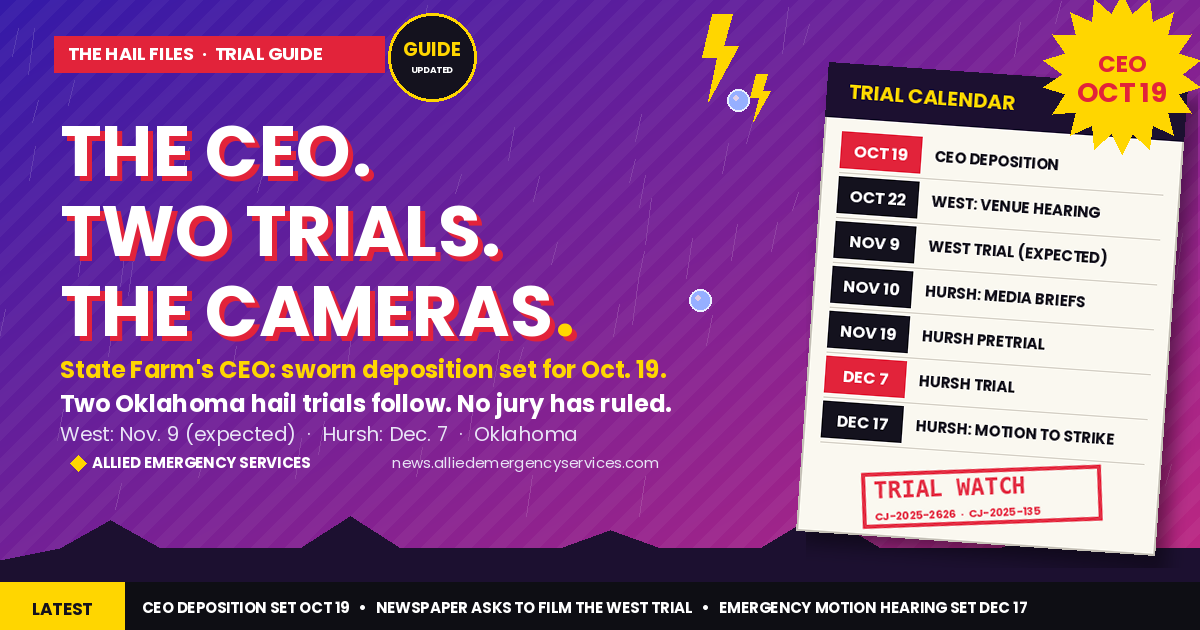
Every date is on the Trial Watch calendar, and the trial guide explains the Oklahoma cases.
What is the timeline of the Hursh case?
- May 2020: The Hurshes apply for a State Farm homeowners policy through a State Farm agent’s office.
- October 4, 2023 (on or about): The storm behind the first claim.
- March 5, 2024: First claim reported; inspected March 9; State Farm’s March 12 letter says the roof’s damage is wear and tear and a workmanship or materials defect, not hail.
- May 24, 2024: State Farm declines a second inspection.
- July 12, 2024: Second claim, for a May 21, 2024 storm; inspected July 24; State Farm’s July 29 letter says the covered damage is below the deductible.
- April 17, 2025: The homeowners sue State Farm and the agent defendants in Oklahoma County (CJ-2025-2626).
- December 2025: The attorney general moves to intervene; Judge Palumbo allows it December 30.
- January 8, 2026: The homeowners serve the discovery answers State Farm later attaches to its motion.
- June 23, 2026: The Oklahoma Supreme Court bars the intervention (2026 OK 51).
- August 26–28, 2026: The homeowners depose State Farm executives Wensley Herbert, Scott Welsh and Kathy Ress in Normal, Illinois.
- September 22, 2026: An agreed amended scheduling order keeps the December 7 trial and sets October 15 as the deadline for dispositive motions.
- October 2, 2026: The homeowners move to compel re-production of State Farm’s electronic records.
- October 15, 2026: State Farm and the agent defendants move for summary judgment.
- October 19, 2026: State Farm files its amended motion and its sealing application; the homeowners re-file their records motion as an emergency motion. That evening, both summary-judgment motions and the October 19 filings are added to The Hail Files archive.
- December 7, 2026: Trial is set to begin.
What does State Farm say?
State Farm denies wrongdoing. In these motions, its position is that the Hursh claims were decided on the condition of one roof, after two inspections, and that disagreement among roofers is a legitimate dispute, not bad faith. In an October 1 FOX23 report on executives’ depositions in Hursh, it said that “neither selectively cited documents nor portrayals of testimony from recent depositions change the truth: State Farm evaluates each claim based on the facts of the loss and the coverage purchased and pays the benefits available under the policy.”
What does this mean for Oklahoma homeowners and contractors?
Nothing has been decided. If Judge Palumbo grants State Farm’s motion in full, the homeowners’ case against State Farm at the December trial would be limited to the contract claim, whether State Farm owed more under the policy, without the bad-faith, punitive-damages and fraud claims; if she denies it, those claims stay in the case. She could also grant it in part. The agent defendants’ motion is separate: if it is granted in full, they would be out of the case.
Either way, the motions show how a storm claim is argued in court. State Farm’s case is built from inspection notes and photos, the dates the claims were filed, and contractors’ estimates, notes and text messages, several of which are exhibits. The homeowners’ case, by their account, depends on what State Farm’s own records show about how roof claims were handled across Oklahoma. For contractors, the exhibits are a reminder that notes, estimates and texts written in the course of a job can end up as evidence in a lawsuit.
Read the documents
State Farm’s October 19 amended motion for partial summary judgment, Part 1 (197 pages: the brief and Exhibits 1–13) · Part 2 (187 pages: the rest of Exhibit 13 and Exhibits 14–23) · The original October 15 motion (359 pages) · The agent defendants’ October 15 motion for summary judgment (262 pages) · The homeowners’ October 19 corrected emergency motion to compel re-production of electronic records (295 pages) and their original October 2 motion (part 1, part 2) · State Farm’s October 19 application to file under seal · State Farm’s motion to reconsider and stay the October 1 minute, with the hearing transcripts · The October 15 court minute · Search the full archive.
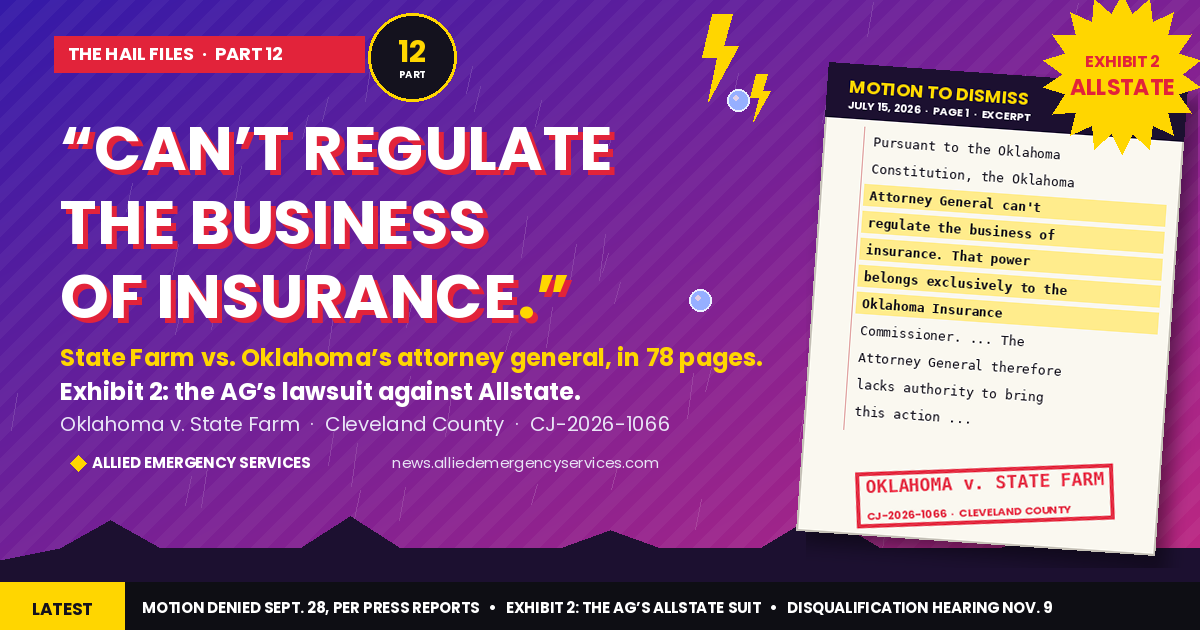
More from The Hail Files: the trial guide · “The Denial Enterprise” · Part 4: Two Trials, 800,000 Pages · Part 5: The Accenture Motion · Part 6: State Farm Asks a Judge to Throw the Attorney General’s Lawyers Off the Case · Part 7: State Farm Wants Out of Lawton · Part 8: “A Little Worried” · Part 9: ‘Outcome-Based Claim Handling’ · Part 10: ‘Legal Implications of Language’ · Part 11: ‘Absolutely Evasive Behavior’ · Part 12: ‘Can’t Regulate the Business of Insurance’.
Frequently asked questions
Not entirely. On October 15, 2026, State Farm moved for partial summary judgment in Hursh v. State Farm (Oklahoma County No. CJ-2025-2626), asking Judge Amy Palumbo to rule that Billy and Lacy Hursh cannot pursue their claims for bad faith, punitive damages and constructive fraud or negligent misrepresentation. It did not seek judgment on their breach-of-contract claim, which would remain for the jury trial set for December 7, 2026. State Farm refiled the motion as an amended motion on October 19. As of the October 19 docket check, the homeowners had not responded and the judge had not ruled.
Under Oklahoma Supreme Court decisions including Manis v. Hartford Fire Insurance Co. (1984), a bad-faith claim against an insurer “will not lie where there is a legitimate dispute” over the claim, because a disagreement between insurer and insured is not by itself bad faith. State Farm’s brief in Hursh v. State Farm also acknowledges that, under federal appeals decisions applying Oklahoma law, a policyholder can still take a bad-faith claim to a jury with “additional evidence” that the insurer did not actually rely on the dispute, denied the claim for an illegitimate reason, treated the policyholder unfairly, or performed an inadequate investigation. This summary describes the parties’ briefs and is not legal advice.
State Farm’s October 2026 motion quotes a July 2024 text in which Lacy Hursh wrote that “all the roofers we had come look had said there was a 50/50 chance” that State Farm would approve a claim. The motion argues that “a ’50/50 chance’ is the definition of a legitimate dispute—it could go either way,” and points to two State Farm inspections that found storm damage below the policy deductible and to roofers who disagreed about whether the roof had hail damage. In the deposition pages State Farm attached, the homeowners’ contractor said part of such a percentage “has to be based on the insurance company because they’re the ones making the ultimate decision.” The homeowners, who allege that State Farm decided their claims under a program to reduce roof replacements, had not responded as of October 19, 2026.
The October 15, 2026 version left 24 paragraph numbers in its citations to its own statement of undisputed facts as “#” and followed one sentence with “[CITE].” The amended motion, filed October 19 in two parts, fills in the paragraph numbers, cites Newport v. USAA (2000) in place of “[CITE],” corrects “Lucy Hursh” to “Lacy Hursh,” removes one sentence about State Farm’s handling of the reinspection request, drops a citation to Kathy Ress’s deposition, which was not among the exhibits, corrects one cross-reference (“¶ 32” to “¶ 45”), fixes a typo in a quotation, and adds a cover sheet before each of its 23 exhibits. A word-by-word comparison by The Hail Files found no other changes to the argument apart from punctuation.
The State Farm agent whose agency sold the Hursh policy, and the agency, also defendants in Hursh v. State Farm, moved for summary judgment on October 15, 2026, on the homeowners’ claims of negligent procurement, constructive fraud or negligent misrepresentation, and punitive damages. They argue that the homeowners received the replacement-cost policy they asked for, that State Farm rather than the agency investigated and decided both roof claims, that the agency had no duty to inspect the home or underwrite the policy, and that the homeowners cannot identify any statement the agency made to them. The homeowners had not responded as of October 19, 2026.
The homeowners say State Farm has produced 156,748 files and that about 90 percent are “flattened” PDF images with substantially no native metadata, so they cannot tell who sent or received emails, when, or which attachments went with them. They argue State Farm promised in its 2025 and 2026 discovery responses to produce metadata and image load files, and they ask the court to order re-production in that form at State Farm’s expense. Their examples include an October 2021 email about a Senior Executive Offsite presentation and a “Fix Profit Task Force” calendar event attributed to CEO Jon Farney. State Farm has said the pertinent information is in the documents’ text, and it has told the court that the Fix Profit Task Force has nothing to do with the allegations in the case.
A seven-day jury trial in Hursh v. State Farm (Oklahoma County District Court No. CJ-2025-2626) is set to begin December 7, 2026, at 9 a.m. before Judge Amy Palumbo, under an agreed amended scheduling order entered September 22, 2026. Before then, the homeowners are to be deposed October 22 and 23, State Farm’s motion to reconsider an October 1 court minute is set for a hearing October 26, motions in limine are due November 1, expert-witness challenges are due November 10, and the pretrial conference is November 19.
About this report. Except where a news outlet is named, everything above is drawn from public court records in Hursh v. State Farm Fire and Casualty Co. (Oklahoma County No. CJ-2025-2626): State Farm’s October 15, 2026 motion for partial summary judgment and its October 19 amended version, with their exhibits, including the homeowners’ January 8, 2026 discovery answers and the deposition excerpts quoted here; the agent defendants’ October 15 motion for summary judgment; the homeowners’ October 19 corrected emergency motion to compel re-production of electronically stored information; State Farm’s October 19 application to file under seal; the October 15 court minute; the September 22 agreed amended scheduling order, the October 1 docket entry and the October 9 agreed order on Jon Farney’s deposition; and the docket as read October 17 and 19. The motions are image scans; quotations were checked against the page images. The comparison of the October 15 and October 19 versions of State Farm’s motion was made by The Hail Files from the text of both, word by word, and every difference was checked against the page images. Individuals named in the filings other than the homeowners, the judge, the lawyers and State Farm executives are not named here. State Farm’s statement is as reported by FOX23 (October 1). Where the report describes what the homeowners say, those are their characterizations; where it describes State Farm’s and the agent defendants’ positions, it quotes their filings. Allegations in this lawsuit are allegations that State Farm and the agent defendants deny; nothing described here has been decided unless the report says so. Get an email when new filings are added to The Hail Files: sign up for alerts.
About the host. Allied Emergency Services is a licensed storm-damage restoration contractor serving Illinois, Wisconsin, Indiana and Michigan — not a law firm, insurance adjuster or public adjuster, and this report is not legal or insurance advice. We inspect, document, provide insurance-ready repair estimates and complete repairs; coverage decisions always belong to you and your insurer. Founded 2015; in the building trades since 1999; Illinois-licensed. 24/7: (800) 792-0212.
⚡ Storm or Roof Damage? Get a FREE Estimate
Text ESTIMATE to (844) 907-2546
Or call (800) 792-0212 for 24/7 emergency response
AI-powered • No obligation • Licensed IL & WI
Storm damage? Start with the documentation
Allied Emergency Services — IL-Licensed Storm Damage Restoration Contractor
Founded 2015, in the building trades since 1999. Allied inspects and documents storm damage, writes the scope and estimate, and does the repairs. We do not adjust or negotiate insurance claims — that is the job of your insurer, a licensed public adjuster, or an attorney. IICRC-certified, EPA Lead-Safe, IL Licensed Roofing Contractor #104.019029. 24/7 emergency response.
How the storm-damage insurance claim process works →Free inspection within 24 hours · No obligation · Photo-documented findings you can share with your insurer
Attorneys: forensic storm damage documentation & construction expert consultation for counsel →