


⚡ Storm or Roof Damage? Get a FREE Estimate
Text ESTIMATE to (844) 907-2546
Or call (800) 792-0212 for 24/7 emergency response
AI-powered • No obligation • Licensed IL & WI
When wind tears through an Illinois neighborhood, the most common roofing injury never makes the morning news. Creased shingles — asphalt shingles that have been bent, kinked, or folded under sustained wind uplift — are among the most misunderstood and underreported forms of storm damage in residential roofing. They don’t look as dramatic as missing shingles or crushed decking, but their effect on your roof’s waterproofing ability is just as serious. Insurance adjusters who lack field experience frequently dismiss them as pre-existing wear, and that gap between what damage actually exists and what gets documented and paid is exactly where Illinois homeowners lose money on otherwise legitimate claims.
Unlike hail impacts, which leave unmistakable circular bruises in the granule layer, wind crease damage presents subtly — a sharp fold line across a shingle’s tab, a slight bow in the mid-section, a barely visible fracture in the asphalt mat that only reveals itself when you flex the shingle by hand. Forensic roofing inspection, the kind that separates legitimate wind damage from age-related degradation, requires a trained eye, an understanding of how shingles are engineered, and familiarity with the testing standards that define wind resistance in the first place. Miss these distinctions in the field, and your claim goes underpaid or denied outright.
Allied Emergency Services has been inspecting, documenting, and restoring storm-damaged roofs across Illinois since 2015. In that time, our licensed roofing professionals have learned exactly what adjusters look for — and exactly what they miss. This guide explains the forensic science behind creased shingles, walks through the test-square and photo documentation protocol we use in the field, reviews what leading manufacturers like Owens Corning and GAF say about crease damage in their technical bulletins, and explains why creased shingles are not a repair item — they are a replacement item. Whether you’ve just experienced a wind event or you’re trying to understand a past claim outcome, this information puts you in a significantly stronger position.
What Wind Does to Asphalt Shingles
Asphalt shingles are designed to resist wind through two mechanisms working in tandem: mechanical fastening via roofing nails, and adhesive sealing via the thermally-activated asphalt strip along the upper edge of each shingle tab. Under normal conditions, these two systems complement each other effectively. The nails anchor the shingle to the deck; the sealant strip bonds the shingle to the row below it, distributing wind uplift loads across a large surface area rather than concentrating stress at the nail heads alone.
When sustained wind speeds increase — particularly during the derecho events, severe thunderstorm straight-line winds, and tornado outflows that Illinois sees multiple times each year — the aerodynamic dynamics shift dramatically. Wind moving across a roofline creates a pressure differential: positive pressure on the windward face of the structure and negative pressure, commonly called suction or uplift force, on the leeward slope and near ridges, eaves, and corners. This suction pulls the exposed tab of each shingle away from the roof deck. If the sealant strip has not fully thermally cured, has aged past its effective bond strength, or if wind speeds exceed the shingle’s rated resistance, the tab begins to lift repetitively with each gust cycle.
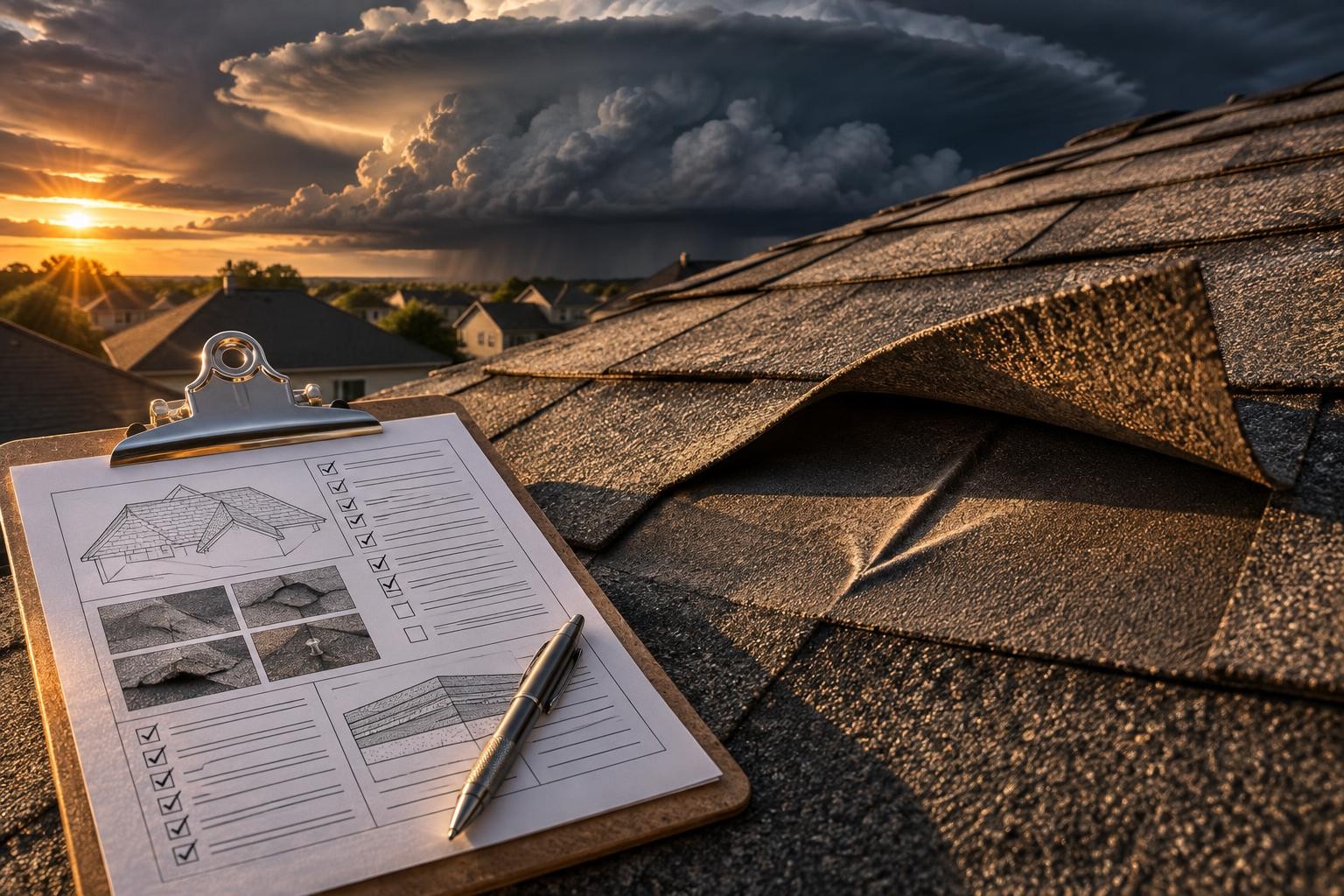
As the tab lifts and returns during a wind event, something happens that is poorly understood by homeowners and even some insurance adjusters: the shingle develops a crease. Each flex cycle work-stresses the asphalt composite at its high-load point — typically just above the sealant strip line, or at the slot between tabs on three-tab designs. The glass-fiber reinforcing mat embedded within the asphalt body begins to separate under repeated tensile and compressive stress. Granules are dislodged from the surface coating at the bend point. Eventually the crease becomes permanent: a sharp, rigid fold line that marks the boundary between the still-intact portion of the shingle and the section that has been structurally compromised. That crease is not a cosmetic blemish. It is forensic evidence — and it tells a trained inspector exactly where the shingle failed, how it failed, and why.
Crease vs. Lift vs. Seal Failure: Three Distinct Wind Damage Failure Modes
Not all wind damage to shingles looks the same, and misidentifying the failure mode leads to inaccurate estimates and claim disputes. Illinois storm restoration professionals distinguish between three primary failure patterns, each with different implications for scope of damage, insurability, and long-term performance risk.
Creasing
Creasing is the most consequential and most commonly missed failure mode. A creased shingle has a visible or palpable fold line across its face, running roughly perpendicular to the direction of wind flow. The crease may appear as a shadowed line or a subtle color change from street level, or it may only be apparent upon hand-testing — when you apply gentle upward pressure to the tab, the shingle bends sharply at the crease point rather than flexing uniformly as an intact shingle would. Internally, the glass-fiber reinforcing mat has separated or fractured at the fold. The asphalt coating on both surfaces of the crease is micro-cracked, eliminating that section’s waterproofing integrity. Granule loss along the crease accelerates UV degradation of the now-exposed asphalt. Moisture infiltration is not a matter of if — it is a matter of when and how much damage it will cause before it surfaces as a visible interior leak.
Lifting
A lifted shingle has partially or fully broken its sealant-strip bond with the shingle course below it. The tab is visibly raised at its free edge, creating a gap that allows wind-driven rain to bypass the overlapping waterproofing course and reach the underlayment or roof deck below. Lifted shingles may or may not be creased; a shingle can lift cleanly if the seal failure occurs uniformly across the full width of the tab. However, repeated lifting cycles almost always produce creasing over time, because the same flex mechanics that break the sealant bond also stress the mat and asphalt coating. Lifted shingles that have reseated — pressed back down by gravity after the wind event subsides — are particularly dangerous. They appear intact from the ground while having lost their adhesive bond and potentially developed hidden crease damage that only reveals itself under hand-testing.
Seal Failure Without Visible Disturbance
The third failure mode is the least visible and arguably the most dangerous from a claims perspective: sealant-strip shear failure without obvious shingle movement. During extreme wind events, the thermal-adhesive strip can be sheared at its interface with the underlying shingle course. The shingle appears perfectly flat and undisturbed. No crease, no raised edge, no missing tabs. But the sealant bond is gone. The first significant rain event after this failure can drive water beneath the shingle course along its full width — a scenario that leads to hidden roof deck rot, mold growth in the attic cavity, and interior damage that surfaces months after the original wind event when the connection to the storm has become far harder to establish. Documenting seal failure requires hand-testing each shingle individually within a measured inspection area, which is precisely why a brief visual inspection or drive-by assessment is wholly insufficient for wind-damaged roofs.
ASTM D3161 and D7158: The Standards Behind Your Shingles’ Wind Rating
When a shingle manufacturer labels a product as “Class H” or “rated to 130 mph,” those designations come directly from standardized laboratory test methods developed by ASTM International, the global standards organization for materials testing. Two standards govern wind resistance in asphalt shingles, and understanding them helps homeowners and adjusters evaluate whether a shingle failed within or beyond its design envelope — a distinction with real consequences for how a claim is analyzed.
ASTM D3161 is the original fan-induced wind resistance test for steep-slope roofing products. Shingle assemblies are mounted on a standard test panel and subjected to continuous, sustained airflow for a two-hour test period. The rating classes under D3161 are straightforward: Class A shingles resist 60 mph winds without failure; Class C resists 90 mph continuous flow; Class D resists 120 mph. While still referenced in older installation specifications, insurance policy language, and some manufacturer warranty documents, D3161 has been increasingly supplemented and in many contexts superseded by more sophisticated testing methods, because continuous laminar airflow in a lab does not accurately replicate the turbulent, cyclic gusting of real storm winds.
ASTM D7158 is the more modern and physically accurate standard, measuring the relationship between actual uplift force applied to the shingle tab and the shingle’s resistance capacity. The test methodology accounts for the fluctuating pressure of real wind events — the rapid gust-and-lull cycles that repeatedly stress the sealant bond and shingle mat during a severe thunderstorm. Under D7158, Class D shingles are rated to resist the equivalent of 90 mph three-second wind gusts; Class G resists 120 mph gusts; Class H resists 150 mph gusts. The vast majority of shingles installed on Illinois homes over the past fifteen years carry D7158 Class D or Class G ratings, which aligns with the peak wind speeds regularly produced by the severe thunderstorm and derecho events that cross the state.
These standards matter for a creased shingle claim in a very specific way. They establish a testable baseline: a shingle that creases during a measured 70 mph wind event — well within its rated Class G capacity — may indicate an installation defect, a faulty sealant strip from manufacturing, a shingle that was stored improperly and lost sealant adhesion before installation, or a shingle that is older and has lost thermal-bond effectiveness. A shingle that creases during a measured 130 mph event may have been operating beyond its design envelope entirely. In both scenarios, the damage is real, documentable, and claimable — but the cause analysis differs, and that matters for how the claim is structured. Some adjusters argue that damage from winds “within the rated capacity” of a shingle constitutes a maintenance issue. That argument fails when a qualified inspector demonstrates that the rated capacity in the laboratory assumes proper installation, adequate sealant cure, and bond integrity — conditions that frequently do not exist on roofs that are ten or more years old.
What Owens Corning and GAF Technical Bulletins Say About Creased Shingles
Owens Corning and GAF — the two largest asphalt shingle manufacturers in North America and the brands most commonly found on Illinois homes — both publish technical bulletins, installation instructions, and warranty documents that address wind damage. These documents are essential references in claim disputes because they represent the manufacturer’s own stated definition of acceptable product performance, storm damage classification, and appropriate remediation. When an adjuster’s position conflicts with the manufacturer’s technical guidance, the manufacturer’s documentation carries significant weight.
Owens Corning’s technical documentation is explicit on the question of repair versus replacement for wind-damaged shingles. The company’s position, reflected across multiple technical bulletins and installation guides, is that asphalt shingle repair is limited to isolated corrections such as nail pops or minor flashing adjustments — not structural shingle damage of any kind. Once a shingle’s glass-fiber mat has been compromised by bending stress, repeated uplift, or sealant-bond failure, the product’s waterproofing and long-term weathering performance cannot be restored by any field repair method available to a roofing contractor. Owens Corning further specifies in their warranty documentation that products must be installed in full compliance with published installation guidelines, and that damage caused by wind events — whether within or exceeding the product’s rated resistance class — requires replacement of affected shingles to restore the system’s intended performance.
GAF, whose products carry a range of wind warranties from standard coverage through their WindProven limited warranty program (which carries no upper wind speed limit when qualifying system components are used together), takes an equally firm technical position on creased shingles. GAF’s technical documentation specifically distinguishes between cosmetic granule loss — a normal weathering phenomenon that affects aesthetics but not waterproofing — and functional granule loss at a crease or structural failure point, which the company categorizes as a waterproofing failure requiring replacement. This distinction is critical in insurance contexts: an adjuster who categorizes crease-related granule displacement as ordinary cosmetic wear is misclassifying the damage in a manner that directly contradicts GAF’s own published technical guidance. GAF’s position on permanently deformed shingles — those exhibiting creases, buckles, or other structural distortions — is that such shingles have experienced failure of the asphalt composite and must be replaced.
The practical implication for Illinois homeowners is straightforward: if your roof carries Owens Corning or GAF shingles and those shingles exhibit wind crease damage, the manufacturer’s own technical documentation supports full replacement, not spot repair. That documentation is part of the evidence package that a qualified restoration contractor compiles when presenting a documented scope of damage to your insurance carrier — and it is documentation that an adjuster cannot easily dismiss.
The Test Square Protocol: How Professionals Systematically Document Wind Damage
Random-sample inspection is not adequate for wind damage documentation, and yet it is what many insurance adjusters — particularly those handling high-volume post-storm claims — perform in the field. A quick visual scan from the eave edge or a brief ridge walk may identify missing tabs and obvious displacement, but it routinely misses creased shingles, reseated lifted shingles, and sealant failures — the hidden damage types that lead to denied supplementals and future water intrusion claims. The industry-standard test square protocol provides a systematic, reproducible inspection method that produces defensible documentation capable of withstanding adjuster review, supervisory escalation, or independent engineering evaluation.
A test square is a precisely defined 10-foot by 10-foot section of roof surface — 100 square feet, equivalent to one “square” in roofing material measurement — examined with the thoroughness the entire roof surface deserves. The protocol our inspectors follow is:
- Select representative locations across all roof planes. Inspectors choose test square locations from multiple slopes, prioritizing the most wind-exposed faces first, then sheltered slopes and intermediate areas. On a standard Illinois ranch home, three to five test squares at minimum are required to establish a statistically meaningful damage picture. On complex multi-slope or hip roofs, additional squares may be necessary to capture variation across exposure angles and wind shadow zones.
- Mark the perimeter clearly. Using chalk lines or string, the inspector defines exact test square boundaries before beginning the hand evaluation. This creates a documented, reproducible inspection zone that a second inspector, an adjuster, or an independent engineer can re-examine and verify independently. The boundary marking is photographed as part of the documentation package.
- Hand-test every shingle within the square. Starting at the eave course and working systematically upward, the inspector applies upward pressure to the free edge of each tab. A creased shingle will bend sharply at the crease rather than flexing uniformly as an intact shingle does. A lifted shingle with sealant failure will offer little to no resistance to upward movement. Each damaged shingle is marked and noted in real time.
- Record findings by shingle course and failure type. The inspector documents each damaged shingle, noting failure classification (crease, lift, full sealant failure, granule displacement at crease point), precise location within the test square, and orientation relative to the prevailing wind direction of the event. This detail allows the damage pattern to be correlated with the meteorological record of the storm.
- Extrapolate across the full roof plane with professional judgment. Once test squares across all planes are complete, the inspector uses damage density findings from each square to estimate total damage across the full slope area. When consistent damage patterns appear across multiple test squares on the same plane — as is typical in wind events — industry practice and insurance carrier guidelines support proportional extrapolation to the full surface.
The test square method transforms a subjective field assessment into an objective, quantified damage count. It is the difference between telling an adjuster “there’s significant wind damage on the south slope” and presenting them with documentation showing “23 creased or sealant-failed shingles across three test squares on the south slope, representing 19% damage density, consistent with the northwest wind direction recorded during the event by the National Weather Service.” That specificity changes the conversation.
Photographic Documentation Protocol for Wind Damage Claims
Even the most thorough physical inspection loses its evidentiary weight without adequate photographic documentation. Insurance claims are ultimately paper and digital files reviewed by people who were not on your roof. The photos in that file are what adjusters, supervisors, and dispute reviewers actually evaluate when determining scope and coverage. Allied’s documentation protocol follows a disciplined three-tier approach: establishing shots, mid-range context shots, and close-up evidence shots — structured to tell a coherent story from the weather event down to the individual shingle failure.
Establishing shots capture the full roof plane from the ground, showing the overall condition of each slope and its relationship to the structure. These shots provide aerodynamic context for the damage pattern — are the creased shingles concentrated near the ridge where uplift forces peak? Along the eave edge where pressure differentials are greatest? On the windward slope but not the leeward slope? A damage pattern that follows predictable aerodynamic logic supports a wind event cause analysis and directly contradicts any suggestion that damage is randomly distributed pre-existing wear. Establishing shots should include enough surrounding context — trees, neighboring structures, compass-identifiable features — to establish slope orientation.
Mid-range shots taken from the roof surface document individual test squares and damage zones. These images show the arrangement of damaged shingles within their courses, the relationship of creased shingles to undamaged ones immediately adjacent, and the density of damage across a measured area. Each test square should have at minimum one overhead mid-range photo establishing the inspection boundary and showing the full square in context. These photos also document the inspector’s chalk markings and any reference measurements that establish scale.
Close-up evidence shots are the most critical images for claim documentation and the most frequently done poorly. Each creased shingle should be photographed with sufficient resolution and proper lighting to clearly show the fold line, the shadow cast by the crease depth, the granule displacement along the crease axis, and the color contrast between exposed asphalt and intact granule-covered sections. For shingles exhibiting sealant failure, photos should capture the inspector demonstrating the lack of adhesion — the tab lifted with minimal applied force, with the contact surface visible and showing no sealant bridging. All photos should preserve their original metadata including timestamp and GPS coordinates, as this data can directly corroborate the inspection date relative to the documented storm event date in case of dispute.
The complete documentation package — weather event data from the National Weather Service, test square field worksheets, and the organized photographic evidence — should be compiled into a report format that tells the damage story from the meteorological event through to the individual shingle-level physical evidence. This is the foundation of a thorough, defensible insurance claim that can withstand scrutiny at every level of review.
Why Creased Shingles Cannot Be Repaired
This point is non-negotiable, and it is worth explaining the material science clearly because “repair versus replace” is one of the most common and consequential dispute points in wind damage claims. When an insurance adjuster or a competing contractor suggests that creased shingles can be resealed, re-nailed, or otherwise corrected in place, they are either unfamiliar with how asphalt shingles are engineered or they are proposing a scope of work that will fail — and when it fails, any resulting water damage may face coverage complications because the original repair was inadequate.
An asphalt shingle’s waterproofing performance depends on three things functioning together: the structural integrity of the glass-fiber reinforcing mat, which provides dimensional stability and tear resistance; the continuity of the asphalt coating on both surfaces, which provides the actual waterproofing barrier; and the adherence of the mineral granule layer, which protects the asphalt from UV degradation that would otherwise cause it to become brittle, oxidized, and prone to cracking within one to two weathering seasons. A wind crease compromises all three simultaneously, at the same location.
At the crease point, the glass-fiber mat has been bent past its elastic limit. Individual fibers have separated or fractured, eliminating the mat’s ability to distribute tensile stress across the shingle’s width. The asphalt coating on both surfaces of the crease has developed micro-fractures — often invisible to the naked eye from any distance, but representing direct channels for water infiltration that will progressively widen with each Illinois freeze-thaw cycle. The granule loss at the crease exposes bare asphalt to direct UV radiation; unprotected asphalt oxidizes rapidly, becoming rigid and prone to further cracking within one to two seasons. A field-applied sealant can bridge the visible crease gap temporarily, but it cannot restore mat integrity, re-adhere permanently lost granules, penetrate and seal the micro-fractures in the asphalt, or restore the original aerodynamic profile that allows the shingle to shed water properly into the course below it.
This is not a matter of contractor preference, business model, or upselling — it is a material science reality confirmed by manufacturer technical bulletins, roofing industry standards, decades of field performance data, and every qualified forensic roofing engineer who has evaluated the question. When Allied recommends replacement of creased shingles, we are following the same guidance that Owens Corning, GAF, and every credentialed roofing forensics professional applies to identical physical evidence.
Allied’s Role in Your Wind Damage Insurance Claim
Allied Emergency Services is a licensed Illinois roofing and restoration contractor — not a public adjuster. That distinction matters and we’re clear about it. What we do: document damage thoroughly using test-square methodology and structured photo protocols, provide detailed repair and replacement estimates that reflect actual material costs, current labor rates, and proper restoration scope, and make ourselves available to meet with your insurance adjuster on-site to walk through our findings and answer technical questions. Once your claim is approved and work is authorized, we perform the covered repairs to manufacturer specifications. What we do not do is negotiate, settle, or adjust your insurance claim on your behalf — that is the domain of licensed public adjusters and we operate transparently within our contractor role.
What we bring to that contractor role is more than a decade of Illinois storm restoration experience, field-tested knowledge of wind event meteorology and its effects on roofing systems, and the forensic inspection skills to document exactly what happened to your roof and why. We know what ASTM standards apply to your installed shingle product. We know what Owens Corning and GAF’s technical bulletins say about crease damage. We know how to build a photographic and test-square documentation package that an adjuster cannot summarily dismiss. And we know how to do the repair work right — with materials and methods that meet or exceed original installation specifications and position you for valid warranty coverage going forward.
If you’re dealing with a recent wind event and suspect crease damage, the first step is a professional roof inspection — not a quick look from the driveway or a street-level scan. The storm damage restoration process begins with documentation, and proper documentation requires a qualified inspector conducting a systematic, hand-tested evaluation on the roof surface itself. If you’re already engaged in the claims process and want to understand how documentation supports your position, our team can walk you through the storm damage insurance claim process in plain language so you understand every step.
Illinois homeowners can find general guidance on insurance claim rights and consumer protections through the Illinois Department of Insurance, and weather event data to support storm documentation — including storm reports, local wind speed records, and event summaries — through the National Weather Service. For general guidance on homeowner insurance rights and claim processes, the Insurance Information Institute provides accessible consumer resources. For severe weather preparedness planning, Ready.gov is a reliable federal resource for Illinois homeowners in storm-prone areas.
This guide is provided as general educational information only and does not constitute legal or insurance advice. Every claim, policy, and roof system is different; consult licensed professionals — including an attorney or licensed public adjuster if appropriate — for guidance specific to your situation.
Schedule Your Wind Damage Inspection — We Answer 24/7
If your roof has been through a wind event — a severe thunderstorm, a derecho, a tornado that tracked through your county, or a winter storm with sustained high gusts — creased shingle damage may be present even if everything looks normal from the ground. The damage that gets missed in the first days and weeks after a storm is the damage that leads to denied supplements, hidden water infiltration, interior damage, and repair bills your insurance could have covered if the documentation had been done right the first time.
Allied Emergency Services has been protecting Illinois homeowners since 2015. We’re IL licensed, fully credentialed, and ready to put a qualified inspector on your roof to document what the storm actually did — not what it looks like it did from street level. We’ve seen how much rides on thorough, accurate damage documentation, and we take that responsibility seriously on every single inspection we conduct.
Don’t wait for water stains on the ceiling or a failed DIY repair to find out you had a problem a professional could have documented and gotten covered. Act while the evidence is fresh and the meteorological record of the event is clear.
Call us 24 hours a day, 7 days a week: (800) 792-0212
Prefer to text? Text ESTIMATE to (844) 907-2546 and we’ll get back to you fast.
Your roof. Your home. Let’s make sure the documentation is done right.
⚡ Storm or Roof Damage? Get a FREE Estimate
Text ESTIMATE to (844) 907-2546
Or call (800) 792-0212 for 24/7 emergency response
AI-powered • No obligation • Licensed IL & WI
Need storm damage help?
Allied Emergency Services — Licensed IL & WI Storm Damage Specialists
For more than a decade, Allied has been restoring storm damage across Illinois and Wisconsin. IICRC-certified, EPA Lead-Safe, IL Licensed Roofing Contractor #104.019029. 24/7 emergency response.
Learn about our Storm Damage service →Free property assessment within 24 hours · No obligation · Photo-documented findings you can share with your insurer
Attorneys: forensic storm damage documentation & construction expert consultation for counsel →