⚡ Storm or Roof Damage? Get a FREE Estimate
Text ESTIMATE to (844) 907-2546
Or call (800) 792-0212 for 24/7 emergency response
AI-powered • No obligation • Licensed IL & WI
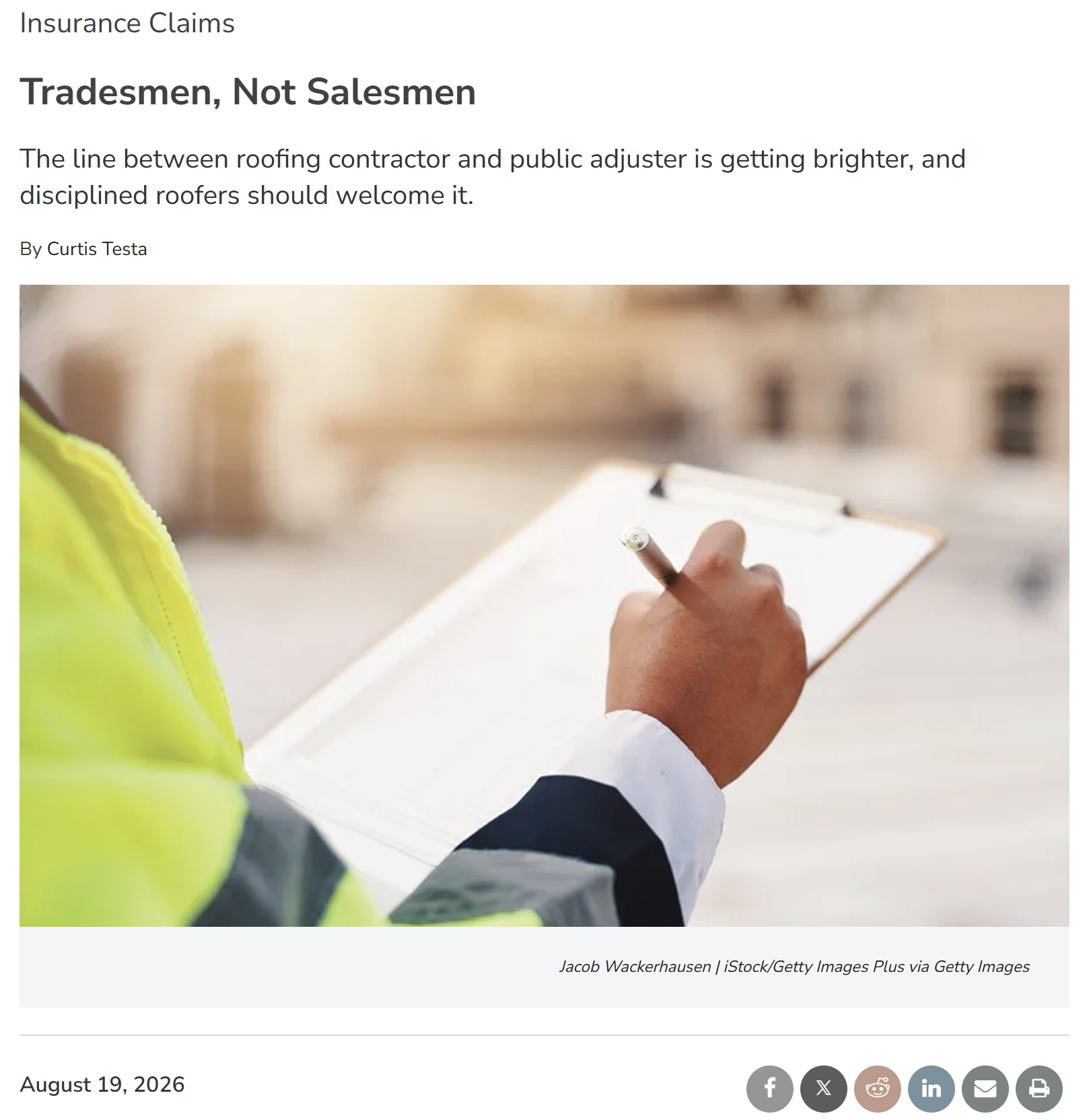
In August 2026, Allied Emergency Services owner Curtis Testa was invited to write a guest column for Roofing Contractor, the national trade magazine, in its annual Top 100 issue. The column — Tradesmen, Not Salesmen — makes a case a lot of storm-restoration contractors get backwards: the tightening legal line between building a roof and adjusting an insurance claim is good news for the honest operator, not a threat.
This post breaks down the heart of that argument for Illinois and Wisconsin property owners: what the contractor-versus-public-adjuster line actually is, why regulators across the country are sharpening it in 2026, and what it means for how your storm-damage claim should be handled. For the full column, read it at Roofing Contractor.
What’s the Difference Between a Roofing Contractor and a Public Adjuster?
They do two different jobs, and in most states one of them requires a license.
A roofing contractor evaluates and restores the building:
- Inspecting and documenting physical damage
- Measuring, scoping, and specifying the repair
- Citing applicable building code and manufacturer requirements
- Pricing the cost to perform the work
- Explaining construction methods and material requirements
- Substantiating its own repair scope as the contractor of record
A public adjuster works the claim:
- Interpreting what the insurance policy covers
- Advising the insured on coverage rights and policy duties
- Valuing the loss as an insurance settlement
- Calculating depreciation or actual cash value as a policy benefit
- Negotiating the claim amount on the policyholder’s behalf
- Representing the insured against the carrier
Writing a complete estimate, taking photos, meeting an adjuster, explaining a repair method, and citing code are all construction functions. The line is crossed when a contractor steps into the policyholder’s shoes — telling a homeowner what a policy “should” cover, calculating depreciation as a claim benefit, or negotiating the settlement. The simplest test is one question: Am I describing the building, or arguing the claim?
Why the Line Is Getting Brighter in 2026
This is no longer one state having a moment. Regulators, lawmakers, and courts across the country are sharpening the same boundary:
- Florida’s 2022 reforms barred assignment of post-loss benefits under new property policies and eliminated the one-way attorney-fee rule that had driven claim litigation.
- Texas prohibits contractors from acting as public adjusters or advertising to adjust claims on work they may perform — a framework the Texas Supreme Court upheld against a First Amendment challenge.
- Iowa’s Insurance Division has issued cease-and-desist orders against contractors it says acted as unlicensed public adjusters, warning that contractors may provide estimates but may not negotiate or represent homeowners in a claim.
- Louisiana’s Act 144 (effective 2025) bars public adjusters from doing repair work on claims they handle and bars contractors from advertising as “insurance claim specialists.”
- Illinois sharpened its own line again in 2026: under IL DOI Bulletin 2026-02, a roofing or repair company generating leads for a public adjuster may itself need a public adjuster license if anything of value changes hands.
Two things about that list matter. It crosses red states and blue states, hurricane coasts and hail country — which tells you it isn’t a local political fight but a structural correction. And contractors challenging these laws in court have had limited success so far. Waiting for the courts to undo this is not a strategy. (For the Illinois-specific mechanics, see our coverage of the Illinois §155 bad-faith statute, the Roofing Act and the Public Adjusters Law, and Power Dry v. Bean.
What This Means for Illinois and Wisconsin Homeowners
For a property owner, the takeaway is simple: the contractor who documents your roof to a professional standard and stays out of the claim is the one who protects both the repair and you. The operators most exposed by these new laws are the ones promising to “make your deductible disappear” and advertising themselves as claim specialists — the same operators who underbid real contractors and give carriers a reason to treat every restoration company with suspicion.
Allied’s approach is built for the compliant side of that line. We document the building exhaustively — photos, measurements, code citations, manufacturer specifications, and a clear scope narrative — and price the work, not the policy. Where a homeowner needs the repair pursued directly, we use a properly drafted Assignment of Claims (AOC) model that lets us stand behind our own construction scope without stepping into the public adjuster’s role.
About Curtis Testa
Curtis Testa is the owner of Allied Emergency Services, Inc., an Illinois- and Wisconsin-licensed storm-damage restoration and roofing contractor. A union carpenter by trade with decades of experience in insurance restoration, he writes about practical compliance systems that keep restoration contractors in the construction lane. His work has been featured in Roofing Contractor magazine.
Frequently Asked Questions
What’s the difference between a roofing contractor and a public adjuster?
A roofing contractor evaluates and restores the building — inspecting damage, measuring and documenting the work, citing building code and manufacturer requirements, and pricing the repair. A public adjuster works the insurance claim — interpreting what a policy covers, valuing the loss as a settlement, and negotiating the claim amount for the policyholder. In most states, public adjusting requires a license, while contracting does not. The test for which side an activity falls on: is it describing the building, or arguing the claim?
Can a roofing contractor negotiate my insurance claim?
Generally, no. In a growing number of states — including Florida, Texas, Iowa, Louisiana, and Illinois — a contractor who negotiates the claim, interprets coverage, calculates depreciation as a policy benefit, or represents the homeowner against the carrier may be acting as an unlicensed public adjuster. A contractor can document damage, prepare a detailed repair estimate, explain construction methods to an adjuster, and substantiate its own scope. Representing the policyholder in the claim itself is the licensed public adjuster’s role.
What is an Assignment of Claims (AOC)?
An Assignment of Claims is a written agreement in which a policyholder assigns certain insurance-claim rights to a contractor so the contractor can pursue payment for covered repair work directly. In Illinois, a properly drafted AOC lets a compliant restoration contractor stand behind its own construction scope without acting as a public adjuster. The enforceability and limits of an AOC depend on state law and how the agreement is written.
Who is Curtis Testa?
Curtis Testa is the owner of Allied Emergency Services, Inc., an Illinois- and Wisconsin-licensed storm-damage restoration and roofing contractor. A union carpenter by trade with decades of experience in insurance restoration, he focuses on compliance systems that keep restoration contractors in the construction lane. In August 2026 he wrote a guest column, Tradesmen, Not Salesmen, for Roofing Contractor magazine’s Top 100 issue.
If your Illinois or Wisconsin property has storm damage, Allied documents the building to the standard described here.
⚡ Storm or Roof Damage? Get a FREE Estimate
Text ESTIMATE to (844) 907-2546
Or call (800) 792-0212 for 24/7 emergency response
AI-powered • No obligation • Licensed IL & WI
Need storm restoration and roofing help?
Allied Emergency Services — Licensed IL & WI Storm Restoration And Roofing Specialists
For more than a decade, Allied has been providing storm restoration and roofing across Illinois and Wisconsin. IICRC-certified, EPA Lead-Safe, IL Licensed Roofing Contractor #104.019029. 24/7 emergency response.
Learn about our Storm Restoration And Roofing service →Free property assessment within 24 hours · No obligation · Photo-documented findings you can share with your insurer
Attorneys: forensic storm damage documentation & construction expert consultation for counsel →