

⚡ Storm or Roof Damage? Get a FREE Estimate
Text ESTIMATE to (844) 907-2546
Or call (800) 792-0212 for 24/7 emergency response
AI-powered • No obligation • Licensed IL & WI
Direct Answer: What Is Roofing Code Compliance?
Roofing code compliance means a roof repair, roof replacement, or storm restoration project is completed according to the building code adopted by the local jurisdiction, the manufacturer’s installation instructions, permit requirements, and the roof system’s required safety and performance standards.
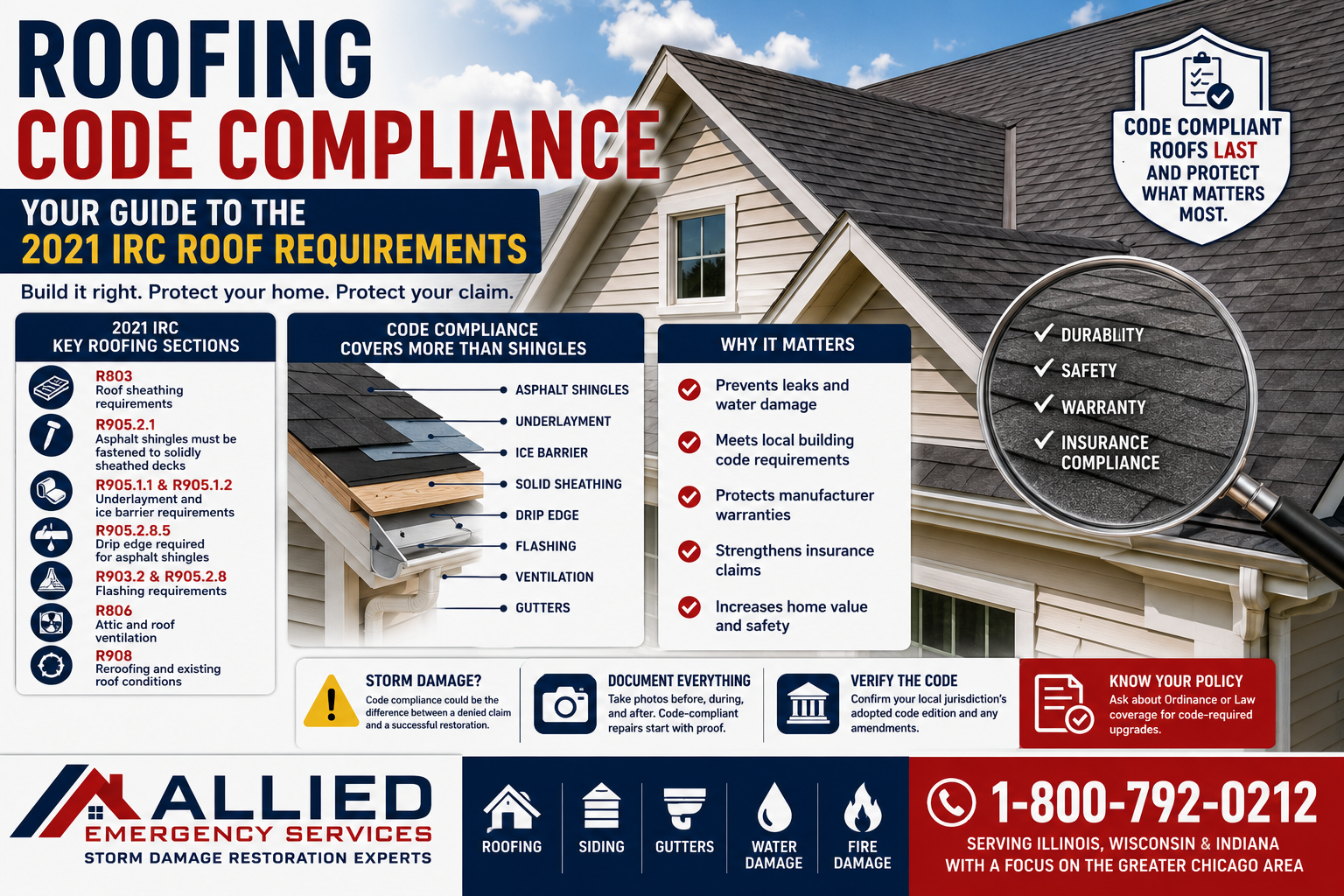
For Illinois homeowners, roofing code compliance often involves the 2021 International Residential Code, commonly called the 2021 IRC, when it has been adopted or used by the local authority having jurisdiction. The most important 2021 IRC roofing sections for asphalt shingle projects include:
| 2021 IRC Section | Why It Matters |
|---|---|
| R803 | Roof sheathing requirements. |
| R806 | Attic and roof ventilation. |
| R903.2 | Flashing requirements. |
| R903.4 | Roof drainage. |
| R905.1 | Roof coverings must follow code and manufacturer installation instructions. |
| R905.1.1 | Underlayment requirements. |
| R905.1.2 | Ice barrier requirements where applicable. |
| R905.2.1 | Asphalt shingles must be fastened to solidly sheathed decks. |
| R905.2.2 | Asphalt shingle slope requirements. |
| R905.2.5 | Asphalt shingle fastener requirements. |
| R905.2.6 | Asphalt shingle attachment requirements. |
| R905.2.8 | Asphalt shingle flashing requirements. |
| R905.2.8.5 | Drip edge requirements for asphalt shingles. |
| R908 | Reroofing, roof replacement, roof recovery, and existing roof condition rules. |
The practical rule is simple:
A roofing estimate is not code-compliant just because it includes shingles. A compliant roof system may also require proper sheathing, underlayment, ice barrier, drip edge, flashing, ventilation, fasteners, roof drainage, permits, and manufacturer-required installation details.
Why Roofing Code Compliance Matters After Storm Damage
After hail, wind, tornado, or severe storm damage, many insurance estimates focus only on visible damage. That can create a problem when the roof cannot be repaired or replaced legally without additional code-required work.
Common storm restoration code disputes include:
- Roof decking that is not solid or fastenable.
- Missing or omitted drip edge.
- Ice barrier omitted from the estimate.
- Flashing that must be replaced during reroofing.
- Improper underlayment for the roof slope.
- Inadequate ventilation.
- Fasteners that do not meet code or manufacturer requirements.
- Starter strip, ridge cap, or accessory items omitted.
- Old roof layers that must be removed.
- Water-soaked or deteriorated materials discovered during tear-off.
- Manufacturer installation instructions ignored.
- Permit or inspection requirements not included.
Roofing code compliance is especially important because improper roof installation can lead to leaks, wind blow-offs, warranty disputes, failed inspections, hidden water damage, and future insurance claim problems.
Related Allied pages:
Important Illinois Code Note: Always Verify the Local Adopted Code
Illinois roofing code compliance is local. A homeowner in Chicago may face different permit requirements or amendments than a homeowner in Springfield, Rockford, Peoria, Joliet, Aurora, Naperville, Champaign, Bloomington-Normal, or a smaller Illinois municipality.
The 2021 IRC is a model code. It becomes enforceable when adopted by the local jurisdiction or incorporated into applicable local law. Local amendments, permit rules, inspection practices, and energy-code requirements may change how a roofing project must be completed.
Before a homeowner uses a code citation in an insurance claim supplement, the best practice is to ask the local building department:
- Which residential code edition applies to this property?
- Are there local amendments to Chapter 9 roof assembly provisions?
- Is a roofing permit required?
- Is drip edge required?
- Is ice barrier required?
- Are roof deck repairs or sheathing overlay required?
- Are ventilation corrections required?
- Are flashing replacements required during reroofing?
- Are inspections required before, during, or after installation?
- Can the building official provide the requirement in writing?
A written code statement from the authority having jurisdiction is stronger than a verbal claim from a contractor or adjuster.
2021 IRC R905.1: Manufacturer Installation Instructions Matter
One of the most important roofing code compliance rules is found in 2021 IRC R905.1, which requires roof coverings to be applied according to the code and the manufacturer’s installation instructions.
This matters because shingles, underlayment, starter strips, ridge cap, flashing, ventilation products, and warranty systems are not generic. Manufacturers often specify:
- Acceptable roof deck conditions.
- Fastener type.
- Fastener location.
- Nail count.
- Nail penetration.
- Starter strip requirements.
- Ridge cap requirements.
- Underlayment requirements.
- Ice barrier requirements.
- Flashing details.
- Slope limitations.
- Ventilation requirements.
- High-wind installation methods.
- Warranty accessory requirements.
For homeowners, this means roofing code compliance is not limited to the IRC text. If the manufacturer’s instructions require a specific installation method, ignoring that method can create a code issue, warranty issue, and insurance restoration dispute.
Related Allied guide:
2021 IRC R905.2.1: Asphalt Shingles Need a Solidly Sheathed Deck
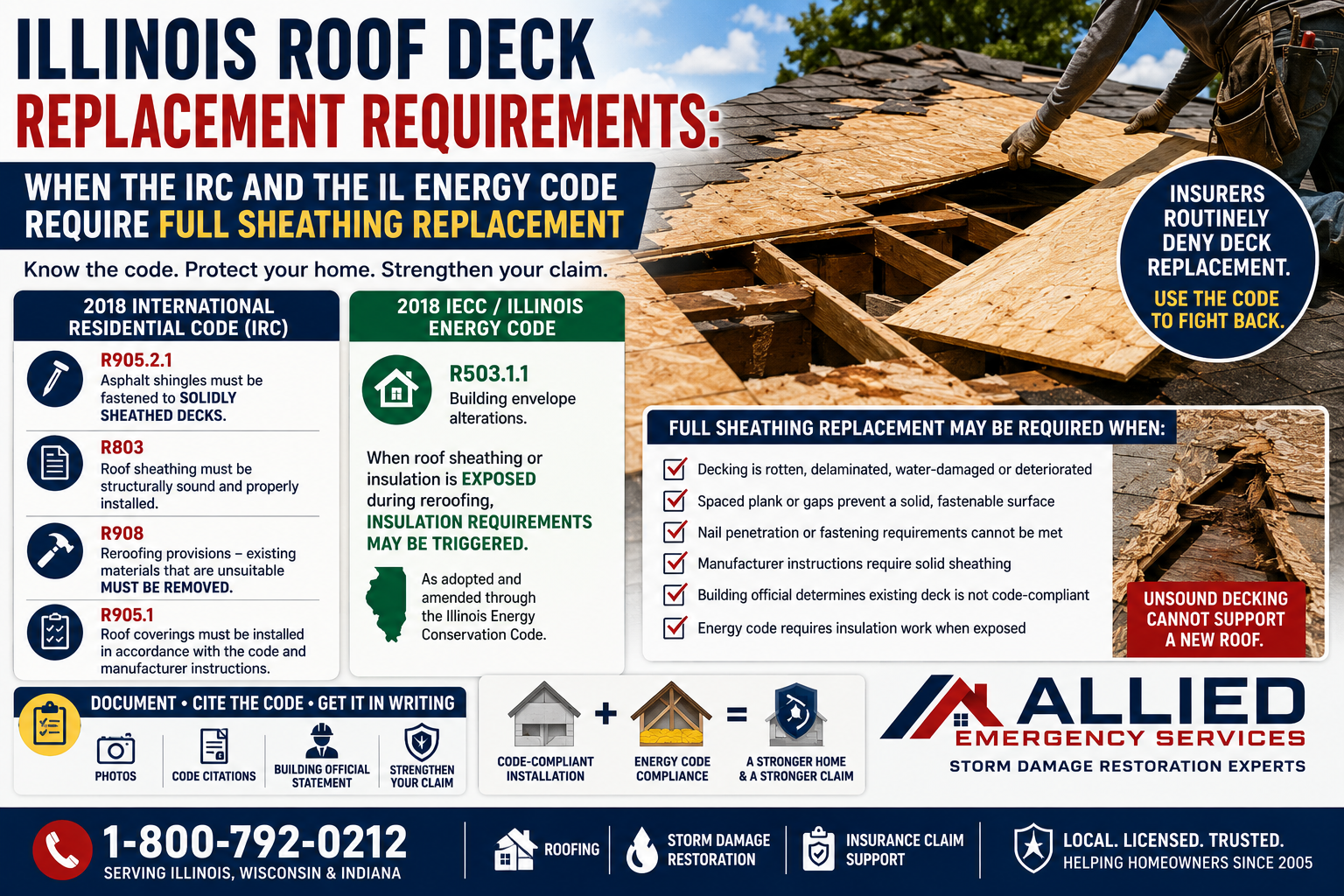
For asphalt shingle roofs, 2021 IRC R905.2.1 is one of the most important code citations. It requires asphalt shingles to be fastened to solidly sheathed decks.
This section matters in storm damage claims because insurance carriers often deny or limit roof deck replacement. But if the existing deck is not solid, not sound, not fastenable, or not acceptable under manufacturer instructions, a compliant asphalt shingle installation may not be possible.
Roof deck problems may include:
- Rotten sheathing.
- Water-soaked sheathing.
- Delaminated plywood.
- Swollen OSB.
- Broken plank boards.
- Large gaps between boards.
- Skip sheathing.
- Loose boards.
- Fire-damaged sheathing.
- Storm-damaged decking.
- Decking that will not hold nails.
- Decking that prevents required fastener penetration.
Full deck replacement is not automatic in every claim. But when the roof deck cannot support code-compliant installation, the contractor should document the condition with photos, manufacturer instructions, and local building official confirmation.
Related Allied guide:
2021 IRC R905.2.2: Roof Slope Controls What Materials and Underlayment Are Allowed
Roofing code compliance depends on slope. Under 2021 IRC R905.2.2, asphalt shingles are limited by roof slope. Asphalt shingles are generally used only on roof slopes of 2:12 or greater, and lower-slope asphalt shingle applications require special underlayment treatment.
This matters because low-slope roof areas are frequently mishandled in storm restoration estimates.
Examples include:
- Porch roofs.
- Patio covers.
- Shed roofs.
- Dormers.
- Low-slope additions.
- Garage tie-ins.
- Bay windows.
- Transitions between steep and low-slope areas.
If the carrier estimate includes standard shingles on a roof area that does not meet the slope requirement, the estimate may not support a code-compliant repair.
A contractor should document:
- Roof pitch.
- Roof area measurements.
- Product limitations.
- Underlayment requirements.
- Whether a different roof covering is needed.
- Manufacturer instructions.
- Local building official interpretation.
2021 IRC R905.1.1: Underlayment Is Not Optional
Underlayment is part of the roof assembly. It is not just a contractor preference. 2021 IRC R905.1.1 addresses underlayment requirements for roof coverings.
Underlayment helps protect the roof deck before shingles are installed and provides secondary weather protection under the roof covering. Underlayment requirements may depend on:
- Roof slope.
- Roof covering type.
- Wind design.
- Manufacturer instructions.
- Local amendments.
- Ice barrier requirements.
- Exposure during construction.
- Product type and listing.
Insurance estimates sometimes omit underlayment details or assume a generic product. A code-aware roofing estimate should identify the type of underlayment required for the roof system and slope.
2021 IRC R905.1.2: Ice Barrier Requirements in Cold-Weather Areas
In areas where ice dams have historically occurred, 2021 IRC R905.1.2 addresses ice barrier requirements. Illinois homes may need ice barrier at eaves depending on local code enforcement, climate conditions, roof design, and jurisdictional requirements.
Ice barrier is important because ice dams can force water back under shingles and into the roof assembly. A code-compliant roof may require ice barrier to extend from the lowest roof edge to a point inside the exterior wall line as required by the applicable code and local interpretation.
Common areas where ice barrier may matter include:
- Eaves.
- Valleys.
- Low-slope transitions.
- Dormers.
- Skylights.
- Roof-to-wall intersections.
- Areas with repeated ice dam history.
Homeowners should not assume the insurance estimate includes required ice barrier. Ask the contractor to identify whether ice barrier is required by code, manufacturer instructions, or both.
2021 IRC R905.2.8.5: Drip Edge Requirements for Asphalt Shingles
Drip edge is a common roofing code compliance dispute. 2021 IRC R905.2.8.5 addresses drip edge requirements for asphalt shingle roofs.
Drip edge helps direct water away from the fascia and roof deck edge. Without proper drip edge, water can curl back under shingles, damage fascia, soak roof edges, and contribute to leaks.
Drip edge issues after storm damage may include:
- Existing roof has no drip edge.
- Drip edge is damaged by wind, hail, or tear-off.
- Carrier estimate omits drip edge.
- Drip edge is installed in the wrong sequence with underlayment.
- Rake and eave edges are handled incorrectly.
- Existing fascia or deck edge damage requires correction.
A code-compliant roof replacement estimate should address drip edge when required by the adopted code and manufacturer instructions.
2021 IRC R903.2 and R905.2.8: Flashing Must Prevent Water Intrusion
Flashing is one of the most important parts of a roofing system. 2021 IRC R903.2 addresses flashing generally, and 2021 IRC R905.2.8 addresses asphalt shingle flashing requirements.
Flashing is used where the roof intersects with walls, chimneys, vents, skylights, valleys, dormers, plumbing penetrations, and other roof openings. Poor flashing can cause leaks even when the shingles are new.
Flashing code compliance may involve:
- Step flashing at sidewalls.
- Headwall flashing.
- Chimney flashing.
- Counterflashing.
- Valley flashing.
- Pipe boot flashing.
- Skylight flashing.
- Kickout flashing where roof edges meet walls.
- Flashing replacement during reroofing.
- Corrosion-resistant metal.
- Manufacturer-specific flashing kits.
Insurance estimates often underpay flashing because the damage is not always visible from the ground. But roofing code compliance requires a water-shedding system, not just new shingles.
2021 IRC R806: Roof Ventilation Compliance
Roof ventilation is addressed in 2021 IRC R806. Ventilation matters because poor attic ventilation can contribute to moisture accumulation, condensation, mold-like growth, ice dam risk, shingle deterioration, and warranty disputes.
A code-aware roof inspection should evaluate:
- Intake ventilation.
- Exhaust ventilation.
- Soffit vents.
- Ridge vents.
- Box vents.
- Gable vents.
- Baffles.
- Blocked ventilation paths.
- Attic insulation interfering with ventilation.
- Unvented attic or enclosed rafter assemblies.
- Bathroom or kitchen exhaust improperly vented into the attic.
A new roof can still fail if the attic ventilation system is not addressed. If storm restoration includes replacing roof vents, ridge vents, or decking, ventilation should be documented and corrected where required.
2021 IRC R905.2.5 and R905.2.6: Fasteners and Attachment Are Code Issues
Fasteners are not a minor detail. 2021 IRC R905.2.5 addresses asphalt shingle fastener requirements, and 2021 IRC R905.2.6 addresses attachment.
Fastening problems can lead to:
- Shingle blow-offs.
- Wind uplift.
- Nail pops.
- Leaks.
- Manufacturer warranty denial.
- Insurance disputes.
- Failed inspections.
A code-compliant asphalt shingle installation should address:
- Correct fastener type.
- Correct fastener length.
- Proper nail head size.
- Proper nail placement.
- Proper nail penetration.
- Correct number of fasteners.
- Fasteners driven flush, not overdriven or underdriven.
- Manufacturer high-wind nailing requirements where applicable.
- Special fastening for steep slopes where required.
If the roof deck is too thin, spaced, rotten, or deteriorated, fasteners may not hold properly. That can turn a roof deck issue into a code compliance issue.
2021 IRC R905.2.4.1: Wind Resistance of Asphalt Shingles
Wind resistance is a major issue in Illinois storm damage claims. 2021 IRC R905.2.4.1 addresses wind resistance for asphalt shingles through applicable testing and classification requirements.
For homeowners, the code issue is not simply whether the shingle package says “wind resistant.” The installed roof system must match the code, product rating, and manufacturer instructions.
Wind-related compliance issues may include:
- Incorrect shingle product for wind design conditions.
- Incorrect nail placement.
- Too few nails.
- Missing starter strip.
- Improper ridge cap.
- Poor deck fastening.
- Missing accessory documentation.
- Improper installation over old materials.
- Shingles installed in conditions that prevent sealing.
- Failure to follow high-wind instructions.
After wind damage, a claim may involve storm damage, installation defects, warranty requirements, insurance coverage, and code compliance at the same time.
Related Allied page:
2021 IRC R908: Reroofing and Existing Roof Conditions
The 2021 IRC R908 reroofing provisions are important for roof replacement and storm restoration projects. They address roof recovery, roof replacement, existing roof coverings, flashings, and conditions where new roofing cannot simply be installed over old roofing.
Reroofing code issues may include:
- Existing roof covering is water-soaked.
- Existing materials are deteriorated.
- Existing roof has too many layers.
- Existing roof covering type is not suitable for recovery.
- Flashings must be replaced or reconstructed.
- Structural loading must be considered.
- Existing deck conditions must be corrected.
- New roofing must be installed over a proper base.
Insurance estimates sometimes assume the roof is a simple remove-and-replace project. R908 matters because the existing roof condition can trigger additional required work once the roof is opened.
A compliant roofing estimate should include a plan for documenting hidden conditions discovered during tear-off.
Roof Drainage and Water Management Under the 2021 IRC
A roof must shed water. 2021 IRC R903.4 addresses roof drainage. While not every residential roof requires the same drainage system, water must be managed so it does not damage the structure.
Drainage-related roof compliance issues include:
- Gutters and downspouts.
- Low-slope drainage.
- Scuppers where applicable.
- Valleys.
- Cricket or saddle details near chimneys where required.
- Roof slope transitions.
- Ice dam areas.
- Water discharge onto lower roofs.
- Water ponding concerns.
Storm damage restoration should evaluate the entire water-shedding system. Replacing shingles while ignoring drainage defects can leave the homeowner with ongoing water intrusion.
Related Allied pages:
Roofing Code Compliance vs. Insurance Coverage
A code requirement and an insurance payment are not the same thing.
A local building official may require a code-compliant repair, but whether the insurance carrier pays for that code upgrade depends on the policy. Many policies include some form of ordinance or law coverage, but limits, exclusions, and conditions vary.
Homeowners should ask the insurance carrier:
- Does my policy include ordinance or law coverage?
- What is the limit for code upgrades?
- Does the carrier agree the roof replacement is covered?
- Does the estimate include code-required drip edge?
- Does the estimate include ice barrier where required?
- Does the estimate include required flashing replacement?
- Does the estimate include roof deck repairs required by code?
- Does the estimate include ventilation corrections if required?
- Does the estimate include permit fees?
- What policy language supports any denial of code-required items?
A contractor can document roofing code compliance requirements. A public adjuster may assist with claim adjustment if properly licensed. An attorney should evaluate legal coverage disputes.
Related Allied guide:
What a Code-Compliant Roof Replacement Estimate Should Include
A roofing code compliance estimate should be more detailed than a basic shingle replacement quote.
A complete estimate may include:
| Code or System Item | Why It Matters |
|---|---|
| Tear-off and disposal | Needed when recovery is not allowed or materials are unsuitable. |
| Roof deck inspection | Required to confirm a solid, fastenable substrate. |
| Deck replacement or overlay | Needed when the deck is not code-compliant. |
| Underlayment | Required as part of the roof assembly. |
| Ice barrier | Required where applicable by code or local enforcement. |
| Drip edge | Required for asphalt shingles under 2021 IRC R905.2.8.5. |
| Starter strip | Required by manufacturer installation instructions. |
| Asphalt shingles | Must meet slope, wind, and product requirements. |
| Fasteners | Must meet code and manufacturer requirements. |
| Flashing | Required to prevent water intrusion. |
| Ventilation | Must meet code and assembly requirements. |
| Ridge cap | Must match manufacturer installation requirements. |
| Pipe boots and vents | Must be properly flashed and sealed. |
| Permit fees | Required in many jurisdictions. |
| Final inspection | May be required by the local building department. |
Common Roofing Code Compliance Problems After Hail or Wind Damage
Storm damage can expose pre-existing roof defects or create new code problems.
Common issues include:
- Hail-damaged shingles but no underlayment line items.
- Wind-damaged shingles but no starter strip replacement.
- Roof replacement approved but drip edge omitted.
- Flashing reused when replacement is required.
- Old plank decking not evaluated.
- Ice barrier omitted in ice-dam-prone areas.
- Multiple layers discovered after tear-off.
- Rotten decking discovered after tear-off.
- Ventilation removed but not replaced.
- Ridge vent installed without proper intake ventilation.
- Incorrect nail pattern for wind conditions.
- Low-slope areas estimated with standard shingles.
- Permit costs ignored.
- Manufacturer instructions not included in the repair scope.
The strongest roof supplement connects each disputed item to a photo, code section, manufacturer instruction, local building official statement, or field condition.
How Contractors Should Document Roofing Code Compliance
A restoration contractor should document facts, not legal conclusions.
A strong roofing code compliance file should include:
- Date of loss.
- Storm report or weather documentation.
- Photos of roof damage.
- Photos of collateral damage.
- Roof measurements.
- Roof pitch measurements.
- Roof slope diagram.
- Existing roof layer count.
- Deck condition photos.
- Underlayment requirements.
- Ice barrier requirements.
- Drip edge documentation.
- Flashing photos.
- Ventilation calculation or observation.
- Manufacturer installation instructions.
- Local code citation.
- Permit requirements.
- Building official written statement when available.
- Carrier estimate comparison.
- Contractor supplement with line-item explanations.
NOAA storm data may support the storm date:
https://www.ncei.noaa.gov/access/search/data-search/storm-events
What Contractors Should Not Say
A contractor should avoid overclaiming.
Risky Statement
“Code requires everything we put in this estimate, so the insurance company must pay it.”
That may be too broad. Coverage depends on the policy.
Better Statement
“The repair scope includes items required for roofing code compliance under the adopted code, manufacturer instructions, and observed field conditions. Insurance coverage should be evaluated under the policy.”
Best Claim File Language
“The estimate includes code-related items tied to 2021 IRC roof assembly provisions, manufacturer installation instructions, and observed roof conditions. Local building official confirmation should control final code enforcement.”
This keeps the contractor in the construction role and avoids legal advice.
Homeowner Roofing Code Compliance Checklist
Before signing a roof replacement contract, Illinois homeowners should ask:
| Question | Answer Needed |
|---|---|
| Which code edition applies to my property? | Confirm with local building department. |
| Is a roofing permit required? | Confirm before work begins. |
| Is the contractor licensed? | Verify through IDFPR. |
| Is the roof deck solid and fastenable? | Confirm during inspection and tear-off. |
| Does the estimate include underlayment? | Required by code/manufacturer. |
| Does the estimate include ice barrier? | Required where applicable. |
| Does the estimate include drip edge? | Required under 2021 IRC R905.2.8.5 for asphalt shingles. |
| Does the estimate include flashing? | Required to prevent water intrusion. |
| Does the estimate address ventilation? | Required under 2021 IRC R806 where applicable. |
| Does the shingle installation follow manufacturer instructions? | Required under 2021 IRC R905.1. |
| Does the insurance policy include ordinance or law coverage? | Ask the carrier. |
| Are all code upgrades documented? | Save photos, estimates, code notes, and letters. |
Illinois roofing license lookup:
https://online-dfpr.micropact.com/lookup/licenselookup.aspx
Questions to Ask Before Hiring a Roofing Contractor
Before hiring a contractor for storm damage roof repair or roof replacement, ask:
- Are you licensed to perform roofing work in Illinois?
- What is your Illinois roofing license number?
- Which code edition applies to this project?
- Will you pull required permits?
- Will you inspect the roof deck after tear-off?
- How will you document code-required decking?
- Will you install drip edge where required?
- Will you install ice barrier where required?
- Will you replace or install required flashing?
- Will you follow the shingle manufacturer’s installation instructions?
- Will you document ventilation?
- Will your estimate separate code-required items from upgrades?
- Will I receive photos of hidden conditions?
- Will you provide warranty documents?
- Are you acting only as a contractor, or are you also offering claim adjustment services?
For licensing and homeowner contract issues, read:
- Illinois Roofing Licensing Act vs. Public Adjusters Law
- Illinois HRRA Contractor Fraud Protection Guide
Roofing Code Compliance
Roofing code compliance means a roof repair or replacement follows the locally adopted building code, manufacturer installation instructions, permit requirements, and required roof assembly standards. For asphalt shingle roofs under the 2021 IRC, important citations include R905.1 for manufacturer instructions, R905.2.1 for solidly sheathed decks, R905.2.2 for slope limits, R905.1.1 for underlayment, R905.1.2 for ice barriers, R905.2.8.5 for drip edge, R903.2 and R905.2.8 for flashing, R806 for ventilation, and R908 for reroofing. Illinois homeowners should verify the local adopted code, document code-required items, confirm contractor licensing, and ask the insurance carrier whether ordinance or law coverage applies to code upgrades after storm damage.
FAQ: Roofing Code Compliance and the 2021 IRC
What is roofing code compliance?
Roofing code compliance means the roof repair or replacement is performed according to the locally adopted building code, manufacturer installation instructions, permit requirements, and applicable inspection standards.
Does the 2021 IRC apply everywhere in Illinois?
Not automatically. The 2021 IRC is a model code. It applies when adopted by the local jurisdiction or incorporated into local requirements. Illinois homeowners should confirm the applicable code with the local building department.
What 2021 IRC section requires asphalt shingles to be installed on a solid deck?
The key section is 2021 IRC R905.2.1, which requires asphalt shingles to be fastened to solidly sheathed decks.
What 2021 IRC section requires roof coverings to follow manufacturer instructions?
2021 IRC R905.1 requires roof coverings to be applied according to the code and manufacturer installation instructions.
What 2021 IRC section covers drip edge?
For asphalt shingle roofs, 2021 IRC R905.2.8.5 addresses drip edge requirements.
What 2021 IRC section covers flashing?
2021 IRC R903.2 addresses flashing generally, and 2021 IRC R905.2.8 addresses flashing for asphalt shingle roof assemblies.
What 2021 IRC section covers roof ventilation?
2021 IRC R806 addresses ventilation of enclosed attics and enclosed rafter spaces, subject to specific requirements and exceptions.
What 2021 IRC section covers reroofing?
2021 IRC R908 addresses reroofing, including roof replacement, roof recovery, unsuitable existing materials, multiple roof layers, and related reroofing conditions.
Does insurance have to pay for roofing code upgrades?
Not automatically. Insurance payment depends on the policy, covered cause of loss, ordinance or law coverage, exclusions, limits, and documentation. Homeowners should ask the carrier to identify the policy language for any denial.
Can a contractor decide what code requires?
A contractor can identify and document code-related construction issues, but the local building official or authority having jurisdiction controls code enforcement. Legal coverage disputes should be reviewed by an attorney.
H2: About the Author
Curt | Allied Emergency Services, INC.
Curt is a restoration and roofing professional with Allied Emergency Services, INC., serving homeowners and property owners across Illinois, Wisconsin, and Indiana, with a focus on the greater Chicago area. His work centers on storm damage restoration, roofing, siding, water damage, fire damage, insurance restoration documentation, building code compliance, and emergency response planning.
Curt’s credentials include Illinois Licensed Roofing Contractor License #104.019029, Wisconsin Dwelling Contractor Qualifier #DCQ‑092100962, EPA Lead-Safe Certified Firm #NAT-F303832-1, EPA / HUD / IL RRP Lead Renovator Cert #R‑I‑T210065‑25‑02292, Vinyl Siding Institute Certified Installer #28216, OSHA construction safety training, HAZWOPER 40-Hour certification, FEMA emergency response coursework, and FEMA/NWS SKYWARN Storm Spotter training. Allied Emergency Services also lists IICRC Certified Restoration Firm #70133670.
For full credentials and verification resources, visit: About Allied Emergency Services
H2: Final Takeaway for Illinois Homeowners
Roofing code compliance protects the home, the roof warranty, the insurance restoration file, and the long-term performance of the roof system. A proper roof replacement may require more than shingles. Under the 2021 IRC, important compliance issues may include solid roof sheathing, underlayment, ice barrier, drip edge, flashing, ventilation, fasteners, slope, roof drainage, reroofing limits, and manufacturer installation instructions.
After hail, wind, or storm damage, homeowners should document the damage, verify the contractor’s license, confirm the local adopted code, request code citations in writing, and ask the insurance carrier whether ordinance or law coverage applies to code-required work.
For immediate service or consultation, you may contact us at Allied Emergency Services, INC.
Contact Information:
Phone: 1-800-792-0212
Email: Info@AlliedEmergencyServices.com
Location: Serving Illinois, Wisconsin, and Indiana with a focus on the greater Chicago area.
If you require immediate assistance or have specific questions, our human support is readily available to help you.
Disclaimer: This article is intended for informational purposes only. For professional advice, consult experts in the field.
⚡ Storm or Roof Damage? Get a FREE Estimate
Text ESTIMATE to (844) 907-2546
Or call (800) 792-0212 for 24/7 emergency response
AI-powered • No obligation • Licensed IL & WI
Need roofing help?
Allied Emergency Services — Licensed IL & WI Roofing Specialists
For more than a decade, Allied has been building and restoring roofing across Illinois and Wisconsin. IICRC-certified, EPA Lead-Safe, IL Licensed Roofing Contractor #104.019029. 24/7 emergency response.
Learn about our Roofing service →Free property assessment within 24 hours · No obligation · Photo-documented findings you can share with your insurer
Attorneys: forensic storm damage documentation & construction expert consultation for counsel →